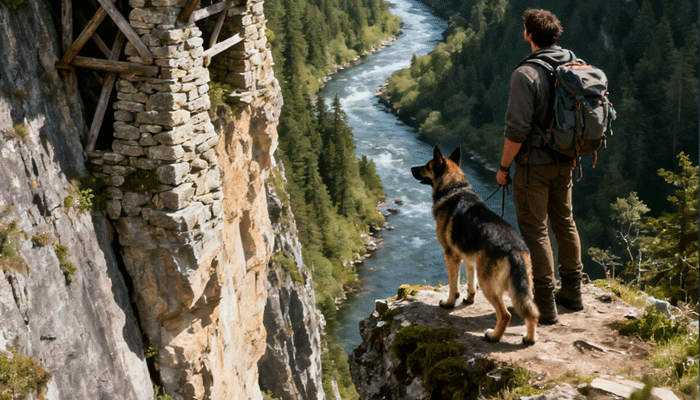
He Went to the Montana Mountains for Peace With His Dog—Then a House Rose Where Nothing Had StoodDemographics
Owen Mercer had not planned to cry when he crossed the Montana state line.
He had planned the drive like he planned everything else now: fuel stops marked, weather checked twice, route memorized, backup route highlighted in blue ink. He had packed his truck with the clean efficiency that came from fourteen years in the Army and one ugly year after the Army, when his body had made it home before the rest of him did. There were two duffel bags, one rifle case, a metal toolbox, a locked pistol safe, a carton of canned food, a chainsaw, blankets, dog food, and the cardboard box containing everything he had not been able to throw away.
He had not planned on crying.
It happened somewhere north of Dillon, where the road cut through dark timber and the mountains rose up like old judges. The sky was cold and huge, the late-afternoon light turning the ridges bronze. In the passenger seat, Ranger lifted his head from the blanket and looked at him with the calm, watchful eyes that had seen worse places than Montana.Dogs
“Don’t start,” Owen muttered, though the dog had done nothing.
Ranger thumped his tail once.
Owen laughed in spite of himself, then wiped his face with the heel of his hand before the tears could fully fall.
That was the thing about grief and exhaustion and war and the long stupid process of surviving them: they never hit when they were supposed to. They waited. They let a man believe he had become hard enough. Then they found him on a mountain road with a dog beside him and a silence wide enough to hear his own heart.
By the time he reached Mercy Gap, dusk had settled over the little town like smoke.
Mercy Gap was hardly a town at all. One gas station. One diner. One hardware store. A post office the size of a toolshed. A church with white paint peeling from its boards. Fewer than six hundred people in the valley, if the woman from the real estate office was to be believed, and Owen suspected she had counted dogs, trucks, and maybe a few deer to make the place sound bigger.
He preferred it that way.
The cabin he had bought sat nine miles outside town at the base of Widow’s Ridge, on a strip of private land backed by miles of national forest. It was small, ugly, and perfect. One bedroom, a stone chimney, a rusted tin roof, a hand pump near the porch, and enough distance from the nearest neighbor that Owen could stand outside in the dark and hear only the creek, the wind, and Ranger breathing.
He unloaded by headlamp.
Ranger patrolled the perimeter first, nails ticking over frozen dirt, nose sweeping the cold air. Belgian Malinois, ten years old, retired military working dog. He had more scars than most men Owen knew and better instincts than almost all of them. They had not served together officially at first. Ranger had belonged to another handler in Afghanistan, a nineteen-year-old specialist from Missouri who had bled out on a dust-choked road south of Kandahar while Owen tried to keep him alive. Afterward, Ranger had refused three new handlers and nearly bitten one. Months later, during a base clearance mission, the dog had walked straight past his assigned man and sat at Owen’s boots like the decision had already been made.
Some bonds were built slowly. Some arrived all at once, with blood already on them.
Inside the cabin, Owen made the bed, stacked wood by the stove, lined canned food on open shelves, and set Ranger’s bowl beside the back door. He worked until his hands ached pleasantly and his thoughts grew quiet. When he finally sat on the porch steps with a tin mug of black coffee, the mountains were only shapes against the stars.Doors & Windows
Ranger leaned against his leg.
For the first time in months, maybe years, Owen felt something close to stillness.
Not peace. Peace sounded too polished, too final. This was rougher than peace. It was emptiness without panic. Space without incoming fire. Silence that didn’t feel like waiting for bad news.
“I can do this,” he said softly.
Ranger’s ears twitched.
Owen looked up at Widow’s Ridge, a black wall of timber rising above the cabin. The ridge ran long and steep, with one bald shoulder of rock and scrub halfway up where lightning had stripped the trees years ago. The real estate woman had told him no one had built there in decades. Too hard to access. Too much rock under the soil. Too much winter.
Good, he had said.
Now he stared at that dark rise until the coffee cooled in his hands and the cold bit through his flannel.
He had come to the mountains to disappear without dying.
At the time, that had felt like enough.
He did not know that by the first snow, the mountain would answer him.
And it would answer with a house.
The first two weeks passed in work.
Owen split wood, patched a draft around the bedroom window, cleaned mouse droppings from the crawlspace, and built Ranger a raised platform near the stove because the old dog liked warmth but refused to act as if he needed it. He drove to Mercy Gap every few days for feed, lamp oil, flour, coffee, and whatever fresh groceries the tiny store happened to have not yet sold.
He kept his conversations short.Dogs
The woman at the diner called him “Army” the second time he came in and “Honey” the third. She was sixty if she was a day, broad-shouldered, iron-gray hair tied in a knot, name tag reading MABEL. She served meatloaf that could bring a man back from the dead and coffee that tasted like rust and miracles.
“You settling in?” she asked one morning as Ranger lay under Owen’s booth, one amber eye open.
“Trying to.”
“Folks say that when they’re not.”
Owen looked up.
Mabel shrugged, topping off his coffee. “Town this size, people notice things. New truck. New face. Dog trained enough not to beg. Posture that says you still sleep light. We notice.”
“I’m not much trouble.”
“That’s not the same as saying you’re not carrying any.”
He almost smiled. “I’ll keep that in mind.”
She nodded toward the window, where the mountains rose blue and severe beyond the main street. “You picked the right place if you want to hear yourself think. Wrong place if you’re trying to outrun it.”Doors & Windows
He did smile then, faint and unwilling. “You say that to all the new customers?”
“Only the ones who look like storms pretending to be men.”
That stayed with him longer than he liked.
Still, life found a rhythm. Wake before dawn. Feed Ranger. Chop wood. Walk the property line. Fix something small. Read a few pages at night without remembering the words. Sleep in broken pieces. Wake again.
It would have stayed that way, maybe, if winter had arrived gently.
It didn’t.
The first storm slammed into the valley in early November with screaming wind and wet, heavy snow that bent pines and killed power in town. Owen spent most of two days keeping the stovepipe clear, breaking ice at the pump, and dragging fallen limbs off the roof. Ranger stayed close, uneasy in a way Owen noticed without fully understanding. The dog kept pausing at the south side of the cabin, staring up the mountain with his muscles locked.Dogs
On the morning after the storm, the sky cleared into hard, brilliant blue.
Snow covered the world cleanly, almost cruelly. Every fence post, stump, and stone stood out sharp beneath the light. Owen carried his coffee to the porch and followed Ranger’s gaze toward Widow’s Ridge.
Then he froze.
Halfway up the bald shoulder of the mountain, where there had been open rock and dead grass and nothing else the week before, stood a house.
Not a cabin. Not a hunting shack. A house.
Two stories. Dark cedar siding. Long front porch. Steep roof buried in snow. A line of windows facing the valley like narrowed eyes. It stood on the ridge with a certainty that made Owen’s skin go cold, as if it had not been built but placed there.Doors & Windows
He lowered the mug slowly.
“No,” he said to the empty air.
Ranger growled.
Owen set the coffee on the railing and stepped off the porch, boots crunching through snow. From the yard, the view sharpened. The house was real. Not a trick of shadow or drifted timber. Real enough that he could see the black railing of the porch and what looked like a rocking chair at one end.
He knew that slope.
He had hiked it with Ranger five days earlier, cutting across the ridge to scout elk sign and get a sense of the terrain. There had been no road. No clearing. No foundation. No construction noise, no machinery, no crews. If a full-size house had been built there, he would have seen tracks or heard engines or at least noticed a scar on the mountain.
There had been nothing.
Now there was a house.
His first thought was not ghost or miracle or anything so dramatic. It was simpler and more unsettling.
Someone had put it there fast.
He went inside, grabbed binoculars from the shelf, and came back out.
Through the lenses, the strangeness only deepened. The siding looked new. The porch posts were straight. No weathering. No rot. A brass weather vane on the roof caught the sun. But there were no visible tire tracks leading to it. No power lines. No chimney smoke. No sign of anyone moving behind the windows.
“Maybe it was hidden by the trees,” he said, though he knew the bald shoulder had no trees thick enough to hide something that size.
Ranger kept staring.
By noon, Owen had convinced himself that maybe snow and light had altered his sense of distance. Maybe the house had always been farther back on the slope, obscured from certain angles. Maybe he had missed it.
He did not believe any of that, but believing nothing felt worse.
So he geared up and hiked.
The climb to Widow’s Ridge took nearly an hour through knee-deep snow and wind-packed crust. Ranger ranged ahead, then circled back twice, restless. The higher they climbed, the more Owen noticed what wasn’t there.
No road.
No utility trench.
No heavy-equipment marks.
There were deer tracks, rabbit tracks, his own from days earlier now half-filled with snow—and nothing else.
By the time he reached the bald shoulder, his pulse had changed. Not from exertion. From the thin, electric feeling of moving toward something wrong.
The house stood thirty yards ahead, silent and dark.
Up close it looked older and newer at the same time. The design was old-fashioned—broad porch, tall windows, fieldstone chimney—but the materials were too clean. The cedar boards were darkly stained, not sun-faded. The porch steps had no warping. The brass doorknob shone bright under a skin of cold.Doors & Windows
Ranger stopped dead.
Owen took one more step. The dog pressed against his leg, hackles raised, a low vibration rumbling out of his chest.
“Easy,” Owen whispered.
The front door was closed. No footprints marked the porch, not even old ones preserved in the snow. The rocking chair sat tilted slightly toward the valley. A child’s red mitten lay near the wall, half-buried and crusted with ice.
Owen looked at it for a long second.
Then he mounted the steps.
The boards did not creak under his boots.Dogs
He knocked once. Hard.
Nothing.
He knocked again and called out. “Hello?”
No answer.
He tested the knob.
Unlocked.
Ranger made a sound Owen had heard only a few times in all their years together—a harsh, uncertain whine that belonged to no command and no confidence.
Owen opened the door.
Warm air touched his face.
He stood very still.
Somewhere inside, faint and steady, a clock was ticking.
The front room was immaculate.
A braided rug stretched across honey-colored floorboards. A leather sofa faced a stone fireplace laid cold with stacked birch logs. On the mantel stood framed photographs in silver and wood. A lamp with a yellow shade glowed softly in the corner, though Owen saw no outlets nearby and heard no generator.
He stepped inside slowly, the door easing shut behind him.Doors & Windows
The warmth was wrong. Not just because the fireplace wasn’t burning. Wrong because it felt lived in. Comfortable. Human. It smelled faintly of coffee, cedar polish, and something sweet underneath—cinnamon, maybe, or apples.
The kind of scent a house picked up when someone baked in it regularly.
But the silence had weight. It pressed against the ears.
“Hello?” he called again.
No answer.
Ranger stayed near the threshold, body low, eyes tracking the hallway to the back of the house.
Owen moved through the front room with the caution that had once kept him alive in villages where doors led to kitchens, sleeping children, or pressure plates. He hated how naturally it came back. The measured footfall. The scan of windows, corners, secondary exits. The catalog of details without conscious effort.
On the coffee table sat a porcelain bowl filled with hard candy. Dust-free.Kitchen & Dining
On a side table rested a book facedown, its spine uncracked. A local history of Ravalli County.
The photographs on the mantel drew him next.
He picked up the nearest frame.
It showed a family posed on this very porch: a man in a suit, a woman in a pale dress, a girl of maybe eight holding a doll. All three smiling toward the camera.
All three faces had been burned away.
Not by accident. The edges were too deliberate. The paper around the missing features had browned and curled in neat, ugly circles.Family
Owen set the frame down.
Every photo on the mantel had the same damage. Family dinner. Christmas tree. Summer picnic. Different moments, same violence. Faces erased cleanly, bodies left untouched.
Ranger barked once, sharp and urgent, toward the hallway.
Owen turned.
At the far end of the hall stood a narrow table with a vase of dried flowers and a door slightly ajar beyond it. From somewhere deeper in the house came a dull sound. Not loud. Not repeated.
A thump.
He drew his sidearm without thinking.Doors & Windows
“Stay,” he told Ranger.
The dog ignored him and moved at his knee.
Past the hallway lay a kitchen so spotless it looked staged. Cast-iron pans hung over a butcher-block island. A pie sat on the counter under a glass dome, one slice missing. In the sink rested a single clean plate, drying upright. A back door led to the yard. Locked.
The sound came again.
Thump.
This time he located it. Downward. Beneath them.Dogs
There was a door near the pantry—painted white, iron latch, slight scrape marks around the frame.
Cellar.
Owen crossed the room, every nerve lit.
He put a hand on the latch.
A vehicle engine sounded outside.
Close.
Ranger’s head snapped toward the front of the house.Kitchen & Dining
Owen killed the lamp over the sink by instinct, though he still had no idea where its power came from, and moved to the window above the counter.
Through a slit in the curtain he saw a black utility vehicle climbing the rear slope where there had been no tracks a moment before—except now there were, cutting hard through the snow from a narrow ravine hidden by the fold of the ridge. Another vehicle followed behind it, tires biting the incline.Doors & Windows
His stomach tightened.
He stepped back from the window and scanned for exits. Back door, but it opened toward the vehicles. Front door, too exposed. The only real chance was the side mudroom he had passed off the hallway.
Men’s voices carried from outside. Two of them. Maybe three.
Owen holstered the pistol, motioned Ranger close, and moved fast but silently through the house. At the side mudroom he found a narrow door leading to a lean-to storage space stacked with split wood and empty fuel cans. Beyond that, a gap between snowdrifts dropped sharply into a brush-choked gully.
He slipped out just as the first truck door slammed.
Voices, clearer now.Autos & Vehicles
“You leave it on?”
“Course I left it on. Girl goes hypothermic, Voss loses his leverage.”
“Then shut the front. Heat’s bleeding.”
Owen flattened against the outer wall, snow soaking through one knee. Ranger trembled beside him, not from fear but readiness.
Another voice, sharper, impatient. “Check the cellar first. I heard something on the cam.”
Camera.
Owen’s jaw clenched. He had missed it.
The side gully offered cover, but barely. He eased backward down the slope, one careful step at a time. A loose rock shifted under his boot and clicked.
Silence fell above.
Then: “You hear that?”
Ranger’s ears pinned back.
Owen did not wait. He shoved off, half-sliding down the gully through brush and hard snow. Branches whipped his face. Behind him a shout rose.
“Hey!”
A gunshot cracked over the ridge.
Ranger lunged ahead, leading the descent. Owen hit the ravine floor hard enough to jar his teeth, rolled, came up running. Another shot snapped through branches to his right. Then the terrain bent sharply and the house vanished behind timber.
Only then did he let himself breathe.
They did not chase far.
That scared him more than if they had.
Mercy Gap looked different after the house.
Smaller. More arranged.
Before, Owen had seen a mountain town with the usual wear—people who minded their own business, old buildings, weathered trucks, lives shaped by winter. After Widow’s Ridge, every pause felt loaded. Every glance held calculation.
He drove straight to the sheriff’s office.
Sheriff Roy Hanley was in his late fifties, big in the gut and shoulders, with a square face reddened by wind and coffee. His office smelled like paper, damp wool, and old heat. He listened while Owen laid it out cleanly: unknown house on the ridge, armed men, probable captive in cellar, concealed access road, shots fired.
Hanley did not interrupt.
When Owen finished, the sheriff leaned back in his chair, laced thick fingers over his belly, and said, “That so.”
“That’s your response?”
“My response is I know every occupied structure within twenty miles of town, and there’s a seasonal lodge on Widow’s Ridge owned by a development company out of Bozeman. Been there awhile.”
“No, it hasn’t.”
Hanley’s expression did not shift. “You new here, Mr. Mercer.”
“I hiked that ridge five days ago. There was nothing there.”
“Maybe you missed it.”
“I didn’t miss a two-story house.”
Hanley gave a slow exhale through his nose that suggested Owen was drifting toward irritation for no good reason. “Storm changes visibility. Snow opens sightlines. Happens more than folks think.”
Owen stared at him.
“Are you going up there or not?”
“I can ride up tomorrow, ask some questions, make sure everything’s in order.”
“There’s somebody in the cellar.”
“According to you.”
“According to what I heard.”
“And what exactly did you hear?”
A thump. That was all. Thin as it suddenly sounded, stripped of the whole feel of the place. Owen hated that.
Hanley spread his hands. “You entered private property with a firearm. You surprised workers. Somebody got nervous and took a bad shot into the trees. That’s what I hear.”
Owen stepped closer to the desk. “I know the difference between nervous and trained.”
The sheriff’s eyes cooled a fraction. “And I know the difference between a concerned report and a man bringing his old war into my office.”
That landed where it was meant to.
For one second Owen saw a road in Afghanistan, saw heat shimmering above the culvert, saw dust on Ranger’s muzzle and Miller on the ground and a radio screaming too far away. He locked the vision down by force.
“You think I imagined it.”
“I think men come back carrying ghosts,” Hanley said. “Sometimes mountains make them louder before they make them quiet.”
Owen’s voice went flat. “I’m asking you one more time. Are you going up there now?”
“No.”
There it was.
Clean.
Simple.
No.
Owen looked at the sheriff long enough to know exactly what he was seeing: not disbelief, not caution, but refusal. Deliberate and settled.
He turned and left before anger could push him into something stupid.
Outside, the sky had gone low and white again. Snow threatened.
He was halfway to his truck when a woman’s voice called from behind him.
“Mr. Mercer.”
He turned.
A deputy stood on the office steps. Mid-thirties, dark hair pulled tight at the nape, green county jacket over a duty belt, posture straighter than Hanley’s and eyes much more awake. Latina, maybe. Name plate: ORTIZ.
“I heard enough to know you’re upset,” she said.
“I’m not upset. I’m being ignored.”
“That too.” She glanced back at the building, then lowered her voice. “There are properties up on the ridge tied to Caleb Voss.”
The name meant nothing to Owen.
“He owns half the land in this county that folks didn’t realize they needed until he bought around them,” Ortiz said. “Luxury parcels, timber rights, access roads, that kind of thing.”
“And?”
“And people who challenge him usually lose.”
“That supposed to scare me off?”
“No.” She held his gaze. “It’s supposed to stop you from walking blind.”
“You believe me?”
Ortiz paused. “I believe Sheriff Hanley made up his mind before you finished talking. That bothers me.”
It bothered Owen too, but not because it surprised him.
“Who’s Voss?” he asked.
“Developer. Money from somewhere bigger than here. Keeps private security. Comes into town twice a month, smiles like a man buying fence posts. Folks let him, because he repaired the school roof and donated to the church and promised jobs. Folks around here are practical.”
“Practical enough to ignore gunfire on a ridge?”
Her mouth tightened. “Practical enough to survive winter next to people they don’t trust.”
She looked toward Owen’s truck, where Ranger sat upright in the passenger seat, watching her through the windshield.
“That dog military?”Dogs
“Yes.”
“Then here’s something free. Military dogs don’t spook for nothing.”
It was the first useful thing anyone in town had said to him all day.
Before he could answer, the diner door across the street banged open and Mabel appeared carrying a sack of garbage. She took one look at Owen, one look at Ortiz, and called out, “If you boys are planning to stand in the cold doing law and mystery, do it after pie.”
Ortiz almost smiled. “That’s my cue.”
She went back inside the sheriff’s office.
Owen crossed to the diner.Doors & Windows
Mabel set the garbage in the bin, wiped her hands on her apron, and said, “You saw it, didn’t you.”
Owen stopped. “Saw what?”
She looked up at Widow’s Ridge beyond the town, hidden now by weather. “Don’t do that with me. I’m too old to waste lies. You saw the house.”
He had the sudden, irrational urge to check who might be listening.
“What do you know about it?” he asked.
Mabel’s face did something strange then. Not fear exactly. Recognition. The kind that comes from old things reopening.
“I know,” she said quietly, “that there wasn’t any house on that ridge when I was a girl, and there wasn’t any house there when my husband hunted it, and there sure as hell wasn’t one there last fall when my grandson got drunk and tried to ski down the slope in October.”
“So what is it?”
She looked at him for a long second. “Trouble with a porch.”
Then she jerked her chin toward the diner door. “Come eat. You’ll think better with real food.”
Inside, over chicken-fried steak and too much coffee, she told him in pieces.
Caleb Voss had started buying land in the valley three years earlier. First the easy parcels—the abandoned mill site, two ranches with no heirs, an empty motel off the highway. Then the harder ones. Easements. Logging routes. Creek access. Timber leases. Men who had never sold anything started getting offers big enough to make them reckless or stubborn, depending on the man.
A few took the money and left.
A few didn’t.
“Then came the stories,” Mabel said, setting a pie slice in front of him unasked. “Broken fences. Dead stock. Threats that never got repeated in daylight. Folks hearing engines at night where there weren’t roads before.”
“Anybody report it?”
“To who? Hanley?” She snorted. “Roy was decent once. Then Voss started donating to county projects and Roy’s nephew got a job as site foreman and suddenly everybody decided progress was the same thing as fate.”
Owen cut into the pie without tasting it.
“What about the house?”
Mabel shook her head slowly. “That part’s new. Or maybe newly visible. Sometimes the mountain hides what men don’t want seen.” She looked embarrassed even as she said it, as if superstition offended her but had stayed useful too long to discard. “One thing I know for sure: the ridge has started taking noise at night. Trucks. Metal. Once, I heard a woman scream up there. Brief. Then nothing.”
“Why didn’t you tell someone?”
She laughed then, a hard, dry sound. “Honey, in a town this size there’s no such thing as telling someone. There’s only deciding which enemy hears first.”
Owen looked toward the window, where gray snow-light lay across the street like ash.Doors & Windows
A woman scream.
A cellar door.
Burned-out faces in photographs.
He set down his fork.
“Do you know a woman named Tessa Quinn?” he asked.
Mabel frowned. “County surveyor. Young. Ponytail, big boots, drove that green Subaru that sounded like a washing machine full of bolts. Why?”
“Just asking.”
“She hasn’t been in for a week.”
That did it.
The old life inside him rose like something bitter and familiar.
Not the war. Worse, in some ways. The part of him built to move when other people froze.
He hated that he still had it.
He hated more that he might need it.
That night, someone came to the cabin.
Owen had expected it by then. Not because he thought himself important, but because he had entered a place men wanted hidden and then walked into town asking questions. If Sheriff Hanley was bought, those questions had already traveled.
He prepared anyway.
He killed every light before dark, banked the stove low, and sat at the kitchen table with Ranger under the window and the shotgun across his lap. Outside, fresh snow fell fine and dry, whispering through the pines. The cabin creaked with settling cold.Kitchen & Dining
At 11:17 p.m., Ranger lifted his head.
Not bark. Not growl. Alert.
Owen stood silently and moved to the side window.
Nothing visible at first. Then, low along the treeline, a shape where no shape belonged. Black against darker black. Then another. Men moving without flashlights, using starlight and terrain.
Professional enough to be dangerous. Not professional enough to stay invisible to a military dog.
Owen stepped back, adrenaline washing cold through his limbs.
Two, maybe three.Doors & Windows
Not here to talk.
He motioned Ranger toward the rear of the cabin and whispered, “Hold.”
Then he slipped out the front door and circled hard around the woodpile, keeping low.
The first man reached the side porch just as Owen came up behind him. Heavy coat, knit cap, pistol in gloved hand. Owen drove the shotgun stock into the man’s kidney, then hooked an arm around his throat and dragged him backward into the drifted dark between the shed and the cabin. The man went down hard. Owen stripped the pistol, jammed a knee into his spine, and hissed, “How many?”
The man spat blood into the snow and said nothing.
Inside the cabin a window shattered.Dogs
Ranger exploded through the sound with a savage bark.
A second man cursed.
Owen struck once behind the ear. The first man went limp.
He turned just in time to see Ranger launch through the broken kitchen window at a shape climbing inside. Man and dog disappeared into the snow beside the porch in a violent blur of limbs and snarling. A shot fired wild into the sky. Ranger’s jaws found something solid and the scream that followed was brief, shocked, animal.
“Ranger! Out!”
The dog released instantly and came back to Owen’s side, chest heaving, muzzle dark.
The wounded intruder crawled toward the trees, clutching his forearm. A third man fired twice from cover, forcing Owen behind the water pump. Splinters jumped from the porch post. Then headlights flared through the woods farther downslope—another vehicle, or maybe someone on the road.Kitchen & Dining
The shooters broke.
Within seconds they were running.
Owen did not pursue. Pursuit in the dark against unknown numbers was how men wound up names on memorial walls. Instead he waited, listening, until the engine noise faded and the forest settled again into snowfall and blood smell.
Then he exhaled.
Ranger pressed against his thigh, trembling with adrenaline, unharmed except for a shallow scrape above one eye.
“You good?” Owen asked.
Ranger sneezed blood onto the snow and sat.Autos & Vehicles
“Yeah,” Owen said. “Same.”
He dragged the unconscious man inside and zip-tied his wrists.
The intruder woke mean. Mid-thirties. Thick beard. contractor build. Not local, Owen thought immediately. Too much gym. Too little weather. There was a tattoo on his neck half-hidden by collar—a stylized wolf’s head above block letters: BCS.
The man stared at Owen with a mixture of hate and disbelief. “You’ve got no idea what you stuck your nose in.”
“Then educate me.”
“Go to hell.”
Owen checked the man’s pockets. Wallet with no ID, burner phone, folding knife, truck key card, and a folded receipt from a supply yard in Missoula. On the phone’s cracked screen was a recent text chain.
Move girl tomorrow. Voss done waiting.
Cabin guy asking questions. Handle tonight.
No guns unless necessary.
Owen felt something hot and precise settle in his chest.
Not fear. Not exactly anger either.
Purpose.
He looked back up. “Who’s the girl?”
The man smiled through bloody teeth and said, “Too late.”
Owen hit him once, hard enough to rock his head back but not enough to break anything. “Who.”
The man just laughed.
By dawn Owen had what he needed anyway.
The key card opened a black utility truck parked half-hidden on an abandoned logging spur less than a mile from his cabin. In the glove compartment he found registration documents listing a company called Black Creek Security. Same initials as the tattoo. The paperwork traced the vehicle to a holding company in Bozeman. On the passenger seat lay a county parcel map with Widow’s Ridge circled in red and three handwritten initials beside the access route: C.V., R.H., B.C.
Caleb Voss.
Roy Hanley.
Black Creek.
On the back of the map was another note: Quinn cellar / move before weather.
Tessa Quinn.
County surveyor.
Mabel had been right.
Someone was in that cellar.
Deputy Lena Ortiz met him at the old church parking lot at sunrise.
He had called the sheriff’s office and hung up when Hanley answered, then left a message from a pay phone at the gas station asking Ortiz to meet if she wanted proof. She arrived in her own truck, no lights, jaw set, hand resting near her holster as she stepped out.
Owen opened the bed of his truck and showed her the captured phone, the map, the truck paperwork, and the unconscious intruder zip-tied under a tarp.
Ortiz stared for three full seconds.
“You kidnapped a private security contractor,” she said.
“He invaded my home armed.”
“That does improve your position.”
“I figured.”
She looked at the phone texts again. “Quinn as in Tessa Quinn?”
“Yes.”
Ortiz blew out a breath that fogged white in the morning air. “She filed a complaint three weeks ago saying a land line on county maps had been altered after one of Voss’s survey requests. Hanley buried it. Said she was green and confused.”
“She’s not confused.”
“No.” Ortiz looked up toward Widow’s Ridge, pale against dawn. “Apparently not.”
“What now?”
“Now,” she said, “I tell you something I should’ve told you yesterday. My cousin Mateo worked seasonally for Voss last year. Equipment crew. He quit after two months, said things on the ridge didn’t make sense—deliveries off the books, GPS blockers on company trucks, work crews sent home before dark while a different set of men drove in after midnight. He disappeared nine days later on a hunting trip. Roy called it exposure. We never found his rifle.”
Owen went still.
Ortiz’s eyes held his. “So no, Mr. Mercer. I do not think you’re imagining things.”
He appreciated that she said it plainly.
“Can you arrest Hanley?” he asked.
“Not with this. Not yet. He’ll claim self-defense, trespass, confusion, whatever his lawyer likes. And if I move too early, Voss empties that house and whoever’s in the cellar vanishes.”
“Then we go now.”
Ortiz glanced at the tarp-covered man in the truck bed. “Against a fortified property with at least three armed contractors and no warrant?”
“You got a better idea?”
“Yes,” she said. “Smarter before faster.”
He almost argued, but she was right and he knew it.
They took the contractor—whose real name turned out to be Brent Culler, according to fingerprint records Ortiz could access through the deputy terminal—to an old storage building behind the church where the pastor, apparently one of the few people in town Ortiz trusted, agreed not to ask questions for one hour. Then they made a plan.
It was not a good plan. Good plans required resources and time. They had neither.
Ortiz would pull archived survey maps and land records from the county annex without tipping Hanley. Owen would return to his cabin, patch the broken window, rearm, and watch the ridge. If movement started before noon, he would call Ortiz. If not, they would go up before dark and confirm whether Tessa Quinn was alive.Doors & Windows
“State police?” Owen asked.
Ortiz shook her head. “Nearest team is hours away in decent weather. And if Hanley hears me reach over him, he warns Voss.”
“What about the man we took?”
“I know a retired game warden with bad knees and zero patience for creeps. He owes me a favor. Brent Culler can spend the morning regretting his career choices.”
For the first time since arriving in Mercy Gap, Owen felt he was speaking to somebody who understood the weight of a sentence.
He nodded once. “Fine.”
Ortiz started to turn away, then stopped. “One more thing.”
“What?”
“Don’t die proving you were right.”
“I’ll put that on a pillow.”
Her mouth twitched. “Try harder than that.”
Back at the cabin, Owen fixed the window with plywood, swept blood and glass from the floor, and fed Ranger an extra portion of kibble mixed with canned beef. The dog ate fast, then returned to the south window and sat staring at Widow’s Ridge.
By noon, Owen had a clear view through binoculars.Dogs
The house looked unchanged at first. Still. Quiet. Porch empty.
Then, at 12:43, a man came out the back carrying what looked like two duffel bags. Ten minutes later another dragged a blue plastic barrel onto a small flatbed hitched to one of the black trucks. Around one-thirty, a third man opened the side door and hauled out something wrapped in a gray blanket—long, limp, unmistakably human in shape.
Owen’s pulse slammed.
He snatched the radio handset Ortiz had given him from her truck’s emergency kit.
“They’re moving somebody,” he said when she answered.
Her reply came quick. “Alive?”Doors & Windows
“Can’t tell.”
“Can you stop them?”
Owen looked at the ridge. Too far. Too exposed. One man and a dog against unknown weapons and terrain.
“No.”
A beat of silence.
Then Ortiz said, “I’m on my way. Don’t engage until I get there.”
But Owen was already reaching for his rifle.
Because the gray shape had moved.
Just once.
Enough.
Widow’s Ridge was uglier in a hurry.
Snow that had seemed beautiful at dawn became treachery by afternoon, crust breaking underfoot, wind blowing spindrift into the eyes, every breath knife-cold. Owen took the steeper eastern approach because it offered more cover and less chance of being seen from the house. Ranger stayed low and silent, reading Owen’s tension before each shift in direction.
Halfway up, Owen heard the truck engines.
He dropped behind a slab of rock and glassed the clearing.
One black utility vehicle idled behind the house. Another had backed toward the concealed ravine road. Two armed men moved quickly between the porch and the trucks. A third stood watch near the cellar bulkhead, rifle across his chest.Autos & Vehicles
And there, leaning half-conscious between them, wrists bound in front with zip ties, hood half-off her head, was a woman in a county survey jacket.
Tessa Quinn.
Even from a distance she looked exhausted, stumbling on her own boots. One side of her face was bruised dark purple. Her hair had been hacked short in places as if somebody had grabbed and cut it in a rage.
Owen’s jaw tightened so hard it hurt.
He keyed the radio once. “Visual confirmed.”
Ortiz’s voice crackled back, breathless. “Three minutes out.”
Too long.
The men were loading Tessa now, shoving her toward the rear truck.
Owen measured the slope, the lines of fire, the spacing between targets. Not good. Not impossible.
He looked at Ranger.
The dog’s ears were forward, whole body humming.Dogs
“Truck man first,” Owen whispered. “Then porch.”
He rose, took the shot, and everything split open.
The round shattered the rear truck’s driver-side mirror and punched into the doorframe inches from the man reaching for Tessa. Close enough. The man flinched hard, dropped the prisoner, and dove for cover.
Owen chambered another round and fired at the watchman near the bulkhead. This time he meant to hit flesh. The bullet caught the man high in the shoulder and spun him backward into the porch post.
Men shouted.
Tessa fell to her knees in the snow.
Ranger launched downhill before Owen gave the command, a blur of tan and black streaking between brush clumps.
“Move!” Owen roared to Tessa.
She tried.
One of the contractors fired toward the ridge. Bark exploded beside Owen’s head. He dropped, rolled left, and fired again. The second shot broke the truck windshield and forced the shooter lower.
Then Ranger hit the clearing.
He did not go for Tessa. He went for the man recovering by the bulkhead, clamping onto the injured arm and dragging him sideways with terrible efficiency. The scream that followed shook the whole slope.
Tessa crawled.
Owen left cover and ran.
The world narrowed into cold air, gunfire, and distance. He slid the last ten feet into the clearing on one knee, grabbed Tessa by the jacket, and hauled her behind the truck as rounds thudded into metal.
“You with me?” he snapped.
She blinked up at him through dazed eyes. “Dog,” she whispered.
“He’s working.”
He cut her zip ties. “Can you move?”
She nodded once and nearly passed out.
The contractor on the porch tried to flank around the front of the house. Owen put a round into the snow at his feet, then another through the porch railing. The man ducked back.
Ranger released his target on command and came bounding to Owen’s side, chest streaked red that wasn’t his.
Truck engine from below.
Ortiz.
Her pickup roared up the hidden ravine path with siren off and grille full of snow. She braked sideways across the rear access and stepped out firing once into the air.
“Sheriff’s department! Drop it!”
One man bolted toward the tree line.
The other ran for the house.
Ortiz swore. “Take Quinn!”
Owen did. He half-carried, half-dragged Tessa downslope behind the truck while Ortiz kept the front of the house covered. Tessa stumbled twice, vomiting once into the snow, then found enough strength to keep moving.
At the edge of the clearing Owen looked back.
The front door of the house stood open.Doors & Windows
No sign of the contractor who had run inside.
No sign of the man who had fled into the trees.
Ortiz saw it too.
“We’re not clear,” she shouted.
As if in answer, a shot cracked from an upstairs window.
The rear tire of Ortiz’s pickup exploded.
She dove behind the engine block. “Go!”
Owen did not argue.
He got Tessa into cover fifty yards downslope, tucked her behind a fallen pine, then returned fast enough to help Ortiz pin the window shooter while Ranger tracked the man who had gone into the trees. Snow burned Owen’s lungs. He fired twice at the upper window, shattering glass and driving the shooter back.
Ortiz reloaded. “There’s at least one still in there.”
“At least.”
She looked toward the house, then at Tessa below them. “Not worth clearing with one deputy and a pissed-off veteran.”
“She might know more.”
“She might. She can tell us from someplace warmer.” Ortiz glanced at the shattered tire. “And that truck isn’t taking us anywhere.”
That decided it.
They retreated on foot using the gully for cover, Owen carrying Tessa the last stretch when her legs gave out. No one pursued. Again, that bothered him.
Because men who didn’t chase either had another route or another plan.
At the cabin, Tessa slept twelve straight hours after water, soup, two blankets, and the small emergency sedative from Ortiz’s medical kit. When she woke, night had returned and the wind had changed.
She opened her eyes to lamplight, saw Owen seated by the stove cleaning a rifle magazine, and flinched so hard Ranger stood at once.
“It’s okay,” Owen said.
She looked at the dog, then at him again, trying to place the room and her own body inside it.Dogs
“Deputy Ortiz?” she asked hoarsely.
“Making calls from town. Quiet ones.”
Tessa swallowed. Her lips were cracked. “They’ll come back.”
“Probably.”
She shut her eyes. “I told Roy. I told Sheriff Hanley what I found. He said he’d handle it.”
Owen let that sit for a moment. “What did you find?”
When she opened her eyes again, whatever was left of fear in them had fused to anger.
“Boundary fraud,” she said. “At first.”
He waited.
“Voss bought parcels that didn’t give him legal access to the upper ridge, so someone altered county overlays. Logging roads moved on paper. Water lines changed. Easements appeared that had never been signed. When I pushed back, Hanley told me to stick to flags and maps.”
“And you didn’t.”
“I went up there to recheck coordinates. I found the house.” She laughed once, bitter and thin. “Not from below. From behind. They’d cut a road through a fold in the ridge where nobody in the valley could see the construction. Prefab sections brought in at night. Whole thing designed to disappear from most angles.”
That answered one mystery and deepened the rest.
“Why build it?” Owen asked.
Tessa stared at the stove flame. “Because under the house there’s an old silver mine entrance. Voss isn’t after timber. He’s after what’s under the mountain.”
“Silver?”
“No.” Her face tightened. “Waste.”
Owen frowned.
“Industrial drums. Old military crates. Chemical disposal. I don’t know all of it, but there are tunnels down there packed with barrels, broken equipment, sealed rooms. Illegal storage, maybe for years. Mateo Ortiz was down there.”
Owen went still.
“You saw him?”
She swallowed hard. “I saw his jacket. And bones.”
The cabin seemed to shrink around that sentence.
Ranger came to rest his head on Owen’s knee. Owen didn’t realize his hand was shaking until the dog steadied it.Dogs
Tessa went on, each word dragged out of pain and fury.
“I took pictures. Sampled soil. Pulled old plat maps from a survey box in one of the rooms. Somebody caught me before I got off the ridge. Caleb Voss came in later. Not once. Twice. He wanted to know who else had seen the files.”
“Did you tell him?”
“No.” Something grim flickered in her bruised face. “I told him to go to hell.”
A small nod escaped Owen before he could stop it.
Tessa continued. “The house isn’t just for the mine. It’s where they bring people who notice things. Contractors. Surveyors. Holdouts who won’t sell. They scare them, pay them, or bury them below. Voss said nobody in Mercy Gap would fight him because everybody eats off his promises.”
Owen thought of Sheriff Hanley, of the school roof, the church donations, the practical silence of small-town people boxed in by winter and money.
“Where are the pictures?” he asked.
Tessa closed her eyes. “I hid the memory card before they grabbed me. Under the false bottom of a trail marker on the east switchback. Red blaze. Hollow cap.”
Owen stood immediately.
Tessa’s head turned toward him. “Where are you going?”
“To get it.”
“You can’t tonight.”
“Why not?”
“Because they know what I know now. They’ll strip the ridge before dawn.”
She was right.
Ortiz returned just after midnight with two facts and one problem.
Fact one: Brent Culler had talked once the retired game warden showed him a tackle box full of old bear-trap parts and explained, very calmly, how far the nearest hospital was. According to Brent, Voss planned to empty the house within twenty-four hours and move records plus hazardous material deeper into the mine until spring transport became possible.
Fact two: Caleb Voss was not alone. A man named Barrett Cole was running security on the ridge. Ex-contractor. Former overseas asset. Violent reputation. Owen knew the name immediately.
“Afghanistan,” he said.
Ortiz looked up. “You know him?”
“I know what kind of man he is.”
That was enough for her.
The problem was weather. A major storm was rolling in from Idaho. State police had promised a team by morning, but mountain roads might close before they reached Mercy Gap. If Voss got one clean night, he could burn the house, seal the mine, and vanish with anything that mattered.
Ortiz laid the issue out flatly, because that was how she talked. “Officially, I need to wait for backup. Unofficially, if we wait, we lose the ridge.”
Tessa looked from one to the other. “Then don’t wait.”
Silence held for one beat too long.
Then Owen said, “We go before dawn. Get the card, get into the house, pull every document we can, and force them into the open.”
Ortiz studied him. “That’s not a law-enforcement plan.”
“No,” he said. “It’s a mountain plan.”
Ranger rose before either human did, as if the dog had already heard the next part.Dogs
The storm came early.
By four in the morning, wind drove snow sideways across the valley and turned headlights into pale smears. Owen, Ortiz, and Ranger climbed Widow’s Ridge under darkness so complete it felt physical, using Tessa’s directions and a red-filter flashlight covered half with tape.
At the east switchback they found the trail marker. Ranger smelled it first, pawing at the base until Owen twisted the cap free. Inside the hollow tube sat a waterproof bag containing a microSD card wrapped in electrician’s tape.
“Owen,” Ortiz whispered, looking uphill.
He looked.
A dim light moved through the upper trees. Not the house. Higher. Mobile.
Patrol.
He pocketed the card. “We’re late.”
They cut west through thick timber toward the house, using the sound of the wind to hide their movement. The plan had been thin even before the weather worsened. Now it was little more than a direction with teeth in it.
Fifty yards from the clearing, Ranger stopped.
Every muscle in the dog’s body locked.
Owen crouched, hand on the harness. Through the trees he could make out the rear of the house and the glow of work lights strung low under tarps. Men moved fast between the cellar doors and a tracked utility sled parked near the ravine road. Barrels. Crates. Files. They were already packing out.Doors & Windows
Too many to quietly infiltrate.
Ortiz leaned close. “Count?”
“Five minimum,” Owen murmured. “Maybe more inside.”
She swore softly.
A man stepped into the spill of yellow work light and turned his head just enough for Owen to see the profile.
Barrett Cole.
Same thick neck. Same way of carrying himself like every room already belonged to him. Eight years older than Afghanistan and just as ugly in motion. Owen remembered him outside Kandahar wearing contractor khakis and mirrored sunglasses, laughing while a translator cried on his knees. Owen had put Barrett through a plywood wall that day. Military police had separated them. Barrett left the theater two weeks later. Owen had never forgotten his face.
Now Barrett was here, on a mountain in Montana, helping bury whatever Voss couldn’t buy.Demographics
Memory sharpened into something cold.
Ortiz followed Owen’s gaze. “That him?”
“Yes.”
“You look like you’d prefer to meet him socially.”
“Not tonight.”
Barrett barked orders toward the men loading the sled. Even through the storm Owen could read authority in him. Not muscle. Direction. The one who stayed calm when others panicked. The one who adapted.
That made him the real problem.
Ortiz touched Owen’s arm and pointed toward the side of the house. One upstairs window glowed faintly blue. Computer light.
Records.
Owen nodded.
He drew a rough sketch in the snow with a gloved finger. Rear loading area. Side mudroom. Upstairs office. Cellar bulkhead. Ravine road. Ortiz understood fast. She would circle wide and cut the sled route from below. Owen would use the storm to breach the side entrance, grab physical files or drives, and signal if he found evidence enough to force immediate arrests.
“And if you find people?” she asked.
“I bring them out.”
“And if you find Barrett Cole?”
Owen looked at the trees beyond the clearing, where wind bent the dark pines like men under weight.
“Then I finish an old conversation.”
Ortiz did not tell him not to. That was one of the reasons he trusted her.
They split.
Owen and Ranger moved low through drifting snow until the house filled their whole field of vision. Up close, the dark cedar siding shone wet beneath ice. The side mudroom door stood partly blocked by stacked fuel cans, exactly where Owen remembered it. Voices echoed from the cellar. Someone laughed. Metal clanged.Doors & Windows
He waited until the laughter swelled, then slipped through the outer shed and into the mudroom.
Warmth hit him again.
Ranger flattened his ears, nose working hard.
Inside, the house smelled less like apples now and more like diesel, sweat, and something chemical leaking faintly through old wood. Owen eased into the hallway. The front rooms were dim, half-packed. Family photos gone. Rugs rolled. Dishes boxed. The staged comfort stripped away.
A set piece being dismantled.
From above came the click of keys on a laptop.Family
He climbed.
At the top of the stairs he found the study open. Desk, printer, portable hard drives, land maps, file boxes. No one in sight.
Then he heard splashing below the floorboards.
Cellar.
He crossed quickly, sweeping paper into a canvas sack. Invoices. Survey overlays. Permits. Bank transfers. A ledger with names and dates. He pocketed three flash drives and the laptop. On the far wall hung a framed aerial photo of the valley with property lines marked in grease pencil.
Under the frame, tucked into the corner of the room, stood a little pair of muddy children’s boots.
Wrong in a way that made his stomach turn.
He grabbed the SD adapter from his pouch and slid Tessa’s card into the laptop. Image folders populated instantly: barrel stacks in mine tunnels, chemical labels, GPS coordinates, faces of workers, a shot of Sheriff Hanley shaking Caleb Voss’s hand beside a survey stake, and finally the photo that stopped Owen cold.
A body in a mine shaft.
Half-buried in dirt and rock.
County jacket.
Ortiz’s cousin, probably. Or what was left of him.
Owen copied everything onto the portable drives as fast as he could.
Below, a man shouted, “We’re missing two drums!”
Another answered, “Check the east tunnel!”
A door slammed.Doors & Windows
Ranger growled low toward the hallway.
Owen looked up just as Barrett Cole appeared in the study doorway.
No gun raised.
Just Barrett, broad-shouldered in a weatherproof jacket, snow melting in his beard, eyes landing on Owen with slow recognition.
“Well,” Barrett said. “I knew that dog before I knew you.”
Owen stood, laptop under one arm, pistol in his right hand.
Barrett smiled without warmth. “Mercer. Hell of a reunion.”Dogs
“Step aside.”
“I’d rather not.”
Ranger bared his teeth.
Barrett glanced at the dog, then back at Owen. “Still letting him do the honest work?”
Owen’s finger tightened on the trigger. “You were trash in Kandahar. Nice to see consistency.”
Barrett chuckled. “And you were always the same—one wounded civilian away from forgetting who signs your checks.”
“They don’t anymore.”
“No. Now you’re just a mountain man with a dead-end cabin and a hero complex.” Barrett’s eyes flicked to the laptop. “You should put that down.”
“Or?”
“Or Voss decides the deputy dies first.”
Ice went through Owen.
“You have Ortiz?”
“Not yet.” Barrett’s smile sharpened. “But the storm’s young.”
Gunfire cracked outside.
Once. Twice. Closer than Owen liked.
Barrett took one step backward. “This house was built to hold against weather, cops, and righteous idiots. You really think you’re walking out?”
Owen fired.
Not to kill. To move him. The round punched the doorframe by Barrett’s head. Barrett flinched sideways exactly as Owen wanted, and Ranger exploded forward.
Barrett barely got his forearm up in time.
Man, dog, and doorway collided in a brutal snarl of weight. Owen lunged, driving Barrett into the hall wall hard enough to crack plaster. The pistol flew from Owen’s hand. Barrett slammed an elbow into his jaw and spun free, dragging Ranger with him. The dog held on like a vise.Dogs
Owen hit Barrett low, carrying all three of them down the stairs.
They crashed into the front room amid splintered banister and flying dust.
Somewhere outside another gunshot sounded, then Ortiz yelling.
Barrett kicked loose from Ranger long enough to draw a knife. Owen saw the blade flash and drove his shoulder into Barrett’s chest, knocking the strike wide by inches. Steel scraped Owen’s ribs, hot and close. Ranger hit Barrett’s wrist. The knife flew under the sofa.
Barrett rammed Owen backward into the stone fireplace. The world flashed white. Barrett was still stronger than he should have been. Owen caught a fist to the cheek, then another to the body that stole breath and lit old scar tissue on fire.
“You never learned,” Barrett snarled, raining down another blow. “Mercy is just delayed math.”
Owen answered with his forehead, smashing Barrett’s nose flat.
Bone crunched.
Barrett reeled.
Ranger lunged for the throat.
Barrett grabbed the dog’s harness and flung him sideways into the rolled rugs. Ranger recovered instantly, but the half-second gave Barrett time to reach his ankle holster.
Owen saw the motion and tackled him through the front door.Doors & Windows
They hit the porch in a spray of snow and broken wood.
Wind slammed into them. The storm had become a white wall, turning the world into fragments—railings, boots, breath, pain. Somewhere to the rear of the house men were shouting over an engine. Owen couldn’t see Ortiz. Could barely see the steps.
Barrett got the ankle pistol clear.
Ranger clamped onto Barrett’s bicep before he could raise it.
The shot went off into the porch roof.
Barrett screamed, punched the dog, cursed, punched again. Owen seized Barrett’s gun hand with both hands and twisted until the wrist popped. The pistol dropped into the snow below the porch.
Barrett’s knee drove into Owen’s stomach. Owen folded, gagging. Barrett tore free of Ranger and stumbled backward toward the porch railing, blood pouring from nose and arm.
Then he laughed.
Actually laughed.
“You know what Voss said about you?” Barrett gasped. “Said Mercer wouldn’t leave it alone. Said men like you need one last war so they don’t notice the one at home.”
Owen spat blood. “He talks too much.”
“He was right, though.” Barrett’s face was red ruin and triumph. “You came up here to hide. All it took was one bad house and you were ours again.”
That struck deeper than Barrett could have known.
Maybe because it wasn’t entirely false.
Owen had come to the mountains to stop being useful to violence.
And here he was on a porch in a blizzard with his dog bleeding beside him, one more body away from becoming the man war had always wanted.Dogs
Barrett saw something shift in his face and smiled wider.
Then a voice rang out from the side of the house.
“Cole! We got the deputy!”
Owen turned.
Two contractors were dragging Lena Ortiz from behind the cellar bulkhead, wrists bound with a strip of electrical cord, pistol gone. One had blood on his neck where she’d clearly earned her capture. The other pressed a gun against her ribs.
Barrett’s grin came back full. “There she is.”
Ortiz looked from Barrett to Owen, saw the balance instantly, and shouted over the wind, “Don’t you dare!”
But Barrett already had his answer. He lunged.
Not at Owen.
At Ranger.
Owen moved without thought. He caught Barrett around the middle just as Barrett reached for the dog’s harness, and the two men crashed through the porch railing together.
The drop was only eight feet.
It felt like falling off a building.
They hit the slope below in splintered timber and packed snow. Owen’s shoulder slammed first, then his head. Sound went distant for a second. Barrett rolled up faster, grabbing for Owen’s throat. Owen shoved his thumb into Barrett’s ruined nose and heard a wet scream.
Above them, Ortiz fought like a wildcat, stomping one captor’s knee backward and twisting hard enough to wrench free for a second before the other contractor clubbed her behind the ear with the pistol. She dropped to one knee.
Ranger went for the gunman.
One contractor fired.
The shot vanished into the storm.
Ranger kept coming.
He hit the shooter high, all teeth and momentum, and dragged the man sideways into the drifted slope by the bulkhead. The second contractor tried to raise his weapon at the dog.Dogs
Ortiz rammed her shoulder into his hips and both went down.
Owen got a hand on Barrett’s jacket and hauled him toward the porch supports, pounding his head once, twice against a cedar post until Barrett’s resistance sagged. Not enough. Never enough with men like him. Barrett clawed for the knife he had lost earlier; somehow he had a second blade now, small and ugly in his sleeve. He slashed upward.
Owen jerked back too late.
Fire opened across his forearm.
He trapped Barrett’s wrist with both hands, teeth bared, and drove the blade slowly, brutally away from his own throat.
Barrett smiled through blood.
“You first,” he whispered.
Then the ground under them gave.
Not much. Six inches, maybe. But enough to shift weight onto rotten snow crust spanning the old mine vent hidden beneath the porch slope. The crust cracked with a hollow boom.
Both men froze.
Too late.
The snow sheared away under Barrett first. He dropped shoulder-deep into darkness and dragged Owen with him. Owen caught the edge of the vent with one hand, pain exploding through his cut arm. Barrett dangled below, one hand clamped around Owen’s leg, boots scraping empty air.
From the hole rose the chemical stench Tessa had described. Metal. Rot. Poison.
Barrett looked up.
In his eyes was the first real fear Owen had seen.
“Help me,” Barrett said.
Above, through snow and blowing debris, Owen could hear Ortiz shouting his name. Ranger barking like a siren.
Barrett’s weight dragged him lower.
One clean pull could free his leg. One boot to the face. Easy. Final.
He saw Miller dying in Afghan dust. He saw burned-out faces on the mantel. He saw Tessa half-conscious in the snow, Mateo in the mine, his own cabin broken open in the night. He saw the deep and simple appeal of ending a bad man.
Then he saw Ranger at the passenger window on the day he crossed into Montana, trusting him without question.Doors & Windows
Owen braced his good arm, found purchase on the vent edge, and snarled, “Take my wrist.”
Barrett stared up in disbelief.
“Now!”
Barrett grabbed.
Owen hauled with everything left in his back and shoulder. Pain tore through him. For one sick second he thought they would both go in. Then hands seized his coat from above—Ortiz, blood running down one temple, boots planted wide in the snow.
Together they dragged Barrett out onto the slope.Demographics
He rolled free, gasping.
And reached immediately for the pistol fallen nearby.
Ranger got there first.
The dog hit him square in the chest and put him flat on his back. Owen stumbled up and kicked the pistol away into the storm.
“Enough,” Owen said, breath shredding in his throat.
Barrett stared at the dog’s teeth inches from his face and finally, finally stopped moving.
Behind the house, the utility sled engine roared.Dogs
Voss.
Ortiz looked back. “He’s running!”
Owen turned and saw Caleb Voss at last—tall, expensive parka, silvered beard, snow goggles pushed to his forehead—climbing onto the tracked sled loaded with crates and fuel drums. He had the look of a man who had spent his life mistaking money for invulnerability.
He gunned the engine toward the ravine road.
Ortiz raised her recovered sidearm and fired twice. One round cracked the sled windshield. The other missed wide.
Voss ducked and accelerated.
Then the house lights blinked once, twice, and died.
A second later a low, ugly boom rolled beneath the floorboards.
Owen understood before anyone else.
Barrels. Fuel. Damaged generator. Maybe a shot line. Maybe Barrett’s men had hit something in the cellar during the firefight.
“Move!” he shouted.
The rear of the house blew outward in a burst of fire and timber.
Flame punched through the kitchen windows. The blast knocked Owen sideways and threw snow, glass, and black smoke across the clearing. The sled fishtailed as Voss fought it through debris. One of the fuel drums in the back struck loose, rolled, and caught fire.Kitchen & Dining
Ranger broke from Barrett at Owen’s command.
Ortiz grabbed Barrett’s collar and started dragging him downslope one-handed, fury doing what strength could not. Owen ran toward the sled.
Not because he wanted Voss dead.
Because the man was driving straight for the ravine cut above Mercy Gap’s watershed, trailing fire and chemical waste behind him.
Voss saw Owen coming and swerved to hit him.
Owen dove, grabbed the side rail, and got dragged ten brutal yards through snow and rock before finding footing on the running track. Voss slammed an elbow into his head, shouting something Owen couldn’t hear over the engine and wind. Owen punched through the side window frame and caught Voss by the hood.Doors & Windows
They wrestled on the moving sled as it bounced down the hidden road.
Below them, the ravine narrowed toward a frozen creek.
Voss was stronger than he looked and twice as desperate. He grabbed a flare gun from the dash and fired blind into Owen’s chest. The flare skipped off Owen’s jacket, scorching cloth and skin, then vanished into the snowbank in a spit of orange.
“You have any idea what that mountain is worth?” Voss screamed.
Owen slammed Voss’s face into the windshield frame. “Less than a life.”
Voss laughed hysterically. “That’s why men like me win.”
The burning fuel drum rolled again in the sled bed.
Owen saw it tipping toward the cab and made the only choice left.
He yanked the steering bar hard.
The sled slewed sideways off the cut road and crashed broadside into a stand of young pines above the creek. Owen flew clear. Voss did not.
By the time Owen staggered up, ears ringing, the sled was on its side and the fuel drum had burst fully into flame. Fire climbed the chassis in a dirty, furious wave.
Voss crawled halfway out of the cab, one leg trapped.
“Help me!” he shrieked.
State trooper sirens wailed in the distance.
At last.
Owen limped forward, reached into the cab, and cut the seat harness binding Voss’s upper body. Then he tried the trapped leg and understood immediately it was pinned under twisted steel he could not shift alone.
Voss clutched his sleeve. “Don’t leave me.”
Owen heard the house burning behind him, heard Ranger barking somewhere upslope, heard the sirens growing closer.
He also smelled what was leaking from the sled. Not just fuel. Chemical runoff. Something biting and wrong.
The fire crept toward it.
Owen met Voss’s wild eyes and said, “Troopers are thirty seconds out.”
Then he pulled free.
Voss screamed curses after him as Owen stumbled back up the cut road, half-blind from smoke and pain.
When the first state trooper truck tore into the ravine, Owen pointed at the wreck and said, “Pinned driver. Hazardous cargo. Move.”
They did.
Three troopers and a tow chain got Voss out alive with seconds to spare before the rest of the sled ignited.
By then the house on Widow’s Ridge was fully burning.
Fire climbed through the cedar shell, blew out the upper windows, and sent sparks spiraling into the storm-dark sky. Men ran where they could. Some surrendered to troopers at once. One contractor made it twenty yards into the trees before Ranger tracked him and held him at bay with such quiet certainty the trooper who cuffed the man later patted the dog with reverence.Doors & Windows
Barrett Cole lived long enough to be arrested, cursing Owen and everyone else in three states.
Sheriff Roy Hanley tried to flee town before sunrise and got stopped at a roadblock two miles west with forty thousand dollars in cash under the seat of his county SUV.
And when the fire finally weakened enough for crews in masks to enter the mine beneath the house, they found enough buried evidence to poison half the state’s political conversation for months.
Illegal waste disposal.
Bribery.
Forgery.
Human remains.Dogs
Mateo Ortiz among them.
Tessa Quinn cried when they told her. Lena Ortiz did not. She stood with her jaw locked and eyes dry as stone while the recovery team worked. Then she went behind the church alone for twenty minutes and came back different—emptier maybe, but steadier too, as if grief had finally received a body it could address.
The storm passed by late afternoon.
Sunlight broke through over a blackened ridge and the ruin of the house smoked against new snow.
Owen sat on the tailgate of an ambulance while a medic stitched his forearm and told him twice that he should probably be in a hospital. He declined twice. Ranger lay at his boots with a bandaged shoulder where shrapnel had nicked him near the cellar blast.
Tessa came over wrapped in a county blanket.
“You saved my life,” she said.
Owen looked down at Ranger. “Mostly him.”
She managed a bruised smile. “Then tell him thank you.”
“I did.”
Ranger opened one eye at the sound of his own importance, then closed it again.
Across the lot, Lena Ortiz spoke with state investigators beneath the glare of portable lights. When she finished, she walked over and leaned against the ambulance beside Owen.
“You look terrible,” she said.
“You too.”
She nodded. “Fair.”
For a while they watched the ridge in silence.
Then she said, “You know if you’d stayed out of it, that place might’ve lasted another year.”
“I know.”
“My cousin would still be missing. Tessa would be dead. Voss would be richer.”
Owen said nothing.
Ortiz studied him. “What?”
He rubbed a hand over Ranger’s head. “Barrett said something before the end. About me needing one last war because otherwise I’d have to notice the one at home.”
“Barrett Cole sounds like a man who mistook insight for permission.”
“Maybe.” Owen looked toward the mountains beyond the town, their lines turning gold under the breaking sun. “But he wasn’t completely wrong. I came up here to hide from myself. Whole truth.”
Ortiz crossed her arms against the cold. “And?”
“And maybe I found out hiding and healing aren’t the same thing.”
That earned him a sideways glance. “That almost sounded wise.”
“Don’t spread it around.”
She smiled, small and tired. “Your secret’s safe.”
By spring, the story of Widow’s Ridge had gone national for two days and then vanished under fresher scandals, as such stories do. But Mercy Gap remembered.
State environmental teams sealed the mine. Federal investigators took over the land fraud case. Caleb Voss survived long enough to face charges. Sheriff Hanley lost everything he had traded his name for. Barrett Cole took a plea in exchange for testimony and spent the hearing staring at Owen like hatred was a religion.
Tessa Quinn got her job back and then a promotion, mostly because every other surveyor in three counties refused to touch Widow’s Ridge after sunset. Mabel put a slice of pie in front of Owen every Tuesday for the next month and called it “evidence preservation.” The church repaired its storage shed and never once asked who had bled on the floorboards.
As for Owen, he rebuilt the cabin window, then the porch, then most of the back wall after deciding if he was going to stay, he might as well do it right. People in town started waving first. Not all of them. Enough.Doors & Windows
One evening in late May, after the last of the snowmelt had thinned the creek and turned the valley green, Lena Ortiz drove out to the cabin with a box of nails she said had been “accidentally overordered by the county.”
Owen took the box. “This a bribe?”
“Community investment.”
“You sure the county wants to invest in me?”
“The county doesn’t know I’m here.”
Ranger trotted down from the porch and leaned into her leg until she scratched behind his ears.
Ortiz looked up at the ridge. Grass had begun reclaiming the black scar where the house had stood. From below, there was no sign now of the porch or the windows or the cellar. Just slope and sky.
“Hard to believe it was ever there,” she said.
Owen followed her gaze. “Not really.”
“No?”
He shook his head. “Places remember. So do people.”
Ortiz considered that, then nodded once. “Yeah. They do.”
She stayed for coffee. Then for sunset. They sat on the porch steps while Ranger dozed with his muzzle on Owen’s boot and the mountains turned from green to blue to shadow.
The silence this time felt different than it had on Owen’s first night.
Not emptier.
Earned.
Not the silence of a man trying to disappear.
The silence of a man who had been seen at his worst, had chosen something better anyway, and remained.
When darkness came, Owen stood, stretched the stiffness out of his healing arm, and looked one last time toward Widow’s Ridge.
No house waited there.
No false light.
No hidden porch.
Only mountain.
Only wind.
Only the long, difficult mercy of another day survived.
He rested a hand on Ranger’s neck and said quietly, “We’re home.”
The dog thumped his tail once against the porch boards.Dogs
And for the first time since leaving the Army, Owen believed it.
THE END