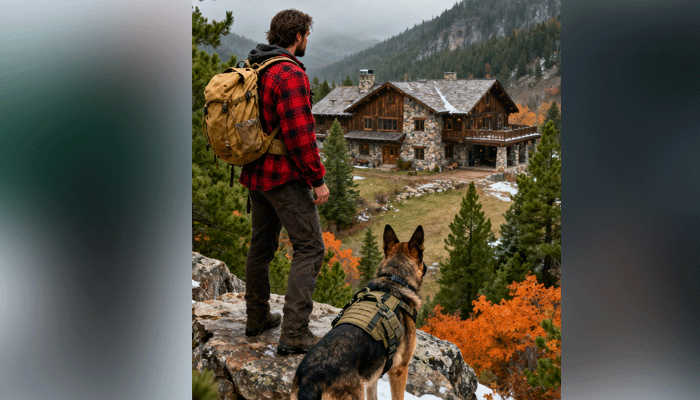
He Came Home From War With Only His Dog—Then the Earth Opened and Took the Last Place He Belonged
Luke Mercer had imagined the drive home so many times that, by the end of his last month in the Army, the memory of it felt older than the road itself.
In his mind, the trip always began the same way. He would cross the county line into Cedar Hollow, Kentucky, with the windows down and late-summer air pouring into the cab of his truck. His dog, Scout, would have his head hanging out the passenger-side window, ears whipping back, tongue lolling like he was grinning at the whole world. Luke would pass the dollar store, the white-steepled church, the high school football field with its rust-red bleachers, and the feed mill with the faded mural of a Holstein cow on the side.
Then he would turn onto Mercer Lane, a narrow blacktop road cut through fields of hay and limestone ridges, and he would see the house.
Not a fancy house. Not one anybody in Nashville or Lexington would put in a glossy magazine. Just a white farmhouse with a deep front porch, a metal roof that sang in the rain, and a porch swing hung by chains his father had bolted into the beam before Luke was born. There was an old sugar maple in the front yard, a rusted hand pump out back, and a red barn leaning slightly to the west like it had gotten tired of standing straight sometime around 1987 and nobody had the heart to correct it.
Luke had clung to that house through the last years of his service the way some men clung to a date circled on a calendar. When the days ran too long and the nights got worse, he told himself there was still a place in the world where the floorboards knew his footsteps. A place that smelled like black coffee, rain-soaked dirt, and cedar chests. A place where nothing had ever exploded except maybe an old truck tire in summer heat.
He crossed the county line on a hot Thursday afternoon in August with Scout beside him in the truck, a duffel in the back seat, his discharge papers in the glove box, and a stiffness in his chest he had not been able to shake for months.
The road looked the same.
The church was still there. The feed mill too. The high school field had new lights. Somebody had painted the water tower. Someone else had opened a vape shop where Benson’s Hardware used to be.
He drove slower as he neared Mercer Lane, one hand on the steering wheel, the other resting lightly on Scout’s neck. Scout was a retired military working dog, a black-and-tan shepherd with one nicked ear and the hard, watchful eyes of an old soldier who had learned to sleep lightly. Luke had gotten him stateside after an IED blast left Luke with a shredded shoulder and Scout with a scar along his rib cage. The Army had written Scout off as too old for service. Luke had signed the adoption papers before anyone could think better of it.
The lane bent past a soybean field, and Luke’s pulse picked up.
Then he saw the sheriff’s SUV.
He braked so hard the truck fishtailed on the gravel shoulder.
There was yellow tape strung between fence posts and traffic cones. Two county vehicles were parked crooked in the yard. Half a dozen neighbors stood near the ditch with their hands on their hips. Somebody had a phone out. Somebody else had both hands over their mouth.
Luke stared through the windshield, unable to make sense of what he was seeing.
Or not seeing.
The house was gone.
Not burned. Not bulldozed. Gone.
In its place yawned a hole in the earth so wide and dark that at first his mind refused to name it. The porch had collapsed inward. One corner of the roof was visible, broken and tilted down into blackness. A slice of the chimney stood at an angle like a snapped neck. The maple tree leaned toward the void, roots exposed on one side. The porch swing, unbelievably, still hung from a beam that jutted over empty air.
Luke cut the engine but did not move.
Scout let out a low sound in his throat, not a bark, not a growl—something more human than either.
Someone tapped on Luke’s window. He turned his head and saw June Whitaker, who had lived next door as long as he could remember. She was in her late sixties now, broad-shouldered, sun-browned, and still wearing the same no-nonsense expression she had worn when she used to catch Luke stealing green apples from her tree.
Her lips moved, but Luke heard nothing.
He rolled the window down halfway.
“Luke,” she said softly. “Oh, honey.”
He stepped out of the truck on legs that didn’t feel connected to him.
“What happened?”
It came out rougher than he meant, as if the words had been dragged over gravel.
June looked toward the hole, then back at him. “Opened up around dawn. Sounded like thunder under the ground. I called the county, then the sheriff. We tried calling you, but your old number—”
“What happened?” he asked again.
A man in a reflective vest approached from the tape. “Sir, you can’t cross—”
“That’s my house.”
The county man pulled up short, took in Luke’s duffel, his close-cropped hair, the dog, and seemed to understand he had walked into the wrong moment with the wrong script.
“We believe it’s a sinkhole,” the man said. “This area sits over limestone. Heavy rain this week may have accelerated subsurface collapse. We’ve got geotechnical—”
Luke brushed past him until the yellow tape pressed against his thighs.
The sinkhole was monstrous up close. Forty feet across at least, maybe more. It swallowed light instead of reflecting it. The edges looked deceptively firm, ringed by broken sod and jagged dirt, but down below the soil dropped away into torn layers of clay and pale stone. Part of the kitchen floor had lodged against one side. Cabinet doors hung open over emptiness. A refrigerator lay crushed beneath debris. He could see one white curtain fluttering from what had been a bedroom window.
The house where his mother had made biscuits every Sunday. The place where his father had snored in the recliner with baseball games on. The hallway where Luke had marked his height in pencil on the trim every birthday until he enlisted.
Swallowed.
Scout stood beside him, every muscle taut, nose working the air. Then he let out a sharp bark and pulled toward the rim.
Luke grabbed his collar. “No.”
Scout strained again.
The county man stepped closer. “Sir, please. The perimeter is unstable.”
Luke barely heard him. His eyes fixed on the porch swing dangling above the void, swaying just enough to say the world still moved even when yours had stopped.
He became aware of June talking near his shoulder.
“There was rain all night,” she was saying. “At six-thirty I heard a crack so loud I thought lightning had hit the barn. By the time I looked out, the front half was already gone. Another minute and the rest folded in.”
Luke swallowed. “Anyone inside?”
“No.” June’s voice softened. “No one was inside.”
That answer should have been a mercy. Instead it hollowed him out further. If somebody had died in there, at least the destruction would have a shape his brain knew how to hold. Loss with a body. Loss with a name.
This was stranger. Meaner.
This was the earth itself deciding to erase a place.
He tried to remember the last thing he had packed before shipping out years ago. A framed photo of his parents? No. He’d left that on the mantel. His high school ring? In a drawer in his old room. His father’s hunting knife? In the hall cabinet, maybe. His mother’s recipe tin. The family Bible. The wooden box of letters she’d saved from Luke’s basic training. The folded American flag from his father’s funeral. Everything he hadn’t been able to carry and hadn’t been ready to let go.
Scout barked again, louder now, pulling hard toward the sinkhole.
Luke knelt and gripped the dog’s face gently. “Easy.”
Scout’s eyes flicked to the hole, then back to Luke. Alert. Insistent.
He knew that look.
Scout had worn it before a convoy got ambushed outside Kandahar. Before a mortar strike that came out of a blue sky. Before Luke himself had heard the blast that ended his career and split his life into a before and an after.
“You smell something?” Luke murmured.
The dog whined, ears forward.
The county man—his badge read HARLAN PIKE—cleared his throat. “Sir, I need you to move back. We’re bringing in a geologist. There may be additional collapse.”
Luke rose slowly.
Everything in him wanted to fight somebody. The county. The rain. God. Himself for leaving the house empty so long. Himself for believing there would still be a place waiting when he got back.
Instead he stepped back from the tape.
June put a hand between his shoulder blades. It was a simple touch, steady and unembarrassed.
“Come stay with me a night or two,” she said. “No use trying to sort all this standing in the road.”
He looked at the hole once more.
The porch swing creaked in the wind.
And for the first time since the day he took off his uniform for good, Luke Mercer felt truly homeless.
That night, he slept at the Red Cardinal Motel because the idea of walls borrowed out of pity felt unbearable.
The motel sat just off Highway 31, behind a gas station and across from a bait shop with a hand-painted sign that read NIGHT CRAWLERS • COLD BEER • LIVE MINNOWS. Luke had stayed there once in high school after a winter storm knocked out power across the county. Back then the place had smelled like lemon cleaner and cigarette ghosts. Now it smelled like bleach, damp carpet, and stale air-conditioning.
The room had a bed, a rattling wall unit, a dresser missing one handle, and a print of a covered bridge bolted over the headboard. Luke set his duffel down and stood in the middle of the room while Scout made a slow circuit, checking corners, closet, bathroom, bed frame, the way he always did.
“All clear?” Luke asked.
Scout jumped onto the rug and settled with a sigh.
Luke sat on the edge of the bed and called the insurance company.
He spent forty-three minutes on hold listening to a piano version of “America the Beautiful.”
When a woman finally came on, her voice was warm and professionally sorry. She confirmed his policy had been active until last March. She also confirmed that sinkhole damage required an additional rider, which had not been added to the plan.
Luke stared at the motel curtain while she talked.
“No coverage for structural loss due to earth movement?” he said.
“I’m very sorry, Mr. Mercer.”
He almost laughed. It wasn’t her fault. It wasn’t anyone’s fault in a way that made yelling useful. But grief likes a target, and paperwork was the only thing standing still long enough to become one.
“So what exactly did I insure?” he asked.
“Fire, wind, theft, water damage, certain storm events—”
“Not the ground vanishing.”
A pause. “No, sir.”
He ended the call before the anger had somewhere to go.
Then he called the county records office, the utility company, the bank. He learned three things in the next two hours.
First, the county had already marked the property unsafe pending geological assessment.
Second, the electrical meter account had closed months earlier after repeated low-use flags and automatic suspension, which he had somehow never noticed while still sorting out his discharge and relocation paperwork.
Third, the house itself might be a total loss, but the land—and any liability tied to it—remained very much his.
By nine-thirty he had a yellow legal pad full of phone numbers, deadlines, and words like condemnation review and hazard exclusion.
By ten, the room felt too small to breathe in.
He took Scout outside.
The night was thick and wet, crickets buzzing in the grass by the parking lot. A truck idled near the gas pumps across the road. Somewhere a country song drifted from a radio, tinny and sad.
Luke walked Scout along the back edge of the motel where scrub pines bordered a drainage ditch. Scout relieved himself, then looked up expectantly, waiting for instruction.
Luke shoved both hands in his pockets.
“Guess this is it,” he said to the dog. “Welcome home.”
Scout came and leaned his warm weight against Luke’s leg.
Luke looked up at the moon hanging over the dark road and felt, all at once, more tired than he had ever felt overseas.
He had spent twelve years in the Army. Three deployments. One busted shoulder. One medical retirement that everyone kept tactfully calling a transition, as if changing the word might soften the loss. He had endured barracks, tents, plywood shacks, flights at dawn, funerals at noon, and too many nights where sleep arrived only after his body gave up defending itself.
Through all of it, he had kept one image alive.
The porch.
The swing.
The kitchen light over the sink.
Home had not just been a destination. It had been structure. The frame holding everything else up.
Now the frame was gone.
He went back inside, stripped down to a T-shirt and boxers, and lay on top of the bedspread. Scout settled on the floor beside him.
Luke shut his eyes.
Almost instantly, the motel room disappeared.
Not because he fell asleep, but because something in him still lived on old reflex. The hum of the air conditioner became rotor wash. The headlights from the parking lot became flash flares through canvas. A slammed door two rooms down became a concussive thud in his bloodstream.
He sat upright before he fully knew he was moving.
Scout was on his feet at once, front paws against the mattress, muzzle pressed to Luke’s chest.
Luke dragged in a breath. “I’m good.”
Scout stared at him.
“You don’t have to look at me like that.”
The dog did not blink.
Luke rubbed a hand over his face.
“You know what’s funny?” he said quietly. “I made it through war, and I get taken out by Kentucky dirt.”
He did not expect the words to hurt the way they did.
He rolled off the bed and sat on the floor beside Scout, back against the mattress. Scout eased down next to him, shoulder to shoulder.
For a long time Luke listened to the air conditioner wheeze and tried not to think about the dark hole where the house had been.
Around midnight, he got up, took his boots from the floor, and pulled from one of them a folded photograph he had tucked there years ago and somehow never removed.
It showed the farmhouse in late October. Maple leaves flaming red, pumpkins on the porch, his mother laughing at whoever stood behind the camera. His father on the swing, pretending he wasn’t posing. Luke himself at seventeen, one boot on the railing, cocky and impatient to leave.
He looked at it until the faces blurred.
Then he set the photo on the motel nightstand, lay back down, and watched the ceiling until dawn.
The next morning he returned to Mercer Lane before most of the town had finished breakfast.
Mist still hovered low over the hayfield. The air smelled of wet clay and cut grass. County trucks remained in the yard, and now there was a temporary chain-link barrier around the sinkhole, more official than yesterday’s tape but somehow no less absurd. A portable sign read DANGER: UNSTABLE GROUND.
The sign stood in his front yard, where his mother used to plant marigolds.
Luke parked under June Whitaker’s walnut tree and got out with Scout. June was already on her porch in a robe and slippers, coffee mug in hand.
“You eat?” she called.
Luke shook his head.
“Then come get a biscuit before you start being stubborn.”
He almost said he wasn’t hungry, but June had always possessed a tone that made refusal feel childish. He crossed to her porch, and Scout trotted beside him.
Inside, June’s kitchen smelled like sausage gravy and strong coffee. The radio played local news low over the stove. Luke sat at her table while Scout lay by the back door and watched the yard through the screen.
June slid a plate in front of him. “Eat first. Glower second.”
Luke looked down at two biscuits smothered in gravy, scrambled eggs, and a slice of tomato.
“I’m not glowering.”
She snorted. “You’ve been glowering since you were eight.”
He ate because not eating would have invited conversation sooner. The food tasted like every Sunday morning of his childhood and nearly undid him.
June sat opposite with her coffee. “County man say anything useful?”
“Not yet.”
“He say when they’ll let you near the place?”
“He said not until a geologist signs off. Might be days.”
June nodded slowly. “There’s caves under this whole county. Everybody knows that. But nobody expects one to come up under their own kitchen.”
Luke looked out the window. From here he could see the top of the sheriff’s SUV through the trees.
“Did you see it happen?”
“I saw the last of it. House shook once, like something pushed from below. Then the porch folded and the front room went down. Sounded like dishes breaking for a solid minute.” She paused. “I’m sorry, Luke.”
He kept his eyes on the yard. “I should’ve come back sooner.”
June did not answer right away, which was why he had always respected her.
Finally she said, “The ground would’ve opened whether you were standing in the living room or in Baghdad.”
“Kandahar.”
“What?”
“That was Kandahar. Not Baghdad.”
June lifted one shoulder. “Point still holds.”
Scout rose suddenly and went rigid at the back door, ears pointed toward the sinkhole.
“What is it?” Luke asked.
The dog gave one sharp bark.
June turned her head. “He’s been doing that since yesterday. Every time a truck door slams out there, he acts like the world’s ending.”
“No,” Luke said quietly. “That’s not what this is.”
Scout whined, pacing once.
Luke stood and moved to the door. Through the screen he could see only the side yard and the line of trees, but Scout’s focus was fixed beyond them—toward the hole.
June watched Luke watching the dog.
“That mutt of yours found bombs overseas, didn’t he?”
“He found things.” Luke opened the door and let Scout out into the fenced back yard. The dog trotted to the far side, nose high, testing the breeze. “He doesn’t bark for nothing.”
“You think somebody’s down there?”
Luke almost dismissed it. The rational part of him knew there could be trapped gas, shifting debris, any number of things a trained dog might notice. But Scout’s posture wasn’t random. It was recognition.
“No,” Luke said. “Not somebody.”
He did not know why that answer felt true.
By ten o’clock, the geologist arrived.
Her name was Dr. Natalie Reeves, and she wore hiking boots, a county ID, and the practical expression of a woman accustomed to delivering bad news to landowners who thought dirt ought to behave itself. She was younger than Luke expected, maybe late thirties, with sun-reddened cheeks and a clipboard thick with maps.
She spoke to him by the fence while another worker unloaded equipment.
“The preliminary assessment is a cover-collapse sinkhole,” she said. “This region sits over soluble limestone. Rainwater enlarges cavities over time. Eventually the soil above can’t bridge the void anymore.”
Luke glanced at the hole. “Could’ve happened any day?”
“Could’ve. Or it could’ve stayed hidden another ten years.” She studied the rim. “Heavy rainfall tends to speed things up.”
“How much of the house is left?”
She blew out a breath. “Hard to say without imaging. There’s debris lodged on ledges and probably more buried beneath. But even if a section remains partially intact, the surrounding ground is compromised.”
“I need to know if anything can be recovered.”
Dr. Reeves looked at Scout, who stood planted beside Luke’s leg, eyes on the sinkhole.
“Maybe,” she said. “Eventually. Not by hand. Not today.”
Luke’s jaw tightened. “There are family things in there.”
“I understand.”
“Do you?”
Something in his tone made one of the county workers glance up. Luke knew he was skirting the edge of unfairness, but anger was the only thing keeping panic from taking over.
Dr. Reeves did not flinch. “I’m not saying no because I don’t care. I’m saying no because unstable rims kill people after the main collapse. I’ve seen it.”
Luke looked past her at the house remains, at the broken beam from which the porch swing still hung crookedly over open dark.
Dr. Reeves followed his gaze. “Was there a basement?”
“No. Just a crawl space. Maybe a root cellar under the kitchen years ago, but my dad filled part of it when I was a kid.”
“Maybe filled part of it?”
“He said raccoons kept getting in.”
Her eyebrows lifted slightly. “Do you remember where it was?”
“Under the kitchen. There used to be a trapdoor in the pantry floor when I was little.”
That got her attention. “A subsurface cavity with old masonry could absolutely affect how the collapse propagated.”
Luke stared at the hole again.
A trapdoor in the pantry. Shelves of canned green beans. His mother’s hands dusted with flour.
Scout leaned forward, muscles trembling.
Dr. Reeves noticed. “He’s scent-trained?”
“Yes.”
“What’s he alerting to?”
Luke did not answer because he didn’t know.
But the idea of the old root cellar lodged in his head like a burr.
If any pocket of the house remained intact, maybe it was there. Below the kitchen. Under stone. Protected by accident and gravity and a hundred years of Mercer stubbornness.
Dr. Reeves said, “I’ll know more after the ground-penetrating radar and drone pass. Until then, nobody crosses that fence.”
Luke nodded once, because there was nothing else to do.
As he turned away, Scout gave a low whine that vibrated through the morning air.
It sounded less like warning than longing.
By the third day, the whole town knew.
Small towns spread disaster the way creeks spread after rain—fast, branching, impossible to contain. A local TV station sent a reporter in a blue windbreaker who spoke solemnly in front of the barrier while Luke sat in June’s barn pretending not to hear his own misfortune narrated in polished, urgent sentences.
A drone buzzed overhead. Somebody posted overhead footage online. Strangers commented with words like unreal, terrifying, and prayers from Texas. An old classmate Luke barely remembered messaged him on Facebook to ask if he was “the Luke Mercer from Cedar Hollow” and whether he could share his GoFundMe.
There was, in fact, no GoFundMe. Yet.
June thought there ought to be. Luke thought absolutely not.
“Boy, pride is a terrible mattress,” she told him that evening as he unrolled his Army-issued sleep pad in the barn loft. “Looks tough from a distance and kills your back by midnight.”
Luke had moved into the loft that afternoon after checking out of the motel. June’s barn smelled like hay, old leather, and motor oil. There was a window looking west across the pasture and just enough room for a cot, a footlocker, and Scout’s blanket.
“It’s temporary,” Luke said.
“So’s life.”
He huffed a laugh despite himself.
June leaned on the ladder, arms folded. “You got a plan?”
“Working on it.”
“You always say that when you don’t have one.”
“I’ll clear the land once the county lets me. Figure out what I can salvage. Build something smaller, maybe.”
“On top of a sinkhole?”
“On another part of the property.”
June nodded. “That’s better.”
Luke sat on the cot, elbows on knees. “Insurance won’t cover it.”
“I heard.”
“County says the hazardous zone might extend farther than the hole. If they condemn that section, I still pay taxes on land I can’t use.”
June made a face. “Government can always find ways to own your headache without sharing your pain.”
Scout, sprawled near the hay bales, lifted his head at the sound of Luke’s name from the yard below. Somebody had pulled up.
A moment later, June glanced out the loft door. “Looks like Ava Collins.”
Luke went still.
He had not seen Ava in ten years, unless counting blurry social-media photos and one newspaper clipping June mailed overseas after Ava won county EMT of the year. In high school Ava Collins had been quick-tempered, funny, stubborn as fresh concrete, and impossible to forget. She had also been the last person Luke kissed before he shipped to Fort Benning and the first person he stopped writing once Army life hollowed his days into survival and little else.
“Tell her I’m busy,” he said.
June gave him a look of pure disgust. “You’re sitting in hay with a dog and a duffel bag. No one alive will believe you’re busy.”
She climbed down.
Luke heard voices below, Scout’s tail thumping once against the floorboards, then Ava’s boots on the ladder.
She appeared in the loft wearing jeans, a navy T-shirt with CEDAR HOLLOW FIRE & RESCUE across the chest, and her dark hair pulled into a rough ponytail. She carried a cardboard tray with two coffees.
“For the record,” she said, “I told June I could just leave this downstairs, but she called you a coward.”
June’s voice floated up from below. “I said mule-headed. Different animal.”
Ava smiled despite herself, then looked at Luke fully.
The years between them did something strange—collapsed, stretched, refused easy accounting.
“Hey,” she said.
“Hey.”
She held out one coffee. “Black. Still?”
He took it. “Still.”
Ava glanced around the loft. “You really are living in June’s barn.”
“Premium accommodations.”
“Mm-hmm.”
Scout approached her and sat, studying her face. Ava crouched and let him sniff her hand.
“So this is Scout,” she said softly. “He’s handsome.”
Scout licked once at her wrist, then leaned into her.
“Traitor,” Luke muttered.
“Good judge of character,” Ava said.
For a moment it felt almost normal, standing in dusty evening light with old history between them and coffee growing cold in their hands. Then the reality of why she was there settled back into the room.
“I heard about the insurance,” Ava said. “My brother-in-law works at the bank. He mentioned they’re sending a site adjuster, but it won’t matter much if earth movement’s excluded.”
Luke stared at his cup. “Town gossip gets more efficient every year.”
“Town concern,” she corrected. “Not gossip.”
He nodded once. “Right.”
Ava set her coffee on the window ledge. “I’m not here to make you feel watched. I just thought you might need help with paperwork or calls or—”
“I’m handling it.”
She absorbed that in silence.
Then, very gently, “You don’t have to handle every piece alone.”
Luke looked up. “I know.”
But the truth was murkier. In the Army, carrying your own weight was survival. Afterward, it became identity. The moment he let other people shoulder his mess, some ugly part of him feared he’d find out he was lighter than he’d claimed all along.
Ava seemed to read enough of that to let the argument pass.
“Okay,” she said. “Then I’ll tell you one useful thing and get out of your hair. My rescue crew got asked to stand by in case the sinkhole widens. Dr. Reeves thinks there may be an old cellar or void off to the east side, where the collapse didn’t fully punch through.”
Luke straightened. “She told you that?”
“She told the emergency team. Not the whole county. Yet.”
“Could there be an access point?”
“Maybe. Maybe not. But if there was old masonry under the kitchen, some part of it could still be wedged in place.”
Luke thought of the pantry trapdoor again. Thought of metal shelves, jars, the cool dirt smell of summer canning days. Thought of the lockbox his father used to keep papers in. He had not seen it in years, but he remembered the scrape of it against the pantry floor when his father pulled it out.
“What would be down there?” Ava asked.
“My parents’ things,” he said. “Maybe the deed. My dad kept records like the apocalypse was audited quarterly.”
“Then it might still be there.”
He looked at her. “That’s not something you should say unless you mean it.”
“I do mean it.” She hesitated. “Luke, I know it’s not the same as having your house. But not everything has to be gone just because the worst thing happened first.”
The words struck him harder than he wanted.
Because he knew that pattern. The brain calling the first blast final. The soul deciding emptiness all at once so it never had to be surprised again.
Scout rose and moved to the loft window, ears up.
Below, from the direction of the sinkhole, came the distant metallic clatter of equipment.
Then Scout barked—one explosive, urgent bark that made Luke’s spine lock.
He crossed the loft in two strides and looked out.
The county crew had shifted the fence line. One worker stood near the eastern edge, waving at someone out of sight. Another was crouched over a tripod-mounted sensor. Beyond them, just inside the hazard line, a patch of ground several yards from the main hole had sunk into a shallow oval depression overnight.
Dr. Reeves stood there pointing.
Luke felt every nerve in his body sharpen.
Scout barked again, this time directly toward the new depression.
Ava came beside Luke at the window.
“Well,” she murmured. “There’s your east-side void.”
The county widened the exclusion zone before noon.
Luke was not allowed within fifty feet, which felt obscene given that he could have thrown a baseball from the barn loft into what used to be his front yard. Dr. Reeves explained that the secondary depression suggested additional undermining and possibly a lateral chamber extending beneath the side yard.
“In English?” June asked.
“In English,” Dr. Reeves said, “the hole may not be done.”
June crossed her arms. “See? I like her. She can talk to normal people.”
Luke ignored them both and watched Scout.
The dog had turned into a compass needle. Every time Luke tried leading him toward the barn or the truck, Scout angled back toward the same point on the east side of the property, a patch of ground now cordoned off with orange stakes.
“What are you smelling?” Luke murmured.
Dr. Reeves heard him. “Could be moisture, wildlife, organic decay, trapped air from a subsurface void. Dogs pick up more than we do.”
“This isn’t random,” Luke said.
She followed Scout’s line of sight. “No. I don’t think it is either.”
That afternoon, she showed him a preliminary radar image on her tablet. Most of it looked like meaningless static to Luke—bands of color, weird shadows, blurred arcs. But one area stood out: a rectangular anomaly beneath the east side of the collapsed footprint, deeper than crawl-space level, bounded on at least two sides by straight lines.
“Could be old masonry,” Dr. Reeves said. “Could be cellar walls.”
Luke’s pulse kicked.
“Could it still be intact?”
“Partially. The roof structure above it likely collapsed, but the stone perimeter might have held enough to form a pocket.” She zoomed in. “See this narrow channel? It might connect to the secondary depression. If so, there could be a void that hasn’t fully opened.”
“Meaning?”
“Meaning the ground over it is dangerous. But also meaning there may be something underneath besides broken lumber.”
Luke stared at the screen.
“What happens next?”
“We stabilize what we can, get better imaging, maybe lower a camera if we find a safe angle.” She looked up. “I need you to keep expectations realistic.”
“Realistic says it’s all crushed.”
“Yes.”
He nodded once. “I’ve had realistic before.”
A flicker of understanding passed over her face.
That evening, Luke walked the fence line while the sunset turned the fields copper and the cicadas screamed from the trees. Scout moved beside him, nose down, then suddenly pulled left toward the eastern boundary.
The fence stopped them, but Scout remained focused on a low mound half hidden by weeds beyond the hazard tape. Luke frowned. He knew that shape. Had known it his whole life without really seeing it.
A hump in the ground under a tangle of honeysuckle, a few yards from where the kitchen had once stood.
When he was a boy, his mother used to tell him not to play there because “the old root cellar breathes cold and doesn’t like company.”
He had not thought about those words in twenty years.
The next morning, before sunrise, Luke borrowed June’s pruning shears and walked the fence line again.
Ava caught him halfway there.
“What are you doing?” she asked, jogging across the grass in boots and a department sweatshirt.
“Looking.”
“With garden tools?”
“With memory.”
She glanced at the shears, then at Scout, then toward the east side mound. “Tell me before you make me guess.”
Luke pointed. “There used to be a vent pipe out there. Or maybe a hatch. I don’t remember exactly. My mom called it the old cellar breathing.”
Ava squinted through the dim light. “You think that’s an access point?”
“I think something’s there.”
“You going under the fence?”
“No.”
She gave him a long look that clearly said she did not believe him for a second.
Luke crouched outside the hazard line and started clipping honeysuckle that spilled through the mesh. Scout stood over him, tail stiff, every bit the sergeant supervising a private.
Within minutes, rust appeared beneath the vines.
Not a pipe.
A circular iron cap about the width of a dinner plate, half buried in dirt.
Ava knelt beside him. “Well, I’ll be damned.”
Luke cleared more weeds and exposed a short length of corroded vent tubing descending into the soil at an angle.
Dr. Reeves, summoned by June’s bellow from the porch, came over carrying a mug of coffee and an expression that shifted rapidly from irritation to interest.
“This,” she said, crouching, “is useful.”
“It’s the cellar vent,” Luke said.
“Looks like it.”
“Can you get a camera down there?”
“Maybe. If the pipe isn’t blocked.” She ran a hand over the cap. “And if it does connect to the chamber we imaged, we may be able to assess contents without putting anyone on the rim.”
Luke felt, for the first time in days, a sensation perilously close to hope.
It made him immediately distrustful.
By noon the county had a small probe camera on site. Luke stood outside the fence with Scout at heel while technicians fed the flexible cable into the vent pipe inch by inch. Dr. Reeves watched the monitor. Ava stood beside her, arms folded.
At first the screen showed only grime, rust flakes, and spiderweb threads illuminated in harsh white light.
Then the pipe opened into darkness.
The camera emerged into a cavity.
Luke moved closer.
He could make out rough stone walls. A shelf. Broken boards. Dust. Something metallic glinting at one edge of the frame.
“Pan left,” Dr. Reeves said.
The technician adjusted.
The beam swept across a collapsed section of timber, then stopped on what looked unmistakably like a row of mason jars toppled sideways in the dirt.
June inhaled sharply behind them. “That old thing really did survive.”
Luke’s mouth went dry.
“Can you see farther in?” he asked.
The camera snaked ahead, brushing debris. The image shuddered. A section of the chamber had clearly caved in; earth pressed down from one side in a packed wall. But the opposite corner remained strangely intact.
A workbench.
Two shelves.
A metal box.
Luke felt the world narrow to that one object.
His father’s lockbox was army green, rectangular, dented on one corner, with a silver latch he used to oil every fall. Luke would know it anywhere.
There it sat under thirty feet of ruined house and Kentucky dirt, stubbornly waiting.
“That’s it,” Luke said, voice barely above air. “That’s my dad’s box.”
Dr. Reeves did not take her eyes off the monitor. “We cannot promise retrieval yet.”
“But it’s there.”
“It appears to be.”
Luke laughed once, sharply, because relief and grief hit the body through nearly the same door.
Scout leaned against his leg.
Ava said softly, “Told you not everything had to be gone.”
Luke looked at the screen again and saw something else beside the lockbox: a folded square of faded blue fabric.
At first he thought it was a feed sack.
Then the technician adjusted focus.
White stars emerged from the dust.
His father’s funeral flag.
Safe in the cellar while the rest of the world collapsed above it.
Luke turned away before anyone could see what his face had become.
Hope, he discovered, was harder to live with than despair.
Despair sits heavy and final. It asks nothing except surrender.
Hope asks for endurance.
The county still would not let him recover anything. The cavity had survived, but it was trapped beneath unstable ground. They needed a stabilization plan, shoring, excavation equipment, safety reviews, and approvals from people whose signatures lived in offices far from the hole in Luke’s yard.
In other words: waiting.
Waiting had never been his best skill.
He filled the next week with anything that felt like motion. He helped June mend a section of fence the county trucks had flattened. He hauled feed for her neighbor. He drove to the VA clinic in Bowling Green and sat through an intake appointment with a counselor who wore colorful ties and said calm things about adjustment, grief, and identity after service. Luke answered most questions in one sentence or less.
At night he slept badly in the barn loft and dreamed of foundations giving way beneath his boots.
Scout did worse.
Twice Luke woke to the dog standing at the loft window, low rumble in his throat, eyes fixed on the direction of the sinkhole. On the third night, thunder rolled over the fields and Scout sprang up barking before the first rain hit the roof.
Luke went to the window.
Lightning lit the yard in white flashes. The chain-link fence gleamed. Beyond it, the black oval of the sinkhole looked bottomless.
Then, in the next flash, Luke saw a section of ground near the east side slump inward six inches and stop.
He was halfway down the ladder before June shouted from her porch.
“Luke! Leave it!”
Rain slammed the yard. Wind bent the trees.
Luke stood under the barn overhang with Scout pressed against his thigh and watched mud slide down the sinkhole’s inner wall in ribbons. The earth seemed to breathe under the storm, exhaling clods and broken roots into darkness.
He wanted to run to it. To do something. To command, intervene, stabilize, save.
But not every battlefield responds to orders.
By morning, the cavity had not fully opened, though the east side depression was larger. Dr. Reeves arrived looking grim and relieved all at once.
“That could have been much worse,” she said.
“Meaning?”
“Meaning the chamber may have shifted but held. Also meaning I’m moving your retrieval request up the chain today before this weather does it for us.”
Luke stared at the muddy yard. “How long?”
“Maybe forty-eight hours.”
He almost snapped at the vagueness. Then he saw the exhaustion in her face and let it go.
Cedar Hollow, meanwhile, had begun doing what small towns do when disaster stays long enough to become personal. June’s church took up a collection. The VFW post called and offered temporary storage. The owner of Collins Hardware told Luke to come pick out work gloves, tarps, and anything else he needed “before my sister starts yelling at me for making it weird.” The sister, it turned out, was Ava.
Luke resisted all of it until June marched into the barn loft one Saturday morning holding a mason jar.
She set it on his cot with a thunk.
Inside were twenty-dollar bills, fives, ones, a folded check, and what looked like quarters at the bottom.
“What’s that?” Luke asked.
“Town money.”
“I didn’t ask for town money.”
“No,” June said. “That’s why they brought it to me.”
He stared at the jar. “I can’t take that.”
June planted her fists on her hips. “You can absolutely take that. You think people only help because they believe you’re helpless? Sometimes they help because they’d like the privilege of not becoming strangers to themselves.”
Luke said nothing.
June softened a fraction. “You went off and wore your country on your back. Fine. Good. Noble. But don’t come home acting like receiving kindness is beneath you. It isn’t.”
He looked away.
After a moment, Scout rested his chin on Luke’s knee, as if to cast his vote.
June noticed. “Dog’s smarter than you.”
“Usually.”
“Then listen to him.”
Luke reached for the jar, thumb brushing the glass. There was no dignity in hunger that could have been prevented. No honor in sleeping colder because pride needed its own blanket.
“All right,” he said quietly.
June nodded once, satisfied. “Good. Also, Ava Collins is downstairs fixing the hinge on my storm door because she can’t stand to sit still. You should probably thank her for the gloves she left too.”
Luke frowned. “She left gloves?”
“And socks. Don’t make me start listing.”
He rubbed a hand over his face. “This town is exhausting.”
June grinned. “You’ve been gone too long. We improve under pressure.”
Ava found him later that afternoon in the hardware store, standing in front of a display of extension cords he had no intention of buying.
“Interesting choice,” she said from the end of the aisle. “Planning to electrify the sinkhole?”
Luke turned. “Depends. Think county would allow it?”
She laughed and came closer, wiping grease from her fingers onto a shop rag. The store smelled like fertilizer, rubber hose, and old pine shelves. Ceiling fans stirred the warm air overhead. A man in overalls argued near the register about feed prices. Two teenage boys wandered by with fishing lures and too much cologne.
Normal life, Luke thought. Still operating.
Ava leaned against the shelf. “You needed socks.”
“I had socks.”
“Not enough dry ones in a barn.”
He wanted to tell her she didn’t have to keep doing this—showing up with things he had not known how to ask for. Instead he said, “Thank you.”
She studied him for half a second, maybe surprised by the easy answer.
“You’re welcome.”
He glanced toward the front of the store. “How’s the rescue crew?”
“Bored, mostly. Which is how we like it.” She folded the rag, then tucked it into her back pocket. “Dr. Reeves said they may bring in a contractor Monday. Portable shoring rig. Small excavator. That sound right?”
“Sounds expensive.”
“That too.”
Luke looked down the aisle. “I keep thinking I’m about to wake up somewhere else.”
Ava was quiet for a beat. “I know.”
“No,” he said, and then regretted the sharpness. “Sorry. I just—people say that. They mean they understand shock. But what I mean is… I got through years by picturing one door. One porch. One exact place. Feels like I spent all that time walking toward something that vanished two hours before I got there.”
Ava’s expression changed—not pity, which he would have hated, but something steadier.
“Then maybe the thing you were walking toward wasn’t the porch,” she said.
He gave her a flat look. “That sounds like the kind of sentence people put on farmhouse signs.”
“Maybe,” she admitted. “Doesn’t make it wrong.”
Luke let out a breath that could almost pass for a laugh.
Ava’s eyes softened. “You remember junior year, when your daddy’s truck broke down at the county fair and he cussed that Chevy for forty minutes in front of the livestock barn?”
Luke blinked. “Yeah.”
“My mama asked your mama how she put up with him. Your mama said, ‘Mabel, house and truck and body are just containers. Home is the one thing that keeps climbing out of them.’”
Luke stared at her.
“I never forgot that,” Ava said. “Because your mom said it while holding a funnel cake and looking like she’d figured out the universe before lunch.”
He looked away quickly.
He had forgotten his mother said things like that. Forgotten how easy wisdom looked on certain people until you needed it and realized they had taken the instruction manual with them when they died.
Ava stepped closer, lowering her voice. “When they get that box out, and they will, you’re gonna find some papers and maybe a flag and maybe a couple photographs. But what you’re really getting back is proof. Proof that the life under your life didn’t cave in.”
Luke swallowed.
The store bell dinged at the front. A customer entered. A radio somewhere in the back crackled with baseball scores.
Ordinary sounds. Beautiful because they asked nothing of him.
“I’m not good at this part,” he said.
“What part?”
“The coming back.”
Ava nodded slowly. “Most people aren’t. They just hide it better.”
He met her eyes then, and for a second all the years between them shrank to one summer evening behind the football bleachers, her fingers ink-stained from writing his name on the inside of her wrist, his whole life still unwritten enough to feel generous.
“What happened to us?” he asked before he could stop himself.
Ava did not look away. “You left,” she said, not cruelly. “Then you kept leaving.”
The truth landed cleanly.
Luke nodded once. “Yeah.”
She gave him a sad half-smile. “Maybe you can stop now.”
Monday brought machinery, fluorescent vests, and a level of official activity that made the yard look like a construction site for the apocalypse.
A small excavation contractor from Bowling Green arrived with a tracked mini-excavator, cribbing timbers, steel plates, and a crew of four. Dr. Reeves briefed everyone by the fence while Luke stood outside the work zone and tried not to vibrate apart.
The plan was simple in theory and terrifying in execution. Approach from the east side, away from the main sinkhole rim. Excavate a sloped access trench toward the detected void. Shore the sides. Expose what remained of the root cellar wall if possible. Lower a camera again before anyone went near the opening.
“If conditions change, we stop,” Dr. Reeves said. “Immediately.”
Luke asked, “Will anyone actually go in?”
“Only if the chamber proves stable enough for a confined-space recovery,” she said. “And if it doesn’t, we retrieve with reach tools or leave it.”
He hated the last two words, but nodded.
By noon they had peeled back several feet of sod and clay. The work was maddeningly slow. Every bucketful required reassessment. Every vibration seemed capable of waking the whole earth.
Scout sat at Luke’s side wearing his old service harness, though he was not officially working. Luke put it on more for himself than the dog. The harness reminded him they had done impossible things before. Or at least survived them.
Around one, the excavator operator uncovered stone.
A jagged line of stacked limestone blocks emerged from the trench wall.
“There,” Luke said under his breath.
Dr. Reeves descended carefully to inspect it. She brushed mud aside and exposed mortar. “Cellar wall,” she called.
The crew paused to shore the trench. Another hour passed. Then a narrow section of buried wooden framing appeared above the stone—a collapsed roof beam or hatch support.
The camera went in through a gap.
Everyone crowded the monitor except Luke, who stayed a step back, too afraid of seeing the chamber destroyed after all.
Then he heard Ava say, “It’s still there.”
He moved in.
The image showed the same corner of cellar as before, only closer now. Dust. Shelves. The dented lockbox. The folded flag. A crockery jug. A jar of what looked like peaches turned amber with age.
Dr. Reeves exhaled. “We have line of sight.”
“Can you reach it?” Luke asked.
One of the contractors, a compact man named Eddie who moved like he had spent a lifetime trusting dirt slightly less than necessary, studied the screen. “Maybe with a grab pole. Maybe by hand from the trench if we open another foot and that wall doesn’t shift.”
Dr. Reeves turned to Luke. “You’re still not going in.”
“I know.”
He did know. But hearing it hurt anyway.
By three o’clock, the opening had widened enough to permit a cautious reach. Eddie lay flat at the trench edge with his upper body supported by a harness line while another worker anchored him. He extended a long fiberglass pole with a hooked claw into the cavity and nudged debris aside inch by inch.
The whole yard held its breath.
Luke’s palms were slick. Scout stood rigid, eyes locked on the trench.
“Easy,” Eddie muttered to the world, the hole, the box, maybe himself.
The claw caught the lockbox handle once and slipped.
Luke cursed.
Second try. The pole wobbled, then settled.
“Got it.”
The box scraped over dirt with a sound Luke felt in his teeth. For one awful second it tipped and seemed ready to vanish beneath broken boards. Then Eddie eased it toward the opening.
The crew hauled him back.
The lockbox came out covered in mud, rust streaked but intact.
Nobody spoke.
Luke stared at it in Eddie’s hands, unable to move.
“Mr. Mercer?” Eddie said quietly.
Luke stepped forward and took the box.
It was heavier than he remembered. Cold. Real.
His father’s initials—R.M.—were scratched into the lid with an awl. The silver latch was caked with clay but unbroken.
Luke’s fingers shook.
“Open it,” June whispered behind him.
He set the box on the tailgate of his truck. Mud smeared the metal. Scout stood so close his breath fogged the surface.
Luke flipped the latch.
For one terrible instant he thought the contents had been ruined after all.
Then he saw waxed envelopes, bundled papers, a leather pouch, and on top of them all a folded letter in his father’s blocky handwriting.
LUKE.
Just that.
Not Son. Not Lieutenant, the old teasing term his father used whenever Luke came home bossy from ROTC meetings. Just his name.
Luke picked up the letter like it might ignite.
Inside the box were the land deed, the property survey, his parents’ marriage certificate, his father’s military discharge, a stack of family photographs wrapped in plastic, and the flag from the funeral. The leather pouch held his mother’s wedding ring, two silver dollars, and a key on a red string Luke did not recognize.
But it was the letter that hollowed the world around him.
He opened it with hands that had gone clumsy.
Luke,
If you’re reading this, then something forced your hand, because you never did like digging where you thought the past was sleeping. That’s all right. Most men don’t.
I’m writing this because there are things fathers mean to say plain and somehow keep putting off until plain gets buried under years.
First, the land is yours free and clear. The deed and survey are in this box, plus the receipts for the roof, well pump, and septic work because a man ought to know what he’s inheriting besides stories.
Second, your mother wanted her ring put away where it wouldn’t get sold off by my bad judgment if times ever got hard. She said you’d understand that she loved beauty but trusted practicality more.
Third, if you come home carrying something you can’t set down, don’t make the mistake of thinking the house can carry it for you. A house is wood and nails. Home is what still reaches for you when you’ve become hard to reach.
I know something about coming back wrong. My war and yours won’t match, but hurt knows its own family. I didn’t always do right by your mother when I got back. I was angry at sounds, at weather, at kindness, at days with no orders in them. I thought silence meant peace and found out it often means loneliness wearing a church shirt.
So hear me plain: if you come back and this place doesn’t fit the man you are, that does not mean you failed it. It means both of you survived long enough to change.
Take care of the porch if you can. Take care of the maple if it outlasts me. And for God’s sake don’t let pride make a hermit out of you. Mercers have always had a weakness for confusing stubbornness with strength.
If there comes a day the house is gone, build again where the ground is honest and put a chair outside where you can watch evening come in. That’s home enough for any man who means well and keeps his word.
Love you whether I said it enough or not.
Dad
Luke finished the letter and realized the truck, the crew, the yard, the entire county had dissolved into a blur around him.
He folded once at the waist, one hand on the tailgate, the other still gripping the paper.
Scout pressed against him immediately, firm and insistent.
Luke laughed and sobbed in the same breath.
June’s hand landed on his back. Ava’s stayed light on his arm.
Nobody tried to tell him to pull it together.
Nobody told him he was lucky.
Nobody spoke over the moment.
That, more than anything, felt like mercy.
After a while, Dr. Reeves cleared her throat gently. “There may be time to retrieve the flag too.”
Luke straightened, wiped his face with the heel of his hand, and nodded.
“Then let’s get it.”
They recovered three more things before the chamber shifted enough to shut the operation down.
The folded funeral flag came out wrapped in dust but dry.
A plastic tote of photo albums followed, one corner cracked but contents mostly intact.
The last item was a cedar recipe box Luke’s mother had painted blue in 1994 after deciding every kitchen needed “one cheerful stubborn thing.” Its lid had split, but the recipe cards inside—banana pudding, chicken and dumplings, chess pie, meatloaf written in two inks after revisions—were tied with twine and salvageable.
Then, at four-seventeen, a section of trench wall slumped with a sudden crack. Not catastrophic, but enough.
Dr. Reeves blew the halt whistle. Workers backed out. The opening to the cellar narrowed beneath a spill of clay.
“We’re done,” she said.
Luke almost argued. There had to be more down there. There was always more. A life cannot be reduced to four recovered objects and a hole in the ground.
But then he looked at the lockbox, the flag, the photographs, the blue recipe box.
Not everything had to be retrieved for something to be saved.
“Okay,” he said.
The machinery shut down.
By evening, the trench had been resecured, the site covered, the county paperwork begun. Dr. Reeves told Luke the house itself would almost certainly need full demolition of the remaining unstable debris and long-term geotechnical review before any rebuilding near the original footprint.
He heard her. He even understood.
But the sharpest edge of the loss had changed shape.
That night, after the workers left and the yard fell quiet except for crickets and the occasional far-off truck, Luke sat on June’s porch with the lockbox at his feet and his father’s letter open in his lap.
June handed him iced tea.
“You all right?” she asked.
“No.”
“Good. Means you’re telling the truth.”
He smiled faintly.
Across the yard, the sinkhole sat black and still under a half moon. The broken porch beam was finally gone, likely taken down during the day for safety. The swing had disappeared with it.
Luke felt the loss of that more sharply than he expected.
“The porch is gone,” he said.
June looked toward the hole. “So it is.”
“My dad told me to take care of it if I could.”
“You couldn’t.”
He nodded.
June settled into the rocker beside him. “You know, after Earl died, I spent six months staring at his boots by the mudroom door because moving them felt like betrayal. Then one day my granddaughter used one as a flowerpot, and I about lost my religion.” June sipped her tea. “Turned out Earl would’ve laughed himself stupid over it.”
Luke let that sit.
June glanced at the letter. “Your daddy say anything useful?”
“He told me not to let pride make a hermit out of me.”
She snorted. “Well, that was an ambitious request.”
He laughed, really laughed this time, and Scout lifted his head from the porch floor as if pleased with himself.
Then Luke grew quiet again.
“I thought if I made it back here, everything would stop moving,” he said. “Like I could set down all the noise and just… be who I was before.”
June rocked once. “You ain’t who you were before.”
“I know.”
“You ain’t who you were over there either.”
He looked at her.
She stared at the dark yard. “Sometimes the meanest trick life plays is making a man choose between ghosts when he ought to be building himself a future.”
Luke folded the letter carefully.
“You ever think the house had to go?” June asked.
He frowned. “What kind of thing is that to say?”
“The kind old women earn the right to say.” She kept rocking. “Maybe you loved that house so hard you were trying to move backward into it. Maybe the earth had ugly timing and no mercy, and that’s all there is. Or maybe loss sometimes drags us where choice won’t.”
Luke looked at the sinkhole again.
He did not believe in neat reasons for ruin. Too much of his life had taught him that chaos rarely respected meaning.
But he did believe in what came after.
The question wasn’t why the ground opened.
The question was what he would build on the honest part that remained.
Three days later, the whole county nearly watched him die.
It started with a boy and a drone.
June’s grandson Owen, twelve years old, bright-eyed and chronically overconfident, had been staying with her for the last week before school started. Luke liked the kid because Owen treated Scout with proper reverence and asked direct questions without pretending adults always knew more than children.
He also, unfortunately, possessed the exact amount of judgment a twelve-year-old boy usually does.
On Friday afternoon, Luke was in June’s machine shed helping replace a busted belt on her riding mower. Scout lay in the shade nearby, half asleep. The August heat pressed down like a hand. Cicadas screamed. Somewhere up the road, somebody practiced trumpet badly enough to count as violence.
Then Scout jerked upright.
Not alert. Alarmed.
He barked once—sharp, explosive.
Luke stood instantly.
From the front yard came June’s voice, high and terrified in a way Luke had not yet heard from her.
“Owen!”
Luke was already running.
He rounded the barn and saw it all at once.
The chain-link access gate at the sinkhole fence stood open.
Owen was inside the hazard line, maybe twenty feet from the rim, holding a controller and looking up at a drone buzzing over the hole. He must have slipped in to get closer footage.
At that exact moment, the ground beneath him fractured.
Not the whole section. Just a crescent of sod and clay that gave with a sick, sliding motion, carrying Owen toward the sinkhole edge.
The boy dropped the controller and screamed.
Luke covered the distance without conscious thought.
“Owen! Don’t move!”
Bad instruction. Impossible instruction. The kid was already sliding on his knees, clawing at grass that tore free in his hands.
June was behind Luke somewhere, shouting his name, but he was already in a different mode—the one the Army had burned into him. Assess. Anchor. Move.
“Scout, stay!”
Scout ignored the order and sprinted beside him.
Luke hit the fence gate, yanked it wider, and looked once at the collapsing ground.
Too far to reach on foot safely.
He spun, grabbed the coil of utility rope hanging from the fence post—left there by contractors—and looped one end around the trunk of the maple tree, the same old tree now leaning over disaster. He cinched a fast knot with fingers that remembered even if his shoulder protested.
Another crack sounded. The earth under Owen slumped farther.
“Luke!” Ava shouted.
She came running from June’s porch with Dr. Reeves right behind her—both must have arrived moments earlier for a site inspection. Ava saw the rope, understood instantly, and seized the standing line.
“I’ve got you!”
“Belay me hard!”
Luke wrapped the rope around his waist once, then ran low toward the sliding boy.
The ground felt wrong beneath his boots—soft, shifting, full of hidden hollows. Scout darted ahead, then veered left and planted himself near Owen, barking furiously.
“Grab the dog!” Luke shouted.
Owen reached for Scout instead of the ground, and that instinct saved him. Scout lunged forward, teeth catching the back of Owen’s hoodie near the shoulder, bracing with all four legs as the boy slid another foot.
Luke dropped to his stomach and skidded the last few yards, rope burning across his hip.
The sinkhole rim loomed inches beyond Owen, crumbling steadily into a black drop full of shattered beams and loose clay.
Luke caught Owen’s forearm with one hand and jammed the other elbow into a patch of sod that still held. Dirt cascaded into the void.
“I got you,” Luke said, though the words came through gritted teeth.
Owen was crying, half-sobbing, half-choking. “I’m sorry—I’m sorry—I’m sorry—”
“Save it. Look at me. On three, you push with your knees. Ready?”
The boy nodded wildly.
Scout still had a death grip on the hoodie and was pulling like fury.
Luke shouted, “Ava—take line!”
The rope snapped taut around his waist.
“One! Two! Three!”
Owen pushed. Luke hauled. Ava and somebody else—maybe Dr. Reeves—pulled from behind.
The sod under Luke’s chest broke free.
For one heart-stopping second his lower body dropped toward the hole, dirt exploding around him.
Then the rope caught. Hard.
Pain tore across his bad shoulder. White sparks burst behind his eyes.
But Owen came with him, sliding up over the broken edge, Scout scrambling and snarling until all three of them were suddenly rolling backward onto firmer ground in a spray of mud and roots.
They did not stop until Ava and Dr. Reeves grabbed arms and collars and dragged them well clear of the hazard line.
Behind them, with a sound like a giant clearing its throat, the section of rim where Owen had been standing collapsed into the sinkhole completely.
The drone whirled once and vanished into the dark.
Everybody froze.
Luke lay flat on his back, chest heaving, Owen sprawled across his legs, Scout on top of both of them as if determined none would escape his jurisdiction again.
Then June reached them.
She snatched Owen off Luke, hugged him once so violently it looked like she might fuse his bones, then switched instantly to swatting his backside with the flat of her hand.
“You foolish little idiot! You precious stupid child!”
Owen cried harder.
Ava crouched over Luke. “Can you move?”
He tried. Pain lanced through his left shoulder and side, but nothing felt broken beyond history and bad luck.
“Yeah,” he hissed.
“Don’t be tough.”
“Not tough. Stupid.”
“Good. Stay there.”
Dr. Reeves, pale as limestone dust, stared at the fresh collapse. “Jesus.”
Luke forced himself up onto an elbow.
And that was when he saw it.
The new break in the rim had sheared away another slice of earth, opening a brief, raw window into the layers below. In that exposed cross-section, ten feet down and slightly to the right, he glimpsed the stone arch of the old root cellar doorway and, beyond it, a glint of reflective metal.
Not imagined. Not a trick.
Real.
“There,” he gasped, pointing.
Dr. Reeves followed his finger. Her eyes widened. “Everybody back farther. Now.”
She was right, of course, but Luke could not stop looking. In that instant between collapse and settling dust, he had seen enough to know the cavity extended deeper and safer than they had guessed. The root cellar wasn’t just a box under the pantry. It connected to a small lateral chamber braced by original stonework. Maybe an old storm shelter. Maybe a storage room his father had never fully filled in.
The sight vanished as loose clay slid again.
Ava gripped Luke’s jaw lightly, forcing his eyes to hers. “Stay with me.”
“I saw it,” he said.
“I know.”
“Cellar door. Another chamber.”
“I know.”
Sirens rose in the distance—somebody must have called rescue the second Owen screamed. Irony, Luke thought dimly. The rescue crew arriving to rescue the rescuer from his own yard.
Scout licked mud off Luke’s cheek with a solemnity that made Ava laugh once from pure relieved nerves.
“Your dog,” she said shakily, “is the bravest pain in the ass I’ve ever met.”
“Same,” Luke said.
June, still clutching Owen with one arm, turned on Scout next. She grabbed his face in both hands and kissed the top of his head.
“And you,” she declared, crying openly now, “get steak for the rest of your life.”
Scout accepted this as overdue tribute.
The rescue incident changed everything.
For one, it made future access a county emergency priority rather than an unfortunate property dispute. Nobody wanted another child—or adult—near an unstable rim with half the town already sneaking peeks from the roadside. Additional fencing went up that evening. Deputies began patrolling the lane. By Saturday morning, state geological consultants were on the phone with Dr. Reeves.
For another, it turned Luke into a local headline again, but in a way he disliked even more than pity.
RETURNED VETERAN SAVES BOY FROM SINKHOLE, read one online news alert.
Luke cursed loud enough in June’s kitchen that she told him to hush before the biscuits absorbed profanity.
“I don’t need a headline,” he said.
“Then stop doing headline-worthy things,” June replied.
His shoulder was strapped in a sling by then. Not dislocated, just badly strained. Ava, wearing both her EMT authority and her annoyance, had wrapped it herself while Luke insisted he was fine.
“You are not fine,” she said for the sixth time.
“I’m ambulatory.”
“That’s a low bar for celebration.”
Owen, chastened nearly into sainthood, sat at the table coloring a thank-you card for Scout in block letters. It read YOU SAVED ME PLEASE FORGIVE MY BAD CHOICES and featured the dog wearing a superhero cape.
Scout slept under the table, exhausted and satisfied.
By Monday, the county approved a specialized recovery team from Louisville—confined-space technicians with micro-excavation equipment and remote cameras. Their mandate was limited: assess the newly exposed chamber, recover critical personal effects if safely possible, and stabilize what they could before long-term demolition planning.
Luke signed every permission form placed in front of him.
This time the operation was larger and more precise. They built a reinforced platform from the east side, used long-reach cameras through the newly exposed section, and confirmed what Luke had glimpsed: a secondary stone-walled chamber connected to the original root cellar by a short passage. It appeared to have been an old storm shelter, maybe dating back to Luke’s grandfather’s era, later forgotten except by implication and family lore.
Inside were more shelves, a broken chair, two galvanized tubs, and a cedar trunk pushed against the back wall.
Luke stood by the monitor with Scout at his side while the team adjusted the camera.
“What’s in the trunk?” he asked nobody in particular.
“About to find out,” one technician murmured.
The lid had fallen partly open during the collapse. Through the gap the camera caught fabric, paper bundles, and what looked like a framed object wrapped in an old Army blanket.
Luke felt suddenly certain.
“My mom’s memory chest,” he said.
June, beside him, inhaled. “Lord, I haven’t thought of that in years.”
“She kept Christmas ornaments in it,” Luke said. “And letters. Baby clothes. She used to stash things in there whenever she got scared of mice or weather.”
Ava looked at him. “You never mentioned a trunk.”
“I forgot.”
The sentence sounded absurd and true.
Trauma edits memory strangely. Some things burn permanent. Others vanish behind smoke until one angle of light makes them visible again.
The technicians recovered the cedar trunk two hours later using a sling harness and more patience than Luke thought human beings possessed. When it rose from the earth, smeared with clay and dripping dirt, June crossed herself. Ava put a hand over her mouth. Luke just stared.
The trunk still smelled faintly of cedar when they opened it on the tailgate beside the lockbox.
Inside, under layers of yellowed linens, they found:
A stack of family letters tied with ribbon.
Luke’s baby shoes.
A cigar box of black-and-white photographs from before he was born.
Three handmade Christmas ornaments shaped like stars.
His mother’s journal from the year Luke enlisted.
And, wrapped in the old Army blanket, a framed portrait of Luke in dress uniform from the day he made staff sergeant—one his mother had clearly cherished enough to hide from disaster.
There were also two VHS tapes labeled CHRISTMAS 1998 and DAD’S 50TH, which made June laugh through tears.
“Well,” she said, “now somebody’s got to find a machine from the last century.”
At the bottom of the trunk lay a second envelope in his mother’s handwriting.
For Luke, after.
He opened that one sitting on June’s porch just after sunset, unable to bear another audience.
Her handwriting leaned slightly right, elegant and firm.
Luke, if your father put this where I told him, then either the Lord got dramatic or life did.
I suspect you may be reading this on a hard day, because we usually only dig up old boxes when something else has already gone wrong.
I don’t know what age you’ll be when this reaches you. Twenty-five? Forty? Old and grumpy? Whatever the number, I hope you’ve learned what I kept trying to teach you in the kitchen: that people can break a little and still be useful, beautiful, funny, and deeply loved.
You always wanted the world to make sense before you’d trust it. That’s an exhausting hobby, sweetheart. Better to love what is good, mend what you can, and let weather be weather.
If home has changed before you got back to it, then make a new one with your whole heart. Don’t preserve sorrow like it’s fruit in a jar. Grief should be carried, not worshiped.
And marry a woman who can out-stare you when you get mule-headed. You come from difficult stock.
Love always,
Mom
Luke lowered the page and laughed helplessly into the evening air.
Ava, sitting on the porch step below him because she had brought over dinner and quietly stayed, looked back over her shoulder. “Good?”
“She just insulted me from the grave.”
“That does sound like your mom.”
He folded the letter carefully.
Then, after a long silence, he said, “She told me to marry a woman who can out-stare me.”
Ava turned fully, one eyebrow raised. “Well. That narrows the field.”
He smiled before he could stop himself.
For the first time since returning, the future did not feel like a blank wall.
It felt like land after floodwater—damaged, uncertain, but visible.
September arrived with cooler mornings, high school football banners on Main Street, and the kind of golden light that makes even tired places look merciful.
The county finalized its recommendations.
The original house footprint and a surrounding buffer zone would remain permanently restricted until long-term stabilization could be completed. Rebuilding directly over the sinkhole area was out of the question. However, the upper west field on Luke’s property, beyond the walnut line and safely uphill from the collapse zone, tested solid.
He could build there.
Small, maybe. Sensible. Expensive in ways he still didn’t fully understand. But possible.
The town, having apparently decided Luke Mercer’s life was now a shared enterprise, moved faster than he could object.
The VFW post organized a benefit fish fry.
Collins Hardware donated tools at cost.
June’s church ladies furnished enough casseroles to feed a National Guard unit.
A local builder named Sam Tiller, who had once coached Luke in Little League and still called everyone under fifty “kid,” offered to help design a one-story cabin with a wide porch and reinforced foundation.
“Nothing fancy,” Sam said, laying graph paper on June’s table. “But stout. Two bedrooms, one bath, open kitchen, proper mudroom, and a porch big enough to sit and ignore people from.”
Luke looked at the sketch. “You had this ready awfully fast.”
Sam shrugged. “Town talks. Also I know what veterans mean when they say they want ‘simple.’ Means they want quiet lines and no surprises.”
Luke ran a finger over the penciled porch.
“Can you put it facing east?”
Sam looked up. “Toward the old house?”
Luke nodded.
“Sure.”
Ava, leaning in the doorway with a clipboard from some rescue meeting, said, “That’s either healing or emotional masochism.”
“Can’t it be both?” Luke asked.
“Fair.”
They broke ground in October.
Luke worked every day his shoulder would allow. He dug, carried, measured, learned. The labor helped in ways therapy alone hadn’t touched. Physical work gave grief a task. Each post hole, each load of gravel, each board lifted into place said the same thing in rough practical language:
Still here.
Scout appointed himself site foreman and inspected all deliveries. Owen, under strict supervision and a new family policy that included the phrase “absolutely nowhere near the sinkhole,” came by Saturdays to hold nails, fetch water, and demonstrate genuine repentance through usefulness.
The sinkhole itself changed with the season. Rainwater collected at the bottom. Weeds sprouted along the edges. What had first looked like a wound began to resemble, if not healing, then at least a scar learning the shape of the body.
Luke fenced it permanently by November. Not ugly chain-link this time, but split-rail with warning signs discreetly mounted where needed. Around the perimeter he planted native grasses and black-eyed Susans on June’s advice.
“Give broken ground something decent to grow,” she said.
He did.
One cold morning while framing the porch roof of the new house, Luke found a section of weathered chain in the recovered debris pile. He knew it instantly.
The porch swing chain.
Bent, rust-scraped, but usable.
He stood there in gloves and sawdust, holding the metal links while wind moved through the bare trees.
Ava climbed the ladder with a thermos and saw his face.
“What is it?”
He held up the chain.
She smiled softly. “Well, look at that.”
“It survived.”
“Seems to be a theme.”
Luke looked at the partly built porch around them. “Think we can hang a swing?”
Ava handed him the thermos. “I think we’d better.”
They found the old swing seat weeks later in a salvage stack from the county demolition crew. One side was splintered, but Sam Tiller repaired it with oak braces and sanded the whole thing down smooth.
When Luke hung it from the new porch beam just before Thanksgiving, June cried openly and denied it was crying because “cold air makes my eyes leak.” Nobody believed her.
The first time he sat on it, Scout jumped up beside him without invitation and nearly tipped them both.
“Still subtle,” Luke told the dog.
Scout leaned into him until balance became a team project.
Luke looked out over the west field toward the distant line of the old yard. Beyond the maples and fence, the sinkhole lay quiet in the afternoon light, transformed now from spectacle to geography. Not erased. Not forgiven. Just incorporated.
A fact of the land.
A fact of the story.
Ava came onto the porch with two mugs of coffee and handed him one. The house behind them smelled like cut lumber, fresh paint, and possibility.
“Sam says you can move in next week,” she said.
Luke nodded. “Feels fast.”
“You’ve been home almost four months.”
He let that settle. Time had moved strangely since August—some days molasses, some days a blur.
Ava sat on the swing’s other side, and Scout, without opening his eyes, adjusted his weight so they all fit.
Luke sipped coffee. “You know, my whole life I thought coming home was one moment. Like crossing a line.”
Ava tucked one leg under herself. “And?”
“And maybe it’s construction. Maybe it’s a lot of hammering and cussing and choosing where to put the porch.”
She smiled. “That sounds more American anyway.”
He laughed.
The sun lowered over the fields. A pickup rattled down the lane in the distance. Somewhere a dog barked back across the county.
Luke looked at the new house—modest, sturdy, clean-lined, with honest ground under it and a porch facing east.
Home enough for any man who means well and keeps his word.
His father had known him too well.
“So,” Ava said after a while, casual in a way that was not casual at all, “your mom also had that line about marrying a woman who can out-stare you.”
Luke turned toward her.
She met his gaze, calm and warm and not looking away.
He laughed softly under his breath. “You really don’t miss an opening.”
“Nope.”
He set his coffee down on the porch rail.
Then he leaned in and kissed her, gently at first, because some things deserve reverence when they return after years gone wrong. Ava’s hand came up to his jaw. Scout grunted in complaint at being jostled and opened one eye.
When they broke apart, Ava rested her forehead lightly against Luke’s.
“Took you long enough,” she murmured.
“Yeah,” he said. “I know.”
The housewarming happened the Saturday before Christmas.
Luke argued against it. The town ignored him. By noon, trucks lined Mercer Lane, people stamped mud off boots on the new porch, and the kitchen counters filled with pies, deviled eggs, crockpots, cornbread, smoked ham, and one aggressively festive Jell-O mold no one admitted bringing.
Someone rigged Christmas lights around the porch rail.
Someone else brought a TV for the living room and put on an SEC game.
June took command of traffic flow, dish placement, and all emotional nonsense within a fifty-foot radius. Sam Tiller kept pointing at the walls and saying things like “She’s square as a rifle shot,” which seemed to be the highest praise in his vocabulary. Dr. Reeves stopped by in jeans instead of field gear and accepted exactly one slice of pie before getting pulled into three separate geology questions by curious neighbors.
Owen presented Scout with a red bandanna that read LOCAL HERO. Scout accepted it with the solemn dignity of a decorated officer.
Luke moved through the crowd feeling something he had not expected to feel for a long time.
Not happiness exactly, not in the shallow easy way of movies.
Something sturdier.
Belonging.
At one point he slipped out onto the porch for air. Dusk had started settling blue over the fields. Christmas lights glowed warm behind him in the window. Laughter rolled out from the kitchen. The swing creaked under his weight as he sat.
Across the west pasture, beyond the fence and the winter-bare trees, he could just make out the dark basin of the sinkhole.
The county had done what it could. It was secured, marked, seeded, stable enough for now. In spring, Luke planned to line a path to an overlook bench on the safe side—not to romanticize it, just to acknowledge it. A scar doesn’t stop being part of the body because you stop looking at it.
Scout came out and hopped onto the swing beside him.
A moment later, Ava joined them, pulling the door shut against the noise. She wore a green sweater and the expression of a woman both amused and resigned by the number of casseroles currently occupying her boyfriend’s new kitchen.
Boyfriend.
Luke still wasn’t used to the word, but he was learning.
“You hiding?” she asked.
“Breathing.”
“Good call.”
She handed him a small wrapped box.
“What’s this?”
“Open it.”
Inside was a brass dog tag on a leather key fob. One side was stamped with SCOUT. The other read:
HOME FOUND YOU TOO.
Luke looked up.
Ava shrugged, suddenly shy. “For the house keys. And because your dog deserves title credit.”
He closed his hand around the key fob. “Thank you.”
She sat beside him. For a while they watched the last light fade.
“You okay?” she asked eventually.
He considered the question honestly.
The hole in the old yard still existed. The house of his childhood was still gone. He still woke some nights reaching for sounds that lived in a continent of memory he could never fully leave. There were bills to pay, therapy appointments to keep, long stretches of life still unwritten and therefore uncertain.
But the porch beneath him was real.
The woman beside him was real.
The dog pressed warm against his leg was real.
The lights in the windows of the house he had helped build glowed like an answer.
“Yeah,” Luke said. “I think I am.”
Inside, June shouted for everybody to gather because apparently someone had found the old VHS player in town and they were about to watch CHRISTMAS 1998 on the television.
Ava laughed. “We should go save our reputation before they discover your bowl cut.”
“That footage should’ve stayed buried.”
“Too late. The earth gave it back.”
They stood.
Luke glanced once more toward the dark shape of the sinkhole beyond the field.
In August, it had looked like the end of his life waiting to happen.
Now it looked like a place where the ground had told the truth too suddenly.
Nothing stays.
Everything changes.
Build where it’s honest.
He put the new key fob on his house key and opened the door.
Warmth spilled over him—food, voices, light, Scout trotting ahead toward applause that clearly belonged to him.
Luke Mercer stepped inside.
This time, when he came home, the house was there.
THE END