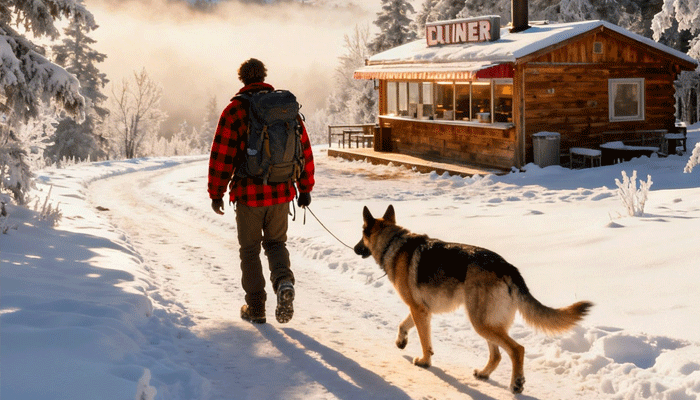
When Fear Owned Her Every Morning, a Veteran and His Dog Walked Into the Diner and Changed Everything
Leah Brooks had learned how to keep her hands steady even when the rest of her was shaking.
It was a skill she practiced every morning inside the Bluebird Diner on Route 17, twenty minutes outside the town square of Mason Creek, Tennessee. The diner had six red vinyl booths with cracks in the seats, a long chrome counter, a pie case that always leaned a little to the left, and a front window that caught the sunrise like it was trying to pretend the place was fancier than it was.
Leah had worked there for four years. Long enough to know which farmers wanted black coffee before they even sat down. Long enough to know when the church ladies were coming in after Wednesday Bible study. Long enough to know the exact sound of fear when it walked through the front door wearing work boots and a calm smile.
Derek Harlan never rushed.
That was part of what made him terrifying.
He was the kind of man who knew the whole county moved around him. His father sat on the county commission. His cousin wore a deputy’s badge. His uncle owned the towing company. Derek himself worked in property enforcement for the county, which sounded harmless until you realized it meant he knew where everybody lived, what they owed, and which rules could be used to make their lives hard.
Three years earlier, Leah had married him too young and left him too late.
Now he came into the Bluebird almost every day between 7:10 and 7:20, sat in the third stool from the register, and ordered biscuits and gravy he never finished. He wasn’t there for breakfast. He was there to remind Leah that he could still reach into every quiet corner of her life.
He would smile and say things that sounded harmless to anyone else.
“Your porch light was flickering last night.”
“I saw your car over at the pharmacy.”
“Rent’s gone up around town. Shame if you had to move someplace less safe.”
He never raised his voice. He didn’t have to.
Leah answered in the same tone every time. “Coffee?”
He liked it when she kept her face blank. He liked it even more when her hand trembled and the spoon tapped the cup.
Around them, life at the diner went on. Truckers. Teachers. A couple of retirees arguing over SEC football. Grease popping on the flat-top. Country music low on the radio. It all made a kind of cover for things people didn’t want to name out loud.
The owner, Miss Mabel Turner, was seventy-two and had bad knees, sharp eyes, and a rule against trouble. She loved Leah in the careful way older Southern women sometimes did—through food, folded cash, and the refusal to ask questions until you were ready to answer them.
But even Miss Mabel had limits.
“Best way with a man like that,” she once muttered while topping off ketchup bottles, “is let him tire himself out.”
Leah had nodded because it was easier than saying the truth.
Men like Derek did not tire out.
They waited.
They pressed.
They learned your schedule and your fear and your breaking point.
And they came back smiling.
That Thursday in early October started like any other. Fog low over the highway. Leah unlocking the side door at 5:12 a.m. Miss Mabel already inside rolling biscuit dough. Jolene, the cook, swearing at the old fryer. The first coffee pot on. The first truck in the gravel lot by 5:45.
At 6:10, Miss Mabel sank onto a stool and pressed a hand to her chest.
Leah was beside her instantly.
“Miss Mabel?”
The older woman tried to wave her off, but her face had gone gray. “Phone,” she whispered.
Jolene called 911. The ambulance came fast from Mason Creek. Leah rode with Miss Mabel to St. Anne’s while Jolene locked the diner and taped a handwritten sign to the door:
CLOSED UNTIL FURTHER NOTICE
By noon, the whole town knew Mabel Turner had survived a mild heart attack and was expected to recover. By two, people were speculating what would happen to the Bluebird. By four, Leah was sitting in a plastic hospital chair with a half-empty coffee cup, feeling the familiar slide of panic because jobs disappeared fast in Mason Creek, and she had exactly one month of rent saved.
Miss Mabel was pale but awake when she crooked a finger and called Leah close.
“There’s somebody coming,” she said.
“From where?”
“Arizona. My nephew.”
Leah blinked. “I didn’t know you had family in Arizona.”
“Neither did he, most days.” Mabel’s mouth twitched. “Sam Turner. Army. Retired. Stubborn as weather. He’ll come run the diner till I’m back on my feet.”
Leah tried to imagine someone crossing the country to run this old roadside place and couldn’t.
Miss Mabel squeezed her wrist. “Don’t let him fool you if he’s quiet. He sees more than he says.”
Leah didn’t know then how true that was.
Sam Turner arrived three days later in a dark green pickup that looked like it had seen every state west of the Mississippi. The truck rolled into the Bluebird lot just after sunrise on a Monday, and half the town noticed because attached to the back was a weathered dog crate large enough for a wolf.
Leah was wiping down the counter when the bell over the diner door chimed. She looked up—and for the first time in a long time, the room felt different before anyone spoke.
The man who came in was tall, broad-shouldered, and carried himself like somebody who had once lived by rules most people never saw. He was in his early forties, sun-browned, with close-cropped dark hair gone silver at the temples. There was a thin scar along one jaw and another disappearing under the sleeve of a faded gray henley. He didn’t swagger. Didn’t scan the room like he owned it. He just stood still for a beat, taking in the booths, the pie case, the coffee station, the kitchen pass, the exits.
Then the dog came in behind him.
He was a black German shepherd, older but powerful, with a chest like a barrel and intelligent amber eyes. No barking. No pulling. Just a measured step at the man’s side, alert and silent.
The few customers inside fell quiet.
Sam reached into his shirt pocket, pulled out a folded note, and handed it to Leah.
It was in Miss Mabel’s handwriting.
This is Sam. He’s in charge till I get back. Don’t let him rearrange my pies. —Mabel
Leah read it twice and looked up.
Sam gave her a small nod. “Ma’am.”
Nobody had called her that in years.
“Leah,” she said.
“Sam.”
The dog sat.
Leah glanced at him. “And this is?”
“Harley.”
Harley lifted one ear like he was amused the humans were behind.
Jolene came out of the kitchen, flour on her cheek and suspicion in her eyes. “You know how to run a diner?”
Sam looked at the grill, the order rail, the cramped prep line, the stack of invoices on the counter, and said, “I know how to learn a system before I break it.”
Jolene stared for one beat, then snorted. “You might do.”
That first morning, Sam asked more questions than he answered. He watched how tickets moved from Leah to the kitchen. He learned the register. Checked inventory. Fixed the wobble in booth four with a folded cardboard shim and tightened the loose hinge on the pie case without anybody asking. Harley lay near the end of the counter, head on paws, watching everything like he was keeping notes.
By noon, three things had become obvious.
First, Sam Turner was not just helping out for a day or two. He meant to keep the Bluebird running exactly as promised.
Second, Harley was no ordinary pet. He responded to hand signals, stayed precisely where Sam placed him, and watched doors before they opened.
Third, Sam noticed fear.
Not in the dramatic movie way. Not with speeches. Just the cold, precise way a man might notice a leak in the ceiling or a crack in a foundation.
At 7:14 the next morning, Derek Harlan walked through the front door.
Leah felt it before she saw him. Her shoulders tightened. Her lungs shortened. The room that had felt oddly steady for the past day suddenly narrowed again.
Derek wore a county jacket and a smile meant for an audience. “Morning, sweetheart.”
Leah kept her eyes on the coffee pot. “What can I get you?”
Derek slid onto the third stool.
Harley’s head came up.
Sam was behind the register doing inventory by hand. He didn’t move at first, but Leah saw his gaze lift, settle on Derek, then shift to her face.
Derek leaned one elbow on the counter. “Didn’t know the Bluebird was under new management.”
“Temporary,” Leah said.
“Shame.” Derek looked past her toward Sam. “You family?”
Sam walked over slowly. Harley rose with him.
“Sam Turner,” he said.
Derek offered his hand, but Sam didn’t take it. “Derek Harlan.”
There was a tiny pause.
Not rude. Not friendly. Just enough to make Derek aware somebody had chosen not to be managed by him.
“Biscuits and gravy,” Derek said finally. “And coffee. Leah knows how I like it.”
“I’m sure she does,” Sam said.
Leah poured coffee. Derek watched her the whole time. When she set the mug down, he let his fingers brush her wrist—not enough for anyone to call it assault, just enough to say I still can.
Harley stood.
No growl. No bark. He simply stood, body angled between Sam and the counter, gaze fixed on Derek’s hand.
The change in the room was instant.
Derek pulled back.
“Dog’s got opinions,” he said lightly.
Sam’s voice stayed calm. “He does.”
Derek looked at Harley, then at Leah, then back to Sam. “Might want to keep him under control.”
“He is under control,” Sam said.
For the first time in months, Leah saw Derek hesitate.
He ate half his breakfast and left without his usual final line. Leah didn’t realize she was holding her breath until the door shut behind him.
Jolene whistled low from the pass-through. “Well.”
Sam picked up Derek’s plate. “You okay?”
It was such a simple question Leah nearly laughed at it. Okay was not a place she visited.
“I’m fine,” she said automatically.
Sam held her gaze one second longer than most people did when they knew they were being lied to. Then he nodded once.
“Copy that.”
He walked away.
That should have been the end of it. In Mason Creek, people minded what belonged to them. Sam was temporary. Leah was private. Derek was trouble. Everybody knew their lanes.
But fear has patterns, and people trained to survive start recognizing them even when no one explains.
Over the next two weeks, Sam said very little and changed almost everything.
He installed a new lock on the back door.
Put a camera over the register after “finding” an old system in storage that somehow still worked once he rewired it.
Moved the bus tubs so the side hallway no longer had blind corners.
Started walking the trash out himself at closing.
He taught the staff a few easy phrases that sounded like diner talk and meant other things.
“Need fresh ice” meant come to the front now.
“Check the freezer temp” meant don’t leave someone alone.
“Call Mabel” meant dial 911.
Leah noticed all of it, though no one explained it to her directly.
Harley became part of the Bluebird as naturally as the coffee smell. He lay under the counter during the breakfast rush, accepted exactly three bacon pieces a day from Mr. Wilkes the mail carrier, and made children laugh by gently offering one paw when they asked. But he changed when Derek came in. His posture sharpened. His gaze never wandered.
Derek noticed too.
The second week, he came in later than usual and waited until the lunch crowd thinned.
“Funny thing,” he said, stirring a coffee he didn’t drink. “People in town are talking. Saying Mabel’s nephew runs the place like a military checkpoint.”
Sam was refilling sugar dispensers. “People in town talk for sport.”
Derek smiled without warmth. “You planning to stay long?”
“Long as my aunt needs.”
“Be a shame if business got difficult.”
Sam set the sugar dispenser down. “Is that a concern or a promise?”
The air seemed to leave the room.
Leah’s pulse kicked hard. Derek had trapped deer with less patience than this. He liked men who barked back. He knew how to twist anger into a weapon.
But Sam wasn’t angry. He was steady, which was worse for a man like Derek.
Derek leaned back. “Just local advice.”
Sam nodded. “Here’s mine. The staff works hard. You want breakfast, eat breakfast. You want an audience, try the courthouse.”
Derek’s eyes flicked toward Leah. “You talking for everybody now?”
“No,” Sam said. “Just for this building.”
Derek stared at him for three long seconds, then stood.
When he passed Leah, he said under his breath, so quiet only she could hear, “You’re making this harder.”
Her skin went cold.
That night, she found her porch light smashed.
No witnesses. No note. Just broken glass under the weak beam of a flashlight and the old certainty settling back into her bones.
She almost didn’t go to work the next morning. Almost called in sick. Almost packed a bag and drove east until the gas ran out.
Instead, she showed up at 5:09 because fear loved isolation, and the Bluebird—despite everything—was the only place left in town where she didn’t feel entirely alone.
She was early, but Sam’s truck was already there.
The diner kitchen light glowed warm through the side window. Harley thumped his tail once when she opened the door.
Sam was at the prep table slicing strawberries for pies.
He looked up. “Morning.”
Leah set down her purse. “You make pie filling now?”
“I make bad pie filling,” he said. “Jolene says I’m under supervision.”
A laugh escaped her before she could stop it.
Sam glanced at her face, then at the small bandage on her thumb where she’d nicked herself cleaning up the porch glass. He didn’t ask about it. Instead, he slid a mug toward her.
Coffee. Cream, no sugar.
She frowned. “How’d you know?”
“I pay attention.”
The words landed harder than they should have.
Leah wrapped both hands around the mug. “That can be dangerous in this town.”
Sam wiped the knife and leaned against the counter. Harley rested one chin on his boot.
“Can be useful too.”
For a moment, the kitchen was quiet except for the hum of the old refrigerator and Jolene banging pans in the dry storage room.
Leah looked at the coffee.
Then at last she said, “He knows where I live.”
Sam didn’t interrupt.
“He watches. He follows sometimes. He says things that aren’t threats unless you know him. I tried filing a report once after I left. It disappeared.” She laughed once, bitter and small. “Funny thing about small towns. Everybody’s related to somebody.”
Sam’s expression didn’t change, but something in him sharpened.
“What’s his full name?”
She told him.
“What’s yours on the lease?”
She blinked. “The trailer?”
He nodded.
“Just mine.”
“Good.”
That startled her. “Good?”
“Means fewer legal knots.”
She stared. “You talk like this happens often.”
His hand rested briefly on Harley’s head. “Different uniforms. Same pattern.”
Leah looked at the dog. “Was Harley military?”
“Sort of,” Sam said. “He was partnered to a handler in Afghanistan. Lost him. Didn’t adjust well after. Neither did I, if we’re being honest.”
Leah looked back up. “You and the dog came as a package deal?”
Sam’s mouth moved, almost a smile. “That’s about right.”
She sipped the coffee.
Then, before she could talk herself out of it, she said, “I don’t know how to make him stop.”
Sam’s answer came without drama.
“You don’t stop men like that by hoping they get bored.”
Leah swallowed.
“You stop them,” he said, “by making sure they lose every place they like to hide.”
The next month changed the Bluebird Diner in ways Mason Creek would talk about for years.
Not because Sam Turner marched around giving orders. He didn’t. Half the time he still looked like a man trying not to draw attention. But order spread around him anyway.
He got motion lights installed by the side entrance and made the county inspector explain why they supposedly violated code in writing. The inspector never came back.
He printed schedules instead of scribbling them on receipt paper. Closed the diner exactly at nine instead of nine-thirty-or-whenever. Started sending Leah home with Jolene or one of the regulars if her shift ended after dark. Fixed the dead bolt on the office door. Replaced the broken back lot bulb. Bought pepper spray for every woman on staff and made a local self-defense instructor teach a Saturday class in the dining room before opening.
When Derek found out, he laughed loud enough for three booths to hear.
“You all starting a militia?”
Sam poured coffee for a table of truckers. “Just improving safety.”
Derek’s smile thinned. “From what?”
Harley rose from under the counter and went to sit beside Leah’s station without a word from Sam.
Derek noticed.
Leah noticed that he noticed.
And for the first time, she saw something beneath his confidence she hadn’t seen before.
Not fear exactly.
Uncertainty.
It was a beginning.
That same week, Sam walked Leah to her car after close and asked, “What happened the night you left him?”
The question made the keys shake in her hand.
He didn’t push. Just stood under the parking lot light with Harley at his knee, waiting.
Leah looked out at the highway. A semi roared by in the distance.
“I thought if I was calm enough,” she said slowly, “careful enough, he wouldn’t get angry.”
Sam stayed silent.
“We’d only been married eight months. He hated when I worked late. Hated if I talked to customers too long. Hated if I wore lipstick he didn’t pick. But he always had a reason. Always a story. ‘You know how men look at you.’ ‘I’m protecting you.’ ‘Don’t make me worry.’”
Her throat tightened.
“One night he came home and said I’d embarrassed him at his dad’s fundraiser because I laughed too loud at something the pastor said. I told him he was acting crazy.” She gave a small, humorless smile. “Turns out men like Derek really don’t care for that word.”
Sam’s face remained still, but Harley leaned lightly against Leah’s leg.
Leah closed her eyes a second.
“He pinned me against the refrigerator. Then he acted sorry. Then he cried. Then he bought flowers. Then he did it again three weeks later. The last time…” She looked down at her hands. “The last time he put one hand on my throat and the other over my mouth and told me if I ever made him look weak again, nobody would find enough of me to bury.”
The highway sound faded. The night itself seemed to listen.
“I left before dawn,” she whispered. “Took my car, two trash bags, and every cash tip I had hidden in a coffee can.”
Sam exhaled through his nose. “Did anybody photograph the injuries?”
“The ER nurse wanted to. Derek’s cousin showed up before she finished the forms.”
Sam nodded once, slow and grim. “Okay.”
That was all.
No pity. No questions about why she stayed. No promise he couldn’t keep.
Just okay—the kind that meant he had heard every word and was already placing it somewhere useful.
Two nights later, Derek followed Leah home.
She noticed his headlights three turns before her trailer road and drove straight past her place, heart hammering. She called Jolene, who called Sam, who was somehow already halfway there when Leah circled back toward town with Derek still behind her.
Sam’s pickup appeared at the intersection near the old grain elevator.
He didn’t chase Derek. Didn’t ram him. Didn’t do anything cinematic.
He simply pulled broadside across the narrow road where Derek had to stop or hit him head-on.
Harley was in the passenger seat, rigid and watching.
Leah stopped fifty yards back, hands locked on the wheel.
Derek got out first, furious. Sam got out second, calm.
They stood in the wash of headlights while insects buzzed in the weeds and Leah sat frozen, unable to hear the first few words over the blood rushing in her ears.
Then Derek shouted, “This is between me and my wife.”
Ex-wife, Leah thought automatically. Not wife. Never again.
Sam’s answer carried clear in the night. “You’re on a public road following a woman who doesn’t want contact. That makes it everybody’s business.”
Derek took a step closer. “You got no idea who you’re messing with.”
Sam took one too, just enough to meet him. “I know exactly what you are.”
Harley came out of the truck then—not charging, not snarling, simply moving to Sam’s side with total focus.
Derek looked from man to dog and seemed to realize, maybe for the first time, that intimidation only worked if the other side agreed to fear him.
He spat near Sam’s boot, got back in his truck, and peeled away.
Leah sat shaking for a full minute before Sam came to her window.
“You okay to drive?”
She nodded, though she wasn’t.
“Then we’re not taking you home alone tonight,” he said.
That was how Leah spent her first night in the small apartment above the Bluebird’s storage room, curled on a borrowed blanket while Harley slept across the doorway like a living lock.
In the morning, Mason Creek had opinions.
By lunch, the story had twisted into three different versions:
Sam Turner threatened a county employee with a police dog.
Leah Brooks lured her ex into a setup.
The Bluebird Diner had become some kind of anti-man circus.
Leah heard all of it in whispers and half-sentences. Every rumor made old shame stir in her stomach. That was Derek’s real talent: turning his violence into someone else’s embarrassment.
She might have folded under it too—if Sam hadn’t done something she never expected.
At 2:00 p.m., in the middle of the lunch lull, he turned the OPEN sign to CLOSED and asked every remaining customer to leave.
Then he stood in the center of the dining room while Jolene, Leah, and the two part-time servers watched from the booths.
“I’m going to say this once,” he said. “No one here owes loyalty to me, to my aunt, or to this diner at the expense of your safety. If anybody wants out because things are getting ugly, I’ll understand. Last paycheck cash. No hard feelings.”
Nobody moved.
Jolene crossed her arms. “You done?”
Sam looked at Leah. “You too.”
She understood the question beneath the words.
Do you want to disappear? Do you want me to back off? Do you want the old silence because it feels safer than a war?
Leah’s heart pounded.
For years, survival had meant making herself smaller. Quieter. Easier to manage. But that road ended the same way every time—with Derek’s voice in her ear and her own life shrinking around it.
“No,” she said.
Sam gave one short nod. “Then we keep going.”
Jolene slapped the booth table. “Good. Because I made meatloaf for dinner and I’m not letting that son of a snake ruin it.”
The room laughed, shaky but real. Even Leah.
The turning point came on a Friday.
Mason Creek High had a home football game, so the diner was packed from four till nine. Families in team colors, teenagers inhaling fries, coaches wolfing down burgers. The noise helped. Derek didn’t like witnesses he couldn’t control.
He came in anyway around six-thirty, this time with two friends from the county garage.
Leah saw him and immediately moved to the far end of the counter. Harley, who had been asleep near the pie case, stood up.
Sam was in the kitchen window calling tickets. He looked out, read the room, and came to the front.
Derek smiled for his audience. “Thought I’d support local business.”
“Order and sit,” Sam said.
Derek took the third stool, like always. “Leah waiting on me?”
“No,” Sam said.
There it was—simple, clean, impossible to mishear.
Derek’s friends chuckled uncertainly, sensing weather changing.
Derek tilted his head. “Since when?”
“Since now.”
Leah felt the whole diner listening while pretending not to.
Derek’s smile vanished. “I didn’t ask you.”
“No,” Sam said. “You don’t ask much.”
A flush climbed Derek’s neck. “You some kind of hero?”
Sam’s voice remained even. “Not interested. You can eat here if you behave like a customer. You address staff respectfully. You do not touch them, corner them, follow them, or wait in the parking lot. You can manage that, or you can leave.”
One of Derek’s friends muttered, “Man—”
But Derek had forgotten there were people around. Forgotten performance. Forgotten charm.
He slapped a hand flat on the counter hard enough to rattle silverware. “You don’t get to tell me where I can sit in my own town.”
Harley moved.
Not at Derek.
To Leah.
He planted himself between her and the stool line, ears forward, body still.
Every head in the diner turned.
Sam didn’t raise his voice. “Out.”
Derek stared at him.
Then at the dog.
Then at the fifty people in the Bluebird who had just seen exactly who he was when someone told him no.
He laughed, but it came out ragged. “This ain’t over.”
He left without eating. His friends followed.
And in the silence afterward, something invisible cracked.
Not in Leah.
In the town.
The next morning Mrs. Alvarez from the hardware store brought over two new motion-sensor bulbs “for the back lot, just in case.” Pastor Green left a card with the number of a lawyer in Knoxville who handled protective orders. Three teachers from the high school asked if Leah wanted one of them to follow her home after close. Mr. Wilkes the mail carrier quietly mentioned he’d seen Derek’s truck parked near Leah’s trailer twice after midnight and was willing to swear it.
Support didn’t come all at once. It came in pieces. In casseroles and witness statements, spare locks and careful offers. But once it started, it kept coming.
Derek had counted on Leah being alone.
He had miscalculated the cost of a veteran with patience and a dog that refused to blink first.
Sam helped Leah file for a restraining order on a gray Tuesday morning in county court.
Derek arrived in a pressed shirt and a smile like polished metal. He brought his father. Leah brought Sam, Jolene, Mr. Wilkes, and Mrs. Alvarez.
The judge—a woman from Nashville on temporary rotation—listened to Derek’s lawyer frame the issue as “an emotional misunderstanding between former spouses.”
Then she listened to Leah.
Really listened.
Leah’s voice shook. Her palms were wet. But she told the truth straight. About the marriage. About the threats. About the following. About the smashed porch light. About the roadblock. About the diner.
Mr. Wilkes testified.
Mrs. Alvarez testified.
Jolene testified in language so plain and fierce it made even the court reporter blink twice.
Then Sam took the stand.
He did not dramatize. Did not embellish. He described dates, times, behaviors, changes in Leah’s affect, direct statements made by Derek in public, and the incident on the county road with the clarity of a man who had learned that details saved lives.
When it was over, the judge signed the temporary order.
Derek looked at Leah with murder in his eyes.
Not metaphor. Not anger. Not hurt pride.
Murder.
Leah saw it and knew he would not stop because of paper.
Sam saw it too.
That night he moved a cot into the diner office and slept there with Harley.
For a week the order seemed to hold.
Derek stopped coming inside. Stopped parking near the Bluebird. Stopped driving past Leah’s trailer. Even the gossip cooled.
Leah began sleeping a little. Laughing a little. She started wearing lipstick again—soft rose, the kind she’d loved before Derek decided color on her mouth belonged to him.
One evening, while closing up, she found Sam on a ladder replacing an old neon tube in the Bluebird sign.
“You know you don’t actually own this place,” she called up.
He looked down. “I have temporary emotional investment.”
She smiled. “Harley’s judging your wiring.”
Harley, lying below the ladder, thumped his tail once.
Leah leaned against the counter outside. The air smelled like fryer oil and autumn leaves. Across the road, the trees had gone gold.
“You ever gonna tell me why you really stayed in Arizona so long?” she asked.
Sam came down from the ladder and set it aside.
“Less history out there.”
“That all?”
He rubbed one hand over Harley’s neck. “My wife died twelve years ago.”
Leah blinked. “I’m sorry.”
Part-2
“She was a paramedic. Drunk driver crossed center line.” He looked out at the dark road. “After that, the Army was easier than home.”
She didn’t know what to say.
Sam glanced at her. “People think grief and fear are opposites. They’re not. They both make the world small.”
Leah felt that settle somewhere deep.
Then he added, almost offhand, “You’ve been making yours bigger lately.”
No one had ever said something kind to her in so few words.
She looked away because suddenly her eyes burned.
“Don’t tell anybody I’m getting sentimental,” Sam said.
“Your secret’s safe.”
For the first time in years, hope began to feel less like a trick.
And that was exactly when Derek decided to strike.
It happened on the Saturday before Halloween.
The Bluebird ran a special that day—chicken-fried steak, mashed potatoes, pecan pie. The place was full from church lunch through supper, then slowed after eight. By 8:45 only three tables remained: a couple sharing cobbler, two deputies from the next county over finishing coffee, and old Mr. Hanley at the counter reading farm reports.
Leah was counting silverware rolls near the pie case. Sam was in the office doing invoices. Harley lay half-asleep by the register.
The front bell rang.
Leah looked up—and every muscle in her body went tight.
Derek stood in the doorway.
He should not have been there. The restraining order was clear. Fifty yards minimum. No contact. No harassment.
But men like Derek often did their most dangerous thinking after humiliation.
He looked wrong immediately.
Too still.
Too pale.
He wore a clean denim jacket, and one of his hands stayed tucked inside it.
Harley was up before Leah could breathe.
Sam stepped out of the office at the same instant, eyes moving from Leah to Derek to the hidden hand.
The room changed.
Derek smiled, but the expression had split at the edges. “Evening.”
The two out-of-county deputies started to rise, sensing trouble.
Derek’s hand came out of the jacket holding a revolver.
Everything after that seemed to happen both too fast and in terrible detail.
The couple at booth two screamed.
Mr. Hanley knocked over his coffee trying to stand.
Leah’s breath vanished.
Derek raised the gun—not waving it wildly, but with horrifying purpose—and pointed it toward the ceiling.
“Everybody sit down!” he shouted. “Nobody move!”
The sound of his voice broke whatever spell had frozen the room.
Sam moved first.
Not toward Derek. Toward control.
“Kitchen!” he barked to Jolene through the pass-through, though she’d already gone white behind the grill. “Back door. Lock it. Call 911.”
Then to the diners: “Stay low. Stay behind the booths.”
To Leah: “Down.”
His tone cut through panic like a knife.
Leah dropped behind the counter.
Harley stayed standing, body coiled, gaze never leaving Derek.
“Get that dog back!” Derek yelled, swinging the gun now toward Sam.
Sam raised his hands slowly, palms out. “Easy.”
“Don’t you tell me easy!”
Derek was sweating. His eyes kept jumping to Leah’s hiding place behind the counter. Not to the customers. Not to Sam.
To Leah.
He had not come to scare her.
He had come to finish something.
“Derek,” Sam said, voice calm and low, “you’re violating a court order in front of witnesses. Walk out now while you still can.”
Derek laughed—a broken sound. “You think this is about court?”
Outside, somewhere far away, a siren began.
Maybe it was already coming. Maybe Leah imagined it because she needed to.
Derek heard it too. Panic flashed across his face, making him more dangerous.
“Leah!” he shouted. “Get up! Now!”
She couldn’t move.
Not because she didn’t want to. Because terror had reached into her body and turned it to stone.
Sam took one measured step sideways, drawing Derek’s focus. “She’s not going with you.”
Derek swung the gun toward him. “You shut your mouth!”
Harley growled.
It was the first sound the dog had made all night, low and deep enough to vibrate through the floor.
Derek flinched and looked at him.
That tiny shift gave Sam information. Distance. Angle. Timing.
Leah saw it in his face.
She also saw something else.
The coffee urn.
It stood at the end of the counter, still hot from the late rush, steam curling faintly near the service station.
Sam saw Leah see it.
No words passed between them.
Derek moved around the counter, gun out, desperate now to get to her before police arrived.
“Get up!” he shouted again.
Leah backed on hands and knees, bumping the under-counter fridge. Her heart was trying to tear through her ribs.
Derek rounded the end.
Sam moved.
He grabbed the coffee urn with a towel and heaved it sideways.
Boiling coffee and steam exploded across the tile between Derek and the counter, not on him but in front of him—enough to make him jerk back, curse, and throw one arm over his face.
At that exact instant Sam shouted one word.
“Harley!”
The dog launched.
Not at the gun hand—at Derek’s shoulder and chest, driving him off balance with a force Leah felt through the floor.
The revolver fired.
The shot shattered the pie case glass.
Screams ripped through the diner.
Sam was already on Derek by then, slamming him into the corner near booth one. The gun skidded under a table. One of the out-of-county deputies dove for it while the other tackled Derek’s arm with Sam.
Harley held fast long enough to break Derek’s stance, then released on command and backed off, barking now—sharp, controlled, relentless.
Derek swung wild with his free hand, caught Sam across the cheek, and tried to reach for Leah even as two men pinned him.
“Mine!” he roared. “She’s mine!”
The word hit Leah harder than the gunshot.
Something in her snapped clean.
Not into fear.
Out of it.
She stood.
Her knees shook. Her ears rang. There was blood on the floor—Sam’s? Derek’s? she didn’t know. Harley still barked. Jolene was crying in the kitchen. The deputy had the revolver. The sirens were close now, impossibly close.
Derek twisted on the tile and saw her standing there.
For one second the whole world narrowed to the two of them.
Leah looked straight at him and said, clear enough for every soul in the Bluebird to hear:
“No. I was never yours.”
Then the county sheriff’s office crashed through the front door.
Blue and red lights painted the windows. More shouting. More hands. More orders. Derek was handcuffed, forced facedown, dragged outside still screaming threats that sounded smaller with every foot of distance.
Leah remained standing until he disappeared into the lights.
Then her body remembered fear all at once.
She folded.
Sam caught her before she hit the floor.
The next hours blurred into statements, paramedics, broken glass crunching under boots, and deputies stringing yellow tape around the front of the Bluebird while townspeople gathered in robes and jackets, called out of bed by sirens and gossip and old instincts.
Sam had a cut on his cheek, a deep bruise forming at his jaw, and teeth marks reddening his forearm where Harley had missed clean release by half an inch in the chaos. He ignored all of it until Leah’s vitals were checked twice and her hands stopped shaking enough to hold water.
The sheriff this time was not Derek’s cousin. He was a state investigator who happened to be in the county on another matter and had responded to the weapons call first. By dawn, the Tennessee Bureau of Investigation had questions about Derek Harlan, his family, the missing report from Leah’s ER visit, and several favors that appeared to have moved quietly through county offices over the past few years.
By noon, Derek’s father was on leave from the county commission.
By evening, Mason Creek finally said out loud what it had whispered around for years.
The Harlans had been protected.
Leah was not crazy.
And fear, once named in public, could lose half its power.
The criminal case moved faster than anyone expected.
There were too many witnesses in the Bluebird that night. Too much physical evidence. Too many prior statements. Too many people, suddenly emboldened, willing to speak about Derek’s temper, Derek’s threats, Derek’s habit of using county authority like a personal weapon.
Other women came forward.
Not all with crimes. Some with stories. Being cornered at fundraisers. Pressured after traffic stops. Called late at night. Warned about permits and inspections and reputations. It painted a pattern wider than Leah had ever imagined, and that knowledge made her sick and strangely steadier at once.
She had not imagined him into being.
He had always been exactly what he was.
At the preliminary hearing, Derek tried once more to look wounded instead of dangerous. But there was no place left to hide. The prosecutor played the diner security footage. Not all of it was perfect, but enough. Derek entering with the gun. Derek shouting. Derek advancing toward the counter. Sam blocking. Harley engaging. Derek screaming possession like it was love.
By Christmas, Derek Harlan accepted a plea deal that would keep him in prison for years and under supervision far longer after.
When the sentencing was read, Leah felt no dramatic triumph.
No fireworks in the chest. No instant healing.
Just release.
Like a fist around her ribs had finally unclenched.
Winter settled over Mason Creek. The Bluebird replaced the shattered pie case glass and repainted the front trim. Miss Mabel came back in December, thinner but fierce as ever, and surveyed the diner with narrowed eyes.
“You changed my coffee canisters,” she told Sam.
“They were inefficient.”
“You look older.”
“I had a month.”
Mabel snorted and then hugged Leah so hard it nearly cracked a rib.
Business at the Bluebird surged after the trial—not because people loved scandal, though some did, but because the diner had become something else now. Safer. Brighter. More honest. Women driving through alone stopped there because they heard it was a good place. High school girls got jobs on the evening shift because their parents trusted the staff. A basket appeared near the register for donations to the county shelter. Sam pretended not to notice who started it.
Leah moved out of her trailer by New Year’s.
Not because Derek knew where it was. He didn’t matter there anymore.
Because she wanted walls that felt chosen.
She rented a small duplex on Oak Street with a yellow door and a kitchen window big enough for herbs. The first thing she bought for it was not furniture.
It was a porch light.
A good one.
Bright enough to leave no corners.
On moving day, Sam carried boxes while Harley supervised from the truck bed.
Jolene brought fried chicken. Miss Mabel brought curtains. Mrs. Alvarez brought a toolkit and changed out every exterior screw in the house with longer security ones because “men are weak, but hardware doesn’t have to be.”
By dusk, the place looked lived in.
Leah stood in the doorway holding a box of plates and watched Sam tightening a loose cabinet hinge.
“You know,” she said, “for a temporary diner manager, you really overcommit.”
Sam glanced back. “I’m told it’s a character flaw.”
Harley wandered in, sniffed the rug, and chose a sunny patch by the window as if approving the whole arrangement.
Leah set the box down. “Stay for dinner?”
Sam straightened. “You inviting me or paying in leftovers?”
“Depends. Can you make pie filling yet?”
He considered. “No.”
“Then you should definitely stay.”
It was not a love story in the way novels sometimes insist on.
Not fast. Not neat. Not a reward for surviving.
It was quieter than that. Truer.
A man who knew what haunted rooms looked like. A woman learning to trust her own footsteps. A dog who understood watchfulness could be a form of mercy.
Spring came soft to Mason Creek. Dogwoods bloomed white along the roadsides. The Bluebird added peach cobbler to the menu again. Harley grew grayer around the muzzle and more shameless about accepting bacon from regulars. Sam bought the diner from Miss Mabel when she finally admitted retirement suited her better than 4 a.m. biscuit dough. Mabel kept a standing table by the window and critiqued everything anyway.
Leah became floor manager by title and, unofficially, the soul of the place.
She trained new girls herself.
Not just on tickets and coffee refills.
On boundaries.
On how to stand square.
On the fact that kindness was not surrender and politeness was not permission.
At closing time one April evening, almost a year after Sam first walked through the diner door, Leah flipped the chairs up on the tables while sunset turned the highway copper.
Sam was counting receipts. Harley slept by the pie case.
The Bluebird was quiet, full of that rich after-hours stillness only restaurants know.
Leah leaned on the counter and looked around.
For so long, fear had been the truest thing in her life. It had chosen her routes, her words, her clothes, her hours, her silence. It had lived in her shoulders and behind her teeth and in the way she checked every mirror before driving home.
Now, it was still there sometimes.
Healing had not erased memory.
A slammed door could still raise her pulse. A stranger lingering too long in the parking lot could still make her throat tighten. Nightmares still came now and then, ugly and vivid.
But fear no longer owned the whole house.
It rented a room.
And every day, it had less space.
Sam looked up from the receipts. “What?”
She realized she had been smiling at nothing.
“Just thinking,” she said.
“Dangerous hobby.”
She nodded toward Harley. “You and him changed this place.”
Sam glanced at the dog, then at the diner. “This place changed itself. We just held the line long enough.”
Leah was quiet a moment.
Then she said, “You saved my life.”
Sam’s expression went still.
“No,” he said after a beat. “I helped buy you time. You did the rest.”
Years earlier, she would have argued. She would have insisted on shrinking herself inside the rescue, making herself only the person something happened to.
Now she understood the difference.
Saving someone once was dramatic.
Standing up every day after that—telling the truth, staying visible, rebuilding a life—that was its own kind of rescue too.
Leah reached for the light switch over the counter.
Outside, cars moved along Route 17. Somewhere a train sounded low in the distance. The Bluebird’s neon sign glowed warm against the dark, steady and certain.
Harley opened one eye.
Sam locked the register drawer.
Leah turned off the front lights, and in the reflection of the diner window she caught all three of them for a second—the veteran, the dog, and the woman who had once believed fear would be her whole future.
It wasn’t.
Not anymore.
She slid the dead bolt into place, checked it once by habit and once by choice, and stepped out into the night without looking over her shoulder.
THE END