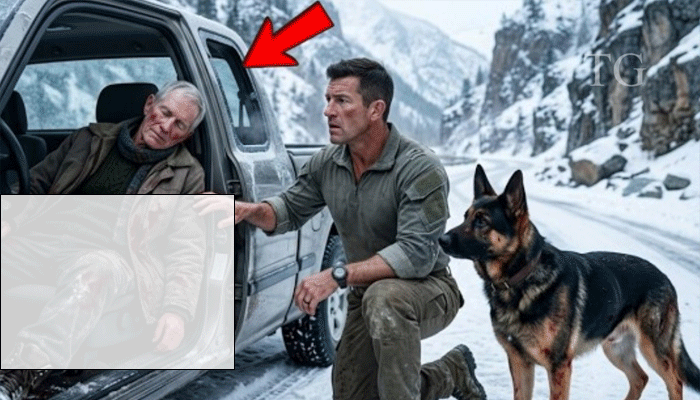
The dog didn’t bark for help, it chose him, and what waited in the ravine would haunt him forever
In the middle of a freezing snowstorm, a wounded German Shepherd stepped into the road and wouldn’t let a man pass.
The man was a former Navy Seal, someone who had learned to keep moving no matter what.
At first, he thought the dog was loSt. But then he noticed. It wasn’t afraid.
It was waiting. When he followed it down into the icy ravine, he found something he couldn’t ignore.
An old man trapped in a wreck and two tiny puppies barely holding on to life.
The dog had left its owner for the first time, not to run away, but to find help, and it chose him.
And in that moment, the soldier understood. This wasn’t just about saving lives. It was about fixing a moment in his past when he didn’t stay.
The wind moved like something alive across the mountain road, sweeping snow sideways in pale sheets that erased the world.
One layer at a time. Pine trees stood like silent witnesses along the slope, their branches heavy with frost, bending but never breaking.
The road itself was a narrow ribbon of ice and memory, half buried, half forgotten, the kind of place where people passed through quickly or not at all.
Gideon Hail drove slowly, both hands steady on the worn steering wheel of his old truck.
He was 38, built lean and efficient rather than bulky, the kind of strength that came from years of controlled movement rather than display.
His face was clean shaven, sharply defined by a square jaw and pronounced cheekbones, the cold air giving his light skin a weathered edge.
His dark brown hair was cut short in a military style, slightly longer than strict regulation, enough to soften the severity without hiding it.
His gray blue eyes were fixed on the road ahead, but they carried the weight of someone who had learned to look past what was visible.
He wore the same outfit he always wore, an old olive gray tactical combat shirt, the fabric softened from years of use, the cuffs and shoulders faintly frayed.
Combat pants in a faded earth tone, knees worn, pockets sagging slightly from habit, boots that had seen mud, sand, and now snow.
A scratched military watch rested on his wrist, ticking quietly, indifferent to weather or memory.
The heater in the truck worked just well enough to keep the glass from freezing over.
The inside smelled faintly of engine oil, leather, and something older, something that never quite left.
Gideon preferred roads like this, empty, predictable in their danger, honest in the way they tried to kill you.
It was people that were harder to read. The storm thickened as he rounded a bend, visibility dropping to a narrow tunnel of white.
The tires hummed softly against packed snow. Somewhere far below the road, unseen but always present, the valley dropped into a jagged cut of rock and shadow.
Then something moved. At first it was just a shift in the white, an interruption in the rhythm of falling snow.
Gideon’s foot eased off the accelerator before his mind fully registered why. A shape broke from the treeine.
A dog. A large one, a German Shepherd, its black and tan coat dulled by snow and stre with something darker.
Blood. It did not sprint blindly into the road. It moved with control despite the limp that dragged slightly through its front leg.
It crossed into Gideon’s headlights and then stopped precisely, deliberately, far enough ahead that a careful driver could still break in time.
Gideon pressed the brake. The truck slowed, tires whispering against ice until it came to a full stop several feet from the animal.
The dog stood there, not barking, not pacing, not panicking. Its chest rose and fell steadily, breath visible in the cold air.
One ear flicked at the wind, but otherwise it held still, balanced despite the injury.
And it wasn’t looking at him. Its head was turned slightly. Gaze angled past the truck, past Gideon, toward something unseen beyond the road’s edge, down toward the ravine.
Only after a moment did the dog turn its head and meet Gideon’s eyes. The contact was brief, but it landed with wait.
Gideon felt something shift in his cheSt. Not fear, not yet, but recognition. The same quiet alertness he had seen in working dogs before.
Not strays, not pets. This one was thinking. This isn’t random,” he muttered under his breath.
The dog didn’t move. Snow gathered along its back, clinging to the thick fur, melting slowly where body heat still held.
A thin line of blood marked its shoulder, not pouring, but steady enough to matter.
Gideon tightened his grip on the wheel. A normal dog would have bolted by now.
The sound of the engine alone would have sent it running. Pain would have finished the job, but this one stayed waiting.
He shifted the truck into park, the engine idling low, and opened the door. The wind hit him immediately, sharp and clean, cutting through the thin warmth he had been holding on to inside.
Boots met snow with a soft crunch. The cold climbed fast, biting through fabric, settling into bone.
Gideon straightened, closing the door behind him with a muted thud. His posture adjusted without thought, weight balanced, eyes scanning.
The dog took a step back, not retreating, creating space. Then it turned and moved a few paces toward the edge of the road.
It stopped again, looked back. That was when Gideon knew. A flicker of something old rose up.
Muscle memory wrapped in instinct. He had seen this before, though not here, not like this.
In a different place, under a different sky. A dog moving ahead, checking, returning, guiding.
Yeah, Gideon said quietly, more to himself than the animal. You’re not loSt. The dog shifted its weight, favoring the injured leg, but not collapsing.
It glanced once more toward the ravine, then back to him, waiting. Gideon hesitated, not because he didn’t understand, because he did.
And understanding came with a coSt. A fragment of memory surfaced, uninvited. A voice over a radio, strained but steady, static, cutting in and out.
A name, his name, spoken once, then swallowed by silence. A moment where he had stood still, just like this, and made a choice.
He exhaled slowly, watching the breath fade into the storm. Not this time,” he said.
The words were barely audible, carried off almost immediately by the wind. The dog turned without hesitation, and began moving toward the edge of the road.
Gideon followed. The snow deepened as they left the packed surface, boots sinking slightly with each step.
The slope angled downward, steeper than it had looked from above. Pine needles and hidden rock made the footing uneven beneath the fresh layer of white.
The dog moved carefully, not fast, but certain. It picked its path with precision, avoiding loose patches, adjusting for the injury without stopping.
Every few steps it paused, looked back, checked, then continued. Gideon kept a steady distance behind, eyes scanning not just the dog, but the terrain, the lines of the slope, the subtle disruptions that didn’t belong.
And then he saw it. Not all at once. First a break in the snow, a shallow depression that shouldn’t have been there.
Then a darker shape beneath the white. Then the angle of something metal wrong against the natural lines of rock and tree.
A vehicle upside down half buried. The truck lay twisted in the ravine, one wheel still slowly turning, as if the motion had only recently stopped, even though logic said otherwise.
Snow had already begun to claim it, softening edges, hiding damage. The driver’s side door was open.
Gideon’s pace quickened. The dog reached the vehicle first and stopped beside it. Head lowered, body tense but controlled.
It did not jump. It did not bark. It simply stood. Gideon closed the distance and crouched near the open door, gloved hands brushing snow aside.
Inside a man lay pinned awkwardly against the interior, his body angled by the crash.
He was older, 70s maybe, thin but not fragile, the kind of wiry build that came from a lifetime of work.
His face was lined deeply, skin pale from cold, lips cracked. Gray hair clung to his forehead in damp strands, and a short unckempt beard framed a mouth that trembled with each shallow breath.
His clothing told its own story. A heavy brown gray coat, worn but maintained, layers beneath it, practical, chosen for function rather than appearance.
Boots built for terrain like this, not a touriSt. “Hey,” Gideon said, voice low but firm.
“Stay with me.” The man’s eyelids fluttered. His gaze struggled to focus, drifting before locking just barely onto Gideon’s face.
“Took you long enough,” he rasped, the words breaking apart in the cold air. Gideon almost smiled, but it didn’t reach his eyes.
“Yeah,” he said. “I get that a lot.” A weak breath escaped the man, something like a laugh that never quite formed.
Behind Gideon, the dog shifted. For the first time, it let out a sound, not a bark, but a low, controlled rumble, as if reminding the world that it was still there, still watching.
Gideon glanced back. The dog had moved closer now, standing near the rear of the vehicle, guarding.
Not Gideon, not the man. Something else. Gideon followed the line of its gaze. The back seat half obscured beneath a collapsed section of the truck’s interior, a container, not large, rectangular, insulated, the kind used for transport.
Gideon’s breath slowed. He reached past the twisted metal, fingers working carefully, clearing debris, shifting weight just enough to create space.
The lid resisted at first, frozen slightly at the edges. Then it gave. Inside, wrapped in layered fabric, were two small forms.
Newborn puppies, their bodies pressed close together, tiny chests. Rising and falling in fragile rhythm.
Eyes still closed, fur barely grown in, soft and thin, alive, barely. A faint warmth lingered inside the container, not from any active source, but from something that had been there before, preserved, fading.
Gideon swallowed. “All right,” he said quietly. The words carrying a different weight now. All right, I see it.
Behind him, the dog exhaled, tension shifting. Not gone, but changed. Not waiting anymore, not searching.
It had done what it came to do. Gideon looked from the puppies to the man, then back to the dog.
“You picked the right truck,” he said. The dog held his gaze for a second longer than before.
Then slowly it stepped closer, closing the distance it had kept since the road. Not desperate, not relieved, certain.
And in that moment, standing between the broken vehicle and the rising storm, Gideon understood something he hadn’t expected to feel again.
This hadn’t been chance. This had been a choice, not his, the dogs, and for reasons he couldn’t yet explain, it had chosen him.
The wind did not ease when Gideon began the climb back up the slope. If anything, it pressed harder, as though the mountain itself disapproved of movement in either direction.
Snow cut across his face in thin needling lines, slipping into the collar of his worn tactical shirt, melting briefly against his skin before turning cold again.
The climb was steeper going up, every step requiring intention. Behind him, the wreck lay half hidden in white.
The old man barely conscious, the fragile lives in the insulated box hanging between minutes and chance.
Gideon adjusted his grip on the container, holding it close to his chest to preserve what little warmth remained.
The two newborn puppies barely stirred, their tiny bodies pressed together, their breath so faint it seemed like a suggestion rather than proof.
He had wrapped them in an extra layer torn from his own shirt. Improvisation born from habit, not panic.
Stay with me, he muttered, though he wasn’t sure if he was speaking to them, to the man below, or to something inside himself.
Ahead of him. Rexor moved with a rhythm that did not match injury. The limp was still there, visible in the way the dog placed weight unevenly on its front leg, but it did not slow him.
He climbed with careful efficiency, choosing footholds that held, avoiding loose snow that might give way beneath pressure.
Every few steps he paused, turning his head just enough to check Gideon’s position, not worried, not anxious, accounting, the difference mattered.
Gideon noticed it because he had lived inside that difference for years. The line between fear and calculation was thin, but it defined outcomes.
Rexor was not hoping Gideon would follow. He was making sure he did. They reached the road after several minutes that stretched longer than they should have.
The truck stood where Gideon had left it, engine still idling, headlights cutting two pale tunnels through the storm.
For a moment, everything held still. Gideon opened the passenger door with his shoulder and carefully placed the insulated container on the seat.
The interior warmth, limited as it was, felt like a different world compared to the biting air outside.
He adjusted the fabric around the puppies, ensuring they were shielded from drafts. Rexor stopped a few feet from the truck.
He didn’t jump in. He didn’t circle. He stood there looking not at Gideon, not at the open door, but back down the slope.
Gideon followed the direction of that gaze. “You’re not done,” he said quietly. The dog’s ears shifted slightly at the sound of his voice, but he didn’t move.
Snow gathered along the ridge of his back again, melting slowly against the warmth beneath.
Gideon exhaled. “Neither am I.” He closed the passenger door gently, sealing in what little heat he could preserve, then turned back toward the slope without hesitation.
The second descent felt different, not because the terrain had changed, but because he had there was no pause this time, no internal debate stretching thin between instinct and memory.
The decision had already been made. The body simply followed. As he moved down, Gideon’s eyes tracked more than just the path.
He scanned the snow, the broken branches, the faint disruptions that spoke of movement before the storm had begun to erase everything.
There, a mark, not natural, a partial bootprint, half filled with fresh snow, but still distinct enough to catch the eye of someone looking for it.
Gideon crouched briefly, brushing away a thin layer with gloved fingers. The tread was different from Otis Brennan’s boots, wider, deeper, with a heavier heel pattern.
Someone else had been here. The realization did not surprise him. It settled instead, like a piece of a puzzle sliding into place.
He continued downward, slower now, attention divided between urgency and awareness. Rexor waited near the wreck, body positioned as before, guarding the space with quiet authority.
Gideon reached the truck and moved to the driver’s side, assessing quickly. Hey, he said again, voice steady.
I’m going to move you. Otis’s eyes flickered open, unfocused at first, then narrowing slightly as if trying to pull Gideon into clarity.
“You came back,” the old man whispered. Gideon didn’t answer that. Instead, he worked carefully, methodically, shifting debris, creating space without causing further damage.
The man’s leg was pinned, but not crushed beyond recovery. Pain flared in Otis’s face as Gideon adjusted the angle, but he did not cry out.
Tough, Gideon said under his breath. Otis’s mouth twitched, something like pride flickering through the exhaustion.
Had to be, he replied faintly. For them. His eyes moved not toward Gideon, but toward the back of the truck.
Toward the puppies. Gideon nodded once. I’ve got them. That seemed to be enough. Working together in silence, broken only by breath and the shifting of metal, Gideon finally freed the old man’s leg.
He lifted him with a controlled effort, supporting his weight against his own body. Otus was lighter than he should have been, not frail, but worn.
The kind of weight that came from years, not weakness. As Gideon steadied him outside the wreck, Rexor moved closer, slowly, deliberately.
For the first time since the road, the dog closed the distance fully, stepping within reach of his handler.
Otus’s hand trembled as it lifted, fingers stiff with cold. Rexor lowered his head just enough for that hand to rest against his fur.
No whining, no frantic movement, just contact, a confirmation. I told you to stay, Otus murmured, voice barely more than breath.
Rexor did not respond, but he did not pull away either. Gideon watched the exchange without comment.
Some things didn’t need translation. He shifted his grip, preparing to move Otus up the slope.
That was when Rexor’s body changed. It was subtle, a tightening, a stillness that was different from before.
The dog’s head lifted slightly, ears angling forward, not toward Gideon, not toward Otus, but toward the upper ridge near the road.
Gideon felt it before he fully understood it. The shift in the air, the sense of being observed, not imagined, measured.
He turned his head slowly, following Rexor’s line of sight. At first, there was nothing, just snow, wind, the blurred outline of the road above.
Then movement. A shape near the edge. A figure partially obscured by the storm, standing beside what looked like another vehicle.
Too far to see clearly, close enough to matter. Gideon’s jaw tightened. “Did you see anyone?”
He asked quietly. Otis’s eyes fluttered again, confusion and memory fighting for space. “Truck,” he whispered.
Stopped. Didn’t stay. Gideon didn’t need more. He adjusted his stance, shifting Otis’ weight more securely.
Rexor let out a low sound, not a growl, but something deeper. A warning that did not escalate, only acknowledged.
Then, just as quickly as it had appeared, the figure above turned and disappeared into the storm.
No engine revving, no headlights cutting through the snow, just absence. Gideon held his position for a moment longer, eyes fixed on the place where the shape had been.
The mountain closed over it as if it had never existed. He exhaled slowly. “Yeah,” he said under his breath.
“I see it.” He didn’t chase, didn’t call out. Some instincts told you to pursue.
Others told you to remember. This was the second kind. He looked down at Otus, then at Rexor.
We move, he said. No hesitation, no second guessing. Together they began the climb. The wind pushed against them.
The slope resisted, but the direction was clear now. Upward, toward the road, toward the truck, toward whatever came next.
Behind them, the wreck sank deeper into the snow, the evidence fading beneath the storm.
Ahead, the path narrowed, but it existed, and for the first time in a long while, Gideon did not feel like he was walking alone.
By the time Gideon reached the road with Otus Brennan, slung carefully over his shoulder, the storm had shifted into something heavier, less chaotic, and more deliberate.
The wind no longer howled wildly. It pressed. It leaned into the mountain, into the trees, into the two figures climbing upward as if testing their resolve.
Gideon moved with measured steps, his boots digging into packed snow, each movement controlled to avoid slipping.
Otus’s weight rested unevenly against him. One arm draped across Gideon’s shoulders, fingers barely holding on.
The old man’s breathing was shallow, uneven, but present. That was enough for now. Rexor stayed slightly ahead, no longer stopping every few steps, but not rushing either.
The dog’s posture had changed again. The urgency of seeking help had given way to something quieter, a steady, watchfulness.
His ears rotated constantly, reading the storm the way Gideon read terrain. When they reached the truck, Gideon eased Otus into the back seat, laying him carefully across the worn fabric.
The interior warmth had risen just enough to soften the biting edge of the cold, but not enough to feel safe.
“Stay with me,” Gideon said again, his voice lower now. “Less command and more anchor.”
Otus’ eyes flickered open briefly. They were pale, clouded with age and fatigue. But there was still something sharp beneath the surface.
Something that had not given up. Dog, Otus murmured. I know, Gideon replied. He’s here.
Rexor stood just outside the open door, snow dusting his back, his injured leg held slightly off the ground.
He did not climb in. Not yet. Gideon reached into the passenger seat and checked the insulated container.
The puppies were still breathing, their tiny bodies curled together beneath layers of cloth. One of them shifted weakly, pressing closer to the other.
“Good,” Gideon said softly. He closed the back door, sealing Otus inside, then moved around to the driver’s side.
He paused before opening it, glancing once more toward the slope. Something didn’t sit right.
Not just the presence of another person earlier. That alone would have been enough to raise questions, but it was the way the scene below had been arranged.
The angle of the truck, the position of the door, the marks in the snow that didn’t align with the simple loss of control.
Gideon opened the door and slid into the driver’s seat, but he didn’t start moving immediately.
Instead, he sat there, hands resting on the wheel, eyes unfocused for a moment. Then, he reached down and grabbed a small flashlight from the center console.
He stepped back out into the storm. Rexor’s head turned toward him instantly. We’re not done yet, Gideon said.
The dog didn’t hesitate this time. He turned and moved toward the slope again, slower now, conserving what strength remained.
Gideon followed. The descent was shorter this time, the path already broken from their earlier climb.
Snow had begun to soften the edges of their tracks, but not enough to erase them completely.
When they reached the wreck again, Gideon didn’t go straight to the cab. He moved around it carefully, methodically.
The beam of the flashlight cut through the dim light, revealing details the storm tried to hide.
The rear tire was angled wrong, not just from impact, but from force applied at an unnatural direction.
The side panel bore a dent that didn’t match the angle of the fall, and near the edge of the slope, partially buried, but still visible, was a long scrape in the snow, not from sliding, from being pushed.
Gideon crouched, brushing away snow with his gloved hand. The ground beneath was compacted differently there, disturbed before the storm had fully set in.
This wasn’t just gravity, he said quietly. Rexor stood a few feet away, watching. Not the wreck, not Gideon, the ground.
The dog stepped forward, lowering his head, sniffing once, twice, then stopping at a specific point just beyond the scrape.
He pawed lightly at the snow, not digging wildly, indicating. Gideon moved closer and knelt beside him, sweeping snow aside.
A fragment of something dark, emerged. Rubber, a piece of tire tread, different from Otus’s truck, thicker, newer.
Gideon’s jaw tightened. Someone hadn’t just been here. Someone had been involved. The wind shifted slightly, carrying a faint scent.
Fuel maybe, or something chemical, barely noticeable, but out of place in the clean, cold air.
Gideon stood slowly, scanning the slope above again. Nothing. Only white, only wind. But absence didn’t mean safety.
It meant distance, and distance could be closed. He turned back toward the truck, mind already moving ahead, assembling pieces without forcing them.
When he reached the vehicle, he opened the back door again. Otus stirred slightly, reacting to the rush of cold air.
“Easy,” Gideon said. The old man’s eyes opened more fully this time. There was pain there, yes, but also awareness.
The kind that came from someone who had spent a lifetime reading situations quickly, accurately.
You saw it, Otus said, voice rough, but steadier than before. Gideon didn’t pretend otherwise.
Yeah, Otus swallowed, his throat working against dryness. I told him not to rush the road, he said.
Storm was coming in too faSt. “Who?” Gideon asked. Otis’ gaze drifted toward the front windshield as if trying to see through the storm to something beyond it.
“Pike,” he said after a moment. “Evan Pike.” The name settled between them. Gideon nodded once.
“Construction?” He asked. Otus’ lips twitched slightly. “Logging runs cruise up here. Knows the roads better than moSt. Knew the roads and still someone had ended up in a ravine.
Gideon leaned back slightly, considering u he asked. Otus closed his eyes briefly as if sorting memory from confusion.
Truck came up behind me, he said slowly. Too close. I moved to give space.
Road edge was soft under the snow. His hand lifted weakly, fingers curling slightly. “Felt a bump,” he continued.
“Not hard. Just enough.” Gideon’s expression didn’t change. “Enough to push you off,” he said.
Otus didn’t answer directly. “Didn’t need to.” Rexor moved closer to the open door, resting his head lightly against the edge of the seat near Otus’s hand.
The old man’s fingers brushed against the dog’s fur again, slower this time. Deliberate. I told him to go, Otis whispered.
Told Rexor to stay, but he wouldn’t. Gideon watched the dog. There was no confusion in Rexer’s eyes, no doubt, only presence.
Then something shifted. Rexer’s body stiffened again, not like before. This time it was sharper, more immediate.
The dog lifted his head, ears forward, gaze locking onto a point beyond the truck.
Gideon turned instinctively. At first, he saw nothing. Then a flicker of light, brief, gone, not lightning, too controlled.
Headlights far up the road, partially obscured by the curve in the trees. A vehicle idling, not moving forward, not leaving, watching.
Gideon felt a quiet tightening in his chest, not fear, but recognition of a pattern.
The same kind of pause he had learned to distrust long ago. Rexor let out a low, steady rumble, not loud enough to carry far, but enough to vibrate through the air between them.
Otis’s hand stilled on the dog’s fur. He came back, the old man whispered. Gideon didn’t respond.
His eyes stayed fixed on the faint glow through the storm. The light didn’t move closer, didn’t retreat.
It held like a question, waiting for an answer. Gideon reached forward and gently closed the back door.
The click sounded louder than it should have. He moved around the truck slowly, every step deliberate, positioning himself between the light and the vehicle.
Not aggressive, not inviting, present. Rexor shifted as well, stepping slightly forward, placing himself just behind Gideon’s leg, his injured stance adjusted, but steady.
The two figures stood there, outlined by snow and silence. The light flickered once more.
Then, slowly it dimmed. The engine sound, faint but detectable, rose slightly, then faded. The vehicle turned and disappeared back into the storm.
No confrontation, no words, just distance widening again. Gideon exhaled. Not relief, not yet, but something close to clarity.
He opened the driver’s door and climbed in, starting the truck properly this time. The engine responded with a low growl, steady and reliable.
Rexor hesitated only a second before jumping into the back, settling near Otus’s side. The old man’s hand found him again without looking.
Gideon adjusted the mirrors, giving one last glance toward the road behind them. Nothing remained but snow.
He shifted the truck into gear. “All right,” he said quietly. “Not to the storm, not to the past, to the present.”
The truck began to move, tires gripping as best they could against the frozen surface.
Inside, the small space held three lives and a fourth that had refused to leave them.
Outside the mountain watched in silence. The truck moved slowly along the mountain road, tires gripping where they could and sliding where they had to.
Snow continued to fall, steady and relentless, covering everything behind them with the quiet finality of something that did not care about truth or consequence.
Inside the cab, the air had warmed just enough to soften the sharpest edge of the cold.
It wasn’t comfort. It was survival. Gideon kept both hands on the wheel, posture upright, eyes scanning not just the road ahead, but the margins of it, the places where danger liked to hide.
His gray blue gaze flicked between the windshield, the mirrors, and the faint outline of the slope beyond the guardless edge.
He didn’t speak, not because there was nothing to say, but because words in moments like this had a way of making things less clear.
In the back seat, Otus Brennan shifted slightly, a low breath escaping him, as pain reintroduced itself now that movement had replaced stillness.
The old man’s face had more color than before, though it was the uneven flush of cold and strain rather than health.
Rexor lay beside him, pressed close without crowding, his large body curved protectively along the seat.
The dog’s coat, black and tan, thick and weatherworn, was still damp in places, stret where blood had dried against fur.
One front leg remained stiff, held at an angle that spoke of injury, but not defeat.
Otus’s hand rested against the dog’s neck, not gripping, just there. “You weren’t supposed to leave,” Otus said after a while, his voice quieter now.
Less accusation and more reflection. Rexor didn’t react outwardly. No movement, no sound, but his ears shifted slightly, acknowledging the tone, if not the words.
Gideon listened without turning. Otus exhaled slowly. I trained him not to, he continued. Stay with Handler always.
Doesn’t matter what happens. You stay. His fingers moved faintly against Rexer’s fur as if tracing something remembered.
But there’s another command, he added. One you only teach if you think ahead. Gideon’s grip on the wheel tightened just slightly.
What kind of command? He asked. Otus opened his eyes fully this time, looking not at Gideon, but at the back of his seat, as if seeing something layered over the present.
Find help, he said. The words sat in the truck like something older than both of them.
“Most dogs never need it,” Otis continued. “Most handlers never want them to use it,” he paused, swallowing against dryness.
“But if the handler can’t move, if staying means dying,” his voice thinned, “Then the dog chooses.”
Gideon said nothing. Outside the road curved, the drop to the right disappearing into white.
The engine hummed low, steady. Behind him, Otus shifted again. He didn’t go right away, the old man said.
He tried to pull me, kept coming back. Three times, maybe more. I don’t know.
Hard to keep count when you’re fading. Rexor’s tail gave a small, almost imperceptible movement against the seat.
Gideon caught it in the mirror. Then he left. Otis finished. The truck fell into silence again.
Not empty, full. Gideon’s mind moved through the pieces without forcing them. The training, the behavior, the timing.
The dog hadn’t panicked, hadn’t abandoned. He had executed. Gideon understood that more than he wanted to.
The road dipped slightly before climbing again, and Gideon adjusted the throttle, keeping the movement smooth to avoid sudden loss of traction.
Snow gathered along the edges of the windshield, the wipers pushing it aside in steady arcs.
They drove for several minutes without interruption. Then Rexor moved. It wasn’t sudden. It wasn’t loud, but it was enough.
The dog lifted his head from the seat, ears angling forward, body shifting from rest into alertness.
His injured leg adjusted automatically, weight redistributed without hesitation. Gideon noticed immediately. “What is it?”
He asked more to the dog than anyone else. Rexor didn’t look at him. He looked forward through the windshield through the storm.
Gideon leaned slightly, following that line of sight. At first, nothing. Then, faint, barely visible, something along the side of the road ahead.
A shape, low, partially buried, not moving. Gideon slowed the truck. “Another vehicle?” He murmured.
Otus stirred faintly in the back. “What?” He asked. Gideon didn’t answer yet. He eased the truck closer, headlights cutting through the snow until the shape resolved into something clearer.
Not a vehicle, a signpost bent, knocked partially free from the ground, its metal pole twisted at an angle that didn’t match wind damage.
Gideon stopped the truck a few yards away, the engine idled. Rexor’s attention did not waver.
Gideon opened the door and stepped out again, the cold greeting him like an old acquaintance.
He approached the sign slowly, boots crunching through fresh snow. It was a standard mountain warning marker, yellow, reflective, but the reflective surface had been scratched, not by weather, by impact.
He crouched, brushing snow away from the base. There it was again, another mark. A tire impression sharper here, less disturbed.
The same pattern, the same tread, the same direction. Gideon exhaled slowly. Whoever had been up here hadn’t just passed through once.
They had moved along this road with purpose. Behind him, Rexor stepped out of the truck, ignoring the pain in his leg, moving toward Gideon with quiet insistence.
He stopped beside the sign, nose lowering, inhaling once. Then he did something different. He didn’t track forward.
He turned back toward the truck, back toward Otus. He held there for a second, then looked at Gideon.
It wasn’t a command. It wasn’t even a requeSt. It was recognition. And in that moment, Gideon felt something settle into place.
Not a conclusion, but a direction. The dog wasn’t chasing. He wasn’t hunting the trail.
He was choosing what mattered. Gideon stood, brushing snow from his gloves. “Yeah,” he said quietly.
“We’re not splitting up.” He walked back to the truck without looking over his shoulder again.
Inside, Otus watched him with a different kind of focus. Now, “You saw something,” the old man said.
Gideon nodded once as he closed the door. “Enough,” he replied. Otus leaned his head back against the seat, eyes narrowing slightly.
“He’s not the kind to come back for nothing,” he said. Gideon glanced at him through the mirror.
“You know him well.” Otus’s mouth tightened. Enough to know what he isn’t,” he said.
“And what’s that?” Gideon asked. Otus didn’t answer immediately. Instead, he looked down at Rexor, his hand resting once more on the dog’s neck.
“Not brave,” he said finally. The word didn’t carry anger, just truth. Gideon absorbed that.
Not brave didn’t mean cruel, didn’t mean violent. It meant something quieter, something more common.
It meant someone who saw a moment and chose themselves. The truck began moving again, tires cutting through snow, carrying them further away from the ravine, but not away from the story.
Behind them, the bent sign stood as a marker, not of warning, but of interruption.
Ahead, the road stretched on, uncertain, but real. Inside the truck, three lives breathed, and a fourth watched, steady and unyielding.
Gideon kept his eyes forward. For the first time since the storm began, he wasn’t just reacting.
He was deciding. The storm began to thin as the truck descended from the higher ridge.
Not enough to reveal the world fully, but enough to suggest that it still existed beyond the white.
The sky shifted from a solid wall of gray into layers, faint shadows moving behind the clouds like something trying to remember the shape of light.
Gideon Hail kept his pace steady, not fast, not slow. The road here was narrower, lined with trees that leaned inward as if listening.
Snow had settled unevenly along the edges, and the drop beyond the right side remained just as unforgiving as before.
His hands stayed firm on the wheel, movements precise, deliberate. In the back, Otus Brennan had grown quieter, not unconscious, but conserving.
His breathing had found a rhythm, shallow but more consistent, the kind of fragile stability that could tip either direction if pushed too far.
One of his hands still rested against Rexer’s fur, fingers occasionally twitching as if verifying something real was still there.
Rexor had not moved from his position. He lay alongside Otus, body curved in a protective line.
His injured leg stretched carefully to avoid pressure. His eyes remained open, tracking the shifting light through the rear window, then returning to Gideon through the narrow angle of the mirror.
Not restless, not tired, present. Gideon noticed it again, that absence of doubt. It wasn’t confidence.
It was something simpler. The dog had already made his decision. Gideon wished for a moment that decisions stayed that clear for people.
He adjusted the heater slightly, angling the vents toward the back seat. Warm air, thin but persistent, moved across Otus and the insulated container holding the puppies.
Temperatures dropping slower now, Gideon said quietly, more as a marker than a reassurance. Otis’s eyes opened just enough to acknowledge the sound.
Good, he murmured. Silence followed, not uncomfortable, but heavy. Gideon’s mind returned uninvited to the name Evan Pike.
He didn’t know the man personally, not in any meaningful way, but the kind of place they were in.
Small towns stretched thin across mountain ranges. Names carried weight differently here. You didn’t need to know someone well to understand what they were made of.
You only needed enough stories, enough observations, enough moments where they either stepped forward or didn’t.
And according to Otus, Pike hadn’t. Gideon’s jaw tightened slightly. There had been a time when that alone wouldn’t have bothered him.
People made choices. Some stepped in, some stepped back. That was the way of things.
But something about this, about the timing, the marks on the road, the presence of that second vehicle, shifted it from absence into something closer to involvement.
Not proven, but not clean either. The road curved again, leading them lower, where the trees opened slightly, and the wind lost some of its bite.
Then, in the distance, through thinning snow, a structure appeared. A building, small, set back from the road, partially obscured by a stand of pines.
Gideon slowed instinctively. Station,” Otus said faintly from the back, his voice carrying just enough strength to be understood.
Gideon glanced at him through the mirror. “What kind?” “Old ranger outpost,” Otus replied. “Used to be staffed year round, now just supplies and emergency shelter.”
Gideon nodded. It made sense. The kind of place designed for situations exactly like this.
He turned the wheel slightly, guiding the truck off the main road and onto the narrower path leading toward the structure.
Snow here was less disturbed. The track uneven but navigable. As they approached, the building came into clearer view, weathered wood, gray with age, its edges softened by years of wind and snow.
A single window faced the road, the glass frosted along the edges. The door was reinforced but not locked.
Standard for emergency access. Gideon parked the truck as close as he could without risking getting stuck.
The engine idled for a moment longer before he shut it off. The sudden quiet was immediate.
Deep. The kind of silence that followed noise not preceded it. Gideon stepped out, boots sinking slightly into fresh snow.
He moved quickly to the back door, opening it and checking Otis. We’re stopping here, he said.
Get you inside. Warm you up properly. Otus nodded weakly. Keys inside, he said. Top shelf left.
Gideon didn’t waste time. He lifted the old man carefully, adjusting his hold to minimize strain, then stepped toward the door of the outpoSt. Rexor followed, not limping as much now, or perhaps simply ignoring it more effectively.
Inside, the air was cold but still dry. The space was small but functional. A single cot against one wall, a narrow table, shelves stocked with basic supplies, blankets, canned food, a small medical kit.
A wood burning stove sat in the corner, unused but ready. Gideon moved with purpose.
He sat Otus down on the cot, covering him with one of the thicker blankets.
Then he crossed to the stove, opening it, checking the interior. Dry kindling was stacked neatly beside it.
Whoever maintained the place knew what mattered. Within minutes a small flame caught, then grew, feeding on the wood, Gideon added with practiced efficiency.
Warmth would take time, but it had started. Rexor settled near the cot, positioning himself where he could see both Otus and the door.
His head rested low, but his eyes remained alert. Gideon retrieved the insulated container from the truck and brought it inside, placing it near the stove, but not too close.
He unwrapped the puppies carefully, checking their condition. Still alive, still fighting. One of them let out a faint sound, barely audible, more breath than voice.
Gideon exhaled. “Good,” he said again. Behind him, Otus watched. “You didn’t leave,” the old man said quietly.
Gideon didn’t turn immediately. “No,” he replied. Otus nodded slowly. Most do,” he said. The words lingered.
Gideon adjusted the fabric around the puppies, ensuring they were evenly covered. “That doesn’t make it right,” he said.
Otus gave a faint, tired smile. “No,” he agreed. “But it makes it common. The fire crackled softly, the only sound in the room.
Then Rexor stood not suddenly but with intent. His head lifted, ears angling toward the door.
Gideon looked up immediately. What is it? Rexor didn’t bark. He moved two steps toward the door, stopped, looked back at Gideon, then at Otus, then back at the door again.
The pattern repeated once more, slower this time. Gideon’s brow furrowed. “What?” He asked, stepping closer.
Rexor’s gaze held steady. Not alarmed, not aggressive, insistent. Gideon moved to the door and opened it slightly.
Cold air pushed in. Snow drifted across the threshold. Outside, the world was quiet again.
Too quiet. He stepped out, scanning the immediate area. Nothing, no movement, no sound, just the fading storm and the trees.
He turned back toward the doorway. And that was when he saw it. Tracks fresh, not theirs, leading toward the outpost, then stopping just short of the door.
Gideon’s expression hardened. Someone had been here recently. Close enough to reach the entrance. Close enough to look inside.
He followed the tracks with his eyes as far as they remained visible. They led back toward the road, then disappeared beneath fresh snowfall.
Behind him, Rexor stood in the doorway, watching, not tense, not reactive, aware. Gideon stepped back inside and closed the door firmly.
Otus saw his face. “He came here,” the old man said. “It wasn’t a question.”
Gideon nodded once. “Looks like it.” Otus’s gaze dropped to the blanket covering him, then to Rexor.
“He doesn’t like being seen,” Otus murmured. Gideon leaned back slightly, arms folding across his chest as he processed.
“No,” he said. “People like that usually don’t.” The fire grew stronger, pushing warmth slowly into the room.
The puppies shifted again, their movements slightly more noticeable now, life returning inch by inch.
Gideon looked from them to Otus, then to Rexor, then to the door. He didn’t move toward it again.
Not yet. Some things didn’t need to be chased immediately. Some things needed to be understood.
And right now, understanding had begun. The fire had settled into a steady burn. No longer struggling, no longer fragile.
It filled the ranger outpost with a quiet, persistent warmth that moved outward from the iron stove in slow waves, touching wood, fabric, skin, and breath alike.
Outside the storm had softened into drifting snow. The wind reduced to a low, constant whisper that pressed against the walls like something unwilling to leave.
Inside, everything felt suspended. Not safe, but held. Gideon Hail stood near the small window, one hand resting lightly against the frame, his body angled just enough to watch both the outside and the room behind him, without turning fully.
His reflection hovered faintly in the glass, overlapping with the pale world beyond. A man divided between what he saw and what he remembered.
He had removed his outer layer, the worn tactical shirt beneath, still marked by dampness from earlier.
Sleeves rolled just enough to expose forearms lined with old scars, thin, pale lines that told stories no one had asked him to explain.
Behind him, Otus Brennan lay on the cot, wrapped in layered blankets. Color had returned slightly to his face, no longer the hollow gray of exposure, but not yet the steady tone of recovery.
His breathing had deepened, slower now, each inhale carrying more strength than before. Rexor remained beside him.
The dog had shifted position, now lying closer to the old man’s torso, his large body aligned parallel to the cot.
The injured leg was still held carefully, but less rigid now. The bleeding had slowed.
The fur around the wound darkened, but no longer fresh. The dog’s eyes were open, not scanning, watching.
There was a difference. Gideon had seen dogs that reacted. Rexor observed that distinction stayed with him.
On the table nearby, the insulated container had been opened fully. The two newborn puppies lay wrapped in cloth positioned near the stove, where the heat reached without overwhelming them.
One of them stirred faintly. A small instinctive movement that might have been searching, might have been reflex.
Life still choosing to stay. Gideon crossed the room and checked them again, adjusting the fabric slightly, ensuring they remained protected from drafts.
His movements were careful, deliberate, the same precision he applied to everything. You’ve done this before,” a voice said.
Gideon looked up. Otus was awake, not fully alert, but aware enough to study him.
“Enough times,” Gideon replied. Otus’s gaze lingered on him, reading more than just the words.
“Not animals,” the old man said. “No,” Gideon admitted. Otus nodded faintly, as if confirming something to himself.
Still the same,” he murmured. “Hands don’t shake. Breathing stays steady. You decide firSt. Feel later.”
Gideon didn’t answer that because it wasn’t wrong. The room fell quiet again, the fire filling the space with soft, crackling sounds.
Minutes passed, or maybe longer. Time moved differently when survival was no longer immediate, but still not guaranteed.
Then Rexor moved, not abruptly, but with intention. His head lifted, ears angling toward the door, body shifting slightly forward.
Gideon noticed instantly. He didn’t speak this time. He watched. Rexor stood, stepping away from the cot with measured care.
He moved toward the door, stopping just short of it. He didn’t scratch, didn’t bark.
He simply stood there, listening. Gideon approached slowly, every sense narrowing. He reached the door and paused, his hand hovering near the handle.
Rexor glanced back at him once, then returned his attention forward. Gideon opened the door.
Cold air slipped inside, carrying with it the scent of snow and something else, faint, almost lost beneath the clean sharpness of winter.
Engine exhaust, old, not fresh, but not long gone either. Gideon stepped outside. The world had shifted again.
The snowfall had lightened enough to reveal shapes more clearly, though the sky remained heavy, the light dim and uncertain.
The ground around the outpost showed a mixture of tracks, some their own, partially filled, others newer.
He moved forward a few steps, scanning the area. There near the edge of the clearing, a vehicle, parked at an angle, not hidden, not fully exposed either, dark colored, dusted with snow, its shape partially obscured by drifting white.
Gideon didn’t recognize it at firSt. Then he saw the front grill, the wear pattern, the slight dent near the lower panel.
It matched the description forming in his mind. Evan Pike’s truck. The driver’s door opened.
A man stepped out. He was taller than Gideon expected, broad-shouldered, but carrying his weight unevenly, as if one side bore more strain than the other.
His jacket was heavy, dark, lined for cold, but worn at the seams in a way that suggested long use rather than neglect.
His face was unshaven, a rough stubble covering a jaw that tightened as soon as he saw Gideon.
Clearly, Evan Pike. His eyes flicked once toward the outpost, then back to Gideon. Calculating, not aggressive, but not at ease either.
I figured you’d stop here, Evan said, his voice carrying across the distance. Controlled but not steady, Gideon didn’t move closer, didn’t retreat.
He stayed where he was. “Roads bad,” Gideon replied. “Not many options.” “Heaven nodded once, as if that explained everything, but it didn’t.
His gaze shifted briefly toward the doorway, where Rexor now stood just inside, visible, but still.
The dog’s posture had changed again, not guarding, not resting, ready. Evan noticed. His jaw tightened slightly.
That your dog? He asked. Gideon shook his head. No. Evans eyes lingered a second longer on Rexor before returning to Gideon.
Didn’t think so,” he said. Silence stretched between them, not empty, waited. Gideon let it sit.
He didn’t rush it. Men like Evan filled silence when they couldn’t hold it. “I didn’t push him,” Evan said suddenly.
The dog didn’t bark for help, it chose him, and what waited in the ravine would haunt him forever – Part
“The words came out faster than the rest of him seemed prepared for.” Gideon’s expression didn’t change.
“I didn’t say you did,” he replied. Evan exhaled sharply, a sound caught between frustration and defense.
He was driving too slow, he continued. Storm coming in, visibility dropping. I came up behind him, flashed my lights.
He moved over. His hands lifted slightly, palms open as if explaining to an invisible judge.
Road gave out under him, he said. That’s it. Gideon watched him. Not the words, the space between them.
“What did you do after?” Gideon asked. Evan hesitated only for a second, but it was enough.
“I stopped,” he said. Got out, looked down. His gaze shifted away toward the treeine.
“He was breathing,” he added. “Barely, and then,” Gideon asked. Evan swallowed. The wind moved between them, quieter now, almost patient.
I figured, he began, then stopped, his hands dropped to his sides. I figured he wasn’t going to make it, he finished.
Gideon said nothing. Evan looked back at him. Something sharper now in his eyes. You don’t get it, he said.
Out here, things go bad faSt. You make the wrong call. You don’t just lose one life.
You lose your own, too. The justification hung there, thin, familiar. Gideon felt something shift inside him.
Not anger, not quite. Recognition. Evan stepped forward half a pace, then stopped himself. I didn’t leave because I didn’t care, he said, voice lower now.
I left because I thought it was already over. Gideon held his gaze. The silence returned, but this time it wasn’t waiting.
It was weighing. Inside the outpost, Rexor moved, not toward the door, toward Otus. He placed himself beside the cot again, pressing lightly against the old man’s side.
Otus’s hand found him without waking fully. A connection unbroken. Gideon glanced back once, then returned his focus to Evan.
“You were wrong,” he said simply. “No accusation, no force, just truth.” Evans shoulders tightened, the words landing harder than anything louder might have.
He looked past Gideon again toward the outpost, toward the life inside it that had continued despite his conclusion.
For a moment something in his expression faltered. Not guilt, not fully, but something close.
Then it closed again. “What now?” Evan asked. Gideon turned slightly, looking back at the door.
“At the moment,” he said. We keep them alive. He stepped back toward the outpost without waiting for a response.
Behind him, Evan didn’t follow, but he didn’t leave either. He stood there between his truck and the storm, between what he had done and what he now understood.
Inside, the fire burned steady. The puppies shifted again, stronger this time. Otus breathed. Rexor remained.
And Gideon stepped back into the warmth, closing the door behind him, not to shut the world out, but to hold something in.
Morning arrived quietly, as if the mountain itself had decided not to interrupt what had already been decided during the night.
The storm had passed without ceremony. No dramatic clearing, no sudden burst of sunlight, just a gradual softening.
The sky lifted from heavy gray into something lighter, almost translucent, and the snow that had buried the road began to settle, its surface smoothing into a pale, unbroken sheet.
The ranger outpost stood where it always had, unchanged, its weathered wood catching the first thin light of day.
Smoke curled gently from the stovepipe, rising in a slow, steady line that seemed almost fragile against the vastness around it.
Inside the air carried warmth now, not just from the fire, from breath, from presence, from the quiet, stubborn insistence of life continuing.
Gideon Hail stood near the stove, one hand resting lightly against the edge of the table.
He had not slept. Not really. His posture hadn’t changed much from the night before, but something in him had shifted.
Subtle, almost imperceptible, like a line that had been drawn differently inside his cheSt. Across the room, Otus Brennan sat propped upright against the wall, blankets wrapped around him.
His face had color again, not strong, not fully restored, but enough to suggest he was no longer drifting between states.
His eyes were open, clearer, watching. The man who had once been carried now held himself with quiet stubbornness, as if refusing to be anything less than present.
“You always stand like that?” Otis asked, his voice still rough, but no longer fragile.
Gideon glanced over. “Like what?” “Like you’re waiting for something to happen,” Otus said. Gideon considered that, then gave a small, almost absent shake of his head.
“Habbit,” he replied. Otis’s lips twitched slightly, not quite a smile, but close enough to suggest understanding.
“Habits don’t come from nowhere,” the old man said. Gideon didn’t answer, because he knew exactly where his had come from.
Near the stove, the insulated container had been replaced with a makeshift nest of blankets and cloth.
The two puppies lay side by side, their bodies no longer rigid with cold, their breathing steadier now.
One of them stirred, not just a reflex this time. A small movement, purposeful, its tiny head shifted, pressing weakly against the fabric, then lifting just slightly.
The eyes didn’t open fully, but they tried. Gideon stepped closer without thinking. Hey, he said quietly.
The sound seemed to settle into the room rather than disturb it. Behind him, Rexor lifted his head.
The German Shepherd had been resting near the doorway, positioned where he could see both inside and out.
His body was stretched along the wooden floor, his injured leg carefully extended, wrapped now in clean bandaging from the supplies in the outpoSt. His coat had dried, the black and tan returning to its natural contrast, though the fatigue remained visible in the way he held himself, alert but conserving.
He watched the puppies, not with curiosity, with recognition. Otus noticed, too. He knows, the old man said.
Gideon glanced back. Knows what? Otus’s gaze remained on the dog. That they made it, he said simply.
Rexor’s ears shifted slightly, as if acknowledging something unspoken. Gideon looked at the dog for a moment longer than necessary.
Then he turned away. Outside, the world continued to quiet. The absence of wind revealed new sounds, subtle, distant, the faint creek of trees adjusting under the weight of snow.
The soft drip of melting ice. The distant call of something alive moving through the forest again.
Now that the storm had passed, life returning. Gideon stepped toward the door and opened it.
Cold air entered, but it was different now. Not biting, not hostile, just cold, clean.
He stepped out onto the small wooden porch. The road stretched ahead, no longer invisible, though still layered with snow.
The tracks from the night before had been partially filled, softened into suggestions rather than clear lines, but they were still there.
He could see where his truck had come from, where it had stopped, where it had turned, and beyond that, fainter.
A second set. Evan Pikes. Gideon stood there for a long moment, hands resting loosely at his sides, not tense, not relaxed, present.
Behind him, the door opened again. Otus stepped out slowly, leaning slightly against the frame for support.
The blankets hung around his shoulders, his breath visible in the cool morning air. “You didn’t go after him,” Otis said.
Gideon didn’t turn immediately. “No,” he replied. Otus nodded as if he had expected that.
“Good,” he said. Gideon glanced back. “Why?” Otus met his eyes. “Because not every wrong needs to be chased,” he said.
“Some of them just need to be faced.” The words settled between them, not heavy, but grounded.
From the road, the sound of an engine approached, low, steady. Gideon turned his head slightly.
A vehicle came into view, moving carefully along the snow-covered path. It was marked official, its shape familiar in a different way than the ones from the night before.
It stopped near the outpoSt. The driver’s door opened. Deputy Nolan Price stepped out. He was a man in his mid-40s, broad-shouldered but not imposing, his presence defined more by steadiness than force.
His uniform was layered for winter, dark jacket with a visible badge, heavy boots, gloves tucked into one pocket.
His face was lined lightly, not from age alone, but from years of watching situations unfold without always being able to control them.
His eyes moved quickly, taking in details. The outpost, the tracks, Gideon, Otus. He didn’t rush, didn’t raise his voice.
He simply walked forward. “You the one who called it in?” Nolan asked. Gideon nodded once.
“Yeah.” Nolan glanced past him toward the interior of the outpoSt. “Everyone alive?” He asked.
“For now?” Gideon replied. Nolan accepted that answer without pushing further. “That’s enough,” he said.
He stepped inside briefly, checking on the scene, his movement sufficient, but not detached. He paused when he saw the puppies, his expression shifting slightly, just a flicker, but real.
Then he stepped back out. “Ambulance is on the way,” he said. Roads clearing up enough for them to make it through.
Otus exhaled a slow release. “Good,” he said. Nolan looked at him for a moment longer.
“You got lucky,” he added. Otus shook his head faintly. “No,” he said. “I got found.”
Nolan didn’t argue. He understood the difference. Rexor stepped out onto the porch, then moving slowly but without hesitation.
He positioned himself beside Otus, his body close but not pressing. Nolan’s eyes shifted to the dog.
“Hell of an animal,” he said. Gideon followed his gaze. “Yeah,” he replied. Rexor looked out toward the road, not searching, not expecting, just looking, as if marking the place, as if remembering.
Time moved forward. The ambulance arrived not long after, its presence louder than anything else had been since the storm ended.
People moved in and out, voices low, controlled. Otus was transferred carefully, wrapped, secured. The puppies were taken too, handled with the kind of care reserved for things that had come too close to not making it.
Rexor resisted for a moment when they tried to separate him. Not aggressively, just firmly.
Otus reached out, his hand finding the dog’s fur one more time. It’s all right, he said.
Rexor stilled, then stepped back. Gideon watched all of it without interfering without stepping away.
When it was done, the vehicles left. The road quieted again, and just like that.
It was over, or at least the part that required urgency. Gideon stood on the porch once more, the space around him larger now, emptier in a way that didn’t feel hollow.
Rexor lay nearby, resting, but awake. His gaze drifted once toward the road they had come from, then settled, not waiting, not searching, finished.
Gideon looked out at the mountain, at the snow beginning to melt, at the world returning to something recognizable.
This time he had stayed. Sometimes miracles do not arrive as light from the sky or voices from above.
Sometimes they come quietly through a wounded dog standing in the road, refusing to let someone pass by.
In this story, nothing felt extraordinary at firSt. A storm, a broken truck, a man too weak to move, and another man who could have kept driving.
But the miracle was not in the moment itself. It was in the choice. The dog did what it was trained to do.
But beyond that, it trusted that someone would listen. And Gideon chose not to turn away.
Maybe that is how God works more often than we realize. Not by changing the world in an instant, but by placing us in moments where we must decide who we are.
Moments where we can walk past or step forward. Every day we are given small chances like that.
A chance to help, a chance to stay, a chance to care when it would be easier not to.
And sometimes the difference between loss and life is simply one person choosing to stop.