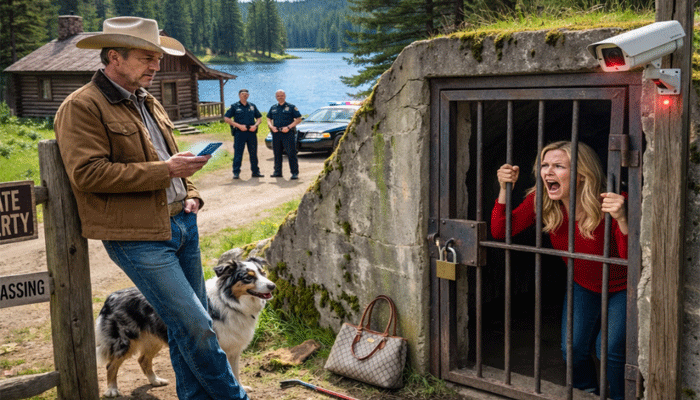
PART 1 (of 3) — The Root Cellar Trap
2:47 a.m.
My phone buzzed against the kitchen table hard enough to rattle my coffee spoon.
SECURITY CAMERA ALERT — MOTION DETECTED: ROOT CELLAR ENTRANCE.
For a second, I just stared at the screen, eyes gritty from staying up too many nights in a row—like my body was trying to convince my brain this was another false alarm. A raccoon. A stray cat. Wind. Anything but what I’d been expecting for months.
Then the video feed sharpened.
A woman in dark clothes moved like she owned the night.
A flashlight beam cut across the grass. She angled it down, careful, controlled, the way someone behaves when they know exactly what they’re doing and they’ve done it before. The light caught her purse—designer, expensive, absurdly out of place with the rest of the outfit. A second later, the beam flashed across her face.
Patricia Whitmore.
HOA president. Real estate shark. Neighborhood queen with a clipboard and a smile sharp enough to draw blood.
And right there in her hand, reflecting moonlight like a promise, were bolt cutters.
She crouched at my root cellar door, the one I built with my own hands after my back gave up on me and the world decided that was as far as I’d go. She leaned in, fiddled with the padlock, tested it like she was checking fruit at a grocery store—squeeze, judge, discard.
She thought nobody was watching.
But I’d been watching for half a year.
I set my mug down and stood slowly, because even righteous adrenaline doesn’t fix damaged vertebrae. Pain flared—hot wire down my spine—but I didn’t care. My hands didn’t shake. Not from fear.
From certainty.
Because this wasn’t random. This wasn’t a drunk stumble. This wasn’t “confused neighbor.”
This was the exact end of the road Patricia had been paving since spring—fine by fine, inspection by inspection, whisper by whisper—toward one goal: getting my land out from under me.
And now she’d finally stepped off the paper trail and onto my property.
My name’s Marcus Sullivan. Mac, if you’re someone who matters to me.
I’m fifty-two years old, a disabled Marine living on VA benefits, and if you’ve never lived on a check that arrives like clockwork while everything else in life tries to fall apart, you might not understand what independence means. You might not know what it feels like to build something not because it’s pretty, but because it’s survival.
My three acres sit like a stubborn tooth in the jaw of Milbrook Heights, Kentucky.
Milbrook Heights used to be farmland. Then developers came—waving checkbooks, smiling wide, talking about “community” and “growth.” Most folks sold. The land became a clean grid of identical lawns, identical mailboxes, identical porches, like someone copy-pasted the American Dream fifty times and called it a neighborhood.
But my family didn’t sell.
My granddaddy used to say land isn’t just dirt. It’s memory. It’s roots that don’t show until someone tries to rip them up. So while subdivisions wrapped around me like a tightening noose, my three acres stayed mine—an old pocket of Kentucky soil surrounded by cul-de-sacs and rules and people who thought ownership meant control.
Two years ago, after a back injury ended my construction career for good, I built a root cellar.
Not a half-buried hole, not some rotting shed. A real cellar: proper foundation, temperature control, ventilation, shelves built to last longer than I probably will. I built it in fifteen-minute bursts between pain flares, day after day, until it stood finished like proof that disability didn’t mean useless.
That cellar holds my independence.
Eight hundred dollars’ worth of preserved vegetables, canned goods, jars lined up like soldiers in formation. Tomatoes, beans, peaches, pickled beets. Food that doesn’t vanish the moment my budget gets tight. Food that doesn’t care if prices rise. Food that doesn’t ask permission.
The smell down there is cool earth, rubber jar seals, and that quiet mustiness that tells you something is stored properly. It smells like self-reliance.
It smells like freedom.
Patricia Whitmore decided freedom was a problem.
She came into my life on a Tuesday morning in March.
I was outside checking seedlings—tiny green heads of tomato plants lifting into the sun—when I heard the sound that always meant trouble in Milbrook Heights.
Designer heels on gravel.
I turned and saw her coming up my driveway like she belonged there: power suit, hair perfect, acrylic nails like polished weapons, clipboard pressed to her chest. She stopped at my cellar entrance and stared at it like it had personally insulted her.
“Mr. Sullivan.” Her voice carried the tone of someone used to getting her way. “Patricia Whitmore. HOA president. We need to discuss your situation.”
She handed me a violation notice on official letterhead as though she were delivering a court summons.
UNSIGHTLY AGRICULTURAL STRUCTURE DIMINISHING NEIGHBORHOOD PROPERTY VALUES.
FINE: $50.
COMPLIANCE DEADLINE: 30 DAYS.
REMOVE STRUCTURE.
I read it twice, then looked at her.
“Ma’am,” I said, keeping my voice steady, “this cellar was built two years ago. Your HOA incorporated last year. Doesn’t that mean I’m grandfathered in?”
Her smile didn’t reach her eyes. “Not according to current community standards, Mr. Sullivan. We’re elevating the neighborhood’s profile.”
She said profile like it was gospel. Like neighborhoods were brands and people were products.
“I’m sure someone with your background understands the importance of following procedures,” she added, and the way she said background made my jaw tighten. Like my Marine Corps service was something she had to acknowledge politely, the way you acknowledge a stain on a carpet.
She left perfume behind her—expensive, cloying, the kind of scent that tries too hard to be memorable.
I stood there holding the notice, staring at the cellar door that had never offended anybody, and I realized something simple:
Patricia Whitmore wasn’t just nitpicking.
She was claiming territory.
The harassment came fast after that.
Week two: grass violation. Measured at 3.1 inches. Limit was 3.0. Fine: $75.
Week three: mailbox paint “faded.” Fine: $75.
Week four: garden hose “visible from street.” Fine: $75.
I paid some. I challenged others. Either way, the message was clear: Patricia could bleed me with paper cuts until I either broke or left.
But money wasn’t the real problem.
The real problem was the pattern.
Patricia didn’t just fine me. She studied me.
She walked my fence line with that clipboard, taking measurements. She photographed my cellar ramp and ventilation pipe and, most of all, the lock on the cellar door. She lingered there, too long, like she was memorizing it.
And I’d been trained to recognize reconnaissance.
When you’ve been a Marine, you learn that enemies don’t always wear uniforms. Sometimes they wear office clothes and talk about “community standards.”
But the behavior is the same:
Observe. Measure. Identify weak points. Plan the approach.
In April, she upgraded from harassment to intimidation with a badge.
I was drinking coffee on my porch when a county pickup truck rolled into my driveway. Two men got out—hard hats, clipboards, one with a camera too expensive for a simple inspection.
“Mr. Sullivan,” the older one said. “Tom Bradley, county building inspector. We received a complaint about unpermitted construction on your property.”
The younger guy lifted his camera and started taking pictures like he was mapping a crime scene.
“What construction would that be?” I asked.
“Underground storage facility,” Tom said. “We need to verify it meets current county safety codes.”
His eyes flicked away when he said it. He wasn’t comfortable. That told me enough.
“Do you have paperwork for this inspection?” I asked.
“Complaint-driven inspections don’t require advanced notice,” Tom replied, reciting.
“And you want to go inside?”
“Yes, sir.”
I watched the photographer angle shots not at safety issues but at sight lines from the road, distances from property lines, structural details that had nothing to do with code.
This wasn’t safety.
This was a survey.
I set my mug down. “Call me this afternoon,” I said. “We’ll schedule it properly. You want access, you bring a warrant.”
Tom’s cheeks flushed. “Sir, we can do this easy or hard—”
“And I can do it legal,” I cut in. “That’s what we’re doing.”
They left after fifteen minutes. But not before they took forty-seven photos.
Forty-seven.
No one takes forty-seven photos of a “quick check” unless someone wants a blueprint.
That afternoon I went to the county courthouse, because one thing my life has taught me is this: if someone is trying to move you, you look for the paperwork trail.
In public records I found it.
A development application submitted by Whitmore Holdings LLC—Patricia’s company—for a mixed-use residential project.
The proposed site included my land.
And suddenly every fine made sense.
Patricia didn’t hate my cellar because it was ugly.
Patricia hated my cellar because it proved I was staying.
After the county came the utility company.
Then the health department.
Each time, a new inspector showed up with that same uneasy energy—like they knew they’d been sent on a mission that didn’t sit right.
The health inspector, Brenda Hayes, actually looked impressed when she stepped into my cellar.
“This is… organized,” she admitted, flashlight sweeping over the shelves.
“It’s how I eat when the check runs thin,” I said.
She tested my temperature system, checked jar seals, examined labels. Professional. Real.
Then she frowned at her tablet. “There are no violations here,” she said. “This complaint said you were storing commercial quantities… selling food.”
I leaned closer. “When was the complaint filed?”
She hesitated, then turned the screen slightly.
Timestamp: 4:47 p.m. yesterday.
Exactly thirty minutes after I’d refused Patricia’s latest “survey request.”
Brenda swallowed. “Filing false reports is a misdemeanor,” she said quietly. “Repeat offenses can escalate.”
I nodded, but inside something hardened.
Patricia wasn’t just annoying.
Patricia was building a machine designed to crush me—using other people as gears.
By May, she moved into psychological warfare.
It started with an anonymous letter—typed, plain white paper, no signature.
Your neighbors are talking.
Military service doesn’t excuse antisocial behavior.
Some people think you might be dangerous.
Maybe it’s time to move somewhere more suitable for your condition.
I held it for a long time, feeling something familiar stir in my chest: that cold anger Marines learn to cage.
This wasn’t about lawns.
This was about painting me as unstable.
Dangerous.
A problem that needed solving.
Then she used the neighbors.
Mrs. Henderson approached me one afternoon, nervous as a deer near hunters.
“Mac,” she said, “Patricia mentioned you might be struggling… you know… with issues from your service.”
“What issues?” I asked.
“She said spending so much time underground might be unhealthy for you.”
There it was.
She was planting doubt—turning my independence into evidence of instability.
I took a breath. “Mrs. Henderson,” I said gently, “I’m fine. Patricia’s been trying to force me off my property. This is just her newest tactic.”
Mrs. Henderson looked horrified. But the damage was done. A seed planted in a community doesn’t need truth to grow. It only needs repetition.
June brought the neighborhood barbecue, and Diesel Rodriguez—my friend, my fellow Marine—talked me into going.
“If you don’t show up,” he said, “she controls the narrative.”
So I went.
The community center smelled like charcoal, ketchup, and suburban politeness. Kids ran around. People laughed too loud. Patricia moved through the crowd like a politician, delivering concern in a sweet voice.
“I’m worried about Mac’s isolation,” she said to a small group. “Spending all that time underground can’t be healthy for someone with his background.”
Then she tried to recruit Diesel.
“Mr. Rodriguez,” she began, “as Mac’s closest friend, I’m sure you’ve noticed changes—”
Diesel’s face went cold.
“What changes?” he asked.
Patricia leaned in, soft. “The hostility. The obsession with the cellar. My husband has seen cases like this—veterans struggle with authority figures—”
Diesel didn’t raise his voice. He didn’t need to.
“Mac Sullivan is one of the most stable people I know,” he said. “What he’s struggling with is you harassing him on his own land.”
Patricia blinked, surprised someone had spoken to her like she wasn’t royalty.
Diesel continued, calm as stone. “Also, funny thing. I looked up Whitmore Holdings. Development applications pending for this block. Mac’s property is the only holdout. Real convenient that he’s suddenly ‘unstable,’ huh?”
For the first time, Patricia’s mask slipped.
Just for a second.
Underneath was something ugly.
Then she smiled again and walked away.
But she’d been exposed, even if only to a few ears.
After that, the stakes rose fast.
My truck tires were slashed—clean cuts meant to leak slow, to strand me, to punish me quietly.
Then the VA called.
“Mr. Sullivan,” the voice said, “we’ve received reports suggesting your disabilities might be affecting your ability to maintain stable housing arrangements…”
My hands went numb around the phone.
Patricia wasn’t content to take my land.
She wanted to take my lifeline.
I hung up and stared at the cellar door out the window.
And something in me snapped into place.
Not rage.
Clarity.
Because now it wasn’t just harassment.
It was coordinated, targeted destruction of a disabled veteran’s life.
That’s not “HOA drama.”
That’s a crime.
That night, I called Sarah Finley at the Disabled Veterans Legal Aid Clinic.
When she answered, her voice was all business. “Mr. Sullivan, talk to me.”
So I did. I told her everything: the fines, the inspectors, the whispers, the sabotage, the VA call.
When I finished, there was a pause.
“What you’re describing,” she said, “sounds like a coordinated campaign targeting your protected status. We need documentation. We may need federal investigators if this escalates.”
“How much further can it go?” I asked.
Sarah exhaled slowly. “People who are desperate—especially people with money and connections—sometimes resort to direct action. Property damage. Break-ins. Violence.”
I stared at my cellar again.
The thing Patricia wanted gone.
The thing she couldn’t buy.
The thing that proved I wasn’t moving.
“Then I’ll be ready,” I said.
And I meant it.
A week later, in the courthouse planning office, I overheard Patricia speaking like she thought the world belonged to her.
“Final approval depends on clearing the Sullivan property,” she said. “The cellar foundation interferes with the drainage easement.”
Another voice answered—male, polished, not local. “Our investors committed twelve million. If you can’t deliver clear title, we explore other options.”
Twelve million.
My stomach turned cold.
Patricia laughed lightly. “The veteran is proving resistant. But we have strategies.”
“What kind of strategies?”
“My husband’s position provides advantages. Code enforcement. Inspections. Competency concerns.”
Then she said something that made my blood run like ice:
“If legal challenges don’t work… rural areas have accidents. Gas leaks. Foundation collapses. Unfortunate incidents that require emergency demolition.”
She was talking about destroying my cellar and calling it an accident.
Maybe with me inside it.
I recorded what I could—enough to make my hands shake when I stopped.
When the meeting ended, I saw the man’s card in his hand as he walked away:
Regional Development Director — Marcus Capital Group.
Back home, I searched the company. Their history looked like a bulldozer track across small towns.
And I realized Patricia wasn’t just trying to steal my land.
She was trying to sell my community to corporate predators—and I was the last obstacle.
That night, I called Sarah again.
When I told her what I’d recorded, she didn’t hesitate.
“This is conspiracy,” she said. “Bribery. Fraud. Civil rights violations. If she follows through, it becomes far worse. Mac—this is serious.”
“I know,” I said.
My eyes drifted to the cellar door.
A thought rose in my mind—not violent, not reckless.
Just… inevitable.
“What happens,” I asked slowly, “if she tries to break into my cellar herself?”
Sarah’s voice sharpened. “Breaking and entering. Burglary tools. Criminal mischief. And if it’s connected to your disability accommodations, federal implications.”
I nodded once. “Good,” I said.
Because the truth was, I could feel Patricia closing in like a predator that had tasted blood.
And predators get sloppy when they’re hungry.
That was the night I stopped waiting for rescue.
I started preparing for the moment she’d finally cross the line.
Because some people only understand consequences when they’re trapped inside them.
And Patricia Whitmore—HOA queen, developer’s puppet, bully in perfume—was walking toward consequences one step at a time.
Soon, she’d be close enough to fall right into them.
PART 2 (of 3) — The Night the Lock Learned Her Name
The next day, I didn’t feel triumphant.
I felt steady.
There’s a difference.
Triumph is loud—fireworks, chest-thumping, victory speeches. Steady is what you feel when you’ve been pushed until you stop bending. Steady is the quiet click of a rifle bolt sliding home. The calm a storm gives right before it hits.
Patricia Whitmore had made her plan.
Now I was making mine.
I called Diesel early Thursday morning.
Diesel Rodriguez wasn’t the type of man who asked why before he asked what you need. Marines don’t do curiosity first. We do mission first.
“Brother,” I said, “I need cameras that see in total darkness. Audio that picks up whispers from fifty yards. And a remote locking system that can’t be defeated with bolt cutters.”
There was a pause on the other end, the kind of pause where you can almost hear someone lifting an eyebrow.
“Mac,” Diesel said, “what kind of operation are we running?”
“The kind that ends with Patricia Whitmore in handcuffs,” I answered.
That got me a low whistle.
“Say less. I’ll be there in an hour.”
We spent the afternoon shopping in places that didn’t advertise on billboards.
Stores where the clerk doesn’t ask if you’re “protecting your family” with the kind of smile that says they don’t care what you’re doing as long as your card clears. Places that sold security gear to private investigators, commercial buildings, people who either had something to protect or something to prove.
We bought:
Infrared cameras small enough to hide in a birdhouse
Motion sensors sensitive enough to detect a mouse
Directional microphones designed to isolate sound through wind
Backup recorders that uploaded automatically to encrypted storage
But the crown jewel was a lock.
It wasn’t the kind of lock you bought at a hardware store and hung on a shed. It was a contained-entry deadbolt system, built for high-security doors where the goal was not just keeping people out, but keeping them in once the door shut.
The security dealer tapped the metal casing like he was showing off a tank.
“Once these bolts engage,” he said, “there’s no forcing it from the inside. Steel bolts slide into hardened plates. You can shoulder it, kick it, pry it—it won’t matter.”
Diesel looked at me. “That what you want?”
I thought of Patricia’s clipboard smile. Her whisper campaign. Her inspectors. The VA call. The tires. The threats disguised as community concern.
“Perfect,” I said.
Friday morning, Diesel arrived at dawn with a toolkit and a grim grin.
We didn’t just install cameras.
We built a net.
The obvious cameras went up first—Patricia would spot them. She’d probably even try to destroy them if she came at night. That was fine. Let her feel clever for a minute.
Then Diesel started placing the real ones.
Inside a hollowed knot in a tree.
Under the roof edge near the gutter.
Inside a birdhouse that looked like it belonged in a magazine.
In a small waterproof container half-buried near the cellar entrance, recording through a fiber-optic pinhole.
Six camera angles on the cellar door alone.
“Even if she brings a crew,” Diesel said, adjusting one of the hidden units, “we’ll still have her face, her tools, and her voice. Prosecution-quality.”
Then came audio.
Diesel set up directional microphones like invisible rifles—pointed at the cellar entrance, calibrated to cancel most of the wind noise.
“If she whispers,” Diesel said, “we’ll hear it.”
We tested it. I walked down to the cellar, muttered, “Patricia Whitmore is a snake,” under my breath.
Diesel played it back in my kitchen.
The recording was so crisp it sounded like I was standing beside myself.
Diesel nodded. “Good. Now for the fun part.”
The cellar door had an old padlock—thick, heavy, classic. Easy to understand. Easy to assume was the only line of defense.
Diesel took it off.
He replaced it with something that looked almost identical from the outside—same general shape, same “normal” appearance.
But inside the doorframe, hidden where Patricia would never notice, the system had steel deadbolts that slid into place when activated remotely.
The visible padlock was a decoy.
The deadbolts were the trap.
Diesel handed me my phone.
“App’s already installed. Secure pairing. Encrypted signal. Tap once—lock engages. Tap again—releases.”
I stood at the cellar door and tapped the screen.
Inside the frame, the bolts slid home with a whisper-soft thunk.
No loud clank. No big mechanical sound. Just a quiet certainty.
I tapped again. The bolts withdrew.
“What if someone’s inside?” I asked.
Diesel’s eyes were flat, calm. “Then they’re staying inside.”
A strange calm settled over me.
Not because I wanted to hurt anyone. I didn’t.
But because I knew something Patricia didn’t:
You don’t need violence to stop a predator.
You just need proof.
And a door that only opens when you allow it.
Saturday was mental rehearsal.
I walked through it like a drill.
Patricia breaks in.
Cameras record.
Audio captures.
She enters the cellar.
I lock the door.
I call police.
No threats. No confrontation. No touching her. No “I’ll teach you a lesson.”
Just a criminal caught red-handed and contained until law enforcement arrives.
That was the key.
Because bullies love chaos. Chaos gives them room to twist stories.
I was going to give Patricia no chaos—only clarity.
Sunday afternoon, I made the call.
Patricia answered on the second ring like she’d been waiting.
“Mac,” she said, voice sweet as poison. “Have you reconsidered?”
“I’ve been thinking,” I told her, slow and casual. “Maybe we can work something out.”
There was a pause—small, controlled. But I could hear the greed behind it.
“What kind of something?” she asked.
“A cash deal,” I said. “No questions asked. But I want to understand why that cellar matters so much to you and your development friends.”
Her breath shifted.
Then she tried to recover. “What makes you think it matters?”
“Family stories,” I lied smoothly. “Grandfather built it during the Depression. Picked that spot for reasons nobody talked about. Sealed sections. Deep excavation.”
Silence.
I could practically hear her imagination opening like a vault.
“I could bring in professionals,” she said finally, voice lowering. “Structural engineers. Archaeological consultants. We’d document everything properly.”
“When?” I asked.
“Soon,” she said. “Very soon. I’ll call you.”
She hung up fast, like she was afraid if she stayed on the line too long, she might reveal too much.
Tuesday night, my motion sensors started pinging.
Patricia’s BMW cruised past my property three times.
Fourth time, slower.
Fifth time, even slower.
She wasn’t checking for new violations.
She was building courage.
When the night got deep enough, she parked two blocks away and walked back in the shadows. My infrared cameras picked her up like she was glowing.
She approached the cellar door and tested it—first with fingers, then with something metallic.
A key ring.
She thought she had a way in.
Maybe she’d gotten a copy made. Maybe she’d studied my old padlock and decided she knew how to beat it.
She didn’t know she’d been studying the wrong lock.
Sunday morning, her call came right on schedule.
“Mac,” she said, “change of plans. Tonight works better.”
I let my voice sound neutral. “Tonight?”
“Cooler temperatures,” she said. “Better working conditions.”
“What time?”
“Late,” she said. “Maybe two or three a.m. I’ll handle everything personally.”
She hung up again before I could respond.
Because she didn’t want discussion.
She wanted control.
And she was so sure she still had it.
That night felt like the calm before a hurricane.
The air in Milbrook Heights sat heavy and hot. Even the cicadas sounded tired.
I checked my systems one last time.
Cameras: online.
Audio: clean.
Locks: responsive.
Backup storage: recording.
Then I waited.
At 10:30 p.m., a motion alert flickered.
Patricia moved through a neighbor’s backyard in dark clothes, hair tucked under a cap. She carried something long and metallic.
Bolt cutters.
She approached my cellar entrance, studied it, tested the decoy lock again, checked sight lines back toward my house.
Then she retreated to her BMW and sat there with the engine running, like she was psyching herself up.
At 12:15 a.m., she made a phone call. I couldn’t hear it clearly—too far—but her posture looked like she was reporting in.
At 1:30 a.m., she paced in the community center lot, talking to herself. The directional mic caught fragments carried on the wind:
“…paranoid veteran…”
“…must be hiding something…”
“…just looking…”
“…not stealing…”
She was building a narrative she could tell herself.
That’s what people do when they’re about to commit a crime they never imagined they’d commit.
They don’t say I’m a thief.
They say I’m being forced to do this.
At 2:00 a.m., she made her approach.
She moved like someone who’d rehearsed.
Crouched low. Flashlight down. Controlled steps.
She reached the cellar door.
The bolt cutters did their work with a crunch of metal.
The decoy padlock snapped.
Patricia didn’t even flinch.
She opened the door.
Cool air rose from the cellar, carrying the earthy smell of stored food and quiet labor.
She paused at the top of the stairs for a long moment.
Then she descended.
Designer shoes tapping wood, the sound oddly intimate through my speakers, like a villain’s heartbeat.
She disappeared into my cellar.
For ten minutes, she rummaged.
She opened storage bins.
Tapped walls.
Checked behind shelves.
Moved jars like they were worthless obstacles.
Her breathing came fast, and the microphone picked up her muttering clearly:
“Where is it…?”
“Has to be something…”
“Nobody fights this hard over vegetables…”
I watched her violate the one place I’d built to keep my life stable.
And I felt something I didn’t expect:
Not hate.
Not even anger.
Just the calm satisfaction of knowing she was already done, she just hadn’t realized it yet.
My thumb hovered over the lock control.
One tap.
That was all it took.
One tap and Patricia Whitmore would learn the difference between authority and entitlement.
One tap and she would finally understand what it feels like when the world stops bending to your will.
I watched her step back toward the stairs—confident, ready to leave with whatever she thought she’d earned.
And then—
I tapped the screen.
Inside the doorframe above her, steel bolts slid into place with a soft, final whisper.
The trap had sprung.
At 2:47 a.m., my phone buzzed again.
Not because she entered.
Because she tried to leave.
And the door did not move.
PART 3 (of 3) — Ice Cold Justice
I didn’t rush.
That’s what Patricia would’ve done—stormed, panicked, demanded control back the instant it slipped.
But I’d spent six months living inside the pressure she created. I’d learned what patience really means: not waiting because you’re helpless, but waiting because you’re ready.
I leaned back in my kitchen chair, the glow of the security monitors painting the room in pale blues and grays. My coffee had gone lukewarm. I poured a fresh cup anyway.
Down below, in the root cellar, Patricia Whitmore still believed she was the one making decisions.
For now.
It took her exactly four minutes and twelve seconds to realize the universe had changed.
Her flashlight beam bounced as she climbed the stairs. Quick steps. Confident. The sound of someone who expected the door to open the moment she touched it.
Then silence.
A pause so sharp it almost had sound of its own.
Then the first push.
Nothing.
A second push, harder.
Still nothing.
Then, through my audio feed, her voice—tight with confusion, already threading into panic:
“What the hell…?”
She rattled the handle. Banged once—like maybe the door simply needed attitude.
It didn’t.
She slammed her shoulder into it.
The deadbolts didn’t care.
Steel is indifferent to entitlement.
Patricia drew a breath that came out fast and brittle. She pounded again, this time with the rhythm of someone testing reality, hoping it will crack if she hits it right.
“Hello?” she called. “HELLO!”
I didn’t answer.
Not yet.
She pressed her face close to the wood, her voice rising.
“Mac! Marcus Sullivan! I know you’re up there!”
I watched the camera view of the cellar entrance: just the door, the frame, and the faint vibration of impacts from inside.
Then her voice sharpened into accusation, like she could bully physics.
“Let me out! This is kidnapping! False imprisonment!”