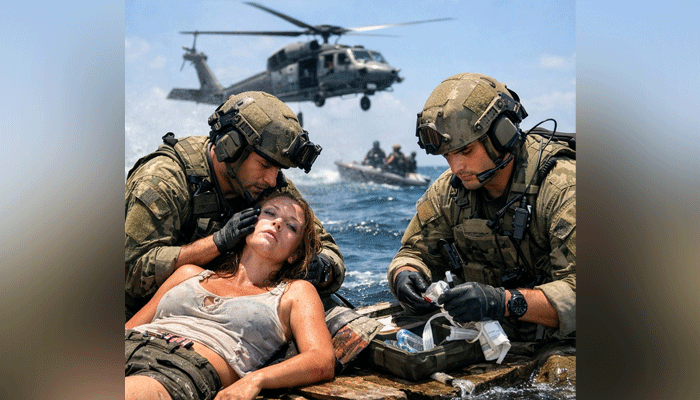
Part 1
By the third sunrise, I had stopped asking the Pacific for mercy.
Mercy implies attention. The ocean was never going to give me that. It rolled under me in long black swells, cold at night, blistering under the noon sun, and every hour it kept making the same point: I was small, I was temporary, and I was only alive because I had learned a long time ago how to be exact.
The piece of hull plating under me was roughly four feet by six, bent along one edge and hot enough by day to sting through my shirt. At night it sweated cold into my shoulder blades. My left arm trailed in the water to keep my core temperature from climbing too high under the afternoon sun. My right hand rested flat over my sternum, counting my pulse the way my father had taught me when I was nine and impatient and still believed panic was just a feeling instead of a math problem.
I had been in the water seventy-two hours.
I knew because I had marked the passage of time by stars, by cloud banks, by the angle of sunlight on the metal, by the ache in my throat and the way my thoughts wanted to loosen around the edges whenever I let them. I did not let them. I tracked current. I tracked wind. I conserved motion. I did not think about rescue as hope. Hope wastes energy. I thought about maritime traffic lanes, estimated drift, and probability.
When I first saw the running lights, they were so dim I thought I’d imagined them.
Then a search beam swept once across the dark water and the white edge of a wave lit up like torn paper. I didn’t wave. I didn’t shout. By then my lips were split, my tongue swollen, and unnecessary movement was expensive. I lay back, watched the beam return, and told myself one thing only: if they are who I need them to be, they will see me.
The rigid-hull inflatable came in fast and low, engine growling, spray blowing cold across my face. A man dropped over the side before it fully settled. He hit the water with the easy violence of someone whose body had forgotten how not to trust itself.
He was broad-shouldered, red-blond in the boat light, maybe late twenties. He got both hands under the edge of the plating and looked up at me.
For a second, neither of us spoke.
“Ma’am,” he said. “United States Navy. You’re okay now.”
His voice had that trained steadiness people use when they want to lend you calm. I appreciated the effort. Then I asked, “Which direction is north?”
He stared at me like I’d answered the wrong question on purpose.
“North,” I repeated. “Please.”
He lifted one hand and pointed. I followed the line of his arm, found the orientation, corrected my last estimate against the stars I’d managed to read through broken cloud cover, and let out a breath I hadn’t realized I was holding.
Not relief. Confirmation.
“All right,” I said. “I’m ready.”
That got another look from him.
They brought me aboard the training vessel under deck lights so bright they hurt. Everything smelled sharp and layered—diesel, hot metal, salt drying on rope, coffee gone stale in a paper cup somewhere nearby. Boots pounded. Orders moved in clipped voices around me. Somebody wrapped a blanket over my shoulders. Somebody else shined a penlight in my eyes.
I let them. My body shook once from delayed cold and then stopped.
A man stood waiting as they lifted me onto the deck. He had the kind of face the sea makes out of command—hard lines, pale eyes, no wasted movement. Fifty, maybe a little past. He watched me without any of the false softness people offer survivors.
“Vitals?” he asked the medic.
“BP low. Severe dehydration. Mild hypothermia. She’s oriented, sir.”
That made him look at me again.
“What’s your name?” he asked.
“Tessa Kane,” I said. “Hospital Corpsman Second Class. HM2.”
One eyebrow moved, barely.
“And your first question,” he said, “was where north was.”
“I needed to verify my drift.”
His jaw tightened just enough to show he’d filed that somewhere. “Commander Reed Stroud,” he said. “You can explain the rest when you’re not halfway dead.”
Part 2
I almost smiled at that, but the motion would have cracked my lips open worse. “Yes, sir.”
Then I looked past him at the team standing under the lights.
You learn certain things as a corpsman. Skin color. Lip tone. The way exhaustion changes a person’s posture before it changes their words. The subtle drag in reaction time. The wrong kind of stillness. On the far side of the line, one operator stood with his arms folded, weight tilted too far onto one leg. Freckles across the nose. Mouth a little too dry. No fresh sweat under the salt trace on his neck.
“The red-haired one,” I said.
No one moved for a beat.
Commander Stroud followed my gaze. “What about him?”
“He needs cooling and fluids now.”
The redhead blinked, almost offended. “I’m fine.”
“You’re not,” I said. “Your sweating stopped. Your lips are going blue at the edges. If you wait until you feel bad, you’ll be stupid enough not to know how bad it is.”
Silence landed hard on the deck.
The medic straightened, annoyed at first, then uncertain. He crossed to the operator, put a hand to his neck, then called for a thermometer. Thirty seconds later his face changed.
“Core temp’s over a hundred and four,” he said.
That moved everyone.
The redhead got hustled below with less dignity than he wanted. Commander Stroud looked back at me, and whatever box he’d first put me in had clearly stopped fitting.
“Get her inside,” he said. Then, to me: “You don’t go anywhere alone on my vessel.”
“That seems reasonable,” I said.
Inside the medical bay, the air was colder and smelled like antiseptic over steel. As the corpsman threaded IV tubing into my arm, I watched his technique without meaning to. Good hands. Fast enough. He reached for a cooling pack, and I heard myself say, “Base of the skull first. Then axilla.”
He glanced up. “You giving directions, HM2?”
“Only if you want the quickest drop.”
He hesitated once, then moved the pack where I’d said.
Across the room, the red-haired operator—Derek Marsh, according to the patch by his shoulder—lay on the second cot, eyes on the ceiling, chastened and irritated in equal measure.
“You okay?” I asked.
He turned his head toward me. “Apparently because of you.”
“That’s not how physiology works,” I said.
One corner of his mouth twitched.
The door opened again. A chief stepped in, silver at the temples, stillness packed into every inch of him. He saw me, stopped, and the room seemed to shrink around that one moment.
I knew his face.
Not from memory of meeting him. From photographs. From the handful of names my father had written down in places he thought no one would find.
“You’re alive,” he said quietly.
Something cold and electric slid through my chest.
So he knew exactly who I was.
And if Everett Wade recognized me on sight, the first question wasn’t whether I was safe anymore.
It was who else would come looking.
Part 3
I didn’t sleep after they put me in the bunk below the porthole.
My body wanted sleep badly enough that it hurt, but my mind stayed bright and hard, going back through the sequence from the moment I’d stepped over the rail of the Aldebaran. I replayed angles, timing, wind direction, the spacing of footsteps on wet deck plating behind me, the taste of copper where I’d bitten the inside of my cheek to keep my breathing quiet.
By sunrise, the sea outside the porthole had turned from black to pewter. A gull wheeled once over the wake, white against the pale sky. I knew the sunrise time within four minutes of my estimate. That made me feel better than it should have.
Some people pray when they survive something. I verify calculations.
At 0840, Derek Marsh knocked on the medical bay door like it was mine instead of his team’s. That told me more about him than a half hour of conversation would have.
“Come in,” I said.
He stepped inside wearing a fresh T-shirt and the humbled expression of a man who’d recently been informed by his own body that pride is not a treatment plan.
“I wanted to thank you,” he said.
“You don’t have to.”
“I know.” He stood there anyway. “Still want to.”
Morning light from the porthole cut across his face. The cyanosis was gone. He looked healthy again, which was exactly why people underestimated heat injuries.
“You nearly cooked yourself,” I said. “Next time you stop sweating and feel weirdly calm, assume your judgment is already compromised.”
He huffed a laugh. “You always this comforting?”
“Yes.”
That actually got him to smile.
Then his expression turned serious again. “You had been floating in the Pacific for three days,” he said. “How’d you even notice me?”
Because that was what I’d been trained to notice. Because bodies told the truth even when people didn’t. Because my father had spent years making me identify weakness, injury, and deception before I’d been old enough to understand why he cared whether I could.
But the truthful answer people can live with is not always the complete one.