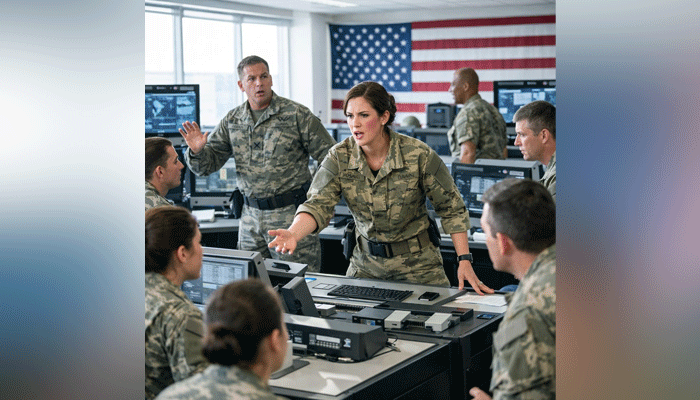
Part 1
The command deck of the Vanguard always smelled faintly like hot metal, burnt coffee, and the lemon oil somebody used on the captain’s rail when they wanted the brass to think discipline could be polished into wood.
I wasn’t supposed to be memorable in that room.
That was the whole point of the plain gray jumpsuit, the lack of insignia, the visitor badge turned inward at my hip. I stood near the port-side bulkhead with a clipboard I didn’t need and watched officers move through their routines with the smooth, practiced confidence of people who had spent years learning exactly where they belonged. Every station was full. Every voice was clipped. Every screen carried more information than one pair of eyes ought to hold at once.
Nobody looked at me twice.
That was fine with me. I’d spent eight years becoming good at being overlooked.
The first glitch wasn’t dramatic. Dangerous things almost never are.
The ship adjusted course three point two degrees to avoid debris in the Kestral lane, and the correction came in half a second late. On a vessel the size of the Vanguard, half a second is the kind of thing most people call nothing. I didn’t. I watched the heading settle, then watched the confirmation lag after it like a nervous thought trying to catch up to a lie.
At Navigation, Lieutenant Harris frowned and tapped his console harder than necessary. “Little sticky today,” he muttered.
Sticky.
That was one word for it.
I shifted my weight and looked at the stacked data streams across the forward screens. The primary feed and backup feed were both dragging, but not together. One was late on receipt. The other was late on authorization. That meant the problem wasn’t the display, and it wasn’t a simple sensor issue either. It was deeper than that, somewhere ugly and quiet inside the system where permissions and trust lived.
I felt the old instinct rise in me, sharp as a blade pulled from cold water.
Don’t, I told myself.
The last time I’d followed that instinct inside a Fleet shipyard, I’d lost my career, my name, and most of the people I used to call family.
A second correction came. This one took a little longer.
The bridge didn’t panic. Bridges don’t panic until the machine starts screaming, and this one wasn’t screaming yet. It was doing something worse. It was pretending.
“Run a diagnostic,” Captain Daniel Mercer said from the central station.
He had one of those voices built for command decks: low, clean, without wasted motion. I’d heard him twice before in person and seen his file a dozen times. Decorated. Controlled. Loyal enough for Fleet, not stupid enough to be loved by them. Broad shoulders in a dark service coat, silver at his temples, the kind of stillness that made other people move faster around him.
Harris ran the diagnostic. The backup officer ran another. Their screens threw back the same answer: no fault, no fault, no fault.
“That’s not right,” the backup officer said.
No, it wasn’t.
I kept watching. A thin pulse of amber flashed at the far edge of the central architecture map and vanished so fast I almost thought I imagined it.
Almost.
I knew that pulse.
My mouth went dry.
It was a mirror-thread request, old architecture, buried so deep in the Aster command spine that most active officers had never even heard the term. The thread didn’t execute commands. It observed command intent, copied it, and waited. Back when I still had a name in Fleet systems, I’d helped build a containment rule for exactly that kind of ghost process.
Except no one should have been able to wake one now.
The third lag was enough that a few heads finally turned.
Part 2
Captain Mercer stepped down from his station and moved toward Navigation. “Status.”
“Primary and backup both showing misalignment, sir,” Harris said. “Overrides aren’t taking.”
“Then stop telling me what it’s doing and fix it.”
His officers moved. Fingers hit glass. Authorization cycles spun.
And restarted.
Again.
The soft hum under the deck changed pitch. Just a little. Enough for me to feel it through the soles of my boots.
The Vanguard wasn’t sick.
It was locked.
I pushed off the bulkhead before I had fully decided to move.
An ensign near the central lane put a hand up. “Restricted access.”
I kept walking.
His hand stayed there, uncertain now, because uncertainty is what happens when somebody breaks the shape of a room without raising their voice.
“Ma’am,” he said more firmly.
Captain Mercer turned. His eyes found me, took in the jumpsuit, the lack of insignia, the civilian face where a civilian face had no business crossing his bridge at a time like this. “Stand down.”
The words hit the deck like a latch dropping into place.
Every instinct in me flinched at them. Not because he was wrong to give the order. He was the captain. That was his deck, his crisis, his chain of command. I respected that.
But I also knew exactly what the amber pulse meant.
If I waited one more minute, the mirror-thread would finish mapping the command spine. If it finished mapping, whatever had woken it would own navigation, targeting, and internal permissions in one clean sweep. And after that, nobody on that bridge—not the captain, not his officers, not Fleet Command itself—would be driving this ship.
I paused.
Just half a second. Long enough to feel every eye on me.
Then I kept going.
Nobody grabbed me. That was the strangest part. It was like the certainty in my walk reached them a beat before my body did. One officer shifted aside. Then another. The room made a narrow path.
The central console waited under a cold wash of blue light.
I put my palm on the surface.
Part 3
The glass was warm. It always surprised people, that part. They expected command consoles to feel sterile. But the Aster spine ran hot when it was thinking hard, and right then it was thinking very hard indeed.
Nothing happened.
Not yet.
Behind me, Mercer’s voice came sharper. “Remove her from that station.”
I leaned toward the interface and spoke the one phrase I hadn’t said aloud in eight years.
“Custodian review. Vale authorization. Open.”
The ship answered so fast it felt like a slap.
Blue screens flashed white. A hard chime cracked across the deck, not an alarm but something stranger—an acknowledgment buried above standard command tier. Data streams snapped into alignment. Authorization loops completed in a cascade. Primary navigation re-synced with backup. The amber pulse disappeared from the architecture map like a rat going down a drain.
Then the words appeared on the central display in neat, merciless text.
FOUNDATIONAL CUSTODIAN RECOGNIZED
VALE, MARA E.
PRIMARY AUTHORITY ACCEPTED
The bridge went silent.
Not tense. Not confused. Silent in the deep, stunned way a room goes when everyone in it has just watched the world fail to behave according to its own rules.
I took my hand off the console slowly.
Across the deck, Lieutenant Harris made a small sound like he’d forgotten how breathing worked.
Captain Mercer stepped closer, eyes locked on the text. “That access tier was retired eleven years ago.”
“Apparently,” I said, my voice rougher than I wanted, “it wasn’t.”
One of the engineers whispered, because sometimes people say the most dangerous things when they think they’re speaking only to themselves.
“It responded only to her.”
The system, as if it had been waiting for the bridge to fully understand what had happened, gave a second line.
CUSTODIAN STATUS: ACTIVE
OFFICIAL RECORD FLAG: DECEASED
A couple of heads turned toward me so fast I heard one man’s collar tab click against his throat.
That was the problem with dead records. They stayed dead right up until a machine decided to tell the truth.
Captain Mercer looked from the screen to my face, and I watched the moment his authority collided with a fact he had not been given permission to know.
Because according to Fleet files, Mara Vale had died eight years ago in a systems fire.
And according to the ship under his feet, I had just come home.
When the central console chimed again and displayed: SEALED ARCHIVE AVAILABLE — RELEASE ON CUSTODIAN PRESENCE, I felt my stomach drop clean through me. Because there are surprises, and then there are voices from the grave waiting for you inside the machine your family built.
Please press ” Like ” and type ” NEXT PART ” so we can post full story⬇️💬 Thank you!!