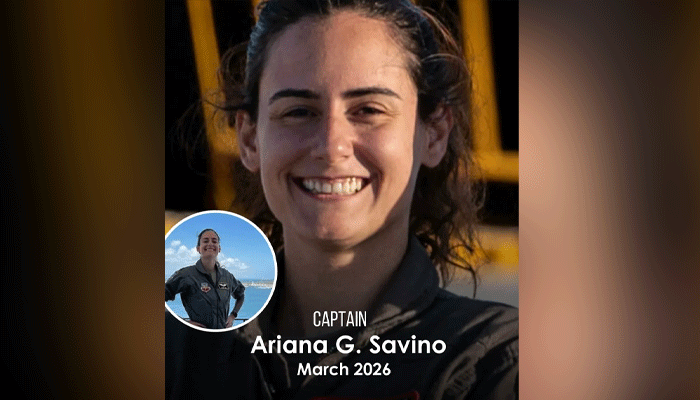
The sky was never just a place of duty for Captain Ariana G. Savino — it was where her purpose lived, where every mission carried the weight of protecting others, and where she quietly accepted risks most could never imagine.
She was only 31 years old, yet her life had already been defined by courage, discipline, and a deep commitment to something greater than herself.
On March 12, 2026, that commitment led her into what would become her final mission.
During an operation supporting Operation Epic Fury, a KC-135 Stratotanker carrying Captain Savino and her fellow airmen crashed in western Iraq.
It happened in friendly airspace, under circumstances that remain under investigation, leaving behind not just questions — but an overwhelming sense of loss that echoed far beyond the desert skies.
Six U.S. Air Force airmen, including Captain Savino, did not return home.
Behind every uniform is a story, and Ariana’s began long before she ever stepped into a cockpit.
Raised with a strong sense of responsibility and quiet determination, she pursued her path with unwavering focus, eventually earning her commission in 2017 through the Air Force ROTC program at Central Washington University.
Those who knew her describe someone who didn’t just chase excellence — she lived it, consistently pushing herself to meet the highest standards while lifting others along the way.
Her journey in the Air Force was marked by both versatility and relentless growth.
In 2020, she qualified as a Combat Systems Officer, taking on roles that required precision, critical thinking, and the ability to perform under immense pressure.
At Robins Air Force Base in Georgia, she quickly earned the trust of her peers and leadership, stepping into positions such as Standardization and Evaluation Officer, Assistant Flight Commander, and eventually Flight Commander.
Each role added layers to her experience, shaping her into a leader who understood both the technical demands of aviation and the human responsibility that came with command.
But Ariana wasn’t finished growing.
She set her sights on becoming a pilot — a transition that required not only skill, but resilience and determination.
In 2025, after completing Undergraduate Pilot Training at Columbus Air Force Base in Mississippi, she earned her pilot wings, marking a defining moment in her career.
For many, that achievement would have been enough.
For Ariana, it was just the beginning of a new chapter.
Assigned as a KC-135 pilot with the 99th Air Refueling Squadron, part of the 6th Air Refueling Wing at MacDill Air Force Base in Florida, she stepped into one of the most demanding roles in modern military aviation.
Operating from Sumpter Smith Joint National Guard Base in Alabama, she became a vital part of missions that ensured aircraft across the region could remain in the air — extending their reach, their endurance, and ultimately, their ability to protect lives.
Aerial refueling is often described as one of the most complex and dangerous tasks in aviation.
It requires absolute precision, coordination, and trust between crews operating at high speeds, often in unpredictable conditions.
For Ariana, it was more than a task — it was a responsibility she carried with unwavering focus.
As Chief of Current Operations Pilot, she wasn’t just flying missions — she was shaping them.
She managed daily flight scheduling, oversaw mission planning, and played a critical role in maintaining the unit’s $21 million flying-hour program.
Every decision she made had real consequences, affecting not only the success of missions but the safety of those involved.
Her leadership extended beyond the cockpit.
She was the kind of officer who understood that behind every mission briefing and flight plan were real people — teammates who depended on her clarity, her judgment, and her calm under pressure.
Over time, she accumulated more than 300 combat flight hours, supporting operations such as Spartan Shield, Sentinel Sentry, and Epic Fury.
Each hour represented time spent in environments where the margin for error was razor thin.
Each mission carried risks that few outside the military ever fully comprehend.
And yet, she showed up every time.
Prepared.
Focused.
Unwavering.
Her dedication did not go unnoticed.
Captain Savino was awarded the Air Medal and the Air and Space Commendation Medal — honors that reflect not just achievement, but the trust placed in her to carry out critical missions under demanding conditions.
But awards only tell part of the story.
Those who served alongside her speak of a quiet strength — a leader who didn’t seek recognition, but earned respect through action, consistency, and an unshakable sense of duty.
The mission on March 12 began like many others — planned, coordinated, and executed with precision.
Two aircraft were involved, working together in a complex operation designed to support ongoing efforts in the region.
At some point during the mission, something went wrong.
One aircraft was able to land safely.
The other did not.
Details remain under investigation, but what is known is this: six airmen were lost.
Six lives dedicated to service, to mission, to each other.
For the families waiting at home, time seemed to stop.
For fellow airmen, the loss was not just professional — it was deeply personal.
Because in the military, especially in aviation units, bonds are forged in ways that are difficult to explain to those who have never experienced it.
They train together.
Deploy together.
Trust each other with their lives.
And when one is lost, the absence is felt everywhere.
In empty chairs during briefings.
In quiet moments before takeoff.
In the silence that follows a mission where someone doesn’t return.
Captain Ariana G. Savino’s legacy is not defined solely by the way her life ended, but by how she chose to live it.
She chose service.
She chose responsibility.
She chose to step into roles that demanded everything she had — and then gave more.
Her story is one of dedication, growth, and a relentless commitment to excellence.
It is also a reminder of the unseen sacrifices made every day by those who wear the uniform.
Behind every mission is a human story.
Behind every loss is a family, a community, and a network of people forever changed.
As investigations continue, answers may come.
But for those who knew her, what remains most important is not just understanding what happened — but honoring who she was.
A pilot.
A leader.
A teammate.
A daughter, a friend, a woman who gave her life in service to others.
Her wings may have carried her through her final mission, but her impact will continue far beyond it.
And somewhere, in the quiet spaces between memory and grief, her story will keep flying.