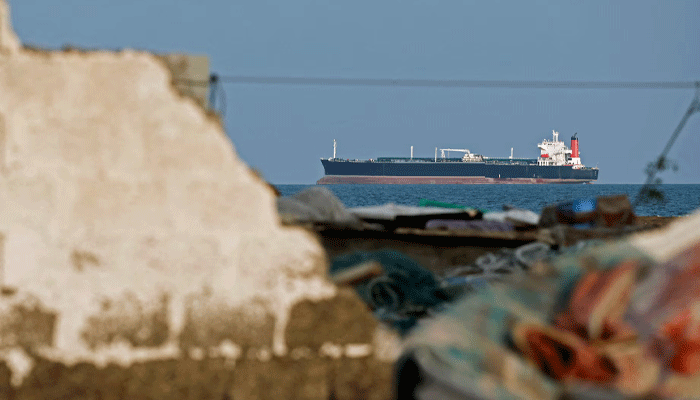
Approximately 21 million barrels of oil per day are transported through the Strait of Hormuz from Saudi Arabia, the United Arab Emirates, Kuwait, and Iran to other countries. These countries include Pakistan, China, Japan, South Korea, Europe, North America, and many other parts of the world.
The Strait of Hormuz connects the oil-producing countries of the Middle East with Asia, Europe, North America, and the rest of the world. On one side of this narrow sea passage are the Arab countries allied with the United States, while Iran lies on the other side.
Around 20 percent of the world’s oil and 30 percent of global gas supplies pass through this waterway. Nearly 90 ships pass through it every day, and about 33,000 ships travel through it annually.
This sea passage is about 33 kilometers wide and contains two shipping lanes, each about 3 kilometers wide, through which large oil tankers travel.
About one-fifth of the world’s total oil supply (20 percent) moves through this route. From the Strait of Hormuz, roughly 21 million barrels of oil per day are exported from Saudi Arabia, the UAE, Kuwait, and Iran to other countries. Qatar, the world’s largest exporter of liquefied natural gas (LNG), also relies on this route for its exports.
On one side of the Strait of Hormuz lies the Persian Gulf, and on the other side the Gulf of Oman. Inside the Persian Gulf are eight countries: Iran, Iraq, Kuwait, Saudi Arabia, Bahrain, Qatar, the UAE, and Oman.
The world’s second-largest economy, China, imports about half of its oil from the Gulf to keep its economy running. Japan imports about 95 percent of its oil through this route, while South Korea imports about 71 percent of its oil via the same passage. These three countries also use this route to export cars and electronic goods to Gulf countries.
According to global analysts, in the event of escalating conflict with Israel or possible U.S. attacks, Iran could use the Strait of Hormuz as a strategic “trump card.” It could lay naval mines, deploy submarines, anti-ship missiles, and warships in the area. As a result, a global oil crisis could emerge, and prices could rise to around $130 per barrel.
Defense experts say the Strait of Hormuz is not only a choke point for Iran but also a lifeline for the world. However, analysts also warn that closing this waterway would have severe consequences for Iran itself.