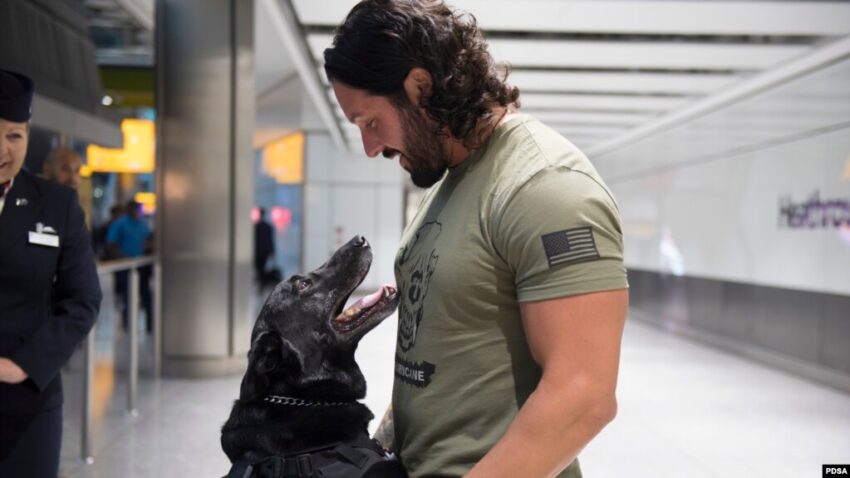
In the United States, 13 states have officially declared a particular breed of dog, the Great Dane, as their state animal. But the story does not end there. According to statistics from last year, there were about 90 million pet dogs in the United States, and nearly 85 million households had at least one dog wagging its tail at home.

And it is not just America—dogs are among the most widely kept animals in the world. The companionship between humans and dogs goes back a very long time. Historians say there is clear evidence that dogs were living alongside humans as far back as 14,000 years ago, helping them in hunting.
Dogs are believed to have descended from wolves, which are known as fierce predators. Yet it is remarkable how these two—humans and dogs—came to trust and depend on each other while searching for food.
A recently published book suggests that the foundation of this relationship is actually love. Give a dog even a little affection and it becomes completely devoted. Once it receives love at a particular doorstep, it remains loyal to that home forever.
Clive Wynne, director of the Canine Science Department at Arizona State University in Tempe and an expert on dog behavior, writes in his book Dog Is Love that dogs are naturally loving animals. We like dogs because they obey our commands and easily understand even the smallest of our gestures. That is why it is relatively easy to train them and use them for various tasks.
According to Wynne, dogs do all this because they expect love and affection in return. He says dogs not only love humans, but forming close relationships with humans is part of their nature. This trait makes them unique compared to many other animals.
Another study suggests that dogs are more intelligent than many animals. If their intelligence is compared with that of humans, it is generally considered similar to that of a four-year-old child. Some dogs, however, demonstrate the understanding of a seven-year-old child.
In the United States, great attention is given to breeding, caring for, and treating dogs. Pet dogs are often obtained from breeding farms where they are trained. Stores selling dog food and accessories are widely available, and even ordinary grocery stores have dedicated sections for dog food.
In addition, there are special places for dog grooming, including bathing, hair cutting, and even styling. Veterinarians and animal clinics can be found in almost every neighborhood. There are also insurance companies that provide health coverage for dogs. If someone needs to travel for a few days and cannot take their pet along, there are special hotels designed for dogs. Surprisingly, there are even television channels dedicated to dogs, broadcasting programs tailored for them.
Recently, another book about pet dogs has also been released titled Our Dogs, Ourselves. Alexandra Horowitz, head of the Dog Cognition Lab at Barnard College in New York, says that questions about the rights of dogs are now beginning to emerge.
Earlier, her book Inside of a Dog (published in 2009) was a bestseller. In her new book, she raises important questions. She argues that dogs have become a part of our culture, yet we still have not fully accepted them as living beings and instead treat them as our property. She asks whether we have the right to control their breeding through specific methods, and whether it is ethical to use dogs as subjects in scientific experiments.
Horowitz also points out that in an effort to keep dog breeds “pure,” humans have adopted cruel breeding practices. In some dog nurseries, puppies are born where the father and grandfather may be the same dog, and the pattern can continue even further. As a result, negative effects are beginning to appear, with genetic diseases emerging in certain dog breeds.
In her book, she discusses various breed-specific genetic disorders, explaining that these problems arise because breeding is restricted within a narrow genetic pool.
Despite all these concerns, Clive Wynne believes that no matter what the situation may be, humans will never lose their love for dogs. 🐶💛