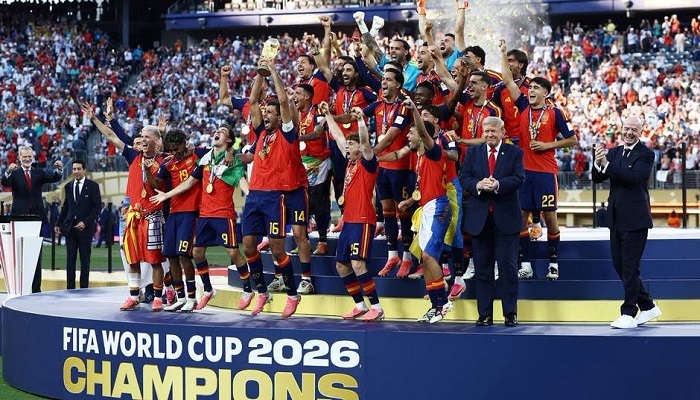
Spain defeated defending champions Argentina 1-0 after extra time in the FIFA World Cup 2026 final, claiming their second-ever FIFA World Cup title. The thrilling contest was decided in the 106th minute when Ferran Torres fired a powerful close-range shot into the net to secure a historic victory for La Roja.
Fans had anticipated a classic World Cup final, but the match was frequently interrupted by tough challenges, repeated fouls, and stoppages, preventing it from developing a consistent rhythm.
Despite the interruptions, Spain dominated from the outset and created several clear scoring opportunities. However, Argentina goalkeeper Emiliano Martínez produced a series of outstanding saves to keep his side in the contest.
Argentina suffered a major setback in the closing moments of normal time when midfielder Enzo Fernández was sent off after receiving a second yellow card for a dangerous tackle. The defending champions were therefore forced to play the entire extra-time period with 10 men.
Martínez continued to frustrate Spain with more brilliant saves in extra time until the decisive moment arrived in the 106th minute. Nico Williams headed the ball into the path of Ferran Torres, who unleashed a powerful strike to score the match-winning goal.
Throughout the match, Spain’s Lamine Yamal, Mikel Oyarzabal, and Nico Williams consistently troubled Argentina’s defense. Williams also had a goal disallowed due to a foul earlier in the game.
The excitement extended beyond the pitch. U.S. President Donald Trump attended the final as a special guest, while the FIFA World Cup featured its first-ever halftime show, with performances by Shakira, Madonna, and Justin Bieber entertaining the crowd.
With the victory, Spain not only captured its second men’s FIFA World Cup title but also achieved a unique milestone. Spain became the first nation in football history to simultaneously hold both the men’s and women’s FIFA World Cup titles.
President Donald Trump presented the trophy and medals to the Spanish team following the final. FIFA also awarded each member of Spain’s squad a commemorative championship ring.
The tournament concluded with Spain’s triumph, Argentina’s disappointment, and the beginning of a new chapter in football history, as La Roja once again demonstrated why they are regarded as one of the world’s elite national teams.
Spain had previously won its first World Cup in 2010 and returned to the final for only the second time, winning on both occasions.
Argentina, meanwhile, reached the World Cup final for the seventh time. The South American side had previously lifted the trophy in 1978, 1986, and 2022, and was hoping to become back-to-back world champions.
The final was also widely viewed as what could be Lionel Messi’s last World Cup appearance. That possibility added even greater anticipation, with fans hoping the Argentine captain would lead his country to another world title. However, Messi was unable to produce his trademark magic in the championship match.