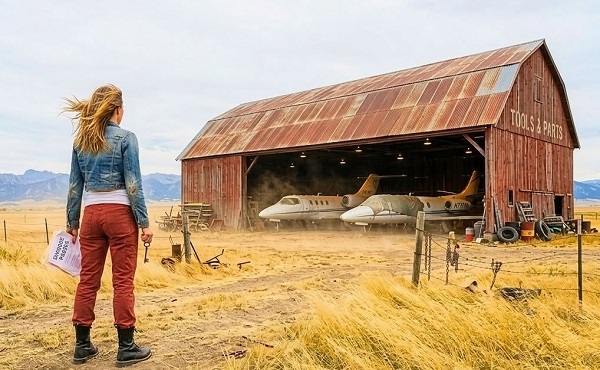
The day the judge finalized the divorce, Emily Carter sat alone in her pickup truck and watched the rain slide down the courthouse windows.
Across the parking lot, her ex-husband, Ryan Mitchell, laughed with his attorney.
He had won almost everything.
The house.
The cattle.
The equipment.
The bank accounts.
Even the small hardware store Emily had helped build for twelve years.
Ryan walked away wearing a tailored suit and a satisfied smile.
Emily walked away with an aging pickup, a few boxes of clothes, and less than three thousand dollars.
For months, people in the small town of Willow Creek, Wyoming, whispered about it.
“Poor Emily.”
“Ryan cleaned her out.”
“She’s got nothing left.”
Emily never corrected them.
Because as far as she knew, they were right.
At thirty-eight years old, she found herself moving into a tiny rental cabin outside town.
The place had peeling paint, squeaky floors, and a roof that leaked whenever spring storms rolled through.
Still, it was hers.
No lawyers.
No arguments.
No memories of betrayal.
Ryan had started seeing another woman long before the divorce.
Emily suspected it.
Everyone suspected it.
But proving it would have cost money she didn’t have.
So she signed the papers and walked away.
For a while, she spent her evenings staring at old photographs.
Most featured her father.
Thomas Carter.
A rancher.
A mechanic.
A man who could fix anything.
He had raised Emily alone after her mother died.
Their happiest memories were spent inside an old wooden tool barn on the edge of the family property.
The barn wasn’t much to look at.
Weathered boards.
A sagging roof.
Rusty hinges.
But inside, her father taught her everything.
How to weld.
How to repair engines.
How to sharpen blades.
How to solve problems with her own hands.
Years earlier, after her father passed away, the property had been sold.
Emily never thought much about the old barn again.
Until one rainy afternoon.
She was digging through a box of old paperwork when a yellow envelope slipped from between two photo albums.
Her father’s handwriting covered the front.
FOR EMILY ONLY
Her heart skipped.
The envelope had never been opened.
With trembling fingers, she unfolded the letter.
Inside was a message dated nearly fifteen years earlier.
Emily,
If you’re reading this, life probably didn’t go the way either of us planned.
I know you.
You always put others first.
Sometimes too much.
So I did something years ago that I never told anyone.
Not even you.
The old tool barn belongs to you.
Legally.
Always has.
Check the attached documents.
One day you may need it.
If that day comes, don’t sell it.
Trust me.
Love,
Dad
Emily stared at the page.
Attached behind it were legal records.
Property deeds.
Tax filings.
Ownership transfers.
Everything appeared legitimate.
The old tool barn had been placed into a separate trust decades earlier.
The owner listed on every document was Emily Carter.
Not Ryan.
Not the family estate.
Emily.
Her pulse raced.
How could she never know?
She immediately called the county clerk’s office.
After two days of paperwork and verification, the answer arrived.
The documents were authentic.
The barn was legally hers.
And because it had never been considered marital property, it had never been included in the divorce.
Ryan had forgotten it existed.
The attorneys never looked.
The court never touched it.
For the first time in months, Emily smiled.
The following weekend she drove out to see the place.
The road looked exactly as she remembered.
Cottonwood trees lined the creek.
Wildflowers covered the hillsides.
When she finally reached the property, her smile faded.
The barn looked terrible.
Half the roof had collapsed.
The paint was gone.
Windows were broken.
Weeds grew through the floorboards.
A family of raccoons apparently considered it home.
Most people would have seen junk.
Emily saw possibility.
Her father’s voice echoed in her memory.
Don’t sell it.
So she didn’t.
The next morning she began cleaning.
Alone.
She hauled out debris.
Removed rotten lumber.
Patched sections of roofing.
The work was exhausting.
But every nail she hammered felt like reclaiming a piece of herself.
Weeks turned into months.
Neighbors began noticing.
Then they began helping.
Old ranchers donated scrap wood.
A retired electrician rewired the building.
A widow down the road brought sandwiches every Friday.
For the first time since the divorce, Emily felt supported.
Valued.
Needed.
By autumn, the old barn stood proudly again.
Not perfect.
But alive.
One evening while organizing shelves, Emily discovered something unusual.
A hidden compartment behind a workbench.
The panel blended perfectly with the wall.
Her father had built it.
Inside she found several metal boxes.
Old journals.
Property surveys.
Maps.
And a collection of stock certificates.
Emily blinked.
Then blinked again.
The certificates carried the name of a small mining company.
Most were decades old.
Probably worthless.
Or so she assumed.
Still curious, she contacted a financial adviser.
The man nearly dropped the phone.
“Do you have any idea what these are?”
“No.”
“These shares merged several times over the years.”
Emily swallowed.
“Okay…”
“They may currently be worth over two million dollars.”
Silence.
Complete silence.
Emily thought he was joking.
He wasn’t.
Apparently, her father had invested small amounts of money throughout the 1980s.
Then forgotten about it.
Or perhaps hidden it intentionally.
The records showed dividends reinvested for decades.
Compound growth had done the rest.
The wealth had sat untouched inside the secret compartment for years.
Waiting.
For her.
Emily cried that night.
Not because of the money.
Because her father had somehow protected her long after he was gone.
News travels fast in small towns.
By Christmas, everyone knew.
Including Ryan.
Especially Ryan.
One snowy afternoon, a black SUV rolled into the barn’s driveway.
Emily knew exactly who stepped out.
Ryan.
His expensive coat looked out of place among the tools and sawdust.
He smiled.
The same smile that once fooled her.
“Emily.”
She kept working.
“What do you want?”
He shoved his hands into his pockets.
“I heard about the inheritance.”
She laughed.
Of course.
Not how are you.
Not I’m sorry.
Straight to business.
Ryan continued.
“I’ve been thinking.”
“Dangerous habit.”
“We spent twelve years together.”
Emily set down her wrench.
“Get to the point.”
He cleared his throat.
“Maybe we should discuss what’s fair.”
She stared at him.
Then burst out laughing.
The sound echoed through the barn.
Ryan’s face reddened.
“You think this is funny?”
“No,” Emily replied.
“I think you are funny.”
For years she had feared this man.
His opinions.
His approval.
His anger.
Now she felt nothing.
No fear.
No regret.
No longing.
Just clarity.
“You took everything,” she said.
“The house. The business. The savings.”
Ryan shifted uncomfortably.
“We followed the settlement.”
“Exactly.”
“So did I.”
His expression hardened.
“You wouldn’t even have that barn if it weren’t for me.”
Emily pointed toward the door.
“My father gave me this barn.”
Ryan opened his mouth.
She continued.
“You forgot it existed.”
Silence.
“You overlooked it.”
More silence.
“You underestimated me.”
Ryan finally turned and left.
Neither of them ever brought up the subject again.
Spring arrived.
The barn became more than a workshop.
Emily started offering repair classes.
Young women came first.
Then teenagers.
Then entire families.
People wanted practical skills.
They wanted confidence.
They wanted to learn how to build instead of replace.
The classes became so popular that Emily expanded.
She converted half the barn into a community learning center.
The other half remained a workshop.
Every Saturday, the building buzzed with activity.
Laughter.
Hammers.
Conversation.
Purpose.
One day a reporter from a regional newspaper arrived.
She interviewed Emily for nearly three hours.
The resulting article carried a headline:
“Woman Rebuilds Her Life From Forgotten Barn.”
The story spread.
Then spread again.
Soon people drove from neighboring counties to attend classes.
Donations poured in.
Not because Emily needed money.
But because people believed in what she was creating.
So Emily established a foundation in her father’s name.
The Thomas Carter Skills Center.
Its mission was simple:
Teach people practical skills and self-reliance.
The same lessons her father taught her.
Years later, visitors often asked about the old photographs hanging near the entrance.
One picture always attracted attention.
It showed a younger Emily standing beside her father inside the original barn.
Both were covered in grease.
Both were smiling.
When people asked why she displayed it so prominently, Emily always gave the same answer.
“Because everything started there.”
Most assumed she meant the foundation.
The success.
The money.
The barn.
But she meant something deeper.
Her father had never simply taught her how to fix machines.
He taught her how to survive disappointment.
How to rebuild after loss.
How to keep going when life seemed unfair.
The hidden inheritance was a blessing.
The forgotten property was a gift.
But the greatest thing her father left behind wasn’t hidden in a wall.
It wasn’t stored in a trust.
It wasn’t worth millions.
It was resilience.
One quiet evening, long after the workshop closed, Emily sat alone on the front porch.
The Wyoming sunset painted the mountains gold.
Wind rustled through the cottonwood trees.
Children’s laughter drifted from the field nearby.
Inside the barn, lights glowed warmly through the windows.
A place once abandoned had become the heart of a community.
Emily looked toward the old workbench where the secret compartment had been found.
Then she smiled.
Ryan had taken nearly everything during the divorce.
Or so he thought.
What he failed to understand was that the most valuable things had never belonged to him.
Not her father’s love.
Not her determination.
Not her future.
And certainly not the forgotten old tool barn that changed everything.
Sometimes the greatest treasure isn’t the thing people fight to keep.
It’s the thing they overlook completely.
And sometimes, the door to a new life is hidden behind weathered boards, waiting for the right person to come home and open it.