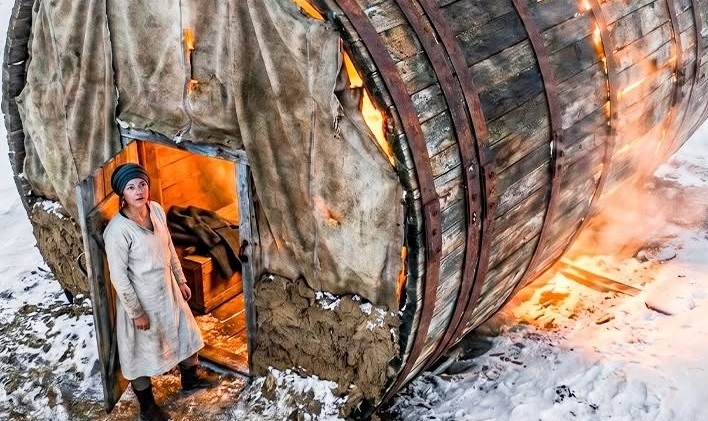
The first winter after the drought was supposed to finish them.
At least, that was what everyone in the small Wyoming valley believed.
The Whitaker family had already lost nearly everything.
Their farmhouse roof had collapsed during a summer storm. Their savings were gone after years of failed harvests. Their livestock had dwindled to a handful of chickens and two aging goats.
By October, the family of six was living inside a patched canvas tent beside a dry creek bed.
Every morning, sixteen-year-old Emily Whitaker woke to frost on her blanket.
Every evening, her mother Martha tried to stretch a pot of soup into enough food for everyone.
And every night, Emily listened to the cold wind howl through the valley and wondered how much longer they could survive.
Her father, Samuel, tried to stay hopeful.
“We’ve made it through hard times before,” he would say.
But Emily saw the worry in his eyes.
Winter was coming fast.
And this time, they had nowhere to go.
One gray afternoon, Emily set out alone to search for firewood.
She climbed farther than usual, following an abandoned railroad grade that wound through the foothills.
The wind carried the smell of snow.
She was preparing to turn back when something unusual appeared on a distant ridge.
A giant cylinder.
At first she thought it was a barn.
Then she thought it might be an old grain silo.
Curiosity pulled her closer.
When she finally reached it, she stopped and stared.
It was an enormous abandoned water tower.
The wooden support structure had long since collapsed, leaving the massive steel tank resting on the ground.
Rust covered much of its surface.
Several dents scarred the metal.
Yet the structure remained mostly intact.
Emily circled it carefully.
The tank was nearly thirty feet across.
A maintenance hatch near the bottom hung slightly open.
She squeezed through.
The interior was dark.
Silent.
And surprisingly warm.
Emily stood motionless.
Outside, the wind whipped across the hillside.
Inside, the thick steel walls blocked nearly all of it.
The enclosed space trapped heat like a giant oven.
Her breath didn’t even fog as much as it had outside.
She ran her hand along the metal wall.
The steel had absorbed warmth from the weak afternoon sun and held it.
An idea began forming immediately.
A crazy idea.
A wonderful idea.
She sprinted all the way home.
“You found what?” her brother Noah laughed.
“A water tower,” Emily said.
“A giant steel tank.”
Samuel looked skeptical.
“You want us to live in it?”
“Just come see.”
The next morning the entire family climbed the ridge.
When Martha stepped inside the tank, her eyes widened.
“Oh.”
Even Samuel fell silent.
The difference in temperature was impossible to ignore.
The thick metal walls blocked wind entirely.
The circular shape left plenty of usable space.
Best of all, it was free.
No landlord.
No mortgage.
No one to drive them away.
The family spent the next week transforming the abandoned tank into a home.
They scavenged lumber from collapsed sheds.
Old railroad ties became supports.
Discarded windows from an abandoned mining cabin were carefully removed and carried uphill.
Neighbors laughed when they heard the plan.
“A family living inside a water tower?”
“They’ve finally gone crazy.”
“Won’t last a month.”
But the Whitakers kept working.
Samuel cut openings for windows.
Emily and Noah built simple bunks.
Martha stitched blankets into makeshift wall coverings.
Little Lucy, only seven years old, gathered wildflowers and insisted on decorating every corner.
By the first snowfall, the family moved in.
Their new home looked ridiculous from the outside.
A giant rusted cylinder sitting alone on a hillside.
But inside?
It felt surprisingly comfortable.
The curved walls created a cozy atmosphere.
The steel shell protected them from Wyoming’s brutal winds.
Their small wood stove sat near the center.
And because the tank retained heat so efficiently, the fire required far less wood than the tent ever had.
For the first time in months, the family slept warmly.
The real test came in December.
A blizzard swept across the valley.
Temperatures plunged far below freezing.
Winds reached dangerous speeds.
Snow buried fences.
Trees snapped under the weight of ice.
Several families in the valley spent days battling frozen pipes and drafty walls.
Inside the water tower, the Whitakers listened to the storm rage outside.
The steel shell groaned occasionally.
But it held.
The stove stayed lit.
The warmth remained trapped inside.
Lucy sat wrapped in a blanket reading a book.
Martha baked biscuits.
Samuel repaired tools.
For the first time all winter, they felt safe.
When the storm finally ended, neighbors came to check on them.
Most expected disaster.
Instead, they found the Whitakers smiling.
Warm.
Healthy.
Comfortable.
Word spread quickly.
Soon people climbed the ridge simply to see the strange water-tower house.
Many arrived expecting a joke.
Most left impressed.
One visitor was a retired engineer named Walter Dawson.
Walter spent nearly an hour examining the structure.
Finally he nodded.
“Actually makes perfect sense.”
Samuel laughed.
“You’re the first person who’s said that.”
Walter pointed at the steel walls.
“The thermal mass stores heat during daylight. Then releases it slowly at night.”
Emily grinned.
“So we’re not crazy?”
Walter smiled.
“Oh, you’re still crazy.”
Then he winked.
“But you’re clever.”
The engineer’s visit changed everything.
Walter began helping the family improve the structure.
He designed better ventilation.
He helped reinforce weak sections.
He showed Samuel how to install insulated flooring.
Every improvement made the home stronger.
More comfortable.
More efficient.
By spring, the water tower barely resembled the rusted shell Emily had discovered.
Flower boxes lined the windows.
A small porch extended from the entrance.
Rain barrels collected water from the curved roof.
Vegetable gardens surrounded the hillside.
Visitors came from neighboring towns.
Newspapers even sent reporters.
One article called it:
“The Most Unusual Home in Wyoming.”
Another called it:
“The Water Tower Miracle.”
Emily hated that title.
To her, it wasn’t a miracle.
It was simply refusing to give up.
The following summer brought another challenge.
A heat wave swept across the region.
Many houses became unbearably hot.
Yet the water tower remained surprisingly cool.
The same thermal properties that held warmth during winter also slowed heat buildup during summer.
The steel walls absorbed temperature changes gradually.
The interior stayed comfortable.
Again, visitors were amazed.
Again, the Whitakers proved the skeptics wrong.
Over time, their strange home became a local landmark.
Travelers stopped to take photographs.
Teachers brought students for field trips.
Even architecture enthusiasts came to study the design.
Emily found the attention amusing.
After all, she’d never intended to create something famous.
She had only wanted to keep her family alive.
Three years passed.
Then came the flood.
An unusually wet spring caused rivers throughout the valley to overflow.
Water rushed through low-lying areas.
Several homes suffered serious damage.
Roads disappeared beneath muddy currents.
Families were forced to evacuate.
The Whitakers watched from their ridge.
Their elevated location kept them safe.
Soon neighbors began arriving.
Then more neighbors.
Then entire families.
The water tower home became an emergency shelter.
Every available corner filled with people.
Mattresses covered the floor.
Children slept side by side.
Martha cooked enormous meals.
Samuel organized repairs.
Emily helped distribute supplies.
For nearly two weeks, dozens of displaced residents found refuge inside and around the tower.
No one forgot that kindness.
Especially those who had once mocked the project.
After the flood receded, the community gathered for a celebration.
Tables stretched across the hillside.
Food covered every surface.
Music echoed through the valley.
Near sunset, Walter Dawson stood to speak.
The crowd quieted.
The old engineer looked toward the giant tower.
Then toward Emily.
“You all know the story,” he said.
“Most of us laughed.”
Several people chuckled.
“I laughed too.”
More laughter followed.
Walter continued.
“We saw a rusted piece of junk.”
He paused.
“Emily Whitaker saw a home.”
Silence settled over the crowd.
“That difference changed everything.”
The old man pointed toward the tower.
“Most people look at problems and see obstacles.”
He smiled.
“The Whitakers looked at the exact same thing and saw possibilities.”
The crowd erupted in applause.
Emily felt her face turn red.
She hated public attention.
But she also understood what Walter meant.
The tower had never really been the important part.
The important part was refusing to quit.
Years later, Emily left for college.
She studied engineering and sustainable design.
Her professors often discussed innovative housing solutions.
Students presented complex projects involving expensive materials and advanced technology.
Eventually one professor asked Emily what inspired her interest.
She smiled.
Then she showed a photograph.
The image displayed a rusted water tower sitting atop a Wyoming hill.
Flower boxes hung from the windows.
Children played outside.
Smoke drifted from a chimney.
The professor stared.
“What is that?”
Emily smiled.
“My childhood home.”
The entire class laughed.
Until she told the story.
Then nobody laughed anymore.
Because hidden beneath the unusual design was something far more powerful.
A lesson.
Sometimes survival doesn’t come from having resources.
Sometimes it comes from seeing value where everyone else sees trash.
The old water tower remained standing for decades.
Visitors continued arriving.
Students continued studying it.
Families continued hearing its story.
And whenever someone asked Samuel Whitaker whether he regretted moving his family into a discarded steel tank, he always gave the same answer.
He would look toward the hill.
Toward the home that saved them.
Then smile.
“Best house I ever owned.”
Because while others saw a rusted water tower abandoned by the world, one determined girl saw shelter.
And that single act of imagination transformed a forgotten piece of scrap metal into the warm heart of an entire community.