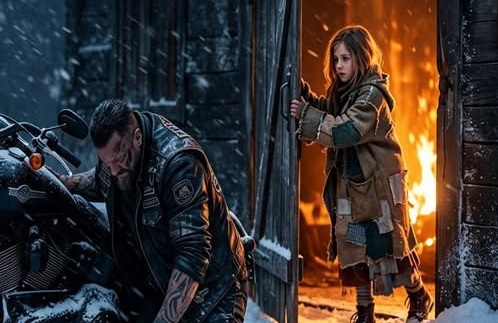
My little rescuer saved four frozen bikers during a mountain storm, and i thought her kindness was the miracle. my chapter came before dawn, but what we found outside her shack changed everything. my town’s mayor was waiting in a warm suv, and his plan for that orphaned girl made my hands shake………..
Part 1….
Come inside quickly. The frost will kill you.
That was the first thing I heard through the storm.
Not the wind. Not the crack of ice in the trees. Not the engine cough of my bike dying behind me on the mountain pass.
A child’s voice.
Thin. High. Terrified.
And somehow, stronger than the blizzard.
I lifted my head from the snow, and pain shot through my neck like a warning. My body did not want to move anymore. My fingers had stopped feeling like fingers. My legs had gone heavy and strange under me, like they belonged to another man.
But there was light.
Not much.
Just a weak amber glow in a window, flickering behind fogged glass. A kerosene lamp. One small square of life in a world that had gone white, wild, and cruel.
Then I saw her.
A little girl stood in the doorway below that light, waving one arm like she was trying to pull me back from the edge of the world.
She had no coat on.
No gloves.
Just a thin dress, boots too worn for weather like that, and a face so pale it looked carved out of the snow itself.
I was six foot six, two hundred eighty-five pounds, and men had crossed streets to avoid looking at me for most of my adult life.
My name is Logan Vance, but on the road, people called me Glacier.
I earned that name in the mountains.
I earned it in the service.
And later, I earned it as the enforcer for the Iceblade chapter of the Hells Angels, where being calm was sometimes more dangerous than being loud.
But that night, none of it mattered.
Not my size.
Not my patch.
Not the things people whispered when I walked into a room.
The mountain was taking me down one breath at a time.
The sabotage had been clean.
Too clean.
Someone had gotten to our heating gear before we hit the pass. Battery seals stripped. Emergency thermal layers punctured. Saddlebag kits ruined just enough that we would not know until the cold had already crawled inside our clothes.
Professional work.
Patient work.
The kind of work done by someone who wanted us far away from help when we understood what had happened.
By the time the blizzard slammed into us, it was already too late.
The forecast had lied.
Or someone had counted on it.
Snow came sideways for hours. The road vanished. The mountain disappeared. My brothers—Webb, Cutter, and Hollis—were still behind me, but I could barely hear them over the wind.
I kept them moving as long as I could.
One more step.
One more breath.
One more yard.
Then the shack appeared out of the white dark like a memory.
I made it within ten yards of the door before my knees gave up.
I remember falling.
I remember the snow coming up fast.
Then that little girl reached me.
She came up to the middle of my chest. Maybe eight years old. Maybe younger. Her hands were pale and thin with cold, but when she grabbed my arm, her grip had steel in it.
“Get up,” she said.
It was not a plea.
It was an order.
I do not know how I stood.
I only know she pulled, and I rose.
One step.
Then another.
The storm clawed at my back. My boots dragged through the snow. My vision narrowed until all I could see was that doorway and her small hand wrapped around my sleeve.
Then we were inside.
Four walls.
One roof.
A door slammed against the wind.
And for the first time in almost an hour, the mountain was outside of me instead of inside my bones.
The shack was one room.
I cataloged it automatically, because that is what I do. One window. One door. Both facing west. A fireplace built into the east wall. Iron grate. Ash in the pan from a fire that had gone out hours earlier.
A cot against the north wall.
One blanket.
A wooden chair.
A small table.
On the table sat the kerosene lamp and one can of soup.
One.
Above the cot hung a photograph.
A man. A woman. A little child, younger than the girl standing in front of me now.
They were smiling in front of the same mountain that had almost swallowed me whole.
The man held an old acoustic guitar. The finish around the sound hole had been worn down by years of playing.
That was everything.
That was the entire world of Clara Lindberg.
I did not know her name yet, but I already knew she had almost nothing.
And she had just opened her door to four men who looked like every warning story small towns tell their children.
Webb stumbled through next, half-frozen and breathing hard.
Cutter and Hollis came in together, leaning on each other like broken pillars.
The little girl looked at all of us once.
Then she turned to the fireplace.
No panic.
No screaming.
No wasted movement.
She grabbed the iron poker from the stand and crouched in front of the grate.
“There’s no wood,” she said.
Not scared.
Not apologizing.
Just stating the problem.
Then she stood, picked up the only chair in the room, and looked at it for one second.
That look hit me harder than the cold.
It was goodbye.
She swung the chair against the edge of the fireplace.
It cracked in two.
She broke it again.
Then again.
She stacked the pieces in the grate with careful hands, arranging the wood like someone who had done this too many times because there had been no one else to do it.
She heated the poker in the kerosene flame.
Touched it to the kindling.
The fire caught.
Small at first.
Then hungry.
The heat came crawling toward us, and it hurt. Warmth always hurts when the cold has gone too deep. It stung my hands, burned my face, and made my bones feel like they were remembering they were supposed to be alive.
We lay close to the fire, four grown men on the floor of a child’s shack.
She went to the table.
Opened the can of soup.
Found a small pot.
One pot, I noticed.
Two mismatched bowls.
She poured the soup in and held it over the fire with a metal rod, her arms steady even though she had to be exhausted.
“It’s not much,” she said.
I swallowed, and my throat felt like sand.
“It’s everything,” I told her.
My voice came out rough. Too rough.
She glanced at me.
“What’s your name?”
“Logan.”
She nodded like names mattered. Like they should be handled carefully.
“What’s yours?”
“Clara.”
The fire snapped between us.
She looked at the other men. “Do they have names?”
I told her.
“Webb. Cutter. Hollis.”
She repeated each name quietly, filing us away in that sharp little mind of hers.
Then she said, “My papa used to say you should know the name of anyone you let into your home.”
My chest tightened.
“Your papa sounds like a smart man.”
A pause.
“He died two years ago,” she said.
The room changed.
Not louder.
Quieter.
“Mama too. Winter fever.”
She said it without falling apart. That almost made it worse. Some children cry because grief is fresh. Some speak calmly because grief has become furniture in the room.
Clara had lived with hers so long she knew where it sat.
“I’ve been here since,” she added.
I looked around again.
The cot.
The blanket.
The lamp.
The empty chair now burning in the fireplace.
The one can of soup warming in the pot.
My throat closed.
“Clara,” I said, “you don’t have to do this.”
She looked right at me.
“You were going to die.”
Simple.
Clean.
No drama in her voice.
Just truth.
Then she said, “Papa always said you help people who need help. That’s just what you do.”
That one got through.
Straight through the leather. Through the road name. Through the years of learning not to show anything unless I chose to.
I looked at that little girl, standing there barefoot in courage and grief, feeding men twice her size with the last thing she had.
And I felt something sharp twist under my ribs.
Betrayal had brought us to her door.
Kindness opened it.
The soup simmered low.
She poured it into the two bowls and divided it with the seriousness of a judge. She brought one to me.
I looked at the bowl.
Then at her.
“You take it.”
She shook her head.
“You were outside longer.”
There are moments when a man understands he is being measured by someone who has nothing and still gives.
This was one of those moments.
“We’ll share,” I said.
She sat beside me near the fire, and we passed the bowl between us.
Behind me, Webb groaned and shifted. Cutter rubbed his hands together, breathing slow. Hollis opened his eyes and stared at the ceiling like he was surprised to still be under one.
None of us spoke much.
There was nothing soft enough to say.
Later, after the room warmed by a few precious degrees, Clara curled into the corner wrapped in my cut.
That was the warmest thing I had.
The black leather swallowed her whole. The Angel patch on the back faced the room like a flag planted over something sacred.
I stayed awake.
The fire was dying again, but I could not close my eyes.
I stared at the photograph on the wall. The father with the guitar. The mother with her arm around him. Clara, smaller then, safe between them.
Beside the photo hung the old guitar itself.
I looked at the broken chair burning down in the grate.
Then I thought about our heating gear.
The stripped seals.
The punctured thermal layers.
The timing.
The storm.
The person who had known our route.
The person who had wanted four Iceblade men gone before sunrise.
And worst of all, I thought about which answers I already had.
My hand moved inside my jacket.
The satellite phone was still there.
Barely alive.
It had survived because it had been closest to my body.
I stepped as far from Clara as the tiny room allowed and made the call.
The voice that answered was low and immediate.
“Logan.”
Brick Callahan, president of the Iceblade chapter, never wasted words. Not when his enforcer called from a mountain in a blizzard at three in the morning.
“How bad?” he asked.
“We’re alive,” I said.
My eyes went to the corner where Clara slept under my cut.
“Barely.”
Silence.
Then I said, “There’s a situation here, Brick. I need you to understand what I’m about to tell you.”
So I told him.
All of it.
The sabotage.
The pass.
The shack.
The little girl.
The broken chair.
The empty soup can.
The photograph of a family that no longer existed.
And the child who had given us the last of what she had because her father once told her that was what decent people do.
The silence on the line lasted four seconds.
“Location,” Brick said.
I gave it.
“We’ll be there before dawn,” he said.
Then came the pause.
“All of us.”
The line clicked dead.
I lowered the phone.
The fire had almost collapsed into coals. I took the last two pieces of Clara’s chair and placed them carefully into the grate.
The flames caught.
I held my hands near the heat and thought about debts.
Some debts can be paid with money.
Some with protection.
Some with a name, a promise, a wall of men standing between a child and the world.
But some debts are bigger than repayment.
Clara made a small sound in her sleep and tucked my cut closer beneath her chin.
I watched the Angel patch rise and fall with her breathing.
And I waited for dawn.
By morning, the storm had not stopped.
It had only changed its voice.
Less screaming.
More grinding.
The kind of cold that made the whole mountain feel like metal.
Mayor Fletcher Sterling had not stepped outside his vehicle.
I saw him through the blowing snow before he saw me.
He sat in his county SUV with the engine running and the windows fogged warm. Coffee in one hand. Expensive coat wrapped around his round frame. Red face. Clean gloves. A man built out of comfort, power, and other people’s losses.
He was fifty years old and looked insulted by weather.
Outside his SUV, men worked around a bulldozer.
The machine crouched in the snow like a yellow animal.
Deputy Barney Cross stood nearby with paperwork tucked under one arm, his shoulders hunched against the wind. Two more men waited by the shack, stamping their boots and looking anywhere but at the little home in front of them.
I knew that look.
Men wear it when they are about to do something wrong and want the cold to make it feel necessary.
The ski resort project was worth $340 million.
Everyone in town knew it.
New lifts. New lodges. New money. New investors with soft hands and hard contracts.
And Clara’s shack sat on the last parcel of land between the existing access road and the proposed mountain lift terminus.
The last piece.
Her parents had owned it.
Legitimately.
Until winter fever took them two years ago and left behind one little girl, one cot, one lamp, one guitar, and a home the town had suddenly decided looked abandoned.
The legal process for declaring the property abandoned was still ongoing.
The resort’s groundbreaking date was not.
Continue in the comments 👇👇…
Part 2….
The bulldozer engine growled through the snow.
I stood in the doorway, still stiff from the night before, still feeling the cold inside my joints. Behind me, Clara slept on the floor under my cut, too tired to understand that another storm had arrived.
This one wore badges.
This one carried paperwork.
Mayor Sterling finally rolled down his window two inches.
“Vance,” he called, like my name tasted bad. “This is county business.”
I looked at the bulldozer.
Then at Deputy Cross.
Then back at the mayor’s warm little box on wheels.
“County business comes before sunrise now?” I asked.
His mouth tightened.
Cross shifted. He would not meet my eyes.
That told me plenty.
One of the men near the bulldozer held a clipboard. The paper on top flapped in the wind, and for one second I saw a name printed in bold.
Lindberg.
Then another name beneath it.
Sterling Development Partners.
My stomach went cold in a way the blizzard had not managed.
I stepped off the porch.
Every bootprint I left in the snow felt like a line being drawn.
The mayor’s face changed when he saw the patch on my back. Not fear. Not yet. Calculation.
Then the far end of the access road began to rumble.
Low at first.
Then louder.
Engines.
A lot of them.
Headlights broke through the white morning one by one, then in rows, then in a river of chrome and black leather.
The first bike came over the rise.
Then another.
Then twenty.
Then more than I could count from where I stood.
Brick Callahan rode in front.
Behind him came the Iceblade chapter.
Behind them came brothers from two counties over.
One hundred fifty Hells Angels rolled up that mountain road like judgment with headlights.
Mayor Sterling’s coffee cup slipped in his hand.
Deputy Cross went pale.
And inside the shack, Clara woke up and whispered one word.
“Papa?”
That was when I saw the object Brick carried strapped across his back.
An old acoustic guitar.
The same worn finish.
The same mark near the sound hole.
And I realized Clara’s story had one more missing piece.
SAY “OK” IF YOU WANT TO READ THE FULL STORY ❤️👇 👇
These two facts existed in attention that Fletcher Sterling had resolved the way he resolved most tensions by deciding that money was more persuasive than process. The girl had been given notice, not proper legal notice that would have required involving county offices that asked questions, but a letter delivered by Cross, which Cross had described to Sterling as sufficient.
What happened to the girl afterward was not a matter Sterling had given explicit instructions on because explicit instructions were the kind of thing that created exposure. He had simply said twice and clearly that once the property was vacant and the structure was cleared, there should be no further issues with that particular parcel. Cross had understood.
Cross generally understood. 5 minutes. Cross set into the radio from outside the lead vehicle. Give the inside one more shout and then we go. Sterling nodded, though Cross couldn’t see it. He looked at the shack, at the single amber glow of the lamp in the window. He thought about the resort, about the investors, about the groundbreaking ceremony and the press coverage and the look on the state governor’s face at the ribbon cutting. He took a sip of coffee.
Cross picked up the loudspeaker. Clara Lindberg, this is Deputy Cross of the county sheriff’s office. You have 5 minutes to exit the property before this structure is condemned and cleared. Come out now. The shack’s door didn’t open. Cross waited. He looked at his watch. He tried again.
Louder, less patient, with the specific edge that men who are accustomed to authority put into their voices when authority is not producing the desired effect. I’m going to personally drag her out. Cross muttered loud enough that the two men beside him could hear. He was 43, heavy set with a deputy’s badge that he wore like a license rather than a responsibility.
He had been on Sterling’s payroll in the informal sense for 11 years. And in those 11 years, he had done a number of things with the county sheriff’s authority that the county sheriff’s authority was not designed to do. He had gotten comfortable with that. He started toward the door. Behind him, in the heated SUV, Fletcher Sterling watched him go and took another sip of coffee.
And that was the moment the world at the bottom of the valley began to change. It started as a vibration, not heard, but felt, through the chassis of the SUV, through the frozen ground, moving up through the seat and into the bones of anyone paying attention. Sterling frowned.
He looked at his coffee, which was rippling slightly in the thermos. Then it became a sound, and the sound became something else. And Sterling sat down the thermos and looked toward the valley road and understood in the way that a man understands certain things just before they happened to him that the situation on the mountain had just undergone a fundamental change.
Brick Callahan had been riding for 31 years. He had ridden in seven states and four countries. He had ridden in rain and heat and hail and once memorably through a dust storm in Nevada that had reduced visibility to approximately the length of his arm. He had ridden at the front of formations ranging in size from a handful of brothers to several hundred.
And he knew as a man knows his own heartbeat the difference between a collection of motorcycles and a formation of motorcycles. What came down that mountain road was a formation. 150 bikes, three chapters combined, running in a column too wide that stretched back further than the valley’s first curve could reveal.
The headlights modified high intensity, the kind that cross into a different category of brightness, turned the pre-dawn dark into something close to noon. The sound of them, even muffled by the remaining snow and the lingering wind, was the kind of sound that is texture that you experience as pressure rather than simply volume that you feel in your chest and in your teeth and in the soles of your feet through whatever surface you happen to be standing on.
The bulldozer operator, whose name was Terry and who had taken this job because it paid double on emergency overnight calls, looked at the column of headlights coming down the mountain road and made a series of extremely rapid personal assessments. He concluded in under 4 seconds that the amount of money he was being paid was not proportional to the current situation and he stopped the engine.
Cross heard the sound and turned around. He was halfway to the shack door. He turned and looked at the road and stood completely still, the loudspeaker hanging from his hand, his breath coming out in small white clouds that the wind took immediately. In the SUV, Fletcher Sterling had stopped drinking his coffee entirely. Brderick came through the valley bend at the head of the column, and the full sight of what was assembled on the mountain flat.
The bulldozer, the two county vehicles, the cluster of men in Cross’s small hired team, the shack with its single window light resolved itself to him in an instant. He had been briefed. He knew what was here. He brought his bike around in a wide arc that brought him facing the scene broadside, and the column behind him spread and adjusted.
Not disordered, but purposeful. the way water finds its level. Riders peeling left and right to form a half circle around the vehicles and the open ground in front of the shack. The movement took perhaps 90 seconds. At the end of it, 150 motorcycles had formed a wall on three sides of the scene.
Engines at a low idle, headlights all forward, and the combined brightness of them illuminated the snow and the machinery and the men standing between them with a clarity that had the quality of judgment. Cross held up his badge. “This is official county business,” he said. His voice had a different quality now. Still loud, still carrying the shape of authority, but hollowed out slightly.
The way a wall sounds hollow when the structure behind it has been compromised. You need to clear this area immediately. Brick Callahan sat on his bike and looked at him. Then he looked at the bulldozer. Then he looked at the shack door which had opened. Logan Vance stood in the doorway. He had 6 in and a considerable amount of the kind of physical presence that comes from a specific combination of genetics and experience on the man standing beside the bulldozer.
And the look on his face was the particular look of someone who has spent the night recalculating what they are willing to do and has arrived at a very large number. Behind him, visible past his shoulder, stood Clara Lindberg, wearing his cut, which came to her knees. that Logan said to Cross, nodding at the bulldozer, is not going to move toward this building.
Let’s talk about what happens next. Cross looked at Logan. He looked at the formation behind Brderick. He looked at the badge in his own hand. And for a moment, just a moment, he seemed to see it for what it had actually been all these years. Not authority, but the costume of authority worn over something much less legitimate.
Then he looked at Sterling’s SUV and whatever he saw in that direction or didn’t see resolved his face into something harder. “Touch one of my deputies,” Cross said, “and I’ll have every one of you in federal custody by morning.” Logan stepped off the porch. What Logan knew about Barney Cross specifically, he had assembled over the previous two hours on the satellite phone while Clara slept.
Evelyn Fitzgerald, the IceBlade chapter’s legal council, currently in a hotel room 300 m south with two laptops running, had provided it in the organized, footnoted way. She provided everything. 11 years of documented irregularities. Property seizures that bypassed the county court process, complaints filed and withdrawn.
Withdrawn because the people who filed them had subsequently found their situations in various ways worsened, which was a mechanism of discouragement that Cross had refined to a degree that implied significant practice. Three civil suits settled quietly with NDAs using county funds that had not been budgeted for that purpose and a financial relationship with Sterling’s development company.
Payments characterized as consulting routed through an LLC registered in a state neither Cross nor Sterling lived in that went back 9 years and totaled in Evelyn’s careful accounting slightly over $400,000. Logan knew all of this. It saddened him with the weight of a thing that needs to be used.
He covered the ground between the porch and cross in the measured way of someone who is not in a hurry because they are confident in the destination. Cross raised the gun sidearm hand still shaking slightly from the cold or from something else. And Logan looked at it and kept walking. The gun in Logan’s assessment was a problem that had a solution.
He had learned the solution in Fort Drum under an instructor whose methods were not gentle, but whose lessons held. The solution took approximately 1 and 1/2 seconds and ended with the gun on the ground and Cross’s arm at an angle it was not designed to achieve. And Cross on his knees in the snow, making the sounds of someone whose confidence in the situation has undergone a rapid revision. Logan picked up the gun.
He looked at it. He ejected the magazine and put it in his pocket and set the empty gun down in the snow at Cross’s knees. “That badge,” he said, looking down at Cross, “represents something. You might not remember what, but it does.” He reached down and took it from Cross’s lapel firmly, without violence. The way you take something that belongs somewhere else.
The federal investigators are going to want it back in better condition than you’ve left it. In the heated SUV, Fletcher Sterling had been watching. He had been watching the gun and watching Logan and watching the 150 men arranged in a wall of light behind the one man standing in front of his deputy and the coffee was entirely cold in the thermos.
His phone had rung six times in the last 20 minutes. He had not answered. He reached for the door handle. The instinct of a man who had always believed that his physical presence, his authority, his weight, the sound of his voice in a room could manage situations that other tools could not. He got the door open. The cold hit him like something structural.
“Do you have any idea?” he said, stepping out. Who I am? What I can do to every one of you? His voice found something close to its usual register. The voice of a man who has spoken to rooms full of people who needed things from him and known always that the need was leverage. I have the governor’s office on speed dial.
I have three federal judges who attend my fundraisers. You think a pack of Mr. Sterling? The voice came from the far side of the formation. It was calm and carried well. The voice of someone accustomed to courtrooms. My name is Evelyn Fitzgerald. You won’t know me yet, but you’re going to. She came through the gap in the formation, 33 years old, dressed for the cold in a way that suggested she had known she would be here, carrying a tablet and a document case, and moving with the unhurried confidence of someone who has already finished the work. I’ve spent
the last 2 hours filing, she said. She reached him and held out the tablet. On the screen was a document header, Department of Justice, Financial Crimes Division. Filed at 4:47 a.m. Everything, Mr. Sterling. The development LLC, the cross payments, the land acquisition irregularities, the federal preservation funds diverted to your resort projects environmental assessment falsification.
All of it with documentation to the relevant federal offices. She looked at him. The networks have had it for 22 minutes. Your phones aren’t working because your lawyers have already read it. Sterling looked at the tablet. He looked at his phone at the 17 missed calls, at the names he could read in the notification bar, at the absence of a single call from any of the people who an hour ago would have answered on the second ring.
The money had been the architecture of everything, of the badge cross war, of the building permits issued and the complaints dismissed and the investigations that went quiet, of the governor who came to fundraisers and the judges who attended them. Money was the infrastructure. Take the infrastructure away and what remained was a 50-year-old man standing in sub-zero cold in an expensive coat while 150 men looked at him and the federal charges loaded on a tablet in a stranger’s hand. You can’t, he started.
Mr. Sterling. Evelyn’s voice was not unkind. It was precise. Look at the screen. He looked. His development company’s stock publicly traded because the resort project had been partially capitalized through a public offering had been in freef fall since 4:51 a.m. when the First Network had run the document package.
It was now worth approximately 11 cents per share. The number was still moving. Sterling sat down in the snow. Not deliberately. His legs simply completed their resignation. The FBI’s public corruption unit had been on route since 4:53 a.m. Dispatched by the duty officer who had received Evelyn’s filing and assessed correctly that it required immediate field response.
They came in four vehicles, unmarked, moving fast, arriving at 5:34 a.m. into a scene that their lead agent, a 12-year veteran, would later describe in her report as unlike anything in my prior experience, but with full documentary support for every action taken. They took Sterling from the snow. They took Cross from the snow.
They went through both county vehicles and the documentation they contained and the communications on the phones belonging to both men. and they were thorough and professional and they did not waste time. Logan watched from the porch. Beside him, Clara watched too, serious and still, her gray eyes tracking everything. “Is it over?” she said.
“The bad part,” Logan said. “Yeah.” She thought about this. “What’s the good part?” He looked at her at the cut on her shoulders, too big by a factor of approximately three. the patch facing forward at the shack behind her. One room, one cot, one empty kin on the table. That’s next, he said. The town came out at first light.
They came the way towns come when something large has happened at the edge of their awareness overnight. Drawn by the sound, by the residual light on the mountain road, by the three-word text messages that had been circulating since before 5:00 a.m., they came expecting, because the story of Clara Lindberg was one they half knew and had mostly decided not to think about, to find what happens when a mountain and a blizzard and a corrupt officials deadline intersect with an 8-year-old girl who has nothing and no one. They came expecting to be too late.
They were not too late. What they found instead required them to stop and stand and look and understand in stages what they were seeing. The shack, the listing gap planked single room structure that Clara had survived two winters in was in the process of becoming something else. 50 men from the three chapters, working through the night in rotating shifts, had reinforced the foundation and replaced the rotted wall studs and replplanked the exterior with material that Brderick had arranged from a supplier by phone at 3:30 in the
morning, paying the emergency overnight rate with the kind of unconcerned efficiency that suggested it was not the largest expense he had authorized this week. The roof had been reshed. The window had been replaced. The door, the door that Clara had flung open into a blizzard to hall in four frozen men had been reset in a new frame, hung level, fitted with a lock that worked.
Inside, the cot had become a proper bed. The iron grade had become a cast iron wood stove, pipe run correctly through the roof. The table had become two tables. The one bowl had become a full set. It was not yet the finished article. It was a building that had been made sound and warm and livable with the clear intention that more would follow.
A truck new white with the keys in the ignition sat in front of it with a bow on the mirror that someone had made from a piece of safety orange flagging tape because no one had brought an actual bow and improvisation was a brotherhood value. The town stood in the road and looked at all of this.
Some of them had known at some level that Clara was up here. Some of them had known that the shack was not adequate. Some of them had known what cross was, what Sterling was, what the resort project was built on. They had known and had made the calculation individually and collectively that knowing was not the same as acting, and that acting had costs that knowing did not.
They stood in the road in the early light and understood without anyone saying it, what the difference looked like. Logan came off the porch. He walked to where Clara was standing at the edge of the new porch, watching the town watch her, and he crouched down to her level. He was holding something, a vest, leather, cut down from his own spare, with the seams restitched to a size that fit an 8-year-old who was small for her age and had been eating one can of soup everyday for longer than she would tell anyone.
on the back in lettering that a chapter member had carefully done by hand over the preceding two hours. Two words. Angel’s keeper. He held it out. She looked at it. She looked at him. “What does it mean?” she said. “It means,” Logan said. That you kept four of us alive last night with a chair and a guitar and a can of soup and a blanket.
He paused. And it means that we’re going to spend a considerable amount of time making sure you’re all right from here on, whether you like it or not. I like it, Clara said. She said it immediately without hesitation, with the directness of an 8-year-old who has spent 2 years practicing how to say the true thing without qualifying it.
He helped her into the vest. It fit more or less. He’d done his best with the measurements. She pulled it straight on her shoulders and turned to look at the reflection in the new window glass. She looked at the patch on the back of it and she was quiet for a moment. Then she said, “Papa would have liked this.
Tell me about him sometime.” Logan said. He played guitar. She said, “I’m sorry I burned it.” Logan looked at her. He thought about the photograph on the wall, the man and the woman and the mountain. He thought about the sound of wood on a fireplace great at 3:00 in the morning and what it cost a person to make that sound without flinching. Don’t be, he said.
It kept us warm. He would have said the same thing. She thought about this. She decided by the quality of her expression that it was probably true. Brderick appeared beside Logan. He was holding a document printed, folded with an attorney’s letter head at the top. He held it out to Clara. This is yours, he said.
Evelyn drew it up this morning. He said it’s simply without ceremony. It’s a trust, educational primarily, but also it covers the property here, proper title in your name, and a monthly income sufficient to live on until you’re old enough to manage the rest of it yourself. There are trustees. He nodded at Logan who will keep an eye on things.
But it’s yours. All of it. Clara took the document with both hands. She held it carefully, the way she held all things, and looked at it. She could not read all of it. It was a legal document and she was eight. But she understood what it was. She had understood what things were and what they meant for longer than she should have had to.
Why? She said it was not. Logan understood a naive question. She was not asking why in the sense of being surprised. She was asking why in the sense of wanting to know the true answer, the honest answer, the one that would hold up over time. He thought about it about the broken share and the guitar and the cold and the single bull divided in two.
About the debt that existed between people who had received the kind of thing Clara had given and knew what it was worth. Because what you did last night, he said, is the bravest thing I’ve ever seen. And I’ve been in some places where brave was the only option. He looked at her. You didn’t have to open that door. Most people wouldn’t have.
You did it because you thought it was right and it cost you everything you had. He paused. That kind of thing deserves a response. A real one. Clara was quiet for a moment. The morning light had come fully now. The sky, the pale gold of a storm fully passed. The mountain above them brilliant with new snow.
The town was still in the road watching. Then she nodded once with the gravity of someone accepting a thing properly. Not lightly, not easily, but with the full understanding of what it represents. Thank you, she said. No, Logan said. He stood up. He looked at the formation at the 150 men assembled on the road in the first light, the chrome and leather and engine weight of them in the gold morning. Thank you.
He turned to face the road. Brderick was already moving to his bike. The signal passed through the formation the way it always does, not spoken, not signaled, just known. The way things are known among people who have ridden together long enough. One engine turned over, then another. The wave of it built from the front.
Each bike picking up the sound of the one before until the whole road was vibrating with it. Low and sustained and full of something that was not aggression and was not celebration but was its own thing. The sound of people who have paid a debt and know the value of what they’ve paid it with. Clara Lindberg stood on her new porch in her new vest and watched them and listened.
The town watched too. Some of them by the time the last engine joined the sound were crying. Though they would have found it difficult to say precisely why. It was something about the morning and the night that had preceded it and the small girl on the porch and the sound of engines running in the cold clear air.
Something about the gap between what the world is and what it could be when the right people decide to close it. The formation began to move. Not away, not yet. Just moving. The slow, deliberate roll of 150 bikes in formation finding their pace, the sound building as they did. Logan looked back once at Clare on the porch at the new door in its new frame.
At the photograph on the wall, visible through the new window, the man and the woman and the mountain, and below it. Now the guitar was gone, but the wall was not empty. Someone had hung in its place a photograph of an 8-year-old girl in an oversized leather vest already taken, already printed, already framed by a chapter member who had done it at 4 in the morning because he’d known this moment would come and thought it should be documented. Logan faced forward.
He opened the throttle. The road opened up before him, cold and clean and running toward whatever came next. And the sound of the formation at his back was the particular sound of 150 people who have decided together that some things matter enough to show up for. Clara Lindberg watched them go until the last light disappeared around the mountains first curve.
Then she went inside into her warm house and sat at her table and held the document in both hands and was quiet for a while. Outside the town went home. And in the going they carried with them the specific lodged irreovable knowledge of what a single person’s kindness, real kindness, the costly kind, the kind that gives what it cannot spare, is capable of setting in motion.
She had opened a door in a blizzard. She had broken her only chair and burned her father’s guitar and given away her last can of soup. And what came back through that door in the end was enough to last a lifetime.