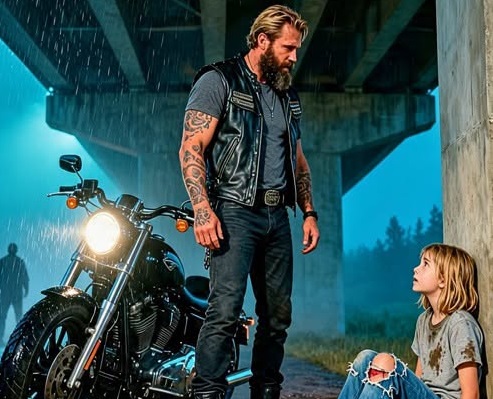
My daughter’s memory was the only reason i stopped beneath that freezing montana bridge. my motorcycle headlight found a hurt little girl hiding in the mud. my brothers thought i was running from grief, but that night proved something worse was chasing her. then i saw her face and heard the name she whispered…………
Part 1….
The bridge was supposed to be empty.
I had ridden that stretch of Montana backroad more times than I could count. I knew every curve. Every broken shoulder. Every dark patch where black ice liked to hide under rainwater and wait for a man to make one lazy mistake.
I almost did not stop.
That is the part that still sits in my chest.
I almost kept riding.
The freezing rain had been coming down for three hours by then, slanting hard across my visor, tapping against my helmet like tiny stones. My Harley’s headlight cut through the dark in one long, shaking tunnel, but everything beyond it was swallowed whole.
Road. Pines. Sky.
All black.
All wet.
All cold.
My name is Ryder Voss. I ride with the Iron Revenants. Some people see the leather, the patch, the bike, and they decide they know the whole story before I ever open my mouth.
Let them.
I had stopped caring what strangers thought a long time ago.
But that night, I was not riding because of club business. Not really. I had told Boone, our road captain, that I had a courier run. Documents. Billing papers. Maybe a pickup along the eastern corridor.
Clean answer.
Simple answer.
A lie with enough truth in it to stand up straight.
Boone had only nodded. He knew better than to press me when I had that look in my eyes. My brothers joked too loud. Drank too hard. Played pool in the compound under yellow lights and wood smoke, pretending all men are built to survive stillness.
I was not.
Stillness made me think.
Thinking made me remember.
And remembering always brought me back to Cora.
My daughter.
Seven years old when I lost her.
Seven.
She would have been fourteen now. I hated that my mind still did the math without asking me. It happened at stoplights. In diners. In the middle of conversations. On long roads where the yellow center line went on forever and there was nothing to do but listen to the engine and regret.
Fourteen.
She might have hated my music by now. She might have rolled her eyes when I asked too many questions. She might have slammed her bedroom door and then opened it ten minutes later because she needed me to fix something.
I would have loved every second.
I never let myself go further than that.
The rain kept coming.
Mean rain.
Montana November rain.
The kind that finds the cracks in leather, slides beneath your collar, and reminds you that a man can cover himself in armor and still not be protected from anything that matters.
My ‘09 Road King growled beneath me. I had rebuilt that bike twice with my own hands. I knew every sound in her engine. Every vibration. Every complaint.
That night, she ran clean.
Too clean for weather that bad.
The bridge appeared suddenly, the way things do in darkness. One second, there was only road. The next, steel rails and concrete rose out of the rain, spanning a swollen drainage creek nobody cared about anymore.
Forty feet across.
No lights.
No traffic.
Forgotten.
That old bridge had been useful once, before the highway bypass went in six years earlier. Now it sat between two stretches of road most people avoided after sunset.
I was already past the approach when I heard it.
A sound.
Small.
Wrong.
I braked before my brain finished understanding why.
The tires grabbed wet asphalt. The back end twitched, then steadied. I pulled onto the shoulder, engine idling, rain hammering around me.
I sat there.
Listening.
Only the storm answered.
Wind through steel. Creek water rushing below. Rain ticking against my helmet. My own breathing trapped inside the visor.
Nothing else.
I looked ahead at the empty road.
I almost rolled on.
Then I heard it again.
Not a word. Not exactly. It was thinner than that. More like the start of a cry that got strangled before it could become one.
My hands tightened on the grips.
I knew that sound.
I had heard it in places I do not talk about. From people who had already learned that calling for help did not always bring help.
Sometimes it brought the wrong people.
I cut the engine.
The silence hit hard.
Huge.
Rain and creek and the slow ticking of hot metal cooling in the dark.
I swung off the bike and walked back toward the bridge. Gravel crunched under my boots. Water ran down my neck. The wind shoved at my shoulders like it wanted me gone.
I reached the railing and looked over.
At first, there was nothing.
Just black water moving fast. Mud slicking the creek bank. Dead grass pasted flat against frozen earth. The weak wash of my headlight barely reached beneath the span.
Then my eyes adjusted.
I saw a shape.
Small.
Hunched against a concrete pylon.
Half hidden where the bridge blocked the worst of the rain, but not enough. Thin streams still fell through the gaps above her. They ran over her hair, her shoulders, her face.
A child.
My heart slammed once.
Hard.
I was over the railing before I thought about the drop.
The slope down was steep and slick. Dead grass tore under my boots. Mud slid beneath me. I half fell the last few feet and caught myself against the pylon.
Then I saw her up close.
And something inside me went cold in a way the weather could not touch.
She was a girl. Ten, maybe eleven. It was hard to tell. Fear does something cruel to children. It ages their eyes while making their bodies seem even smaller.
Her clothes were soaked straight through. Her jeans were torn from the left knee down. Her leg was wrong, bent in a way that made my stomach clench and my breath stop for half a second.
Her shoes were gone.
Bare feet in frozen mud.
Her toes looked pale, almost blue under the weak light.
She shook so hard it did not look like ordinary shivering. It looked like her whole little body was trying to hold itself together and losing.
Then her eyes found mine.
The sound she made was sharp and broken. Not loud. Not full. Just enough to tell me what she expected from a grown man appearing in the dark.
I dropped to one knee immediately.
Hands up.
Palms open.
“Easy,” I said. “I’m not going to touch you.”
She stared at me.
I stayed where I was.
“I’m not coming closer unless you say I can. I just want to talk.”
Her eyes moved fast over me.
The leather. The patch. The beard. The size of me. The way my hands were held. She was measuring every inch like her life depended on reading me correctly.
That hurt.
More than I wanted it to.
“My name’s Ryder,” I said. “I ride motorcycles. I heard you from the road, and I came down.”
The rain dripped from the bridge above us.
I kept my voice low.
“What’s your name?”
She said nothing.
Only breathed.
Fast. Thin. Ragged at the edges.
“You don’t have to tell me,” I said. “That’s okay.”
For a long moment, the creek spoke louder than both of us.
Then her lips moved.
“Nyla.”
Barely sound.
But I heard it.
“Nyla,” I repeated softly.
Not as a question. As proof.
A name matters when the world has tried to make you feel like nobody.
“Okay, Nyla,” I said. “I can see your leg is hurt. I think it might be broken. Can you tell me how long you’ve been down here?”
Her jaw trembled. She tried to answer, but the shaking stole the words.
I watched her fight for them.
This kid had grit.
Whatever had brought her under that bridge had not taken that from her.
“Since…” She swallowed. “Since yesterday.”
Yesterday.
In November.
In Montana.
With no shoes.
Something hot and dangerous moved through my chest, but I kept my face still. I had learned control the hard way. Pain is allowed. Panic is not.
I looked at her feet again.
The clock was running.
“Nyla,” I said, “I need to get you warm.”
Her eyes widened.
I held my hands steady.
“That means I’m going to have to carry you. I know you don’t know me. I know that’s scary. I’m not asking you to trust me.”
Her breathing hitched.
“I’m asking you to let me get you out of the cold.”
She stared at me for a long time.
I could see the decision moving behind her eyes. Not trust. Not safety. Something harsher. The exhausted math of a child with no good options left.
Then she gave one small nod.
I took off my cut before I reached for her.
The leather was heavy. Worn soft from years of road, rain, sun, and engine heat. It smelled like oil, smoke, and miles.
I wrapped it around her as carefully as I could.
She flinched anyway.
I stopped.
“I’m sorry,” I said.
She did not answer.
I slid one arm beneath her, bracing the injured leg as best I could, and lifted her against my chest. She made a tiny sound when the leg shifted.
It cut through me.
I absorbed it and kept moving.
Because the rain did not care.
The cold did not care.
And whoever had left her there might still be close enough to care very much.
The climb back to the road was worse than the descent. Mud sucked at my boots. My knees slipped. The weight of her changed with every step, small but fragile in my arms.
She did not cry.
That scared me more than crying would have.
She pressed her forehead against my shoulder and shook so hard I felt it through my ribs.
When we reached the Road King, I stopped.
That was when the real problem hit me.
A hurt child.
A motorcycle.
Freezing rain.
Black ice.
No proper shelter.
No good way to move her safely.
And no phone signal.
I checked anyway.
One bar flickered, useless and cruel, like the world was admitting I existed but refusing to help.
I looked down the road. Empty.
I looked back at the bridge.
For one second, I imagined headlights appearing behind us. Not help. Not chance. The kind of headlights that arrive because someone realizes what they lost.
My jaw tightened.
“Nyla,” I said, “I’m going to get us somewhere the phone works.”
Her fingers curled weakly into my shirt.
I wrapped my cut tighter around her and tucked her against the bike’s windshield. Then I stood over her as a second shield, my back to the rain, my body taking what weather I could.
I do not remember every mile after that.
I remember the headlight shaking over wet pavement.
I remember riding slower than my fear wanted me to.
I remember counting curves.
I remember watching the signal.
One bar.
Gone.
One bar again.
Then two.
Then nothing.
Nyla’s head rested against me. Too still sometimes. Then trembling again. I kept talking, even when I did not know if she heard me.
“Stay with me.”
Another mile.
“Almost there.”
Another curve.
“You’re doing good, kid.”
The road opened near a ridge where the trees thinned, and my phone finally showed three bars.
Three.
I pulled over so hard the bike fishtailed.
I steadied it, grabbed the phone, and hit the only number that made sense.
Boone answered on the second ring.
“Where are you?”
His voice was sharp. Awake already. Like part of him had been waiting for something to go wrong.
I looked at Nyla.
Then at the road behind us.
Then at the rain swallowing everything.
“About fourteen miles north of the Harlan Bridge on Route 9,” I said.
Continue in the comments 👇👇…
Part 2….
Boone went quiet.
Not long.
Just long enough for me to hear the rain tapping the phone and the weak, broken rhythm of Nyla’s breathing under my cut.
“What happened?” he asked.
I turned my back to the wind and looked down the road again.
Still empty.
But empty did not mean safe.
“I found a girl,” I said. “Under the bridge.”
Another pause.
Then Boone’s voice dropped.
“Alive?”
I closed my eyes for half a second.
“Yes. Hurt. Cold. Barefoot. Maybe ten or eleven.”
Nyla stirred against the bike. Her eyes opened, glassy and scared, and she stared past my shoulder like she saw something I did not.
“Don’t let them,” she whispered.
The words barely made it out.
My hand tightened around the phone.
“Don’t let who?”
Her lips trembled.
She looked toward the bridge.
Then at me.
“The men.”
Boone heard it.
I knew because his breathing changed.
I lowered my voice. “She says men are after her.”
“How many?”
“I don’t know.”
“Vehicle?”
“I don’t know.”
“Names?”
I looked at Nyla.
She had pulled my leather tighter under her chin. Her fingers were so small against the black cut that, for one terrible second, all I saw was Cora. Seven years old. Then fourteen. Then gone again.
I forced myself back.
“Nyla,” I said gently. “Can you tell me a name?”
She shook her head fast, then stopped like the movement hurt.
I thought that was all I would get.
Then her eyes dropped to her own wrist.
There was something there I had missed before. A thin plastic band, half hidden under mud. Not a hospital bracelet. Not jewelry.
A tag.
I wiped it with my thumb.
One word showed through.
VALENTINE.
My stomach went tight.
“Boone,” I said, “there’s a tag on her wrist.”
“What kind of tag?”
Before I could answer, headlights appeared far behind me on Route 9.
Two of them.
Slow.
Searching.
Nyla saw them too.
Her whole body went rigid.
I felt her panic before she made a sound.
“Ryder,” Boone said, “talk to me.”
I looked at the headlights.
Then at the child wrapped in my cut.
Then at the bridge behind us, waiting in the rain like it had secrets buried under every beam.
“They’re here,” I said.
SAY “OK” IF YOU WANT TO READ THE FULL STORY ❤️👇 👇
I need you to text me the closest motel that isn’t on the main strip, something quiet. Cash only. A pause. Boone had known Ryder Voss for 11 years. He knew the voice Ryder used when he was doing something that would require explanation later, and he developed a patience with it over the years that most people hadn’t. There’s a place called the Milestone Motor Lodge, about 8 mi south of you off the Old Mill Road. Vern Hadley owns it.
He’s good people. He won’t ask questions. Call ahead, Ryder said. Already on it. Ryder? Later. He hung up. He made it to the Milestone in 11 minutes. Vern Hadley, a weathered man in his 60s with the careful stillness of someone who had seen enough of the world to stop being surprised by it, met them at the door of the end unit without a word, held it open, and when Ryder carried Nyla inside and laid her on the bed, Vern set a first aid kit and two folded towels on the dresser and said only, “Heat works fine. Hot water takes about
2 minutes. There’s soup in the cabinet above the mini fridge. Then he closed the door behind him on his way out. Some people were built right. Ryder had learned to recognize them and be grateful for them and not interrogate them. The room was small and smelled of old carpet and wood polish and the ghost of 10,000 different nights.
The heat kicked on with a rattle and a smell of burning dust. A single lamp beside the bed through amber light over the worn bedspread and in that light for the first time Ryder could see Nila clearly. She was small for 10. He’d established her age in the car through careful quiet questions. The kind you ask sideways so a frightened child doesn’t feel interrogated.
Dark hair matted with mud and river water. Her face was scratched. A thin cut below her left eye sealed with dried blood. She had the kind of cheekbones that would have made her beautiful when she was older, but right now they just made her look fragile. The skin drawn too tight over the structure beneath by cold and hunger and fear.
She’d stopped shaking as violently once the heat hit her, but her hands still trembled when she moved them and she moved them in small careful ways as though she wasn’t sure what was safe to touch. He worked on her leg with the first aid kit and the two clean sticks he’d found leaning against the back wall. Part of a broken mop handle, good enough for a field splint.
He’d set bones before. Not under these conditions, not on a 10-year-old girl, but the principle was the same and he worked quickly and precisely and talked through what he was doing every step. Not asking permission, but informing her, which was different. She cried once, a single flat sound when he aligned the fracture and then was silent again.
He taped the splint tight and elevated the leg on a folded blanket. “You hungry?” he asked. A nod so small he almost missed it. He found the soup. Tomato, canned, the kind you eat and forget immediately, but it was hot. He warmed it on the single burner and brought it to her in the cup because they didn’t have bowls and watched her drink it in careful small sips, both hands wrapped around the warmth of it.
Her eyes tracked him whenever he moved. She never looked away from him for more than a few seconds. He understood that. He was the unknown variable. You kept your eyes on the unknown variable. “How’d you get under that bridge?” he asked when she was halfway through the soup. The hesitation was long enough that he thought she wasn’t going to answer.
“I ran.” She said. “From what?” Another pause. She looked down at the cup. He waited. “Men.” She said. Then quieter. “They thought I was dead.” “The water.” Her voice was flat in the way voices go flat when they’re describing things that were too large for feeling at the time. “I fell in the creek.
I got out, but I couldn’t walk with my leg. I crawled to the bridge and I hid.” A beat. “I’ve been hiding for a while.” Ryder sat very still. “Before the creek, where were you before the creek?” She set the cup down on the bedspread. Her hands went still. The silence stretched between them like a wire pulled tight.
And Ryder watched her face and understood that whatever was on the other side of that question was the reason her eyes looked the way they did. “A place.” She said finally. “With other kids?” He didn’t press her further. Not then. He’d been trained in ways that had nothing to do with the military and everything to do with years of watching people in crisis, that there was a pace to truth.
Push it and it collapsed. Give it room and it sometimes moved toward you on its own. He got her settled under the blankets. She kept his cut pulled around her even with the sheets, wouldn’t let go of the leather, and turned the lamp down and moved to the chair by the window. Outside the rain was transitioning to snow.
Big wet flakes pressed against the glass and dissolved, then pressed against it again. The neon sign at the road end of the property, Milestone Motor Lodge, No Vacancy, the second O burned out, threw a thin red glow across the parking lot. Ryder sat in the chair and didn’t sleep. He was thinking about what she’d said.
A place with other kids and men who thought she was dead. He’d been around enough of the world’s dark machinery to understand what connected those three elements. He’d seen the signs of it before in people he’d worked with after they’d been through the system and the kinds of jobs the Iron Revenant sometimes got pulled into that left brothers quiet and hard-eyed [clears throat] for weeks.
There was a specific species of criminal enterprise that operated in the invisible spaces of rural America, in the dead zones between small towns where the distance between law enforcement posts was measured in hours rather than minutes, and it ran on silence and fear and the reliable complicity of people who were paid well not to look too closely.
He was still thinking about it at 2:00 in the morning when Nyla spoke from the bed. Are you going to call someone? Her voice was calm. Too calm. The calm of someone who had asked a version of this question before and was braced for the answer. What kind of someone? Police. He looked at her. In the low light her eyes were dark and steady.
I don’t know yet, he said. Why? She was quiet for a moment. Last time, she said, the police were the ones who brought me back. The air in the room changed. Ryder kept his face still and his voice even. Back where? She didn’t answer. She just looked at him with those old eyes and that young face, and he understood that she’d already told him everything she was going to tell him with that single sentence, and that it was enough.
He turned back to the window. The snow fell. The neon sign guttered once, twice, steadied. He didn’t sleep. By morning, the snow had laid 2 in on the parking lot, and the temperature had dropped to 18°. Ryder walked to the diner attached to the motel property at 6:15 while Nyla was still asleep.
The bolt locked behind him, and a chair wedged under the door handle with the kind of force that would wake him from 100 yd. The diner was warm and smelled of coffee and bacon grease, and the particular staleness of a room that has been breathing the same recycled air for decades. Three truckers occupied stools at the counter. A waitress with a practiced invisible face poured coffee without being asked.
He sat in the back booth where he could see the door and drank two cups and thought. He called Boone from the table, voice low, back to the wall. Anything moving? Ryder asked. Nothing on our end. Boone paused. You going to tell me what’s going on? Not on this line. Ryder. Boone’s voice dropped into the register that meant he was serious.
I need something. I’ve got Decker asking questions about where you went last night. Decker. Marcus Decker, the Iron Revenant sergeant-at-arms. A man built like a concrete pillar with the interpersonal warmth of one. He didn’t ask questions because he was curious. He asked questions because he believed information was a form of ownership.
Tell him I’m handling a private matter. He’ll want to know more than that. Tell him I said so. Ryder hung up. He was staring at his coffee cup when he registered the vehicle. Black SUV, clean despite the snow, parked at the far end of the lot with its engine running and its windows tinted dark. It had been there when he walked to the diner.
He’d clocked it without consciously noting it the way you clock things when you’ve spent enough years in environments where noticing things keeps you alive. Now, 40 minutes later, it was still there. Hadn’t moved. Engine still running, rural Montana, 6:00 in the morning, 18°, an SUV with tinted windows running in the parking lot of a forgotten roadside motel.
The waitress appeared at his elbow with the coffee pot. He looked up at her. “That vehicle been there long, say?” he asked, casual, like it was just conversation. She glanced toward the window. The practiced invisible expression shifted fractionally into something more guarded. “Came in about an hour ago,” she said.
“Never saw them come inside.” She moved on. Ryder watched the SUV. He paid in cash and walked back to the room without looking at the vehicle again, which took the kind of deliberate control that left his shoulders tight. Inside, Nyla was awake, sitting up in the bed with the blankets pulled to her chin, watching the door with the attentiveness of a person who has learned to listen for what happens outside closed doors.
“Someone’s in the parking lot,” he said. No preamble. He’d decided on the walk back that she was 10 and sharp and had already been treated like someone who couldn’t handle information, and that had clearly worked out badly for everybody. Her face didn’t change. That scared him more than if she’d flinched. “How many?” she asked.
“One vehicle. Don’t know how many inside.” She nodded once. A small precise motion, and began calculating the same way he was. He watched her do it, and something complicated moved through his chest. Admiration, grief, anger, all compressed into one thing that had no clean name. “They find places like this because they have people everywhere, She she said.
Her voice was matter-of-fact, reciting intelligence rather than expressing fear. Diners, gas stations, motels, they pay people to call when someone comes in with a kid. A pause. Or a kid alone. He looked at her. How long have you known that? A while. She met his eyes. Are we leaving? We’re leaving, he said. He moved fast and quietly, packed what could be packed in 30 seconds, which wasn’t much, rearranged the room to look undisturbed to anyone who glanced through a window, and helped Nyla off the bed.
The splint held. She could put weight on the leg with him beside her, his arm around her waist as a second structure. She was good at moving quietly, better than most adults he’d worked with. They went out the back window. The alley behind the motel row opened onto a service road that ran parallel to the main lot, and Rider’s Road King was parked behind a dumpster.
Habit, not foresight, but the kind of habit that becomes foresight in retrospect. He got the bike running before they came around the front of the dumpster, throttle low, just enough to move. He settled Nyla in front of him on the tank, the position awkward and unorthodox, and the only thing available, her splinted leg braced on the right side.
His arms on either side of her holding the handlebars and forming a cage. He pulled out of the service road onto a gravel track heading south, away from the main road, away from the black SUV and its running engine and its occupants who still hadn’t shown themselves, which was somehow more unsettling than if they had. 3 miles down the gravel track, Rider’s phone buzzed against his thigh.
He rode another half mile to where the track widened at an old fence line and pulled over and checked the screen. Unknown number. A text message. It said, “They know she’s alive. There are more of them than you understand. Do not go to law enforcement. If you want to keep the girl breathing, find me first. W.” He read it twice.
Looked at the empty gravel road in both directions. Looked at Nyla. She was watching him with those gray-green eyes, her breath making small white clouds in the freezing air. His leather coat still wrapped around her like the only solid thing in a world that had turned to water. “What is it?” she asked.
Ryder locked the phone screen and put it back in his pocket. “Someone who says they want to help us,” he said. “Do you believe them?” He started the bike. “No,” he said, “but I’m going to find out.” The gravel road stretched ahead of them into the white and gray morning, snow-covered and trackless. The pines pressing close on both sides, and the sky so low it felt like a ceiling.
Somewhere behind them, the black SUV was in motion. He could feel it the way you feel weather before it arrives. A pressure change in the atmosphere. A certainty that had nothing to do with evidence and everything to do with years of surviving situations where the next move was always the most dangerous one.
He pushed the Road King to 40 and held it there, the engine sound filling the hollow world around them. Nyla’s small back pressed against his chest, her hands gripping the handlebars just below his. He didn’t know where the text had come from. He didn’t know who W was, or what they knew, or what finding them would cost.
He didn’t know how many vehicles were behind him, or how far the network that had held this child extended, or who among the people he might think to call was already compromised. What he knew was the road ahead, and the child in his arms, and the fact that something in him that had been still for years had been hibernating, frozen, closed off behind a wall he’d built one stone at a time after Cora’s funeral, had cracked open in the mud under that bridge and was now running hot and clear and purposeful through him like he’d forgotten it could.
He knew this. He was not leaving her behind. Whatever came next, whatever the road cost, whatever the men in the black SUV were prepared to do, he was not leaving Nyla Reed behind. The pines blurred past on either side. The snow kept falling. The engine kept singing its single sustained note, low and certain and alive.
And somewhere in the trees ahead moving parallel to the gravel track at a distance just beyond visibility, a second engine growled. They were not alone. The second engine wasn’t following them. It was pacing them. Ryder caught the difference at the three-mile mark. The sound staying parallel rather than closing, moving through the tree line at a distance calculated to stay invisible but audible, which meant whoever was running that engine wanted him to know they were there without showing themselves.
That was a specific choice. That was a message. He eased off the throttle and let the Road King drop to 30, then 25, listening. The parallel engine adjusted, slowed with him, still in the trees, still invisible through the wall of snow-laden pines, but present with the consistency of a shadow. Nyla felt the change in speed.
Her hands tightened on the handlebars below his. “Why are we slowing down?” she asked. “Someone’s running alongside us in the trees.” He felt her body go rigid. Not a flinch. She was past flinching, but a specific muscular preparation, the kind that came from practice. She had learned to go still when danger announced itself.
It made him think things about the months before the bridge that he forced himself to file away for later. Later, when there was a later. “Is it them?” she asked. “Don’t know yet.” He pulled the Road King to the edge of the gravel track and killed the engine and sat in the sudden silence with Nyla braced in front of him and both of them listening.
The wind moved through the pines in a long horizontal sweep. Snow fell without sound. The creek was somewhere to the east, audible as a low continuous murmur beneath everything else. The parallel engine had stopped, too. 20 seconds, 30. Then a single deliberate sound. A Harley’s distinctive engine note turned over once and shut off immediately.
Not a threat. Not an approach. An identification. “I’m one of yours.” Ryder exhaled through his nose. He knew that sound, the specific voice of a Softail Slim running a stage two tune, the exhaust note fractionally deeper than stock. He knew it because he’d been present at the bench when that bike had been worked on three summers ago in the Iron Revenants garage outside Harlan.
“Stay on the bike,” he said to Nyla. Then he stood, dismounting in one motion and moving to the tree line with his right hand near the small of his back. He stopped at the edge of the gravel. The pines started immediately past the shoulder, dense and dark. The ground beneath them a mix of snow and brown pine needles.
He waited. A figure emerged from between the trees 12 ft ahead of him. Tall. Lean in the way of a man who had never in his life carried comfortable weight. A face that had been handsome once and was now just specific. Heavy jaw, gray eyes set close, a scar running from the corner of the left eye toward the ear that Ryder had always privately thought looked like a map line.
Denim jacket under leather, no Iron Revenants cut, which was the first wrong note. Fingerless gloves despite the cold, a cigarette burning behind his right ear. Ren Cole. Formerly Iron Revenants, Harlan chapter. Formerly because he’d been patched out 18 months ago under circumstances that had never been fully explained to most of the membership.
Ryder knew the full version and it was complicated in ways he’d spent those 18 months choosing not to examine too closely. He stopped 6 ft from Ryder and they looked at each other in the snow-filtered light of a Montana morning. “You texted me.” Ryder said. “Took you long enough to process the W.” Ren’s voice was the same, low and unhurried with the barely perceptible rasp of a man who had smoked since he was 15 and considered this a character choice rather than a flaw.
He looked past Ryder at the Road King and at Nyla sitting on it, wrapped in the leather cut, watching them with the focused attention of a child who had learned to read situations before the adults in them recognized what they were. Something moved in Ren’s face, brief, controlled, gone. “She’s smaller than I expected.
” “You know who she is?” “I know who she is.” Ren pulled the cigarette from behind his ear, lit it off a match from his jacket pocket, drew the first pull long and slow. He exhaled upward into the cold air. “I know what she saw. I know who’s looking for her and I know what they’ll do when they find her.” He looked at Ryder again.
“Do you know those things?” “Working on it.” “Work faster. The SUV at the motel has already made two calls. They’re pulling in people from Billings and from the eastern corridor. By tonight there will be 12 armed contractors inside a 40-mi radius of wherever you stop.” Ryder felt the number sit on him. 12. Not law enforcement, contractors, which was a specific word choice that told him the kind of resources behind this.
Organizations that used contractors didn’t do it because they were cautious. They did it because they were insulated, because there was enough money between them and the violence to make the violence deniable. “Victor Kane.” Ryder said. Ren’s expression didn’t change, but he drew the cigarette again in a way that suggested the name cost him something.
“You know it.” “I know the name.” “Tell me the shape of it.” Ren looked out into the trees for a moment, somewhere beyond Rider’s shoulder, seeing something at a distance that wasn’t there. Then he brought his eyes back. “Kane runs a network across four states, rural corridors, the dead zones between federal oversight.
He moves product and people through the same infrastructure, trucking, logistics, legitimate businesses as fronts.” A pause, pulling the cigarette. “The people part is what the girl saw. She can place three men by face, and two of them are Kane’s direct lieutenants. One of them is currently holding a position in the county sheriff’s department in Langford County.
” There it was. The reason Nyla’s voice had gone flat when she said, “Last time the police were the ones who brought me back.” “She’s been in it a year?” Rider asked. “14 months. She was taken from a bus station in Idaho. Family reported it, the report was filed, the investigation was assigned to a deputy who is on Kane’s payroll, and the case went cold in 6 weeks.
” Ren dropped the cigarette to the snow and stepped on it with the precise finality of a man closing a chapter. “There are seven other kids across two of the four corridors. She’s the only one who’s been in a position to identify the structure.” His eyes stayed steady on Rider’s, “which is why she’s worth more dead than she is worth recovered.
” The pine trees moved around them. The wind came through in a long corridor between the trunks, and Rider felt it cut through his flannel and didn’t feel the cold, was beyond the cold, operating in that space where the body’s thermometer stops registering because other systems have taken priority. “Why are you here?” Rider asked.
Not hostile, specific. He needed to understand the geometry of this. Ren was quiet for a beat. I’ve been watching Cain’s operation for 8 months. I’ve got contacts inside. When she went into the creek, one of my contacts sent me the location. He looked toward Nyla again. I thought she was dead. When I picked up your Road King on a traffic camera heading south on Route 9 with a passenger, he stopped, started again.
I was already in the area. That’s not all of it. Ren looked at him, a long look, level and unrevealing, the look of a man who has built his entire survival strategy around the gap between what he knows and what he shows. “No,” he said, “that’s not all of it.” He left it there. Ryder let him. “What do you need from me?” Ryder asked.
“I need you to keep her alive for 48 hours. I have a contact, federal level, not local, not state, completely outside Cain’s reach, who can take everything I’ve built over 8 months and use it, but she’s the connective tissue. She’s the witness that makes the network real.” Ren held his gaze. “I need 48 hours and I need her breathing at the end of it.
” Ryder looked at the man he had once considered something close to a brother and calculated the distance between past and present and the things that had happened in the 18 months between them. “And the club?” he asked. The word landed between them with weight. Ren’s jaw moved. “The club doesn’t know about this.
” “Boone knows I’m out here.” “Boone knows you’re handling a private matter. That’s different.” A pause. “Marcus Decker cannot know. You understand what I’m saying?” Ryder understood. He understood it in the specific, detailed way of a man who knew Marcus Decker not as an idea but as a physical reality.
The particular density of him, the way he occupied a room, the fact that Decker’s loyalty to the Iron Revenants was absolute and undiluted by anything as inconvenient as ethics. Decker knew things. And Decker’s circle of knowledge occasionally intersected with people who paid well for information about freight moving through the rural corridor.
He hadn’t let himself think about that intersection directly before now. “48 hours,” Rider said. “48 hours.” He went back to the Road King and stood beside Nila. “That man,” she said immediately. “Do you trust him?” “No,” Rider said. He swung onto the bike. But I trust what he’s scared of. That’s something. She thought about that for a second, then she settled back against him as he started the engine.
“Okay,” she said and nothing more. They rode south. He mummed. The Iron Revenants secondary safe house was a property nobody in the chapter officially acknowledged. A working farmstead 12 miles outside Harlan deeded under a holding company name that Rider knew belonged to the chapter through three layers of paper separation. He’d used it twice before.
Once after a job in Wyoming that had gotten complicated. And once when he’d needed 3 days to think without anybody knowing where he was. It had a kitchen, a wood stove, and a back bedroom with one window and heavy curtains, which was what he needed right now. He called Boone from the road. “I need the Alderman property for 2 days.
” A silence that contained several separate calculations. “The Alderman property,” Boone repeated. Not a question, confirming he’d heard correctly. “Yeah.” “That’s going to get back to Decker.” “I know.” “Rider, I need you to give me something. I’m trying to run interference, but if Decker comes to me directly tell him it’s a safe extract.
Someone brought me a situation and I’m sitting on it for 48 hours while it resolves.” He let that land. “That’s true.” A longer silence. “Is it ours?” Boone asked. Meaning, is this an Iron Revenants matter? Meaning, do we need to bring it to the table? “Not yet.” Ryder said. “Maybe not ever.” He could hear Boone thinking.
Boone was a careful man, had been a careful man for a long time. The kind of careful that came from watching impulsive men destroy things around them and deciding early that patience was a form of power. He’d been road captain for 6 years. He held the club’s practical machinery together with the same quiet consistency that a load-bearing wall holds a house, invisible until it’s gone.
“24 hours.” Boone said finally. “Then you call me with something real.” “24 hours.” Ryder said. He made it to the Alderman property by noon. The farmhouse sat at the end of a half-mile gravel drive flanked by dead cornfields, the stalks broken and gray against the snow. The house itself was white clapboard gone slightly yellow.
A porch that listed to the left, windows with the milky quality of old glass that had been cold for a long time. There was a barn behind it that the club used for storage. There was a generator and a 2-month food supply and a wall safe in the master bedroom closet that contained things Ryder didn’t need to know about.
He got Nyla inside and settled her on the couch in the main room with the wood stove going. He’d built the fire in 7 minutes, the efficiency of someone who has done it a thousand times in conditions where speed matters, and found soup again and crackers and a blanket that smelled of cedar from the chest at the foot of the bedroom.
He re-examined the splint. The leg was holding. She needed a real doctor, but she was a long way from that right now, and she seemed to understand that in the practical, unglamorous way she understood most things. Ren arrived 40 minutes after them in a truck he’d clearly borrowed or acquired. A Ford F-150, decade old, plates from a different county.
He came inside without being invited and without ceremony and went directly to the kitchen table and spread out what he’d been carrying in a canvas satchel. Printed pages, photographs, a hand-drawn diagram on legal paper, two USB drives, and a burner phone. Ryder stood in the kitchen doorway with his arms crossed.
“Show me the shape,” he said. Ren talked for 20 minutes. He talked the way he’d always talked, economically, without performance, laying information down in order of operational relevance rather than dramatic weight. Ryder listened and watched the pictures and the diagram and built the structure of it in his head the way he’d been trained to build enemy positions in his military years, locating the load-bearing points first and working outward.
Victor Cain, 43 years old, legitimate face, logistics company, three warehouses across two states, government contracts for agricultural transport. Illegitimate interior, the same warehouses, the same trucks, the same drivers, supplemented by a recruited network of rural contractors who move secondary freight.
The secondary freight was children. The route ran north to south along the rural corridor, drawing from five source points, bus stations, transient motels, drop points at truck stops, and terminating at two end points that Ren had not yet fully identified. Cain himself was three layers removed from operational contact.
His name appeared nowhere near the actual machinery. The men who ran the practical side, the recruiters, the drivers, the guards, knew Cain only as a voice on a phone, filtered through layers of middle management. Two of those middle managers were the men Nila had seen. Their names were in Ren’s file. Their photographs were on the table.
Nila had come to the kitchen doorway while Ren was talking. Neither man had told her to stay away. She stood there in the cedar-smelling blanket and looked at the photographs on the table. And when her eyes found the two faces she’d been described as being able to identify, her expression did not change at all.
She just looked at them with that same flat processing steadiness she brought to everything. “The one on the left,” she said, “his name is Garrett. He smells like clove cigarettes.” She looked at Ryder. “He was the one who drove me from Idaho.” Neither Ryder nor Ren said anything. Ren reached out and turned the photograph face down on the table.
A small gesture, the only one available. “Go back to the couch,” Ryder said, not harshly. She went. He watched her go, the careful gait with the splinted leg, the blanket trailing. He turned back to Ren. “Who’s your federal contact?” “A woman named Sorenson, Deputy U.S. Marshal, currently detailed to a task force that’s been building a parallel case on Kane’s legitimate business structure.
They have the tax records and the shipping manifests and the financial architecture. They’re missing the human trafficking component because there’s been no surviving witness who can speak to it directly.” Ren looked at him across the table. “Nila Reed is the surviving witness.” “How long to get her to Sorenson safely?” “That’s the problem.
” Ren put both hands flat on the table. “Sorenson is in Billings. Billings is currently the location of at least four of Kane’s contractors. The direct route is compromised. I’ve been trying to find a secondary route for 6 hours.” “What’s the timeline before the contractors saturate the region?” “Tonight.
By nightfall, they’ll have coverage on every main road within 60 miles. By tomorrow morning, the rural secondaries.” He paused. “We have one window. Tomorrow, just before dawn. There’s a rest stop on the old route 3 corridor, 40 miles north of Billings, where Sorenson is willing to meet if we can get there.” Ryder looked at the diagram.
40 miles north of Billings, moving through a county where Cain’s network had demonstrated reach. Before dawn, with a 10-year-old with a broken leg on a motorcycle or in a stolen truck. “I’m going to need the club,” he said. Ren didn’t answer immediately. “I told you what “I heard what you told me. I’m telling you the math.
” Ryder kept his voice level. Two men and one vehicle can’t run through a network with 12 contractors. I need riders on the roads. I need eyes on the intersections. I need the kind of presence that makes people think twice about moving. If you bring the club in, you’re exposing them to Cain’s network, and you’re exposing the operation to whoever in the club might be passing information.
” The sentence laid itself down between them like something that had been waiting a long time to be said out loud. Ryder looked at him. “Say it directly,” he said. Ren’s gray eyes were steady. “You know what I’m saying.” “Say it.” A beat. “Marcus Decker,” Ren said, “has been receiving payments from a logistics intermediary connected to Cain’s operation for 11 months.
I have three confirmed transactions. I don’t have proof of what he delivered in exchange, but I have the financial record, and I have the timing, and the timing lines up with two situations where operations that the club was adjacent to developed problems that looked a lot like information leaks.” The kitchen was very quiet.
Outside the wind pressed against the old glass in the windows with a high, thin sound. The wood stove in the other room made its consistent low rumble. Somewhere down the drive, nothing was moving, which was what you wanted and still didn’t feel like enough. Ryder had known Marcus Decker for 9 years, had ridden with him, worked beside him, trusted him with the kind of operational weight that clubs only assigned to men they’re certain of.
Decker was present at the table when jobs were discussed. Decker knew the safe houses. Decker knew Decker knew the Alderman property. The thought arrived and sat in Ryder’s chest like something swallowed wrong. He turned and walked to the front window and looked down the long gravel drive to the empty road beyond the dead cornfields.
Nothing visible. Just gray sky and white ground and the thin dark line of Route 9 half a mile out. He stood there for 30 seconds with his hands at his sides and his breathing very controlled. Then he took out his phone and called Boone. Boone picked up on the first ring. Decker asked about the Alderman property 10 minutes ago.
Boone said before Ryder could speak. I told him you were sitting on an extract and it was quiet. He didn’t say anything and walked away. Where is he now? He took his bike out about 20 minutes ago, didn’t say where. Ryder looked at the gravel drive. Call everyone you trust, he said. Not the table, boss, specific people. Hendrix, Luca, Priest if he’s in the county.
Tell them I need them at a location. I’ll text you in 10 minutes. This is happening, Boone said. Not a question. This is happening. Do I need to know why? Yes, Ryder said. But not on this line. He hung up and looked at Wren, who had been standing in the kitchen doorway listening to the one side of the conversation he could hear, and whose expression had shifted into something complicated.
Relief and dread occupying the same territory, neither one fully winning. You said you didn’t want to bring the club in.” Ryder said. “I said it was a risk.” “It’s a risk either way now.” He moved back to the table and picked up the photograph of the man Nyla had named Garrett and looked at it. Then he set it down. “Decker knows this location.
That means we move in the next 2 hours.” Ren nodded once. “Where?” Ryder asked. “I have a place. Old auto body shop outside of Granger. Been closed 3 years. The owner is a former club associate who doesn’t ask questions.” “How far?” “52 miles.” 52 miles of snowed-over backroads with a child who had a broken leg and contractors moving to saturate the region before nightfall.
52 miles if the route was clean, which it would only be if Decker hadn’t yet made contact with whoever he was going to call. Ryder went to the back bedroom and retrieved the go bag he’d assembled since arriving. Food, water, the first aid materials, the burner phone Ren had left on the table, the USB drives containing Ren’s 8 months of documentation.
He stood at the foot of the bed for a moment and thought about Cora the way he almost never let himself think about her directly, fully, with the lights on. He thought about the morning they’d found her. The impossible smallness of the situation. The way the world had simply continued around it.
Traffic moving outside, birds present, the unreasonable persistence of everything that wasn’t that moment. He’d stopped being able to live inside ordinary time after that. He joined the Iron Revenants not because he’d believed in what they were, but because they’d given him a structure to exist inside when his own had dissolved.
He thought about Nyla on the couch in the other room drinking soup from a tin cup with her splinted leg elevated on a folded blanket watching the fire with those old processing eyes. He picked up the bag and walked back out. She was already standing. She’d known without being told. The blanket was folded on the couch.
Her injuries managed with the matter-of-fact practicality. He was beginning to understand was just how she moved through the world. “We’re going again?” she asked. “We’re going again.” She held out her hand. The gesture was simple and unrehearsed, and it hit him somewhere below the sternum with a force that had no relationship to anything rational.
He took her hand and they walked to the door. The three of them went out into the cold. Ren’s truck was behind the barn. They loaded into it, Nila in the middle, Ryder passenger side, Ren driving, and pulled down the gravel drive to the road. Ryder watched the mirror all the way down the half mile, watching the farmhouse reduce behind them, watching the empty road in both directions.
At the end of the drive, Ren stopped before pulling onto Route 9. A mile to the north on the route, a single headlight was visible, moving south at speed. A motorcycle. Ren looked at Ryder. Ryder looked at the headlight. “Is that Ren started. “South.” Ryder said. “Now.” Ren turned south. The truck accelerated on the snowed-over asphalt, rear tires tracking sideways for a half second before catching.
Ryder watched the mirror. The headlight turned onto the gravel drive behind them a half mile back, now moving toward the farmhouse they’d just left. Nila looked at him. She didn’t ask. She’d learned when to ask and when to just watch the adults manage what they were managing. Ryder faced forward.
His phone buzzed, Boone’s number. He answered. “Decker just radioed me,” Boone said. His voice was careful in a way Ryder had never heard from him. “He said he found your location and you’d already moved. He wanted to know if I had another location for you.” A pause that contained everything. “Ryder.” He asked in a way that wasn’t asking as a brother.
The truck moved south through the white corridor of Route 9. The farmhouse was behind them. The headlight was at the farmhouse, and somewhere ahead were 52 miles of road that might or might not be clean. “What did you tell him?” Rider asked. “I told him I didn’t know.” Boone’s voice dropped another register.
“I need you to tell me right now if what I’m thinking is what’s happening.” Rider looked at the road ahead, at the snow coming down in the headlights, at Nyla’s small profile beside him, her face turned forward, her hands folded in her lap with the careful stillness of someone who had survived this long by being very very quiet when it mattered.
“Yeah,” Rider said. “It’s what you’re thinking.” The silence on the line was the kind that preceded a man reorganizing everything he thought he knew about the world he lived in. “Hendricks and Luca are already moving,” Boone said finally. “Priest is 20 minutes out. I’ll send you the coordinates.” A pause. “And Rider?” “I’m going to need a conversation when this is done.
” “You’ll get one,” Rider said. He put the phone in his pocket. Ren drove. The truck’s heater ran loud. Nyla’s shoulder was warm against Rider’s arm. Outside, the snow kept coming down, patient and indifferent, covering everything equally. The roads, the fields, the gravel drive they just left, the tracks of a motorcycle turning in where they’d been, the whole blind and complicated landscape of what was happening to all of them.
30 miles to go. Rider’s phone buzzed again. Unknown number. Different from Ren’s morning text. He opened the message. It read, “She’s not the only witness. There’s a boy. Kane knows this now. He’s changing the protocol. Before dawn tonight, they move the others.” He read it twice. He read it three times. The others.
Seven other kids across two corridors, Ren had said. Moving them meant losing them. Losing the locations, losing the trail, losing the window that Ren’s 48 hours was built around. He showed the phone to Ren without a word. Ren read it. His knuckles went white on the wheel. “Who sent this?” Rider asked. “My contact inside.” Ren said.
His voice had dropped to something barely above a breath. “Which means Kane already knows we’re moving, which means which means 48 hours just became tonight.” Rider said. The truck ran through the dark and the snow, and somewhere ahead the old auto body shop waited in a town that didn’t know what was coming.
And somewhere behind them, the countdown that had already been running accelerated past the point where caution was still an option. And Rider Voss, who had spent 7 years convincing himself that nothing was worth fighting for anymore, felt something close to the opposite of despair move through him. Cold and clean and certain, like a road you’ve been on before and finally recognize.
There was no more waiting. There was no more calculating. There was no more thinking about what this was going to cost. Tonight, they moved. And whatever came at them in the dark was going to find out that the man they’d been hunting was done running. The auto body shop in Granger smelled like motor oil and rust, and the specific cold of a building that hadn’t been heated in 3 years.
Ren pulled the truck around back, off the road, into the darkness behind a chain-link fence that had half collapsed under a winter’s worth of snow, and hadn’t been repaired because nobody was coming here anymore. The building itself was a low rectangle of corrugated metal siding. Two bay doors facing west, a side entrance with a padlock that Ren opened with a key he kept on a ring with nothing else on it.
Rider noticed that. A single key on a ring, no others, and filed it without comment. Inside, two empty lifts, a part shelf running the length of the back wall, a workbench with its tools gone, but the outlines of them still present in the pegboard’s painted silhouettes. A hanging fluorescent light in the first bay that Wren reached up and switched on, and it came alive with the flickering reluctance of a light that hadn’t been used in months, throwing pale yellow across the concrete floor and the oil stains that no amount of
time would fully erase. Ryder helped Nyla inside and settled her on a mechanic’s stool against the back wall, elevated her leg on an overturned plastic crate, and checked the splint without speaking. She watched him work with her hands folded in her lap. “It still hurts,” she said. Not a complaint, a medical report.
“I know.” He pressed two fingers gently along the outside of the calf, feeling for heat. The swelling was stable, not great, but stable. “You’re doing good.” She looked at him in a way that said she knew he was simplifying, but appreciated that he was trying. Hendrix arrived first, eight minutes after them, his Harley’s exhaust note filling the alley before he cut the engine.
Ryder heard him come up the side of the building and unlocked the side door before he knocked. Hendrix was a compact man, mid-40s, a face that looked like it had been through a series of unplanned structural renovations over the years. Nose broken and reset, scar tissue over the left brow, permanent squint from years of riding into wind. He came inside and looked around, and looked at Nyla, and then looked at Ryder with a question in his eyes that he was disciplined enough not to ask out loud yet.
Luca was four minutes behind him, younger, 29, a second-generation club member who had his father’s broad shoulders and none of his father’s patience for ambiguity. He came in already reading the room. Ren at the workbench with his papers and drives, Nyla on the stool, Rider standing with the go bag on the floor beside him, and his face settled into the specific blankness of a man deciding to hold his reactions until he had more information.
Priest was last. He was 61 years old, had been riding since he was 16, and had a quality of stillness that made rooms feel quieter when he entered them. He’d earned the road name not for any association with organized faith, but from the way he conducted himself at funerals, of which the club had seen too many.
He came in, looked at each person in the room in sequence, and then sat on the edge of the workbench with his arms crossed and waited. Boon was not here. Boon was staying at the chapter compound, maintaining the appearance that nothing unusual was happening, which was the most valuable thing he could do right now, and they all understood it.
Rider told them everything. He didn’t condense it, and he didn’t soften it. He laid it down the way Ren had laid it down for him, in order of operational relevance, starting with Nyla under the bridge, and ending with the text message about the other children and Cain changing his protocol before dawn. He watched their faces while he talked.
Hendrix went still. Luca’s jaw tightened progressively over the course of the telling. Priest didn’t move at all, which with Priest meant he was processing at full capacity. When Rider got to Decker, the room changed temperature. He said it plainly. Decker had been receiving payments connected to Cain’s network for 11 months.
Decker knew the Alderman property. Decker had arrived at the Alderman property within 20 minutes of their departure, which either meant he’d been monitoring Boon’s communications or he’d already known from another source that they were there. Luca stood up from the crate he’d been sitting on. “You’re sure?” he said, not asking Ryder, asking Wren.
Wren didn’t flinch. “Three transactions, documented. Two of them I can tie to operational timeline failures that cost this chapter.” “Which failures?” Wren looked at him. “The Rollins situation and the thing in December with the Casper delivery.” Luca made a sound that wasn’t quite a word.
He turned and walked to the far bay door and stood facing it with his back to the room. Both hands pressed flat against the cold metal and the sound of his breathing was audible in the silence of the shop. Hendrix hadn’t moved. His eyes had gone to a place beyond the room. “The Casper delivery,” he said. His voice was measured with the effort of keeping it that way.
“My brother was on that run.” “I know,” Wren said. “My brother came home with two broken ribs and a concussion because the contact point was hot when it shouldn’t have been.” “I know.” Hendrix looked at the floor. A muscle worked in his jaw. Then he looked up at Ryder. “What do you need?” That was Hendrix. Ryder had always respected that about him.
The ability to absorb catastrophic information and redirect immediately toward function. Grief was real with Hendrix. He just refused to let it park in front of the door while the door needed to be open. “I need eyes on the road west of here and the Route 3 approach from the south,” Ryder said. “I need someone who can move fast and quiet if the route develops problems and I need it done without touching the club’s usual communication channels.
“Burners only,” Priest said from the workbench, his first words since arriving. “We go dark on everything else.” “Agreed.” “What’s the timeline?” Hendrix asked. “The meet point is 40 mi north of Billings. Wren’s contact, the federal marshal, is willing to move to us if we can get Nyla to the Route 3 rest stop before 5:00 a.m.
Ryder looked at his watch. It was 9:47 p.m. 7 hours. And the other kids, Luca said from the bay door. He turned around. His face had reset into something harder and more specific than anger. The flat determination of someone who has located a purpose and locked onto it. The text said Kane is moving them before dawn.
Ren’s contact may be able to trigger a parallel action if we can get Nyla to the meet point and establish the witness testimony. Ryder looked at Ren. That’s how this works, right? Nyla is the trigger. Nyla’s testimony combined with my documentation gives Sorenson enough to move on the network simultaneously across all four corridors, Ren said.
It has to be simultaneous or they scatter. Kane has a protocol. If one piece of the network goes down, the others go dark within hours. So, we get her to Sorenson, Hendrix said, or all of it disappears. All of it disappears, Ren confirmed. The fluorescent light flickered once, steadied. Priest unfolded his arms and stood from the workbench with the deliberate economy of a man who has made a decision and is now moving to execute it.
I’ll take the western approach. 2 miles out, parking lot of the old grain co-op. I can see the Route 9 intersection from there. Luca, Ryder said, south. Luca nodded without speaking and picked up his helmet from the floor. Hendrix, you’re with me and the girl. Ryder picked up the go bag. Ren drives. Ren had been pulling his papers together at the workbench, ordering the USB drives into a waterproof case he’d produced from the satchel. He looked up.
One more thing, he said. His voice had taken on a quality that made every person in the room pay attention before he continued. Because Ren Cole did not use that voice casually. The text I received tonight, the one about Cain changing the protocol, I need to tell you where that came from. Nobody spoke. There’s a woman named Carla Voss, Ren said. He looked at Ryder.
She’s been inside Cain’s logistics network for 6 months. She’s the one who alerted me to Nyla’s location when the girl went into the creek. A pause, small and devastating. She reached out to me 8 months ago because she was trying to find a way out of the network, and she needed someone who could help her do it without Cain knowing.
Was it Ryder had not moved? His body had become very still in the specific way of a person absorbing a frequency they didn’t expect. Voss, Hendrix said, and looked at Ryder. That’s a common name, Lucas said carefully. Ren kept his eyes on Ryder. Her husband was killed in a traffic accident 6 years ago. She had a daughter named Cora. Cora died in the same accident.
He stopped. After that, she she ended up somewhere she never should have ended up. Cain’s network picked her up through a legitimate trucking job that wasn’t legitimate. By the time she understood what she was inside, she was too deep to walk out. The fluorescent light hummed. Ryder’s ex-wife was named Carla.
Had been named Carla Voss before the divorce, which had happened 4 months before the accident, which meant she’d gone back to Voss as her name after. He had not had contact with her in 6 years. He had not known where she was. He had not let himself look, because looking meant confronting the question of whether the accident that had killed Cora would have happened differently if he’d been there.
If the divorce hadn’t happened, if he’d come home from the job he’d been on, if any of the choices he’d made in the 18 months before had been different choices. He had built a wall around that question and lived behind it for 6 years. She’s inside Cain’s network, Ryder said. His voice was completely level.
The levelness cost him. “She has been for 5 years,” Ren said. “She came to me because she’d seen my name in the Iron Revenant’s peripheral network, and she knew we had a history. She didn’t know I was in contact with you.” His jaw moved. “I didn’t know how to tell you.” “For 8 months?” Ryder said. “For 8 months?” Nyla had been watching this from her stool against the wall.
Her eyes moved between Ryder and Ren with the careful tracking of a child who understood that what was happening between the adults in this room was not about logistics anymore. She didn’t speak. She pulled her knees, the one that could bend, up to her chest and made herself smaller in the way children do when the adult world becomes too large around them.
Ryder picked up the go bag from the floor. He picked it up and held it and stood there for a moment that stretched. Then he said, “Where is she right now?” “One of Cain’s transit points,” Ren said. “A property outside Langford. 40 miles east of the Route 3 rest stop.” He paused. “Ryder, the priority has to be I know what the priority is.
” He looked at Ren with a directness that ended the sentence. “After we get Nyla to Sorenson. After you tell me exactly where that property is.” Ren held his gaze for a moment, then gave a single nod. Priest, Luca, and Hendrix had the sensitivity to find something else to look at during this. It was a small grace, and Ryder registered it without acknowledging it.
“We move in 20 minutes,” he said. He went to the side wall of the shop, away from the others, and stood with his back to the room for 90 seconds. He breathed in and out, carefully, the way he’d learned to breathe in places where losing control meant losing everything. He put Carla in a room inside his chest, closed the door, and walked away from it.
He had done this before with other things. He knew the room would not stay locked. He knew it would come open later at some moment when he was least prepared and everything inside it would come out at once. But later was later. Right now was the 40 miles ahead of them, the 7 hours, the 10-year-old girl on the mechanic’s stool who was the hinge on which everything turned.
He came back to the group. Nila was watching him. He met her eyes and held them for a moment and whatever she saw in his face settled something in hers. She unfolded from the stool and stood up and held out her hand again, same as before, simple and unrehearsed. He took it. They were 8 minutes from moving when Ryder’s burner buzzed.
He answered it expecting Boone. It was a voice he didn’t recognize, male, calm, the particular calm of someone who doesn’t feel the need to perform threat because the threat is already established. “You’ve been busy,” the voice said. “I appreciate the energy. >> [clears throat] >> I want you to know I’m not angry. Business is business and you’ve been operating on incomplete information, which I understand makes people make poor decisions.
” A pause. “My name is Victor Cain.” The shop went quiet. Ryder had not put it on speaker and didn’t now, but the quality of his stillness communicated to every person present that the call was significant. “You have the girl,” Cain said. “I have someone you want back. I think we can find an arrangement that satisfies everyone’s interests.
” Ryder said nothing. He was thinking about the burner phone. This number was new, pulled from Ren’s supply, not connected to anything, which meant Cain either had the ability to monitor the region cell traffic at a level that went well beyond what a logistics operation should have access to or someone in the building or connected to it had communicated this number in the last hour.
He looked at the room. Hendrix at the bay door, Luca checking his bike. Priest with his eyes already on Ryder, already reading the situation. Ren at the workbench. Ren at the workbench with his phone in his hand. Ren whose phone was face down on the workbench surface. Ren who had looked down at the workbench surface 30 seconds before Ryder’s burner rang.
“What arrangement?” Ryder said into the phone. “Keep him talking. Get information.” “Simple. The girl to me, your ex-wife to you. No further involvement for you or your club.” The voice was patient, reasonable. The voice of a man who had conducted many negotiations and found patience more efficient than aggression.
“I have no particular interest in the Iron Revenants. You’re peripheral to my concerns. I want the witness and I want the documentation your friend has been building and then your lives return to exactly what they were.” “And the other kids?” A brief silence. “That’s not your concern.” “It is now.” A longer silence.
When Kane’s voice returned, the reasonableness was still present, but something underneath it had shifted very slightly, like a reading that has changed 1°. “Mr. Voss, I’ve been in this business for 14 years. I’ve had 14 years of people who decided to make things that weren’t their concern into their concern.
I want you to think very carefully about the sample size of people who came out of that decision intact.” “I’m thinking about it,” Ryder said. “Good. You have 1 hour to communicate your decision to the number I’m calling from. After 1 hour, the terms change.” The voice paused. “The girl is brave. She’s had a difficult year.
I would very much prefer not to add to that difficulty, but preference is not policy, Mr. Voss. I hope you understand the distinction.” The call ended. Ryder lowered the phone. He turned and looked at Ren Cole across the width of the auto body shop, across the oil-stained concrete in the yellow fluorescent light, and the look he gave him was not angry.
It was past angry. It was something quieter and more final than anger. The thing that comes when a man has confirmed what he was already afraid was true and finds the confirmation less surprising than he’d hoped. Ren set his phone face up on the workbench. His expression was complicated in ways that Ryder didn’t have time to fully read.
“He had this number in the first 60 minutes,” Ryder said, “before Priest or Luca got here.” That’s a very short list of how he got it. “I know how it looks,” Ren said. “Tell me how it isn’t.” Ren was quiet for a moment. He ran his hand across the back of his neck and looked at the floor and then looked up. “I was inside Kane’s network before I was outside it,” he said.
“I built the inside access by being inside it. I had to give him things, smaller things, to protect bigger things.” He stopped. “3 months ago, I gave him a communication protocol, burner number generation sequence, to establish my credibility. I didn’t know he’d reverse engineered it to monitor new numbers generated from the same source.
” He looked at Ryder. “I didn’t know. I understand why you don’t believe that.” “You were feeding Kane information,” Luca said from across the room. His voice was flat and precise. “While building a case against him.” “You were feeding him.” “Controlled information.” “Managed.” “The Rowland situation,” Hendrick said very quietly.
“Was that controlled?” Ren looked at him. Something behind his eyes shifted. “No,” he said. “That one got away from me.” The silence in the shop was total. Priest, who had been still this entire time, moved. He walked across the shop floor to where Ren was standing and stopped 18 inches from him and looked at him for for long moment, not threatening, measuring.
Priest never wasted violence. He used it precisely like a tool with a specific application, and the moment before he decided whether this was an application was always very quiet. “The federal contact,” Priest said. “Sorenson, is she real?” Ren met the old man’s eyes. “Yes.” “Kane just offered Ryder an exchange, the girl for the ex-wife.
If your contact is real, what does Kane gain by making that offer instead of just taking the girl?” Ren blinked, and Ryder saw it. The moment when Ren’s expression changed because the question had arrived at something he hadn’t fully processed yet. “He doesn’t know where we are,” Ren said slowly. “He traced the number, but he can’t pinpoint the location yet.
The offer buys him time,” Ryder said. “Time. He’s stalling. The contractors aren’t in position yet.” Ren straightened. “Which means we’re still inside the window.” “Barely,” Hendrick said. Ryder looked at the clock on the shop wall. It had stopped, hands fixed at 3:18 from 3 years ago, but his watch read 10:41 p.m. 6 hours and 19 minutes to the route 3 meet point.
40 miles of compromised road. “Ren,” he said. “Is Carla at the Langford property right now?” “As of 3 hours ago, yes.” “Is she there as staff or as” “Staff,” Ren said. “She drives. She doesn’t participate in the other side of it. She’s never” He stopped, understanding that the distinction, however real, was not the point right now. “She drives the legitimate freight.
She’s been trying to find a way out for 2 years, and she can’t because Kane doesn’t let people leave.” Ryder processed that. “If Kane is stalling us and the contractors aren’t in position,” Priest said, “we move right now, not in 20 minutes. Now. “We can’t all run together,” Lucas said. “One vehicle with the girl, separate riders on the approach roads.
If they’re scanning for a convoy, we split the signal.” “Ren drives Nyla and me,” Rider said. “Nyla doesn’t move without me.” He looked at the three riders. “You’re not escort, you’re distraction, if it comes to it. You do not engage unless there’s no other option, and if there’s another option, you take it. This is not a fight tonight.
” He looked at each of them. “Tonight is a delivery.” Hendrix gave a short nod. Luca pulled his helmet on. Priest was already at the side door. Rider went to Ren and stood close. “What you were inside of,” he said, his voice low enough that only Ren heard it. “How deep it went and for how long?” “We’ll have that conversation when this is done. You and me.
But right now, I need to know one thing.” Ren waited. “Sorenson, you call her right now, in front of me, and you confirm the meet point, and you confirm she’s moving, and I listen to every word of it.” Ren held his gaze for a moment. Then he took out his phone and dialed. It rang twice. A woman’s voice, alert despite the hour, professional in the way of someone who had been waiting for this call.
“Ren.” “We’re moving,” Ren said. “Route 3 rest stop. We need 5:00 a.m. or as close as we can get. The witness is intact, and we have the documentation.” A pause on the line. “Papers? Movement?” “I can have two vehicles at the rest stop by 4:30. I need you to know that I’ve had communication from the regional field office suggesting someone has been monitoring my case files.
” Her voice dropped slightly. “I don’t know how deep the compromise goes on the law enforcement side. My team only. Nobody else knows the meet point.” “Understood.” “Ren.” “Is she okay? The girl?” Ren looked at Nyla who was standing beside Ryder with her hand in his, watching the phone with those precise measuring eyes.
She’s standing up, Ren said. Good enough. 4:30. Don’t be late. The call ended. Ryder stepped back. He looked at Nyla. Ready? He asked. She looked up at him and then for the first time since the bridge for the first time since the mud and the cold and the broken leg and the creek and the 14 months before the creek she gave him something that was not quite a smile, but occupied the same territory.
A small thing, barely a shift in the muscles of her face. But real. Let’s go. She said. They went out into the cold Montana night. The bikes started up one by one in the alley. Their exhaust notes filling the frozen dark and the sound of them moved through Ryder’s chest the way it always had. That particular resonance that was the closest thing he had to a home.
He helped Nyla into the truck. He climbed in beside her. Ren was already starting the engine. 40 miles. 4:30 a.m. Six other children somewhere in the dark in motion now or about to be moved by men who had decided they were freight. And somewhere 40 miles east at a property outside Langford, a woman named Carla Voss was driving trucks for a man who didn’t let people leave and had been doing it for 5 years and had reached out through the only connection she had left because she was trying in the only way available to her to The truck had been
running 17 minutes when the first headlights appeared behind them. Not one set. Two. Spaced wide apart, moving in the coordinated way of vehicles that were communicating with each other, holding distance, holding formation, neither accelerating nor falling back. Professional spacing, the kind you learned or the kind you were taught.
Ren saw them in the mirror first. He didn’t say anything. He just adjusted his grip on the wheel and his foot came off the accelerator by a fraction, and Rider, who had been watching the mirror from the passenger seat, registered the change in engine note before he saw the lights. “How long?” Rider said. “Since the grain co-op.
” Ren’s voice was flat. “They were parked dark. Picked us up when we passed.” Which meant they had the general area, but not the shop’s exact location, which was the only piece of information that still mattered about the last 3 hours. And it was a small piece. Rider’s burner buzzed. “Hendrix.” “Two vehicles on your six,” Hendrix said. “I’m behind them.
Priest has a third on the Route 3 approach coming north. Lucas running interference on the county road.” “Can you make them hesitate?” “Working on it.” The line stayed open. 30 seconds later headlights in Rider’s mirror bloomed wide as Hendrix’s Harley swung between the two trailing SUVs with the controlled aggression of a man who had been doing this for 25 years.
His single headlight cutting across both lanes, forcing the lead vehicle to brake. The gap between the SUVs and the truck opened by 200 yards. “Go,” Rider said. Ren went. The truck accelerated hard on the snow-packed asphalt and fishtailed at the rear before the tires caught and drove them forward into the dark corridor of Route 3, the headlights sweeping the road ahead, the tree line a black wall on both sides.
Nila had not made a sound. She was sitting rigid between them, both hands pressed flat on her thighs, her eyes forward. Her breathing was shallow and controlled. The breathing of someone managing fear the way you manage a physical wound, with pressure and stillness. Rider put his hand over hers. She turned it over and gripped his fingers.
He squeezed back and didn’t let go. The rest stop appeared in the headlights at 4:22 a.m. A concrete block building, two covered picnic areas, a parking lot with three light poles, two of the three bulbs dead. A government model SUV was already there, parked nose out near the building, engine running, exhaust visible as white breath in the frozen air.
A second vehicle, unmarked, dark, sat at the far end of the lot. Ren pulled in and stopped 20 ft from the government SUV. He killed the headlights but left the engine running. A woman climbed out of the government vehicle, 50s, short hair gone silver at the temples, a federal marshal’s bearing that had nothing to do with the badge and everything to do with the way she moved across the parking lot, direct and unhurried and completely without performance.
Deputy Marshal Sorenson. She stopped at the truck’s passenger side and Rider put the window down. She looked at him. Then she looked at Nyla. “Hey.” she said. Her voice dropped into something that had nothing federal in it. “You must be Nyla.” Nyla looked at her for a long second. “Are you going to help the other kids?” Sorenson didn’t break eye contact.
“That’s why I’m here.” “Okay.” Nyla said. Then she looked at Rider. He understood what was in her eyes. The question she was asking without words. The question she’d been carrying since the bridge, since before the bridge. The question at the center of 14 months of learning not to trust anything that looked like safety.
“She’s good people.” he said. “I promise.” Nyla held his eyes for one more moment. Then she nodded. That was when Priest’s voice came through the burner and the single word he said changed the temperature of the entire parking lot. “Incoming.” Three sets of headlights turned into the rest stop from the north approach simultaneously.
The coordinated entry of vehicles that had been staged and waiting that had known the meet point. Sorenson spun toward her own vehicles and had a radio up in the same motion. From the south, a fourth set of headlights swung off the highway. Ryder was out of the truck before the door was fully open. Sorenson, get the girl inside the building, now.
I have two agents. There are four vehicles. Go. Sorenson went, one arm around Nyla’s shoulders, moving fast across the lot toward the concrete building. Nyla’s gait was broken by the splint, but she was moving. She was moving hard and without complaint. Her jaw set, her eyes forward. The three northern vehicles stopped in a line across the lot’s entrance.
Their doors opened. Ryder counted shapes in the dark. Five, six, seven men. Armed, organized, spreading to cut the lot’s perimeter. The fourth vehicle from the south stopped behind Wren’s truck. A single figure got out. Marcus Decker. He walked around the front of the truck and stopped in the space between the headlights.
And in that harsh, backlit moment, he looked exactly like what he was. A large man who had made a specific choice and had come to finish what the choice required. His cut was on. The Iron Revenants patch faced forward. He was carrying that identity into this space deliberately, and the deliberateness of it was its own kind of violence. Ryder stood 8 ft from him.
Marcus, he said. You should have taken the exchange, Decker said. His voice was the same as always, Deb. Heavy, unhurried, certain of its own weight. Girl for the woman. Nobody else needed to be here. There are seven other kids. There are always other kids. He said it without particular cruelty, which was worse than cruelty.
He said it like a man stating a condition of the world rather than a crime. That’s not your weight, Ryder. That was never your weight. It is now. Decker looked at him across the 8 ft of frozen parking lot. Something moved in his face. Not regret, not exactly, but the specific expression of a man who respects the position of someone he is nevertheless prepared to destroy.
11 years, he said. Yeah. You were always going to end up here. He wasn’t wrong. You couldn’t ever just let the road be the road. No, Ryder said. I couldn’t. Then Hendrix came in from the east side of the lot on his Harley at 50 miles an hour with the headlight off and the engine at full scream and the world stopped being about conversation.
The Harley hit the gap between two of the northern contractors at speed, scattering them, and Hendrix laid the bike sideways in a controlled slide across the icy asphalt that threw sparks against the dark and brought him up behind their line. Priest came in from the opposite direction, older, more deliberate, using his bike as a physical barrier rather than a weapon, cutting the lot’s southern entrance.
Luca was on foot, already inside the lot’s perimeter from somewhere Ryder hadn’t tracked, moving toward the nearest contractor with the focused efficiency of someone who had done this before. Decker moved toward Ryder. He was bigger and he was fast for his size and he threw the first with the economy of motion that Ryder respected even as he took the partial hit on his shoulder and rolled with it. The impact was enormous.
Decker was a genuinely dangerous man, which was why he’d held the sergeant at arms role for 6 years and what Ryder felt in that shoulder told him something about what the next 60 seconds were going to cost. He didn’t have 60 seconds to spend. He came back inside Decker’s reach, the only safe place when a larger man is throwing, and hit him twice in the body, short and hard, and felt Decker absorb them with the disappointment of a man who expected more.
Decker grabbed his jacket and drove him back against the side of the truck, and Rider’s head hit the panel, and the lot went briefly bright at the edges. He dropped his weight instead of fighting the grip. Went down, took Decker’s balance with him, and came back up with his elbow into Decker’s jaw at the apex of the move. A motion that had been practiced to the point of reflex in places and times he didn’t think about anymore.
Decker’s head snapped sideways. He didn’t go down, but he released the jacket. 3 ft away, the lot was chaos. Controlled, purposeful chaos. The kind that three experienced Riders and two federal agents create when they have committed to a position and are executing it without hesitation. Sorenson’s radio was audible from inside the concrete building.
Backup already called, already inbound. Decker straightened. He looked at Rider with blood at the corner of his mouth and the expression of a man reassessing. “Kane’s not going to let this go,” he said. He was breathing harder now. “Even if you walk out of here tonight, even with the marshal, he will not let this go.” “I know,” Rider said.
“Then what are you doing?” Rider looked at him. At Marcus Decker, 11 years, the man he trusted at the table, trusted on the road, trusted with the weight of things that mattered. He felt the 11 years like a physical presence between them, every mile of it, and then he felt it settle into its true shape, which was simpler and sadder than betrayal.
A man who had made small choices that accumulated into an enormous one, and then kept making them because the alternative was to face what the first ones had already cost. “I’m doing the thing I should have done a long time ago,” Rider said. He hit Decker once more, precisely, with everything he had left.
Decker went down. He hit the asphalt and stayed there, not unconscious, but finished. One hand pressed to the ground like he was feeling for something solid to hold on to. Ryder stood over him for one breath. Just one. Then he turned. The lot was quieting. Three contractors were down. >> [clears throat] >> Two had retreated to the vehicles.
Hendrix was bleeding from his forearm, but upright. His Harley on its side behind him. Luca was holding a man against the hood of one of the northern SUVs with both of the man’s arms behind him. Priest was at the south entrance, simply present. His bike idling. His posture communicating that the entrance was closed.
Sorenson came out of the building. “Backup is 6 minutes out.” she said. “I have Nila. I have the drives.” She looked at the lot. The bodies, the bikes, the breathing men, >> [clears throat] >> and the still ones. She looked at Ryder. “Are you intact?” He checked himself. Shoulder, head, both functional. “Yeah.” “There’s something else.” she said.
Her voice had changed, dropped into the register she used for information that needed to be delivered carefully. “While I had Nila inside, she told me something she hadn’t told anyone yet.” She paused. “About the property outside Langford.” Ryder went still. “She said there’s a woman there who helped her when she was inside the network, one of the drivers.
Nila said this woman gave her food when nobody else did. Told her the name of the creek. Told her if she could get to the creek, she could follow it to the bridge.” Sorenson’s eyes were steady on his. “She said the woman made her memorize it. Said she’d been waiting for a chance to tell someone, and nobody ever came until you did.
” The parking lot sounds receded. The cold pressed in. The exhaust from the idling vehicles rose in white columns against the black sky. “Carla.” Ryder said. It wasn’t a question. “Nila didn’t know her She just said the woman had gray eyes and drove the big truck and smelled like coffee and hadn’t slept in a very long time.
Sorenson paused. The Langford property is in my operational perimeter tonight, Ryder. When my backup arrives and we move on Kane’s network, that property is on the list. She held his eyes. But it’s going to take time we may not have. If whoever is at that property gets moved before we reach it. He was already walking to the truck.
Ren, he said. Langford, now. Ren was already behind the wheel. Ryder pulled the passenger door open and stopped. He looked back at this concrete building, at the dark rectangle of its entrance, at the space where Nila was inside with two federal agents and the documentation that was going to bring down a 14-year operation and free six children from locations across four states.
She was safe. She was going to be okay. He had done the thing he came here to do. He had 40 miles east and one more thing left. He got in the truck. The engine turned over. The headlights swept the lot. In the mirror, the parking lot of the Route 3 rest stop shrank behind them.
The bikes, the men, the deputy marshal standing in the cold watching the truck go. The whole complicated aftermath of a night that had started under a bridge in the freezing rain with a child calling out to nobody. The highway opened ahead of them, dark and long and straight. And somewhere at the end of it was a property outside Langford and a woman who had spent five years in a place she couldn’t leave and who had spent at least some of that time making sure that when a chance finally appeared, one small girl would know exactly which direction to run.
The truck ran east at 90 miles an hour through the last hour of Montana darkness and Ryder Voss gripped the door handle and felt the road beneath him and breathed and thought about gray eyes and the smell of coffee and a woman who had never stopped trying to find him. The Langford property was a working farm on the surface.
Grain storage, equipment barn, two silos that hadn’t held grain in years. The kind of operation that looked right from the road and felt wrong the moment you turned into the drive. The wrongness coming from the specific absence of things that should be there. No lights in the house at 4:50 in the morning despite the vehicles parked outside. No dogs.
No ordinary disorder of a place where people actually lived. Everything too clean. Everything too still. Ren cut the headlights a quarter mile out and rolled the last stretch on momentum and engine idle and they came to a stop at the tree line where the drive met the county road. Through the bare winter trees, the farm’s security lights.
Motion activated halogen, the kind that cost more than farms usually spent. Threw hard white cones across the yard. Four vehicles in the yard. Two of them were cargo vans, the sides blank and white. One was a pickup with commercial plates. The fourth was a car Rider didn’t recognize parked close to the house’s back door at an angle that suggested it had arrived fast and stopped without care.
Sorenson had 6 minutes on them, maybe 7. She’d called it in from the rest stop. Langford property, confirmed operational location, backup inbound. But federal response time to a rural Montana address was what it was and 6 minutes in a location that was already in motion was a long time. “How many inside?” Rider said.
“Last count from my contact was four staff, two drivers.” Ren looked at the yard. “If they’re moving tonight, they’ll have additional contractors.” “The drivers,” Rider said, “where do they stage?” “Equipment barn.” “They’re supposed to look like agricultural workers if anyone looks too closely.” Rider looked at the barn.
Its sliding door was cracked, a thin line of light visible at the edge, a thread of exhaust rising from behind it, a vehicle running inside warming up, getting ready to move. He got out of the truck. Ren grabbed his arm. Rider, we wait for Sorenson. We wait for Sorenson and whoever is in that barn moves before she gets here.
You don’t know Carla is in there. No, Rider said. I don’t. He removed Ren’s hand from his arm without force and walked into the tree line and moved along it toward the barn’s near corner, staying in the shadow of the trees until the shadow ran out and then crossing the open yard in the flat white light with the specific deliberateness of a man who has decided that speed matters more than cover.
The gravel under his boots was loud in the frozen air and he couldn’t make it quieter, so he didn’t try, just moved. He reached the barn’s near wall and pressed against it and listened. Inside, an engine idling. Two voices, male, talking in the low tones of people managing logistics rather than conversation.
The scrape of something being loaded. A door. Not the barn sliding door. A smaller interior door. Opening and closing. And then, beneath all of it, another sound. A woman’s voice, very quiet, speaking words he couldn’t parse from outside the wall. The tone of them carrying through the corrugated metal. Not frightened, not commanding, something in between.
The tone of someone managing a situation with the resources they had. He went around to the sliding door. He pulled it open. The barn’s interior. One cargo van running, its rear doors open, the cargo area empty and waiting. Two men near the van’s front, both turning at the sound of the door.
Work clothes, both of them, and the look of men who had been doing this long enough to have stopped thinking of it as unusual. They registered him. Wrong person, wrong time, wrong everything. And moved toward the back of the barn at the same moment. Toward the interior door. Ryder was faster than they expected. He crossed the barn’s width in the time it took them to process the geometry of the situation.
And the first man he reached went down with the efficiency of someone who had learned a long time ago that a fight you end in 4 seconds costs you less than one you let develop. The second man had enough time to raise his hands and make a sound that wasn’t quite a word before Wren came through the sliding door behind Ryder and resolved the situation with the calm practicality of a man who had spent 8 months operating inside environments where improvised solutions were the only kind available.
The interior door. Ryder opened it. A small room behind the barn’s main space, clearly retrofitted. Concrete block, a space heater in the corner glowing orange, a folding table with a CB radio and a laptop. Two more people in the room. A man at the table standing now, and a woman near the far wall who had been standing at the space heater with her hands wrapped around a tin cup.
She turned when the door opened. Gray eyes. Dark hair gone partly gray at the temples since the last time he’d seen her. Cut short now in a practical way that had nothing to do with style. Thinner than he remembered. The kind of thin that accumulated over years of not sleeping enough and not eating right and running on whatever fuel was available.
She was wearing a work jacket with a logistics company logo on the chest that he recognized from Wren’s photographs as one of Caine’s front operations. And the sight of it on her was briefly unbearable in a way he had to absorb and move past immediately. Her face when she saw him went through three separate things in less than 2 seconds.
Shock, and then something that broke briefly open before she locked it back. And then a focused assessing calm that he recognized because he’d spent years developing the same thing in himself. And looking at it on her face was like looking at his own survival strategy reflected back at him. “Ryder,” she said. “Carla.” The man at the table made a decision to be relevant to this situation, and Ren handled it without Ryder having to look away from Carla, which he was grateful for.
She looked at the door behind him. “Are you alone?” “No. Federal marshal is 6 minutes out.” Something moved through her. Relief. Enormous and barely contained, the kind that the body shows before the mind can stop it. Her hands tightened on the tin cup and then deliberately loosened. “The girl,” she said. “Nyla.
Is she She’s safe. She’s with Sorenson at the Route 3 rest stop.” He looked at her. “You gave her the creek.” Carla looked at him for a moment. Her jaw moved. “I gave her everything I could think of,” she said. “I didn’t know if it would work. I didn’t know if she could She stopped, swallowed. “I’ve been trying to find a way to get a child out for 2 years.
Nobody ever had a chance before. She was the first one who was small enough and fast enough and Her voice stopped again. “She made it,” Ryder said. “She made it and she’s sitting in a federal vehicle right now telling a deputy marshal everything she knows about Victor Cain’s operation.” Carla put the tin cup down on the table behind her.
She pressed both hands flat on the table surface and stood like that for a moment, and he watched her breathe. Watched her take the information in and let it become real. And he was quiet and let her have the time it needed. Then she looked up at him and her eyes were clear. “How many contractors are still on the property?” Ren asked from behind Ryder, practical and immediate.
“Two that I know of,” Carla said, shifting into operational register with the fluency of someone who had been living in it for years. One in the house and one who was walking the perimeter. He comes around the east side every 12 minutes. She looked at Ryder. The one in the house is the problem. His name is Trent.
He’s Kane’s direct man on this location. He’s been waiting for instructions from Kane for the last 40 minutes and not getting them. Which means he already knows something has gone wrong tonight and he’s The sound came from outside the barn. Not the perimeter man. Too close, too fast. The house’s back door. Ryder moved Carla behind him in the same motion he turned toward the interior door and the door opened from the other side.
The man who came through it, Trent, Ryder assumed, Kane’s direct man, was not large, but he was organized in a way that communicated training. He took in the room in a second and a half and the assessment he ran was fast and professional and what he decided at the end of it was visible in the way his body shifted weight.
“Step away from her.” he said. His voice was level. He was looking at Ryder. “No.” Ryder said. A beat. “That woman is contracted property of” “She’s not.” Ryder said. “She’s never been.” “And the man who told you otherwise is currently in federal custody, which you’d know if your phone was working.” The man’s eyes moved to his jacket pocket.
The microtell of someone checking on a device they’d been monitoring, confirming a silence that had been wrong for too long. Ryder watched the information land on him, watched him run the calculation of what that silence meant about the support structure he’d been operating under. It took 4 seconds. That was enough. Ren came around Ryder’s left and the man named Trent made a choice that wasn’t the right one and then the choice was made for him and 30 seconds later he was on the barn floor and the situation in the barn was resolved.
Ryder’s burner buzzed. Sorenson. “We’re on the drive, she said. Talk to me. Barn is clear. Two contractors down, non-lethal. One more in or around the house. Woman named Carla Voss is with me. She’s a witness and she needs to be treated as such. Copy. My people are taking the house now. A pause, movement audible on her end.
Ryder, the parallel actions on Kane’s other locations launched 11 minutes ago. We have confirmation on three of the four sites. Her voice shifted. We have the children. Four confirmed recovered so far. The other two locations are still active, but our teams are on them. He stood in the barn with the space heater glowing orange beside him and the cargo van still idling, its exhaust filling the cold air with white smoke, and he took that sentence in and held it.
Four children confirmed recovered and counting. The fifth site, he said, the one that’s still uh We’ll get them, Sorenson said. That’s a promise I’m able to make right now. A beat. Come out of the barn, hands visible. My people don’t know your face. He put the phone away. He turned to Carla. She was still behind him, her hands at her sides now, her face carrying an expression he didn’t have a name for.
Something that was the aftermath of a long prolonged bracing. The way a person looks when they have been waiting for either rescue or the end for so long that when rescue actually arrives, they don’t know yet how to wear it. She looked at him and he looked at her and five years and a divorce and a daughter and the full weight of everything that had happened between the last time they’d been in the same room and this moment occupied the space between them in a way that couldn’t be addressed right now and both of them
knew it. Come on, he said. She nodded. She picked up the tin cup from the table an automatic gesture, the reflex of a person gathering what was theirs before moving and then she looked at it and set it back down. She didn’t need it anymore. They walked out of the barn into the cold white light of the halogen security lamps and the blue and white flash of federal vehicles filling the farmyard, and Ryder kept himself between her and everything else until Sorenson’s people got close enough to take over, and then he stepped back and let them because
that was what this moment required. He stood in the yard with his hands visible and his breath fogging the air and watched the federal process of the farm unfold around him. Agents moving with the purposeful efficiency of a rehearsed operation. Voices on radios. The back door of the house producing the perimeter man in restraints with the absence of drama that meant it had gone cleanly.
And he felt the adrenaline that had been holding him together for the last 6 hours begin its slow recession like a tide going out, and what it left behind as it went was everything it had been covering. He sat down on the barn’s door rail and put his head in his hands. Not crying, not close to it, just done for a moment.
Just a man sitting on a rail in a farmyard in Montana at 5:00 in the morning after a night that had cost more than he’d known he had left, letting the cost register. Ren sat beside him. Neither of them spoke for a full minute. “She’s going to need time,” Ren said eventually. “I know.” “You both are.” “I know that, too.” Ren was quiet.
He lit a cigarette, the last one from a pack that had been full at the beginning of the night, and smoked it in the cold and let the silence be what it needed to be. He was good at that, Ren Cole, had always been good at that beneath everything else. Beneath the complicated history and the 8 months of operating in spaces that required compromises that had cost him parts of himself he hadn’t finished accounting for.
He was good at sitting beside people in the worst moments and not making it about himself. Ryder was going to have to decide what to do with Ren Cole. Not tonight, but soon. The sky to the east had begun its first pale shift. Not dawn yet, not even close. But the earliest possible announcement of dawn’s intention, a faint gray easing in the black above the tree line.
Ryder watched it and thought about Nila. The Route 3 rest stop at 6:45 in the morning was a different place than it had been 2 hours earlier. The contractors’ vehicles were gone, replaced by two additional federal SUVs and a county sheriff’s vehicle whose deputy was standing at the parking lot’s edge looking like a man who had arrived at a situation significantly larger than his briefing had suggested.
The concrete block building had its interior lights on, washing a warm yellow through the windows, and it was in this light that Ryder found Nila. She was sitting on a plastic chair inside the building, a federal issue emergency blanket around her shoulders over his leather cut, which she had refused to relinquish.
Sorenson’s partner, a young agent named Diaz who had the careful gentleness of someone who had worked with traumatized children before, was sitting across from her with two cups of hot chocolate, one extended toward Nila, one in his own hands, and they appeared to be talking about something that was not the events of the night.
The specific deliberate subject change of a professional creating breathing room. Nila saw Ryder in the doorway before Diaz did. She stood up. The emergency blanket fell from her shoulders. She crossed the small room to him in three steps, her gait interrupted by the splint. And when she reached him, she stopped and looked up at him, and her face did the thing it had done once before in the auto body shop.
Not quite a smile, but the territory adjacent to it. The territory that Nila Reed apparently occupied instead of smiling because smiling required a kind of safety she was only beginning to relearn. “You came back,” she said. “I came back.” She looked at him for another moment, then she put her forehead against his chest, not leaning, just touching, the most provisional physical contact, giving herself the option to pull back.
And he put one hand on the back of her head and stood there. Diaz found something in the corner of the room to look at. Rider held the back of her head and felt her breathe and said nothing because there was nothing to say that would be more true than what they were already doing. After a while, she stepped back. She picked up the emergency blanket from the floor and folded it with the automatic neatness that he was coming to understand was one of her things, the need to have the immediate physical world in order as a surrogate for everything else. She handed it to Diaz.
She kept the leather cut. “Sorenson said they got four kids,” she said. “Four confirmed, more coming.” She nodded. She looked at the floor for a moment. “Were any of them the ones I knew?” “I don’t know yet. We’ll find out.” She accepted that. She looked back up at him. “The woman, the one who helped me.” A pause.
“Did you find her?” “Yeah,” he said. “I found her.” Something settled in Nyla’s face, a thing that had been held tense releasing. “Is she okay?” He thought about Carla in the back of Sorenson’s vehicle with a federal protective detail and a blanket of her own and the paperwork of a life that was going to take considerable time and considerable support to rebuild.
He thought about what okay meant and what it was going to need to become and the long road between here and there. “She will be,” he said. “It’s going to take time, but she will be.” Nyla seemed to understand that this was the most truthful answer available and that he was giving it to her straight, which she appreciated in the way she appreciated everything, quietly, without performance, storing it somewhere useful.
“What happens to me now?” she asked. It was the question he’d been sitting with since the creek bank. Since the moment he’d wrapped her in his cut and carried her up the slope and understood that the distance between picking someone up and putting them down safely was more complicated than any road he’d ever ridden. “Right now,” he said, “you’re going to let Sorenson’s team look at your leg properly and you’re going to eat something that isn’t soup from a tin can.
” She almost smiled. “And after that?” “After that we figure out the rest.” He met her eyes. “But you’re not going through any of it alone. That part I can promise.” She looked at him for a long moment. That assessing, calibrating look that was so practiced and so heartbreaking in someone her age. And then she gave a single nod, small and definitive, the same nod she’d given him under the bridge when she’d decided to let him carry her.
The nod that meant I’m choosing to believe this. I’m making a decision to trust this. It might be wrong, but it’s what I have. He’d been given that trust once before from someone smaller and gone now, and he had failed to protect it. He looked at Nyla Reed and felt the full weight of that knowledge and made the decision, not loud, not ceremonial, just a clear internal movement like a compass needle finding north, that he was not going to fail this one.
Uh Hendrix’s forearm took 12 stitches at a clinic in Granger whose night shift nurse asked no questions that a $50 bill didn’t already answer. He sat on the paper-covered table with his sleeve rolled up and his face carrying the expression of a man reviewing the night’s ledger, and when the nurse left the room he looked at Rider and said, “My brother’s going to want an explanation.
” “Your brother’s going to get one,” Rider said. “From you or from the club?” “From me first. Then we’ll see what the club does with it. Hendrix looked at the stitched forearm. Decker’s in federal custody. Yeah. The club’s going to feel that for a long time. I know. Hendrix was quiet. Then, worth it? Ryder thought about four children confirmed recovered and counting.
He thought about Nyla with her forehead against his chest. He thought about Carla in the farm yard with her hands at her sides, finally putting down the tin cup. “Yeah,” he said. “It’s worth it.” Hendrix nodded once. He rolled his sleeve down over the stitches with the careful movements of a man whose arm hurt more than he was going to acknowledge out loud, and he stood up and picked up his jacket.
“Then that’s what I’ll tell my brother,” he said. Luca was in the clinic’s waiting room when they came out, sitting in a plastic chair with his helmet in his lap, his chin down, apparently asleep, but not. His eyes opened before they’d taken two steps. Priest was outside in the parking lot standing beside his Harley in the gray early morning, smoking the last of someone else’s cigarettes, looking at the eastern sky with the patience of a man who had lived long enough to know that dawn always eventually arrived and
that the waiting was just part of it. They stood together in the clinic parking lot, four men in a history between them. The cold was still present, but different at 6:30 in the morning than it had been at midnight, less aggressive, more honest. The cold that simply was rather than the cold that was trying to prove something.
“What about Wren?” Luca said. It was the question that had been in the room with all of them since the auto body shop. Ryder looked at the sky. “Wren built a case that’s going to bring down Cain’s entire network. He built it by being inside something that cost him more than he’s told me yet.” He paused. “He also operated in ways that put brothers in danger.
Both of those are true. “That’s not an answer.” Luca said. “No.” Rider said. “It’s not. I’ll have the answer when I’ve had the conversation with him that we haven’t had yet.” Priest tapped his cigarette against the knuckle of his index finger, a thing he did when he was thinking. “The chapter’s going to want a table.” he said. “The chapter’s going to get one.
” Rider said, “but not today. Today everyone goes home. Today we sleep.” He looked at each of them. Hendrix with his stitched arm, Luca with his jaw still set from hours of sustained focus, Priest with the cigarette and the sky and the patience he wore like a second jacket. “You rode tonight when you didn’t have to.
When I came to you with something that had nothing obvious in it for the club, you came anyway.” He stopped, let that sit. “I don’t know what to say about that except that I know what it cost and I won’t forget it.” Hendrix made a sound that was not quite dismissive but occupied that general territory. The sound of a man uncomfortable with being thanked for something he’d considered obligatory.
Priest dropped the cigarette and stepped on it. “Go see the girl.” he said. “The rest can wait.” The children came in twos and threes over the course of that day. Recovered from locations across four states as Sorenson’s parallel operations completed their work. Rider was at the federal field office in Billings when the numbers updated.
Five, then six, then seven. The seventh child, a 12-year-old boy from Nevada who had been missing for eight months, was recovered from a property 200 miles south at 7:43 in the morning. And the agent who brought the update into the room where Sorenson was working said it like a fact, professional and clipped. And Sorenson pressed two fingers to the bridge of her nose and breathed and said, “Good.
What’s the condition?” And the answer was all seven kids. And the answer was they were alive. And Ryder was standing at the coffee station across the room when he heard it. And he put his cup down and stood there for a moment with his hand on the counter. All seven. He stood there for a moment and let that be true.
Nyla was down the hall in a room with a social worker, a woman named Patricia Oaks, who Sorenson had described as the best in the state, and who had, in Ryder’s 30-second assessment when she’d arrived, the quality he most trusted in people. She didn’t perform her competence, she just exercised it. Nyla’s leg had been properly assessed by a physician.
The break was clean, the field splint had held it correctly. She would need a cast and 6 weeks and physical therapy, and she was going to be fine. Her aunt, located in Oregon through a federal family tracing protocol, had been called and had wept on the phone with the Sorenson’s partner for 4 minutes before pulling herself together enough to ask what she needed to do to get to Billings.
Nyla had two people left in the world who were her family by blood. Her aunt was one of them. And she was already buying a plane ticket. Ryder stood at the coffee station and thought about this and felt something he couldn’t fully name. Something adjacent to relief but more complicated, threaded through with the specific awareness of a man who has carried something heavy and can feel the exact shape of his hands after setting it down.
He went down the hall. He knocked on the doorframe. Patricia Oaks looked up from her chair. She’d positioned herself at Nyla’s level, not across a desk, which told him everything he needed to know about her. And read his face in the practiced way of someone accustomed to assessing people quickly and accurately.
“5 minutes?” she said to Nyla. Nyla was already looking at the door. “Yeah,” she said. He came in and sat on the edge of the chair Oaks vacated, which put him at Nyla’s level the way Oaks had been. The room was small and warm and smelled of the coffee someone had brought and the antiseptic of the medical examination that had happened earlier.
And Nyla was sitting with her casted leg extended and his leather cut in her lap, her hands resting on it. “Seven kids,” he said. “All of them.” She absorbed it. He watched her face process it. The arithmetic of seven against the number she knew from her time inside, the faces she would remember whether she wanted to or not.
The question of which of the seven she had known. “Did they get Cain?” she asked. “Not yet. He’s running. But he’s running without his network and without his financial architecture and without his contractors, most of whom are either in custody or talking to federal prosecutors to avoid being in custody. He’s going to run out of road.
” He looked at her. “Sorenson’s very good at her job.” Nyla looked down at the leather cut in her lap. She ran her thumb along the edge of the Iron Revenants patch. The worn stitching, the faded thread. She’d had it since the bridge and he hadn’t asked for it back and had no intention of doing so. “My aunt’s coming,” she said. “I heard.
That’s good.” “I haven’t seen her in two years.” She looked up. “I don’t know if she’s going to I mean, I don’t know what she knows about what happened and I don’t know if she She stopped. The sentence had run into something she didn’t have language for yet, which was the question of whether love that had been separated from its object for two years was still the same love on both ends.
Whether the people who were supposed to protect you still wanted to after everything. “She cried for four minutes on the phone,” Rider said, “and they told her you were safe.” Nyla’s face went through something. She looked back down at the cut. “She might not understand,” she said quietly, “what it was like where I was.
” “She might not,” Rider agreed, “not away. That’s real.” He kept his voice even. “But Oaks is going to help you both figure out how to talk about it in a way that doesn’t break you. That’s what she does.” He paused. “It’s going to be hard, and it’s going to take time, and it’s not going to be smooth.
But your aunt is getting on a plane right now, which means she’s already decided that whatever comes next, she’s in it.” Nyla pressed her lips together, the expression of someone holding something very large inside a very deliberate stillness. “Are you going to disappear?” she asked. She asked it without looking at him, her eyes on the cut.
He understood the question precisely. “Not are you going to leave right now. Are you going to be one of the people who arrives in her life at a significant moment, and then removes themselves from it, the way every significant moment so far had been followed by removal?” “Are you going to be another person she has to grieve while still being alive?” “I’m going to give you my number,” he said.
“The real one, not a burner. And I’m going to check in, and if you need me to be somewhere, I’ll be there.” He waited until she looked at him. “That’s what I can promise. I’m not your family, and I’m not going to pretend to be, but I’m not disappearing, either.” She looked at him for a long time. Long enough that he held the look without flinching, let her run every version of it she needed to run.
Let her test it against everything she’d learned about what promises from adults were worth. Then she held out the leather cut. He looked at it. “Keep it,” he said. She looked at him. “It’s your cut.” “It’s a leather jacket,” he said. “You can keep a leather jacket.” She looked at him for another moment, then she pulled it back into her lap and held it with both arms and looked away.
And he saw her swallow once, hard, and that was all. That was enough. He sat with her until Oaks came back. He didn’t say anything else, and neither did she. The room was warm and quiet, and outside the window the Montana sky was moving toward a pale winter noon. The clouds high and still, the light coming through flat and clean and cold and honest.
He found Carla in a different room down the hall. She was alone. Sorenson’s team had finished the initial debrief and given her space and coffee and the particular privacy of a federal building hallway where everyone is professionally occupied with something else. She was standing at the window. She looked at him when he came in with the same three-phase expression as the barn.
The opening and the closing and the arriving at steadiness. He sat down. She sat across from him. They hadn’t been in the same room alone since before Cora, since a different version of both of them. “You look like you’ve been awake for a hundred years,” she said. “Probably about 30 hours,” he said. “It feels similar.” She held her coffee cup.
Outside the window a pigeon was working the ledge with the methodical persistence of a creature for whom the world was simply the world, whatever it contained. “Nyla told Sorenson I gave her the creek,” Carla said. “She did?” “I didn’t know if she’d make it. I’ve been She stopped, started again. I’ve been trying to think of the right words for five years and I don’t have them.
For what I ended up inside. For how I ended up there.” She looked at her coffee. “I know you didn’t look for me.” “No,” he said. “I didn’t.” “I understand why.” “Do you?” She looked up. “After Cora, you went somewhere I couldn’t follow and I went somewhere I couldn’t come back from. We were both just gone.” She paused.
“Different directions.” He looked at her. At the gray in her hair and the lines that hadn’t been there and the way she held the cup like it was the one solid thing available. And he thought about six years and the wall he’d built and the road he’d ridden and the question he’d never been able to stop asking about whether a different set of choices at any point in the chain would have led somewhere other than here.
“Carla,” he said, “the accident, the day it happened.” “Don’t,” she said quietly, not defensive, definitive. That road ends nowhere we can afford to go right now.” He held her eyes. “Okay,” he said. “Okay,” she said. They sat together in the room with the coffee and the pigeon and the weight of a decade of separate catastrophes and they didn’t try to make it smaller than it was and they didn’t try to make it larger than it was and that writer thought was perhaps the most honest thing they’d managed in all the years
they’d known each other. “What happens now?” he said. Not to her specifically, just the general question. “Sorenson has a victim services program,” Carla said. “Placement, counseling, identity protection for the first year.” She looked at the window. “I need to rebuild something that resembles a life from approximately nothing.
” A pause. “That’s going to be strange.” “It is,” he said. “But you’ve been doing the impossible version. The other kind is easier.” She almost laughed. It didn’t quite make it all the way to her face but it made it to her eyes which was close enough and which he hadn’t seen in so long that it stopped him for a moment.
“Go sleep,” she said. “You look like you’re being held together by habit.” “Mostly,” he said. He stood. He looked at her one more time. Carla Voss, who had driven trucks for five years for a man who didn’t let people leave and had spent that time looking for the one chance she could find to help one child get to a bridge and had found it and had taken it.
And he felt the complicated full weight of everything they were to each other and had been and had cost each other and he let it be complicated. He didn’t try to resolve it into something cleaner. “I’m glad you’re out.” he said. “Me, too.” she said. He left. >> Mhm. >> Ren was in the parking lot. He was sitting on the hood of the borrowed truck with a cigarette going and his eyes on the middle distance.
Doing the accounting that a man does when a thing he has been building for 8 months has finally become real and he has to decide what he is now that the building is done. Ryder stopped beside the truck. He leaned against the front quarter panel and looked at the same middle distance. “The Rollins situation.” he said.
Ren smoked. “Yeah.” “Hendrix brother?” “Yeah.” “That one wasn’t controlled.” “No.” Ren said. “It wasn’t.” A car pulled out of the lot. A crow moved across the gray sky. “I’m going to bring it to the table.” Ryder said. “What you did and what it cost. All of it. The case you built and the things that went wrong and what the club is owed.
” He looked at Ren. “I’m not going to tell them what to decide but I’m not going to hide it, either.” Ren looked at him. “Fair.” he said. “It might go badly for you.” “I know.” Ren took a long pull from the cigarette. “I’ve been inside things that went badly before.” Ryder looked at him for a moment. At the scar that ran from the corner of his eye toward his ear like a map line.
At the single key on the ring. At the 8 months of loneliness that had a shape to it. The shape of a man operating in the dark without anyone knowing he was there. Building something that might not survive to be used and doing it anyway because he decided it was worth building. “Why did you really come to me?” Ryder said.
“When you picked up the Road King on the traffic camera, you had other options. People outside the club. You didn’t have to bring me in. Ren was quiet for a long time. He dropped the cigarette and watched it smolder on the wet asphalt. Because I needed someone who would do it for the right reason, he said. And I knew you’d gotten stupid enough to still have those.
He looked at Ryder sideways. I was right. Ryder said nothing. He pushed off the truck. Go home, he said. Talk to nobody until the table meets. And Ren, he stopped. Don’t disappear. Ren looked at him. Something in the complicated architecture of his face resolved briefly into something simpler. No, he said. I’m done disappearing.
He rode back to Harlan alone. He’d left the Road King at the Milestone Motor Lodge, Vern Hadley having kept an eye on it without being asked, which was the kind of thing Vern Hadley did. He retrieved it in the early afternoon, checked the oil in the chain out of habit, and a need to do something with his hands, and then he sat on the bike in the motel parking lot for a moment before starting it.
The neon sign above him, Milestone Motor Lodge, no vacancy, the second O still burned out, threw its familiar thin red glow across the snow. The diner next door was open, coffee smell drifting from the exhaust vent. A truck idled at the fuel station across the road. Normal things. The world going about itself. He thought about Nyla’s aunt landing in buildings at 3:00 that afternoon.
He thought about seven children and the word recovered. He thought about Carla saying, “Go sleep in.” the way she’d always said the practical thing when the impractical thing was what he actually wanted to hear. And the fact that even now, after everything, that quality was still present and still recognizable and still, in its way, true.
He thought about Cora. He let himself do it directly, the way he’d done it in the Alderman property bedroom, fully, with the lights on, without the wall. 7 years old. 14 now, if the world had been a different kind of world. He held that for a moment, and let it hurt the way it was always going to hurt, and then he let it settle into the place where it lived, which was not behind a wall anymore, but not exposed either.
A room with a door he could open. A room he could visit. A room that didn’t have to be a sealed place of catastrophe, but could be, in time, in the same way that grief eventually becomes a place where the person you lost is present without destroying you. He wasn’t there yet, but he could see the direction of it. He started the Road King.
The engine came alive beneath him with its familiar voice. That low sustained note. The engine he’d rebuilt twice with his own hands. The machine that had carried him through more miles of American dark than he could count. That had been running through a freezing Montana night when a sound too small to have existed had stopped him at a bridge.
He pulled out of the Milestone Motor Lodge parking lot and headed south toward Harlen, and the road opened ahead of him in the cold afternoon light, straight and long and familiar. The kind of road that doesn’t ask you anything. That just carries you where you’re going, and for the first time in a very long time, where he was going felt like something other than away.
The engine sang its single sustained note beneath him. The road ran south. The sky above Montana was pale and wide and cold and honest, the way it always was and always would be, indifferent to the specific human dramas occurring beneath it. Uncaring and permanent and somehow, in its uncaring, a comfort. He rode. The miles fell away behind him.
And somewhere in a federal building in Billings, a 10-year-old girl with a cast on her leg and a leather cut in her lap was waiting for her aunt’s plane to land. And the waiting was hard, and the future was uncertain, and nothing about what came next was going to be simple or easy or clean.
But she was waiting in a warm room with good coffee and a social worker who knew what she was doing, and she had a phone number in her pocket that she hadn’t put there because someone had told her to, but because she’d decided, in the way she decided everything, carefully, with full knowledge of what decisions had cost her before, that this was one she was going to keep. That was enough.
For now, it was enough.