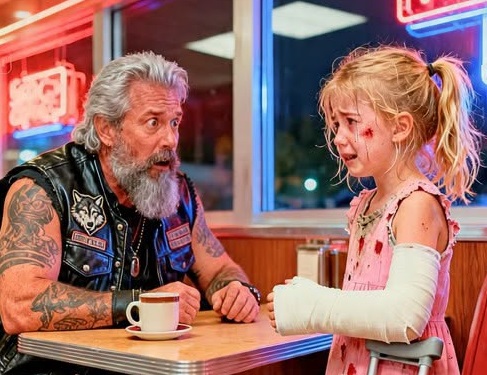
My little caller whispered four words that turned a freezing montana night into a nightmare i couldn’t ignore. my brothers saw the look on my face and knew something dangerous had already started inside me. my motorcycle was ready, but an old truck with chains became the only way to reach her. then i heard her address and understood the man in that house was still sleeping somewhere close…………..
My little caller whispered four words that turned a freezing montana night into a nightmare i couldn’t ignore. my brothers saw the look on my face and knew something dangerous had already started inside me. my motorcycle was ready, but an old truck with chains became the only way to reach her. then i heard her address and understood the man in that house was still sleeping somewhere close…………..
Part 1….
The night I almost became the kind of man I feared, it wasn’t rage that stopped me.
It was a phone call.
Four words came through the static in a child’s voice so small I had to press the phone hard against my ear to catch them.
“He broke my arm.”
That was all.
Four words.
Then breathing.
Fast. Thin. Terrified.
I sat frozen in the far corner of the Black Ridge Wolves compound, staring at the old wooden table in front of me like the grain had suddenly turned into a map. The room did not change around me. That was the cruel part.
The card game kept going.
The radio kept playing.
The neon sign above the bar kept buzzing red and blue across the smoke.
But inside me, something shifted.
I knew the voice.
I had heard it only twice before, both times at a roadside diner off Route 87. A five-year-old girl with dark hair, uneven braids, and eyes too careful for a child that young.
Mila.
The first time I met her, she sat on a spinning stool at the counter and watched me eat eggs like I was some strange animal that had wandered in from the weather.
I was used to that.
My name is Ryder Voss, but nobody in the club called me Ryder unless things were serious. To most people, I was Ghost. Scar from jaw to temple. Black Ridge Wolves cut on my back. Eyes that made people lower their voices before they understood why.
I knew how I looked.
Big.
Quiet.
Marked up by life in ways people could see and ways they couldn’t.
That day in the diner, Mila studied the wolf’s head on my back with equal parts fear and wonder. Her mother sat behind me in a booth, speaking low into a phone. The woman looked compressed. Not weak. Not dramatic. Just folded inward by something heavy she had been carrying too long.
Mila kept staring at the pie case.
No one bought her any.
So I did.
One slice.
Apple.
She ate it in careful bites, like wasting sweetness was a serious crime.
Then she looked at me with all the gravity a five-year-old could hold and said, “You’re big.”
I said, “Yeah.”
“Are you scary?”
I thought about it because she deserved the truth.
“Sometimes,” I said. “Not to you.”
Her mother took her away fast, apologizing like her child had broken a rule. I handed the woman my card without planning to.
“Just in case,” I told her.
She stared at it like she couldn’t decide if it was a threat or a lifeline.
Then she took it.
I had not thought about them much since.
Until that Thursday night in late February, when the temperature outside had dropped to eleven degrees and falling, and Mila called the only number she remembered.
The cold that night did not negotiate.
It came down off the Montana peaks and moved through everything. Walls. Windows. Old insulation. Bone. The wind came through the Ponderosa pines with a sound that almost felt human, low and grieving, like the mountains themselves knew something bad was happening somewhere in the dark.
I had been sitting alone in the corner for almost an hour.
A cup of coffee cooled in front of me.
A cigarette burned between my fingers.
I wasn’t drinking.
I wasn’t smoking.
I was just occupying space, which is different from being present.
There were seven other men in the main hall. None of them were talking to me. I wasn’t talking to them.
That was not hostility.
That was understanding.
My president, Cole “Ironside” Briggs, sat at the center table playing cards with Dex and two prospects. Ironside was fifty-two, gray in the beard, steel in the eyes, built like he had been forged instead of born.
He missed nothing.
He had glanced at me twice in the past hour without looking like he had glanced at me at all.
Hatch, our road captain, stood near the side door cleaning a carburetor at the workbench. He had lost three fingers on his right hand to a grinding machine years back and never once used it as an excuse for anything.
A radio played low beside him.
Country station out of Missoula.
A truck.
A woman leaving.
Same old song.
My phone sat face down on the table.
I never put it face down.
That should have told me something.
Around eight, a pressure had moved into my chest. Not pain. Not fear. More like a warning without words.
At 9:17, the phone rang.
I felt it through the table before I heard it.
The vibration moved through the wood and into my forearm.
I looked at it.
Unknown number.
I almost didn’t answer.
That is another part that stays with me.
My thumb hovered over the screen for one long second while I calculated like I always did. Unknown number at night in February meant trouble, a bill collector, a wrong number, or somebody trying to drag me into a mess that was not mine.
Then I answered.
“Yeah.”
At first, nothing.
Just breathing.
Small.
Shallow.
Frightened.
Then the words.
“He broke my arm.”
The whole world narrowed to that sound.
My cigarette burned down between my fingers.
I didn’t feel it.
“Who is this?” I asked.
It came out flat. Controlled. Almost too calm.
“Mila.”
A breath.
“From the diner.”
My body went still.
Not the stillness of a tired man avoiding old memories.
This was different.
This was the stillness of a weapon being lifted from a table.
“You gave me your card,” she whispered.
Her breath hitched.
“You said if I ever needed help.”
Hatch stopped moving at the workbench.
He did not turn around.
He did not have to.
“Mila,” I said, and my voice changed. I heard it. So did everyone in that room. “Where are you right now?”
“Closet.”
Her voice cracked.
“In the coats.”
My jaw tightened.
“Is he in the house?”
A pause.
“Sleeping.”
Another breath.
“He drinks and then he sleeps.”
I stood up.
I do not remember deciding to stand.
One second I was at the table. The next, my chair was scraping against the floor and my hand was reaching for my cut hanging on the wall.
“Is your mom there?”
“She went to work,” Mila said. “She doesn’t know.”
Then a tiny sound came through the phone. A sob trying not to be a sob.
“I didn’t want to call 911 because last time they made her cry.”
Something moved through me then.
Not rage.
Not yet.
Something colder and more focused.
I had spent most of my life believing pain was a private thing. You swallowed it. You locked it down. You let it turn you into whatever shape helped you survive.
But a child hiding in a coat closet with a hurt arm was not private.
That was a line.
And somebody had crossed it.
“Mila,” I said, “listen to me. Are you listening?”
“Yes.”
“I need your address. House number and street. Can you tell me that?”
Silence.
I could hear her thinking. I could almost see her little face in the dark, trying to pull the right words from memory while every part of her body begged her to stop talking.
Then she said it.
A county road east of Hover.
Route Two.
A mile marker.
A house somewhere north of Billings, tucked in the frozen dark.
I was already building the map in my head.
Hover was about ninety miles.
Ninety miles in February.
Black ice.
Hard wind.
Low visibility.
Back roads.
I had ridden worse.
I had done worse.
“I’m coming,” I said.
Her breathing changed.
Not relief.
Not exactly.
Hope is a dangerous thing when a child has learned not to trust it.
“Do not open that closet door until you hear a motorcycle,” I told her. “Only me. You understand?”
A little sound came through.
“Yes.”
“Mila.”
I stopped at the door with my coat in one hand and my keys in the other.
“You did the right thing calling me. You hear that? This was exactly right.”
I ended the call before she could answer.
Not because I didn’t care.
Because conversation was over.
Movement had started.
Ironside had stopped pretending to look at his cards. His hand rested flat on the table. His eyes were on me.
He knew that look.
He had known me eleven years, and he had seen that switch flip four times before.
Every time, something got destroyed.
Sometimes property.
Sometimes something worse.
“Ghost,” he said.
His voice was level.
That was Ironside. He could calm a room just by not raising his voice.
“What is it?”
“Kid I know,” I said, pulling on my coat. “Hurt. About ninety miles northeast.”
I put my cut over the coat.
The patch settled between my shoulders like a promise.
“I’m going.”
“In this weather?”
It was not a question.
It was an observation from a man smart enough to know what cold roads could do to pride.
“Yeah.”
“Take someone.”
“No time.”
I was at the door.
“Ryder.”
He only used my real name when he needed the man beneath the name to hear him.
I stopped.
“What kind of hurt?”
The wind pushed under the door and slid across the concrete floor like it was looking for warmth.
I did not turn around.
“Hurt arm. Five years old. Hiding in a closet.”
The room went quiet.
Not empty quiet.
Heavy quiet.
Then I said the part that made the silence change shape.
“The man who did it is in the house.”
No one moved for a second.
Then Ironside set his cards face down.
Hatch turned fully from the workbench, the carburetor forgotten. His three-fingered hand rested on the metal surface, perfectly still.
I could feel all of them staring at my back.
They knew me.
They knew what that sentence had done inside my head.
And they knew what I might do if I arrived alone.
I put my hand on the doorknob.
“Take Dex,” Ironside said.
“He’ll slow me down.”
“He’s got a truck with chains on it, Ghost.”
I stayed still.
“You ride a Harley in eleven degrees on black ice, you end up in a ditch twenty miles from that kid.”
I hated that he was right.
But he was.
The part of my brain still working as a reasoning organ, not a loaded weapon, registered the truth of it. Pride was noise. A motorcycle was speed until the road became ice. Then it was a gamble.
Mila did not need a gamble.
She needed me to arrive.
Continue in the comments 👇👇…
Part 2….
I turned away from the door.
Dex was already standing.
He had not waited for Ironside to repeat it. He pushed his chair back, grabbed his coat from the hook, and moved with that wordless efficiency men learn after enough years in a club where hesitation gets people hurt.
Dex was younger than me by almost ten years, but steady.
That mattered.
He did not ask who Mila was.
He did not ask what the man had done.
He did not ask why my hands were so still.
He only reached for his keys.
Ironside rose from the card table.
The whole room changed with him.
The prospects stood too, confused but smart enough to keep their mouths shut. Hatch wiped his hands once on a shop rag and stepped toward the wall map pinned beside the bar.
“County road east of Hover,” I said.
My voice sounded like gravel.
“Route Two. Mile marker she remembered, but she was scared. Might be off.”
Hatch’s eyes moved across the map.
“There are three places it could be.”
I stared at the road lines.
Three places.
One child.
One man asleep inside the house.
And me standing ninety miles away while the cold kept dropping.
My chest tightened so hard I had to breathe through it.
Not panic.
Never panic.
But helplessness is its own kind of fire.
Ironside looked at me.
“Call her back?”
I shook my head.
“She’s in the closet. Phone might ring. Might wake him.”
No one argued.
Dex zipped his coat.
“Truck’s outside. Chains are on. Full tank.”
I nodded once.
Then my phone buzzed again.
Everyone froze.
Unknown number.
Same number.
I answered before the second ring.
No words came at first.
Only a tiny scrape.
A breath.
Then Mila whispered, “I hear him.”
My blood went cold.
“Do not move,” I said.
“He’s walking.”
A floorboard creaked through the phone.
Soft.
Far away.
Then closer.
Dex had his hand on the door.
Ironside’s jaw hardened.
I pressed the phone to my ear so tight it hurt.
“Mila,” I whispered, “stay in the coats.”
Another creak.
Then a man’s voice, muffled by distance and walls.
Not words I could catch.
Just tone.
Sharp.
Impatient.
Dangerous.
Mila’s breathing turned thin.
I looked at Dex.
He was already moving.
Coat on.
Keys in hand.
Ready to run into the frozen Montana dark with me.
SAY “OK” IF YOU WANT TO READ THE FULL STORY ❤️👇 👇
Dex was 38 and quiet and had the wide, calm hands of someone who spent a lot of time doing mechanical work. He’d spent 11 years as an army mechanic before coming home to Hav and then eventually to the wolves. And the army had given him the ability to move quickly and without drama when drama was counterproductive.
He didn’t ask what was happening. He just grabbed his keys and his coat and looked at Ryder and said, “Ready.” They went out into the cold. The temperature outside hit Ryder like a wall. 11° plus wind was nothing human. It was a condition of the planet that humans merely survived in by maintaining fire and shelter.
The truck was parked on the east side of the compound, a battered F350o with three winters of roads salt on the underside and chains on the rear tires that Dex had put on last week without being asked because that’s the kind of man he was. They climbed in and Dex had it running in 30 seconds and the heater came on with a sound like something protesting and the frozen air inside the cab started its slow reluctant movement toward warmth.
Ryder stared through the windshield at the snow the headlights were catching fine and horizontal driven by the wind. How bad? Dex said. Bad enough. How old? Five. Dex put the truck in drive and didn’t say anything else. The roads north of the compound were two-lane state routes and county roads. And in February, in this weather, in the dark, they were the kind of roads that asked serious questions about a driver’s judgment.
The chains bit into the ice and held, and Dex drove the way he did everything, steadily, without urgency, but without any wasted motion. He kept both hands on the wheel and his eyes on the road, and he didn’t ask about the music or the temperature in the cab or where exactly they were going. He waited for Ryder to give him the coordinates and Ryder gave them and Dex made the adjustments and drove.
The radio was off. The only sound was the engine and the chains and the wind hitting the glass. Ryder had his phone in his hand. He wanted to call Ma back to check, to hear the breathing, to know she was still in that closet and Travis Holt was still sleeping and nothing had changed in the last 15 minutes.
He didn’t call because if Travis had woken up and found her with the phone, a call coming in would make it worse. He sat with his hands on his knees and he looked at the road unrealing in front of them. And he tried to do the thing he’d been taught by a therapist in a VA clinic in Billings 3 years ago. The thing about staying in the present moment rather than building catastrophes out of future possibilities. It didn’t work.
It never worked when it mattered. He built the catastrophe instead, the way his brain had always been wired to do. He walked through every version of what he might find when they got there. He assigned probabilities. He assessed responses. He thought about what he would do if Travis Hol was awake.
He thought about what he would do if Travis Hol had already moved from the drinking and sleeping phase to the waking up mean phase. He thought about a closet full of winter coats and a child with a broken arm sitting in the dark on a concrete floor and counting down the minutes until a man she barely knew came through a door she’d been told not to open.
He thought about what he would do to Travis Hol if Travis Hol had touched her again, he closed his eyes for 3 seconds, and he made himself let that thought dissolve before it could become a decision. Left here, he said. Dex turned. The address was a prefab house set back from a county road. Singlestory aluminum siding the color of old bone.
The kind of house that had been put up fast and cheap in the 70s and had been declining ever since in small incremental stages. A window resealed with tape, a gutter hanging from one screw, the porch steps reinforced with 2x4s that didn’t quite match the originals. There was a porch light on. There was a truck in the driveway, a Ram with a dented rear quarter panel and a cracked tail light, and it didn’t belong to Elena Ren because Elena Ren drove a Subaru and it was gone.
So that was Travis Holt’s truck. Travis Holt was inside. Dex pulled off the road a 100 yards short and cut the headlights. Ryder was out of the cab before the engine was all the way off, moving through the snow at the edge of the road where the plow had pushed it into a ridge. He moved quietly for a man in heavy boots.
He had always moved quietly. There was something about the way he placed his feet that he couldn’t explain and had never tried to. The house was dark except for the porch light, and a blue flicker in one window. That meant a TV was on in a room where no one was watching it. He went up the porch steps one at a time, testing each for sound. The door was unlocked.
In rural Montana in winter, people left doors unlocked because the cold was a sufficient deterrent. There wasn’t much worth stealing anyway, and anyone who came in uninvited would have to contend with whatever was waiting for them inside. He pushed it open and stood in the threshold for three full seconds, listening, snoring, deep and rhythmic from somewhere down the hall to his right.
The television was playing a rerun of something in the main room to his left. Voices, a laugh track, a sound completely alien to the situation. He stepped inside and closed the door behind him and stood in the entry hall with snow melting off his boots and into the cheap carpet. To his left, living room, kitchen beyond it.
To his right, hallway, bedrooms, and presumably the closet. He went right. The hallway had three doors. The first was open, a bathroom, dark. The second was open, a bedroom with the TV going, and in the bed a shape. Travis Holt. Writer’s eyes moved over him without stopping, cataloging, large male, heavy through the chest, face slack, and sleep, a bottle of wild turkey on the nightstand at roughly a third full, breathing steady, drunk steady, the kind of sleep that didn’t shake loose easy.
He kept moving. The third door was a closet. He could tell by the way it sat in the wall, the absence of a doororknob on the same side as the others. He crouched in front of it, putting himself at something closer to the height of whatever was behind it, and he set his knuckles lightly against the wood. Three quiet taps. Nothing. Two more.
Then a sound that was not quite a word and not quite a cry. Something in between. Something that came from the throat of a child who’d been trying very hard not to make sounds for several hours. Then the scrape of something shifting and the door opened 3 in and two dark eyes looked at him from the gap between coats.
For a moment they just looked at each other. Then the door opened all the way and Ryder got his first clear look at Ma Ren in the light coming down the hallway from the living room. She was sitting on the floor of the closet surrounded by winter coats that had fallen around her. Her right arm was held against her chest at an angle that was wrong.
The wrist swollen even in the low light, and she’d wrapped her left hand around it the way children protect things, instinctively with her whole body curling to shield the injured part. There was a bruise running along her jaw that hadn’t been there when he’d seen her in September. Both her eyes were dry. She had used up whatever was available for crying and was operating purely on the determination that had kept her quiet and in one place for however long she’d been in there.
She was the bravest thing he’d ever seen. He didn’t say anything. He opened his arms. She came out of the closet and into them. And when her good arm went around his neck, he felt the weight of her settle against him. And something in the center of his chest, something that had been clenched for years, for decades, for as long as he could remember, shifted, not broke, not opened, just shifted like a stone moved a fraction of an inch.
“I’ve got you,” he said against the top of her head into her hair that smelled like strawberry shampoo and dust. “I’ve got you. We’re going.” She nodded against his shoulder, didn’t speak. That was fine. That was exactly right. He straightened with her against him, keeping her right arm free from contact, and he turned toward the hallway.
Travis Holt was standing in the doorway of the bedroom. He was bigger than he’d looked lying down, 6’2, maybe 63, with the kind of mass that came from a physical job and too much beer. Not fat exactly, but dense, packed, the weight distributed in a way that suggested momentum more than speed. He was in boxers and a thermal shirt, and his eyes had the glazed, deliberate focus of someone who was not sober, but was working very hard at appearing so.
His hair was pushed up on the left side from the pillow. His jaw was slack. He looked at Ryder. He looked at Mila in Ryder’s arms. “The hell?” he said. Ryder said nothing. He moved toward the hallway and Travis didn’t get out of the way. That’s not your kid. Travis’s voice had found something. Not quite sobriety, but the register above it, where drunk people find anger.
Who the hell are you? Move, Ryder said. Travis looked at him the way men look at something they’re sizing up and miscalculating. Ryder was big. Not Travis big, not volume big, but leaner and harder and still with those eyes. Those eyes that had been described by people who’d been on the wrong side of them as looking like someone had turned something off behind them.
Travis was drunk and slow and had spent years being the most dangerous thing in rooms he was in. He had never been in a room with Ryder Voss. “You’re trespassing,” Travis said. And there was something in the word that was reaching for authority it couldn’t quite grip. I’m calling the sheriff. Call him, Ryder said.
While you’re doing that, I’m walking out of here with this child. And if you put a hand on either of us, he paused. Let the space in the sentence do the work. You will not call anyone after. Mila’s good hand had tightened on the back of his neck. She was very still. The way animals go still when a predator is nearby.
Travis’s eyes went to the bruise on Mila’s jaw. Something moved in them that wasn’t remorse. Ryder had been watching men’s eyes for a long time, and he knew what remorse looked like, and this wasn’t it. What moved in Travis Holt’s eyes was calculation, risk assessment. He was a man who had been getting away with things for a long time by being smart about when to push and when to step back.
and some animal part of him was running numbers on this biker in the hallway with the dead flat eyes and the child against his chest. Travis stepped back. Ryder walked past him down the hallway, through the living room where the television was playing a laugh track to an empty room, out the front door, and into the cold that hit them both like a physical thing.
Mila tucked her face against his neck. He felt her exhale. Dex was at the foot of the porch steps, having come up from the road without being asked. He took one look at Mila’s arm at her face and his own face did something complicated and then went flat and professional. “I’ll drive,” Dex said, which was not information Ryder needed, but was the only thing Dex could think to say.
They moved through the snow to the truck. The nearest hospital with an emergency room was in Hav, 35 mi southwest. The roads were what they’d been before, black ice under the chains, wind hitting the windshield. But something had changed in the truck now. The temperature was the same. The sound was the same.
But Mila was in the middle seat between them with Ryder’s coat wrapped around her and her injured arm held carefully against her chest. And she was making a sound so low and controlled it might not have been a sound at all. Just breathing, just managing. “Can you tell me what happened?” Ryder said, not pressing, just offering the space. A long pause.
She was watching the road through the windshield, the headlights catching the snow. He got mad at Mama’s phone. She said it in the voice children use when they’re reporting things they’ve had to make sense of alone. Factual, stripped of drama because the drama had already been processed. She was late coming home from work and he called and she didn’t answer because she was driving and he she stopped started again. He threw my arm.
He grabbed it and threw. Ryder kept his eyes on the road. Is that the first time he hurt you? No answer, which was its own answer. Has he hurt your mom? Yes, said immediately with the certainty of someone stating a known fact, not hesitating, not protecting anyone, just yes. Ryder exhaled through his nose. Dex’s jaw moved once and went still.
“How’d you get my number?” Ryder said. He wanted to know. He needed to know because there was something in the knowing that felt important. Though he couldn’t have said why. Mama kept your card. Mila said in her wallet. I looked at it sometimes. I thought if I learned the numbers, a pause. I counted them like a game. I knew all of them.
a 5-year-old who had memorized a biker’s phone number the way other children memorized the lyrics to songs because something in her understood even at five that there might come a night when she needed it. The truck moved through the dark and the cold and Ryder didn’t say anything else for the rest of the drive because there was nothing left to say that wasn’t going to come out of him wrong.
He just kept his shoulder against hers in the seat, solid and warm through the coat. And she leaned against it in increments over the next 30 m until her head was resting against his arm and her eyes had closed, and she was somewhere in the blurred country between pain and sleep. The Hover Regional Emergency Room at 10:45 on a Thursday in February had the particular quality of a place designed for crises that had gotten too accustomed to them.
The fluorescent lights were the color of something that had given up. The lenolium floor carried the memory of 10,000 pairs of wet boots. There were two nurses at the station, a doctor somewhere behind a curtain, and a security guard near the entrance who looked at Ryder when he came through the door, the way security guards always looked at Ryder with the eyes of someone recalculating their day.
Ryder didn’t look back at him. He went straight to the desk with Ma still wrapped in his coat and he said, “5-year-old, broken arm, possible other injuries. We need someone now.” The nurse, a woman of around 50 with the unimpressible face of someone who had processed many large men bringing in injured children, assessed the situation in about 3 seconds and reached for her phone without breaking eye contact.
“How did the injury occur?” A man threw her by the arm. Ryder said, “There’s an abuser at a house on County Road east of Hav. I can give you the address.” A pause. The nurse and Ryder looked at each other. Something passed between them. A kind of mutual recognition, a professional assessing an unknown quantity. An unknown quantity offering complete transparency and trade for speed.
“Give it to me,” she said, and reached for a notepad. He gave it. They moved quickly after that. A room, a doctor, a pediatric nurse who spoke to Mila in the particular register people use with children, calm and slightly silly, taking the medical situation seriously without making it feel like a catastrophe.
Mila went with them without looking back, and Ryder stood in the hallway outside the room and felt the absence of her weight against him like a specific physical thing. He went and sat in the row of plastic chairs in the waiting area. Deck sat next to him. Neither of them spoke. Ryder found a half-c crushed pack of cigarettes in his coat pocket and looked at it for a moment and then put it away because you couldn’t smoke in here and the impulse was just something to do with his hands. 20 minutes passed.
Then 40 Ryder was on his feet before he heard the main doors open because his body had registered the change in air pressure before his brain processed it. He turned. Elena Ren came through the emergency room doors at 11:23 and she looked like a woman who had received a phone call while driving home from a double shift and had not fully reassembled herself since.
She was in her work clothes, dark pants, a knit top, a puffy coat that was unzipped and hanging open despite the cold because she hadn’t thought to zip it in the parking lot. Her dark hair was pulled back the way Mila’s had been in two braids, but hers was clean and contained, and her face was the face of a woman running a calculation that kept producing the same result, and she couldn’t stop running it.
She scanned the room and found Ryder, and for a moment, she just stopped. He watched her face go through several things in rapid succession. Recognition. She remembered him, or recognized the cut, or both. gratitude so sharp it looked like accusation, fear, something that might have been relief if the circumstances had left any room for relief.
Mostly, she just looked like someone who had been managing something enormous for a very long time and had just discovered she was not managing it alone. And the discovery wasn’t comforting. It was disorienting. “Where is she?” Elena said. “Room three. She’s with a doctor. She’s” He picked the word carefully. She’s okay.
The arm is broken, but she’s okay. Elena covered her mouth with her hand. He’d been expecting tears and she didn’t cry. She breathed. She breathed the way someone breathes when they’ve been underwater for a long time and have just broken the surface. Not grateful, not relieved, just desperate and mechanical and focused entirely on the next breath.
How did she stopped? She called you. Yeah. She memorized your number. Yeah. Elena looked at him. He’d expected anger directed at herself, at Travis, at him, at any available surface. But what he saw instead was something more complex and harder to categorize. She was doing what people did when they’d been carrying something alone for so long that the presence of another person felt like an invasion of the carrying.
“I need to see her,” Elena said. Room three, he said and stepped back. She walked past him and he watched her go and then he sat back down in the plastic chair and Dex produced from somewhere inside his coat a gas station coffee in a paper cup and handed it to him without looking at him. Ryder took it. It was bad coffee.
It was the best thing he’d had in months. He drank it and thought about Travis Hol in that doorway doing his drunk risk calculation and deciding to let him walk. and he knew with the certainty of someone who’d spent enough time reading men that Travis Hol had only stepped aside because he thought Ryder was taking something temporarily.
That the math would look different by morning when Travis was sober and the weight of what had happened had settled into what men like Travis did with discomfort, which was converted into grievance and then into action. He thought about that county roadhouse and the dented ram in the driveway. He thought about the wild turkey bottle on the nightstand.
He thought about the size of Ma’s hand and the bruise on her jaw and the angle of her arm. Then he thought about something worse. That this had been happening long enough for a 5-year-old to develop a contingency plan. To memorize a phone number like a lifeline, to know instinctively which adult in her small radius of experience was the one to call when the world went wrong at 9:00 at night.
He’d given his card to Elena Ren as a reflex, the way he did things that felt right without knowing why. He hadn’t thought about it since. He’d been living his life, whatever it was that his life was, 90 mi away, and this child had been in that house filing away numbers. The thought sat in his chest like a coal. A uniformed officer came through the doors at midnight, young, nervous, doing the math when he saw Ryder and Dex, and then doing it again.
He went to the desk, spoke to the nurse, and the nurse pointed to room three. Then she said something else and pointed at Ryder. The officer turned. He came over slowly. Are you the one who brought her in? Yeah. I need to take your statement, sir. Sir. Ryder looked at him. You send anyone to that address yet? A pause.
We’re looking into the address is on your desk right now. Ryder kept his voice level. Not a threat, just a direction. A man who broke a 5-year-old’s arm by throwing her is in that house right now sleeping off a bottle of whiskey. You have maybe until 4 in the morning before he wakes up and decides to become someone else’s problem. The officer wrote something.
We’ll send a unit. Send two. Another pause. Sir, if he is family and local law enforcement, Ryder said, because he was starting to understand certain things about how this was going to go, send two. The officer looked at him for a long moment. Then he wrote something else. D. They sent one unit.
The report came back at 1:15. Travis Hol had been at the address. He had been cooperative. He had a version of events. There were no grounds for immediate arrest. He would need to be questioned further. They were looking into it. Ryder read the officer’s face while he delivered this report. The careful diplomatic neutrality of a man who was not comfortable with what he was saying, but had been told to say it.
And the pieces arranged themselves in a configuration he’d seen before in other towns with other men. The kind of men who slid through accountability on the grease of the right last name or the right uncle with a badge. He didn’t say anything. He looked at the officer until the officer left.
And then he looked at the ceiling of the waiting room, which was the cheap dropped tile kind with water stains that mapped the history of every roof leak this building had ever had. Dex beside him said nothing, but his three-fingered hand had curled into something that wasn’t quite a fist. Elena Ren came out of room 3 at 145. Mila was being admitted.
The arm needed setting, and there were other things the doctors wanted to look at, things that the nurse’s careful face suggested were not good news. Elena came to the waiting room and sat in a chair across from Ryder and Dex with her hands in her lap, and she looked at the floor for a long time.
“His uncle is Daryl Hol,” she said at last. “He’s been a deputy with Blaine County for 18 years.” “There it was. Reports disappear,” she continued. twice before I filed. Nothing happened. She looked up. Her eyes were dry and they were exhausted in a way that had nothing to do with the hour. I stopped filing. Ryder nodded once.
“What do I do?” she said, and it wasn’t quite a question to him. It was more like she’d stopped trying to figure it out alone and was giving the problem to the air in the room. He thought about it. He thought about the one unit they’d sent and the version of events Travis Hol had offered and the 18-year deputy and the reports that disappeared.
He thought about Elena Ren alone in this waiting room for the next 6 hours until Ma came out of the treatment room and then alone in the parking lot and then alone in a car driving somewhere because they couldn’t go back to that house. He thought about Ironside back at the compound who was not asleep. Ironside never slept on nights when Ghost was out.
You’re not going back to that house, Ryder said. Tonight or any night until this is settled. Elena looked at him. We can’t stay here. No, he agreed. You can’t. He picked up his phone. Ironside answered on the first ring. We’re going to need the spare rooms. Ryder said two people, woman and a kid. She’s coming out of treatment in a few hours. A pause.
Kid had a broken arm. Mom’s got nothing left. Travis Holt has a deputy uncle in Blaine County. Silence on the line for 3 seconds, then I’ll have the heat on. Writer ended the call and looked at Elena. She was watching him with that complicated expression he was going to have to get used to. The one that was gratitude and weariness and the careful suspicion of someone who’d been let down by enough people to make them careful about who they let back in.
I don’t know you, she said. It wasn’t an accusation. It was just accurate. No, he said, “And you want me to take my daughter to a biker compound?” “Yeah,” she looked at her hands. “Why?” He thought about Mila in the closet. He thought about a memorized phone number. He thought about a child who had decided he was safe enough to call in a crisis and what it cost a child to make that kind of decision and what it would mean to be wrong.
“Because you’ve got no other options tonight,” he said. and because your daughter trusted me,” he held her gaze. “I’d like to deserve that.” Elena Ren looked at him for a long time. The fluorescent lights buzzed. Somewhere behind a curtain, a monitor beeped its steady claim against the dark. Then she said, “Okay.” The Black Ridge Wolves compound was dark when the truck pulled in at 4:00 in the morning, except for the lights ironside had left on in the main hall, and the warm amber glow from two windows in the living quarters on the north side. Snow
was still falling, lighter now, the kind that was more suggestion than weather. The trees along the perimeter fence held it in their branches, and the compound sat in the mountains like something settled and unmovable, like it had been there long before the road, and intended to outlast it.
Ryder helped Mela from the truck, careful with her arm, which was set and wrapped and held in a pediatric sling the ER had provided. She was half asleep and said nothing. She curled against him on instinct, and he carried her across the lot. Her weight familiar now, already familiar, and that fact sat somewhere in him, and he didn’t examine it too closely.
Ironside opened the door before they reached it. He looked at Mela, and his face did the same complicated thing Dexes had done, and then went quiet. He looked at Elena and gave her a single nod. Not a greeting exactly, more like an acknowledgement, one person registering the existence of another, and stepped back to let them through.
The main hall was warm. Someone had put coffee on and the smell of it hit them as they came in. That particular comfort of coffee at 4:00 in the morning, the smell that means someone has been awake for you. Hatch was there, still at the workbench, though the carburetor was gone, and he’d made no pretense of doing anything.
He looked up when they came in, and then looked down. The prospects were gone, just the core members, the ones who’d been there long enough that Ironside didn’t send them away when something real was happening. Ryder carried Mila to the back rooms to the spare room Ironside had set up, a cot and a real bed, and a space heater glowing orange in the corner.
He set her on the bed, and she went straight down into sleep. the way children do, boneless and complete, her good hand finding the edge of the pillow. Elena stood in the doorway watching her and then looked at Ryder and then looked away at the window and the dark and the snow. She’s going to ask for you when she wakes up, Elena said. Quiet. Not quite a warning.
I’ll be here, Ryder said. Elena turned and looked at him. There was something new in her face, something underneath the exhaustion and the fear and the careful weariness, something that might not have had a name yet. Ryder held her gaze and then moved past her back into the hallway, giving her the room and the quiet and the sleeping child.
He walked back to the main hall and he got himself a cup of the bad coffee and he stood at the window looking out at the snow. Ironside came and stood next to him, not close, just in the same vicinity. The uncle is a deputy, Ryder said. Blaine County. Yeah. Ironside drank his coffee. Daryl Hol. Ryder looked at him.
I know the name, Ironside said. You want to know what I know or do you want to stand here and watch snow? Tell me. Ironside told him. And what he said changed the shape of the room, made the walls of it feel closer, made the coffee in Ryder’s hand feel like something he was holding rather than something he was drinking.
Because what Ironside described was not just a deputy uncle protecting a nephew from consequences. It was something older and wider and considerably darker than that. It had to do with missing reports, yes, but also with other things. Women in the county who’d filed complaints that went nowhere. a pattern across three years that the state attorney’s office had been looking at from a very careful distance without yet deciding to act.
Travis Hol wasn’t just a violent drunk with a convenient uncle. He was a piece of something. Ryder set his coffee down. How long have you known? He said long enough. Ironside said long enough to know that whoever ends up in the middle of it is going to need more than just getting the woman and kid to safety. a pause. It’s going to need someone willing to go all the way. The snow kept falling.
The compound sat still in the mountains, dark except for these windows, warm except for the wind. Inside, somewhere in the back, Ma Ren was sleeping in a biker’s spare room with her broken arm in its sling. And her mother was sitting in a chair next to her, watching her breathe. And Travis Hol was 90 miles away in a house on a county road doing whatever Travis Hol did at 4 in the morning.
And Ryder Voss stood at the window of a place that was as close to home as he’d ever managed to find. And he thought about a child memorizing a phone number. And he thought about Ironside’s word all the way. And he knew with the absolute certainty of someone who has just had the shape of the next several months revealed to them that this was only the beginning.
He just didn’t know yet what Travis Hol was going to do about it. He didn’t know that by morning, the one unit they’d sent to the county roadhouse would file a report clearing Travis Hol of any wrongdoing. He didn’t know that by afternoon, Travis Hol would make a phone call to a man who wasn’t his uncle, a man whose name would surface in documents 6 months later and rearrange everything Ryder thought he understood about what he’d walked into.
He didn’t know that the attorney who would eventually crack this open was already in Billings that night, working late at her desk on an unrelated case, and that her name was Vivien Cross, and that she would not enter this story gently. He only knew what he knew right now, the weight of a child who’d trusted him, the sound of small breathing down the hall, and the particular kind of trouble that comes when someone with power decides they’ve been embarrassed.
He picked up his coffee. Outside the snow was coming harder now, the way Montana snow did when it made up its mind. Sudden absolute erasing the road. And somewhere on that road, headlights moved through the white, coming this way. The headlights didn’t stop. Ryder watched them from the window. Two pale cones moving through the falling snow on the road that ran parallel to the compound’s north fence and tracked them until they disappeared around the bend toward the highway.
A truck moving too fast for the conditions. Gone in 30 seconds. Nothing. Just someone heading somewhere in the middle of the night the way people did in Montana when the distances didn’t care what time it was. He let out a breath he hadn’t known he was holding. The coffee had gone cold in his hand. He set it on the sill and stayed at the window another minute, watching the road go empty and white again, watching the snow refill the tire tracks until they were just suggestions, then nothing.
Then he walked to the back room, stopped outside the spare room door long enough to hear the small, steady sound of Ma breathing, and went to his own room and sat on the edge of his bed with his boots still on and stared at the floor until the sky started going gray. He didn’t sleep. He didn’t try. Um Mila awoke at 7:30 and the first thing she said was his name.
Not her mother’s. His. Elena was already awake, had been awake most of the night in the chair beside the bed. From what Ryder could tell from the dark circles and the particular quality of her stillness when he came to the doorway, and she heard it, too. The way the child said Ryder before she said anything else.
He watched Elena process that, watched her face go through something careful and private, and she turned to look at him in the doorway, and he nodded once and stepped back to give the room its privacy. He heard them talk, low and intimate, mother and daughter in the early morning of a strange place, Elena’s voice carrying the particular cadence of a woman explaining something terrible to someone small in language that wouldn’t make it worse than it already was. He didn’t listen.
He went to the kitchen off the main hall and started fresh coffee and found eggs in the refrigerator and made them the way he’d been making eggs alone for 15 years in a cast iron pan with too much butter and not enough patience. Hatch materialized in the kitchen doorway at some point, the way Hatch materialized places quietly and without announcement.
He looked at the eggs. He poured himself coffee. How is she? Hatch said, meaning Mila. Arms set. She’ll heal. Ryder pushed the eggs around the pan. Physically, Hatch drank his coffee and the other kind. Ryder didn’t answer. He didn’t have one. Ironside came in at 8 with his phone in his hand and his expression arranged in that particular configuration.
That meant he’d been making calls since before sunrise. He sat at the kitchen table and put the phone face up in front of him and looked at Ryder. “I talked to Manny Santos in Billings,” he said. He says Daryl Holt’s been dirty for a long time. Not just the nephew thing. Other stuff. Girls going missing in the county.
Reports that vanish. Three years of it. Maybe more. Writer turned off the burner. State attorney has a file. Hasn’t opened it. Ironside’s voice was flat. Informational because two of the witnesses recanted and one moved to Oregon in a hurry. Pressured. That would be the word. Hatch set his coffee down. So, we’ve got a violent drunk with an uncle who’s been running protection for 3 years and a state attorney sitting on a file he’s afraid to open. He paused.
That about the size of it? That’s the floor of it? Ironside said Manny thinks the ceiling is higher. The word higher sat in the room and took up more space than a word should. Ryder plated the eggs. He brought them to the table and sat down and looked at them and didn’t eat them. We need an attorney who isn’t afraid of the ceiling.
working on it, Ironside said. Uh, Mila came out of the back room at 8:45, her good hand wrapped around Elena’s, the pediatric sling bright blue against her dark sweater, her hair down from the braids and loose around her face. She stopped in the entrance to the main hall and looked at the room, the long tables, the workbenches, the neon signs dark in the morning light, the leather jackets on hooks by the door, with an expression that was assessment rather than fear.
She’d been here for less than 5 hours, and she was already cataloging, already building a map. Then she saw Ryder at the kitchen table and walked to him directly, without hesitation, the way she’d come out of the closet the night before. like the calculation had been made previously and didn’t need to be made again. She stopped next to his chair and looked at his eggs.
“Are those for anyone?” she said. “They’re for you,” he said, because apparently they were. She climbed into the chair across from him, careful with her arm, wincing once, then refusing to acknowledge the wse, and ate his eggs with focused deliberation. Elena sat beside her and accepted the coffee hatch appeared with from the kitchen and held it in both hands and looked around the main hall with an expression that was the same calculation as her daughters just with more weariness built into it.
Ironside sat across from Elena. Mrs. Ren. Miss. She said Miss Ren. He corrected himself without blinking. We need to talk about your situation. Yes, Elena said we do. Ironside laid it out. Not all of it. He kept Manny’s information about the ceiling to himself, at least for now, because there was no value in front-loading someone with the full weight of a thing they were already struggling to carry.
He told her about Daryl Hol and about the pattern of disappeared reports, and about what she could expect from local law enforcement in the next 24 hours. He was clear and methodical and didn’t soften anything that shouldn’t be softened. and Elena Ren sat across from him and listened with the attention of someone taking notes in their head.
He’s going to file something, she said when Ironside finished. Travis, he’s going to say Mila was taken without my consent. He might try. He will. Her voice was certain. He’s done it before. When I took her to my sisters in Bosezeman 2 years ago, he called the police and said I was keeping Mila from him, even though she stopped.
Something moved across her face. He’s not her father. He has no legal claim. But Daryl Hol made two calls and by morning my sister was fielding questions and I had to come back. Ryder looked at Ironside. Ironside looked back. He knows how to use the system. Ryder said, “He knows how to use that system.
” Elena corrected. Quiet but precise. There was something in the correction. A careful intelligence. a woman who’d been thinking about this longer than last night. We’re not that system. Ironside said. Elena looked at him steadily. I know what you are. Then you know we can keep you here until this is settled. And after she said, “What happens to me and Ma after it’s settled and I’ve been sheltered in a biker compound and Travis’s attorney gets up in family court and there won’t be family court.
” Ironside said, “Because Travis Hol doesn’t have family rights, and because by the time this is settled, family court is going to be the least of his concerns.” The kitchen was quiet, except for the sound of Mela eating eggs. Elena looked at Ryder. “You said you’d like to deserve her trust.” “Yeah,” he said.
“Prove it to me,” Elena said. “Not to her. To me.” Ryder held her gaze. Across the table, Mila had finished the eggs and was now studying the wolf’s head patch on his cut, the way she had at the diner with that fierce, concentrated attention, like she was trying to understand the grammar of it. He looked at Elena.
We’re going to need everything you have, he said. Every report you filed, every incident, dates, times, anything documented, photos if you have them. Elena didn’t hesitate. I have a box, she said. At my sisters in Bosezeman. I started keeping records 18 months ago. Why didn’t you? Hatch started. Because the first report I filed disappeared and Daryl Hol called my employer.
Elena’s voice was perfectly level. I kept the records because someday I thought I might find someone who could actually use them. She paused. I just didn’t expect it to be a motorcycle club. Ironside almost smiled. Almost. We’re not a motorcycle club, he said. We’re a brotherhood. What’s the difference? Elena asked. Clubs have rules, Hatch said from the doorway.
Brotherhoods have each other. Dex left for Boseman at 10 to get the box from Elena’s sister. He took one of the prospects and a truck and a list of exactly what he needed, and he was gone before Travis Holt’s first phone call of the morning came in. It came to Elena’s cell at 10:12. She was sitting in the main hall when it rang and she looked at the screen and her face went the particular blank that people go when they’re very frightened and have decided not to show it.
She turned the phone to show Ryder the name on the screen. Travis, don’t answer, Ryder said. If I don’t, I know. Let it go. It rang four times and went to voicemail. 30 seconds later, it rang again and again. On the fourth call, she answered, not because she’d changed her mind. An writer could see in her face that she hadn’t, but because something in her had calculated that not answering was making a choice she wasn’t ready to make yet, and the box from Boseman was still 4 hours away, and she needed time. She answered and walked to
the far end of the hall by the door and spoke quietly. Ryder didn’t follow her. He watched from across the room, and he watched her posture change as the call went on. The shoulders pulling up and then forcing themselves down, the hand that wasn’t holding the phone pressing flat against her thigh.
The small controlled movements of a woman managing very old fear. The call lasted 4 minutes. When she came back, her face was arranged again, but her jaw was tight. “He says he wants to see Mila,” she said. “He says if I don’t bring her to him by tonight, he’s calling his uncle. He’ll call his uncle anyway, Ryder said. I know. She sat. He also says.
She stopped. What? He says he knows where I am. She looked at the table. He said the compound. He knows I’m here. The room adjusted. Not physically, but in the particular way rooms adjust when information changes the weight of the air. Ryder looked at Ironside. Ironside stood up from his chair with the unhurried deliberateness of a man who’d been waiting for something and had just been told it was here.
“He’s got someone watching the road,” Ironside said. “Or had someone follow the truck last night,” Hatch said from the workbench. “Or both.” “He’s had this place watched before,” Ryder said. “He said it without surprise because it wasn’t surprising. Men like Travis Hol didn’t show up to confrontations unprepared.
They prepared the confrontation in advance and then showed up to it as if it were spontaneous. He’s been building this since last night. Elena looked at him. You knew he’d do this. I knew he’d do something. Ryder stood. I didn’t know the shape of it yet. The shape was starting to clarify it. the church that afternoon.
The brother’s closed meeting, what they called church, even though the word had nothing to do with its common meaning, just the gathered weight of the brotherhood in one room with the door shut, was the tensest one Ryder had sat in since a dispute about territory with the Copper Kings 3 years back that had eventually resolved itself without anyone getting hurt, but had taken two months of church meetings and approximately 10,000 collective years of collective patience to get there.
This was worse. Not because of the external situation. The external situation was manageable. Ryder had managed worse. Ironside had managed worse. The men in this room had collectively managed things that would make Travis Hol and his deputy uncle look like a bar misunderstanding. What made it worse was the internal thing.
The thing that had been building since morning, and now it was in the room, and the room was closed. Lund put it on the table first, which was both predictable and useful because Lund put everything on the table first. He was 35 and had been with the wolves for 6 years, and he was not cruel, but he was tactical in the way that men without sentiment are tactical, and sentiment was not a resource he wasted.
He had a long face and careful gray eyes and a scar on his chin from a bar fight in Missoula 8 years ago, and he looked at Ryder across the church table and said, “We don’t know them.” No, Ryder said, “We’ve got a deputy in Blaine County who knows we exist and now knows they’re here and we’re holding them. We’re sheltering them.
” Ghost, Lun said his name flatly, not disrespectfully, just to mark that he was looking at the situation differently from the outside, from any official outside. We’re holding a woman and child whose domestic situation is a local law enforcement matter. Whatever Daryl Holt says it is, that’s what it will be filed as.
The box from Boseman is not here yet. Lun leaned forward. We have a woman who says she’s been abused. We have a child with a broken arm. Both of which legally could be represented as something else depending on who’s doing the representing. He paused. I’m not saying it’s true. I’m saying that’s what Daryl Hol is going to build.
The room sat with this. He’s right, said Cam, the wolf’s sergeant-at-arms, who was 45 and built like a loadbearing wall, and spoke rarely and with the careful precision of someone who’d spent a long time being misqued. “We need to think about what this looks like from their side because their side has a badge and a courthouse, and we’ve got a compound in the mountains.
” “We’ve got documentation,” Ironside said. “We’ve got the beginning of documentation,” Lond said. And we’ve got a 5-year-old girl who when she testifies to anything, if she testifies to anything, is going to be talking about a biker who came into her house in the middle of the night and took her. Ryder looked at the table.
That’s not what happened, he said. I know what happened, Lun said. Daryl Holt will know differently. A pause. I’m not saying walk away. I’m saying we need to understand what we’re walking into because if this gets filed as abduction, it was a welfare call. Ryder said by a man with a prior assault conviction. The room went quiet.
Ryder’s prior assault conviction. Blaine County 7 years ago. A man outside a bar in Hav who had swung first and not hit anything and Ryder had swung second and hit everything that mattered. And the man had gone down and stayed down. And the charges had eventually been reduced to misdemeanor assault, but the conviction was there.
It was on record. It existed the way things exist when they’ve been written down and given a case number. He’d known this was coming. He’d known it since last night. The way you know weather is coming from the feel of the air. He’d just been hoping the conversation would wait. Londonside said, “I’m not attacking him.
” Lun said, “I’m telling you what their attorney is going to say in the first 10 minutes of any proceeding.” “He’s right,” Cam said again. “And again, the weight of him saying it.” Ryder looked at Ironside. Ironside looked back with those old steel eyes, and what passed between them was the language of men who have known each other long enough to speak without speaking.
Ironside had brought him in 11 years ago, half dead, coming out of a VA psych unit with a prior record and no particular reason to keep going, and had given him a cut and a purpose and the specific dignity of being trusted. He had never once referenced the record. He had never once held the prior against him, but Ironside couldn’t hold the situation.
He could only hold the Brotherhood. “What do you want to do?” Ironside said to Ryder. “Quiet.” Not the president talking to his road captain. Just one man talking to another. Ryder took a breath. I want to go to Hover tonight, he said. I want to find Travis Holt before he finds us. Dead silence. No. Ironside said Cole. No. The president’s voice now full weight.
That is exactly what they want. That is the exact shape of the trap. He leaned forward. You go to Travis Holt tonight and whatever happens, they file it as a home invasion by a convicted asalent and Elena Ren loses custody of her daughter and you go back to prison and Daryl Hol closes the file and buries it so deep it never surfaces. Ryder knew this.
He knew it completely. But the knowing and the feeling were different things and the feeling was very loud right now. Then what he said. His voice was lower than he intended. We wait for the box from Boseman. Ironside said, “We find an attorney who isn’t afraid of what’s in it, and we let the system take it from here.
” The system is Daryl Hol, Ryder said. The system is also a state attorney’s office that has a file it hasn’t opened, Ironside said. And a federal wire fraud statute that’s been sitting next to that file, waiting for someone to connect them. He held Writer’s gaze. Manny gave me a name this morning, an attorney in Billings. She’s been working the edges of this thing from a different angle for 2 years.
Her name is Vivien Cross. Ryder had never heard the name. She’ll meet us. Ironside said, “When?” Ryder said, “Tomorrow. If we can hold through tonight.” “If we can hold through tonight.” The sentence was small and contained something very large inside it. “I’ll hold,” Ryder said. Lund looked at him. Not with satisfaction.
L didn’t do satisfaction, but with the particular recognition of a man who respects someone, even when he’s making his case against them. He gave a single nod. Church ended, quot The box arrived at 5:00 in the afternoon. Dex carried it in from the truck and set it on the main table, and Elena opened it, and for the next 4 hours, the main hall of the Blackidge Wolves compound became something that looked like a war room and felt like a confessional.
Elena had been meticulous. 18 months of documentation. The way someone documents when they know the documentation is all they’ll have. Date and time in the margin of everything. Photographs taken on her phone and printed at the pharmacy and filed in manila folders. Copies of the two reports she’d filed with Blaine County that had subsequently disappeared.
Copies of her emails to the sheriff’s department that had received no response. A log of incidents with notation of any witnesses. medical records from a walk-in clinic in Hav where she’d been twice and had listed her injuries as accidental both times because she’d known better than to tell the truth. Ryder sat across from her while she went through it because she asked him to, not explicitly, but by the way she arranged things on the table, turned toward him, presented to him like she was making her case to someone she’d decided to trust on a provisional basis.
He looked at the photographs and he kept his face very still. And when she reached the clinic records and he saw the nature of the injuries documented there, he got up and went to the kitchen and stood over the sink for 90 seconds with cold water running over his hands. When he came back, she was looking at him. “Are you all right?” she said.
The question struck him as so backward that he almost said so. He wasn’t the one with clinic records. He wasn’t the one who’d been managing something enormous alone for how long? He looked at the dates on the earliest documents. How long before you started documenting? He said Elena looked at the table. He hit me for the first time 8 months before I started. So at least 2 and 1/2 years.
Yes. He sat back down and Mila the first time he touched Mila was 14 months ago. Her voice didn’t change. This was a woman who had processed this past the point where it could break her voice. Not because she’d gotten over it, but because she’d had to keep functioning. After that, I started the box.
Why not leave? She looked at him. There was something in her expression that was very tired and very patient. The tiredness and patience of someone who’s been asked an obvious question by someone who should know the answer. I have a sister in Boseman, she said. I have $80 in my checking account after rent.
I have a job at a diner 40 minutes from the nearest city. I have a daughter with no health insurance because Travis took me off his when I threatened to leave. I have a deputy in the county with Daryl Holt’s phone number in his contacts. She looked at the table. Where exactly would you like me to have gone? He held that. I’m sorry, he said.
She didn’t acknowledge the apology, not because she rejected it, but because there wasn’t a place for it in what she was doing right now. She kept organizing the documents. Writer watched her and thought about the nature of the trap. Not just the official trap, the legal one Lund had outlined in church, but the older, more fundamental trap that had been built around Elena Ren piece by piece.
Each piece designed to remove one option at a time until she was left with none and still had to get up in the morning and function. Hatch appeared with coffee and sandwiches at 7 and set them on the table without comment. And they ate without stopping. The documents spread between them and by 9:00 Ryder had a shape in his head of what they were dealing with that was both better and worse than he’d thought this morning. Better.
Elena’s documentation was extraordinary. The clinic records alone, combined with Ma’s ER records from last night and a witness statement Elena had somehow obtained from a neighbor who’d seen Travis’s truck at the house during two of the documented incidents created a pattern that was legally significant. Not conclusive, but significant.
Worse, the pattern pointed at something beyond Travis Halt. There were two names in Elena’s log. women who’d worked at the same diner she did and who’d both had brief unhappy interactions with Travis that Elena had documented because Travis had mentioned them to her later in ways that disturbed her.
Both women were no longer in Blaine County. One had a forwarding address in Oregon. Oregon, the same state Ironside had mentioned that morning where a witness had moved in a hurry. Writer looked at the name, looked at it for a long time. These women, he said, “Did you know them well?” “Tara, I knew well.” Elena said, “She worked doubles with me for 8 months. She was funny.
She had a daughter about Mela’s age.” A pause. She stopped coming in one day. I called her phone and it was disconnected. They said she’d given notice, but nobody saw her give it. When was this? 16 months ago. 16 months ago. 2 months before Elena started the box. He looked at the other name and this one. Greta.
She only worked there 2 months. She left before Tara. Elena was quiet for a moment. She was afraid of something. I could tell some people you can tell. The way they sit with their back to the wall. The way they watch doors. Ryder understood the impulse completely. Did Tara and Greta know each other? They overlapped by about a month.
Elena frowned at the table. Now that you ask, yes, they talked sometimes. I remember thinking they’d become friends quickly. She paused. Tara brought her to Travis’s once, to a party. I was there. Travis? She stopped. What? Travis paid a lot of attention to Greta, Elena said. At the time, I thought it was just Travis being Travis, but now she didn’t finish the sentence because she didn’t need to.
Ryder took out his phone and called Ironside, who was across the compound in his own quarters, and answered immediately. “I need you to call Manny Santos again,” Ryder said. “Tell him we have two names. Women who worked at a diner in Blaine County. One moved to Oregon. One, he looked at Elena who shook her head. One has no forwarding address.
Tell him I need to know if either name shows up in whatever file he’s been looking at.” A pause. I’ll call him now, Ironside said. Ryder ended the call and looked at Elena, who was looking at him with the expression she’d had this morning. That complicated mixture of weariness and the beginning of something that might become trust if nothing broke it.
She was doing the same calculation she’d been doing since last night, deciding moment by moment whether the provisional trust was warranted. “You think this is bigger?” she said. “I think Travis Hol broke your daughter’s arm,” Ryder said. I think that’s what we came for. I think we need an attorney and a plan and to get you and Mila somewhere safe and let the law handle the rest of it. He paused.
But yes, I think this is bigger. She sat with that. Then she reached across the table and moved one of the manila folders to sit in front of him. There’s something else, she said. In the back of that one. He opened it. At the back behind the clinic records were three pieces of paper folded together. He unfolded them.
They were printouts from a county records website. Property records, ownership records, the kind of thing anyone could look up if they knew where to look. Three properties in Blaine County, all registered to different LLC’s with names that meant nothing on their surface. Apex Holdings, Cascade Property Group, Northern Light Management.
Travis talked about these, Elena said when he drank and got proud. He talked about the business. He never explained it, just the business. A pause. Daryl Holt’s name is on two of those LLC’s as registered agent. I found it in the county filings. Writer looked at the pages. There it was. the ceiling Manny Santos had mentioned right here on three sheets of paper in a manila folder in a box that had been sitting in Elena Ren’s sister’s apartment in Bosezeman for 18 months waiting for someone to open it.
He folded the papers carefully, put them back. You need to call your sister tonight, he said. Tell her not to discuss any of this with anyone who calls asking about you. Elena nodded. And tomorrow morning, he said, you’re going to meet an attorney named Vivien Cross. She’s been looking for this for 2 years. He looked at Elena.
I think you’re the person who can give it to her. Elena looked at the table for a long time. Then she looked at him. Something in her face had changed. The weariness was still there. The careful intelligence was still there, but under it there was now the particular quality of someone who has been carrying a weight alone and has just felt another pair of hands take part of it.
Not enough to rest, but enough to shift the balance. Okay, she said. They sat in the warm main hall with the documents spread between them and the neon signs dark and the compound quiet around them. And outside the snow had stopped and the temperature had dropped another 3° and the pine stood still in the cold, and the road beyond the fence was empty.
It looked safe. It had that particular nighttime quality of safety that was really just the absence of visible threat. Ryder’s phone rang. unknown number. Again, he answered, “No voice this time. A sound, a vehicle, an engine, something moving.” And then a man’s voice, thick and deliberate, doing what men like this did when they wanted to establish something, making him wait.
Ghost, the voice said. “That’s what they call you, right? Ghost.” Travis Hol writer recognized the quality of it. the particular blend of drunk, careful, and mean deliberate he’d heard in the hallway at the county roadhouse the night before. But Travis was more sober now, more composed, which was worse.
“I know you’re there,” Travis said. “I know she’s there with you. I know what she showed you.” A pause, the sound of him breathing. That box she’s been keeping, all those pretty pictures. She thinks that’s evidence, but that’s just a story she’s telling herself. Another pause. You know what I’ve got? I’ve got a deputy who filed a report tonight saying you walked into my home without a warrant and removed a child from the premises.
Child endangerment by a man with a prior assault conviction. The breathing again. That’s not a story. That’s a record. Ryder sat very still. Across the table, Elena was watching his face. “You’ve got one chance,” Travis said. “Send them back tonight by midnight. I’ll make one call to my uncle and all of this goes away and you go back to whatever you were doing before you decided to make my life your business.” A pause.
Or I keep making calls and you find out how fast that prior record becomes a felony. Ryder said nothing. “You don’t know what you walked into,” Travis said. then quieter. Be smart, ghost. The call ended. The main hall held its silence for 3 seconds. Then Elena said very quietly. He’s already filed it. Yes, Ryder said.
What does that mean for you? He looked at the table at the Manila folders, the clinic records, the photographs, the three property ownership printouts with Daryl Holt’s name on them as registered agent. the evidence of what Travis Halt was and what he’d built and who he’d built it with. Evidence that an attorney named Vivien Cross had been searching for from a different angle for 2 years.
It means Ryder said that tomorrow matters. He called Ironside again, told him about the call, told him about the filing. Ironside was quiet for 4 seconds. I’ll call Cross tonight, he said. Tonight, not tomorrow. Appreciate it, Ghost. Ironside’s voice was careful. You understand what happens if she can’t move fast enough.
If that filing gets picked up before she can intervene. Yeah. Ryder said, “They come for me.” “And if they come for you, they have grounds to take the woman and the girl.” “Yeah, so you can’t be here.” Ironside said, “If they come, you can’t be on the property.” The sentence sat in the room in occupied space.
Ryder had been on this property in one form or another for 11 years. He’d helped build two of the structures on it. His name wasn’t on the deed. Nothing here was in his name, but this place had become the nearest thing to an address he’d ever had since his mother’s house burned down when he was 16.
And he’d understood for the first time that places don’t stay. He’d spent 11 years making a different choice, learning that certain things could stay, certain people could stay. If they come, Ryder said, I’ll be gone before they arrive. A pause. That’s not what I wanted to hear. I know. He looked at the documents on the table, the evidence, the shape of what they were fighting.
But if I’m gone, you can keep them safe. If I’m here and they take me, everything goes with me. Ironside didn’t say anything, which was its own answer. Call Cross, Ryder said. tonight. He ended the call and put the phone on the table and looked at Elena. She had been listening and her expression told him she’d understood what she’d heard.
If they arrest you, she said, because of us, that’s not your responsibility, Ryder said. It’s not yours either. Her voice was tight. You didn’t do anything wrong. Having a record makes you responsible for things you didn’t do, he said. Not bitter, just accurate. That’s how it works. She looked at him with something that was sharp and sad and very clear, the look of a woman who understood that particular algebra firsthand.
You’re going to have to leave, she said. Maybe, Ryder said. And Mila, she stopped pressed her hands flat on the table. Mila will be safe, Ryder said. Cole Briggs will not let anything touch her. Neither will Hatch or Dex or any of the rest of them. She’s not going to understand. He held that held the image of Mila waking up in the morning and asking for him the way she’d done this morning and getting an empty hallway instead.
He held the weight of that and let it sit and didn’t look away from it. “Then I need to talk to her tonight,” he said. “Before it’s tonight.” Elena looked at him for a long moment. Then she stood. “Come on,” she said. Mila was awake. She was sitting on the real bed in the spare room with a dogeared coloring book someone had found for her. Hatch probably.
Hatch was the one who knew where things were and a set of markers in her good hand working on what appeared to be a very serious coloring of a horse with a blue mane. She looked up when Ryder came in and shifted on the bed in a way that made room for him instinctively the way children make room for the adults they’ve decided to trust.
He sat next to her, looked at the horse. Blue, he said. Blue is better, she said. Seriously. Horses can be any color in pictures. True, he agreed. She kept coloring. He watched her work the marker over the page, the care she took at the edges, the way she kept her injured arm braced against her side without complaining about it.
Outside, the night was very cold and very quiet. The space heater in the corner made its steady low sound. “Mila,” he said. She looked up. I might have to go somewhere tomorrow for a little while. She studied him the way she studied things, completely with that fierce intelligence. Are you coming back? She said. He thought about the right answer.
He thought about what it meant to promise something to a child who had already been let down by every promise the world had made to her. And he thought about what it cost to be wrong. And he thought about the nature of the trap they were in and how far out the edges of it extended. He thought about Ironside’s voice. Call Cross tonight.
He thought about a woman in Billings right now, an attorney named Vivien Cross, who had been looking for what was in those Manila folders for 2 years. He thought about the property records and the LLC’s and Daryl Holt’s name on two of them as registered agent. And he thought about the file the state attorney’s office hadn’t opened and the witnesses who’d moved and the women from the diner.
He thought about the ceiling. Yes, he said. I’m coming back. Mila looked at him for three more seconds with those dark, serious eyes. Measuring. She was 5 years old, and she had the assessment capability of someone four times that age, and she used it with the unself-conscious honesty of someone who hadn’t yet learned to pretend she wasn’t measuring.
Then she went back to the horse. “Okay,” she said. Ryder sat with her until she fell asleep, which took another 40 minutes and happened the way it always happened with Mila. Quickly, completely, without warning, mid-reache for a marker. He set the marker on the nightstand and pulled the blanket up and sat for another minute in the dark, listening to her breathe.
Then he went to find Ironside. Ironside was on his phone on the far end of the porch, jacket on against the cold, visible in the amber light from the window. Ryder could hear from 10 ft away from the quality of Ironside’s stillness that this was a good call, that Cross had answered, that she was talking. He waited.
When Ironside finished and turned, his expression had changed. Not dramatically. Ironside’s face didn’t do dramatic, but in the specific small way that meant the situation had shifted. “She wants the documents,” Ironside said. Tonight, tonight. She’s driving up from Billings now. Ryder looked at him. She’s been waiting for those property records.
Ironside said she said she knows the names. She said the LLC’s connect to something federal. He held Writer’s gaze. She said if she can get those documents tonight and make two phone calls by morning, she can have an FBI contact in Hava by noon. The FBI. The word changed the temperature of the porch. That’s the ceiling.
Ryder said that’s above the ceiling. Ironside said they stood in the cold and the quiet and the dark. And somewhere inside the compound, a door opened and closed. And somewhere down the hall, Mila Ren was sleeping with her broken arm and her blue horse. And somewhere out on that road, the empty white distance was not in fact empty. Ryder’s phone lit up.
Not a call, a text from a number he didn’t recognize sent at 11:47 at night from a Blaine County Exchange. Four words. Your time is up. And then 30 seconds later, the headlights appeared at the end of the compound road. Not one pair, three. Not moving. Just sitting there in the dark at the edge of the treeine.
Engines running. watching the compound the way something watches something before it commits to moving. Ironside looked at the headlights, looked at Ryder. “Ghost,” he said. His voice had the weight of a man who’s about to say something he’s been hoping not to say. “You need to make a choice right now.” Ryder looked at the three sets of headlights sitting in the dark at the edge of his world.
He thought about the choice. He already knew which one he was going to make. had known since the moment he’d answered a phone call at 9:17 in a warm room and heard four whispered words from a closet full of coats. The choice had been made then in that room by whoever it was that he’d become without quite noticing. The question was just what the choice was going to cost him.
The headlights didn’t move. The night held its breath. Ryder didn’t move. That was the first thing, the stillness. Three sets of headlights sitting at the treeine 200 yards out. Engines running low and Ryder Voss standing on the porch of the Black Ridge Wolves compound, not moving, not speaking, just looking at them the way he looked at things he was computing.
The cold was absolute. His breath came out in small controlled clouds and dissolved into the dark. Ironside was beside him, also still, also looking. Count, Ironside said. Three vehicles, Ryder said. Two trucks, one sedan. Sedan’s got a light bar. Sheriff’s department. The other two private. Travis’s Ram is one of them.
He could tell by the headlight spacing the height off the ground. He’d cataloged that dented Ram at the county roadhouse the night before the way. He cataloged everything automatically without deciding to because his brain had been wired since the army to treat every vehicle as a potential variable. The other truck, I don’t know.
So Daryl Holt brought back up, Ironside said, or Travis did, and Daryl came after. They stood with that distinction because it mattered. If Daryl Hol had organized this, it was an official operation with at least a surface of legality. If Travis had organized it and Daryl followed, it was something raar and potentially less controlled, which was in some ways more dangerous.
The headlights didn’t advance. They just sat there, engines idling, watching. They’re waiting for something, Ryder said. For us to do something stupid, Ironside said behind them, the compound door opened and Hatch stepped out. Then Cam, then Lond, and the five of them stood on the porch in the cold and looked at the treeine.
And the treeine looked back at them with its three sets of eyes. The night was very quiet, except for the engines and the wind moving through the pines and the occasional creek of the compound fence in the cold. L said, “How long till Cross gets here?” She left Billings 2 hours ago, Ironside said. Maybe another hour and a half. They’re not going to wait an hour and a half, Cam said. No, Ironside agreed.
Ryder’s phone buzzed again. Same Blaine County number. Another text. Send them out. Just the woman and the kid. Nobody gets arrested. He showed it to Ironside without comment. Ironside read it. His jaw moved once. They don’t want you. He said they want the documents. They want Elena. Ryder said they can control Elena.
They’ve been controlling Elena for 2 and 1/2 years. If she goes back, she goes back and the box disappears and Mila ends up back in that house and this is finished. He put the phone in his pocket. That’s not happening. Then we need to move the documents, Ironside said. right now before anything else. He turned to Hatch.
Get the Manila folders from the main table. All of them. Take them to the garage. Put them in the lock box under the workbench. And don’t come back to the porch until I tell you. Hatch went inside without a word. Londonside said, “Wake the prospects. I want everyone in the main hall except the two of us.” Lond went. Cam stayed. He looked at Ryder with his loadbearing wall face and the particular set of his shoulders that meant he’d already made a decision and was waiting to see if anyone was going to contradict it.
I’m not going inside, Cam said. Not defiant, just informational. I know, Ironside said. The three of them stood on the porch. The headlights held their position. Then the sedan’s door opened and a figure got out. And even at 200 yd in the dark, Ryder could read the body language. The deliberate pace, the posture of someone carrying authority, they expected to be respected.
The figure walked toward the gate, stopped at the perimeter, and called out, “This is Deputy Sheriff Hol. I have a civil welfare order for a minor child identified as Mila Ren. I need the child’s mother to come to the gate.” His voice carried well in the cold air, clear and official, and carefully modulated.
the voice of a man who’d practiced this, who’d done versions of this before. Ryder looked at Ironside. Ironside raised his voice without raising it. Bring the order to the gate and we’ll have our attorney review it. A pause. Your attorney isn’t present. She will be, Ironside said, in approximately 90 minutes. Another pause. Longer.
Daryl Holt was doing the same calculation London. the risk assessment, the variables, the optics of what happened next, depending on which choice he made. He was a deputy with 18 years of service who had been doing dirty things very carefully for three of them. And careful people didn’t rush into confrontations with uncertain outcomes.
I’ll need to speak with the child’s mother, Daryl Holt said. She’ll speak with you through our attorney, Ironside said. 90 minutes. The figure stood at the gate for another 30 seconds. Then it walked back to the sedan. The headlights stayed. “That bought us something,” Cam said. “Not 90 minutes,” Ryder said. “He’s calling Travis right now, telling him we’re stalling for an attorney.
” He watched the sedan. Travis is going to push for something before she arrives. How do you know? Cam said, “Because I would.” Ryder said match. Inside the compound had reorganized itself in the 15 minutes since the headlights appeared. the prospects. Two young men who were in their first year of hanging around, not patched, not yet, but already conducting themselves with the careful watchfulness of people learning what watching carefully means, had been woken and briefed by Lund and were now stationed at the interior perimeter, not armed,
not threatening, just present. The main hall was lit and inhabited, and the documents were gone from the table. Elena was in the hallway outside the spare room with her arms crossed over her chest and her back against the wall and her eyes very open. She’d heard the deputy’s voice carry through the cold air. She’d heard her daughter’s name.
When Ryder came inside, she looked at him and said quietly. He got a welfare order. It’s a civil order, Ryder said. Cross can challenge it. She’s not here yet. No. Elena pressed the back of her head against the wall and looked at the ceiling. He used that before. She said the welfare order.
It’s how he got my neighbor to open her door. She let him in because it was official. Her voice was very controlled. He took Mila for 6 hours. Brought her back after midnight. Said it was a welfare check. Said she seemed fine to him. A pause. Mila didn’t speak for 4 days after. Ryder filed this.
Filed it in the place where he put things that needed to not affect his judgment right now. things that were too large to sit with in the middle of an active situation. He would come back to it later. He would come back to all of it. He’s not getting through that gate, Ryder said. Elena looked at him. You can’t hold them off forever. I know.
If Cross doesn’t get here, she’ll get here. He held her gaze. Go back in with Mila. Stay in that room. If you hear anything, anything at all, you keep that door closed and you don’t open it for anyone except me or Cole Briggs. You understand? She looked at him for 3 seconds. Then she went back into the room and closed the door and he heard the lock click from the inside and he stood in the hallway alone and exhaled.
He went to find Ironside. What he found instead was Dex coming fast from the direction of the garage with his expression arranged wrong, too tight, too controlled, the face of a man who has processed information he doesn’t want to deliver. He stopped when he saw Ryder and for a fraction of a second he did the thing people do when they want to find a better way to say something and have run out of time.
What? Ryder said the lockbox. Deck said under the workbench. A breath. It’s been opened. The world stayed exactly the same size, but something in it changed dimension. Hatch just put the documents in it 10 minutes ago, Ryder said. I know. Dex’s jaw was tight. The documents are still there, but someone got into it before tonight.
Someone went through what was already in there. He held Ryder’s gaze. We keep the member records in that box. the emergency contacts, the legal documentation, the the property deed, Ryder said. And the membership files, Dex said, everyone’s personal information, prior records, family addresses. He stopped. Someone’s been in that box.
Ryder stood very still in the hallway. When? He said, I don’t know. The locks been picked. You can see the scratch marks on the interior pin if you know what you’re looking at. It’s not recent. The marks are worn. Could be weeks. Weeks, Ryder said. Or longer. The headlights at the treeine. The text to his phone from the Blaine County number.
Ghost. That’s what they call you. Travis Hol using his road name on a first contact. Using it casually like he’d known it, like it had been provided to him. The property deed, the membership files, the personal information, the address his mother’s sister still lived at in a small town outside of Callispel.
He moved past Dex toward the garage fast enough that Dex had to turn and walk quickly to keep pace. The garage was the old structure, the original building on the property before the main hall was built. A highse ceiling space smelling of motor oil and cold metal, and the particular staleness of a space that worked too hard to stay warm in winter.
Three bikes, a truck on a lift, tools arranged on pegboards with the obsessive precision of men for whom organization is a form of control. The lock box was under the far workbench, a steel cabinet about 18 in square, bolted to the floor. Hatch was crouched in front of it. He looked up when Ryder came in, and his three-fingered hand was resting on the open door of the box, and his expression was the one Ryder had been dreading.
Not anger, not surprise, resignation. The face of a man who has seen the thing he feared and found it exactly as bad as he feared it. “How long have you known?” Ryder said. Hatch stood. 2 minutes longer than Dex. Before that, a pause. I didn’t know, Hatch said, but I suspected something was wrong.
3 weeks ago, I found the box not quite flush against the wall. I moved it back and I told myself it was nothing. His voice was flat. It wasn’t nothing. Who has access to the garage? Ryder said. Brothers, prospects, anyone Cole vouches for. The prospects both been with us less than a year. Hatch’s jaw tightened.
The one Dex took to Boseman today. He’s solid. I’d stake on it. And the other one, silence. Ryder turned and went back through the garage door and into the compound yard at a pace that was not quite running because running communicated panic and panic spread. He went to the main hall and scanned the room and found the second prospect, a 23-year-old from Hav named Wes, who’d come around 6 months ago with good hands and a quiet manner and a story about his father’s workshop and working bikes since he was 14.
Wes was at the far table. He was sitting with his back very straight and his hands on the table in front of him, and he was looking at his hands, not at the door, not at the other people in the room, at his hands. Ryder walked to the table and sat across from him and waited. Wes looked up.
He was young enough that he couldn’t fully control his face yet. The guilt was there, working at the surface, trying to arrange itself into something else. His eyes were the eyes of someone who had been carrying something for weeks and had just felt the weight of it become unservivable. How long? Ryder said. Wes’s mouth opened.
Don’t think about it, Ryder said. Just say it. 4 months, Wes said. His voice was almost nothing. Who? His uncle. He didn’t say which uncle. He didn’t need to. He came to me before I came around here. He knew I was planning to. He knew someone who knew someone. He said he just wanted to know if anything interesting came up.
What the club was doing, who was coming and going. Wes’s hands pressed flat on the table. He said it wasn’t about the club. He said it was about a specific person he was looking for. Who? Ryder said. He said a woman. He He described her. Dark hair. Worked at a diner. He stopped, swallowed. I didn’t know who she was.
I said I’d look. He gave me the lockbox combination. So, said he’d had someone get it for him before I was around and said if any files on a woman matching that description came through, he wanted copies. Uh, did files come through? No, she was never here before. Wes looked at Ryder with the raw, desperate honesty of someone who’d realized too late that the thing they were in was very different from what they’d been told it was.
I never took anything. I never gave him anything because she was never here. Until last night, Ryder said. Wes closed his eyes. He’s been looking for Elena Ren, Ryder said. Not a question. I didn’t know her name. I swear I didn’t know. Did you tell him she was here? The pause that followed lasted two full seconds and was the most informative 2 seconds in the conversation.
He called me this afternoon, Wes said. He asked if anyone knew had come to the compound last night. I said yes. I said a woman and a kid. His voice had gone to almost nothing. He asked me to describe them. Ryder sat with this. He sat with it the way you sit with a heavy thing. Not fighting it, not processing it, just letting it be present for the seconds required before you could move.
Daryl Hol had been running an intelligence operation against the Black Ridge Wolves for at least 4 months. He’d had a pipeline into the compound, and through that pipeline, he’d confirmed that Elena Ren was here within hours of her arrival, and the three sets of headlights at the treeine were not an improvised response to last night’s events.
They were the end point of a 4-month preparation. Travis Hol hadn’t miscalculated when he let Ryder walk out of that house with Ma. He’d known exactly where they’d go. He’d been watching the compound for months, and he’d let them come here because here was where he could build the case he wanted. Abduction by a convicted asalent, harboring a minor obstruction of a civil welfare order.
He’d constructed the trap before the trap was needed, the way men with resources and patience and a deputy uncle construct things. And then he’d waited for Ryder to walk into it. Four whispered words from a closet had been the trigger and Ryder had pulled it himself. He stood. Wes said, “I’m sorry.
” and then stopped because there was nothing else to say, and more words wouldn’t make it anything different. Lond was at the other end of the room. He’d heard enough to understand the shape of it, and his expression had gone to the particular blankness that was loned at his most dangerous. not angry, not reactive, just processing.
He looked at Ryder and Ryder looked at him and the old friction between them, the one that had been running since church that afternoon, dissolved, not because it had been resolved, but because it had become irrelevant. They were past the point where Lun’s caution was applicable. Ryder went to find Ironside. Ironside took the information the way he took everything without visible reaction for the first 30 seconds and then with the controlled methodical response of someone rearranging a battle plan in real time. He was in his quarters phone
in hand when Ryder told him and he listened to the whole thing without speaking and then he called Manny Santos. The call was short when it ended. Ironside’s face had done the thing it did when information was very bad. Manny says Daryl Holt’s name came up in a federal wiretap in October. Ironside said Blaine County.
The wiretap was on a distribution network. Not drugs, people. He paused. Women, young women. Ryder sat down on the edge of the chair in Ironside’s quarters and put his hands on his knees and breathed through his nose. Terra, he said the name from Elena’s documents. The woman from the diner who’d moved to Oregon in a hurry.
The woman who’d brought Greta to Travis’s party and who Travis had paid a lot of attention to. Manny doesn’t have names yet, Ironside said. But the network is real. The wiretap is real. And the reason the state attorney’s office hasn’t opened its file is because the FBI asked them to wait. He held Ryder’s gaze.
They’re building something larger. They asked the state attorney to hold because they didn’t want a local prosecution to tip off the network. And Daryl Hol knows this, Ryder said. Daryl Holt may know he’s on a federal wire tap. Ironside said, which means he knows his time is limited, which means he needs to close the Elena Ren situation before it opens a door that puts him in the same room as whatever the FBI is building.
The shape of the ceiling, the full shape of it, finally visible. Travis Holt was not just a violent drunk. He was a recruitment mechanism. The women from the diner, Tara Greta, were not women who had moved away. And Daryl Hol was not just a dirty deputy protecting his nephew. He was the architecture, the protection layer around something that moved women through Blaine County and out the other side.
And Travis Hol was one of the people who identified candidates. And the diner, where Elena worked, was where he’d found them. and Elena had been documenting it without knowing exactly what she was documenting, without knowing what the names in her log connected to. She’d kept records because she was meticulous and frightened and had understood that someday someone might be able to use them.
And she’d been right. And what she’d recorded was not just the abuse of herself and her daughter. It was the operational behavior of a man who was part of a federal investigation. the property records with Daryl Holt’s name, the LLC’s, the women. Vivien Cross had been looking for the link between the properties and the network.
Elena Ren was the link and Daryl Hol knew it. That’s what the four months of compound surveillance had been about. Not just protecting Travis, protecting the network, finding out if Elena had given anyone what she’d recorded. Finding out where the box was. They weren’t after Elena because she was a loose end in a domestic situation.
They were after her because she was an accidental witness to something that could put Daryl Hol in a federal prison. Ryder stood up. Cross, he said. Ironside was already dialing. He held up one finger. Wait. And the call connected and he spoke quickly, efficiently, with the precision of a man who understood that every word had to carry maximum freight right now.
Ryder heard Cross’s voice on the other end, clipped and alert. road noise behind it. She was still driving. Ironside told her what Manny had said. The wiretap, the network, the LLC’s. She was quiet on the other end for 10 seconds, which was the longest 10 seconds Ryder had experienced in recent memory.
Then she said, “I need to make a call to my FBI contact right now. Don’t let those vehicles move. Stall by any legal means.” How long? Ironside said, “As long as you can.” Her voice was very steady, the voice of someone who had been waiting for exactly this information to arrive and had prepared for what to do when it did. I’m 40 minutes out.
Tell them your attorney is 40 minutes out. And Cole, a pause. Tell Ryder that Elena Ren needs to be kept safe at all costs. She is the most important witness in a federal investigation she doesn’t even know she’s part of. Ironside ended the call and looked at Ryder. You heard? He said, “Yeah, go to her.” Ironside said, “Don’t leave that hallway.” Ryder went.
The spare room was quiet when he came to the hallway. The door was still closed and locked the way he’d told Elena to keep it. He knocked twice, the way he’d knocked on the closet door. The particular knock that was specific to him, not a code exactly, just a rhythm. a knock that said, “It’s me.” The lock clicked.
Elena opened the door 4 in and looked at him and he could see Mila in the bed behind her, still asleep, the blue horse coloring book on the nightstand. “What’s happening?” Elena said. “Low,” not frightened, just asking. “We’ve got about 40 minutes until our attorney arrives,” he said. “I need you to stay in this room until she does.” And after she arrives.
After she arrives, Ryder said, “She’s going to ask you some questions, and I need you to answer them completely. Everything in the box, every name, everything Travis said about the business.” He held her gaze. The women from the diner, Elena, Tara, and Greta. Do you remember anything else about them? Anything Travis said, any detail? She looked at him. Something changed in her face.
Not Not fear, something deeper than fear. the particular expression of someone who has just understood something they’d been trying not to understand for a long time. Tara’s daughter, she said. What about her? She went with her. Elena’s voice had gone very quiet. When Tara left, the daughter went with her. She was four. I assumed she stopped.
Her hand was on the door frame and her knuckles had gone pale. I assumed Tara took her daughter when she moved. That’s what you assume. That’s the normal thing. She looked at Ryder. But I never saw them leave. They were just gone. One day they were there and then they weren’t. Do you have a last name for Tara? Ryder said. Tara Bunch.
Elena said immediately without having to think. We worked doubles for 8 months. I know her birthday. I know her daughter’s name was Iris. Her voice was controlled, but something had come into her eyes that hadn’t been there before. Is she dead? I don’t know, Ryder said. Is she in Oregon? He held her gaze.
I don’t know, he said again, and it was true. He didn’t know, and the not knowing was in some ways worse than either of the possible answers. Elena closed her eyes for 3 seconds. When she opened them, something had changed in her expression. The careful weariness was still there, but it had reorganized itself around something harder.
Something that had found its ground and planted itself. “Tell your attorney, I’ll give her everything,” Elena said. The distant sound of an engine changed pitch outside. Ryder turned through the small high window at the end of the hallway. He could see the tree line, the three sets of headlights, and one of them was moving.
The second truck, the one that wasn’t Travis’s ram, was pulling forward along the fence line, not to the gate, to the far end of the fence, the north corner, where the exterior light didn’t reach, probing, looking for something other than the gate. “Stay in the room,” Ryder said. He moved down the hallway toward the main hall at speed. Chunked.
Ironside had seen it. Cam had seen it. They were already at the north wall of the compound moving through the yard and the prospects were at the interior fence line and Hatch was coming from the garage with his phone out calling someone. The truck at the north fence had stopped and its headlights were off now which was worse.
Darkness was preparation. They’re going to go over the fence. Cam said flat statement of fact. One vehicle Ironside said they don’t have the manpower for a breach. They don’t need manpower. Cam said, “They need two men to grab a woman and a kid and get back in a truck before we can respond.” “Two men come over that fence,” Ryder started.
“Two men with a civil welfare order and a deputy on the road,” Ironside said. “And a convicted asalent who attacks them. That’s the scenario they want.” The scenario was crystallin, perfect in its ugliness. Come over the fence, grab Elena and Mila. When the brothers respond, the deputy on the road has grounds to enter the property and make arrests. Ryder gets arrested.
The documents are seized as part of the investigation. Elena and Ma go with Travis and the story becomes what Travis needs it to be. It was a good plan, the kind of plan that worked against people who responded with violence. Ryder turned and went back to the main hall and stood in the center of it and looked at the room, the tables, the tools, the men, the neon signs, and the warm electric light.
He thought about Wes with his hands flat on the table and his eyes looking at his hands. He thought about the lock box. He thought about 4 months of slow, patient preparation. He thought about Elena saying, “Tell your attorney. I’ll give her everything.” He picked up his phone and called the Blaine County number that had texted him twice.
It rang twice, then a careful voice, older than Travis, modulated differently. The voice of a man who had spent 18 years being official. “Hol,” the voice said. “This is Ghost,” Ryder said. “I know about the wiretap. I know about the network. I know what those LLC’s are. And I know what Vivian Cross has been building for 2 years.” He paused.
And I know you have a truck moving on my north fence right now that I’d like you to call back before I have to make another phone call. Silence on the line. You’re bluffing. Daryl Holt said the wiretap started in October. Ryder said Blaine County. The FBI asked the state attorney to hold their file. There are two women from a diner in your county who went to Oregon.
Except Terra Bunch never made it to Oregon and you know where she is and I don’t yet but I will. He kept his voice level. informational, the voice of someone presenting facts. “Call the truck back.” The silence lasted 7 seconds. “You don’t want to be in the middle of this,” Daryl Holt said quietly.
The official tone was gone, replaced by something older and more personal. The voice of a man talking to another man. “This is bigger than a woman and a kid. You understand? You’re a smart man. Walk away from this.” And you walk away clean. Call the truck back, Ryder said. Another silence, then very quietly. You just made a mistake. The line went dead.
Ryder went to the north wall. The truck at the fence had not moved. Its headlights were still off. He stood at the fence and looked at it through the dark, and the truck looked back at him, and nothing happened for 30 seconds. Then the doors opened. Two men got out, not in uniform, in civilian clothes, and they moved toward the fence with the practice deficiency of men who had done versions of this before.
And one of them had something in his right hand that caught the ambient light from the road and registered as metal. Ironside, Ryder said. I see it, Ironside said. Ryder’s whole body went to the particular stillness that preceded action. The stillness he’d first discovered in the army and had been trying to live without ever since.
the stillness of someone whose training had taken over from their choices. Every instinct in him, every year of suppressed violence rose to the surface and arranged itself and waited. And then headlights came from the south. New headlights, a single vehicle on the compound road moving fast. Not a truck, a sedan, not law enforcement, no light bar, but moving with the certainty of someone who knew where they were going.
The two men at the north fence stopped. The sedan pulled up to the gate and stopped and the door opened and a woman in her 40s stepped out. She was in a dark coat, boots, and she carried a briefcase and she walked to the gate with the absolute unhurried authority of someone who had been preparing for this moment for 2 years and had arrived exactly when she needed to.
She looked at the deputy’s vehicle on the road. She looked at the truck at the north fence. She looked at the two men standing at the fence with the metal thing in one hand that had gone very still. Then she looked through the gate at Ironside and said, “Cole Briggs, I’m Vivien Cross. I have federal authorization for the preservation of witness testimony.
” She held up a document. I need you to open this gate and I need Elena Ren right now. The night held absolutely still. The two men at the north fence looked at each other. They got back in the truck. Vivien Cross stood at the gate in the cold Montana air with her briefcase and her document and the absolute composure of someone who has just played the hand she’s been building for 2 years and she looked at Ironside and Ironside looked at Ryder and Ryder for the first time since 9:17 the previous evening felt something in his chest loosen by exactly
one degree. One degree, not more. Because Daryl Holt’s voice was still in his ear. You just made a mistake. and the truck at the north fence hadn’t gone back to the road. It had turned its lights off and moved into the trees. Ryder watched the dark tree line where the truck had disappeared, and the dark tree line gave him nothing back.
And he thought about what Daryl Hol had said. Not a threat, not bluster. The quiet statement of a man who was running out of time and had just identified the person responsible for running it out. You just made a mistake. He thought about the membership files in the lock box. the personal information, the address outside Callispel.
He thought about the aunt who still lived there, the only family he had left in the world, the woman who had taken him in at 16 when the house burned and kept him until the army took him instead, who still sent him a card on his birthday with a $20 bill inside because she hadn’t quite updated the amount since he was 17.
And he’d never told her she didn’t need to send it because it was the only card he received every year. His phone buzzed. A photograph from the Blaine County number. A house. Small white clabboard with a green door. A porch with a windchime. He recognized snow on the roof. Recent snow, which meant this photograph was recent. His aunt’s house.
And standing on the road in front of it, visible at the edge of the frame, the tail end of a truck he didn’t recognize. Ryder stared at the photograph. He had made a phone call and named the wiretap. and he had thought he was buying time. And what he had actually done was tell Daryl Hol exactly how much he knew and confirm that the person who’ told him was worth protecting by any means available.
He had turned himself into the central problem, the single obstacle between Daryl Hol and the closing of every open door. And Daryl Hol had responded the way men respond when they are cornered and running out of time and have calculated that the obstacle has a weakness. The windchime on the porch moved in the photograph.
His aunt had put that up 20 years ago and it was still there and it moved in the cold Montana wind and the truck sat at the edge of the frame and Ryder Ryder stared at the photograph for 4 seconds. Then he moved not toward the gate where Cross was standing with her documents and her federal authorization. Not toward Ironside.
He moved toward the garage and he moved at the particular pace that was faster than walking and slower than running because running was panic and panic got people killed. But every cell in his body was burning at a frequency he hadn’t accessed in years. Since before the VA, since before the compound, since a forward operating base in a country that had taken three men he loved in 11 days, and left him with a scar and a way of being still that had taken years to learn wasn’t the same thing as being okay.
Hatch was in the garage, saw his face, didn’t ask. Keys, Ryder said. Hatch pointed to the hook on the wall where Ryder’s own bike key lived and Ryder took it and put his hand on the Harley’s handlebar and then stopped. Thought the road to Callispel was 240 mi in this cold at this hour on these roads 2 and 1/2 hours minimum.
The photograph had been sent 10 minutes ago. The truck in the photograph was already there. He turned around. I need the truck, he said with chains. That’s my truck, Dex said from the doorway. He was already holding the keys. They looked at each other. You’re not going alone, Dex said. I’m not asking you. I know.
Dex walked to the truck. I’m not waiting to be asked. Ironside appeared in the garage doorway. He’d followed without Ryder hearing him, which meant Ironside had been moving fast, too. And Ironside at speed was something Ryder had only seen twice. His eyes went from Ryder to the truck to the keys in Dex’s hand.
And he assembled the situation in about 1 second. “Ghost,” he said. “They have a location on my aunt.” Ryder said, “Current. Someone’s at her house right now.” Ironside looked at him for 3 seconds. Three full seconds, which was a long time for Ironside when something needed deciding. Then he said, “Cam goes with you. Cole, non-negotiable.
” He stepped back. Cross is here. I have the documents. Elena and Mila are staying in that room and no one is getting through that gate tonight with Vivian Cross standing at it with federal authorization. He held Ryder’s gaze. Your people are handled. Go handle yours. Ryder went took 240 mi at night on winter roads in a truck with chains.
Cam in the passenger seat, not speaking, Dex driving because his hands were the most reliable hands any of them knew on ice and he understood this without being told. Ryder sat in the back with his phone and called his aunt’s number 14 times over the first hour and got voicemail 14 times. And on the 15th, he got a picked up call and silence and then a voice that wasn’t his aunt.
Male, careful, young. She’s fine, the voice said. She stays fine if you turn around. Ryder closed his eyes for one second. Put her on. Turn around first. Put her on the phone or I stop turning around and start doing something else entirely. His voice was very quiet. The particular quiet that wasn’t calm.
That was the thing underneath calm. The thing that calm had been built to contain. A shuffling sound. Then his aunt’s voice. 63 years old, small, built like someone had compacted her, still with the trace of her Wisconsin childhood in the vowels. Writer. She said his name the way she always said it, without the road name, without the history, just the name she’d used since he was 16 and showed up on her porch with nothing, and she’d opened the door. I’m all right.
Don’t do anything. The call cut. He put the phone on his knee. Cam in the front seat didn’t ask what had been said. He’d heard enough. He reached inside his jacket and checked something and then put his hands back in his lap and looked at the road. Dex drove. They came off the highway outside Callispel at 2:40 in the morning and the town was as quiet as everything was quiet in Montana at this hour, completely without apology.
The way the dark here didn’t pretend to be anything other than dark. Ryder directed from the back seat, street by street, for memory that was 20 years old and absolutely intact. His aunt’s house was on a county road three mi east of town, the small white clabbered with the green door and the windchime, and the massive cottonwood in the sideyard that dropped branches in every storm.
And his aunt refused to have trimmed because she said it had been there longer than she had and had more right to its branches than she did. The truck in the photograph was still in front of the house. Ryder could see it from the road 50 yards back and he told Dex to cut the headlights and pull to the shoulder and they sat in the dark and he looked at the house and the house showed him one light in the front room and the shape of the truck and nothing else. One vehicle, Cam said low.
Could be more inside, Ryder said. How how many doors? Front back door off the kitchen basement door on the east side. He knew this house with his eyes closed. He’d spent 2 years in it after the fire. He knew which stairs creaked and which windows stuck in cold weather. And where his aunt kept the key, she pretended not to keep.
They’ll have the front and back covered, one man each, minimum. So, three men, Cam said, one inside with her, one front, one back. Or two inside, Dex said. One outside watching the road. They sat with the arithmetic. I go in the basement door, Ryder said. You two take the outside coverage. And when you’re inside, Cam said, I handle it. Cam looked at him over the seat.
Ghost, these aren’t barf fighters. No, Ryder said, “They’re not.” “So, what exactly are you going to do when you’re inside with men who know what they’re doing, and your aunt is in the room?” Ryder looked at the light in the front window of the house where he’d spent 2 years being rebuilt from something that had almost become nothing.
And he thought about the windchime, and he thought about birthday cards with $20 bills. and he thought about the voice that had said, “She’s fine with the particular confidence of someone who knew that confidence was leverage.” “I’m going to offer them something worth more than she is,” he said. The basement door was frozen.
He worked it with cold hands in the dark for 90 seconds, the way you work something that requires patience rather than force, and it gave. The basement was dark and smelled like old wood and the particular damp of a space that stayed cold through winter, and he moved through it without light because he didn’t need it step by careful step through the stored furniture and the boxes and the memory of the space up the stairs to the interior door.
He could hear voices above him, two of them. One he recognized as his aunts, short, controlled, giving nothing. She was sitting somewhere in the front room and she was angry rather than afraid, which meant she was all right, which meant the leverage was intact rather than damaged. And he let that land and held it.
He came through the interior door into the kitchen. One man standing at the back window watching the yard, young, younger than Ryder expected, in dark clothing, with the posture of someone who’d had training somewhere and had been doing exactly this kind of work long enough to be bored by it.
He heard Ryder two steps before Ryder reached him, which was good reflexes, and he started to turn. Ryder put him against the wall with one hand at his throat and one hand at his wrist, and the man’s training responded, and his elbow came up fast and connected with Ryder’s jaw hard enough to light the inside of his skull white.
And Ryder absorbed it and applied pressure to the wrist until the thing in the man’s hand hit the floor. And then it was 30 seconds of the particular controlled brutality that isn’t violence for its own sake, but his violence as communication, the communication of stop. And then the man was on the kitchen floor, not unconscious, but reassessing his options.
Ryder’s jaw was already swelling. He could feel it in the way the cold made it specific. He picked up the thing from the floor. Not a gun, a phone. He looked at it. Unlocked. A call in progress. Someone had been listening. He put the phone to his ear, breathing on the other end, then the voice he recognized. Older now, the official register gone completely.
Just a man on a line. You’re in the kitchen, Daryl Holt said. Yeah, Ryder said. There’s still a man in the front room. I know. And there are charges pending against you that will be filed in. Daryl. He used the first name deliberately. You have a wiretap problem. You have a federal problem. You have an attorney at the gate of my compound right now with federal witness authorization.
And in about 4 hours, she’s going to make a phone call that opens that file at the state attorney’s office and connects it to the FBI case. And every LLC in Blaine County with your name on it is going to be an exhibit. He kept his voice at the same level throughout. The charges against me are nothing compared to that.
You know it, and I know it. Silence. I want my aunt on her porch in 10 seconds, Ryder said. And your men walk into that truck. And I want you to call whatever you’ve filed on me tonight and pull it back. And if I don’t, then I walk into the front room and I have a very different kind of conversation with the man in there.
And then I call Vivian Cross and I tell her everything you just told me on this phone. And you spend whatever time you have left making very bad decisions. A long silence, the longest since the three sets of headlights appeared at the treeine. Ryder stood in his aunt’s kitchen with his swelling jaw and his cold hands, and the phone pressed to his ear, and he waited, because waiting was the thing, because men like Daryl Hol made their final calculations in silence, and you had to give them the silence to make them in. Then Daryl Hol
said very quietly, “This isn’t over.” “No,” Ryder said. It’s not, but tonight it is. He heard movement in the front room, a voice he didn’t recognize saying something low, then the front door opening. Then his aunt’s voice, sharp and immediate, “Get off my porch.” Ryder crossed the kitchen and pushed through the hallway and came into the front room.
And his aunt was standing at the open front door, watching two men walk to the truck with the particular posture of someone who has decided to be furious about this rather than frightened. and she turned when she heard his boots on the floor and looked at him at the scar at the jaw already going dark and she said, “You look terrible,” which is what she always said and had said since the first time he showed up at her door and probably always would.
“I know,” he said. She crossed the room and put her arms around him the way she’d done at 16 when he’d been too broken to ask for it. And he stood in his aunt’s front room at 3:00 in the morning with the smell of her house around him and the truck outside pulling away into the dark and his phone buzzing in his pocket buzzing and buzzing.
And he knew without looking that it was Ironside and that whatever Ironside was calling to say had changed the shape of the call was Ironside. Ryder stepped back from his aunt’s arms and answered it and Ironside said four words. They took Travis feds. He stood in the front room with the windchime moving outside and his aunt watching his face and he said, “Daryl Hol 20 minutes ago,” Ironside said.
Cross made the call. Her FBI contact had been waiting for the documentation. The property records connected the LLC’s to the federal case, and that was enough to move. A pause. They picked up Daryl Holt at the compound road. He was still sitting in the sedan. Another pause. Something in it that wasn’t quite satisfaction, but was adjacent to it.
He didn’t run. Men like that never run, Ryder said. They always think they can talk their way through. Not tonight, Ironside said. Come home, ghost. He ended the call and looked at his aunt, who was looking at his jaw with the expression she reserved for things she had opinions about, but had decided not to voice.
She went to the kitchen and came back with a dish towel filled with ice from the freezer and handed it to him without ceremony. And he held it against his jaw and sat on her couch for 20 minutes while she made coffee and didn’t ask him questions because she was a woman who understood that some nights required presence rather than explanation.
When he stood to go, she handed him a thermos. “Drive careful,” she said. “Always,” he said. She looked at him with 63 years of living in her eyes. “No,” she said. “You don’t. But maybe start.” He drove back through the dark. “Mom, the compound was different when he returned at 6:00 in the morning. The difference wasn’t visible exactly.
The structures were the same. The fence was the same. The pines held the same cold weight of snow, but the air had changed. The headlights at the treeine were gone. The road was empty. The gate stood open the way it stood on ordinary mornings, and the main hall had light in its windows, and the smell of coffee reached him before he was through the door.
Vivien Cross was at the main table with three manila folders open in front of her, and a yellow legal pad covered in handwriting. She was in her 40s and had the particular quality of someone who’d spent years doing work that required her to sit with very bad information and continue functioning. She looked up when Ryder came in and assessed his jaw and then looked back at her notes.
“Travis Hol is in federal custody,” she said. “Daryl Hol is in federal custody. The two men who were at your aunt’s property have been detained.” She turned a page on the legal pad. “The LLC’s have been frozen. The properties are being searched this morning.” Ryder sat down. Terra Bunch. Cross looked at him. We don’t have answers yet.
We have a location in Oregon that the FBI is moving on this morning. She held his gaze. There is a reasonable chance she’s alive. There is also a reasonable chance she’s not. I won’t give you odds that aren’t honest. Elena needs to know. I’ll talk to Elena, Cross said. That’s my job. She looked at him for a moment.
You did good work tonight. Not all of it was smart work, but it was good work. He almost smiled. High praise for the circumstances, she said. It is. Elena was awake. She was sitting in the chair beside Mila’s bed when Ryder came to the hallway, the door half open, the room still warm from the space heater. Mila was asleep.
Elena had her knees pulled up and her coffee balanced on them, and she was watching her daughter’s face with the particular attention of a woman who had spent too many nights not being sure she’d be able to watch it tomorrow. She looked up when she heard his boots. He came in and sat on the floor beside the chair, his back against the wall, the ice from his aunt’s thermos long gone, and his jaw a deep settled ache.
They sat together in the quiet and listened to Ma breathe. It’s done, Ryder said. Elena didn’t say anything for a long time. Then, “Is it really?” The federal case was already built. We gave them the piece they needed to close it. He looked at Mila. Travis and his uncle are in federal custody. The charges against me have been withdrawn.
Elena set her coffee on the nightstand. She pressed her palms flat on her knees and looked at the floor. “I kept that box for 18 months,” she said. I didn’t know what it was. I just knew it was something. Her voice was quiet and very steady. I thought maybe someday it would be enough to get Mila away from him. I didn’t think it was. She stopped.
Evidence in a federal trafficking investigation, Ryder said. No. She looked at him. I didn’t know about Tara. What he she stopped again. The word she didn’t say sat in the room and they both understood it. I should have known. You documented what you saw, Ryder said. That’s not a small thing. It feels small, she said. It isn’t.
He held her gaze. Cross is going to find Tara or find what happened to Tara. Either way, it gets answered. He paused. Because of what was in that box. Elena looked at her daughter for a long moment. Something moved through her face. grief and relief and the particular exhaustion of someone who has been fighting so long they don’t quite know how to stop.
What do we do now? She said, not a question for him exactly, more like saying it to the air. Now, he said, you sleep for the first time in 2 and 1/2 years, you sleep. She looked at him with something that had moved past weariness into something simpler and more honest. I don’t know how to thank you, she said. Don’t, he said. Just sleep.
She looked at him a moment longer. Then she put her feet on the floor and lay down beside Mila on the bed carefully and put her arm around her daughter and closed her eyes. Ryder sat on the floor against the wall and watched the space heater glow and the room settle into its warmth. And after a while, the sound of Elena’s breathing slowed and evened, and she was gone.
He sat there for another 20 minutes. Then he got up quietly and went out and closed the door behind him. 3 weeks later, the snow began to soften at the edges. Not spring, not yet. Not in Montana in early March. But the quality of the cold had changed. The light was different in the afternoons, lower and longer, and the pines let go of small falls of snow that had been holding since February, and the roads were cleaner, and the compound in the afternoon had a quality it didn’t have in deep winter, something almost like permission. The trial prep was underway.
Vivien Cross had filed in federal court, and the case was large and meticulously assembled and was going to take months. And Elena had given her full testimony across three sessions that Ryder did not sit in on because he’d been asked not to and had respected that without difficulty.
He’d been in the parking lot of Cross’s Billings office during all three sessions, drinking gas station coffee in the cold, and Elena had come out after each one looking lighter in a way that had nothing to do with the sessions going well and everything to do with the sessions going honest. Tara Bunch was alive. She was in a facility in Portland.
She had been there for 14 months and her daughter was with her and she was going to testify. Cross had told Elena this on a Tuesday afternoon in the parking lot of her own office, and Elena had sat on the hood of the borrowed car for a long time without speaking and then had said, “Thank you,” in a voice that was barely voice at all.
The charges against Ryder had been formally withdrawn. The assault conviction from 7 years ago remained, as it always would, and the permanent record of a man who had been trying for a long time to live past a version of himself. But the new charges were gone, and Wes had been cut from the Brotherhood without ceremony, not with anger, just the quiet, irreversible closing of a door, and the lockbox had been changed, and the membership files relocated.
The Brotherhood did not discuss these things at length. They moved through them and came out the other side the way they moved through everything, together, without drama, with the steady loyalty of men who had made their choice about what mattered a long time ago. On a Saturday in mid-March, the Black Ridge Wolves rode.
Not for any reason, not going anywhere specific, just the first real ride since November, when the roads had turned and the bikes had gone into storage, and the cold was still there, but survivable now, and the road was dry and black and straight going north out of the mountains. All seven of them. Ironside in front, Cam and Hatch behind him, Dex and Lond, the remaining prospect, and Ryder at the back where he always rode.
The road captain’s position, watching the whole line of them, counting them by sound as much as sight. The engines were everything. Seven Harleys in formation on an empty Montana road with the mountains behind them and the sky going huge and pale blue ahead. and the sound of them together was the sound of something that didn’t have a better word than family, even though it was an imperfect word, and they were imperfect men.
Ryder rode and felt the cold on his face, and the engine in his hands, and the road unrealing under him, and he thought about very little, which was a condition he’d been working toward for 11 years, and occasionally achieved. They stopped at a diner outside Hav at noon, not the one off Route 87, a different one, smaller, with a handpainted sign and coffee that came in mugs the size of serious intentions.
They filled two boos, and the waitress, a woman of around 60, who had clearly seen groups like this before, poured coffee without being asked and didn’t make conversation, which they appreciated. Ryder was on his third mug when his phone lit up. Elena. He stepped outside into the cold air and answered. She started walking, Elena said.
No preamble. Her voice had something in it he hadn’t heard there before. Something unharnessed, almost surprised. She walked from the kitchen to the living room without even thinking about it. She just walked. Ryder understood the arm. 6 weeks in the pediatric sling and two weeks of physical therapy and Mila Ren had apparently just decided today was the day she was done being careful about it. She okay? He said she’s running.
Elena said she’s been running around the apartment for 20 minutes and I can’t get her to stop. A pause. The sound of small feet on a floor somewhere. She wants to talk to you. A shuffling sound. Then Ryder said exactly the way she’d said it. the first morning in the spare room before anything else. “Hey,” he said.
“I ran.” She said, “I heard. I ran really fast,” she said. “I believe it,” he said. A pause. He could hear her breathing quick and warm and present. “Are you coming back soon?” she said. He looked at the road through the diner window, at the seven bikes in the lot, at the mountains in the north and the long pale sky.
He thought about the spare room in the compound and the blue horse in the coloring book. And he thought about a child who had memorized a phone number the way other children memorize songs. And he thought about what it meant to be the person someone called in the dark and what it meant to be worthy of that call and how long it took to know if you were.
Yeah, he saidon. Okay, Mila said, and then with the absolute certainty of a child who has made her assessment and filed it permanently. I knew you would. She gave the phone back to her mother. Elena came back on for a moment and said, “Thank you.” And he said, “Don’t.” And she said, “Rider.” And he said, “I know.” And she said, “Okay.
” And they ended the call. He stood outside the diner with the cold on his face and the sound of seven engines cooling in the parking lot ticking in the stillness and the road going north under the pale March sky and the mountains behind him holding their snow one more season before they let it go. He went back inside.
Ironside looked at him when he sat down. That old steel gaze missing nothing. Good news, he said. Not a question. Kid ran, Ryder said. Ironside looked at his coffee. The faintest movement at the corner of his mouth. “Good,” he said. “The coffee was bad. The diner was small, and the boos were vinyl, and the light was the flat, practical light of a place that had never tried to be anything other than what it was.
Outside, the road was empty and clean, and went all the way to the horizon without asking anything of anyone who traveled it.” Ryder drank his coffee. He thought about what Ironside had said in his first week at the compound 11 years ago when he’d been half dead and looking for a reason to stay. The work is just showing up. Everything else follows from that.
He thought it was too simple to be true. He’d spent 11 years finding out it was exactly that simple. He showed up. He answered the phone. He drove 90 m through 11° cold on black ice. He sat on a floor outside a room where a child was sleeping. He stood at a fence and said, “Not tonight to men who had built careers out of tonight.
” And then he came back, the way he’d promised. Outside the engines were cold, and the road was long, and the mountains held their white against the pale advancing sky. He left a good tip and walked back to his bike and started it, and the sound came up through his hands and into his chest, and steadied there, the way it always did, the way it always had.
He rode.