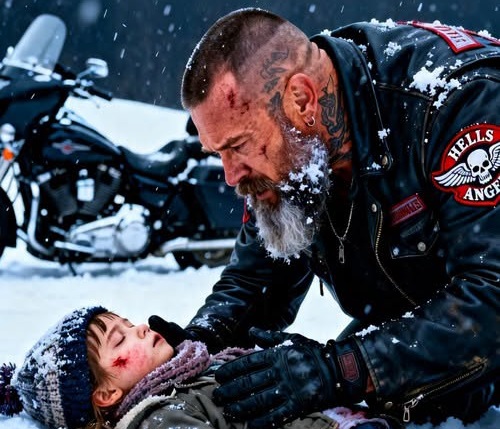
The frozen little boy lay buried beside a mountain guardrail while a january storm tried taking everything. i had spent years keeping my heart empty, until his faint pulse broke through every locked door. my motorcycle could not carry us safely, and the closest shelter waited beyond a blinding white bend. then i wrapped him in my coat, faced the mountain, and realized the cold was following us……………
Part 1…
The mountain did not care about me.
It never had.
The Blue Ridge rose on both sides of Route 119 like walls built from gray stone and black pine. Ancient. Silent. Indifferent to every man foolish enough to believe he mattered out there.
Snow came sideways across the asphalt.
It struck my goggles in thick white sheets and vanished beneath the front tire of my Road King. Wind screamed through the gaps in the ridgeline, rattling the guardrails, bending the trees, and pushing against eight hundred pounds of motorcycle as if the machine were made of paper.
I tightened both gloved hands around the handlebars.
A gust slammed me from the left. The Harley shuddered beneath me, and the back wheel shifted just enough to make my stomach tighten.
I leaned into it.
I had spent my life leaning into things.
Bad roads. Worse choices. Men who smiled before betraying you. Cold rooms where nobody said the name of the person who should have been there.
This storm was nothing new.
My boots were soaked where the wet had found the seams. My leather cut, with the Hells Angels patch across the back, blocked most of the wind.
Most was not enough.
Cold always found the cracks.
I had been riding since shortly after noon, returning from a parts run two counties over. It should have been simple. Pick up the order, secure it, ride home.
Then the mountain changed its mind.
The storm rolled off the ridge without warning, the way January storms often did in that part of the Blue Ridge. One minute, the sky was pale and heavy.
The next, it turned white and furious.
Visibility disappeared. The road narrowed to a faint gray strip beneath my tires, and every familiar landmark vanished behind moving curtains of snow.
Most riders would have searched for a diner, a gas station, or a wide shoulder.
I kept moving.
Maybe it was stubbornness. Maybe stopping meant sitting alone with thoughts I had spent years outrunning.
I squinted through my goggles and held the throttle steady. I could barely see the pavement, but I could feel it through the tires.
The road spoke through vibration and resistance, sending tiny changes into my hands before my eyes understood them.
I trusted that feeling.
Maps failed. Phones lost signal. People disappeared when loyalty became inconvenient.
The guardrail to my right appeared, then vanished in the blowing white. Beyond it was a long drop into the valley.
I knew what waited below.
Rock. Trees. Steep ground. Nothing soft.
I moved closer to the center line, giving the edge more room. No vehicles had passed in either direction for miles.
My mind went quiet, as it always did when danger demanded everything I had. Not peaceful.
Empty.
At forty-five, I had become skilled at keeping the room inside me bare. Once, it had held garage laughter, cold beers, and friendships I believed could never break.
I was wrong.
Everything breaks when enough pressure finds the right place.
I breathed slowly through my nose. Warm air fogged the inside of my goggles for half a second, then cleared.
I did not think about the past often.
There was no use.
A man could not ride forward while staring over his shoulder. I had learned that lesson the hard way, like every lesson that stayed with me.
Then the wind dropped.
Only for a moment.
The white wall ahead thinned enough for me to see farther down the road. My eyes swept the asphalt, the shoulder, and the base of the guardrail.
Something was there.
A dark shape.
Small. Low. Half buried.
It did not belong.
Before I could identify it, snow swept across the road again and hid everything. But in that brief opening, I had seen the shape move.
My hands reacted before my thoughts did.
I eased the bike toward the shoulder, braked carefully, and brought the Road King to a stop. The tires slipped once before catching.
I killed the engine.
The sudden silence felt enormous.
Without the Harley beneath me, there was only the howl of wind and the hiss of snow skimming across asphalt.
I kicked down the stand and swung off.
The cold attacked immediately.
Riding through it had been brutal. Standing inside it was worse.
I left the motorcycle half on the shoulder and turned toward the guardrail. Snow had piled deep along the road’s edge.
My first step sank almost to my knee.
I pulled free and stepped again.
The snow was soft and hungry. It swallowed my boots, hiding ice underneath and forcing me to lift each leg high before planting it again.
The guardrail was only thirty feet away, but every step felt stolen from the storm.
Wind struck my chest. I lowered my head and drove forward.
I had seen something move.
That was enough.
Twice, I slipped on hidden ice and caught myself against the rail. By the time I reached the spot, my breathing had changed.
I scanned the drift.
Nothing.
Only smooth snow piled along the base of the guardrail. The wind had shaped it into soft curves with no tracks and no obvious disturbance.
For one second, I wondered whether exhaustion had placed movement where none existed.
I started to turn.
The drift shifted.
Barely.
But I saw it.
I dropped to one knee.
Snow pushed through my pants as I leaned closer. I pulled off my right glove with my teeth and pressed my bare hand against the drift.
My fingers swept over packed snow.
Then they touched fabric.
Soft.
Wet.
Real.
I began digging with both hands, fast but careful. I threw snow behind me while the wind tried to put it back.
My bare fingers burned with cold.
I kept digging.
A sneaker appeared first.
Small. Gray. Worn white sole.
Completely wrong for a mountain road in January.
Then I uncovered a thin corduroy leg, soaked through and stiff with cold.
My chest tightened.
I cleared more snow.
A child’s jacket appeared. Puffy. Bright red once, but now dark with moisture and crushed beneath the weight of the drift.
Then I saw a face.
I stopped for half a heartbeat.
A little boy lay curled on his side.
Six years old, maybe. Small even for that.
His knees were pulled against his chest. His arms folded inward. His entire body had drawn into itself, as if he had tried to become too small for the storm to notice.
His eyes were closed.
His lips had turned a deep bluish purple. His skin was pale in a way no child’s skin should ever be.
Ice had formed along his hairline.
I had seen hard things, but that child beneath the snow struck somewhere I had spent years keeping numb.
“Kid,” I said.
The wind stole the word.
I leaned closer and brushed snow from his face. He did not react.
No flinch.
No sound.
I pressed two fingers to the side of his neck and held still.
At first, I felt nothing.
My own pulse hammered through my fingertips, making it hard to separate his body from mine. I changed the angle and waited.
There.
Faint.
Slow.
But there.
I lowered my face toward his mouth. My cheek hovered near his lips while I blocked the wind with one shoulder.
A tiny breath touched my skin.
Then nothing.
The pause stretched.
Another shallow breath came, barely more than the last bit of air escaping a balloon.
He was alive.
For now.
I pushed down my relief. The mountain had not given us time for it.
I slid one arm beneath his shoulders and the other under his knees.
Then I lifted.
He weighed almost nothing.
He felt like a bundle of sticks wrapped in soaked cloth, as though the cold had begun hollowing him out.
I pulled him against my chest.
His head settled beneath my collarbone. Even through my layers, cold radiated from his body.
This was not the ordinary chill of someone who had stayed outside too long.
It had gone deeper.
The cold was inside him now.
Working.
I turned my back toward the wind and studied his face. His eyelids held a faint gray cast, and the skin on his cheeks looked stiff and waxy.
I touched the back of one finger to his face.
Shockingly cold.
I knew what severe hypothermia looked like. Years earlier, I had seen a rider stranded too long on freezing pavement.
This child looked worse.
His breathing scared me most.
Each breath came as a weak little pull, followed by a pause that lasted too long. Three seconds.
Then four.
Each time the next breath arrived, I released one of my own.
He did not move.
Not a finger.
Not an eyelid.
He was far under.
I had to decide quickly.
That was one thing I still trusted about myself. When a choice had to be made, I made it.
I shifted the boy against my left side and held him firmly with one arm.
With my free hand, I reached for the zipper of my riding coat.
Continue in the comments 👇👇…
Part 2…
The zipper resisted for one terrible second.
Ice had formed along the teeth. I pulled harder until it broke free, then dragged it down with numb fingers.
I shrugged the heavy coat from one shoulder, then the other.
The cold struck immediately.
My thermal layer blocked almost nothing once the leather came off. Wind cut across my arms and chest, sharp enough to steal half a breath.
My teeth clenched.
I ignored it.
I could handle the cold longer than he could.
I wrapped the coat around the boy, covering him from head to shoes. The quilted lining folded over his soaked red jacket, and I tucked every edge inward until no gap remained.
Then I raised the collar around his small head.
Only part of his face remained visible.
Those blue lips.
That frightening stillness.
I pressed him tightly against my chest, trying to force my own warmth through leather, fabric, and freezing air.
“Stay with me,” I said.
He gave no sign he heard.
I turned toward the road.
My Road King stood where I had left it, black against the white storm. For one desperate moment, I considered putting him in front of me and riding.
I dismissed the idea.
I could not hold him safely and control the motorcycle on icy roads. One gust or hidden patch could send both of us over the guardrail.
The bike was not the answer.
The clubhouse might be.
It sat about half a mile away, beyond the next bend and up a cutoff road hidden by the storm. In clear weather, the distance was nothing.
In this, it could become everything.
Still, there would be shelter. Heat. Men with phones, blankets, and enough hands to help.
I knew these mountain roads the way I knew my own engine.
I tightened my grip around the child and faced the white wall ahead.
Then I started walking, my boots punching through the snow with every step.
SAY “OK” IF YOU WANT TO READ THE FULL STORY ❤️👇 👇
The wind hit him full in the face, mean and relentless. He tucked his chin down over the top of the boy’s head and kept going, moving at a steady, grinding pace toward the clubhouse, and whatever warmth was waiting inside it. The clubhouse door hit the wall hard when Rafe’s boot kicked it open. The sound of it cut through the low rumble of voices inside like a gunshot.
Three men looked up from a card game at the far table. Two more turned from where they stood near the fireplace. One was halfway through pulling a beer from the old fridge in the corner. Nobody moved for a half a second. Then everybody moved at once. “Get the fire up,” Rafe said. His voice was flat and steady, the same tone he used for everything.
But they all heard the weight underneath it. Kids in bad shape. Big Lou was the first one to him. Lou was not a small man. He stood 6’4 and had hands the size of dinner plates with a beard that had gone mostly gray over the past few years. He looked at the bundle in Rafe’s arms, and something shifted in his face.
“How long was he out there?” Lou asked. “Don’t know. Long enough.” Rafe moved through the room toward the couch nearest the fireplace. Clear that off. Denny, a wiry guy with a faded tattoo running the length of his neck, swept the couch clean in one motion. Jackets, a crumpled magazine, an empty chip bag. All of it hit the floor.
He grabbed a thick wool blanket from the chest by the wall without being asked and had it spread out on the cushions before Rafe even reached them. Rafe lowered the boy down gently, slow and careful, the way you would set down something fragile. He kept one hand behind the small head until it was resting fully on the cushion.
Then he straightened up and looked at the group gathering around him. He needs heat. Real heat, not just blankets, Rafe said. Somebody get the fire higher and find something warm to drink. Not hot, warm. We got broth, said a man named Cutter from across the room. He was already moving toward the back kitchen. Put some on the stove this morning.
Make it lukewarm, Rafe called after him. Nothing hot. Big Lou had crouched down beside the couch and was studying the boy’s face with an expression that looked almost tender on a man his size. He reached out and touched the boy’s hand, then looked back at Rafe. He’s real cold, man. I know. Rafe knelt down and began checking the boy over again.
He unwrapped his riding coat from around the small body and passed it off to Denny, then pulled the wool blanket up and tucked it in firmly on all sides. He pressed the back of his hand to the boy’s forehead. Still cold. still that stiff, alarming cold that had no business being in a living person. The fire behind him roared up suddenly as someone added another log and worked the damper open.
The heat began reaching across the room in strong rolling waves. Rafe pulled the couch closer to the fire, scraping it across the floor until the boy was within a few feet of the flames. Then he sat down on the edge of the cushion beside the small legs and leaned forward with his elbows on his knees watching.
One of the younger guys, a man called Burch, who never said much, came over and sat on the other side of the boy without a word. He pressed his hands gently along the outside of the blanket, adding pressure, adding warmth. He did not make a big thing of it. He just did it. Rafe noticed. He did not say anything either.
The room had gone quieter. The card game was gone. The beer was forgotten. All of it had been set aside without anyone deciding to set it aside. They had simply stopped and gathered. Then it happened. The boy’s fingers moved. Just a small curl barely visible beneath the edge of the blanket. But Rafe saw it. His eyes locked onto that tiny hand, and he watched the fingers pull in slowly, then loosen again.
Then the boy’s chest rose with a breath that was just slightly deeper than the ones before it. The boy’s eyelids fluttered. It was the smallest thing, like a moth wing brushing against glass. But Rafe caught it, and he leaned forward just slightly, hands clasped together between his knees, watching. “Hey,” he said quietly.
“Just that one word, soft and low.” The boy’s eyes opened halfway. They were glassy and unfocused at first, the pale blue gray of a winter sky. His gaze moved across the ceiling slowly, like he was trying to figure out where up was. Then it drifted down to the fire. The orange light played across his face, and for a moment, he just stared at it.
Nobody in the room spoke. Bigloo had settled into a chair nearby, his massive frame somehow making itself small and still. Denny stood back near the wall with his arms crossed, but his face was open. Bur stayed where he was on the edge of the couch, his hands resting lightly on top of the blanket. The boy’s eyes moved again, slowly this time.
They found Rafe. Rafe did not look away. He held the boy’s gaze steady and kept his own face calm, the way you would hold a hand out to a stray dog that had been frightened badly. “You’re okay,” Rafe said. “You’re inside. You’re warm.” The boy blinked. His lips parted just slightly, but no sound came out yet.
Cutter appeared from the kitchen doorway, holding a ceramic mug in both hands with the kind of focus usually reserved for carrying something explosive. He crossed the room quietly and held it out toward Rafe. Lukewarm,Qar said under his breath, checked it twice. Rafe took the mug and nodded once. He turned back to the boy.
“Think you can sip something?” he asked. The boy’s eyes stayed on him. There was fear in them, but it was a soft kind of fear now. Confused more than panicked, he gave the tiniest nod. Rafe slid one hand carefully behind the boy’s head and tilted him up just enough to bring the mug to his lips. The boy took one small sip. Then another.
A little bit of the broth ran down his chin, and Rafe wiped it away with his thumb without thinking about it. “Good,” Rafe said. “That’s good.” He set the mug down on the floor beside the couch and eased the boy’s head back against the cushion. The child’s color was changing. The terrible bluish gray was giving way to something closer to pale pink at the edges of his cheeks.
It was slow, but it was there. Big Lou exhaled from his chair like he had been holding that breath since Rafe walked through the door. The boy’s eyes were still open. He was looking at the ceiling again, then at the fire, then back at Rafe, like he was doing a slow inventory of the world around him. His gaze moved to Birch, then to Lou, then across the rest of the room.
all these big rough men standing quietly around him. Under different circumstances, one small child surrounded by a room full of hell’s angels might have been the most frightening thing imaginable. But the boy did not look frightened. He looked tired, deeply, completely tired in the way that goes beyond the body. His fingers curled around the edge of the blanket and pulled it just slightly tighter under his chin.
He blinked slowly. His breathing had evened out into something that sounded almost peaceful. Rafe thought he might be drifting back towards sleep. Then the boy’s mouth moved. It was barely a sound at first, a breath shaped into something almost like words. Rafe leaned in closer, close enough to hear. The boy swallowed once.
His eyes stayed fixed on the ceiling above him, and his voice came out in a thin, frail thread of sound. “Don’t fight,” he whispered. The words landed in the room like a stone dropped into still water. Rafe stayed very still. He looked at the boy’s face. Those pale eyes, heavy and distant, staring upward at nothing. “Don’t fight,” the boy said again, softer this time, like he was saying it to someone who was not there.
The boy had slipped back into a shallow sleep. His breathing was steadier now. Not strong, but steady. The kind of breathing that told you the body was finally doing what it was supposed to do. fighting to stay warm. Fighting to stay here. Rafe watched him for a long moment before he looked up at Birch. “We need to get the wet clothes off him,” Rafe said quietly.
“Keeping them on is keeping him cold.” Bur nodded. “Got some old flannel in the back room. Probably drowns him, but it’ll do. Get it.” Birch disappeared down the hallway without another word. Rafe turned back to the boy. He reached forward and gently pulled the blanket down just enough to work. The outer layer, the small jacket the boy had been wearing, was stiff with cold and moisture.
It crinkled like paper when Rafe moved it. He worked the zipper slowly, careful not to jostle the boy too much. The child stirred once, made a small sound, then went still again. Easy, Rafe murmured. More to himself than to the boy. He peeled the jacket back off thin shoulders. The shirt underneath was damp and clinging.
Rafe worked that off, too, moving slowly, keeping the blanket draped across the boy’s lower half for warmth. The child’s skin was still cool to the touch, but no longer ice cold. Another good sign. Rafe handed the wet clothes back to Big Lou, who took them without a word, and laid them out near the fire to dry. That was when Rafe saw it.
A thin silver chain around the boy’s neck. It had been hidden under the collar of his shirt, pressed flat against his skin. At the end of the chain hung a small locket, no bigger than a coat button. The metal caught the fire light and threw a soft flicker across Rafe’s hand. He paused. The locket needed to come off, too.
Metal held cold, and the last thing the boy needed was a piece of chilled silver sitting against his chest all night. Rafe reached around and found the clasp at the back of the chain. His fingers were large and blunt from years of mechanical work, but he was patient with small things. He worked the clasp free and drew the chain gently over the boy’s head without disturbing him.
He held it up in the fire light. The locket was simple. No engraving, no decoration, just a small oval of tarnished silver with a tiny hinge along one side. the kind of thing someone kept, not because it was expensive, but because what was inside it mattered. Rafe turned it over once in his palm.
Then, without fully deciding to, he pressed his thumbnail into the small groove along the edge and eased it open. Inside, on the left, was a photograph of a woman. She had dark hair and a wide smile, the kind of smile that made it impossible not to look twice. She was holding something, maybe flowers, but the image was too small and worn to make out clearly.
Rafe’s eyes moved to the right side of the locket. Another photograph. A man this time, standing outdoors somewhere, squinting slightly against bright light. He had broad shoulders and a familiar tilt to his jaw. He was laughing in the photo, head turned just slightly to one side, the way some people do when a laugh catches them off guard.
Rafe’s breath stopped. He knew that face. He had not seen it in 15 years. Not since a night that ended in raised voices and a door slamming hard enough to shake the frame. Not since a friendship that had meant more to him than almost anything else in his life had come apart at the seams over something he had never fully been able to explain, even to himself.
But he knew that jaw, that laugh, that way of standing like the ground beneath him was something he had personally earned. Rafe sat very still with the locket resting open in his palm. The fire crackled beside him. The boy breathed slowly. The room went on quietly around him and Rafe just stared. Bur came back with the flannel shirt draped over one arm.
He handed it to Rafe without a word and crouched down near the fire, warming his hands. Rafe set the locket carefully on the low table beside him. He would come back to it. He had to. But right now the boy needed tending to, and that came first. He eased the flannel over the child’s thin arms and pulled it down across his chest.
It swallowed him whole, the hem falling nearly to his knees, the sleeves folding over twice at the wrists. But it was dry and thick and warm, and that was what mattered. The boy stirred, his eyes opened slowly, not all the way, just a crack, like a door with a broken hinge. He looked up at Rafe with eyes that were brown and glassy and very tired.
“Hey,” Rafe said quietly. “You’re okay. You’re safe.” The boy blinked. His lips moved, but nothing came out at first. “Take it easy,” Rafe said. “No rush,” the boy swallowed. tried again. “I ran away,” he said. The words came out thin and hoarse, like he had been holding them in for a long time.
Rafe kept his voice level. “I figured.” The boy’s eyes moved around the room slowly, taking in the rough walls, the big men sitting quietly nearby the fire. His expression was careful. Not frightened exactly, more like a kid who had learned to read a room fast and was still deciding what he thought about this one. “My mom and dad were yelling,” he said finally.
“Refe.” “They yell a lot now.” The boy’s voice was flat, the way voices get when something has happened so many times it stops feeling like a surprise and starts feeling like weather. I didn’t want to hear it anymore, so I went outside. In the storm, the boy gave a small shrug with one shoulder. I didn’t think it was that bad yet.
Big Lou shifted across the room and Rafe caught him exchanging a look with Birch. Nobody said anything out loud. They did not need to. Do you know where your mom and dad are right now? Rafe asked. The cabin, the boy said. Up the road. He paused. They probably don’t even know I’m gone. The way he said it was the worst part.
Not angry, not sad, just matter of fact. Like it was something he had already decided was true a long time ago. Rafe felt something tighten in his chest. He kept his face steady. “What’s your name?” he asked. The boy looked at him for a moment. “Eli.” “Eli,” Rafe gave a single nod. “I’m Rafe.” Eli looked at him for another beat, then closed his eyes again.
His breathing evened out. He was not asleep. Not quite, but he was close. Rafe picked up the locket from the table and closed his hand around it. It was Decker who heard the radio crackle first. He was over by the old CB unit mounted near the far wall, the one they kept tuned to the Ranger Station frequency, out of habit more than anything else.
He held up a hand, and the low murmur of voices in the room went quiet. The message came through in broken pieces, cut up by static and the howl of the wind pressing against the building. But the words that came through were clear enough. Missing child, male, approximately 6 years old.
Last seen near mile marker 14 on the upper mountain road. All units and area residents advised to report any information immediately. Nobody moved for a second. Then Decker turned slowly from the radio and looked at Rafe. Rafe looked down at Eli, sleeping now against the blankets. Then he looked back at Decker. “They’re looking for him,” Decker said.
“I know.” Outside, the storm hit the building with a sound like a fist. The lights above them flickered once, held, then flickered again. The wind was getting worse, not better. And somewhere in the static, the radio kept repeating its message. The storm made the decision for all of them.
By 8:00, the road outside was buried. Decker had cracked the front door twice to check, and both times the wind shoved back like it had something to prove. Snow piled against the base of the door in a thick white wedge. The trees beyond the lot had disappeared completely into the dark and the white. There was no going anywhere. Not tonight.
The ranger station frequency had gone to pure static an hour ago. Inside, the clubhouse held its warmth. The fire ate through wood steadily, and Big Lou had dragged out every extra blanket he could find from the back storage room. A mismatched pile of old wool and flannel that smelled like motor oil and dust, but did the job just fine.
Someone had found a can of chicken broth in the back cabinet. Burch had heated it on the small camp stove and poured it into a tin cup, and Eli had sat up just enough to sip at it slowly, both hands wrapped around the cup like it was something precious. He did not talk much, but he watched everything. Rafe noticed that about him.
The boy’s eyes moved around the room in that quiet, careful way, taking inventory. He watched Decker sharpen a pocketk knife by the fire. He watched Big Lou patch a tear in a jacket sleeve with the kind of focused patience that big men sometimes have. He watched Bur hum something low under his breath while he cleaned up the camp stove.
None of it seemed to frighten him. If anything, the boy seemed to settle a little more with each passing hour, the way a person does when they realize the thing they feared is not going to come. Around 9, Eli fell into a real sleep, not the shallow, broken kind from earlier, a deep one. His chest rose and fell in a slow, steady rhythm.
The color in his face had come back. His lips were pink again. His fingers, curled loosely at his side, looked like the fingers of a normal sleeping child, and not a boy pulled out of the snow. Rafe sat on the floor beside him and did not move. The other men found their spots around the room.
Decker stretched out on the old couch with his arm over his face. Big Lou settled into the wide chair in the corner, his chin dropping to his chest within minutes. Birch killed the overhead light so only the fire was left, and the room went warm and amber and quiet. Outside, the storm pressed on. Rafe listened to it.
The wind finding the gaps in the old walls, the soft groan of the roof under the weight of the snow, the occasional deep crack of a tree somewhere in the dark. He had sat through bad weather before many times. But there was something different about sitting through it with a child sleeping 2 ft away from you.
It changed the sound of the storm somehow. made it feel less like something you endured and more like something you stood between and something fragile. He looked at Eli’s face, smooth and still in the firelight. A six-year-old boy who had walked out into a white out because the noise inside had gotten too loud.
Who had said his parents probably did not even know he was gone. Who had said it without any drama at all, just quiet certainty. That was the part Rafe could not shake. He reached over and adjusted the edge of the blanket where it had slipped off the boy’s shoulder. Tucked it back into place. Birch appeared at his side, moving quietly.
He held out a mug of black coffee without a word, and Rafe took it. “Get some sleep,” Bur said low and easy. “I’ll watch him for a while.” Rafe looked at Eli. Then he looked at the fire. He turned the mug in his hands once slow. “I’m good,” he said. Burch studied him for a moment, then he gave a single nod and moved away without pushing it.
Rafe settled his back against the wall and kept his eyes on the boy. He was not going anywhere. The fire had burned low by the time Eli stirred the first time. Rafe was still awake, still sitting against the wall with the cold mug balanced on his knee. He caught the movement before it became anything.
Just a small shift under the blankets, a tightening of the boy’s shoulders. Then Eli’s eyes opened. He did not look around the way a rested child does, slow and soft and wondering. He looked around fast, like he needed to know where he was before anything else. His breathing picked up. His small hands gripped the blanket.
Rafe moved closer, quiet and deliberate. “Hey,” he said. Just that, low and steady. Eli’s eyes found him. Something in the boy’s face eased. “Not completely, but enough. His breathing slowed back down. He looked at the fire. He looked at Decker on the couch and Big Lou in the chair and the general stillness of the room.
His grip on the blanket loosened. “Go back to sleep,” Rafe said. Eli looked at him once more. Then he pulled the blanket up close to his chin and closed his eyes again. Rafe watched him until his breathing went deep and even. It happened again around midnight. This time it was different. Eli came awake with a gasp that cut right through the quiet.
He sat up partway, eyes wide, and for a few seconds he was not in the clubhouse at all. Rafe could see it. The boy was somewhere else, somewhere loud. Hey. Rafe put his hand gently on the boy’s arm. You’re okay. You’re right here. Nothing’s happening. Eli blinked. He looked down at Rafe’s hand on his arm.
He looked up at Rafe’s face. “I heard them,” the boy said. His voice was still rough from sleep and from the cold that had settled into his chest earlier. “Heard who?” Rafe asked. Eli pulled his knees up and wrapped his arms around them. He was quiet for a moment. The fire popped once and threw a small spray of orange sparks up the chimney.
My mom and dad, he finally said they were really loud. Rafe did not say anything right away. He just stayed where he was, close, steady, not filling the silence with noise. “Were they fighting?” he asked. Eli nodded small and tight. “They fight a lot now,” the boy said. “But tonight it was different.
” He pressed his chin against his knees. It was really different. different. How? Eli thought about it for a moment. His face scrunched like he was trying to find the right words for something that did not have easy ones. Like they weren’t even talking to each other anymore. He said, like they were just both really sad and really mad at the same time.
And they kept saying stuff about who gets the house and who gets me. He paused. I don’t want anybody to get me. I just want them to stop. Rafe stayed very still. “So, I went outside,” Eli said. He said it simply, like it was the only thing that had made sense at the time. “I just wanted it to be quiet.” The wind pressed against the side of the building.
Inside the room, Big Lou’s soft snoring continued from the corner chair. The fire burned low and steady. “You found quiet out there?” Rafe asked. Yeah, Eli said, and then after a beat, almost to himself. Too much quiet, I think. Rafe looked at the boy’s face in the fire light, the shadows under his eyes, the way he held himself small and tight, like he was trying to take up as little space as possible.
Like, if he got small enough, maybe the big painful things happening around him would stop touching him. “They signed some papers,” Eli said quietly. Tonight before it got loud, I heard my dad say the papers were what made it real. His voice dropped even lower. That’s when they started crying. Both of them. That’s when I couldn’t stay anymore.
He looked up at Rafe then. His eyes were dry, but deep and very serious. “Is it real?” he asked. “When you sign something, does that mean it can’t ever go back?” Rafe did not answer right away. He looked at the boy for a long moment. The question hung in the air between them, soft and heavy at the same time.
Eli was watching him with those serious waiting eyes. Eyes that had already seen too much for a six-year-old. Some things can go back, Rafe said carefully. Some things can’t. But the people who love you, that part doesn’t change because of a piece of paper. Eli considered that. He turned it over quietly, the way kids do when they are really listening and not just waiting for the next thing.
Then he gave a small nod like he had filed it somewhere important, and slowly let himself sink back down into the blankets. Rafe stayed beside him until the boy’s breathing stretched long and slow again until his shoulders finally let go of the tension they had been carrying. Then Rafe sat back. He reached into the front pocket of his vest and pulled out the locket.
He had tucked it there hours ago after Decker found it near the boy’s collar. He had barely looked at it then. There had been too much to do, too much cold to fight back, too much fear to manage. But now the clubhouse was quiet. The fire was steady. The boy was asleep. He opened it. The hinge was stiff from the cold, but gave with a small click.
Inside, the photo was tiny and slightly creased along one edge. A family picture, the kind people take outside in autumn with the leaves coming down. A woman with dark hair and a bright smile. A small boy, younger than he was now, grinning and missing a front tooth. And a man. Rafe’s eyes went still.
He brought the locket closer to the fire light, tilted it slightly so the warm glow fell across the photo without washing it out. The man in the picture was maybe 10 years older than the last time Rafe had seen him. His hair was shorter now, and there were lines around his eyes that had not been there before. But the jaw was the same.
The way he tilted his head slightly when he smiled, that was the same, too. There was a particular kind of ease in his posture, shoulders loose, head tipped just a little to the left, like the world was something he leaned into rather than braced against. Rafe had spent years with that posture, standing next to his own. “Danny,” he said.
The word came out barely above a breath. Not a question, not a shout, just a name, dropped into the quiet room like a stone into still water. Daniel Voss, his best friend for nearly 12 years. The man he had built things with, broken down alongside, laughed with in cold garages and on long empty highways.
The man who had been closer to him than any blood relative had ever managed to be. the man he had not spoken to in 15 years. Rafe stared at the photo. All at once, the memories came loose in a way he could not stop. Laughter in a parking lot after midnight. A road trip out to the coast that had taken 4 days longer than planned.
The summer they rebuilt a 1972 shovel head from bare frame to running machine and felt like they had done something worth doing. The look on Dy’s face the last time Rafe had seen him. Not angry, which would have been easier, but just broken. Quiet in the way that meant something had already finished. Rafe closed the locket.
He sat there holding it in his fist. The metal had picked up the warmth of his hand and was no longer cold, but the rest of him had gone somewhere very far away. He stood up slowly so as not to wake the boy. He pulled on what was left of his outer layer. He crossed the room without a word to anyone.
Decker opened one eye from the couch, watched him move toward the door, and said nothing. The door swung open. The cold hit him like a wall. Rafe stepped out into the dark and the silence and the freezing mountain air, and he stood there alone with the locket pressed tight in his palm. The cold outside was absolute. No wind now, just stillness and dark, and a sky buried under thick cloud.
The snow had stopped falling for the moment, but the world it left behind was white and silent in every direction. The trees stood heavy with it. The road was gone under it. The mountains beyond were just shapes, dark suggestions rising up into nothing. Rafe stood on the small wooden porch and stared at all of it.
He opened his fist. The locket caught the faint light spilling through the frosted window behind him. He opened it again and looked at Danyy’s face. 15 years. He had not let himself think about Daniel Voss in a long time. Not because the memory had faded, but because it had not. And that was the problem with it.
The beginning of that friendship had been the easiest thing Rafe had ever stumbled into. He was 22 and working at a garage outside of Asheville, doing oil changes and brake jobs for $11 an hour and not thinking much past the weekend. Dany had rolled in on a beat up Honda that was burning oil from three different places and making a sound that was half mechanical failure, half prayer.
He was 23, laughing at his own bad luck before he even got out of the car. And somehow that had been enough. They were talking for 2 hours before either of them thought to introduce themselves properly. After that, it was just easy. The way real friendship is. No effort, no performance, just two people who made sense standing next to each other.
They rode together, worked together, trusted each other with the kind of things men usually keep locked behind their back teeth. Dany was the only person Rafe had ever told about his father, about growing up in a house where silence was safer than speaking. Dany had listened without fixing anything, which was exactly right.
And then came the year things went wrong. It was not a dramatic falling out. That was what had made it so hard to move past. There was no single fight to point at, no moment where everything exploded clean. It was something quieter and more permanent than that. There had been money involved. Club money borrowed in trust and not returned the way it should have been.
Rafe had been blamed. He had believed Dany would speak up. would tell the truth about what had actually happened, would stand beside him the way they had always stood beside each other. Dany had stayed silent, not because he was cruel. Rafe had figured that much out eventually, long after the damage was done.
Dany had been scared. He was dealing with something of his own at the time, something he had never explained, and the silence had come out of fear rather than betrayal. But fear and betrayal can look exactly the same from the outside. And Rafe, standing on the wrong side of that silence at 29 years old, with half the club turning their backs and his pride already bleeding, had not been able to see the difference.
He had walked away. Dany had let him. And that was how 15 years of nothing had started. Rafe closed the locket again slowly this time. He thought about the boy inside, about the way Eli had curled in on himself in that snow. About the word he had whispered when he first came around. Don’t fight. Not help me. Not I’m cold.
Don’t fight. a child who had heard too many angry words and walked out into a blizzard rather than listen to any more of them. A child wearing a locket with Danny Voss’s face inside it. Rafe looked down at his own hand, at the leather and the cold and the years written into both. He breathed out slowly and watched the breath disappear into the dark.
The boy sleeping by that fire was not a stranger who had wandered into his life by accident. He was the son of the man Rafe had once called his closest friend. The son of the silence that had broken something in both of them. This was not coincidence. This was something older than the storm. The sound came sharp and hard through the quiet.
Three knocks official. the kind that do not ask permission. Rafe was still outside when he heard it. He turned and stepped back through the door before anyone else could move. The warmth of the room hit him in the face like a wall. The fire was still going strong. Eli was asleep under a pile of blankets near the hearth, his small chest rising and falling in a slow, steady rhythm.
Two of the brothers, Cutter and a big quiet man they called Hound, were sitting close, not hovering, just present. The way a good dog sits near someone it has decided to protect. Big Lou was already at the door. He was the oldest one there, 53, and built like a vending machine, with a gray beard that touched his chest and hands that had worked hard enough to look like they belonged on someone twice his size.
He was also, without anyone ever voting on it, the most level-headed man in the room when things got difficult. He opened the door. The man standing on the porch was not a sheriff’s deputy. He was a mountain rescue official, wearing an orange and gray jacket with a county emblem on the chest and a flashlight clipped to his vest.
He looked to be around 40, lean and sharpeyed with snow melting on his shoulders and the kind of expression that had already made up its mind about something before he knocked. His name badge read Garrett. He looked at Lou, then passed Lou. Then his eyes moved around the room and landed on the pile of blankets near the fire.
“Evening,” he said. His voice was careful. “We have a missing child report active in this area. Boy, 6 years old, dark hair, went missing from a cabin approximately 4 mi up the ridge. I need to know if anyone here has seen anything.” Lou did not step aside. “Not yet.” but he kept his voice level and his hands visible.
Come on in out of the cold. Garrett stepped inside. He did not take his hand far from the radio clipped to his left shoulder. His eyes went straight back to the blankets. Eli shifted in his sleep. One small hand appeared from under the edge of the top blanket and curled against the floor. Garrett’s jaw tightened.
Is that the child? It is, Rafe said. He had moved to the center of the room without realizing it. Standing there in his heavy boots and his flannel shirt, arms at his sides, not threatening, just solid, just present. Found him in the snow off the south guard rail about 3 hours ago, Rafe said, buried up to his shoulder.
Lips were blue. He was not moving much when I got to him. I brought him here because here was closer than anywhere else and he would not have made it to anywhere else. Garrett looked at him for a long moment. You’re the one who found him? Yes. Alone. On my bike. Yes. Garrett pulled out a small notepad. And you didn’t call it in.
Storm knocked the signal out up on that stretch. I tried. Rafe held his ground. I made a choice. The road or the kid? I chose the kid. The silence in the room was not comfortable. Cutter had straightened up from his chair. Hound had his arms crossed, not in anger, but in the specific way large men cross their arms when they are trying very hard not to look like a threat and failing somewhat at it. Garrett wrote something down.
Then he looked around the room again, at the leather vests, at the patches, at the fire and the broth cup sitting on the floor near the blankets and the wet child’s jacket hanging on a chair to dry. A Hell’s Angel’s Clubhouse, he said. Not a question, more like something he was confirming for himself. That is correct, Lou said.
Garrett looked back at Rafe. And none of you thought to reach emergency services the moment any signal was available. Signal came back 20 minutes ago. Rafe said you knocked on our door 17 minutes after that. Garrett wrote one more thing in his notepad. Then he clicked his pen shut and tucked it into his jacket pocket.
I am going to need to examine the child. He said he is sleeping. Rafe said I understand that. But I still need to verify his condition. Rafe looked at him for a moment. Then he nodded once and stepped to the side. Garrett crossed the room slowly. He crouched down near the blankets, pulling a small flashlight from his vest.
He was careful. Rafe noticed that the man may have come in with suspicion in his eyes, but his hands near the child were gentle. He checked the boy’s breathing, checked his color, lifted the edge of the blanket just enough to look at his fingers and confirm they were not white or waxy. Eli stirred.
His eyes opened partway, cloudy and slow with sleep. Garrett leaned back slightly. He kept his voice soft. Hey, buddy. You okay? Eli looked at him. Then his eyes moved past him. He found Rafe standing a few feet away and something in the boy’s small body relaxed like a knot coming loose. He reached one hand out from the blanket. Rafe walked over without thinking.
He sat down on the floor beside the boy close enough that Eli could grab a fistful of his flannel sleeve. The boy held on and pulled the blanket back over himself with his other hand and closed his eyes again. Garrett watched that. He did not write anything down. He just watched it. Then he stood up slowly and walked back toward the door.
He stopped before he reached it. His back was still to the room. He stood there a moment like he was deciding something. Then he turned around. I will need to file a report, he said, and someone from the county will be out here before morning. That is not something I can change. He looked at Rafe. But the boy is warm.
He is breathing right. And right now he is holding on to you like you are the only solid thing in his world. He paused. You did the right thing bringing him here. Lou gave a small nod. Cutter uncrossed his arms. The tight held breath feeling in the room loosened just slightly. Garrett stepped back out into the snow and pulled the door shut behind him.
Nobody said anything for a little while after that. The fire burned lower as the night deepened. Cutter added another log without being asked. Hound moved to the far corner and stretched out in a chair with his boots still on, chin dropping toward his chest. Lou turned off the overhead light and left only the lamp on the far table burning, casting the room in a low amber glow. Eli woke up again around 9:00.
He did not cry this time. He just blinked at the ceiling and then turned his head and looked at Rafe, who was sitting on the floor beside him with his back against the couch. “Is the storm still there?” Eli asked. His voice was still rough, still small, but it was clearer than before. More present. Yeah, Rafe said.
Still going, Eli looked at the fire. Is it going to stop? Storms always stop. The boy seemed to think about that. Then he pushed himself up slowly until he was sitting. The blanket pulled around his waist. His color was better. His lips were no longer pale. There was a faint pink in his cheeks from the fire’s warmth. Lou had left a cup of warm broth on the floor nearby.
Rafe picked it up and held it out. Eli took it with both hands. He sipped it carefully, the way a small child handles something hot with that very serious look of concentration. After a few sips, he lowered the cup and leaned sideways until his shoulder was resting against Rafe’s arm. Rafe did not move.
Eli finished the broth slowly, set the empty cup down on the floor, and then, without a word, he turned and leaned fully into Rafe’s side, tucking his head against his chest, and closed his eyes. His breathing evened out within minutes. Rafe sat very still. The fire crackled softly. Outside, the wind pushed against the walls of the clubhouse, but in here it could not reach.
The boy’s small weight against him felt like something he had not realized he was missing until right now. He did not move for a long time. Rafe felt it before he heard it. The wind stopped, not slowly, not gradually. It just stopped the way a held breath finally releases. The constant pressing sound against the walls of the clubhouse went quiet, and the silence that replaced it felt almost too big for the room.
He looked towards the window above the sink. The glass had been fogged with cold for hours. But now, through the top corner where the fog had not reached, he could see something different. Not the thick gray dark of the blizzard. Something softer, something that looked almost like open sky. Eli felt the change, too.
He lifted his head from Rafe’s chest and blinked. His eyes moved to the window. It stopped, Eli said. For now, Rafe said. The boy pushed the blanket off his legs. He was wearing an oversized flannel shirt that Lou had dug out from a back room, rolled at the sleeves so his small hands could poke through.
His jeans had dried near the fire hours ago. He looked at the door. “Can we go outside? Rafe looked at him, then at the window. The sky through the glass had turned a pale, washed out silver, the kind of light that comes after a storm takes a breath. The trees had stopped bending. The snow on the ground was still it would not last long. He knew that.
But right now, this moment, the mountain had gone quiet. “Yeah,” Rafe said. For a few minutes. He helped Eli pull on his boots, which had been drying on the hearth. Rafe pulled on his own jacket and grabbed a thick wool blanket from the couch. He wrapped it around Eli’s shoulders like a cape, tucking it snug across his chest.
Hound looked up from his chair. Rafe gave him a small nod. Hound understood. He would stay close to the door. Rafe pushed the door open and stepped out first. The cold hit him clean and sharp. Not the mean, biting cold of the blizzard, but a still cold, the kind that feels honest. The snow on the porch was nearly a foot deep.
It had drifted up against the side of the building and smoothed itself over every surface like someone had laid down a white sheet over the whole mountain. The sky above them had cracked open just enough to let in a pale gray light. Stars were not visible yet, but the heavy pressing ceiling of storm clouds had thinned out and pulled back in places, and the darkness had a kind of softness to it that felt different from the darkness of the blizzard.
Eli stepped out beside him. He stopped at the edge of the porch and looked out at the snow-covered world. His eyes went wide. He had not seen it like this. He had only seen the storm from the inside, from a place of cold and fear. But now, standing here with warm clothes and dry feet and a blanket pulled around him with wraith solid beside him, the snow looked like something else entirely. It looked beautiful.
“Wow,” Eli said quietly. It was barely a word, just a sound that slipped out of him. Rafe stood beside him. He did not say anything. He watched the boy take it all in. Then the clouds shifted above them. Slowly, gently, small snowflakes began to fall again. Not the hard sideways kind that had been tearing through the mountain all day.
These were soft, almost lazy. They drifted down like they had nowhere particular to be. One landed on Eli’s cheek. He reached up and touched it, but it was already gone. Another one floated down and landed right on his eyelashes. Eli froze. His eyes went wide, and then he scrunched them up, feeling the cold tickle of it.
And then, without warning, without buildup, he laughed. It was a real laugh, small and bright, and completely his own. the laugh of a six-year-old who had found something delightful and could not help himself. Rafe felt something shift inside his chest, like a door opening that had been shut for a very long time. He stood in the snow and let himself feel it.
The piece did not last long. Rafe heard them before he saw them. The low grind of engines pushing through packed snow. headlights cutting through the tree line from down the access road. More than one vehicle. He could tell by the sound. Two, maybe three. He put his hand gently on Eli’s shoulder. Let’s go back inside, he said.
Eli looked up at him. He must have heard something in Rafe’s voice because he did not argue. He just nodded and let Rafe steer him back through the door. Inside, Hound was already at the window. Crow stood near the back wall with his arms crossed. Lou had set down his coffee mug and was watching the door with quiet, steady eyes.
Company, Hound said. “Yeah,” Rafe said. “I see it.” He guided Eli to the couch near the fireplace and crouched down in front of him. He kept his voice calm. Steady. Some people are going to come in, Rafe said. They’re here to make sure you’re okay. You don’t need to be scared. Eli looked at him.
His small face was serious. Are they going to take me away? Rafe held the boy’s gaze. He did not lie to him. He did not look away. I don’t know, he said. But I’m not going anywhere. Okay. Eli nodded slowly. He pulled the wool blanket tighter around himself. The knock at the door was loud and official. Three hard wraps.
Rafe stood and crossed the room. He opened the door. There were four of them on the porch. Two county sheriff’s deputies in heavy winter gear. A woman in a dark jacket with a state child services badge clipped to the front. And behind them, a man Rafe recognized from earlier, the rescue official who had come through asking questions.
He was not smiling this time. The woman stepped forward first. She was maybe 40 with short hair and careful eyes that moved past Rafe immediately into the room behind him. Sir, I’m Carol Vest, Department of Child Protective Services. We received a report of a missing child, and we have reason to believe he may be on this property.
She paused. We’re going to need to come inside. Rafe stepped back without a word and let them in. Carol Vess walked directly to the fireplace where Eli sat. She crouched down in front of him the same way Rafe had, but her voice was more careful, more practiced. “Hi there,” she said.
“What’s your name?” Eli glanced at Rafe. Rafe gave him a small nod. “Eli,” the boy said. She smiled, but it was a working smile. the kind people put on because the situation requires it. Hi, Eli. Are you okay? Are you hurt anywhere? I’m warm now, Eli said. Good. She looked him over carefully, checking his hands, his face, the color in his cheeks.
Then she stood and turned to Rafe. Her voice dropped lower. He needs to come with us for a proper medical evaluation and protective custody assessment. That’s not optional. Rafe looked at her. He’s been warming up for hours. He’s eating. He’s stable. I’m sure he is. She said it was not unkind, but it was firm. But protocol requires a full evaluation.
We also have no confirmed identification and an open missing person’s report. One of the deputies moved towards the couch. That was when Eli understood. No. The boy slid off the couch and crossed the room in three quick steps. He pressed himself against Rafe’s side, grabbing a fistful of Rafe’s jacket with both hands. No, I want to stay here.
Eli, Carol said gently. We’re going to take care of you. I don’t want to go. His voice cracked. He turned his face up toward Rafe. His eyes were wet and wide and full of something desperate. Don’t let them take me, please. The deputy reached down and carefully, professionally, lifted the boy away. Eli screamed.
He reached back with both arms stretched wide, fingers open, grabbing at air. His eyes were locked on Rafe’s face as they carried him towards the door. And he was crying hard now, the kind of crying that comes from somewhere deep. Rafe. The door closed. The sound of it was small, just a soft click, but it landed in the room like something heavy dropped from a great height.
Nobody spoke. The fire crackled, the wind pressed against the windows. Outside, engines turned over and tires crunched through snow as the vehicles pulled away. The sound faded slowly until there was nothing left of it at all. Rafe stood in the middle of the room with his hands at his sides. He did not move for a long moment. His jaw was tight.
His eyes were fixed on the door as if the boy might still come back through it. He did not. Hound exhaled through his nose and looked at the floor. Crow turned away and leaned both palms against the back wall, staring at nothing. Lou picked up his coffee mug, realized it was empty, and set it back down without drinking.
The couch where Eli had been sitting still had the wool blanket on it. It was bunched up in the shape of a small person, like an outline left behind. Rafe finally moved. He walked to the fireplace and stood in front of it. He pressed one hand against the stone above the mantle and stared into the flames. He could still hear it.
That one word cut through everything else the boy had screamed. Not a name, not a plea, just his name. Rafe. He breathed in slow. He breathed out slow. It did not help much. “You did everything right,” Loose said from across the room. His voice was quiet and honest. “Kids alive because of you. Don’t forget that part.
” Rafe did not answer. “Love’s right,” Crowe said. He turned around and leaned back against the wall with his arms folded. You pulled him out of the snow. You kept him warm. You kept him safe all night. That’s what matters. He was scared, Rafe said. His voice came out flat and low. They carried him out of here screaming and he was scared. “Yeah,” Hound said.
“He was, and that’s hard to see, but he’s going somewhere warm and safe with people whose whole job is looking after kids. That’s the truth of it. Rafe stared at the fire. He knew they were right. He knew it in his head. That part of him understood the logic just fine. But there was another part, something older and quieter and harder to reason with that kept replaying the image of those two small arms reaching back through the air.
He turned away from the fireplace and sat down in the wooden chair beside it. He leaned forward with his elbows on his knees and ran both hands over his face and through his hair. The locket was on the table beside him. He had set it there earlier after coming back in from the cold. It sat in a small curve of silver chain on the worn wood.
He looked at it. He did not pick it up. The sound of a radio crackled from the back of the room. Hound had a handheld unit he kept tuned to the ranger station frequency for weather updates. He turned the volume up slightly, listening. Then he went still. Rafe. His voice had changed. It was careful now, like he was choosing how to deliver something.
Rafe looked up. Hound crossed the room and held out the radio. Ranger Station just relayed a message. Father of the missing child has been located and notified. He was about 2 hours out when the storm hit. Roads are starting to open up on the south route. Rafe took the radio. He listened to the tail end of the relay.
A name came through in the middle of it. Short and clear between bursts of static. He stopped breathing. He knew that name. He had not heard it spoken out loud in 15 years. Not since the night everything between them fell apart in the worst possible way. Not since the friendship he had valued more than almost anything else in his life had been swallowed up by hurt and silence and the kind of distance that only grows with time.
But he knew it. He would have known it anywhere. Rafe set the radio down on the table. He sat with the name still ringing in his ears. The fire popped and sent a small burst of orange light across the room. He watched it without really seeing it. Hound stood nearby, not pushing, just present. That was one of the things Rafe had always respected about him.
The man knew when to talk and when to just be in the room. Lou broke the quiet first. “You know him?” he said. It was not a question. Rafe nodded slowly. a long time ago. Good history or bad? Rafe thought about that for a moment. Both, he said. Mostly good for a long time, then bad at the end. Nobody asked anything more.
The brothers understood that some stories did not need to be told all at once. Rafe reached over and picked up the locket from the table. He turned it over in his fingers. The silver had warmed slightly from sitting near the fire. He pressed the small clasp and let it fall open. The photo inside was tiny but clear enough.
A man, a woman, and a small boy between them. The boy was grinning wide, squinting a little against the sun. The man had his arm around the woman’s shoulder, and he was looking at the camera with that same half smile Rafe remembered from 20 years ago. He stared at the man’s face for a long moment. Then he closed the locket gently and set it back down.
He stood up. His knees were stiff from sitting too long in the cold, and his back achd from the night before, but he stood straight and looked around the room with clear eyes. I need to find out where they took him, he said. Crow looked up. the ranger station would know or the county sheriff’s office.
Then that’s where I start. Hound crossed his arms. You think they’re going to let you walk into a child services facility? A Hell’s Angel? No history with the kid? No legal connection. Rafe looked at him. Probably not. So, what’s the plan? Rafe was quiet for a second. Then he said, “I ask anyway.” Hound let out a short breath that was almost a laugh, not mocking, something closer to respect.
Rafe moved toward the back of the room where his riding jacket hung on a hook beside the door. He checked the inside pocket out of habit, his phone, his wallet. He pulled the jacket on and zipped it up halfway. He thought about Eli, the way the boy had looked when he first woke up, pale and small and afraid of every sound.
And then later, after a few hours of warmth and quiet voices, how something had started to soften in him, the way he had finally let himself be still, the way he had laughed outside in the snow when the flakes landed on his face. That laugh had been real. It had come from somewhere deep and honest. Kids could not fake something like that.
Rafe wanted to make sure whoever had that boy right now understood what he had been through. Not just the cold, the other part. The part that had driven a six-year-old out into a blizzard in the first place. He turned back to the room. One of you have a contact at the county office. Anyone we can call ahead? Lou pulled out his phone.
My cousin works dispatch. She knows people. I can make a call and get a name at least. Do it, Rafe said. Lou stepped to the side and dialed. The room was quiet except for the fire and the low hum of wind still pressing at the walls. Rafe picked up the locket one more time and slipped it into his jacket pocket. It belonged to Eli.
He would make sure it got back to him. Lou came back after a few minutes. He had a name and an address written on a scrap of paper. He handed it to Rafe without ceremony. Rafe looked at the address. A county facility about 14 mi south. The roads were beginning to clear. He folded the paper and put it in his pocket alongside the locket.
Then he walked to the door, pushed it open, and stepped outside into the cold white morning. He pulled out his phone and dialed the number Lou had written down. It rang three times before a woman answered. County Child Protective Services, how can I help you? Rafe kept his voice steady. My name is Rafe McKenna. I’m calling about a boy named Eli.
I was the one who found him in the storm last night. I’d like to come in and speak with whoever is responsible for him. The county facility was a low building set back from the road. Red brick walls, a parking lot with thin ice still stretched across the asphalt in patches. A few bare trees stood near the entrance like quiet guards.
The kind of place that was easy to miss if you did not know what you were looking for. Rafe pulled into the lot and cut the engine. He sat on the bike for a moment, both boots flat on the ground, hands resting on the handlebars. He watched the front doors. Two police cruisers were parked near the entrance. A county truck sat beside them.
A woman in a gray coat was walking toward the building from the far end of the lot, talking on a phone with her head down against the wind. Rafe climbed off the bike. He pulled his jacket straight and walked toward the doors. Inside, the lobby smelled like floor cleaner and warm air from old vents. Pale yellow walls, a row of plastic chairs lined up along one side.
A front desk sat directly ahead behind a low partition of frosted glass. A man in his 30s sat at the desk looking at a computer screen. He glanced up when Rafe walked in. The man looked at Rafe’s jacket. He looked at the patch on the chest. Then he looked at Rafe’s face. “Can I help you?” he said. “I called earlier.” Rafe said. “Rafe McKenna.
I’m here about the boy brought in last night, Eli.” The man at the desk reached for a clipboard. Are you a family member? No. Legal guardian? No. Sir, I’m going to need you to state your relationship to the child. I found him, Rafe said, in the storm. He was half buried in snow on the side of Route 11. I kept him alive until last night.
He paused. I’d like to know he’s okay. The man behind the desk studied him for a moment, then picked up his phone and spoke quietly into it. Rafe stood still. He did not lean on the counter. He did not cross his arms. He just stood there calm and patient. “After a minute, the man set the phone down.” “Someone will be out to speak with you shortly,” he said.
Rafe nodded and moved to the row of plastic chairs. He sat down and rested his hands on his knees. The chair was too small for him, and the back was straight and uncomfortable, but he did not fidget. He looked around the room slowly. A bulletin board on the wall had flyers pinned to it, emergency contacts, safety resources. A child’s drawing was tucked among them, a crayon house with a yellow sun above it, and stick figures standing in the yard.
Somebody had taped it there carefully, making sure all four corners were flat. Rafe looked at that drawing for a long moment. He heard the front door open behind him and felt the brief rush of cold air sweep through the lobby. Footsteps crossed the floor. Firm, quick steps. The steps of someone moving with purpose.
Rafe did not turn around right away. He heard the man at the desk say something. He heard a voice respond. a low voice, a little rough around the edges, the kind of voice that had spent a lot of years being used for serious things. Rafe knew that voice. He turned slowly in his chair. The man standing at the front desk was maybe 40 or 41 now, a little leaner than Rafe remembered.
His hair was shorter, and there were lines on his face that had not been there before. He wore a dark jacket and jeans, and his shoulders were pulled back tight, the way a man stands when he is holding himself together by will alone. He had not looked over yet. He was focused on the clerk, answering questions, nodding, reaching into his jacket for something.
Rafe stood up from the chair. The movement caught the man’s eye. He turned for a second. Neither of them moved. Neither of them spoke. The air in the room seemed to go very still. The man’s face shifted. First confusion, then recognition, then something that was harder to name. “Refe,” he said.
His voice came out low and quiet, like a word he had not expected to say out loud. Rafe looked at him steadily. “Hey, Danny.” Dany did not move toward him. He just stood there near the front desk with his hand still halfway inside his jacket, frozen in place the same way a man freezes when something surprises him that he thought he had already prepared for.
Rafe did not move either. The clerk looked between them and then quietly became very interested in his computer screen. It was Dany who finally broke the stillness. He pulled his hand out of his jacket, empty, and let it fall to his side. He walked across the lobby slowly, stopping a few feet away, close enough to talk, far enough to keep something between them.
“You found him,” Dany said. It was not quite a question. “Yeah,” Rafe said. Dany looked at him hard. His jaw was tight. His eyes were red around the edges. The kind of red that comes from too many hours without sleep and too many hours trying not to fall apart. They told me a biker found him, Danny said. On route 11. That’s right.
Dany exhaled slowly through his nose. He looked at the floor for a moment, then back up. They told me he was at a clubhouse all night. He was, Rafe said. He was warm. He had food. He was never alone. Something moved across Danyy’s face. It was not anger exactly. It was more like a man trying to hold on to anger because it was easier than the other thing sitting right underneath it.
He’s my son, Rafe. I know. You should have called someone the minute you found him. The road was cut off, Rafe said, keeping his voice even. Storm closed everything down. We did what we could with what we had. Dany stared at him. 15 years, he said. Not a word. And now you’re standing here telling me you spent the night with my kid.
I’m not telling you that to start something, Rafe said. I’m telling you because it’s true and because you deserve to know what happened. What I deserve. Dy’s voice dropped lower. There was something cracked in it now. That’s something coming from you. Rafe did not flinch. I know why you feel that way. Do you? Yes.
Dany looked away. He put one hand up and pressed it flat against the back of his neck, staring at the bulletin board on the wall. His shoulders rose and fell with one slow breath. “You left,” Dany said. “After everything, you just disappeared.” I did, Rafe said. No explanation, no call, nothing. Dany turned back to face him.
You know what I thought happened to you? Rafe said nothing. He let the question stand. I thought you were dead, Danny said. For the first two years, I actually thought you were dead. Then I heard you were riding with the angels up in the mountains, and I thought, okay, okay. He made his choice.
He shook his head slowly. I just never understood what I did. The lobby was very quiet. Rafe pulled in a breath. It wasn’t what you did, he said. It was what I was told you did, which wasn’t the same thing. I didn’t find that out until it was too late to fix it. Dany went still. Someone lied to me, Danny, about you, about what happened with the business and the money and all of it.
Rafe’s voice stayed calm, but the words had weight to them. Real weight. I believed it. I shouldn’t have. I should have come to you first. I didn’t. Danny looked at him for a long moment. His expression was hard to read. It was the face of a man sorting through too many things at once. Before either of them could say anything more, a door opened on the far side of the lobby.
A woman in a lanyard and a navy sweater stepped through it. She looked at both of them with careful eyes. “Mr. Callaway,” she said, looking at Dany. Then she glanced at Rafe. “Mr. McKenna.” Both men looked at her. “Eli’s been asking for both of you,” she said quietly. “If you’ll come with me.” The hallway smelled like cleaning supplies and warm recycled air.
Their footsteps were quiet on the lenolium floor. Rafe walked on one side of the woman in the lanyard. Dany walked on the other. Neither of them spoke. The distance between the two men was only about 4 ft. It felt much wider than that. The woman stopped outside a door with a small square window in it. Through the glass, Rafe could see a room with soft yellow light and a couch and a low table with crayons spread across it.
A child-sized cup sat near the edge of the table, still half full of something orange. And there, sitting cross-legged on the couch with a blanket pulled up to his waist and a green crayon loose in his hand, was Eli. He was looking at the door, like he had been watching it for a while. The woman pushed the door open gently and stepped aside.
“He knows you’re here,” she said softly. “I told him.” Rafe let Dany go first. That felt right. That felt like the one thing he was sure about. Dany stepped through the doorway. His whole body changed the moment he saw his son. The stiffness in his shoulders dropped away. His face opened up in a way that erased everything hard about it.
He crossed the room in a few quick steps and dropped to one knee in front of the couch. “Hey bud,” he said, his voice was rough. “Hey, I’m here.” Eli looked at his father. He did not jump up. He did not cry. He just looked at him the way a child looks at something they were not sure was real until right now.
Then he reached out one small hand and touched his father’s face just barely with his fingertips. Dany caught his breath. “You came,” Eli said. “I came,” Dany said. “I’ve been trying to get here since last night. The roads were bad, but I came.” Eli nodded slowly. His eyes moved past his father. Then they moved to the door. They found Rafe.
Rafe was still standing in the doorway. He had not moved. He was not sure he was supposed to come further in. He was not sure of a lot of things in that moment except that the boy was safe and warm, and that was what had mattered since the beginning. Rafe, Eli said, just his name, one word. But the way the boy said it made something tighten in Rafe’s chest.
Hey, little man, Rafe said. Eli pushed the blanket off his legs. Dany put a hand on his arm gently. “Easy,” Dany said. “Take it slow.” But Eli was already sliding off the couch. His socks were yellow with little dinosaurs on them. He stood on the floor and looked at the space between his father and Rafe like he was measuring something.
Then he walked toward the middle of the room and stopped. He looked at his dad. He looked at Rafe. He stretched both arms out to his sides, one hand reaching toward each of them, just waiting. Dany stood up slowly. Rafe stepped forward from the doorway. They both crossed toward the boy from opposite sides of the room, and Eli grabbed onto them at the same time, one fist curling into Danyy’s sleeve and the other hand wrapping around two of Rafe’s fingers.
He pulled them closer, not toward himself exactly, toward each other. The three of them stood there in the middle of the small room with the yellow light and the scattered crayons and the half full cup of orange juice. Eli looked up at his father. Then up at Rafe, his face was calm and serious in the way that only a six-year-old can be serious, like he had thought very hard about this and made up his mind.
“You know each other,” he said. It was not a question. He said it like a fact he had been carrying around and was only now setting down. Dany looked across the top of his son’s head at Rafe. Rafe looked back at him. Neither man answered right away because neither man had words yet for what was happening in that room.
Dany was the first one to look away. He glanced down at Eli. His hand rested on top of the boy’s head, smoothing the dark hair back the way parents do without thinking about it, like a reflex, like breathing. “Yeah, bud,” he said quietly. “We know each other.” Eli seemed satisfied with that. He loosened his grip on both of them and shuffled back to the couch, dragging the blanket back up over his legs and picking up the green crayon like the whole thing had been settled, like his work was done. Maybe it was.
Rafe watched the boy for a moment. Then he looked at Dany. Dany was already looking at him. There’s a room down the hall, the woman in the lanyard said from the doorway. She spoke gently like she understood what was happening without needing it explained. If you two need a few minutes, I’ll stay right here with him.
Eli looked up from his drawing. Don’t fight, he said. The same two words he had whispered in the clubhouse, half frozen and barely breathing. And still those were the words he chose. Rafe felt them land the same way they had the first time. “We won’t,” Rafe said. He meant it. The room down the hall was small.
Two chairs and a round table and a window that looked out over a parking lot, still white with packed snow. A paper cup of cold coffee sat forgotten on the windowsill. The fluorescent light above them hummed quietly. Dany sat down first. He leaned forward with his elbows on his knees and pressed both hands over his face.
He stayed like that for a moment. Then he dropped his hands and looked at Rafe. “You found him,” Dany said. “Yeah, in the snow near the guard rail. He was curled up like he was trying to disappear.” Dy’s jaw tightened. He nodded once, slow. His mother and I have been. He stopped, started again. It got loud the night before last.
We didn’t know he could hear us. We thought he was asleep. Rafe said nothing. He just listened. By the time we realized he was gone, the storm had already gotten bad. Dy’s voice cracked on the last word. He pressed through it. I’ve never been that scared in my life. Rafe leaned back in his chair. He looked at the table between them.
The old wound was right there now, sitting in the room with them like a third person. Both of them could feel it. It was Dany who finally reached for it. Rafe, he said about what happened. You don’t have to. Yeah, Danny said. I do. He exhaled long and slow. I knew it was Marcus who started that rumor. Dany said the one about the money. I knew it wasn’t you.
I knew it the whole time. The words were quiet, but they hit Rafe like something physical. You knew, Rafe said. I knew. Dy’s eyes did not move away. He held the look even though it was clearly costing him something. Marcus told me the truth about 3 months after everything fell apart between us. He thought it was funny.
He actually thought it was funny. Dany shook his head. By then, you were already gone. You’d left the county. I didn’t have a way to reach you, and I told myself it was too late anyway, that you wouldn’t want to hear from me. Rafe was quiet for a long moment. 15 years. The weight of 15 years sat on top of that sentence. “I would have wanted to hear from you,” Rafe said.
His voice came out lower than he intended. “I know that now.” Danny rubbed the back of his neck. I think I knew it then, too. I was ashamed. I let a lie ruin the best friendship I ever had, and I didn’t have the guts to fix it. Something shifted in Rafe’s chest. Not all the way, not completely, but something that had been locked up tight for a very long time moved just slightly, like a door that had been stuck finally giving an inch.
I spent a long time being angry at you, Rafe said. You had every right to be. Yeah. Rafe nodded. I did. Neither man spoke for a moment. The parking lot outside sat still and white. The fluorescent light kept humming. I’m sorry, Rafe, Danny said. Simply no extra words around it. I am genuinely sorry. Rafe looked at him.
He looked at the face he had not seen in 15 years and could still read like a road he had driven a hundred times. The same face, just older, just more tired, just more honest maybe than it had been before. I know you are, Rafe said. And he meant that, too. Dany looked down at his hands. They were rough hands.
Not the same kind of rough as Raf’s, but rough in their own way. The knuckles were dry and cracked from the cold. There was a healing scrape along the side of his right thumb. He turned them over once, then set them flat on the table. “I need to say something else,” Dany said. Rafe waited. “You saved his life.” Dy’s voice was steady, but only just.
You pulled him out of that snow, and you kept him warm, and you stayed with him through the whole night. A stranger’s kid. You didn’t know who he was. You didn’t know anything about him. You just He stopped. He pressed his lips together for a second. You just did it. Anybody would have, Rafe said. No. Danny shook his head.
They wouldn’t. Plenty of people would have driven past. Plenty of people would have told themselves it wasn’t their problem, or they would have panicked and made it worse. He looked up. You didn’t. You knew exactly what to do, and you did it without hesitating. Rafe did not answer right away. He looked at the window.
The snow in the parking lot was flat and unbroken. Quiet in the way. Only snow can make things quiet. He was just a kid, Rafe finally said. Didn’t matter who he belonged to. He’s my kid, Dany said. And you brought him back to me. The words settled in the room like something solid. Rafe felt them in his throat.
He did not trust himself to speak for a moment, so he didn’t. He just let the words sit there between them, and he let himself feel the weight of them honestly without pushing it away. That was harder than it sounded. He had spent a long time getting very good at pushing things away. “How was he?” Danny asked. When he woke up, what was he like? Rafe thought about it.
Really thought about it. Scared, he said, but quiet about it. Not the screaming kind of scared. The kind that goes deep. He paused. He kept saying, “Don’t fight.” Even before he was fully awake, like it was the thing sitting heaviest on him. Dany closed his eyes briefly. We didn’t know, he said again, softer this time, more to himself than to Rafe.
He trusted easy once he felt safe, Rafe continued, which surprised me honestly. Kid had every reason to be closed off, but he wasn’t. He was Rafe searched for the right word, open, even after everything. Dany smiled at that, small and a little sad and completely real. That’s Eli. That’s just who he is.
He rubbed his eye with the back of his hand. He gets that from his mother. Rafe nodded slowly. A silence came between them. But it was different now. It did not have the same sharp edges it had carried when they first walked into this room. It was softer, still uncertain, still careful, but softer. The guys at the clubhouse, Rafe said.
They helped every one of them. I want you to know that because I know what people think when they hear about a place like that. I know the picture that forms in their head. He looked at Danny directly. Those men tore open every blanket they had. They kept the fire going all night. Big Tommy sat on the floor next to him for two hours without moving because the boy seemed calmer when someone was close.
Dany listened to every word. They’re good men, Rafe said. Not easy men, but good ones. I believe you, Dany said. And the thing was, he looked like he meant it. Not politely. Not the way people say they believe something when they are just trying to move past it. He looked like he was genuinely taking it in and filing it somewhere real.
Rafe leaned forward slightly and rested his own arms on the table. “So, what happens now?” he asked. Dany looked at him. The question hung between them. “Not hostile, not loaded, just honest.” “I don’t know yet,” Dany said. “But I don’t think either of us should be figuring that out alone.” A social worker named Clare was brought in to sit with them.
She was a small woman, maybe 50 years old, with reading glasses perched on top of her head like she kept forgetting they were there. She carried a yellow legal pad and a pen that had seen better days. She sat across from Rafe and Dany at the table and set the pad down and looked at both of them without any particular expression on her face.
I want to be clear about something before we begin. She said, “My job is Eli. That’s it. Everything we talk about in this room comes back to what is best for that boy. Not procedure, not paperwork.” Eli. Rafe appreciated that. He did not say so, but he did. Okay. Danny said. “Okay.” Rafe agreed.
She looked at Rafe for a moment. “You’re not family.” “No,” he said. But Eli responds to you. She said it plainly, like a fact she had already confirmed before walking into the room. He does, Dany said quietly. Clare tapped her pen against the pad. In cases like this where a child has experienced emotional trauma alongside physical danger, we look for consistency, familiar voices, safe spaces, routines that remind them the world is still steady.
She looked between the two men. The worst thing we can do right now is strip away the connections he’s already formed. Rafe felt something loosen slightly in his chest. He can see me? He asked. That depends on how cooperative and transparent you’re all willing to be. She said she which based on what I’ve heard so far sounds promising.
Dany glanced at Rafe. Something passed between them. Not quite a smile, not quite words, just a small recognition that this was the part where they had to choose what kind of men they were going to be going forward. Whatever Eli needs, Dany said. Whatever he needs, Rafe echoed. Clare wrote something on her pad.
They talked for a long time after that. They talked about Eli’s current living situation and the divorce proceedings and the arguing that had been happening inside the cabin. Dany was honest, painfully honest, in the way that people sometimes become when the fear of losing something finally outweighs the pride of protecting their image.
He admitted the fighting had gotten loud. He admitted he and his wife had stopped thinking about the walls being thin. He admitted he had not realized just how much Eli had been absorbing until the moment the ranger knocked on the door and told them their son was missing. “That sound,” Dany said. “Those words, missing, I don’t think I’ll ever forget what that felt like.
” Clare nodded. She did not rush him. Eventually, she closed her legal pad. We’re going to take this one step at a time, but I think we can make this work in a way that puts Eli first. She stood up and smoothed the front of her jacket. He’s been asking for both of you. I think it’s time.
The hallway outside the room was quiet. Fluorescent lights hummed softly overhead. Their footsteps were muffled by a thin strip of carpet that ran down the center of the floor. Rafe walked slightly behind Dany, not out of hesitation, but out of respect. This was still a father walking toward his son. Rafe understood his place in that.
Clare opened a door at the end of the hallway. The room inside was small and warm. There was a couch with a green blanket draped over the back of it. There were a few children’s books stacked on a low table. A lamp in the corner gave everything a soft yellow glow. Eli was sitting on the couch with the green blanket pulled over his legs.
He looked up when the door opened. For one second, he was very still. Then his whole face changed. He scrambled off the couch and crossed the room in about four steps and hit Rafe’s legs first, arms wrapping tight, face pressing against him. Then he turned without letting go and grabbed his father’s hand and pulled both of them close at the same time.
He did not say anything. He just held on. And then slowly, quietly, he began to smile. The mountains looked different in February. The snow was still there, tucked into the ridges and pressed along the tree lines, but the sky above had gone a deep and honest blue. the kind of blue that felt like a promise.
The road had been cleared, the ice was gone, and Rafe McKenna rode through it all with the steady rumble of his engine underneath him and the cold air moving clean and sharp against his face. He was not running from anything. That was the difference. He had ridden this road a hundred times before, maybe more. But every one of those rides had felt like something chasing him, like the road was less about going somewhere and more about getting away.
From the quiet of the clubhouse, from the weight of things he never talked about, from the ghost of a friendship he had convinced himself was buried and gone. This ride was different. He kept both hands steady on the grips as the road curved around a long bend. The guardrails flashed silver in the morning light.
Below the ridge, the valley stretched out wide and pale, still holding winter in its low places. He could see the tree line where the storm had hit hardest 3 weeks ago. The branches still wore ice in the deep shadows. But up here where the sun reached, the road was dry and open. He thought about Eli. He thought about the way that boy had grabbed his hand like he was something worth holding on to.
Like Rafe’s rough, scarred, engineest stained hand was the most trustworthy thing in the room. Kids had a way of seeing through the leather and the patches and the reputation. They did not care what your jacket said. They cared how you made them feel. Eli had looked up at him that last day at the facility with those serious brown eyes and said, “You’re going to come back, right?” And Rafe had looked right back at him and said, “Yeah, buddy.
I’m going to come back.” He had meant it. He meant it still. Dany had walked him out to the parking lot after that. They had stood next to Rafe’s bike for a few minutes without saying much. Two men who had spent 15 years not speaking, suddenly finding that words were both too heavy and too small for everything they needed to say.
Finally, Dany had stuck out his hand. Rafe had looked at it for just a second. Then he had taken it. Not a quick shake. A real one. The kind where neither man lets go right away because letting go feels like wasting the moment. Thank you, Dany had said. His voice was rough at the edges for all of it. Rafe had nodded.
He had not trusted himself to say much. “Come around,” Dany had added. “Eli’s going to need people in his corner. Both homes. Doesn’t matter which one he’s at.” “I’ll come around,” Rafe had said. And that had been enough. He shifted gears now as the road climbed a little higher. The engine answered him the way it always did, loyal and low and honest.
He had always liked that about machines. They did not pretend. They either worked or they did not. They either held together or they fell apart. People were harder than that. People could break in ways that looked fine from the outside for years. He knew that better than most. He had been broken like that himself. Smiling when he needed to, riding when he needed to be still, staying quiet when saying one true thing might have saved 15 years of distance.
But the boy had changed something. Eli had walked into his life half frozen and barely breathing. And somehow through all the fear and the noise and the storm, he had thawed something loose inside Rafe that Rafe had not even known was still frozen. He crested the top of the ridge.
The whole range spread out before him. Mountain after mountain, layered in blue and white and the soft brown of bare winter trees, beautiful and big and completely indifferent to any one man’s grief. He breathed it in. The cold filled his lungs. The engine hummed beneath him, and somewhere in the quiet between one breath and the next, Rafe McKenna felt something he had almost forgotten the shape of. peace.
Real peace. The kind that does not come from silence or distance or keeping the world at arms length. The kind that comes from finally setting something down you have been carrying too long. The kind that grows in the space left behind by forgiveness. He was not the same man who had ridden into the storm. He did not want to be.
I hope you like this story. Please share what’s your favorite part of the story and where in the world you are watching from.