My Sister Told Me Grandma Left Nothing But Debt — Then I Found the Locked Cabin She Had Been Hiding for Years
My sister smiled at our grandmother’s funeral and told me I was too late.
Too late for the house.
Too late for the money.
Too late, she said, to be considered family.
Then she handed me a cardboard box full of chipped mugs, old church bulletins, and one cracked picture frame, like she was giving leftovers to a stray dog.
“Grandma made her wishes clear,” Monica said, her black dress sharp enough to cut paper. “There was no inheritance for you, Claire.”
I looked at the box.
Then I looked at her pearl earrings.
They had belonged to Grandma Ruth.
Monica touched one earring when she saw me notice.
A tiny movement.
A guilty one.
I did not cry.
I did not shout.
I did not ask why my older sister had locked me out of the house where I learned to braid my hair, bake apple dumplings, and sleep through Colorado thunderstorms.
I only said, “Show me the will.”
Her smile got smaller.
Around us, mourners drifted through the church basement with paper plates of ham, potato salad, and sheet cake. Someone laughed too loudly near the coffee urn. Someone else hugged our mother’s old neighbor and said Ruth Wallace had been “a treasure.”
A treasure.
That was exactly what Monica had treated her like.
Something to open.
Something to empty.
Something to hide.
“The lawyer already handled it,” Monica said.
“Which lawyer?”
Her husband, Brian, stepped closer. He had one hand in his suit pocket and the other around a plastic cup of lemonade. Brian always looked like a man standing beside something expensive he hoped people thought belonged to him.
“Claire,” he said softly, “today is not the day.”
I turned my eyes to him.
He stopped talking.
Monica’s cheeks flushed.
“You disappeared for years,” she said. “Don’t come back now pretending you cared.”
“I called Grandma every Sunday.”
“A phone call is not caregiving.”
“No,” I said. “But stealing pearl earrings off a dead woman’s dresser is not grief.”
The room went quiet in pieces.
First the table near the cake.
Then the cousins by the folding chairs.
Then Pastor Jim, who looked down at his shoes as if the carpet had become suddenly fascinating.
Monica’s hand flew away from her ear.
Brian’s jaw tightened.
I lifted the cardboard box.
It was light.
Too light for a lifetime.
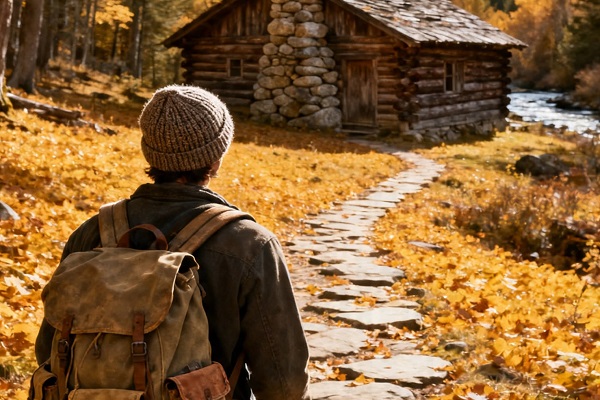
Inside were three mugs, two recipe cards, a stack of grocery receipts, an old keychain without keys, and a photograph of Grandma Ruth standing beside a mountain cabin I had never seen before.
Snow on the roof.
Pines behind it.
A red door.
Grandma’s hand resting on the porch rail.
On the back of the photo, in her handwriting, were four words.
For Claire. Not Monica.
My pulse slowed.
That was what happened when danger got close.
The world did not speed up for me.
It narrowed.
Monica saw the photo at the same moment I did.
Her face changed so fast most people would have missed it.
But I worked fraud investigations for a credit union in Denver. I watched people lie for a living. I knew the difference between grief and panic.
Monica reached for the photo.
I moved the box away.
“What cabin is this?” I asked.
She laughed once.
Too sharp.
“Probably some old vacation rental. Grandma saved junk.”
“Where is it?”
“How would I know?”
Brian looked at Monica.
Monica did not look back.
That told me enough to put the photo in my coat pocket.
I left the church basement before anyone could stop me.
Outside, the November air bit clean and hard. The mountains sat blue beyond the town, quiet as witnesses. I put the box in the passenger seat of my Subaru and opened the recipe cards.
Apple dumplings.
Cinnamon rolls.
Peach preserves.
On the back of the peach preserves card, in Grandma’s tilted script, was a line that had nothing to do with peaches.
When the first snow comes, go where the red door remembers.
I sat very still.
A truck door slammed behind me.
Monica was coming across the parking lot fast, heels clicking, black coat flying open.
Brian followed slower, scanning the lot like he was checking for witnesses.
I locked the doors.
Monica slapped her palm against my window.
“Open the door.”
I lowered the glass two inches.
Her perfume rolled in first.
Expensive.
Sweet.
Wrong.
“Give me the photo,” she said.
“Why?”
“Because it’s mine.”
“You said it was junk.”
Her mouth tightened.
“Claire, you don’t understand what you’re messing with.”
That was the first honest thing she had said all day.
I looked at her through the narrow gap.
“Then explain it.”
She leaned closer.
For one second, she looked less like my polished sister and more like the girl who used to hide broken plates behind the washing machine and let me take the blame.
“Grandma was confused near the end,” she whispered. “She wrote things down that weren’t real. She made promises she couldn’t keep. If you start digging, you’ll embarrass the whole family.”
“The whole family,” I said.
“Yes.”
“You mean you.”
Her eyes hardened.
Behind her, Brian put a hand on her shoulder.
“Let it go,” he murmured.
But his voice had a crack in it.
Not fear of embarrassment.
Fear of discovery.
I rolled up the window.
Monica stepped back before the glass caught her fingers.
Then my phone buzzed.
A text from an unknown number.
Do not trust your sister. Ruth left you the mountain cabin. She left more than that.
I stared at the message.
Another one came in.
Leave town before dark, or go to the cabin before Monica does.
No name.
No explanation.
Just a pin dropped on a map.
Three hours west.
Deep in the Rockies.
Near a place called Silver Creek Pass.
I looked through the windshield at Monica standing in the church parking lot, her pearl earrings glowing against her neck like stolen moons.
For years, I had let her be the loud one.
For years, I had let her rewrite rooms.
For years, I had let her turn family into a courtroom and herself into the judge.
For years, I had swallowed the smaller plate, the worse bedroom, the colder apology.
For years, I had mistaken silence for peace.
Not that day.
That day, I put the Subaru in reverse.
That day, I drove away with my grandmother’s cardboard box beside me.
That day, I followed the red door into the mountains.
And by sunset, I found out my sister had not only lied about the inheritance.
She had been waiting for Grandma Ruth to die.
The road to Silver Creek Pass climbed through old mining country, past shuttered bait shops, boarded motels, and slopes of black pine. By the time I lost cell service, the sky had turned the color of bruised steel.
Snow started twenty miles from the pin.
Light at first.
Then thick.
The kind of snow that erased distance and made every curve feel like a secret.
I kept both hands on the wheel.
Grandma had taught me that.
“Panic makes you loud,” she used to say, tapping my knuckles when I was sixteen and learning to drive her old Ford pickup. “Calm makes you useful.”
So I stayed useful.
I watched the mile markers.
I watched the tree line.
I watched for headlights behind me.
At mile marker 38, I saw them.
A black SUV.
Far back.
Then closer.
Then gone behind a bend.
Then close again.
I did not speed up.
Speed made mistakes.
Instead, I pulled into a turnout beside a frozen creek, killed my headlights, and let the snowfall swallow the car.
The black SUV passed three minutes later.
Slow.
Too slow.
Its brake lights glowed red through the white.
Then it kept climbing.
I waited until my breathing sounded normal.
Then I drove on.
The map pin led me off the paved road and onto a narrow forest service track marked by a rusted sign half buried in snow.
PRIVATE ROAD
NO TRESPASSING
WALLACE PROPERTY
My name.
Not Monica’s married name.
Wallace.
I stopped the car.
The sign was old, but someone had scraped snow off it recently.
The letters showed fresh and dark.
I got out with my flashlight.
The cold hit my face like a slap.
At the base of the signpost, tucked beneath a flat stone, was a brass key.
Not hidden well.
Hidden for someone who had been told where to look.
The key had a red string tied through its hole.
Grandma’s favorite color.
I closed my fist around it.
The cabin sat half a mile up the track, behind a stand of blue spruce.
Red door.
Stone chimney.
Tin roof under snow.
A porch swing moving slightly in the wind.
It should have looked abandoned.
It did not.
There was firewood stacked beneath a tarp.
The porch had been swept.
A pair of muddy boot prints crossed the steps.
Fresh.
I crouched and touched one print.
The edges were still sharp.
Someone had been there within the hour.
I took the tire iron from my trunk before I went to the door.
The brass key slid into the lock.
It turned smooth.
Inside, the cabin smelled of cedar, dust, and something faintly lemony. Like furniture polish. Like Grandma’s kitchen.
My flashlight crossed a small living room.
Braided rug.
Two brown leather chairs.
A woodstove.
Shelves of books.
A quilt folded over the back of a couch.
On the wall above the fireplace hung a framed photograph of Grandma Ruth with a man I did not know.
He was tall, silver-haired, wearing a flannel shirt and holding a trout.
Grandma was laughing.
Not smiling.
Laughing.
I had never seen that version of her.
Not in town.
Not after Grandpa died.
Not around Monica.
On the coffee table sat an envelope.
Claire Ann Wallace
Not Claire Bennett, my married name from the divorce.
Wallace.
My first name.
My real one.
I opened it with cold fingers.
Inside was one page.
My dearest Claire,
If you are reading this, then Monica has done exactly what I feared.
Do not confront her yet.
Do not call the county office from your own phone.
Do not trust any paper she shows you unless it has Judge Harlan Pike’s seal.
The cabin is yours.
It has always been meant for you.
But the cabin is not the inheritance.
It is the door.
I read the last line twice.
Then the floor creaked behind me.
I turned with the tire iron raised.
A man stood in the kitchen doorway.
Gray beard.
Wool coat.
Hands open.
“Easy,” he said. “Your grandma told me you’d probably swing first.”
“Who are you?”
“Name’s Wyatt Bell.”
“Why are you in my cabin?”
His eyes moved to the envelope.
“Because Ruth asked me to keep it standing until you found it.”
“Ruth is dead.”
“Yes, ma’am,” he said. “And your sister’s been trying to get in here since Tuesday.”
Tuesday.
Grandma had died Wednesday morning.
My stomach went cold.
“How did Monica know about it before Grandma died?”
Wyatt did not answer right away.
That was when I knew the truth would be worse than the question.
He walked to the window and moved the curtain with two fingers.
“Black SUV come up before you?”
“Yes.”
He nodded.
“Then we have maybe fifteen minutes before they realize they passed the turn.”
“They?”
“Your sister,” Wyatt said. “And the man she hired to make this place disappear.”
I looked at the fireplace.
At Grandma’s laughing face.
At the letter in my hand.
Then I folded the page and put it in my coat.
“What exactly is in this cabin?”
Wyatt’s mouth pressed into a grim line.
“Not in,” he said. “Under.”
He crossed the living room, lifted the braided rug, and revealed a square cut into the pine floor.
A trapdoor.
Iron ring.
Fresh scratches around the edge.
Someone had tried to pry it open.
Wyatt handed me a second key.
“This one never leaves your hand.”
The lock beneath the trapdoor was old and black.
The second key turned with a heavy click.
Cold air rose from below.
Not damp cellar air.
Cleaner.
Deeper.
Wyatt opened the hatch.
Wooden stairs descended into darkness.
My flashlight beam found stone walls, metal shelves, and boxes sealed in plastic.
Then it found a steel cabinet with a red ribbon tied to the handle.
My throat tightened.
Grandma again.
Always the red.
I went down first.
The room beneath the cabin was larger than the cabin itself. Reinforced beams crossed the ceiling. A workbench ran along one wall. Maps covered another.
County maps.
Land surveys.
Water rights.
Mineral rights.
Timber parcels.
Some dated back fifty years.
On the steel cabinet, a label read:
WALLACE FAMILY TRUST
ORIGINALS — DO NOT REMOVE WITHOUT CLAIRE
I opened the cabinet.
Inside were files.
Dozens of them.
The first file held a deed.
The second held a trust document.
The third held bank statements.
The fourth held letters from an attorney named Harlan Pike.
The fifth held a copy of Grandma’s will.
A real will.
Not the one Monica had apparently “handled.”
I read the first page.
Then the second.
Then the line that made the room tilt.
I leave my residence in town to Monica Elaine Porter, as she has always valued appearances.
I leave the Silver Creek cabin, the Wallace timber parcels, all associated mineral rights, water rights, and the full remaining balance of the Wallace Family Trust to my granddaughter Claire Ann Wallace, as she has always valued truth.
The trust balance was listed on the next page.
$3,870,419.22
I did not gasp.
I did not cry.
I sat on the bottom stair and let the number become real.
Nearly four million dollars.
Plus land.
Plus water.
Plus whatever timber and mineral rights meant in this county.
Monica had looked me in the eye and given me mugs.
Wyatt watched me carefully.
“Ruth was afraid Monica would contest it,” he said. “Then she got more afraid Monica wouldn’t bother contesting.”
“What does that mean?”
“It means your sister didn’t need to win in court if she could make the originals vanish.”
Above us, a sound broke through the cabin.
A car door.
Then another.
Wyatt turned off his flashlight.
I turned off mine.
Darkness swallowed the cellar.
Boots crossed the porch.
A man’s voice said, “Door’s unlocked.”
Monica answered, “Then she’s here.”
My sister’s voice.
Not polished now.
Not sweet.
Flat.
Hungry.
Wyatt leaned close enough for me to hear him breathe.
“There’s an old mining exit behind the shelves,” he whispered. “Ruth had it reopened after the first break-in.”
“The first break-in?”
A key scraped in the cabin door above us.
Wyatt pointed to the steel cabinet.
“Take the red folder.”
I grabbed it.
He took two hard drives from a lockbox and shoved them into my coat pockets.
“Do not let them get those.”
The cabin door opened.
Cold air rolled across the floorboards above.
Brian spoke first.
“She beat us here.”
Monica said, “Find the cellar.”
No hesitation.
No pretending.
No grief.
Just find the cellar.
I moved behind Wyatt through the dark, one hand on the stone wall, the red folder clutched under my arm.
Behind the shelves was a narrow passage framed in old timber.
The air smelled of rock and rust.
Wyatt pulled the shelf back into place behind us.
A thin blade of light remained between the boards.
Through it, I saw the cellar brighten as someone opened the trapdoor.
Boots came down the stairs.
One pair.
Then another.
Then Monica.
She stepped into view wearing funeral black and Grandma’s pearls.
Her eyes went straight to the steel cabinet.
Open.
Emptying.
Exposed.
For the first time in my life, my sister looked truly afraid.
Not afraid of me.
Afraid of what Grandma had left behind.
Brian came down after her.
So did a broad man in a dark jacket.
I knew his type before he spoke. Not a lawyer. Not a relative. Paid muscle. Former cop maybe. Someone who knew how to stand where cameras could not see him.
Monica slapped the cabinet door.
“Where is it?”
Brian opened drawers.
The other man walked slowly around the room.
“She has the originals,” he said.
Monica’s face twisted.
“You said this place was secure.”
“It was,” he answered. “Until your grandmother changed the locks.”
Grandma had changed the locks.
While dying.
While Monica circled.
While everyone thought she was just an old woman fading in a house full of quilts and pill bottles.
My grandmother had been fighting.
Quietly.
Precisely.
Like me.
Monica grabbed a stack of papers and threw them on the floor.
“She ruined everything.”
Brian flinched.
The hired man looked up.
“Careful.”
“No,” Monica hissed. “You don’t get it. She promised me I’d be taken care of. She promised after Dad died. She knew what Brian owed. She knew about the loan. She knew we’d lose the house.”
There it was.
Not the whole plot.
Just motive.
Debt.
Status.
Desperation wearing pearls.
Brian said, “Monica.”
She rounded on him.
“Don’t say my name like that.”
The hired man opened his phone.
“No signal.”
“There’s a booster upstairs,” Brian said.
Wyatt touched my shoulder and pointed down the tunnel.
We moved.
Slow.
Silent.
Behind us, Monica’s voice rose.
“She can’t have it. Claire doesn’t even belong here. She left. She always leaves. Grandma only picked her because Claire acted noble from three hours away.”
I stopped walking.
Wyatt looked back.
I forced myself to keep moving.
Not because her words did not hurt.
Because they were bait, even if she did not know she was setting it.
The passage sloped upward.
My shoulder brushed cold rock.
Water dripped somewhere far off.
After thirty feet, Wyatt stopped at a wooden ladder.
“Goes out behind the old shed,” he whispered. “Your car’s exposed. Mine is hidden lower down.”
“What about the cabin?”
He looked back toward the faint light.
“If they can’t find what they came for, they’ll burn what’s left.”
I believed him.
Not because Monica was dramatic.
Because she was practical.
A burned cabin meant missing records.
Missing records meant confusion.
Confusion meant time.
Time was all she needed to forge, file, transfer, borrow, sell.
I climbed the ladder.
The hatch opened behind a collapsed-looking wood shed twenty yards from the cabin. Snow fell harder now, thick as torn paper.
The black SUV sat near my Subaru.
Another truck idled behind it.
Wyatt led me through the trees to an old green pickup hidden under a camo tarp.
He opened the passenger door.
“Get in.”
“No.”
He stared at me.
“Claire.”
“My car has a dashcam.”
“So?”
“So it saw them arrive.”
Wyatt’s expression changed.
“That matters.”
“Yes,” I said. “It does.”
I pulled my keys from my pocket and pressed the lock button.
Across the clearing, my Subaru chirped.
Every head in the cabin snapped toward the sound.
Wyatt swore under his breath.
I pressed the panic alarm.
The Subaru exploded with noise.
Horn blaring.
Lights flashing.
Red and white pulses cut through the snow.
Monica ran onto the porch.
Brian behind her.
The hired man came last, scanning the trees.
I crouched behind a pine.
Wyatt crouched beside me.
“Was that the plan?” he whispered.
“Half of it.”
“What’s the other half?”
I lifted my phone.
No bars.
But the dashcam app had connected through Bluetooth when I got close enough.
The clip downloaded slowly.
Painfully slowly.
One percent.
Three.
Seven.
The hired man started toward the Subaru.
Monica yelled, “Stop that thing!”
He reached through the broken back window.
Broken.
They had already smashed it.
The alarm cut off.
My phone showed twelve percent.
Then the connection failed.
Not enough.
But enough maybe.
A thumbnail had loaded.
Monica on the porch.
The hired man at the door.
Brian’s face clear in the flashing lights.
I backed into the trees.
Then my heel snapped a branch.
The hired man turned.
His flashlight hit the woods.
“Run,” Wyatt said.
We ran downhill through snow and brush, not toward the road but parallel to it. Branches whipped my face. The red folder stayed under my coat. The hard drives knocked against my ribs.
Behind us, a shout.
Then footsteps.
Heavy.
Fast.
Wyatt knew the terrain.
I knew how to stay quiet under pressure.
We cut through a creek bed, climbed over deadfall, and slid down an embankment toward his hidden pickup.
A gunshot cracked through the trees.
Not close enough to hit.
Close enough to explain.
I did not scream.
I dropped behind the truck’s rear tire, pulled the tire iron from my coat, and waited.
Wyatt looked at me like I was insane.
The hired man came down the slope too fast.
His boot hit ice.
His body twisted.
He slammed hard onto his back, the gun flying into snow.
Before he could recover, I stepped out and brought the tire iron down on his wrist.
Once.
Clean.
He made a sound like air leaving a tire.
Wyatt kicked the gun into the creek.
“Truck,” I said.
We got in.
He started the engine with shaking hands.
I watched the side mirror.
The hired man rolled in the snow, clutching his arm.
Monica appeared at the top of the slope.
Even from a distance, I could see her earrings.
Grandma’s pearls.
She saw me in the passenger seat.
I lifted the red folder just enough for her to understand.
Her mouth opened.
No sound reached me.
Wyatt drove.
The pickup tore down the mountain road with no headlights for the first hundred yards, then snapped them on at the curve.
“Where are we going?” I asked.
“Judge Pike.”
“The lawyer?”
“Retired judge now. Ruth trusted him.”
“Is he alive?”
Wyatt gave me a sideways look.
“Meaner than a cornered badger.”
“Good.”
My phone buzzed as we dropped lower into the valley.
One bar.
Then two.
Messages arrived all at once.
Six missed calls from Monica.
Three from Brian.
One voicemail.
I played it on speaker.
Monica’s voice filled the truck, breathless and low.
“Claire, listen to me. Whatever Wyatt told you is only part of it. Grandma was not who you think she was. That cabin is dangerous. Those papers are dangerous. People have died over that land.”
Wyatt’s hands tightened on the wheel.
The voicemail continued.
“You think this is about money? Fine. Keep the money. I don’t care anymore. But do not open the red folder. Do you hear me? Do not open it.”
The message ended.
Snow hammered the windshield.
The road bent hard left.
Wyatt did not speak.
So I opened the red folder.
Inside was not a deed.
Not a bank statement.
Not a will.
It was a birth certificate.
Mine.
Except the mother’s name was not my mother.
The father’s name was blank.
And clipped behind it was a photograph of Grandma Ruth standing outside the red-door cabin, holding a newborn wrapped in a yellow blanket.
On the back, in Grandma’s handwriting, were seven words.
Claire must never know who brought her here.
I turned the next page.
There was a newspaper clipping from 1994.
MISSING INFANT SEARCH CALLED OFF AFTER MOUNTAIN CABIN FIRE
Below it was a name I had never heard.
A name that made Wyatt slam the brakes so hard the truck fishtailed across the icy road.
Because standing in the headlights ahead of us, blocking the mountain pass, was an old state trooper cruiser with no plates.
And beside it stood a woman in a tan coat.
White hair.
Straight posture.
A face I knew only from the photograph above Grandma’s fireplace.
The woman who had been laughing beside Ruth.
The woman who was supposed to be dead.
She raised one hand.
In it was a red ribbon.
And behind her, half hidden by the snow, three more vehicles rolled silently out of the trees.