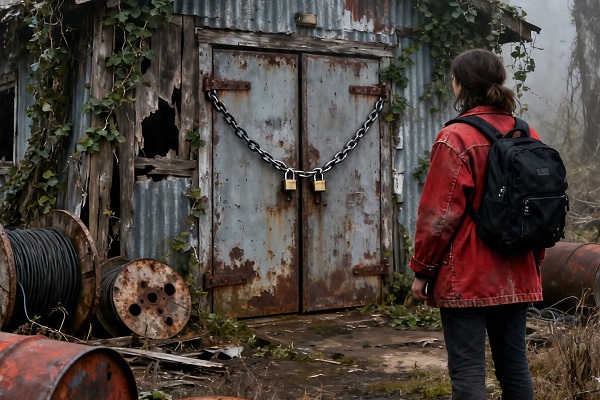
Her Brothers Stole the Farm, the Cash, and the House—But the Shed They Mocked Held Their Father’s Secret Since 1954
The morning after the funeral, my brothers handed me a rusted padlock, a stack of unpaid property taxes, and a laugh sharp enough to cut skin.
“Congratulations, Ellie,” Brent said, dropping the key into my palm like it was roadkill. “Dad left you the garbage.”
Doyle smiled beside him, his gold watch flashing under the lawyer’s office lights.
They had taken the farmhouse.
They had taken the pasture.
They had taken the bank accounts, the tractors, the timber contract, the cattle money, and the lakefront parcel our mother used to call God’s favorite mistake.
And they had left me one thing.
The equipment shed.
The one sealed since 1954.
The one nobody in Fairhope County ever touched.
The one my father used to stand in front of at dusk, hat in hand, as if he were guarding a grave.
I did not cry.
That disappointed them.
I could see it in Brent’s face. He wanted my chin to shake. He wanted me to beg. He wanted me to look like the little sister they had always accused of being too soft to survive.
So I looked down at the key.
It was black with age.
A red string was tied through the hole.
And written on the tiny paper tag in my father’s handwriting were four words.
For Eleanor. Not them.
Doyle’s smile faded first.
Brent leaned forward.
“What does that say?”
I closed my fingers over the tag.
“Nothing you own,” I said.
The lawyer, Mr. Callahan, cleared his throat behind his walnut desk. He was eighty-one, with hands like folded paper and eyes that missed nothing.
“As stated in your father’s will,” he said, “the primary residence, active farmland, liquid accounts, and livestock operation transfer to Brent and Doyle Whitaker in equal shares. The sealed equipment shed, including its contents, underlying land parcel, and all associated documents, transfers solely to Eleanor May Whitaker.”
Doyle snorted.
“All associated documents?” he said. “What documents? It’s a shed full of raccoon crap.”
Mr. Callahan did not smile.
“That remains to be seen.”
Brent looked at me then. Really looked.
His eyes were the same pale blue as Dad’s, but without the warmth. He had always been the handsome one. The one who could walk into a bank with muddy boots and leave with a loan. The one who called himself practical after doing something cruel.
“You can’t even afford the taxes on that corner lot,” he said. “Sell it to us for a dollar and save yourself the embarrassment.”
I slipped the key into my purse.
“No.”
His jaw tightened.
Doyle leaned back, chuckling.
“There she is. College girl thinks she’s got strategy.”
I had strategy.
I had eight hundred twelve dollars in checking.
I had a twelve-year-old Toyota with a cracked windshield.
I had a part-time bookkeeping job at the feed store and a room above Mrs. Alvarez’s garage that smelled like lemon soap and old quilts.
And I had spent twenty-nine years learning how to sit quietly while loud men told on themselves.
Brent wanted the shed gone.
Doyle wanted the land cleaned up before the bank inspection.
Neither of them had asked why Dad sealed it.
Neither of them had asked why the padlock had been replaced three times.
Neither of them had asked why the county map showed a separate survey square beneath that collapsing roof.
That was their mistake.
They thought inheritance was what you could sell.
Dad had always taught me inheritance was what someone trusted you not to waste.
Outside the lawyer’s office, Main Street was bright and windy. American flags snapped above the courthouse. A logging truck groaned past, carrying fresh-cut pine toward the mill. Fairhope County looked the same as it had when I was ten: brick storefronts, church steeples, pickup trucks, men in seed caps standing outside Ray’s Diner pretending they weren’t gossiping.
Brent and Doyle followed me to the sidewalk.
Doyle jingled the keys to Dad’s truck.
“You need a ride back to pack?” he asked.
“I already packed.”
Brent laughed.
“Of course you did. Always dramatic.”
I looked at him.
“I packed when you changed the locks before the funeral.”
That landed.
Doyle glanced away.
Brent’s mouth curled.
“You were staying there out of pity.”
“No,” I said. “I was staying there because Dad asked me to manage his medication after his surgery.”
“He asked everybody for something,” Brent said. “You just made it your personality.”
A horn honked. Someone waved at us. Brent waved back like we were a happy family handling paperwork after a sad but peaceful loss.
That was his gift.
Cruelty in private.
Charm in public.
Doyle’s gift was worse.
Silence at exactly the moment decency required speech.
I opened my car door.
Brent put his hand on the frame before I could get in.
“One more thing,” he said quietly. “Stay away from the farmhouse. Anything you left inside is ours now unless you can prove otherwise.”
I stared at his fingers on my car.
Broad fingers.
Clean nails.
Dad’s signet ring on his right hand.
He had taken that too.
“Move your hand,” I said.
He didn’t.
“You’re not built for this, Ellie.”
I smiled then.
Not wide.
Not friendly.
Just enough.
“You have no idea what I’m built for.”
His hand moved.
I drove away without looking in the mirror.
But I could feel them watching.
The equipment shed sat at the far northeast edge of Whitaker land, beyond the abandoned orchard and the dry creek bed where the soil turned from red clay to dark loam. It was not large. Maybe thirty feet by forty. Corrugated tin roof. Weather-gray boards. Two small windows covered from the inside. A loading door wide enough for a tractor that no tractor had passed through in seventy years.
When I was little, I asked Dad what was inside.
He said, “A promise.”
When Brent asked, Dad said, “Nothing you need.”
When Doyle asked, Dad said, “Trouble, if opened by the wrong man.”
That answer had become family folklore.
Brent used to dare me to touch the door.
Doyle used to throw rocks at the roof.
Mother, before she died, would go quiet whenever anyone mentioned it. She would press her lips together and look toward the north field, like she expected someone to come walking out of the trees.
The day I drove there after the will reading, the sky was the color of pewter. May storms were building over the hills. Grass whipped around the tires. Honeysuckle had climbed halfway up one wall. A black snake slid under a fallen fence rail as I parked.
I sat in the car for a minute.
Not because I was afraid.
Because I knew my brothers.
If they had left me the shed, they had already decided it was worthless.
If they had decided it was worthless, they had not looked closely.
If they had not looked closely, I had one advantage.
Time.
I took pictures first.
Every wall.
Every window.
Every hinge.
The roofline.
The padlock.
The survey pin half-buried near the southeast corner.
I took video too, speaking clearly.
“This is Eleanor Whitaker. May 18th. First entry attempt into the equipment shed parcel inherited from Henry Whitaker. Exterior appears undisturbed, except for weather damage along the west siding. Lock intact.”
Dad had taught me that.
Not directly.
Dad was not the kind of man who gave speeches.
He taught by placing a receipt in a coffee can.
By writing dates on feed bags.
By taking pictures before moving a fallen tree.
“Memory gets emotional,” he once told me. “Paper stays sober.”
I touched the lock.
Cold.
Heavy.
Old.
The key fought me at first. Rust scraped inside the mechanism. I almost stopped. Then I remembered Dad’s hands the week before he died, thin and bruised from IVs, gripping my wrist with surprising strength.
“Don’t let them rush you,” he whispered.
I thought he meant grief.
Now I was not sure.
I turned the key again.
The lock opened.
The sound was small.
A click.
But in that field, with thunder walking slowly over the ridge, it sounded like a gun being cocked.
I lifted the lock free.
The big door groaned when I pulled it.
Dust fell in a sheet.
For a second, all I saw was darkness.
Then the smell hit me.
Old oil.
Dry wood.
Metal.
Burlap.
And something else.
Cedar.
Not rot.
Not ruin.
Preservation.
I switched on my flashlight.
The beam cut through dust and landed on a tractor.
Not just any tractor.
A 1953 red Farmall Super M, parked in the center of the shed like a king in exile.
Its paint was faded but intact. The tires were wrapped in canvas. The engine had been coated in grease. Beside it sat crates stacked waist-high, each marked with stenciled letters.
WHITAKER ORCHARD CO.
FAIRHOPE COUNTY, KY.
1954.
My mouth went dry.
There were shelves along the wall.
Not junk shelves.
Organized shelves.
Glass jars.
Oil cans.
Ledgers.
Tool rolls tied with twine.
A workbench clean beneath seventy years of dust.
And at the back of the shed, beneath a tarp, was a long wooden cabinet with a brass lock.
I did not touch it.
Not yet.
I stood there breathing through my nose, letting my eyes adjust, letting the room tell me what mattered.
Dad had not abandoned this place.
He had maintained it.
Quietly.
For decades.
That was the first payoff.
My brothers had mocked a sealed shed.
But someone had been guarding a time capsule.
I stepped inside and the floorboards held firm.
A mouse darted under a crate. Rain began ticking on the tin roof. I moved slowly, filming everything, narrating like a county inspector.
The ledgers came first.
Three of them.
Brown covers.
Dates written on the front.
1951–1954.
1954–1962.
1963–1978.
The handwriting changed halfway through the second book. My grandfather’s blocky script became my father’s careful cursive.
I opened the first ledger on the workbench.
The first page read:
Equipment inventory, orchard yield, mineral survey, north parcel access, private.
Mineral survey.
I read that line three times.
Then I turned the page.
Maps had been folded inside.
Old county maps.
A soil survey.
A hand-drawn diagram of the north field.
And a yellowed envelope stamped by the Commonwealth of Kentucky in 1954.
Before I could open it, a truck door slammed outside.
I froze.
Another door.
Then Brent’s voice.
“Well, I’ll be damned.”
I closed the ledger.
Not fast.
Not guilty.
Just closed it.
Doyle laughed outside.
“She actually opened it.”
I slipped the envelope into my jacket pocket, left the ledgers on the bench, and walked back to the entrance.
Brent stood ten feet from the door in his funeral suit, boots sinking in wet grass. Doyle was beside him wearing Dad’s old barn coat.
Dad’s coat.
My stomach tightened, but my face stayed still.
Brent looked past me into the shed.
His eyes moved to the tractor.
Then the crates.
Then the shelves.
He took one step forward.
I stepped into the doorway.
“This is my property.”
He smiled.
“Relax. We’re family.”
“No,” I said. “We’re related.”
Doyle’s smile vanished.
Brent tilted his head.
“You really want to start that?”
“You already did.”
Rain darkened his shoulders.
Behind him, Doyle kept staring into the shed like a dog smelling meat.
“What’s in the crates?” Doyle asked.
“I don’t know yet.”
“Then move.”
“No.”
Brent’s voice lowered.
“Ellie, don’t be stupid. If there’s anything valuable in there, it belongs to the estate.”
“The will says contents.”
“That old man was half-sedated when he signed.”
I pulled out my phone.
“Say that again.”
He stopped.
That was the second payoff.
Brent could bully a sister.
He could not bully a recording.
Doyle put a hand on his arm.
“Come on. Let’s talk to Callahan.”
Brent’s face changed.
Public Brent disappeared.
Farmhouse Brent arrived.
The one I remembered from childhood.
The one who broke my bicycle and told Dad I left it in the driveway.
The one who sold Mom’s silver after she died and said he thought everyone had agreed.
The one who learned early that confidence could pass for truth if nobody challenged him fast enough.
“You’re going to regret making enemies today,” he said.
I looked at the padlock in my hand.
“No,” I said. “Today is the first day I stopped pretending I didn’t have any.”
They left.
But not far.
Their truck parked by the old orchard for ten minutes before finally disappearing behind the hill.
I waited until the sound faded.
Then I closed the shed door from inside and slid the old wooden bar into place.
The rain got harder.
The shed became a drum.
I stood under that tin roof, surrounded by my father’s secret, and opened the envelope.
Inside was a deed.
Not to the shed.
Not to the north parcel.
To something called Whitaker Equipment and Extraction Cooperative.
Dated June 4, 1954.
Filed.
Stamped.
Witnessed.
Attached was a mineral rights lease covering “subsurface deposits, limestone, shale, clay, and associated rare earth-bearing strata beneath Parcels 17B, 17C, 19A, and all contiguous access roads thereto.”
I knew enough bookkeeping to understand one thing immediately.
Dad had not just left me a shed.
He had left me whatever was under it.
And maybe under half the farm my brothers thought they had won.
My hands were steady.
My breathing was not.
On the back of the deed, in Dad’s handwriting, was one sentence.
Start with the blue cabinet, then call Miriam Bell before sunset.
Miriam Bell.
I knew that name.
Everybody in Fairhope County knew that name.
She was ninety-two years old, lived on Sycamore Road, and had been county clerk for thirty-eight years. She wore purple church hats, drove a Buick older than me, and once told a state senator to wait his turn because she was helping a farmer renew tags.
Dad used to bring her peaches every July.
I thought it was kindness.
Maybe it was payment.
Maybe it was gratitude.
Maybe it was guilt.
The blue cabinet stood at the back of the shed beneath the tarp.
I pulled the tarp away.
Dust rose.
The cabinet was steel, not wood. Painted dark blue. Knee-high, wide as a coffin, with two drawers and a brass plate stamped:
BELL & WHITAKER MACHINE WORKS
LOUISVILLE, KY
1954
The key from the shed did not fit.
I searched the workbench.
The shelves.
The tractor seat.
Nothing.
Then I noticed the Farmall’s gearshift.
A red string.
The same red string as the tag on my key.
A smaller key hung there, tied below the knob.
I almost laughed.
Dad had always said the right tool was usually closer than panic wanted you to believe.
The blue cabinet opened with a sigh.
Inside the top drawer were documents sealed in oilcloth.
Inside the bottom drawer were metal cylinders, each labeled with dates and depths.
Core samples.
Rock cores.
I lifted one.
Gray stone with strange dark bands running through it.
Another had a greenish streak.
Another was marked:
17C / 42 FT / HIGH-GRADE / DO NOT DISCLOSE
I sat back on my heels.
My brothers had taken the cows.
They had taken the hayfield.
They had taken the farmhouse with the wraparound porch and the lake view.
And they had left me the ground beneath their feet.
Near the back of the drawer was a photograph.
Black and white.
Four men in work shirts standing in front of the equipment shed when it was new. My grandfather was one. Younger, broad-shouldered, unsmiling.
Beside him stood a Black man in overalls, one hand on the Farmall, chin lifted with quiet pride.
The name written beneath him was Samuel Bell.
Miriam’s husband.
I turned the photo over.
Written on the back:
Henry, if the boys grow greedy, give it to the one who listens.
My throat closed.
Not with tears.
With recognition.
Dad had seen this coming.
Maybe not every detail.
But enough.
I locked the cabinet again.
I took the deed, the photo, one ledger, and three core sample labels photographed clearly but left the samples in place.
Then I shut everything, replaced the tarp, and secured the shed.
By the time I reached my car, the rain had soaked through my jacket.
My phone buzzed.
A text from Brent.
Last chance. Sell us the shed parcel by Friday. After that, things get expensive.
I looked across the field toward the farmhouse.
Lights glowed in the windows.
My brothers were probably standing in Dad’s kitchen, drinking Dad’s bourbon, planning what pressure felt legal enough to survive court.
I typed back one word.
No.
Then I drove to Sycamore Road.
Miriam Bell’s house was small, white, and perfect. Red geraniums on the porch. Wind chimes made from old spoons. A ceramic rooster near the steps. Her Buick sat in the driveway, polished like a church shoe.
She opened the door before I knocked.
“Eleanor Whitaker,” she said.
Her voice was thin but sharp.
“Yes, ma’am.”
“You opened it.”
I nodded.
She looked past me at the rain.
“Then you’d better come in before your brothers remember matches exist.”
I stepped inside.
The house smelled like coffee, lemon wax, and old paper.
Miriam moved slowly with a cane, but nothing about her felt fragile. She wore a lavender cardigan, pearl earrings, and an expression that suggested she had outlived every fool who underestimated her.
She led me to the kitchen.
On the table sat two cups, a plate of biscuits, and a folder already waiting.
“You knew I was coming,” I said.
“Your daddy called me three weeks before he passed.”
I sat down.
She pushed a cup toward me.
“He said, ‘Miriam, Ellie will come when the wolves start smiling.’”
That hit harder than I expected.
I wrapped my hands around the cup.
“Mrs. Bell, what is this?”
She sat across from me.
“It is not one thing, child. That is why greedy people missed it.”
I waited.
She smiled faintly.
“Good. Henry said you knew how to wait.”
Outside, thunder rolled across the county.
Miriam opened the folder.
Inside were copies of county records, old business filings, survey maps, lease transfers, and handwritten notes.
“Your grandfather and my Samuel built custom farm equipment after the war,” she said. “Not fancy. Practical. Soil drills. orchard sprayers. stone cutters. They worked for farmers who paid in cash, eggs, timber rights, whatever they had.”
She tapped the photograph I had brought.
“In 1953, a road crew cut through your north field and found something in the stone.”
“Rare earth?”
She looked at me with approval.
“You read before you ran your mouth. Good.”
I glanced at the papers.
“Why seal it?”
“Because powerful men wanted it cheap. Because Samuel was Black and your grandfather was poor and the county in 1954 was not gentle to either one. Because the first company that tested those samples offered them five hundred dollars and a lie.”
“What lie?”
“That the deposits were worthless.”
My fingers tightened around the cup.
Miriam nodded.
“Yes. Men have been calling valuable things worthless for a long time. Especially when they want to steal them.”
She slid one page toward me.
It was a letter from a mining company dated September 1954.
Blue Ridge Industrial Materials.
The letter stated the north parcel held “no commercially significant value.”
Attached behind it was a private lab report from Cincinnati dated one month later.
High concentration.
Commercial potential.
Strategic value.
I looked up.
“They lied.”
“Of course they lied.”
“Did my grandfather know?”
“Not at first. Samuel suspected. Your grandmother believed him. That mattered.”
The rain softened against the windows.
Miriam’s voice dropped.
“They formed the cooperative to protect the mineral rights. Then threats came. A barn burned. A bank note was called. Samuel was beaten outside the feed store.”
I went cold.
“Miriam.”
She lifted her chin.
“He lived. But he never walked right again.”
I looked at the photo.
Samuel Bell’s hand rested on the tractor like he had built more than machinery. Like he had built proof.
“What happened then?”
“Your grandfather sealed the shed. Your father inherited the documents. He kept the farm quiet. Refused every development offer. Paid the taxes. Pretended the north field was bad luck.”
I thought of Dad standing at the shed at dusk.
Hat in hand.
Guarding a promise.
A promise to a friend.
A promise to a family.
A promise to tell the truth only when someone strong enough to carry it arrived.
Miriam reached into her cardigan pocket and placed a small brass key on the table.
“This opens the second drawer under the false bottom.”
My skin prickled.
“I opened two drawers.”
“No, baby,” she said. “You opened what your father wanted careless eyes to find.”
I stared at the key.
“What’s under the false bottom?”
Miriam’s face changed.
For the first time, she looked tired.
“Proof that Samuel Bell owned half.”
The kitchen went silent.
Not quiet.
Silent.
The kind of silence that arrives when history opens its mouth.
“My brothers inherited the farm,” I said slowly.
“They inherited surface rights on most of it,” Miriam said. “Not all. Not cleanly. Not if Henry filed what I think he filed.”
“What did he file?”
She slid another paper toward me.
A notarized transfer.
Dated six months before Dad died.
Henry Whitaker transferred controlling interest in Whitaker Equipment and Extraction Cooperative to Eleanor May Whitaker and the Samuel Bell Family Trust.
My eyes burned.
I blinked once.
That was all I allowed.
Miriam watched me.
“Your father made mistakes,” she said. “But he tried to fix the right ones before the end.”
I looked at the transfer again.
Samuel Bell Family Trust.
“Why me?”
“Because Brent would sell the county for applause. Doyle would sign anything Brent put in front of him. And you…” She leaned back. “You balance books. You keep receipts. You listen when old people talk.”
A laugh escaped me.
Small.
Unsteady.
“Those are not heroic qualities.”
Miriam smiled.
“They are if the villains depend on chaos.”
My phone buzzed again.
This time it was a call.
Brent.
I let it ring.
Then Doyle.
Then Brent again.
Miriam glanced at the screen.
“They’re standing in that shed right now.”
My blood chilled.
“What?”
She pointed toward my phone.
“You think men like that wait until Friday?”
I stood so quickly the chair scraped.
“I locked it.”
“Locks tell honest people no.”
I grabbed my keys.
Miriam’s voice cut through the room.
“Eleanor.”
I turned.
She held out the brass key.
“When you go back, do not confront them in the dark. Do not threaten. Do not explain. Record. Witness. Preserve.”
I took the key.
Then she added one more sentence.
“And if they found the wall safe, call the state police, not the sheriff.”
I stopped.
“The sheriff?”
Miriam’s eyes hardened.
“His father signed the 1954 lie.”
The third payoff was not money.
It was a map of enemies.
And it had just gotten bigger.
I drove back through rain that blurred the road into silver ribbons. My windshield wipers slapped hard. My headlights caught deer at the tree line, then mailbox numbers, then the old Whitaker fence.
When I turned onto the farm lane, I cut my headlights.
Dad had taught me that too.
Light announces fear.
Darkness rewards patience.
I parked behind the old apple trees and walked the last hundred yards with my phone recording in my jacket pocket.
The shed door was open.
A lantern glowed inside.
Brent’s truck was parked nose-out near the loading door.
Doyle’s voice drifted through the rain.
“I’m telling you, this is bigger than old tools.”
Brent answered, muffled.
“Then stop talking and help me move it.”
I stepped behind the corner of the shed and looked through a crack in the siding.
They had found the blue cabinet.
They had dragged it into the center of the shed.
Doyle had a crowbar.
Brent was kneeling near the bottom.
Neither had noticed the false bottom yet.
Good.
My hands stayed calm.
My heart did not.
Brent cursed.
“Where’s the rest?”
Doyle wiped rain from his face.
“Maybe she took it.”
“She doesn’t even know what she’s looking at.”
“You sure?”
Brent stood.
His face was red.
“No. And that’s the problem.”
He kicked the cabinet.
Metal rang through the shed.
“She was supposed to fold. Callahan said give her the shed and she’d come begging by June.”
I went very still.
Callahan.
Mr. Callahan had advised them?
Or had Brent just assumed?
Doyle lowered his voice.
“What if Dad told her?”
“Dad was too far gone.”
“He wasn’t too far gone to change the locks on the co-op records.”
Brent turned on him.
“What did you say?”
Doyle froze.
I stopped breathing.
Brent stepped closer.
“How do you know about that?”
Doyle looked toward the open door.
“I heard him on the phone, okay? Before he died. He said something about co-op records and Bell trust. I thought it was dementia.”
Brent stared at him.
Then, slowly, he smiled.
Not happily.
Hungrily.
“Bell trust?”
Doyle swallowed.
“Maybe.”
Brent pulled out his phone.
“Then we need the old woman.”
My hand tightened around my own phone.
Miriam.
I backed away from the shed.
One step.
Two.
My heel snapped a twig.
Inside, Brent’s head jerked up.
“Who’s there?”
I ran.
Not toward my car.
Toward the creek.
Behind me, Brent shouted my name.
Doyle cursed.
A flashlight beam whipped across the orchard.
I knew that land better than they did in the dark. Brent had spent twenty years managing men from an office. Doyle had spent twenty years avoiding work that scratched his truck. I had spent childhood hiding in those trees with scraped knees and a pocketknife.
The dry creek bed cut through the north field like a scar. I slid down the bank, mud slick under my boots, and crouched behind a sycamore root.
Brent’s flashlight passed over my head.
“Ellie!” he shouted. “Stop acting crazy!”
There it was.
A man breaking into my property in a storm, calling me crazy for witnessing it.
Doyle appeared near the fence line, breathing hard.
“She’s probably recording.”
Brent stopped.
For the first time that night, fear crossed his face.
“Find her.”
I held my breath.
Rain ran down my neck.
My phone vibrated in my hand.
I looked down.
Unknown number.
Then a text appeared.
Do not go to the farmhouse. Your father kept a copy in the freezer.
I stared at it.
Another text came.
Your brothers are not the first to come looking.
Then a third.
Check the tractor battery box before sunrise.
A flashlight beam hit the creek bank.
I shoved the phone into my pocket and moved.
Not far.
Just enough.
Brent climbed down into the creek bed, slipping once, swearing under his breath. His flashlight swept left.
I went right, low and silent, using the rain as cover.
When I reached the old culvert, I crawled through on hands and knees, mud soaking my jeans. The pipe emptied behind the equipment shed, near the collapsed hog pen. From there, I could see Brent’s truck.
Door open.
Keys in ignition.
That was Brent.
Always confident the world would protect what belonged to him.
I moved to the truck, reached inside, and pressed the lock button on the key fob.
The horn chirped.
Once.
Sharp and loud.
Both brothers turned toward the sound.
I stepped into the lantern light with my phone raised.
“You are trespassing on recorded video,” I said. “You broke into a legally inherited structure. You attempted to remove property. You discussed contacting a ninety-two-year-old witness. Leave now.”
Brent stared at me.
Rain dripped from his hair.
Then he laughed.
But it was thin.
“You think a video scares me?”
“No,” I said. “I think evidence does.”
Doyle looked at Brent.
“Let’s go.”
Brent didn’t move.
His eyes locked on mine.
“You don’t understand what you stepped in.”
“I’m starting to.”
“No,” he said quietly. “You’re not.”
For one second, something real flashed beneath his anger.
Not guilt.
Not regret.
Fear.
Then headlights swept across the field.
Another vehicle rolled down the lane.
Slow.
Deliberate.
A black SUV.
Not sheriff.
No markings.
Brent looked over his shoulder.
Doyle whispered, “Who is that?”
The SUV stopped beside the shed.
The driver’s door opened.
A tall woman stepped out wearing a dark raincoat and boots polished too clean for farm mud. Her silver hair was pulled back. She carried a leather folder under one arm.
Behind her, a man got out holding a camera with a long lens.
The woman looked at Brent.
Then Doyle.
Then me.
“Eleanor Whitaker?”
“Yes.”
She walked toward me and handed me a card.
Federal Land Management Review Office.
Dr. Caroline Mercer.
I had never heard of her.
Brent clearly had.
His face drained.
Dr. Mercer glanced at the open shed, the blue cabinet, the crowbar, and my brothers’ muddy shoes.
“Well,” she said, “that answers one question.”
Brent found his voice.
“This is private property.”
Dr. Mercer looked at him with the calm expression of someone who had made louder men feel smaller in cleaner rooms.
“Part of it is,” she said.
Doyle frowned.
“What does that mean?”
She opened her folder.
“Mr. Henry Whitaker filed a restricted disclosure packet shortly before his death. It triggered a federal review of strategic mineral records tied to this parcel.”
Brent took a step back.
“Strategic mineral records?” Doyle said.
Dr. Mercer ignored him and looked at me.
“Ms. Whitaker, did you open the sealed structure today?”
“Yes.”
“Did you remove or alter any core samples?”
“No.”
“Did anyone else enter without permission?”
I turned my phone so she could see the recording screen.
“Yes.”
Brent lunged.
Not at me.
At the phone.
I stepped back, but his fingers caught my sleeve.
That was his final mistake of the night.
The man with the camera moved faster than he looked. He caught Brent’s wrist, twisted once, and Brent dropped to one knee in the mud with a sound I had waited twenty-nine years to hear.
Pain surprised him.
It always surprises men who think they own every room.
Dr. Mercer did not raise her voice.
“Touch her again and this stops being a property matter.”
Doyle raised both hands.
“Okay. Okay. Nobody’s touching anybody.”
Brent glared up from the ground.
“You have no idea what this family—”
“Mr. Whitaker,” Dr. Mercer cut in, “I know exactly what this family buried.”
The rain seemed to stop.
Not literally.
But every sound narrowed.
The tin roof.
The creek.
The wind in the orchard.
My brothers breathing.
My own pulse.
Dr. Mercer looked at me.
“Your father’s packet included one instruction. If the shed was breached, I was to deliver this directly to you.”
She handed me a sealed envelope.
My name was written across the front.
Dad’s handwriting.
I broke it open with wet fingers.
Inside was a single page.
Ellie,
If you are reading this, then I am gone, the shed is open, and your brothers have proven me right sooner than I hoped.
The minerals matter.
The Bell trust matters more.
But neither is the real reason I sealed the shed.
In 1954, Samuel Bell did not just find valuable stone.
He found the wreckage.
The rest of the page blurred for half a second.
I blinked hard and kept reading.
Under the equipment shed is a service hatch. Below it is a tunnel built before the war. At the end of that tunnel is a rail car that was never reported, never emptied, and never meant to be found.
Do not enter with Brent.
Do not enter with Doyle.
Do not trust the sheriff.
And, Ellie—
if the brass bell inside the rail car is missing, leave the farm immediately.
I lowered the letter.
My brothers were staring at me.
Dr. Mercer was staring at the shed.
Doyle whispered, “Rail car?”
Then from inside the equipment shed, beneath the floorboards, something rang.
Once.
A deep, hollow bell note.
Not loud.
But old.
Buried.
Awake.
Dr. Mercer’s face went white.
The man with the camera reached into his coat.
Brent slowly smiled from the mud.
And under the shed sealed since 1954, something heavy dragged across metal in the dark.