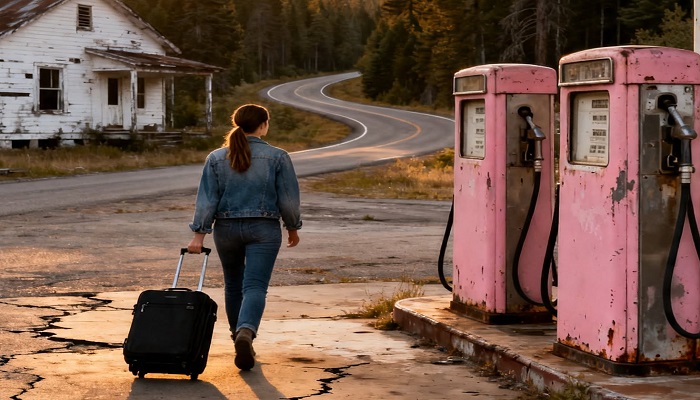
When Her Ex Left Her Homeless With One Suitcase, She Turned Her Father’s Dead Gas Station Into a Home—Then Found What He Hid Under Pump Three
The morning after the divorce was finalized, Dean Mercer changed the locks before sunrise and left Mallory Hayes’s clothes in black trash bags beside the sprinkler system.
He kept the house.
He kept the truck.
He even kept the coffee mug that said Best Dad Ever, though he had never been one.
Mallory stood at the edge of the driveway in her courthouse flats, holding one suitcase, her father’s old key ring, and the kind of silence people mistook for weakness.
Dean leaned in the doorway of the white two-story house they had bought with her inheritance and smiled like he had won something clean.
“You’ll be fine,” he said. “Women like you always land somewhere.”
Behind him, his new girlfriend, Brooke, lifted one manicured hand and gave Mallory a little wave.
Not a guilty wave.
Not even an embarrassed one.
A queen’s wave.
Mallory looked at Brooke’s bare feet on the hardwood floor she herself had refinished. She looked at Dean’s hand resting on the doorframe her father had once helped install. Then she looked at the sheriff’s deputy standing by the curb, uncomfortable, eyes down.
Dean had planned this carefully.
The decree said she had thirty days to retrieve personal items.
Dean had found a loophole.
The house was under an LLC.
The LLC had been “restructured.”
Her name had been removed six months ago.
Mallory had signed the papers while grieving her father and trusting her husband.
That was the part that bothered her most.
Not the betrayal.
Not the money.
The paperwork.
Dean knew she read everything.
So he had waited until she was too broken to read closely.
“Anything else?” Dean asked.
Mallory lifted the old key ring. Three keys hung from it.
One to a padlock.
One to a rusted office door.
One small brass key with no label.
“No,” she said.
Dean laughed once. “Where are you even going?”
Mallory slid the keys into her coat pocket.
“My father’s place.”
Dean’s smile changed.
It was quick.
A twitch at the corner of his mouth.
The first useful thing he had done all morning.
“Mallory,” he said, softer now, “that dump? The county will condemn it before you can sweep the floor.”
“Then I’ll sweep fast.”
Brooke giggled.
Mallory looked at her.
Not hard.
Not angry.
Just long enough for Brooke to stop.
Then Mallory picked up her suitcase, walked past the trash bags, past the sprinkler mist, past the mailbox with Mercer still painted on the side, and got into the only thing Dean had not bothered to steal.
Her father’s 1989 Ford pickup.
It started on the third try.
It smelled like oil, wintergreen mints, and Earl Hayes.
Mallory rested both hands on the cracked steering wheel.
She did not cry.
She made a list.
Call the bank.
Call the county clerk.
Check the deed.
Buy bleach.
Find out why Dean looked afraid when she mentioned the gas station.
The station sat fourteen miles outside Fairhope, Kansas, on a county road that used to matter before the highway moved east.
Hayes Service & Fuel had been closed for seven years.
Longer, if you counted the years her father had kept the lights on just so old farmers could get air in their tires and coffee from the dented machine in the corner.
It had two pumps with cloudy glass faces.
A service bay with one crooked red door.
A flat-roofed office building painted a tired blue.
And a faded sign tall enough to be seen across wheat fields:
HAYES SERVICE
FULL SERVICE, FAIR PRICES
Someone had spray-painted LIAR across the word SERVICE.
Mallory parked under the canopy.
The wind moved dry leaves in circles around the pump islands.
A crow sat on the roofline and screamed at her like the place already had tenants.
She stepped out.
The October air cut through her thin courthouse blouse. Her suitcase wheels clicked over cracked concrete. The padlock on the office door was rusted but familiar. Earl had always kept it oiled when he was alive.
Now it fought her.
Mallory took a breath, wrapped her scarf around her palm, and turned the key until the lock gave with a sound like a cough.
The office smelled of dust, mouse droppings, old coffee, and sun-baked rubber.
A calendar from 2016 still hung behind the counter.
A jar of peppermint candies sat beside the register, melted into one red-and-white lump.
The cracked vinyl stool where her father used to sit remained tucked under the counter.
Mallory touched it with two fingers.
“Hi, Dad,” she whispered.
The room gave nothing back.
No warm voice.
No radio baseball game.
No big hand reaching for her hair to tug gently and say, “There’s my girl.”
Just dust.
And a buzzing fluorescent light that came on after she found the breaker and flipped it with a broom handle.
The first night, she slept on moving blankets in the service bay with a tire iron beside her.
A raccoon knocked over something in the storage room at 2:17 a.m.
Mallory sat up, held her breath, and listened.
One crash.
Then another.
Then tiny claws.
She almost laughed.
“Rent’s due Friday,” she called into the dark.
The raccoon left through a broken vent.
The second morning, she found a working spigot behind the building, brown water first, then clear.
She washed her face in freezing water and used paper towels from the restroom that had gone stiff with age.
Then she took inventory.
One office.
One bathroom.
One service bay.
One storage room.
One old apartment above the office, accessible by metal stairs outside.
She had forgotten about the apartment.
Earl had once let traveling mechanics sleep up there during harvest season. Mallory remembered a little room with wood paneling, a metal bed, and windows that rattled in storms.
The stairs groaned under her.
The apartment door was swollen shut.
She shouldered it once.
Twice.
On the third hit, it opened.
Dust lifted like smoke.
Inside, sunlight fell through two dirty windows across a narrow room.
A rusted bedframe.
A cracked sink.
A small stove.
A bathroom with no shower curtain.
A closet with one of her father’s flannel shirts still hanging inside.
Mallory stood still.
Her throat tightened.
Not because it was beautiful.
It was ugly.
Peeling paint.
Mouse nests.
Dead flies on the sill.
A ceiling stain shaped like Texas.
But it had walls.
It had a lock.
It had a roof that only leaked in two places.
And for the first time in twenty-four hours, it had something Dean could not touch.
Mine.
Mine, even if it smelled like mildew.
Mine, even if the pipes screamed.
Mine, even if everyone laughed.
Mine, even if the floor sagged.
Mine, even if I have to rebuild it with blistered hands.
Mine, because my father left me more than a place to sleep.
By noon, Mallory had dragged the mattress outside, scrubbed the sink, opened every window, and filled three contractor bags with trash.
By evening, she had driven to Dollar General and bought a shower curtain, bleach, a can of soup, a battery lantern, steel wool, instant coffee, duct tape, and a notebook.
At the checkout, the cashier, a teenage boy with acne and a name tag that said TROY, looked at the bleach, tape, and soup.
“Big night?” he asked.
“Renovation,” Mallory said.
He looked at her courthouse skirt, dusty knees, and hair tied up with a rubber band.
“Cool.”
She paid cash.
That night, sitting cross-legged on the apartment floor, she opened the notebook and wrote:
GAS STATION PLAN
Make safe.
Make clean.
Make warm.
Make legal.
Make beautiful.
Find out what Dean wants.
She underlined number six twice.
On Friday, the first visitor arrived.
Not Dean.
Worse.
Her mother-in-law.
Former mother-in-law, Mallory corrected herself.
Gloria Mercer drove up in a pearl-white Cadillac and parked as if the cracked concrete might infect her tires.
She stepped out wearing cream wool, gold earrings, and pity like perfume.
“Oh, Mallory,” she said, looking around. “This is worse than Dean described.”
Mallory was kneeling by the pump island, loosening a bolt on a rotted metal cover.
She wiped her hands on a rag.
“Good morning, Gloria.”
Gloria’s eyes moved over Mallory’s jeans, work boots, and grease-smudged cheek.
“I came because I still care about you.”
Mallory said nothing.
That always bothered Gloria.
Gloria liked begging.
She liked shouting.
She liked tears.
Silence gave her nothing to arrange.
“There’s no shame in admitting this is too much,” Gloria said. “Dean said he’d be willing to give you a small settlement. Enough for a rental in Wichita, perhaps.”
“Dean already had his chance to be generous.”
Gloria’s mouth tightened. “You don’t want to make him your enemy.”
Mallory leaned back on her heels. “He changed the locks while I was at the courthouse.”
“He was advised to protect his assets.”
“My father’s inheritance bought those assets.”
Gloria smiled sadly. “And yet paperwork matters.”
Mallory looked up.
There it was again.
Paperwork.
Always paperwork.
Gloria opened her handbag and removed an envelope.
“Sign this, and you’ll have ten thousand dollars by Monday.”
Mallory stood.
The envelope was thick.
Too thick for a simple offer.
“What is it?”
“A release. Standard language. You agree not to pursue any claims against Dean, his companies, or related holdings.”
“Related holdings?”
“Mallory.”
“Does Dean have a related holding connected to this property?”
Gloria’s face did not move.
But her eyes did.
Toward pump three.
The third pump had not worked since Mallory was twelve. It stood apart from the others near the edge of the canopy, half-hidden by weeds, its numbers frozen at $17.43.
Mallory followed Gloria’s glance.
Then looked back.
Gloria slid the envelope onto the hood of the Cadillac.
“Ten thousand dollars is a gift.”
“No,” Mallory said. “It’s bait.”
Gloria’s smile disappeared.
“You always did think too highly of yourself.”
“And Dean always did send someone else when he was scared.”
A gust of wind rattled the old sign.
Gloria picked up the envelope with two fingers.
“You have no idea what you’re standing on.”
Mallory gave her a calm smile.
“Then I guess I should keep standing here.”
Gloria got into her Cadillac and left without another word.
Mallory waited until the car vanished beyond the grain elevator road.
Then she walked to pump three.
The weeds around it were thick, dead and brown, tangled around the base like wire.
She crouched.
The concrete pad beneath pump three was different.
The other pads were cracked in random spiderwebs.
This one had been cut and patched.
Years ago.
Not recently.
But intentionally.
Mallory ran her fingers over the seam.
“Dad,” she whispered, “what did you do?”
The first mini-payoff came two days later in the county records office.
Mallory walked in wearing clean jeans, a gray sweater, and the expression of a woman who knew asking nicely worked better when people underestimated you.
The clerk, Mrs. Alvarez, had known Earl Hayes.
Everyone had known Earl.
Some had loved him.
Some had owed him money.
Some had bought gas from him on credit and never mentioned it again.
Mrs. Alvarez looked up from her monitor and froze.
“Mallory Hayes.”
“Hi, Mrs. Alvarez.”
The older woman came around the counter and hugged her hard.
“I heard about the divorce.”
“Fairhope has fast mail.”
“Fairhope has no secrets.” Mrs. Alvarez pulled back. “Except the ones men put in file cabinets.”
Mallory smiled. “That’s what I’m here for.”
She requested every public record connected to Hayes Service & Fuel.
Deed.
Tax liens.
Environmental filings.
Easements.
Zoning.
Underground storage tank reports.
Mrs. Alvarez brought folders, then boxes, then a rolling cart.
Mallory worked through lunch.
She found old inspection notices.
Paid tax receipts.
A permit for pump removal never completed.
A letter from the state environmental office.
A 1998 easement dispute with a pipeline company.
And then, in a folder mislabeled HAYES—SIGNAGE, she found a quitclaim deed.
Not from Earl.
To Earl.
Dated twenty-three years earlier.
It transferred a narrow strip of land behind the station from Mercer Development Group to Earl Hayes for one dollar.
Mercer.
Mallory’s skin went cold.
Dean’s family.
She read it again.
The signature at the bottom belonged to Warren Mercer.
Dean’s grandfather.
Mrs. Alvarez returned with coffee in a Styrofoam cup.
“You found something.”
“Why would Dean’s grandfather give my father land?”
Mrs. Alvarez looked at the paper.
Her face changed.
Not surprise.
Recognition.
“Lord,” she said softly. “He kept it.”
“Kept what?”
Mrs. Alvarez glanced toward the front desk, then lowered her voice.
“Your father came in here the week before he died. Asked how to make certified copies of old deeds. I asked if he needed help. He said no. Said if anything happened, you’d know how to read.”
Mallory’s fingers tightened around the folder.
“He said that?”
Mrs. Alvarez nodded.
“Then he paid for twelve certified copies. Cash.”
“Of this deed?”
“I don’t know. He used the self-service copier. But he looked scared, Mallory. Earl Hayes didn’t scare easy.”
Mallory went home with copies stuffed in her backpack and a new entry in her notebook.
Dean wants land behind station.
Maybe not station itself.
Why?
That evening, she cleaned the old service bay windows.
The glass was so dirty the sunset came through brown.
She sprayed vinegar, scraped paint flecks with a razor blade, and wiped until the world outside sharpened.
Golden field.
Empty county road.
Old pump three.
Behind the station, beyond the weeds, lay four acres of scrub grass and cottonwoods.
A drainage ditch cut across the far edge.
Nothing valuable.
Nothing obvious.
Which meant something was buried, hidden, planned, or already stolen.
On the eighth day, a man named Cal Ransom knocked on the service bay door.
He was sixty, built like a fence post, with a gray beard and a canvas jacket stained by decades of work.
“You Earl’s girl?”
Mallory lowered the pry bar in her hand.
“Yes.”
“Cal Ransom. Used to run plumbing for your dad when his pipes froze.”
“I remember your truck.”
“Your dad said you had a memory like a courthouse camera.”
Mallory almost smiled. “I need plumbing.”
“I figured. Saw your light on last night. Also saw Dean Mercer’s black Tahoe parked down the road at midnight.”
Mallory stopped.
“Where?”
Cal pointed west. “By the old feed billboard. Lights off.”
Mallory looked toward the road.
She had slept poorly but not because of fear. She had felt watched.
Now she knew why.
Cal shifted his weight.
“I don’t ask questions I don’t want answered. But I owe Earl Hayes. You need a shower upstairs?”
“I need a lot more than a shower.”
Cal looked at the ruined apartment, the bay, the weeds, the peeling sign.
Then he nodded once.
“Good. I hate being bored.”
Cal worked for cheap and coffee.
Mallory paid him anyway.
Over the next two weeks, Hayes Service changed.
Not dramatically.
Not like television.
No magical montage.
Just one fixed thing at a time.
Cal replaced rotten pipe.
Mallory patched drywall with YouTube videos playing on her phone.
She sanded the apartment floor until her knees bruised.
She found a used clawfoot tub on Facebook Marketplace and convinced the seller to knock off fifty dollars because one foot was cracked.
She painted the apartment walls warm white.
She replaced the broken mini-fridge.
She hung curtains made from canvas drop cloths.
She built shelves out of old pine boards from the storage room.
At night, she cooked canned chili on a hot plate and slept under three blankets.
Every morning, she made coffee in her father’s dented percolator.
People began slowing down when they passed.
Some stared.
Some waved.
Some shook their heads.
Fairhope had a way of deciding who was finished before God had voted.
Mallory ignored them.
Until the second mini-payoff arrived in the form of a red tag taped to her office door.
COUNTY NOTICE
UNSAFE STRUCTURE
OCCUPANCY PROHIBITED
She found it at 6:42 a.m., while carrying a bucket of soapy water.
The notice claimed anonymous complaints had reported illegal residential use, exposed wiring, fuel contamination, and structural instability.
Anonymous.
Mallory photographed the notice.
Then she photographed the breaker box she had already had inspected.
The plumbing invoice.
The roof repair estimate.
The clean water test.
The apartment windows.
The smoke detectors she had installed.
By 8:15, she was at the county building.
By 8:22, she was sitting across from a young code officer named Martin Pike, who looked like he had expected a crying woman and got a tax audit instead.
“I understand the concern,” Mallory said, placing documents in neat stacks. “So I brought proof.”
Martin blinked.
She slid the first stack forward.
“Electrical inspection.”
Second stack.
“Plumbing repair.”
Third.
“Water test.”
Fourth.
“Temporary residential use application filed yesterday. Your office stamped it.”
Martin shuffled papers.
“This notice was generated after a complaint.”
“Who filed it?”
“I can’t disclose complainants.”
“Of course. Then disclose the specific violation.”
He looked at the screen.
Mallory waited.
The office clock ticked.
A printer whined.
Martin cleared his throat.
“It says… suspected occupancy in commercial structure.”
“Suspected?”
“Yes.”
“Is suspicion a violation?”
“No.”
“Has anyone inspected?”
“No.”
“Then remove the tag until inspection.”
Martin looked annoyed now, but not at her.
At whoever had put him in this position.
“I can schedule an inspection Friday.”
“Today.”
“Ms. Hayes—”
“I am living in a permitted upstairs apartment attached to a commercial property with utilities in my name and repair documentation. A red tag on the public-facing door implies danger and damages my ability to hire contractors. If the county has evidence, inspect today. If not, remove it today.”
Martin stared at her.
Then he sighed.
“I can be there at one.”
“I’ll make coffee.”
He came at one.
He inspected.
He found three minor issues.
None occupancy-prohibiting.
At 2:40 p.m., he removed the red tag himself.
At 2:43 p.m., Mallory photographed him doing it.
At 3:10 p.m., Dean called.
She let it ring.
At 3:12, he texted.
You’re making this harder than it needs to be.
Mallory typed back:
Good.
Then blocked him.
That night, someone threw a brick through the office window.
Mallory did not scream.
She rolled off the cot she had temporarily moved downstairs because the upstairs heater was acting up. Glass glittered across the floor in the moonlight.
A brick lay beside the candy jar.
Wrapped around it was a page from her own divorce decree.
Highlighted in yellow:
Petitioner waives any future claims.
Mallory put on boots.
Picked up the brick with a towel.
Photographed everything.
Then walked outside with the tire iron.
The road was empty.
The fields were black.
But pump three stood under the canopy light.
And beside it, fresh mud marked the concrete.
Not footprints.
Tire tracks.
Someone had backed close to pump three.
Mallory crouched.
The mud was wet.
The night had been dry.
Whoever came had brought mud from somewhere else.
Or from behind the station.
She followed the faint track around the building, flashlight low.
Behind the service bay, near the strip of land from the old deed, the grass had been crushed.
A vehicle had parked there.
Mallory shone her light toward the cottonwoods.
Something metal flashed.
She walked closer.
A survey stake.
Fresh.
Pink ribbon tied at the top.
The third mini-payoff came the next morning when Mallory called a surveyor before she called the police.
His name was Ben Sutter.
He arrived in a muddy Subaru, chewing gum, wearing a vest with too many pockets.
He walked the property with a GPS receiver and a frown that deepened every ten minutes.
By noon, he had printed a preliminary map on a portable printer from his back seat.
“This is weird,” he said.
Mallory took the map.
The station property formed a rough rectangle.
But the narrow strip behind it curved like a hook along the drainage ditch.
The strip Warren Mercer had signed over to Earl.
The strip Dean’s family had once owned.
The strip someone had marked with fresh stakes.
“What’s weird?”
Ben pointed. “County road expansion plan from the nineties would’ve made this strip worthless. But the highway relocation killed that. Now this drainage corridor is the only clean access route between the old rail bed and the south industrial parcel.”
“Industrial parcel?”
“Mercer Development bought it last year.”
Mallory looked at him.
Ben lifted both hands. “Public record. I don’t do drama.”
“What would they need my strip for?”
“Access. Utility run. Maybe stormwater. Without it, they have to go around Miller Creek. Expensive.”
“How expensive?”
Ben chewed slower.
“Million or two, depending what they’re building.”
Mallory looked over the field.
A million dollars.
Dean had offered ten thousand.
Gloria had warned her.
Dean had watched at midnight.
The brick through the window suddenly felt less like anger and more like math.
Mallory folded the map.
“Can you certify this?”
“Already did. Earl paid me for the original survey years ago.”
Mallory went still.
“My father hired you?”
“Twice. Once before he got sick. Once after.”
“After what?”
Ben’s expression shifted.
“After the Mercer people started sniffing around.”
“What Mercer people?”
He looked toward the road, as if someone might be listening from the ditch.
“Your ex-husband came with a woman. Not his mother. Younger. Dark hair. Real estate type. They asked if Earl would sell. Earl told them the only way they’d get that strip was if they dug him up and had him sign with a dead hand.”
Mallory pictured her father saying it.
Calm.
Dry.
Absolutely serious.
“When was this?”
“About six weeks before he died.”
Mallory felt the air leave the field.
Earl Hayes had died of a heart attack in the service bay.
Alone.
At night.
At least, that was what everyone said.
The sheriff’s report had been short.
No foul play.
Natural causes.
Mallory had been too wrecked to question it.
Dean had handled arrangements.
Dean had called the funeral home.
Dean had helped her sort papers.
Dean had brought her soup and sleeping pills and told her not to worry about legal things.
Mallory looked at pump three.
The numbers still read $17.43.
“What else did my father ask you?” she said.
Ben hesitated.
“He asked what happens if a property owner disappears before recording a boundary affidavit.”
“Disappears?”
“His word.”
Mallory folded the certified survey carefully and put it in her bag.
Then she called Sheriff Nolan herself.
Sheriff Nolan was a broad man with tired eyes, a gray mustache, and the slow walk of someone who had heard every lie in the county twice.
He arrived at dusk.
Mallory showed him the brick, the decree page, the tire tracks, the survey stake, and the map.
He listened.
He did not interrupt.
When she finished, he looked toward pump three.
“Your dad kept a shotgun under the counter,” he said.
“I know.”
“Still there?”
“No.”
Sheriff Nolan frowned.
“It was there when we found him.”
Mallory turned.
“No. Dean said the station was empty when he cleaned out personal items.”
The sheriff’s jaw moved.
“Dean cleaned this place?”
“He said he did.”
“When?”
“After Dad died. Before I came back from Topeka.”
Nolan looked at the office.
Then the service bay.
Then the pump.
“I don’t like that.”
“Neither do I.”
He took the brick as evidence and promised extra patrols.
Mallory knew promises were not locks.
So she bought cameras.
Cheap ones.
Motion-activated.
Cloud backup.
She mounted one over the office.
One in the bay.
One facing pump three.
One hidden in an old motor oil sign.
Then she did something Dean would never expect.
She invited Fairhope in.
Not all at once.
Just carefully.
She put a handwritten sign on the door:
FREE COFFEE SATURDAY
OLD HAYES CUSTOMERS WELCOME
BRING STORIES, NOT ADVICE
By Saturday morning, she had swept the office, taped cardboard over the broken window, set up two folding tables, and made coffee in three mismatched pots.
At first, no one came.
Then Cal arrived with cinnamon rolls.
Then Mrs. Alvarez came with a folder of copied recipes from Mallory’s mother.
Then old Mr. Dobbins came with a photograph of Earl standing beside a snowplow in 1988.
Then Troy from Dollar General arrived pretending he had “just been passing by,” though he carried a bag of paper cups.
By noon, the office was full.
Farmers.
Retired teachers.
A mail carrier.
A woman who said Earl had fixed her flat and refused money because she had a baby in the car.
A man who said Earl had lent him fifty dollars in 2003 and never asked for it back.
Mallory listened.
She wrote names.
She collected dates.
She laughed twice.
Really laughed.
And with every story, the station became less dead.
People touched the counter.
Pointed to old stains.
Argued about whether the coffee machine had always sounded like a dying tractor.
Then Mr. Dobbins said something that silenced the room.
“Earl used to say pump three was his insurance policy.”
Mallory looked up.
“What?”
Mr. Dobbins stirred his coffee though he had no sugar in it.
“Maybe he was joking.”
“Say it anyway.”
The old man scratched his chin.
“Mercer boys came around years ago. Warren, then his son, then that grandson of his. Earl never trusted them. Said if anything happened to him, pump three would tell the truth.”
No one moved.
Cal lowered his cinnamon roll.
Mrs. Alvarez looked down at her cup.
Mallory kept her voice even.
“Did anyone ask what that meant?”
Mr. Dobbins gave her a sad smile.
“Your daddy was a vault, honey. Vaults don’t explain the lock.”
That afternoon, after everyone left, Mallory closed the office door and stood behind the counter.
Pump three would tell the truth.
She took out the unlabeled brass key.
The smallest one on Earl’s ring.
It did not fit the office.
It did not fit the padlock.
It did not fit the storage room.
She walked outside.
The sun was dropping behind the grain silos, turning the canopy posts orange.
She knelt at pump three.
The old panel screws were stripped.
She used penetrating oil.
Waited.
Turned.
One screw moved.
Then another.
The panel came loose with a metallic groan.
Inside were wires, dust, a wasp nest, and the old mechanical guts of the pump.
No lock.
No compartment.
No obvious secret.
Mallory almost smiled.
“Of course you wouldn’t make it easy.”
She reached deeper.
Her fingers found something smooth beneath the lower meter plate.
A keyhole.
Hidden behind a sliding metal tab.
The brass key fit.
Mallory turned it.
Something clicked under the concrete.
Not inside the pump.
Under it.
A square section at the base shifted up a fraction of an inch.
Mallory stared.
Then she heard tires.
She slid the panel back into place, grabbed her tools, and stood.
Dean’s black Tahoe rolled under the canopy.
He stepped out wearing a wool coat and expensive boots that had never touched mud without complaining.
He looked thinner than he had at the divorce hearing.
Or maybe fear made him smaller.
“Still playing mechanic?” he said.
Mallory leaned against pump two.
“Still sending your mother to negotiate?”
Dean smiled tightly.
“I came to be reasonable.”
“No, you came because Gloria failed.”
His eyes flicked to pump three.
Mallory caught it.
So did he.
For half a second, they both knew too much.
Then Dean looked away.
“This property is unsafe. You don’t have money to maintain it. You don’t have the skill to develop it. And you definitely don’t have the stomach for a legal fight.”
Mallory wiped her hands with a rag.
“You practiced that.”
“I’m offering you a way out.”
“You already did. Ten thousand.”
“Fifty.”
Mallory laughed softly.
Dean’s face hardened.
“Don’t get cute.”
“There he is.”
“I know you think silence makes you powerful, but it just makes you alone.”
Mallory folded the rag.
Carefully.
Corner to corner.
“My father died here six weeks after refusing to sell you land.”
Dean stared at her.
Not shocked.
Not offended.
Calculating.
“That’s a disgusting accusation.”
“I didn’t accuse you.”
“You implied it.”
“You heard it.”
The wind moved between them.
Dean stepped closer.
“You know what your problem has always been, Mallory? You think being calm means you’re in control.”
“No,” she said. “Being prepared does.”
His eyes dropped to her pocket.
The phone-shaped outline.
Recording.
He stepped back.
Smart man.
Cruel, but smart.
“You’re going to lose this place,” he said.
“Maybe.”
“You’ll be buried in legal fees.”
“Maybe.”
“The county will force environmental remediation. The tanks alone could bankrupt you.”
“There are no active tanks.”
Dean smiled.
And there it was.
Too fast.
Too pleased.
“You sure about that?”
Mallory’s stomach tightened.
Dean walked back to his Tahoe.
Before getting in, he turned.
“Ask yourself why your father never sold fuel from pump three after 2001.”
Then he drove away.
Mallory waited until he was gone.
Then she opened her notebook.
Dean knows underground issue.
Pump three possibly connected to tank.
Environmental threat.
But why want land if contaminated?
Unless contamination is leverage.
Or evidence.
She did not open the hidden compartment that night.
That was the difference between fear and caution.
Instead, she called Cal.
Then Sheriff Nolan.
Then Ben Sutter.
Then, after staring at the phone for five minutes, she called someone she had not spoken to since her father’s funeral.
Mara Whitcomb.
Environmental engineer.
Mallory’s college roommate.
Mara answered on the fourth ring.
“Mallory Hayes,” she said. “Tell me who we’re burying.”
“Maybe nobody.”
“That’s disappointing.”
“I need help with underground tanks at my father’s old gas station.”
There was a pause.
Then Mara’s voice changed.
Professional now.
“Do not disturb anything. Do not dig. Do not open sealed structures. Photograph from a distance. Tell me what records you have.”
Mallory exhaled.
“I also think my ex-husband wants the land.”
“Of course he does. Men like that don’t haunt gas stations for nostalgia.”
By the following afternoon, Mara arrived from Kansas City with steel-toed boots, a hard case full of testing equipment, and the same sharp black bob she’d worn at twenty-two.
She hugged Mallory once, hard.
Then stepped back and looked at the station.
“Oh, honey,” she said. “It’s hideous.”
“I know.”
“I love it.”
Mara spent three hours walking the property.
She checked vent pipes.
Mapped probable tank locations.
Compared old permits with ground markings.
She frowned at pump three.
Then at the drainage ditch.
Then at the strip behind the station.
At sunset, she sat with Mallory on the service bay floor, both of them eating takeout tacos from paper wrappers.
“Good news,” Mara said.
“Start there.”
“The station may not be the environmental disaster Dean wants you to believe. Your dad properly closed two tanks in 2004. Foam-filled, documented, signed off.”
Mallory waited.
“And the bad news?”
“Pump three was connected to a separate tank.”
Mallory’s hand tightened around the taco wrapper.
“Undocumented?”
“Not exactly. Old rural stations sometimes had auxiliary tanks for farm diesel or kerosene. But this one is strange.”
“Strange how?”
Mara pulled out a sketch.
“Based on the vent location and the concrete cuts, it’s not under the main island. It’s offset. Toward the strip of land.”
“The strip Dean needs.”
“Exactly.”
“What does that mean?”
“It could mean your father installed it before regulations tightened and forgot paperwork. It could mean someone else installed something. Or it could mean it isn’t a tank anymore.”
Mallory looked at her.
“What else would it be?”
Mara took a sip of soda.
“A vault.”
The word hung in the service bay.
Vault.
Mr. Dobbins had used the same word.
Your daddy was a vault.
Vaults don’t explain the lock.
Mallory pulled the brass key from her pocket.
Mara stared at it.
“Tell me you didn’t open anything.”
“I unlocked a mechanism. I stopped when Dean arrived.”
Mara closed her eyes.
“Of course he did.”
They waited until morning.
Sheriff Nolan came in plain clothes.
Cal came with a crowbar, two thermoses, and the expression of a man hoping the day would be illegal in an interesting way.
Mara insisted on safety.
No sparks.
No smoking.
Gloves.
Ventilation.
Photographs before every step.
Mallory knelt at pump three and removed the panel again.
The hidden keyhole waited behind the metal tab.
She inserted the brass key.
Turned.
The concrete section clicked.
Cal used suction handles to lift it.
Beneath was not dirt.
Not a pipe.
Not a tank cap.
A metal hatch.
Painted black.
Small.
Heavy.
With an old combination dial.
Sheriff Nolan swore under his breath.
Mara looked at Mallory.
“Your father was not storing kerosene.”
Mallory touched the dial.
Beside it, scratched into the metal, were three letters.
M.H.L.
Mallory Hope Hayes.
Her initials before marriage.
Her throat closed.
“Do you know the combination?” Nolan asked.
Mallory looked at the frozen pump numbers.
$17.43.
She turned the dial.
Then paused.
The pump had stopped at $17.43.
But old pumps also counted gallons.
She leaned closer.
The faded gallon meter read 6.12.
June 12.
Her birthday.
She turned the dial again.
The lock opened.
Cal stepped back.
Mara whispered, “Oh, Earl.”
Mallory lifted the hatch.
Cold air rose from below.
Not fuel.
Dry air.
Metal stairs descended into darkness.
Sheriff Nolan drew his weapon.
“Stay behind me.”
Mallory almost obeyed.
Almost.
But this was her father’s place.
Her initials were on the hatch.
Her key had opened it.
Her birthday had unlocked it.
So she followed two steps behind.
The stairs led to a narrow underground room lined with concrete block.
Battery lights hung dead from hooks.
Shelves ran along one wall.
Plastic bins.
Metal filing cabinets.
A dehumidifier with a full tank, long dead.
And on a workbench beneath a dust-covered tarp sat three things.
A cassette recorder.
A lockbox.
And a framed photograph of Mallory at age nine, standing beside Earl in front of pump three, both of them covered in grease and grinning.
Mallory’s knees almost failed.
She grabbed the workbench.
Mara touched her back.
Sheriff Nolan checked the corners.
“All clear.”
Cal stood at the bottom of the stairs, hat in hand.
Mallory lifted the tarp fully.
The lockbox had a note taped to it.
MALLORY ONLY.
Her father’s handwriting.
Blocky.
Careful.
Alive in blue ink.
She did not open it immediately.
She looked first at the shelves.
Each bin was labeled.
MERCER LAND
COUNTY PERMITS
WATER TESTS
DEAN
Mallory stared at the last label.
DEAN.
Not Mercer.
Dean.
Her ex-husband had a box in her father’s underground vault.
Sheriff Nolan saw it too.
His face darkened.
“Mara,” Mallory said quietly, “camera.”
Mara filmed.
Mallory put on gloves and opened the DEAN bin.
Inside were photographs.
Dean’s Tahoe outside the station years earlier.
Dean speaking with Earl behind the service bay.
Dean beside a woman with dark hair near the drainage ditch.
Copies of checks.
LLC documents.
A printed email thread.
And a small flash drive in an envelope.
On the envelope, Earl had written:
If I’m dead, he didn’t stop asking.
Mallory sat down on the metal stool.
No one spoke.
The room felt too small for breathing.
Sheriff Nolan picked up one photograph by the corner.
“This woman,” he said. “I know her.”
“Who is she?” Mallory asked.
“Lena Cross. Land acquisitions. Worked with Mercer Development.”
“Worked?”
“She disappeared from town right after your father died.”
Mallory looked at the photo again.
Lena Cross was standing beside Dean, holding rolled survey plans.
Her expression was not romantic.
Not friendly.
Afraid.
Mara opened the lockbox only after Mallory nodded.
Inside were documents sealed in plastic, two cassette tapes, an old flip phone, and a handwritten letter.
Mallory picked up the letter.
My brave girl,
If you are reading this, then I either got too sick to explain or I waited too long and trouble found me first.
I know you will want the whole story at once.
You can’t have it that way.
That is how people get careless.
Start with the deed.
Keep the strip.
Do not sell the station.
Do not trust a Mercer with a handshake, a promise, or a pen.
Pump three is not about money.
It never was.
There are things buried under Fairhope that rich men built roads over and poor men got blamed for.
I made copies.
I hid them where they laughed too hard to look.
I am sorry I did not tell you sooner.
I wanted you to have a life far from this.
But if Dean is standing near you when you read this, smile until he leaves.
Then run the tape marked JULY.
Love,
Dad
Mallory read it twice.
Then once more.
Smile until he leaves.
Her father knew Dean.
Before she did.
Maybe before she married him.
Sheriff Nolan’s face had gone pale.
Mara picked up the cassette marked JULY.
“We need a player.”
Mallory looked at the recorder on the table.
It had batteries inside.
Dead, of course.
Cal produced a pack from his jacket.
Everyone looked at him.
“What?” he said. “Man should carry batteries.”
Mara inserted them.
The recorder clicked.
Hissed.
Then Earl Hayes’s voice filled the underground room.
Older.
Tired.
But steady.
“July ninth. Warren Mercer came by again, this time with Dean. Boy smiled too much. Asked about the east strip. Told him no. Warren said old debts have long shadows. I told him sunlight’s free.”
A pause.
Paper rustled.
“Lena Cross called after. Said Mercer Development plans to file access through condemnation if purchase fails. Said Dean has been asking questions about Mallory. Said he met her in Topeka last month.”
Mallory’s breath stopped.
Met her?
Last month?
Dean had always said they met at a charity auction in Wichita two years later.
The tape continued.
“If that boy goes near my daughter, it isn’t love. It’s leverage.”
Mallory closed her eyes.
The room tilted.
Dean had not married her and then discovered the station.
Dean had found the station and then married her.
Mara whispered, “Mallory.”
Mallory opened her eyes.
No tears.
Not yet.
Tears could come later, when they were useful to no one.
“Keep playing it.”
The tape hissed again.
Earl’s voice lowered.
“There’s another thing. Lena says Warren’s old disposal pit wasn’t on Mercer land like everybody thought. It was on county property first, then moved through the Hayes easement after the flood of ’93. If true, those barrels are still down by Miller Creek. If they build that road, they cover it forever.”
Sheriff Nolan muttered, “Jesus.”
Mallory looked at him.
“What barrels?”
Nolan rubbed a hand over his mouth.
“Old rumor. Chemicals from the seed plant. Solvents. Pesticides. Nobody proved it. Couple kids got sick in the nineties. One family sued. Case vanished.”
Mallory looked at the boxes.
Her father had not hidden a treasure.
He had hidden a county’s wound.
The tape clicked.
Earl coughed.
Then:
“If anything happens to me, check the service bay camera. I put the backup in the wall behind the Texaco sign.”
The tape ended.
For a moment, no one moved.
Then every phone in the room buzzed at once.
Mallory’s.
Mara’s.
Cal’s.
Even Sheriff Nolan’s radio crackled.
Above them, tires screamed on the concrete.
A crash shook dust from the ceiling.
Then another.
Glass shattered.
Someone was inside the station.
Sheriff Nolan snapped off the recorder.
“Stay here.”
But Mallory was already moving.
She climbed the stairs behind him, heart steady, hands cold.
Through the gap beneath the pump panel, she saw flames reflecting in the office window.
Not big yet.
A trash fire.
Paper.
Gas station rags.
A warning meant to become evidence of accident.
Dean stood in the service bay doorway, holding a red fuel can.
Only it was not gasoline.
Mallory knew that smell.
Paint thinner.
Fast.
Messy.
Easy to blame on renovation.
Dean saw her emerge from pump three.
For the first time since she had known him, he looked truly afraid.
Not angry.
Not annoyed.
Afraid.
Because she had come out of a place he believed was only a rumor.
Because she had found what Earl left.
Because she was not homeless anymore.
She was standing on evidence.
Sheriff Nolan raised his gun.
“Dean Mercer, put it down.”
Dean’s hand shook around the can.
Behind him, Brooke stood near the broken office window, white-faced, clutching Mallory’s old laptop bag.
Brooke had not come for love.
She had come for files.
Mallory looked at her calmly.
“Wrong bag,” she said.
Brooke began to cry.
Dean did not.
His eyes moved from Nolan to Mallory to pump three.
“You don’t understand what he did,” Dean said.
Mallory stepped closer.
“Then explain it to the sheriff.”
Dean laughed once.
A cracked sound.
“You think this is about land?”
“No,” Mallory said. “Now I think it’s about Miller Creek.”
The color drained from his face.
That was enough.
That was confirmation.
Nolan ordered him again to drop the can.
Dean slowly lowered it.
For half a second, Mallory thought he might obey.
Then the old office phone rang.
Everyone froze.
The phone had not worked in seven years.
It sat behind the counter, beige plastic yellowed with age, cord curled like a dead snake.
But it was ringing.
Once.
Twice.
Three times.
Mallory looked at Dean.
Dean looked as stunned as everyone else.
The phone rang a fourth time.
Mallory walked past the fire, past the broken glass, past Brooke’s sobbing, and lifted the receiver.
Static breathed in her ear.
Then a woman whispered:
“Mallory Hayes?”
Mallory gripped the phone.
“Who is this?”
The woman’s voice trembled.
“My name is Lena Cross.”
Mallory turned slowly toward Dean.
He stared at the receiver like a dead woman had climbed out of a grave.
Lena whispered again.
“Your father didn’t die of a heart attack.”
Then the line went dead.