Part 2: The Strength of Knowledge
The winter of 1882 had settled into Prospect Creek with a chilling finality. As the temperature dropped to 31°F below zero, the town was gripped by a sense of desperation. The once vibrant community, filled with laughter and camaraderie, now seemed haunted by the specter of hunger and fear. Yet, in the small cabin on the hill, Bess Hadley thrived.
Her days were marked by a steady routine, governed by the sun and the demands of her work. She rose before dawn, stoked the fire, and prepared breakfast—a simple meal of oatmeal and coffee. Then she would step outside into the biting cold, ready to face the challenges of the day. The cabin was a bubble of warmth in a frozen landscape, and Bess was determined to maintain that sanctuary.
As the weeks passed, the townsfolk struggled with dwindling supplies. Abernathy’s store was nearly empty, and rationing became a grim affair. The Gables and the Millers, once proud families, now faced the harsh reality of starvation. Rumors of hoarding circulated, and tensions rose as neighbors turned against one another. The fragile bonds of community began to fray under the pressure of hunger.
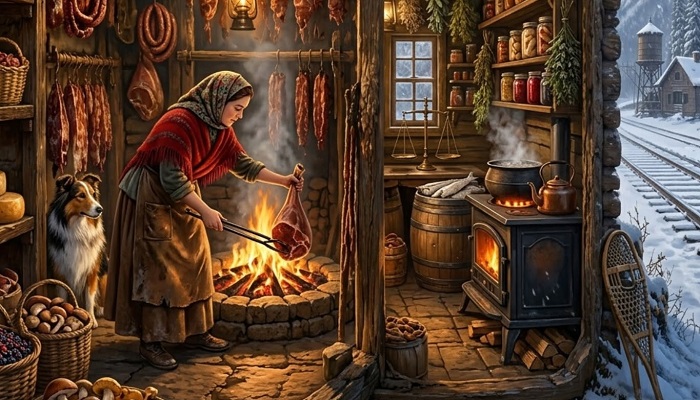
But Bess remained steadfast. Her preparations had provided her with more than enough food to last through the winter. The jerky she had meticulously crafted hung from the rafters, and her stores of pemkin were carefully packed away, waiting for when they would be needed most. She had transformed her father’s teachings into a lifeline, and her confidence grew with each passing day.
On the night the temperature plummeted to a record low, Bess sat by the fire, mending a pair of leather gloves. The wind howled outside, a physical presence that seemed to probe the cabin for weaknesses. But within the walls, there was only the sound of her needle and the crackle of the fire. She felt a deep sense of security, knowing she was prepared for whatever lay ahead.
It was on a particularly cold night that a knock echoed through the cabin. Bess opened the door to find Tom Gable, his face pale and drawn, and his wife Mary, shivering and desperate. In Tom’s arms was their youngest son, Daniel, wrapped in a thin blanket, his face flushed with fever.
Without hesitation, Bess ushered them inside. She settled Daniel onto her bed, piled quilts on top of him, and began to prepare hot broth for the family. As they warmed by the fire, Bess felt a sense of purpose wash over her. She was not just a survivor; she was a caretaker, and her knowledge was a gift she was willing to share.
After ensuring the boy was comfortable, Tom attempted to speak of payment. “We have nothing left to trade, Bess,” he said, his voice thick with shame. “But I’ll work for you for a year, two years, whatever it takes.”
Bess looked at them, their faces etched with exhaustion. “Your son needs you healthy, Tom,” she replied. “Eating today is more important than a promise for spring.” She brought out a side of smoked venison and a sack of jerky, far more than they could repay.
“This is yours,” she said firmly. “But it’s not a gift.” She explained the principle of survival her father had taught her, emphasizing the importance of knowledge and skill over mere charity. She wanted them to understand that they could rebuild, that they could thrive if they learned to rely on themselves.
Word of Bess’s generosity and knowledge spread through the valley like wildfire. Families began to approach her, not with desperation, but with a willingness to learn. The Gables, Hendersons, and Millers all came to her cabin, seeking guidance on how to survive the harsh winter. Bess welcomed them, treating each visitor with respect and dignity.
As the winter raged on, Bess became the heart of the community. She taught them how to hunt, how to preserve food, and how to prepare for the unexpected. Each lesson was an investment in their collective future, a way to ensure that they would not just survive but thrive together.
However, Abernathy and Reverend Michael watched from the sidelines, their authority challenged by Bess’s growing influence. They had expected her to fail, to come crawling back for help, but instead, she had transformed into a leader. The town’s dynamics shifted, and the once-dominant figures found themselves sidelined as Bess’s methods gained traction.
One day, Abernathy approached her again, this time with a different demeanor. He had come to recognize the strength of her character and the value of her contributions. “Bess,” he began, his voice softer, “the town is struggling. We need your help.”
Bess regarded him carefully. “You mean you need my knowledge,” she replied evenly. “You’ve seen what I can do. I’ll trade you what I have for what you can offer. But I won’t give it away.”
Abernathy nodded, understanding that the power dynamics had shifted. He agreed to work with her, and together they began to implement a new system in Prospect Creek, one based on cooperation and shared knowledge rather than competition and isolation.
As the winter continued, the townsfolk learned to adapt. They worked together, pooling resources and sharing skills. The community began to flourish in ways they had never imagined, and Bess’s influence spread beyond the valley. She became a symbol of resilience and strength, a woman who had turned her father’s teachings into a lifeline for the entire community.
When spring finally arrived, the landscape transformed from a frozen wasteland to a vibrant tapestry of life. The townsfolk emerged from their cabins, weary but hopeful, ready to embrace the new season. Bess stood at the door of her cabin, watching the world awaken around her. She felt a deep sense of satisfaction, knowing that she had played a crucial role in their survival.
The stories of the winter of 1882 became legends, tales of courage and perseverance that would be passed down through generations. Bess Hadley, once considered a fool, had become a beacon of hope and knowledge, proving that even in the face of adversity, one could rise above and thrive.
As the years went by, Bess continued to teach and inspire those around her. She never married, finding fulfillment in her work and the community she had helped to build. The Hadley place became a hub of activity, a place where knowledge was shared freely, and everyone was welcome.
In the summer of 1895, a journalist from a Portland newspaper came to document the growth of the remote territories. He spent days interviewing Bess, captivated by her story and the resilience of Prospect Creek. His article spread across the country, bringing attention to the valley and its remarkable inhabitants.
But Bess remained humble, refusing to seek fame or fortune. She continued to live by her father’s teachings, believing that knowledge belonged to everyone who needed it. The silver candlesticks from Abernathy remained on her mantelpiece, a reminder of the journey she had taken and the strength she had found within herself.
Bess Hadley died peacefully in her sleep on a quiet March morning in 1934, at the age of 71, surrounded by the land her father had built and the community she had nurtured. Her legacy lived on in the hearts of those she had touched, a testament to the power of knowledge, resilience, and the belief that even in the face of adversity, one could rise above and thrive.