PART 1
The scream didn’t belong to the storm.
Amos Crane had been riding through blizzards for twenty years. He knew every sound they made — the high wolf-howl at the ridge, the low grinding moan through the pines, the particular silence that came right before a gust that would knock a horse sideways. He knew all of it, and he’d stopped being afraid of any of it.
” “
This was different.
He pulled his mare up hard and turned her against the wind. Snow hit his face like small thrown stones. He yanked his scarf up over his mouth and leaned into the gale and listened.
There. Under the wind. A child’s voice, raw with desperation:
Mama. Please. You promised. You said we’d be safe.
The sound reached into his chest and took hold of something he’d thought was gone.
He spurred forward.
The world past ten feet was nothing — white static, noise, cold that bit through every layer and kept going. He navigated by instinct, by the faint shadow of the tree line and the way the snow moved around obstacles he couldn’t see. His mare didn’t want to go this direction. He made her.
Then he saw them.
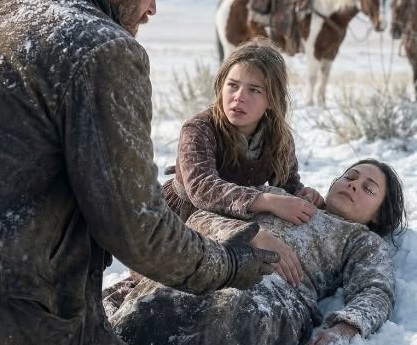
A girl — small, maybe five years old — was crouched in the snow beside a woman’s body. She had both hands wrapped around the woman’s arm, shaking her, her fingers the blue-white of someone who had been in the cold too long.
Her coat was wrong for the weather. Her boots were too small, the soles worn past using. Her cheeks were raw and burning from crying and cold simultaneously.
“Hey,” Amos called out. He raised his gloved hands, making them visible. “Little one — I’m not going to hurt you.”
Her head snapped up.
She looked at him for one held moment — wide, terrified eyes taking in his size, his horse, the rifle across his back — and then she threw herself forward and spread her arms over the woman’s body, making herself into a barrier.
“No,” she screamed. “Get away from her. She’s mine. You can’t have her.”
Amos stopped.
He dropped slowly to one knee in the snow, keeping his hands up, keeping his voice low.
“I’m not taking anyone. You have my word.”
“Men say that.” Her teeth were chattering so hard he could hear it over the wind. She was shaking violently, her whole small body working against the cold. But she didn’t move from where she stood. “He said that too and then he came anyway.”
“What’s your name?”
“Doesn’t matter.”
“Matters to me.”
She stared at him. Her eyelashes were stiff with ice, white-crusted, beautiful and terrible.
“Wren,” she whispered.
“Wren.” He nodded. “That’s a real name. That’s a name that means something.” He looked at the still form beneath her. “That’s your mama.”
“She’s resting.” Her voice cracked on the word. “She got tired. She said she needed to sit down for just a minute and then she’d get back up.”
Amos’s chest tightened with the specific pain of someone who recognized a lie a child was telling herself to survive another few minutes.
“I was a field doctor during the war,” he said. “I’ve kept people alive that had no business still being here. Let me look at her.”
“You’re lying.”
“I’m not.” He reached slowly into his coat and withdrew a small carved figure — a bird, dark wood, worn smooth. “This is a cardinal. My wife carved it. She was better with wood than I ever was at most things.” He held it out toward the girl. “If I do anything to hurt you or your mama, you keep that, and when you find someone you trust, you tell them Amos Crane gave it to you as a debt he owed.”
Wren stared at the carving.
Then she reached out with trembling blue fingers and took it.
“She’s cold,” she said. “I took off my coat and put it on her but I’m too little. It didn’t cover enough.”
He edged forward, moving slow, crouching beside the woman. Her skin had the waxy quality he recognized from the war — not death, but the approach to it. He pressed two fingers to her throat, counting.
There. Barely there, but there.
“She’s alive,” he said.
Wren made a sound he hadn’t expected — not relief, but something older than relief. Something that sounded like a person who has been holding a weight alone for so long that putting it down is almost worse than continuing to hold it.
“We have to move,” Amos said. “My cabin is a mile and a half east. Fire, blankets, food. But we have to go right now or the window closes.”
The girl looked at her mother. Then at him. Then she nodded — a single decisive motion, as if she’d run the calculation and arrived at an answer she didn’t like but trusted.
Amos shrugged off his heavy coat and wrapped it around the woman’s still form. She didn’t stir. He gathered her up — she was shockingly light, frighteningly so, with the lightness of someone who had been surviving on less than was sufficient for too long — and turned back to the mare.
“Can you walk?”
“I walked all yesterday and this morning,” Wren said. “I’m not a baby.”
“No,” he said. “You’re not.”
He mounted with the woman held in front of him, then reached down. “Climb up behind. Arms around my middle and don’t let go, whatever happens.”
She climbed with the ease of someone who’d done it before. Her arms came around his waist and her face pressed into his back, her breath hot through all the layers between them.
He urged the mare east. The storm closed around them.
The mile and a half took an hour.
The mare fought for every step in the low spots, snow to her chest in the drifts, the wind doing everything it could to push them sideways. Amos navigated by the memory of the land underneath the whiteness, by the faint ridge outline when gusts thinned for a moment, by the way cold air moved differently near the tree line.
Wren didn’t speak behind him. She held on.
When the cabin appeared through the white — dark wood, chimney smoke he’d banked that morning still threading up — he felt the same surprise he always felt when the place survived his absence. He kicked the door open and carried the woman inside.
The fire he built up fast and high.
He worked with the automatic efficiency of a man who has done emergency medicine in a tent during a winter campaign — removing wet layers, replacing them with dry, checking the woman’s breathing, her pupils, the pulse at her wrists. She was hypothermic and running a low fever that would climb before it broke. He’d seen worse cases survive. He’d seen better cases not.
“Blankets are in the chest,” he said without turning. “Get out of those wet clothes. There are flannel shirts on the hook — wear one of those.”
Behind him: the sound of the chest opening, small movements, a child negotiating with a garment too large for her.
He kept working.
When he turned, Wren was sitting on the folded quilts by the stove, wrapped in his largest flannel shirt, the carved cardinal clutched in both hands. She’d pulled her knees up inside the shirt for warmth. Her hair stuck up at odd angles, damp and dark.
She was watching her mother the way people watched things they were afraid to look away from.
“Is she going to die?” Wren asked.
“Not if I can do anything about it.”
“People say that.” Her voice was flat. Not angry — flat the way a surface becomes flat when it’s been worn down by friction. “And then people die anyway.”
Amos crouched in front of her so they were level. This close, he could see how young she was — five, maybe just turned six — and how old her eyes were. The combination was the specific kind of unbearable thing that happened to children who got handed too much reality too early.
“Come here,” he said.
She didn’t move.
“You’ve been the strong one long enough. You can put it down for a few minutes.”
A beat. Two.
Then she leaned forward, and he gathered her in, and she held on and shook silently — not crying so much as releasing something that had been under pressure for too long. Her small hands clutched his shirt.
“She promised we’d be safe,” Wren said, against his chest. “She said if we got far enough away, we’d be safe.”
“I’m going to do everything I know how to do,” Amos said. “And I know a lot.”
She didn’t answer. She just stayed where she was, the cardinal pressed between her palm and his shirt, until the shaking slowed and her breathing steadied.
He held the child and fed the fire and kept watch over the woman on the bed.
Outside, the storm made its intentions clear. It was going to be here a while.
PART 2
The woman’s name was Ada.
He learned it when Wren woke from a short hard sleep by the stove and started talking, the way exhausted children talked when the immediate terror had passed and the need for information could finally surface.
Ada Brennan. Wren’s mother. They’d come from east of the mountains, from a town called Sulphur Creek, where Ada’s late husband’s brother — a man named Silas Grant — had been systematically dismantling their life since the funeral.
“He had papers,” Wren said. “Mama said papers were how men like him did things. So you couldn’t fight it like a real fight.”
Amos was at the stove, heating broth. “What kind of papers?”
“Court papers. Saying Mama was bad at her head. That she couldn’t take care of me right.” Wren had pulled the cardinal out and was turning it over in her hands, studying the detail of the wings. “He paid a doctor. Mama said that’s something you can do if you have enough money.”
“Did your mama fight it?”
“She tried.” Wren set the carving down. Picked it back up. “She went to the judge herself and told the truth and the judge listened to Silas instead. Because Silas looked like someone the judge had known before.” A pause, in which a five-year-old described something ancient and specific about the shape of the world. “Mama said that’s also something that happens.”
Amos set a cup of broth on the floor beside her. She took it without looking up.
“So you left,” he said.
“In the night. She packed my things and some of hers and we used the last money for train fare. She said if we got far enough west, the courts wouldn’t reach us. That Silas had money but not that much reach.” Wren sipped. “We were almost to far enough.”
He looked at Ada on the bed. In the last hour her color had shifted fractionally — still bad, but differently bad, the early stages of the fever doing its necessary work. Her breathing was slightly less shallow.
“She protected you,” he said.
“Always.” Wren said it without drama, the way you said the sky is up or water is cold. A simple and proven fact. “Even when she was scared, which was mostly always. She was scared a lot but she kept going.”
Amos sat in the chair beside the bed, watching Ada breathe.
He’d had a wife, once. He’d had a son. He’d buried them both within the same month in 1872 — the fever that went through the valley taking them in the particular cruel sequence that left you just long enough with one to hope before taking the other. He’d come to these mountains after, not with any specific plan but with the understanding that he could not remain in the place that still smelled like them.
He’d been here eleven years. He’d built the cabin, built the fences, built the life of a man who had reduced his needs to what he could provide himself. He’d been adequate at it. He’d told himself adequate was enough.
He’d told himself that until a child’s scream came through a snowstorm and his body knew, before his mind agreed, that he was going to turn his horse toward it.
“She’s fighting,” he said.
“She better be,” Wren said. “Because if she dies, I’m not going back. I’ll run until there’s nowhere left to run.”
He looked at the girl. He believed her completely.
Ada’s fever broke and climbed twice in the next thirty-six hours, the classic pattern of someone fighting something serious.
Amos barely slept. He tended the fire, checked her pulse at intervals, coaxed water past her lips when she was semiconscious enough to swallow. Wren appointed herself assistant, appearing at regular intervals to report on the fire’s condition and ask pointed questions about what he was doing and why.
She was more useful than she should have been at five years old. She didn’t panic and she didn’t get in the way.
On the second night, he told her to go sleep.
“I’ll watch,” she said.
“Wren.”
“I always watch at night. Mama sleeps better when someone’s watching.”
He looked at this small person in his flannel shirt with her carved cardinal and her specific gravity, and he pulled the rocking chair close to the bed and put a quilt over her and she was asleep in four minutes.
He sat in the regular chair and kept watch himself.
Ada’s eyes opened at some point before dawn — glassy, confused, but open.
She grabbed his wrist when he leaned to check her forehead. Her grip was surprisingly strong.
“He’ll come,” she said. “He always comes. If he finds us—”
“He hasn’t found you. You’re in my cabin. Your daughter is asleep ten feet away.” He kept his voice level. “You’re safe right now.”
Her eyes moved to Wren. The grip on his wrist loosened slowly, though she didn’t fully release it.
“She tried to carry me,” Ada said. “She kept saying we needed to find trees. As if trees—” She stopped. Her throat worked.
“She found a person instead,” Amos said. “Which was better.”
Ada looked at him. Really looked, the way sick people sometimes looked when the fever-haze thinned — with unusual directness, without the social armor that health allowed you to maintain.
“Why are you helping us?” she said.
He thought about the accurate answer. “Because I heard her and I didn’t ride away.”
“That’s not an explanation.”
“It’s the only one I have.”
She was quiet for a moment. Her hand finally released his wrist. “She thinks you’re her hero.”
“She’s wrong.”
“She’s not usually wrong about people.” Ada’s eyes were closing again. “She has a gift for it. Always had.”
He pulled the blanket up higher on her chest.
“Sleep,” he said. “You’ll think better tomorrow.”
“I don’t have a tomorrow yet,” she said. And fell back into the fever.
Hazel Struck arrived two mornings later.
She was Amos’s nearest neighbor — a Métis woman of about sixty who ran a trading post eight miles south and functioned as the region’s closest approximation to a news service. She came at dawn, dusted with snow, her gray braid tucked into a fur cap.
“Someone came through my post,” she said, before she’d fully stepped inside. “Yesterday morning. Well-dressed. Eastern accent. Had a badge with him that looked newer than it should.” She looked past Amos to the bed, where Ada slept, and to Wren eating cornmeal at the table. “That them?”
“Yes.”
Hazel crossed to Ada, pressed a practiced hand to her forehead. “Still in the thick of it. But something’s pulling her back.” She looked at Wren. “That’d be you, I’d guess.”
Wren regarded her with the steady appraisal she gave everyone. “Did he say where he was going?”
Hazel sat down at the table across from her. “He said he was looking for a woman who’d run off with a child that wasn’t hers to take.”
“She’s mine,” Wren said. Her voice was perfectly flat. “She’s my mama.”
“I know that,” Hazel said. “I’m telling you what he said, not what’s true.”
Wren considered this distinction. Then she nodded. “What’s he going to do?”
“Looking for a judge who’ll hear him, I expect. Looking for a lawman who doesn’t know the country.” Hazel looked at Amos. “He’s got money. Money buys time.”
“How much time do we have?”
“Not as much as I’d like.” She pulled dried meat and a paper-wrapped parcel from her pack, set them on the table. “But Silas Grant has never been to this country. That’s worth something.”
Amos looked at Wren, who was watching this conversation the way she watched everything — with the fixed attention of someone who was taking notes.
“We’re going to handle this,” he told her.
“I know,” she said. “I’m going to help.”
He and Hazel exchanged a glance.
“Yes,” he said. “You are.”
PART 3
Jonas Reeves came from two valleys east when Hazel sent word — a trapper of indeterminate age who’d known Amos since before the cabin, who communicated primarily in short declarative sentences and the language of practical action.
He arrived at first light and didn’t ask many questions. He walked the property line, tested the ground, strung warning bells along the southern approach through the timber, and set trip-lines in the low corridor where anyone coming from the road would pass.
“Two days, maybe three,” he said, which was his assessment of how long they had.
He was off by one day.
The bells rang on the first night.
Two shapes at the timber edge — scouts, moving careful, pausing under the ridge with a map they couldn’t read properly in the dark. Amos and Jonas walked them out at gunpoint with the calm of men who had done this before. No shots. The men looked at the terrain, looked at each other, looked at the two figures in front of them, and made the calculation. They went back the way they’d come.
Ada was sitting up by then.
The fever had broken for good on the third day — the real break, the one that left her wrung out but clear-eyed. She’d eaten a full bowl of broth that evening and managed half a biscuit, and Wren had sat beside her on the bed the whole time talking, explaining everything that had happened since they’d left the road, leaving nothing out.
“She reports,” Ada told Amos, when Wren had finally fallen asleep wedged against her side. “She always has. Whatever happened, she’d find me at night and tell me all of it. Like she was filing the day away somewhere safe.”
“She’s been filing this whole situation,” Amos said. “I wouldn’t be surprised if she has a plan.”
Ada almost smiled. “She always has a plan.”
She looked around the cabin with the careful attention of someone cataloguing what had been done for them, the way people looked when they were trying to measure a debt.
“You’ve kept this place a long time,” she said.
“Eleven years.”
“Alone?”
“Since the second year.”
She looked at the cardinal on the shelf — she’d noticed it almost immediately after waking, before she’d known what it was. “You gave it to her.”
“She needed something to hold.”
“She still has it.” Ada was quiet for a moment. “The man you asked about is never going to stop. I want you to understand that. He doesn’t do this because he wants Wren. He does it because I said no to him and he’s not a man who accepts that.”
“Then we’ll give him something he can’t work around,” Amos said.
“What does that look like?”
He thought about the shape of the valley, about the people in it. About Hazel at her post, who had known every family in the region for thirty years. About Jonas, who didn’t talk but showed up. About the preacher in Dry Creek who’d buried Ada’s husband’s first wife and knew the Grant family’s history better than Silas would want him to.
“Witnesses,” he said. “The right ones.”
Ada looked at him for a long moment.
“I’ve had people believe him over me,” she said. “Important people. People who should have known better.”
“These aren’t those people.”
She held his eyes. “Why are you doing this? Truly.”
He looked at the fire.
“When my wife died,” he said, “I stopped doing most things. The ones that required believing something good was still possible.” He paused. “I’ve been maintaining the machinery of a life without running it for anything in particular.” A longer pause. “And then I heard your daughter in that storm. And my body went toward her before I’d decided to.”
Ada was quiet.
“I think some things override the deciding,” she said.
“I think so too.”
She looked toward Wren, asleep and small and ferocious even in sleep.
“If this works,” Ada said, “I don’t know what comes after it. I’ve been so focused on running that I haven’t let myself think past the running.”
“That’s all right,” Amos said. “That’s what right now is for.”
Silas Grant arrived in Dry Creek on a Wednesday, which was fortunate, because Wednesdays were when the trading post women gathered at Hazel’s for the week’s exchange of goods and news.
He rode in with two men flanking him and the particular bearing of someone who had always gotten what he came for. His coat was good wool, his gloves spotless. He looked like a reasonable man, which was the most dangerous thing about him.
Ada met him in the street.
She stood in the center of the main road with the cold coming off the mountains and the mud of early thaw under her boots, and she held Edmund’s letters in one hand — the ones she’d carried sewn into the coat lining since the night she’d packed Wren’s things and walked out in the dark.
The letters were in Edmund’s handwriting. They documented, with the specificity of a man who knew he was dying and had time to be precise, his brother’s management of their father’s estate, the money Silas had moved, the pressure Silas had applied to their father in his final years.
Edmund had not been a good man. But he had been, at the end, an honest one.
Silas looked at Ada in the street and then at the people around her — Hazel behind her, arms folded; Jonas to her left; the preacher from the church at the road’s end, who had a long memory and no particular affection for the Grant family; three women from the trading post who had heard Ada’s story the previous Sunday and whose opinion of it was visible on their faces.
“You always were dramatic,” Silas said. “Edmund warned me.”
“You come to take something?” Amos said. He was standing back, off to the side — not leading this, because this wasn’t his to lead.
Silas looked at him with the assessment of someone deciding how much opposition cost. “I came to retrieve what’s mine by law.”
“She’s not yours by any law that matters here,” Ada said. Her voice was steady in a way that had taken her five years to find. “And you know what Edmund wrote about you. So do the people behind me. So does the judge in Helena who is going to receive a copy of these letters, along with a report from three witnesses about what you paid a doctor to say in court.”
Silas looked at the letters in her hand.
His face changed in a way he probably didn’t mean to let it change.
“Those are forgeries,” he said.
“They’re in Edmund’s hand,” the preacher said. “I’ve known Edmund’s hand for thirty years.”
Silas looked at the street. At the faces on it. At the absence of any face that was his.
He had done this in Sulphur Creek and it had worked because Sulphur Creek had his money in it, his history, his version of events told first. This was not Sulphur Creek. These were not people who needed to believe him.
He left without Wren. He left without Ada.
He rode out the way he’d ridden in, and the only difference was that he didn’t look back, which was the thing men did when they’d decided not to come back.
Ada stood in the road for a moment after he was gone. Then she sat down on the step of the trading post because her legs had decided that was enough.
Wren appeared from behind Hazel and climbed into her lap, which was not possible given Ada’s current stability, but happened anyway.
“Did it work?” Wren said.
“Yes,” Ada said, into her daughter’s hair.
“I knew it would,” Wren said. “I had a backup plan, but we didn’t need it.”
Amos crouched beside them both. “What was the backup plan?”
Wren looked at him with the expression of someone deciding what information to disclose. “I was going to make Coppah go different directions and confuse them,” she said. “I already asked Jonas’s horse.”
Amos looked at Jonas.
Jonas looked at his horse.
“She did ask,” Jonas confirmed.
The letter from Judge Niles came on a Tuesday in March.
Ada Brennan retains full legal custody of Wren Brennan-Grant. No further court action shall be entertained regarding the matter of Silas Grant’s petition. All previously submitted testimony of questionable origin has been stricken from the record.
Ada read it at the kitchen table, read it again, and set it down next to the cardinal.
Through the window, Wren was in the yard attempting to teach Hazel’s chicken to stay in one place, which the chicken was not cooperating with.
“What’s next?” Amos said. He was at the stove with coffee.
Ada looked at the letter. “I’ve been making a list,” she said. “Things I want to do. Things Wren and I want to do.” She paused. “Things I want to do that aren’t related to surviving something.”
“What’s first on the list?”
“Plant a garden.” She looked out the window. “A real one. One that I’m still here for when it produces.”
He brought her a cup of coffee and sat across from her. The morning light came through the window at a low angle, cutting across the table.
“There’s a south-facing slope above the east fence line,” he said. “Soil’s deep there. Gets sun six months.”
“You’ve been thinking about it.”
“I’ve been thinking about a lot of things.” He wrapped his hands around his cup. “The cabin has a second room I framed but didn’t finish. Been that way for four years. I started it when I thought I might want visitors and then stopped when I decided I didn’t.”
Ada looked at him.
“I’d like to finish it,” he said. “If you’re staying.”
She held his eyes across the table.
“Wren picked out where her bed should go two weeks ago,” she said.
“I know. She told me.”
“She also told Jonas’s horse.”
“She tells that horse everything.”
Ada almost smiled — and then did smile, the full version, the one she’d been rationing for a long time and had apparently decided she could afford now.
“We’re staying,” she said.
Spring came to the mountains the way it always did — reluctantly and then all at once.
The south slope above the east fence thawed first. Ada and Wren planted it on a Saturday in April — onion, carrot, bean, a row of sunflowers that Hazel had brought from her grandmother’s saved seeds. Wren patted the soil with the seriousness of someone engaged in official work, which she was.
Amos finished the second room with pine boards still smelling of fresh-cut wood. Wren approved of it by walking the perimeter three times and then sitting in the middle of the floor and declaring it the right size.
Jonas came by in May and didn’t say much but helped rebuild the fence line on the north side, which had been needing it for two years. He and Amos worked in the companionable silence of people who had known each other long enough that silence was a form of conversation.
Hazel brought seeds and news and occasional strong opinions. She also brought Wren a book she’d had since childhood, with pages soft from handling, and Wren received it with the gravity of someone receiving a significant inheritance.
Ada learned to read the creek.
Not metaphorically — literally. Amos showed her how the sound changed in early thaw, how to tell from the movement where the depth was, where the rocks were, which crossings would be safe. She stood on the bank and listened and asked questions until she could do it herself.
“You could have just told me,” she said, after she’d correctly predicted a crossing that looked passable but wasn’t.
“I did tell you,” he said. “And then you needed to try it to know it.”
She looked at him sideways. “Is that a general philosophy?”
“It’s a farming philosophy. I applied it to creeks.”
She went back to watching the water. “What else does it apply to?”
He thought about that. “Most things, probably.”
Ada nodded slowly, watching the water move.
She had started sleeping through the night. She’d noticed it as a fact before she’d noticed it as a change — had woken one morning and realized she hadn’t been awake at two, at three, at four, the hours she’d been monitoring since Sulphur Creek.
She’d lain still for a long time, feeling the unfamiliar quality of the silence.
Not the silence of holding her breath. Not the silence of listening for footsteps.
Just quiet.
She’d gotten up and written in the small book the preacher’s wife had sent:
April 14th. Wren, Ada. We planted things today that we’ll still be here to eat. I don’t know what to call that except forward. This is the first morning in five years I didn’t wake up running.
She closed the book.
Outside, the last snow was retreating up the north slopes, chased by green. Wren was in the garden talking to the onions about their responsibilities. Amos was at the east fence with Jonas, the sound of hammer work coming through the clear air at intervals.
Ada stood on the porch with her coffee and looked at all of it.
Not at what they’d survived. At what was here.
The garden and the warm south slope and the creek she could read now. The room that smelled of new pine. The cardinal on the shelf inside, worn smooth from a child’s keeping. The list in her book that had been about not dying and was now about what to do next.
She had built this. She had been part of building it, which was different from being saved into it.
She had stood in a road with letters in her hand and spoken clearly, and the people behind her had known she was telling the truth because they’d had time to learn her, and that had been enough.
She heard Wren’s voice from the garden, instructing the beans.
She heard Amos’s voice from the fence line, saying something to Jonas that made Jonas make a short sound she’d started to recognize as his version of laughter.
Ada drank her coffee on the porch in the spring morning.
She was not looking over her shoulder.
She was looking at the mountains, which were doing what mountains did — standing, old and patient and indifferent, while small human events happened at their feet and the seasons turned.
She thought: I know this place now. Not the way you know a place you’re passing through. The other way. The way you know somewhere you’re going to be for a long time.
Wren came out of the garden and ran across the yard in bare feet and climbed the porch steps and leaned against Ada’s side.
“The beans are doing what I told them,” she said, with satisfaction.
“Beans don’t do what they’re told, Wren.”
“These ones might.”
Ada put her arm around her daughter’s shoulders.
“Maybe,” she said.
Amos came around the corner of the cabin, hammer in his hand, Jonas behind him. He stopped when he saw them on the porch.
Something passed across his face — the expression of a man who has been alone long enough that the sight of people on his porch still surprised him, and who had started, recently, to find the surprise welcome rather than strange.
“Fence is done,” he said.
“Good,” Ada said.
“There’s a section on the south side that needs attention before fall.”
“Then we’ll do it before fall.”
We. He heard the weight in it. She’d started using it naturally, without calibrating it first, which was how she knew she meant it.
He climbed the porch steps and stood beside her, looking at the mountains.
“Hazel says there’ll be a good summer,” he said.
“Hazel says a lot of things.”
“She’s usually right.”
Ada looked at the garden, at the green rows, at Wren already heading back to inspect the bean situation.
“She is,” she said. “She usually is.”
Something was growing in the soil and also in the space between two people who had each, in their own way, been carrying too much alone for too long. It was growing the way things grew in mountain country — slowly, without announcing itself, pushing through ground that had been frozen and finding, to its own apparent surprise, that the ground was ready.
That summer, Wren named every animal on the property.
She named the mare Thistle. She named Jonas’s horse in absentia, which Jonas allowed without comment. She named the three chickens after geographical features of the valley.
She told Amos he needed a name too.
He said he already had one.
She said that was his people-name, and she’d been thinking about his mountain-name.
He asked what she’d decided.
She looked at him with the serious eyes that had looked at him over her mother’s body in the snow and said: “The one who turned around.”
He thought about that for a long time.
He thought it was the most accurate thing anyone had ever said about him.
— The End —