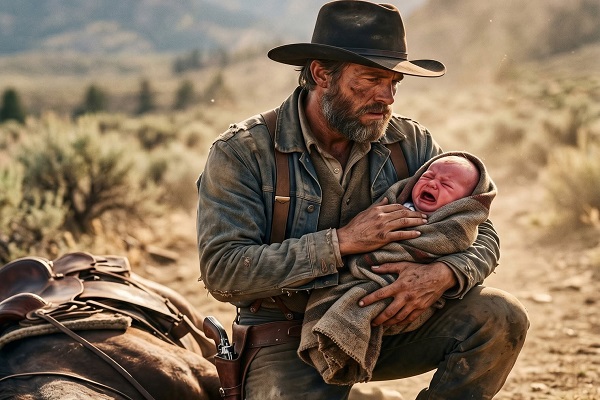
The baby was the only thing alive out there.
I’d ridden out before sunrise to check the south fence line, which was the kind of errand that never felt urgent until it was, and that’s when I saw the horse. It had gone down in the tall grass beside the creek bend, ribs already showing through the hide in the early heat, flies working the eyes. A brown mare, well-bred once, ridden to death in a hurry. I almost turned back. Then something beneath the carcass moved, and I heard it — a sound so small and so furious it took me three full seconds to understand what I was hearing.
I dropped off my horse and pulled the blanket back with both hands.
The baby was maybe five months old. Wrapped in half a wool blanket, face red and wet, fist opening and closing in the hot morning air like it was trying to grip something that kept disappearing. Alive. Just barely keeping at it, but alive.
I took her inside and sent for Agnes Pruitt, the only woman in two counties I trusted with something this fragile. While I waited, I looked at what else the dead mare had carried. A saddlebag, nearly empty. A torn piece of paper with a deposit box number written in a woman’s hand. And a small brass key on a leather cord, tagged with a number that matched.
Agnes arrived inside the hour, assessed the situation with the efficiency of a woman who had delivered half the children in Callow County, and set to work with goat’s milk and a clean cloth while I stood at the window trying to understand what I was holding.
The key was the part I couldn’t stop looking at.
PART 1
My name is Will Hale, and I ranch the eastern quarter of the Coldwater basin, which is a modest way of saying I work hard land in a county where the richest man owns most of the rest of it.
That man’s name was Edmund Vance.
Vance ran cattle, freight contracts, and a substantial portion of the county’s elected officials from a limestone office building on Main Street in Callow. He gave generously to the church, attended funerals with appropriate gravity, and shook hands with the practiced ease of someone who understood that warmth, deployed correctly, was cheaper than lawyers. Men called him a pillar. What they meant was that he was structural in the way load-bearing walls were structural — everything was built around him and nobody wanted to think too hard about what happened if he came down.
I had kept my distance from Vance by keeping my head down and my fences tight and my business to myself. It was the approach my father had taken too, and his father before him. Hales minded their own. That was the family principle, worn smooth as river stone from decades of use.
I was beginning to understand it differently than I once had.
The baby — I was already thinking of her as the baby, as though she’d arrived with a kind of permanent residency — settled against Agnes’s shoulder and stopped crying by midmorning. Agnes had a way with small frightened creatures, human and otherwise, that I had always attributed to patience and now thought might be something closer to authority. She simply held them as though there was no question about the outcome, and the creatures believed her.
“You found this with her?” Agnes asked, looking at the key.
“On the saddle. Along with a box number.”
She turned it over once in her fingers. Her expression didn’t change, exactly, but something behind it did. A tightening, or maybe the opposite — a release, like a word she’d been holding back for years had finally found a door.
“Agnes.”
“Boil more water,” she said quietly. “And load your rifle.”
“Tell me why.”
She looked at me then, and what was in her face was not quite fear. It was the specific expression of a person who has known something dangerous for a long time and is calculating whether the moment has finally come to say it aloud.
“Because whoever left that child left her in a hurry,” she said. “And whoever was chasing her will follow the horse.”
My dog Rex was off the porch before the hoofbeats registered.
He didn’t bark. Rex always barked. The silence from him was worse than any sound would have been, and I had the rifle in my hands before I consciously decided to pick it up.
The horse outside stopped. Leather stretched. One boot hit the porch boards, then another.
Three knocks. Evenly spaced. Patient in the way that had nothing to do with patience and everything to do with knowing the person inside was already afraid.
I opened the door with the rifle behind my leg, barrel down.
The man on my porch was tall, dressed in a dark coat despite the heat, with dust caked along the hem and a nick in his lower lip where something metal caught the morning light when he spoke. He held a piece of torn wool in his left hand. I recognized the weave before I understood why — it matched the blanket the baby was wrapped in, the half that had been left with her.
His eyes moved past me once, quick as a blade thrown in dim light, and found what they were looking for.
“There she is,” he said.
The baby was breathing against Agnes’s shoulder. The room behind me smelled of warmed milk and cedar and gun oil. I had not told this man anything. I had not told him there was a child here at all.
“What do you want?” I asked.
“The girl’s name is Clara.” He said it the easy way you said something you’d been told recently, information still fresh in the mouth. “And you’ve got something else that doesn’t belong to you.”
Only the woman who’d ridden that horse to death could have given him the child’s name. Or someone who’d been close enough to hear her say it while she was running.
I kept one hand on the door edge. “Most men ask after the horse before the baby.”
“Hand me the key, rancher.”
Behind me, a floorboard shifted near the stove. Agnes, moving her weight.
“You don’t know what you’re holding onto,” the man said, and his voice had dropped the courtesy entirely now, down to something that had been there all along underneath it.
“I know enough,” I said.
He stepped forward without being asked.
The door caught his wrist before his hand cleared the holster. The shot went wide anyway, punching through the door frame and showering splinters across the entry. Rex hit him from the left, low and hard, teeth sinking into his calf. The man cursed and stumbled, and Agnes came from the side room with my cast iron pot still half full of near-boiling water and hit him across the cheekbone with the sound of something final.
He went down badly.
I put my knee between his shoulder blades and got the pistol out of his hand before he could think clearly enough to fight for it, and by the time Clara started crying in earnest the stranger was tied to the kitchen chair with my saddle rope at his chest, wrists, and ankles, one eye swelling purple, blood running from the corner of his mouth.
The silver tooth still caught the light when he smiled.
“Too late either way,” he said.
Agnes took the baby to the far end of the room and swayed her into hiccups. Her hands only shook the once.
I pulled a chair up across from him and sat.
“Name,” I said.
He worked his jaw and spat onto the floor near the door. “Cole Arden.”
The name didn’t reach me. But it reached Agnes.
I saw it in the way she went very still.
Arden noticed too.
“Ah,” he said softly. “So Callow County hasn’t forgotten Dry Fork.”
“What happened at Dry Fork?” I asked.
Agnes didn’t look at me. “He rode for Edmund Vance.”
That name I knew.
Everybody in three counties knew it.
PART 2
Arden leaned back as far as the ropes would allow.
“Ask your neighbor there about the Marshalls,” he said. “She knows more than this town ever admitted to itself.”
Agnes’s jaw tightened. Clara had quieted again, one small fist hooked into the collar of Agnes’s dress like an anchor.
“Yesterday evening,” Agnes said at last, “a woman came to me.”
My breath caught somewhere high in my chest.
“She was riding hard. The horse was blown white with sweat. The baby had been crying for hours. The woman — her name was Lena Marshall — had blood on her sleeve and her eyes had the look of someone who has been making decisions in a very small window of time for a very long time.” Agnes kept her gaze on the child. “I cleaned the baby. I tried to tend Lena too. She wouldn’t stay. Said she had to reach the bank before noon or everything she’d carried for eight years would be worth nothing.”
I looked at the key.
“Ruth Marshall did not die in the Dry Fork fire,” Agnes said.
The room changed shape around that sentence.
“She and Lena got out through the cellar. Daniel stayed behind to slow the men down.” Agnes’s voice stayed level, which took a visible effort. “Ruth hid with Lena in New Mexico under another name. Worked laundry at a mission near Roswell. Raised her girl. Daniel had pressed the blanket and the key into her hands the night before — told her if he didn’t survive, she was to keep both hidden until the moment was right to use them in the open.”
“What’s in the box?” I asked.
“I don’t know,” Agnes said. “But Ruth believed it was proof. Not of debt. Of what Vance did to build everything he has.”
Arden smiled through split lips. “Proof’s just paper.”
Agnes looked at him with the expression of a woman who has outlived several men who thought exactly that. “Paper lasts longer than men like you.”
He grinned, thinner now.
“Lena married in New Mexico,” Agnes continued. “A careful man. An accountant named James Reed. Two months ago he found freight records that carried Vance’s name beside fraudulent land claims and shipping fees that didn’t match any real cargo. He started working through Ruth’s old papers with Lena at night after Clara slept. They found the deposit box number. They found Daniel’s notes. James said if the originals were still where Daniel had hidden them, then Vance wasn’t just a bully with money. He was a thief with a system.”
“And James?” I asked.
Agnes closed her eyes once. “His wagon went over in a ravine ten days ago.”
Arden shifted his shoulders in something meant to be a shrug. “Roads out west are hard on careful men.”
I hit him before I decided to.
Not with the pistol. Just my fist, enough to rock the chair back and open his lip wider.
Rex growled from the corner.
Arden licked blood from his mouth. “Doesn’t change noon,” he said.
A pulse started behind my eyes. “Where is Lena?”
He smiled without heat.
I leaned forward and pressed the barrel of his own pistol into the gap between two chair slats, right beside the inside of his knee.
“Consider carefully,” I said, “what you’re willing to lose.”
For the first time, something flickered across his face that wasn’t performance.
“Old irrigation culvert past the cottonwood bend,” he said. “Dry wash. She went in after the shot. Maybe she’s still breathing. Maybe she isn’t.”
I was on my feet before he finished.
Agnes caught my sleeve. “Take my roan. She handles the broken ground better than yours.” She glanced at Arden, then at the stove. “Don’t rush on my account. I’ve managed difficult men before.”
PART 3
The ride to the wash took twenty minutes and felt like being pulled through hot wire by the ribs.
Every pale stone in the grass looked like a shoulder from a distance. The heat came off the ground in wavering sheets, distorting the mesquite, making the far hills shift and breathe. I kept my eyes moving and my thoughts narrow. Not what I might find. Just the distance to cover. Just the next landmark.
I reached the cottonwood bend and saw the dried blood on the cracked mud outside the culvert before I saw anything else.
I slid off the roan and dropped to one knee.
“Lena.”
Nothing.
A sound from inside. Cloth on concrete. Movement.
I went in on hands and knees.
She flinched away from me before she could see who I was. Then her eyes adjusted, and she stopped flinching, and what replaced the fear wasn’t relief so much as a decision — the body choosing to keep going for one more hour.
Lena Marshall had dark eyes that were the same as her mother must have been, direct and undeceived, sharpened now by eight years of hiding and ten days of running. Her hair was plastered to one side of her face with dust and dried sweat. Blood had traveled from a wound high in her left shoulder all the way down to her wrist in a dark stripe.
“Clara,” she whispered.
“Fed and loud,” I said. “Agnes has her.”
She tipped her head back against the culvert wall and let out one long shaking breath that wasn’t quite crying and wasn’t quite relief but was the sound of someone deciding not to die for another few hours.
“Arden?” she asked.
“Tied to my kitchen chair.”
The corner of her mouth moved.
I got my arm behind her and helped her toward the light. The fabric of her sleeve pulled wetly against my hand.
“James kept telling me daylight was safer,” she said as we moved. “He said honest paper always won in daylight. He believed that.”
There are sentences that sound foolish until you understand how much a person needed them to be true.
“My mother hid that key for eight years,” she said as I settled her sideways on the mare. “When the lung sickness came for her and she knew she was leaving, she gave it to me and said my father hadn’t stayed behind in that fire so we could spend our whole lives underground.”
We started back through the cottonwoods.
“What’s in the box?” I asked.
“Everything it takes to ruin Edmund Vance,” she said. “If the right people see it before the wrong ones do.”
By half past eleven, Lena lay in Agnes’s spare bed with fresh bandages on her shoulder and Clara sleeping in the crook of her arm like the child had found the exact place she’d been fighting to reach all along.
Cole Arden sat where I’d left him, though Agnes had also looped his chair to the stove leg with a second rope. His cheek had gone the color of a storm. He had stopped smiling with any real conviction.
There is a particular stillness that enters a room when the past finally walks all the way through the door and takes a seat at the table. That was what filled Agnes’s kitchen while Lena drank broth and told the rest.
Daniel Marshall had not discovered one bad transaction. He had discovered a method.
Edmund Vance used false debt instruments — clean-looking notes, backed by obliging county clerks and paid witnesses — to swallow land that stood in the path of his freight routes and grazing expansion. When men refused to sell, other things followed. Accidents. Fires. Foreclosures on sums so precise they sounded too real to question. One figure kept appearing in Daniel’s records, again and again, the same way a pattern only becomes visible when you lay enough examples side by side.
Three thousand two hundred dollars.
Just large enough to sound like real debt. Just specific enough to bury a family in embarrassment before anyone thought to ask whether the number was invented.
“My father believed that if he put the original records in a bank and sent my mother away with the key, somebody honest might eventually open the box,” Lena said. “He believed paper frightened men like Vance. He believed it outlasted witnesses.”
Agnes, at the foot of the bed, was mending the torn edge of the blanket with quick precise stitches. “Smart man.”
Lena’s eyes moved to me. “Your father knew that too.”
Something in the room dropped away.
“What do you mean?”
She looked at Clara first, then back at me. “There’s a letter in the box. My mother told me near the end. She said Daniel didn’t trust many men, but he trusted one enough to leave a second statement with his records. Will Hale Senior.”
My father.
Agnes’s needle stopped.
“That isn’t possible,” I said.
Agnes said, without looking up, “It’s possible.”
I turned to her. “You knew.”
“Not what was in the box.” Her voice was careful. “Only that your father rode to the Marshall place the night before the fire. He came to me after midnight with ash on his collar and a split knuckle and asked for bandages. Wouldn’t say for who. Next morning he stood at the road and told his boy to keep riding and not stop.”
I had been that boy.
For fifteen years I had carried my father as a fixed point — honest in the narrow way men of his generation were honest, quiet where silence was easier than cost, unwilling to put himself between someone else’s danger and his own family’s safety. I had spent years building myself in deliberate opposition to that. Being decisive where he’d been hesitant. Speaking where he’d kept quiet. Telling myself I was different.
Now the floor shifted under all of it.
“What did he do?” I asked.
Lena shook her head slowly. “I only know what my mother said. That your father made one brave decision and one cowardly one, almost in the same breath. She never blamed him for the second one. But she never forgot it either.”
That was harder to hear than if she’d called him a villain outright.
At twenty minutes before noon, a horse hit the yard at speed.
I stepped onto the porch with the rifle up and saw Deputy Ada Merritt dismount in a burst of dust, coat open, star visible. Ada was Agnes’s granddaughter, twenty-six, with the kind of intelligence that Callow County’s sheriff’s office had spent four years pretending not to notice because Sheriff Grant Hollis found capable women inconvenient. She had friends in the Texas Rangers and a very clear sense of which laws were worth enforcing and which ones were being rented out.
“Gran sent Danny to the telegraph office when you rode out,” Ada said. She handed me a folded paper.
ARRIVING NOON. HOLD EVERYTHING PUBLIC. DO NOT TRUST HOLLIS. —RANGER J. CROSS
Four lines. Enough.
So Hollis was bought. Which meant Vance was already at the bank or close to it, and noon was the hinge the whole morning had been swinging on. If we missed it — if the box was emptied or swapped or quietly absorbed into the machinery rich men used to turn evidence into clerical confusion — then Daniel Marshall’s eight years of hiding came to nothing, and Lena’s running came to nothing, and James Reed’s careful reading came to nothing, and Clara would grow up with a mother who had survived and a world that had gotten away with it anyway.
I looked through the window at Lena with her baby. At Arden tied to the chair. At the mended blanket folded on the table, its seam barely visible now, which Agnes had stitched back together so carefully you had to look for the repair to find it.
Then I heard my father’s voice.
Not a memory, exactly. Something older than memory. The tone of him. The particular way he had of saying it isn’t our business — not with malice, not even with cowardice, but with the exhausted resignation of a man who had already decided the cost was more than his family could afford to pay.
For the first time, I understood what that sentence had really meant.
It hadn’t meant innocence. It had meant consent, dressed in quieter clothes.
“We go now,” I said.
The Callow County Savings Bank sat on Main Street behind limestone columns that were trying very hard to look like they’d been standing longer than twenty years. Ceiling fans turned in the lobby. Clerks moved paper with the concentration of people who understood that paper was what power looked like in daylight.
When we came through the door, the room thinned to silence in pieces.
I was still dusty from the wash. Lena wore her mother’s dark shawl pinned over the bandage and carried Clara against her good side. Agnes came beside her with her chin level and her expression that of a woman who has made up her mind about something and is no longer interested in discussing it. Ada wore her star openly. Two ranchers I knew — men whose land had been cropped back year by year until it ended exactly where Vance’s began — had heard enough outside to follow us in. Cole Arden came last, wrists bound, led on a short rope, looking like a man who had made a series of assumptions that were not panning out the way he’d planned.
Edmund Vance stood near the manager’s desk.
He was older than I remembered from the auction yards, thicker through the chest, hair gone silver and combed back with intention. Summer suit the color of cream. Watch chain at the vest. The kind of man who wore courtesy the way other men carried firearms — as a tool, not a character trait.
His eyes found Lena first.
“There you are,” he said, and his voice had genuine warmth in it, which was the most frightening thing about him. “You’ve made this so much harder than it needed to be.”
No one answered him.
The bank manager — a slope-shouldered man named Croft who had always looked like he was apologizing for something he hadn’t done yet — looked from the key to Lena to Arden and appeared to lose confidence in the structural integrity of the room.
Ada laid Ranger Cross’s telegram on the manager’s desk where the whole lobby could read the header.
“Open box two-eighteen,” she said.
Vance smiled at her. “Deputy Merritt. Surely you understand the privacy of banking law.”
“Open it before privacy becomes an accessory to fraud.”
Croft swallowed and went for the gate key.
The corridor beyond the counter smelled of iron and floor wax and the particular staleness of rooms that held old paper. Box 218 was three rows down, its brass face dulled from years of strangers’ fingers. My chest tightened as Lena stepped forward with the key. Her hand shook once — one visible tremor — and then steadied. Agnes took Clara so Lena could use both hands.
The key turned on the second attempt.
Inside were four things.
An oilskin packet.
A cloth pouch.
Two deeds bound with cord.
And a sealed envelope with my father’s name written across the front in a hand I had never seen before, followed by four words that felt like a door opening onto something I hadn’t known was behind it.
If Ben fails, use this.
The air in the corridor changed.
Even Vance felt it. I saw the fractional pause before his expression reassembled itself into polished ease.
“Old sentiment,” he said lightly. “This county has always been sentimental.”
Lena opened the oilskin packet first.
Daniel Marshall’s affidavit lay on top, witnessed and notarized eight years earlier by a railroad land inspector from El Paso who would have had no reason to lie and every professional reason to be exact. Beneath it were freight records — land transfers, false debts, bribe payments, county clerk signatures, transport records tied to Vance’s company seal. Names appeared through the documents like landmarks on a map: clerks, a deputy, a judge, two surveyors, Cole Arden. And beside four separate land seizures, including Daniel Marshall’s own property, the same figure, repeated:
$3,200.
The cloth pouch held government railroad bonds in that exact sum, serial numbers matching an entry in Daniel’s ledger. Not a debt owed by the Marshall family.
A payment.
The price Edmund Vance had paid to burn a family out of their land.
Vance’s smile went thin as wire.
“Circumstantial,” he said.
“Not finished,” Lena said.
She untied the cord on the deeds. They were originals to the Marshall land and three neighboring parcels later absorbed into Vance’s holdings. On the back of one, in Daniel Marshall’s tight hand, was a single line:
He steals by paper because bullets draw too much attention.
Then there was my father’s envelope.
My hands were unsteady enough that Ada took it first, looked at me, and handed it over anyway.
Inside was a sworn statement signed by Ben Hale.
My father had gone to the Marshall place the night before the fire because Daniel Marshall had asked him to witness copies of the records. Daniel believed he had accumulated enough to force federal scrutiny. He planned to travel east with the documents at dawn. But Vance learned he was moving.
Men came before midnight.
My father was there when they arrived.
He helped Daniel hide Ruth and Lena through the cellar. He helped Daniel carry the packet to the wagon shed. He heard the first shot. Daniel pressed the documents into his hands and told him to get the women out and nothing else mattered after that.
My father obeyed that part.
He got Ruth and Lena across the dry creek bed and onto a mule cart headed west with a family of migrant farm workers who asked no questions and kept moving.
Then he came back.
Too late to save Daniel.
Too early to stop the fire.
Vance’s men found him there and offered him a choice. Sign a false witness statement saying Daniel Marshall had died in an accident of his own making — or go home to his wife and his boy and accept that courage was not free, and in this county, the price was higher than one man’s conscience.
My father signed it.
Then, later, quietly, he carried copies of Daniel’s records to the bank under Daniel’s prior instructions and made Daniel’s final note part of the deposit. He kept his silence in public. He kept the false witness on record. He lived with both of those things under the same roof inside him until the day he died.
At the bottom of the statement, in a different hand from the legal language, shakier and more specific, he had written:
My son was in the field with me that morning. I told him to keep riding because I wanted him to stay alive. If he reads this someday, tell him that fear can look so much like duty that a man can spend half his life mistaking one for the other. I did. I’m not sure I can fix it from here. But I wanted him to know I tried.
I could not breathe for a moment.
All those years I had carried my father as one thing — a man who kept his head down, who minded his own, who chose safety over courage and called it practicality — when in truth he had been two things at once, both incomplete, both costly, both alive in him until the end: the man who had saved Ruth and Lena and gotten them out of that county alive, and the man who had let Daniel Marshall’s name be buried in a false story because he was afraid of what telling the truth would cost his own family.
I had spent fifteen years building myself in opposition to one of those things.
I had not known about the other.
Agnes, reading over my shoulder, pressed her lips together and looked at the wall.
Vance let out one short dismissive sound. “A dead man’s bad conscience. Nothing more.”
He said it too fast.
And behind us, in the lobby, a voice spoke up.
One of the ranchers from outside — a man named Garrett whose east pasture had been seized on a debt claim four years ago that he’d never fully believed — said, “That number. Three thousand two hundred. That’s the exact figure they put on the paper they served me.”
A second voice, from near the door: “Same for my brother’s place.”
Then another.
It is a specific and irreversible kind of moment when private shame discovers it has been manufactured in bulk.
Every head in the bank turned toward Edmund Vance.
His expression held. But the hold had cost in it now, visible at the edges.
The front doors opened.
Texas Ranger James Cross came in with a second Ranger at his shoulder and Sheriff Grant Hollis two steps behind them wearing the expression of a man who has arrived at a religious conversion he did not choose and does not find comfortable. Cross was lean and unhurried and took in the entire room in one sweep — the open box, the documents spread on the corridor table, Lena with Clara back in her arms, Arden with the rope at his wrists, Vance standing too correctly beside the manager’s desk.
“Noon,” Cross said. “Glad everything held.”
Hollis opened his mouth.
Cross looked at him without heat. “Careful, Grant. I just came from your office safe.”
That ended Hollis. Whatever architecture had been holding up his face simply gave way.
Vance shifted his cane slightly. I saw Cross notice.
“Don’t,” the Ranger said.
Vance smiled one more time — the last one, the one with nothing human remaining in it. “You think paper undoes forty years of work?”
“No,” Lena said, before anyone else could. “Fear does. Paper just gives it somewhere to go.”
For the first time that morning, I watched Edmund Vance lose the room.
Not dramatically. Not with a confession or a collapse. Just a small change in the quality of the air around him, the way a room changes when people stop pretending. The lobby was doing arithmetic. The lobby was coming up with the same answer. And Vance, who had built his entire life on the assumption that enough money made other people’s arithmetic irrelevant, was standing in the middle of the result.
Cross reached over and took the cane from Vance’s hand.
A small pistol dropped from a clasp inside the handle and rang against the tile floor.
Someone in the lobby made a sound.
Cross handed the pistol to his partner. “Edmund Vance. You are under arrest for conspiracy, bribery, fraud, arson, and murder pending formal charges from the federal land office and the State of Texas.”
Vance looked at Hollis.
Hollis was examining the floor.
Cole Arden, from where he stood with the rope at his wrists, gave one short bitter laugh. “Told you paper scares him,” he said.
Nobody answered him.
By evening, the telegraph wires were carrying Daniel Marshall’s name farther than the smoke had carried it eight years ago.
Before sunset, Hollis resigned in a room full of people he could no longer pressure. By the following morning, Vance’s freight office was being inventoried by federal clerks. Within the week, courts had begun suspending the land claims tied to the repeating debt figure, and the men who had lost property to that number were already talking to lawyers with less complicated loyalties than the ones they’d previously had access to.
Through all of it, I kept turning my father’s last line over in my mind like a stone in a current.
Fear can look so much like duty that a man can spend half his life mistaking one for the other.
It explained him. It did not excuse him. Those two things had to exist side by side, and learning to hold both of them without collapsing one into the other was its own slow work. I was not finished with it. I didn’t expect to be finished with it for a long time.
On the fourth morning after Vance’s arrest, two ranchers rode out to Agnes’s place before breakfast to watch Lena Marshall sign her own name beside the recovered deed to her father’s land. Clara slept through the signing in a crate Agnes had lined with cloth from one of Ruth’s old dresses. Sunlight came through the window and fell across the deed like an endorsement.
A week later, Lena and I went back to the place in the south field where the brown mare had gone down.
No ceremony. The shovel struck hard ground in flat, punishing rhythms. When the mound was done, Lena tied a strip of dark wool to a mesquite branch above it and stepped back. The cloth lifted once in the afternoon wind and settled.
“She kept Clara in the shade,” Lena said quietly. “She died doing one decent thing.”
I nodded, because that seemed true of more creatures than horses.
Summer moved slowly after that.
Surveyors came to measure lines that had been displaced. Lawyers came with careful language. Some people apologized to Lena. Most didn’t know how. Ada Merritt was offered Hollis’s position on an interim basis and accepted it with the expression of someone agreeing to clean a very large mess left by someone else, which was an accurate description of the job.
And Agnes pretended not to notice that Clara stopped fussing quickest when I was the one who picked her up. I pretended not to notice Agnes noticing.
One evening in late August, Lena and I rode out to where the Marshall house had stood.
What remained was less than memory deserved. A rectangle of darker earth. Scattered stone. One rusted hinge half-swallowed by weeds. The light was going the color of old copper, and Clara had fallen asleep against my chest with one fist caught in my shirt.
Lena knelt where the door had been.
From her pocket she took out the brass key to box two-eighteen, dulled now from months of handling. She unfolded the blanket beside it — the one Agnes had stitched back together so carefully the seam was only visible if you knew to look. She laid both on the blackened stone near the hinge. The evening wind moved across the field and lifted one corner of the blanket, slow and steady, like something still breathing.
Neither of us spoke for a while.
“My mother used to say survival isn’t the same thing as living,” Lena said at last. “For years I told myself getting Clara safe would be enough. Then James died. Then I came back here and found out that even justice doesn’t raise the dead.”
“No,” I said.
She looked at me. “That’s not as hopeless as it sounds.”
“I know.”
She ran her fingertips across the stitched seam in the wool. “Your father saved us and failed us. I’ve spent a long time trying to decide what to do with that.”
The crickets had started in the tall grass. Somewhere far off, a calf called for its mother. The sky was turning colors that didn’t have names.
“What did you decide?” I asked.
“That people are sometimes smaller than the moment asks them to be,” she said. “And if they’re lucky, they try again before it’s entirely too late.”
Clara made a soft sound in her sleep against my chest. I looked out over the field where smoke had climbed eight years ago and where silence had once been cheaper than courage.
“I’m trying again now,” I said.
Lena’s eyes met mine, and something moved through them that wasn’t gratitude and wasn’t rescue and wasn’t any of the things I might have expected. It was something steadier and more careful than any of those. Recognition, maybe. Or the first deliberate shape of trust, which is different from trust itself — more honest, in a way, because it knows what it’s choosing.
The wind came up once more. The blanket rose and fell. The key caught the last of the sun.
Behind us, the future waited in the warm weight of a sleeping child and two people who had survived enough to know exactly what that meant.
And for the first time since I’d knelt in the grass and pulled back that blanket at dawn, the world did not feel like a place whose primary business was burying its own truths.
It felt like something harder and better than that.
A place where truth arrived late, paid for dearly, and still — if enough hands refused to let it go — managed to outlive the fire that had tried to take it.
My father had held on with one hand and let go with the other.
I intended to use both.