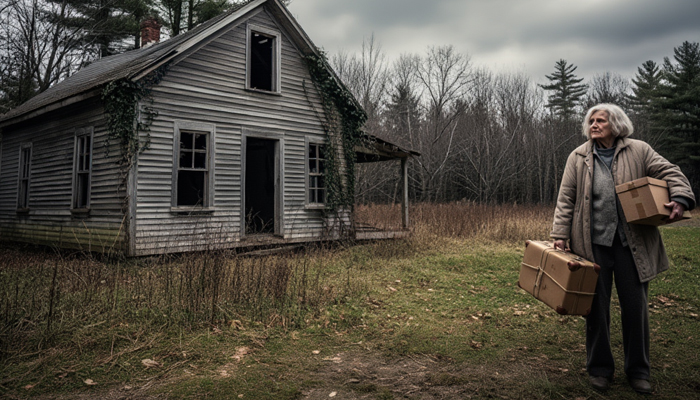
The day Margaret Hale turned seventy, her son handed her a suitcase.
It wasn’t wrapped.
There was no cake.
No celebration.
Just a quiet, uncomfortable silence hanging in the hallway as she stood there, staring at the worn leather case at her feet.
“I think it’s time,” Daniel said, not quite meeting her eyes.
Margaret blinked.
“Time for what?” she asked gently.
Daniel sighed, rubbing the back of his neck. “Mom… we’ve talked about this. The house is small. The kids need space. And… you can’t really take care of yourself like before.”
Margaret looked past him, into the living room she had helped pay for, decorate, and maintain for years.
Her grandson’s toys were scattered across the floor.
Her daughter-in-law stood near the kitchen doorway, arms crossed, avoiding her gaze.
“I cook. I clean. I stay out of the way,” Margaret said quietly. “What exactly am I not taking care of?”
“It’s not about that,” Daniel replied, his voice tightening. “It’s just… it’s better this way.”
Better.
Such a simple word.
Such a cruel one.
Margaret nodded slowly.
She didn’t argue.
Didn’t beg.
Because something inside her—something that had been bending for years—finally stopped.
“Alright,” she said.
She picked up the suitcase.
And walked out.
—
She had nowhere to go.
Not really.
No savings worth mentioning. No close friends left nearby. Just a small monthly check and a lifetime of memories she suddenly had no place to keep.
For the first two nights, she stayed at a cheap roadside motel.
On the third morning, she sat on the edge of the bed, staring at the peeling wallpaper.
“Seventy years,” she murmured. “And this is where I end up?”
The words stung.
But they also stirred something else.
Defiance.
Margaret stood up.
“No,” she said firmly. “This is not how it ends.”
The idea came from a flyer.
Taped crookedly to a bulletin board outside a small-town diner.
“Property Auction — Starting at $5.”
Margaret almost laughed when she saw it.
Five dollars?
That couldn’t be serious.
But something made her tear off the bottom strip with the address anyway.
“What’s the worst that could happen?” she muttered.
—
The house looked worse than she expected.
Much worse.
It leaned slightly to one side, like it had given up trying to stand straight. The paint was long gone, the wood weathered and gray. Several windows were broken, and the front porch sagged dangerously.
Weeds had claimed the yard.
The roof…
Well, parts of it were barely there.
A small group of people stood nearby, shaking their heads.
“Place should be torn down,” one man said.
“Not worth the land it’s on,” another added.
Margaret walked closer.
The door hung crooked on its hinges.
The inside was dark, hollow, forgotten.
But as she stepped across the threshold, something strange happened.
She didn’t see ruin.
She saw possibility.
The light filtering through the broken roof.
The open space.
The quiet.
It wasn’t dead.
It was waiting.
—
“Five dollars,” the auctioneer said with a shrug. “Anyone?”
No one spoke.
Margaret raised her hand.
“I’ll take it.”
A few people laughed.
But the auctioneer just nodded.
“Sold.”
—
That night, Margaret stood in her new home.
If you could call it that.
The wind slipped through the cracks, whispering through the empty rooms. The floor creaked under her feet.
She set her suitcase down in the center of what used to be the living room.
“Well,” she said softly, “it’s just you and me now.”
The house didn’t answer.
But somehow…
It didn’t feel lonely.
—
The first week was brutal.
Margaret cleaned.
And cleaned.
And cleaned.
Dust, debris, broken glass—she cleared it all with her own two hands.
Her back ached.
Her knees protested.
But she didn’t stop.
“You’re not done yet,” she told herself every morning.
“You don’t get to quit now.”
She patched what she could.
Boarded up windows.
Used old scrap wood to reinforce weak spots.
It wasn’t pretty.
But it held.
—
People noticed.
At first, they just drove by slowly, curious.
Then one afternoon, a young man stopped.
“You actually living here?” he asked.
Margaret wiped sweat from her forehead.
“I am.”
He looked around, skeptical.
“You know this place is falling apart, right?”
Margaret smiled faintly.
“So was I,” she said. “But I’m still here.”
The man didn’t laugh.
Instead, he nodded slowly.
“Name’s Tom,” he said. “I’ve got some spare tools. Might help.”
Margaret’s eyes softened.
“Well, Tom,” she said, “I won’t say no to that.”
—
That’s how it started.
One person.
Then another.
A woman brought extra blankets.
Someone else dropped off old paint.
A retired carpenter offered advice—and later, his time.
Margaret never asked for help.
But she didn’t refuse it either.
And slowly…
The broken house began to change.
—
Weeks turned into months.
The roof was repaired.
The walls were strengthened.
Windows replaced.
The porch rebuilt.
It wasn’t perfect.
But it was alive again.
And so was Margaret.
She moved differently now.
Stronger.
Lighter.
Like each nail she hammered, each board she lifted, was putting something back together inside her too.
—
One evening, as the sun dipped low, Margaret sat on the newly rebuilt porch.
Tom joined her, handing her a glass of lemonade.
“Didn’t think you’d pull it off,” he admitted.
Margaret chuckled.
“Neither did I.”
They sat in comfortable silence for a moment.
Then Tom asked, “What are you gonna do with it now?”
Margaret looked out at the yard.
At the people who had helped her.
At the place that had given her something she didn’t know she needed.
“I’m not keeping it just for me,” she said.
Tom raised an eyebrow.
“No?”
She shook her head.
“There are others,” she said slowly. “People like me. People with nowhere to go.”
Tom leaned back, thoughtful.
“You thinking what I think you’re thinking?”
Margaret smiled.
“I think so.”
—
They called it The Second Chance House.
It wasn’t fancy.
It wasn’t big.
But it was open.
For anyone who needed a place to land.
A place to rest.
A place to start again.
Margaret ran it with quiet strength.
She didn’t ask for stories.
Didn’t demand explanations.
Just offered what she had once needed most:
A door that opened.
—
Months later, a car pulled up outside.
Margaret was tending to the small garden when she saw him step out.
Daniel.
Her son.
He looked older.
Tired.
Ashamed.
For a moment, neither of them moved.
Then he walked toward her slowly.
“Mom…” he started, his voice breaking.
Margaret straightened, wiping her hands on her apron.
“You look well,” she said calmly.
Daniel glanced at the house.
At the people moving inside.
At the life she had built.
“I heard about this place,” he said. “I didn’t believe it at first.”
Margaret said nothing.
“I was wrong,” he added quietly. “About everything.”
The words hung in the air.
Heavy.
Real.
Margaret studied him.
This was the moment.
The one most people would dream about.
An apology.
Regret.
Vindication.
But she didn’t feel triumphant.
She felt… peaceful.
“You made a choice,” she said gently. “So did I.”
Daniel nodded, swallowing hard.
“Is there any way I can fix this?”
Margaret looked past him, at the house behind her.
At the people inside who now called it home.
Then back at her son.
“You can start by understanding something,” she said.
He waited.
“You didn’t throw me away,” she continued. “You set me free.”
Daniel blinked, stunned.
Margaret smiled softly.
“And I built something better with it.”
—
That night, the porch was full.
Laughter echoed through the air.
Warmth spilled from every window.
Margaret sat in her chair, watching it all.
Seventy years old.
Kicked out with nothing but a suitcase.
And yet…
She had never felt richer.
Because sometimes…
Losing everything isn’t the end of your story.
Sometimes—
It’s the beginning of the one that changes everything.
Kicked Out at 70, an Elderly Woman Bought a Broken House for $5 — What It Became Changed Everything!
Part 2
The first summer at The Second Chance House was louder than Margaret expected.
Not noisy in the way of chaos.
But alive.
Doors opening and closing. Laughter spilling into the yard. The clatter of dishes, the murmur of late-night conversations, the quiet footsteps of people who were slowly learning how to belong somewhere again.
Margaret sat on the porch one morning, a cup of coffee warming her hands, watching as a young woman struggled to hang freshly washed sheets on a line that leaned slightly to the left.
“Pull it tighter,” Margaret called out.
“I am!” the girl laughed, wrestling with the clothespins.
Margaret shook her head, smiling.
“Not like that. Come here—I’ll show you.”
The girl jogged over, cheeks flushed, hair tied back in a messy knot.
Her name was Lila.
Twenty-two. Recently out of a bad relationship, with nowhere else to go.
Now she was here.
Learning how to hang laundry like it mattered.
Because here…
It did.
—
By the end of that summer, the house was full.
Not just of people.
But of stories.
A man who had lost his job and everything with it.
A mother trying to rebuild her life with her son.
A veteran who hadn’t spoken much when he arrived—but now sat outside every evening, watching the sunset like it meant something again.
Margaret didn’t ask them to share.
But they did anyway.
Because something about the place made it safe.
—
It didn’t take long for word to spread.
What started as a curiosity became something else entirely.
Cars began pulling up more often.
Some people just wanted to see it.
Others…
Needed it.
One afternoon, a woman stood at the edge of the property, hesitant, clutching a worn bag to her chest.
Margaret noticed her immediately.
She always did.
“You don’t have to stand out there,” Margaret said, walking toward her.
The woman looked startled.
“I—I wasn’t sure if—”
“You are,” Margaret said gently. “If you need to be.”
The woman’s eyes filled with tears.
And just like that…
Another life stepped through the door.
—
But not everyone was happy about it.
Change rarely comes without resistance.
One evening, as Margaret finished setting the table for dinner, Tom walked in with a look she hadn’t seen in months.
Tight.
Concerned.
“What is it?” she asked.
Tom leaned against the doorway.
“Town council had a meeting,” he said. “About this place.”
Margaret didn’t react immediately.
“What about it?”
“They’re saying it’s getting too big. Too many people coming in. Too much… attention.”
Margaret set a plate down carefully.
“And?”
Tom hesitated.
“They’re talking about shutting it down.”
The words landed quietly.
But they hit hard.
—
That night, Margaret didn’t sleep.
She sat in the kitchen long after everyone had gone to bed, staring at the walls she had rebuilt with her own hands.
The house had started as something personal.
Something small.
But it had become more than that.
It had become necessary.
And now…
Someone wanted to take that away.
“Not again,” she whispered.
Because she recognized the feeling.
Being told she didn’t belong.
Being pushed out.
Only this time…
It wasn’t just her.
—
The meeting was scheduled for the following afternoon.
Margaret didn’t dress up.
Didn’t prepare a speech.
She simply showed up.
The room fell quiet when she walked in.
Not out of disrespect.
But something else.
Something closer to… anticipation.
Sheriff Dalton—older now, quieter—gave her a small nod from the side of the room.
Margaret returned it.
Then she waited.
—
“We’re not saying what you’re doing is wrong,” one council member began. “But it’s becoming… complicated.”
“How?” Margaret asked calmly.
“More people means more responsibility. More risk. What if something goes wrong? What if someone gets hurt?”
Margaret tilted her head slightly.
“People are already getting hurt,” she said. “That’s why they come here.”
A murmur moved through the room.
Another council member spoke up.
“This isn’t a proper shelter. There are no regulations, no oversight—”
“There’s care,” Margaret interrupted gently. “There’s food. There’s safety. Sometimes that’s more than people have anywhere else.”
“And what happens when you can’t handle it anymore?” the man pressed.
Margaret paused.
That was a fair question.
She was seventy.
The work wasn’t easy.
The responsibility wasn’t small.
But she didn’t look away.
“Then someone else will,” she said.
The room stilled.
“Because this place…” she continued, “…isn’t just mine anymore.”
—
Before anyone could respond, a voice came from the back.
“She’s right.”
Heads turned.
Lila stepped forward.
Then Tom.
Then another.
And another.
People from the house.
People from the town.
One by one, they spoke.
“She gave me a place when I had nothing.”
“She didn’t ask who I was—just what I needed.”
“She saved my life.”
The room shifted.
Not loudly.
But undeniably.
Because this wasn’t just a building anymore.
It was a community.
—
By the end of the meeting, no official decision was made.
But something had changed.
The resistance wasn’t gone.
But it was quieter.
Less certain.
Because now…
They weren’t just arguing against an idea.
They were standing in front of proof.
—
Weeks passed.
The tension eased.
And instead of shutting it down…
Something unexpected happened.
The town started helping.
Not all at once.
Not dramatically.
But slowly.
Donations came in.
Supplies.
Volunteers.
Even the council, reluctantly at first, began discussing ways to support the house instead of stopping it.
Margaret watched it all unfold with quiet disbelief.
“You did this,” Tom said one evening.
Margaret shook her head.
“No,” she replied. “They did.”
—
One crisp autumn morning, Margaret stood in the yard, watching as a new section of the house took shape.
An addition.
More rooms.
More space.
More chances.
She felt the weight of her years in her bones—but not as a burden.
As a reminder.
Of everything she had lived through.
Everything she had lost.
And everything she had built back.
Footsteps approached behind her.
Daniel.
He had been coming by more often.
Helping.
Not trying to fix the past.
Just… being present.
“I brought more lumber,” he said.
Margaret smiled faintly.
“Good. We’ll need it.”
He hesitated.
Then asked, “Do you ever regret it?”
Margaret glanced at him.
“Regret what?”
“Not fighting to stay,” he said. “Back then.”
Margaret looked out at the house.
At the people.
At the life that wouldn’t exist if things had gone differently.
“No,” she said softly.
Then she met his eyes.
“Because if I had stayed… none of this would’ve happened.”
Daniel nodded slowly.
Understanding, finally settling in.
—
That evening, the porch was full again.
Voices overlapping.
Laughter rising.
The warm glow of lights spilling into the night.
Margaret sat in her chair, the same one she had placed there months ago when the house was still barely standing.
Only now…
Everything was different.
She wasn’t just surviving anymore.
She was leading something.
Building something.
Leaving something behind.
Seventy years old.
Once unwanted.
Now irreplaceable.
Margaret Hale leaned back, listening to the life around her.
And for the first time in a long time…
She didn’t wonder what came next.
Because she already knew.
It would be more doors opening.
More lives changing.
More second chances.
And it all started…
With five dollars—
And the courage to begin again.