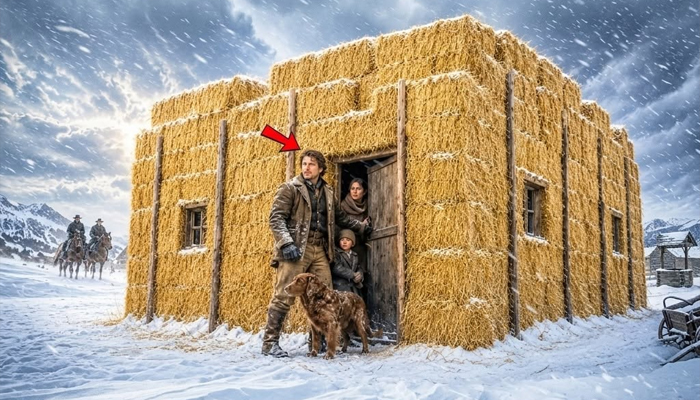
The winter of 1887 arrived early on the northern plains of Montana Territory.
The old-timers claimed they had never seen the sky turn that color before.
It was a hard steel gray, heavy and silent, stretching from one horizon to the other like a giant iron lid pressing down on the world.
Most settlers ignored the warning.
They had survived storms before.
They would survive another.
But one man wasn’t willing to gamble with his family’s life.
His name was Ethan Walker.
At thirty-eight, Ethan had already buried too many dreams beneath prairie snow.
He had lost crops to drought.
Lost cattle to disease.
Lost two fingers to a frozen fence post during the winter of 1883.
What he had never lost was his stubbornness.
And that stubbornness was exactly why the neighbors laughed when he started building his house from straw bales.
“You’ve finally lost your mind, Walker!”
The words echoed across the settlement one cold October afternoon.
A group of ranchers stood beside their horses, watching Ethan stack giant golden bales into thick walls.
The speaker was Caleb Morris, owner of the largest cattle operation within fifty miles.
Caleb spat tobacco into the snow.
“A wolf could sneeze and blow that thing down.”
The other men laughed.
Ethan didn’t.
He simply adjusted his leather gloves and lifted another bale into place.
His wife Sarah stood nearby holding their six-year-old daughter Emma’s hand.
Sarah’s cheeks were red from the cold wind, but she trusted her husband.
That wasn’t always easy.
When Ethan first explained his idea months earlier, she had stared at him as though he were proposing to build a castle from hay.
“A house made of straw?” she had asked.
Ethan smiled.
“Not straw. Straw bales.”
“What’s the difference?”
“A lot.”
That evening he spread books and farming journals across their table.
Settlers farther west had begun experimenting with bale construction.
The walls were thick.
They trapped heat.
They cost almost nothing.
And most importantly, they could withstand brutal winters better than many wooden cabins.
Sarah remained skeptical.
But Ethan’s arguments made sense.
Lumber was expensive.
Stone was difficult to transport.
The prairie offered one resource in abundance.
Straw.
Months later, the strange structure stood completed.
The cabin looked unlike anything else in the territory.
Golden-yellow walls nearly two feet thick rose from a sturdy timber foundation.
Heavy wooden posts reinforced every corner.
A strong roof rested atop massive beams.
Small windows minimized heat loss.
The neighbors laughed even harder.
Children called it the “hay fort.”
Travelers slowed their wagons to stare.
One man actually asked if Ethan planned to keep horses inside.
Ethan ignored them all.
Winter was coming.
And winter didn’t care about opinions.
By late November, snow covered the prairie.
The world transformed into an endless ocean of white.
Inside the straw-bale cabin, however, warmth lingered.
A small wood stove heated the entire structure.
The thick walls trapped every ounce of warmth.
Sarah noticed the difference immediately.
Their previous cabin had always been drafty.
Cold air slipped through cracks.
Frost formed on interior walls.
Some mornings they woke to ice inside the windows.
Not anymore.
Now the cabin remained cozy long after the fire died down.
Even little Emma noticed.
“It feels like a blanket,” she told her father one evening.
Ethan smiled.
“That’s exactly what these walls are.”
The family settled into a comfortable routine.
Snow fell.
The wind howled.
Yet inside their unusual home, life remained peaceful.
Then came January.
And with it came the blizzard.
The storm announced itself three days before arrival.
Animals sensed it first.
Birds vanished.
Coyotes disappeared into hidden dens.
Even the horses became nervous.
On the morning before the storm, Ethan stood outside studying the horizon.
The western sky looked wrong.
Dark.
Angry.
Moving.
He tightened every shutter.
Secured every roof beam.
Stocked extra firewood beside the stove.
Filled every water barrel.
Sarah watched him through the window.
“You think it’s going to be bad?”
Ethan’s expression remained serious.
“Worse than bad.”
That night nobody slept well.
The wind arrived shortly after midnight.
By dawn it sounded like a thousand screaming spirits racing across the prairie.
Snow struck the cabin walls in endless waves.
Visibility dropped to almost nothing.
The world beyond the windows disappeared.
Inside, Emma curled beside the stove with their faithful Irish Setter, Rusty.
The dog’s rich auburn coat glowed in the firelight.
He rarely left the child’s side.
Sarah prepared breakfast while Ethan checked every corner of the house.
Everything remained solid.
No drafts.
No shifting walls.
No leaks.
The storm intensified throughout the day.
By evening, snowdrifts reached halfway up the windows.
The wind screamed louder.
And louder.
And louder.
Then came a knock.
Three sharp blows against the door.
Everyone froze.
No one should have been outside.
Not in this weather.
Ethan grabbed his rifle and approached carefully.
Another knock.
“We need help!”
The voice barely carried through the storm.
Ethan opened the door.
A blast of snow exploded into the cabin.
Standing outside were two horsemen nearly buried in ice.
One was Caleb Morris.
The man who had mocked the cabin more than anyone.
The other rancher looked even worse.
His face was pale.
His beard coated in frost.
Their horses trembled violently.
Caleb’s pride had clearly suffered.
But survival mattered more.
“Our house roof collapsed,” he shouted over the wind.
“We’ve got families trapped.”
Ethan didn’t hesitate.
“Bring them.”
Caleb blinked.
“Bring who?”
“Everyone.”
The rancher stared at him.
“There are twelve people.”
Ethan looked back at the thick walls surrounding them.
The warm air.
The sturdy roof.
Then he faced Caleb again.
“Bring everyone.”
For a moment, Caleb couldn’t speak.
Months of ridicule hung heavily between them.
Yet Ethan offered help without resentment.
Without hesitation.
Without conditions.
The two horsemen disappeared into the storm.
Sarah moved immediately.
Preparing blankets.
Cooking extra food.
Making space.
The cabin might be small, but nobody would be left outside.
Hours later the refugees arrived.
Men.
Women.
Children.
Faces red from cold.
Eyes wide with fear.
Snow coated their clothing.
One little boy was crying.
Another woman carried an infant wrapped beneath layers of blankets.
As the families entered, they expected chaos.
Crowding.
Cold.
Discomfort.
Instead they found warmth.
Real warmth.
The thick straw walls trapped heat so effectively that the temperature remained comfortable despite the raging storm outside.
People removed gloves.
Then coats.
Then scarves.
Disbelief spread across every face.
One man touched the wall.
“It’s actually warm.”
Another shook his head.
“I don’t understand.”
Caleb stood silently near the door.
He looked around the cabin.
At the smiling children.
At the sturdy walls.
At Ethan.
Outside, the greatest blizzard anyone could remember continued to bury the prairie.
Inside the house everyone once mocked, life remained safe.
For the first time, Caleb realized something.
Maybe Ethan Walker hadn’t been crazy.
Maybe he had simply been right.
And before the storm was over, the entire settlement would learn just how right he truly was…
Part 2
The blizzard showed no mercy.
For three straight days, the wind battered the prairie with a fury that seemed almost supernatural. Snow drifted higher than wagon wheels. Fence lines vanished. Barn roofs disappeared beneath mountains of white.
Inside Ethan Walker’s straw-bale cabin, sixteen people now shared the space.
Normally, such a crowd would have turned any frontier home into an uncomfortable nightmare.
Yet somehow, the cabin remained warm.
The thick straw walls held the heat like a giant insulated blanket. The small stove burned steadily, consuming far less wood than anyone expected.
The settlers couldn’t stop talking about it.
Each morning, someone would place a hand against the inside wall.
Each morning, they would shake their head in amazement.
“It’s warmer in here than my house was before the storm,” one rancher admitted.
His wife nodded.
“I thought straw belonged in barns.”
Sarah smiled.
“So did I.”
The mood lightened slightly, but danger remained.
Every few hours, Ethan forced the door open to check conditions.
The snowdrifts continued to rise.
At times, the wind was so strong he could barely remain standing.
One afternoon, as he struggled against the storm outside, Rusty suddenly began barking.
Not his usual bark.
A sharp, urgent warning.
The Irish Setter raced toward the door.
Then back.
Then toward the door again.
Ethan immediately noticed.
Rusty was trying to tell him something.
The dog had spent years helping track lost cattle.
His instincts were rarely wrong.
“What is it, boy?”
Rusty barked again.
Then scratched frantically at the door.
The cabin grew silent.
Everyone watched.
Ethan exchanged a glance with Sarah.
“I think somebody’s out there.”
The statement sent a chill through the room despite the warmth.
Nobody should have been outside.
Not anymore.
Not after three days of blizzard conditions.
Yet Rusty wouldn’t stop barking.
Finally Ethan grabbed a lantern, wrapped a scarf around his face, and opened the door.
The wind slammed into him immediately.
Visibility was almost zero.
The world had become a swirling white wall.
Rusty bolted forward.
“Ethan!” Sarah called.
But he was already following the dog.
The snow reached his thighs.
Each step required enormous effort.
Rusty disappeared into the blowing snow and reappeared moments later.
Then disappeared again.
The dog was tracking something.
Or someone.
Ethan pushed forward.
Ten yards.
Twenty.
Thirty.
Then he saw it.
A dark shape half-buried in a drift.
His heart sank.
A man.
Frozen motionless.
For a terrifying moment Ethan thought he was dead.
Then the figure moved.
Barely.
Ethan rushed forward.
The man was unconscious but alive.
Nearby, another shape emerged beneath the snow.
A woman.
And beside her—
A child.
No older than eight.
The family had likely become lost while trying to reach shelter.
Another hour outside would have killed them.
Ethan lifted the child first.
Then shouted toward the cabin.
The wind carried little sound.
But Caleb Morris had been watching from the doorway.
Within minutes, several men joined the rescue effort.
Together they dragged the survivors back through the storm.
Inside the cabin, Sarah and the other women sprang into action.
Blankets.
Hot broth.
Dry clothing.
Warm stones wrapped in cloth.
Everything possible was done.
Hours later, the little girl opened her eyes.
Then her mother.
The father regained consciousness near midnight.
His name was Thomas Reed.
He had been traveling from a distant settlement when the blizzard struck.
They had become lost two days earlier.
Thomas looked around the crowded room in confusion.
Then he noticed the straw walls.
“What kind of place is this?”
Laughter erupted throughout the cabin.
The first genuine laughter anyone had shared in days.
“A miracle,” Caleb answered quietly.
Everyone turned toward him.
The wealthy rancher stood beside the stove.
His weathered face looked older than usual.
More humble.
More thoughtful.
Finally he faced Ethan.
“I owe you an apology.”
The room became silent.
Caleb Morris wasn’t a man known for apologies.
Months earlier he had mocked Ethan openly.
Repeatedly.
Now dozens of witnesses listened carefully.
Caleb swallowed.
“I called you crazy.”
Ethan shrugged.
“You weren’t the only one.”
“I laughed at this cabin.”
“So did everyone.”
Caleb looked around the room.
At the warm walls.
The sleeping children.
The families who were alive because of this strange house.
Then he shook his head.
“Looks like the fool was me.”
Nobody spoke.
Then Ethan smiled.
“We’re all still learning.”
The tension dissolved instantly.
Even Caleb laughed.
Outside, however, the storm continued.
And the worst was still coming.
That night a tremendous crash echoed through the darkness.
The sound resembled cannon fire.
Everyone jumped awake.
Another crash followed.
Then another.
Ethan knew immediately what it was.
Roof collapses.
Buildings across the prairie were failing beneath the enormous weight of snow.
By dawn, the storm finally began weakening.
The wind slowed.
The snowfall lessened.
For the first time in days, pale sunlight filtered through the clouds.
When Ethan opened the door, the sight stunned everyone.
The landscape was unrecognizable.
Snowdrifts towered twelve feet high in places.
Entire fences had vanished.
Barns looked like white hills.
Some houses were completely buried.
The settlers stared in disbelief.
Several men climbed onto the roof to survey the area.
What they saw confirmed their fears.
The settlement had suffered devastating damage.
Two barns had collapsed.
Several sheds were destroyed.
One ranch house had lost most of its roof.
Another cabin had partially caved in.
But Ethan’s straw-bale house stood untouched.
The walls remained solid.
The roof remained straight.
The structure looked almost exactly as it had before the storm.
Word spread quickly.
Over the next several days, settlers dug pathways through the snow.
As travel became possible again, people came to see the famous cabin for themselves.
Many arrived expecting exaggeration.
Instead they found proof.
Proof that a simple idea had succeeded where traditional methods had failed.
The visitors examined every detail.
The thick walls.
The timber supports.
The insulated windows.
The reinforced roof.
Questions filled the air.
“How much did it cost?”
“How long did it take?”
“Would you help me build one?”
Ethan answered them all patiently.
He never mentioned the ridicule.
Never reminded anyone how often they had mocked him.
The storm had already delivered that lesson.
One afternoon, nearly two weeks after the blizzard, Caleb arrived with a wagon.
The bed overflowed with lumber, tools, and supplies.
Ethan met him outside.
“What’s all this?”
Caleb climbed down.
“A thank-you.”
“You don’t owe me anything.”
“I disagree.”
Caleb glanced toward the cabin.
“My wife and children are alive because of you.”
“Ethan—”
“No.”
Caleb interrupted firmly.
“You opened your door when nobody else could.”
His voice softened.
“You saved more than one family.”
For a moment neither man spoke.
Then Caleb extended his hand.
Ethan shook it.
A simple gesture.
But on the frontier, it meant everything.
Spring eventually returned.
The snow melted.
Grass reappeared.
Life resumed.
Yet the settlement had changed.
The straw-bale cabin no longer inspired laughter.
It inspired respect.
That summer, three new straw-bale homes appeared on neighboring properties.
The following year, seven more were built.
Within five years, the design had spread across much of the territory.
Travelers passing through often stopped to ask about the unusual homes.
And every time, someone would tell the same story.
The story of the great blizzard.
The story of the families who survived.
The story of the man who trusted his judgment when everyone else doubted him.
Years later, when Emma Walker was grown and had children of her own, she would sit beside the fireplace and tell them about that winter.
She would describe the howling wind.
The endless snow.
The frightened families crowded together for warmth.
And she would always finish the story the same way.
“People laughed because something was different,” she would say.
“But being different isn’t the same as being wrong.”
Then she would smile toward the old family photograph hanging above the mantel.
A photograph of Ethan, Sarah, herself, and faithful Rusty standing proudly before a golden straw-bale cabin in the snow.
The house that everyone mocked.
The house that saved them all.
And the lesson the frontier never forgot:
Sometimes the strongest shelter is the one nobody believes in—until the storm arrives.