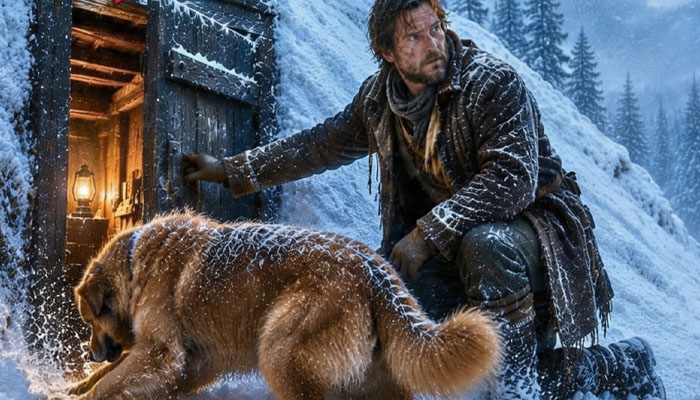
The first storm of winter came over Pine Kettle Ridge like it had been waiting for a death in the Reed family.
It moved down from the high Wyoming country before dawn, swallowing the upper timber first, then the rock cuts, then the hay meadows below the old farmhouse. By noon the sky had turned the color of dirty wool. By dusk the wind was throwing snow sideways so hard it sounded like gravel striking the window glass.
Tobias Reed stood in the kitchen with his hat in his hands and the smell of cold ashes in the stove.
The room had not changed much since his father died, and somehow that made it worse. The same long table stood under the same low beam. The same coffee tin sat near the stove. His father’s heavy coat still hung from the peg by the back door, sleeves empty, shoulders sagging as though the old man had only stepped outside to check the stock and would be back any minute.
But Eli Reed was buried beneath frozen ground behind the little church in Black Hollow, and nobody in that kitchen spoke his name.
Marla Reed sat at the table with a stack of papers before her. She was a narrow woman with sharp cheekbones and a mouth that never seemed to rest easy. Tobias had known her since he was fifteen, since his father married her after his mother’s fever took her in a bad spring. Marla had never beaten him, never starved him, never done anything a neighbor could point to and call wicked. She had simply made sure, year after year, that Tobias knew he was not truly hers.
Now she held the deed papers in one hand and tapped their edge on the table.
“You heard me,” she said. “Your father never put your name on the land.”
Tobias looked at the papers, then at the window, where snow stuck to the glass in trembling white clumps.
“I fixed the north barn,” he said quietly. “I dug the drainage trench after the creek flooded. I cut cedar for this house every winter since I was sixteen.”
“I didn’t say you didn’t work.”
“You’re selling the south field.”
“It’s mine to sell.”
“My mother’s ashes are under the cottonwood.”
Marla’s eyes lifted then, and something almost like discomfort passed across her face. It was gone in a breath.
“Your mother has nothing to do with the deed.”
Outside, Brindle gave a low growl.
The dog lay near Tobias’s boots, an old brindled shepherd mix with gray on his muzzle and a scar down one ear from a coyote fight years earlier. Brindle had belonged to Tobias since both of them were half-grown and stubborn. He had followed Tobias through lambing nights, fence repairs, creek crossings, and every hard winter the ridge had thrown at them. Now the dog watched Marla with his head low and his eyes bright.
Marla glanced at him.
“You can take the dog,” she said. “I don’t want him worrying the chickens.”
Tobias’s jaw tightened.
From the next room came the faint clink of glass. Marla’s cousin Vernon had been staying at the farm since the funeral, sleeping in Tobias’s old room and talking too freely about which cattle would bring the best price in March. He stepped into the kitchen now with a bottle in his hand and a red flush across his nose.
“Best go before it gets worse,” Vernon said. “Road’ll be mean by nightfall.”
Tobias looked at him. “You wearing my father’s boots?”
Vernon looked down, almost amused. “He ain’t using them.”
For a moment, Tobias did not move. Something old and hot rose in him, not anger alone, but grief sharpened into a blade. He saw his father in those boots, standing in the barn doorway with snow melting on his shoulders. He saw his father’s hands teaching him to cut a mortise, set a brace, read the weather by the smell of the wind. He saw the man coughing blood into a rag and still trying to climb the barn ladder because winter was coming and the roof had to hold.
Then Tobias looked at Marla, and he understood that nothing he said would make this kitchen remember him.
Marla pushed a flour sack across the table. It was not full. Beside it she placed a rolled blanket and a strip of salt pork wrapped in paper.
“That’s fair,” she said. “You’re grown. Black Hollow’s got boarding rooms. Maybe Nolan Price can find you work.”
The storm hit the side of the house so hard the walls creaked.
Tobias picked up the sack.
“You locking me out in this?”
Marla would not meet his eyes. “I’m not keeping a grown man who has no claim here.”
Vernon stepped closer to the stove, warming his hands over a fire Tobias had built that morning.
“That old man spoiled you,” he said. “Made you think labor was the same as ownership.”
Tobias turned toward him.
Brindle rose.
For half a second, the kitchen became so still Tobias could hear sleet crawling against the window seam. Vernon’s smirk loosened. Marla’s hand moved toward the table edge.
Tobias said nothing. That was how his father had taught him to survive men who wanted him to spend his strength foolishly. Don’t throw your heat at a cold world unless it buys you something.
He tied the blanket over his shoulder, tucked the food sack under one arm, and reached for his coat. It was not his warmest coat. That one hung in the mudroom, and Vernon had likely already claimed it. The coat Tobias wore had patched elbows, a torn cuff, and seams that let wind through when the weather turned bitter.
Brindle pressed against his leg.
At the door, Tobias paused and looked once more at the house.
He had set the stone under the stove after the old floor sagged. He had replaced the cracked window glass after a hailstorm. He had made the shelves where Marla now kept her preserves. He had smoothed the table edge with his own plane after his father cut his hand on a splinter. Every corner of that house knew the shape of his labor.
None of it spoke for him.
He opened the door.
The cold hit him with such force it took his breath.
Behind him, Marla said, “Tobias.”
He turned.
For one fragile moment, he thought she might soften. He hated himself for wanting it.
She held out a small tin cup. “Take this. For water.”
He stared at it, then took it.
“Thank you,” he said, because his father had raised him with manners even when the world gave him none.
He stepped onto the porch with Brindle at his side. The yard was already disappearing. Snow blew across the ground in white ribbons, hiding the wheel ruts, the chopped woodpile, the path to the barn. Somewhere inside the storm, the cattle bawled uneasily.
Tobias looked toward the barn, instinct pulling him there. He wanted to check the latch, make sure the hayloft door was tied, make sure the old brindle cow had dry bedding. Then the door behind him closed.
The bolt slid into place.
The sound was small, but in the cold it carried like a verdict.
Brindle barked once at the door.
“Leave it,” Tobias said.
His voice came out rougher than he meant.
He took the porch steps carefully. Already snow had drifted over the bottom one. The wind shoved at him from the west, trying to turn him sideways, trying to drive him toward the cattle shed and the familiar dark shapes of home. He pulled his hat low and started down the road toward Black Hollow.
Fourteen miles.
In fall weather, with a wagon and a steady horse, it was nothing. A man could leave after breakfast and be in town before the afternoon shadows stretched. But winter changed distance. Winter took a mile and made it five. Winter filled ditches, erased roads, turned familiar land into a white deceit.
Tobias knew that. He had lived long enough in hard country to know that pride killed almost as many men as cold.
Still, he walked.
The first mile was anger.
He used it like fuel. He pictured Vernon’s feet in his father’s boots. He pictured Marla’s flat voice, the way she had said no claim, as though twelve years of labor meant less than ink on a page. He pictured the south field sold to strangers, timber rights traded, cattle driven off, the farmhouse changed board by board until there was nothing left of Eli Reed but a name on a stone.
The second mile was pain.
Snow found the gap between his collar and scarf. Meltwater seeped through the cracked leather of his left boot. His fingers numbed inside his gloves. The sack of cornmeal grew heavier against his hip. Wind scraped the breath from his mouth before he could use it.
Brindle trotted ahead, then fell back, then stopped altogether.
Tobias turned. “Come on, boy.”
The dog was not looking down the road.
He faced the western ridge.
The limestone hill beyond the pines stood half-hidden behind curtains of blowing snow. It was rough country there, full of old rock shelves, sinkholes, bent timber, and gullies that could break an ankle under a foot of powder. Nobody used that way in winter unless they had no sense.
Brindle whined.
“Road’s this way.”
The dog took three steps toward the ridge and pulled at the rope Tobias had tied to his collar.
“No.”
Brindle pulled harder.
Tobias swore under his breath, not at the dog but at the storm, the road, the cold settling into his bones. He looked ahead. The road south had nearly vanished. Only the faint depression between fence lines showed where it had been. Beyond that, open fields stretched white and exposed all the way toward the creek crossing.
The wind there had room to run.
Near the ridge, the pines broke it.
Tobias wiped ice from his lashes. He tried to think past the cold. The dog was old, but not foolish. Brindle had once smelled a cougar before Tobias saw the tracks. He had dragged Tobias away from a rotten creek bank two seconds before it collapsed. He knew weather in his own way, through pressure and scent and vibrations no man could name.
Tobias looked back toward the farm.
The house was gone. Not distant. Gone. Snow had swallowed it completely.
A strange hollow opened in his chest.
“Fine,” he said.
Brindle’s ears lifted.
“Fine, you stubborn old sinner. Show me.”
They left the road.
The moment Tobias stepped into the field, snow rose nearly to his knees. Under it lay frozen stubble and hidden ruts. Twice he stumbled. Once he fell hard enough that his shoulder slammed into the ground and the cornmeal sack burst slightly at the seam. He shoved snow over the tear, tied it with a strip of cloth, and pushed himself up.
The ridge seemed to move farther away with every step.
By the time they reached the first pines, daylight had thinned to a dirty gray. Wind shrieked in the upper branches but struck weaker below. Tobias leaned against a trunk, panting. His legs trembled. His toes had passed from aching into something worse, a numb absence that frightened him.
Brindle nosed his hand.
“I know,” Tobias whispered. “I know.”
He wanted to sit down.
The thought came softly. Not as a decision. As comfort.
Just sit under the pine. Let the wind go over. Rest your legs. Close your eyes for a minute.
He stared at the hollow beneath a bent tree where the snow had not filled all the way in. It looked almost inviting, a small dark pocket in the white violence. He could crawl in there. He could pull the blanket around him. Just a minute.
Brindle lunged and bit his sleeve.
“Hey!”
The dog pulled backward, growling.
Pain flashed in Tobias’s arm where the teeth pinched through cloth. The shock cleared his mind. He looked again at the dark pocket under the pine, and this time he saw it for what it was.
A place men went to die quietly.
He staggered on.
They climbed.
The land rose beneath the pines in broken shelves of limestone buried under snow. Tobias used roots and trunks to pull himself upward. The wind came in bursts now, swirling between stone and trees, filling his ears, stealing direction. His breath rasped. Ice formed on his mustache. His father’s voice seemed to come and go with the storm.
Don’t stop where the cold wants you to stop.
Ahead, Brindle vanished behind a white mound.
Then the barking began.
Not frightened barking. Not warning barking.
Insistent. Furious. Commanding.
Tobias lifted his head.
“Brindle?”
The dog barked again and again.
Tobias forced himself toward the sound. He rounded a jut of rock and saw Brindle clawing at the side of the hill. At first there was nothing there but drifted snow and dead grass stiff with ice. The dog dug as if something alive were buried under it.
“Leave it,” Tobias said weakly.
Brindle ignored him.
Tobias took another step, and then he heard it.
A breath.
Not his. Not the dog’s.
A faint hollow pull beneath the storm, as though the hill itself were inhaling through clenched teeth.
Tobias froze.
He dropped to one knee and shoved his bare hand into the snow where Brindle had been digging. The cold burned his skin. He scraped until his fingers struck wood.
Not root.
Wood.
He dug harder. Snow came away in chunks. A blackened board emerged. Then another. Then the iron curve of a handle crusted with ice.
A door.
Tobias stared at it, unable for a moment to understand what his eyes were giving him.
The door was set into the hillside, nearly hidden beneath rock and drift, framed by old timbers dark with age. Iron straps crossed it. Moss and frozen dirt packed the seams. No trail led to it. No mark showed above. If Brindle had not heard or smelled whatever moved through the cracks, Tobias would have passed within yards of it and died under the trees.
His hands shook as he cleared the handle.
“Good boy,” he whispered.
Brindle whined, pressing close.
Tobias pulled.
The door did not move.
He braced one boot against the lower frame and pulled again. Something groaned inside the hill. The hinges fought him, then gave with a long, rusty complaint. A gap opened, and air slid out across his face.
Dry.
Not warm, exactly, but free of wind. Free of knives.
Tobias nearly wept.
He shoved the door wider, pushed Brindle through, then stumbled after him and dragged the heavy timber shut.
The storm died.
Not completely. It still existed beyond the door, pounding and screaming somewhere outside. But inside the hill, it became distant, muffled, robbed of its teeth.
Darkness closed around him.
Tobias fumbled for matches with fingers that barely worked. The first broke. The second sparked and failed. The third flared.
In the trembling light, stone steps descended into the earth.
Part 2
Tobias stood at the top of the stairs with the match burning down toward his fingers, and for a long moment fear held him still.
Men in mountain country knew better than to trust holes in the ground. Old mine shafts collapsed. Bear dens looked empty until they were not. Root cellars could trap bad air, snakes, rot, and death. The dark below him seemed too deep, too deliberate, as if it had been waiting for someone desperate enough to enter.
Then the match burned his thumb.
He hissed, shook it out, and struck another.
Brindle had already started down.
That decided him.
The dog’s nails clicked softly on stone steps. Tobias followed one careful foot at a time, one hand sliding along the wall. The passage smelled of old cedar, dry earth, faint smoke, and something else he could not name at first. Preservation. Human care. The scent of a place built not by accident but by intention.
The stairway turned once, then widened.
Tobias lifted the match.
The chamber revealed itself in pieces.
First the shelves.
They lined the walls from floor to ceiling, thick boards held by hand-cut braces. On them stood rows of jars, some cloudy with age, some still clear enough to show beans, carrots, stewed apples, pickled beets, and corn. Sacks of grain rested on raised stone blocks. Bundles of dried herbs hung upside down from ceiling beams. Salt pork dangled from iron hooks wrapped in cloth. Barrels sat sealed under waxed canvas. Potatoes lay packed in ash inside wooden crates.
Then the stove.
A small cast-iron box squatted at the center of the room, pipe rising into stone. Behind it stood a broad limestone slab, blackened in places by old heat. Beside the stove lay a stack of cedar split neat and dry beneath oilcloth.
Dry wood.
Tobias stared at it like a starving man seeing bread.
Brindle circled the room once, sniffed a corner, then sank down on the packed earth floor with a deep sigh. The dog’s whole body seemed to loosen. Snow melted slowly from his fur.
Tobias wanted to drop beside him. He wanted to close his eyes and let whatever would happen happen.
Instead, he forced himself to move.
“Fire first,” he whispered.
His father had said that often enough. When the world turns mean, do the first needful thing. Then the next.
He set the match aside in a cracked saucer near the stove and opened the firebox. Old ash lay inside, dry and gray. He ran his fingers along the pipe joint, checked the damper, looked upward into darkness. No smell of heavy creosote. No wet soot falling. Whoever had last used it had known what they were doing.
He laid cedar shavings, then kindling, then two thumb-thick sticks.
The match flame took. Fire caught with a hungry whisper.
For one blessed minute, the smoke rose clean into the pipe.
Then the chamber filled with it.
Tobias coughed hard, bending double. Brindle sprang up, barking toward the ceiling. Smoke rolled back in a dark sheet, spreading low at first, then gathering overhead. Tobias’s eyes watered. His lungs, already scraped raw by the storm, seized in protest.
“Damn it.”
He grabbed the lantern hanging from a peg, found oil in it by some miracle, and lit the wick. Smoke blurred the room. He climbed onto a crate, holding the lantern near the pipe where it entered the stone.
A bead of water slid down from above.
Blocked.
Snow must have sealed the outer vent.
Tobias spotted an iron rod hanging from a nail by the stove. He snatched it down, climbed higher, and shoved it up beside the pipe into a narrow draft shaft. Ice cracked somewhere above. He drove the rod again, harder. Something shifted. A clump of packed snow dropped down, striking his shoulder and exploding into powder.
A sudden cold breath rushed through the shaft.
The stove changed voice.
The smoke pulled upward.
Tobias stayed on the crate, coughing until his ribs hurt, watching the gray cloud thin and twist and vanish into the pipe. When he climbed down, his legs almost folded. He gripped the stove handle until pain from the warming iron forced him to let go.
“All right,” he said.
Brindle sneezed.
“All right, boy.”
The fire settled.
Heat came slowly. It did not leap across the room or wrap him in comfort. It gathered like a promise. First in the stove’s iron belly. Then in the stone behind it. Then in the air near Tobias’s hands. He removed his gloves and saw his fingers white and stiff. He held them near the heat, not too close, because he knew frozen flesh could be injured by greed.
Pain returned with warmth.
It came in sharp needles through his toes and fingers. He clenched his teeth and breathed through it. Tears ran down his face, though whether from smoke, pain, or grief, he could not have said.
He pulled off his boots.
Steam rose from the wet leather. His socks were soaked through, stiff in places where ice had formed. Two toes on his left foot looked pale and waxy. He rubbed them gently until feeling came back in punishing waves.
Brindle crawled closer and rested his head on Tobias’s knee.
“You saved us,” Tobias whispered.
The dog’s eyes closed.
Only after his hands steadied did Tobias allow himself to examine the food.
He chose carefully, ashamed though no one was there to judge him. A jar of beans. One strip of salt pork. A heel of hard rye bread wrapped in cloth. He opened the jar with his knife and smelled it. Good. Sour at the edge, but good. He warmed the beans in a small pot hanging beside the stove, added a sliver of pork, and waited until the smell filled the chamber.
It nearly broke him.
He had not realized how hungry he was until the food warmed. He ate slowly because he knew better than to shock an empty stomach. Brindle ate bits from Tobias’s hand, gentle despite his hunger.
The storm raged overhead. Sometimes Tobias heard it through the vent, a distant moan passing through the hill. But the door held. The walls held. The earth around him did not tremble.
After eating, he walked the chamber with the lantern.
The place was larger than he first thought. The main room led to two smaller storage alcoves. One held tools: a shovel, an axe head without a handle, wedges, a hand saw wrapped in oiled cloth, coils of rope, spare hinges, nails sorted into jars. The other held bedding: wool blankets, rolled canvas, sacks stuffed with straw, and a narrow cot made from pine poles.
On the rear wall someone had carved a cross.
Below it, a shelf held a ledger wrapped in canvas.
Tobias touched it but did not open it yet.
Not tonight.
Tonight he had only enough strength to survive the hours in front of him.
He barred the outer door from inside with a heavy timber set into iron brackets. He checked the corners for animal tracks and found none. He set his boots near the stove, turned his socks inside out, and wrapped his feet in a dry cloth he found among the bedding. Then he lay on the packed earth floor with Brindle against his side and the old blanket over them both.
He meant to stay awake and feed the fire.
Instead, sleep took him like a fall.
He dreamed of the farmhouse.
In the dream, his father stood in the barn with a lantern. Snow blew through cracks in the boards, but Eli Reed did not seem cold. He wore his old coat and the boots Vernon had taken, and he held a hammer in one hand.
“You got to brace from the inside,” his father said.
Tobias tried to answer, but his mouth filled with snow.
“You hear me?” Eli said. “Outside pushes. Inside holds.”
When Tobias woke, the stove was low but not out.
For a moment he did not know where he was. Darkness pressed close. Brindle breathed beside him. The room smelled of ash and cedar. Then memory returned all at once: Marla’s table, the road, the ridge, the door.
He sat up.
The chamber was cold, but not deadly. The water bucket near the wall had a thin skin of ice but had not frozen solid. His boots were damp but no longer dripping. The limestone behind the stove still held a faint warmth when he touched it.
Tobias stared at the stone.
Stable heat.
He added cedar to the coals and watched the flames climb. The stove breathed properly now. Smoke went where it should. The room brightened by slow degrees.
Above him, the storm continued.
He climbed the stairs to the door and listened. Wind hammered the other side. Snow scraped along the threshold like claws. He did not open it. Not yet.
Instead, he returned to the chamber and opened the ledger.
The first page bore a name written in thick pencil.
Silas Bracken.
The handwriting was blunt, slanted, practical. The early pages were not diary pages in any sentimental sense. They were records. Wood burned. Flour stored. Temperature outside. Temperature inside. Vent opened. Vent sealed. Moisture found behind barrel two. Potatoes better in ash. Beans lasted. Apples molded near warmth. Keep grain raised.
Tobias read for an hour, maybe more.
With each page, the shelter changed from a miracle into a lesson.
Silas Bracken had been no fool hiding from the world. He had been a freight station keeper in the old pass, back when wagons still crossed high country through weather that would humble any man. One winter, long before Tobias was born, a storm season had trapped the station for weeks. Men died in cabins they had thought stout. Food spoiled from damp. Firewood burned too fast. Horses froze. Roofs cracked. Heat escaped through every exposed wall.
After that, Silas stopped trusting walls.
He dug into the hill.
Tobias turned a page and found a sentence pressed so hard into the paper the pencil had nearly torn through.
Cabins fight winter on all sides. Earth gives winter only one door.
He read it three times.
Then he sat back and listened to the storm over his head.
The shelter was not luck. It was memory turned into timber and stone. It was grief made useful. Some man had survived something terrible and had refused to let the lesson die with him.
Tobias closed the ledger gently.
“Silas Bracken,” he said aloud.
Brindle lifted his head.
“I owe you.”
That afternoon, Tobias opened the outer door only a crack.
Wind slammed into it so hard his shoulder jolted. Snow poured through the gap. What little he saw outside looked nothing like land. The pines had become blurred black shapes in a moving wall of white. The path they had made was gone. The road was gone. The whole world had been erased.
He forced the door shut and barred it again.
His hands shook afterward, not from cold this time.
Had Brindle not pulled him away from the road, he would be dead.
He knew it with a certainty that settled deep and quiet. Not maybe. Not likely.
Dead.
He went back down into the earth, added wood to the stove, and sat with one hand on the dog’s back.
For the first time since his father’s funeral, Tobias let himself cry.
Not loudly. Not the way a child cries. The tears came without permission, running down his face while he stared into the stove and saw the farmhouse kitchen, the locked door, his father’s grave, the life he had worked for and never owned.
Brindle pressed closer.
Tobias wiped his face with his sleeve.
“All right,” he said at last. “We’re still here.”
The stove popped softly.
“We’re still here.”
Part 3
By the third day, Tobias stopped thinking of the shelter as a hiding place.
It was a living thing.
Not alive like Brindle, with breath and hunger and eyes that watched him from beside the stove, but alive in the way a good barn was alive, in the way a well-built house responded to weather. It needed care. It had moods. It warned him before it failed.
When the fire burned too hot for too long, moisture gathered on the rear beams. When he kept the door sealed too tightly, the air grew heavy and the flame dulled. When he opened the lower intake just enough, the stove burned clean and the chamber stayed dry. The shelter did not forgive laziness, but it rewarded attention.
Tobias knew that kind of arrangement. Most useful things in his life had been the same.
He made routines.
Morning: check the stove, shake ash, inspect vents. Feed Brindle. Eat small. Read Silas’s ledger. Walk the storage shelves and count what he took.
Midday: climb to the entrance, listen for shifts in wind, clear snow from the inside edge of the door when it pressed too hard against the frame. Repair what needed repairing. Move supplies away from damp.
Evening: bank the fire, check the drainage trench, lay his boots so the soles dried evenly and did not crack, rub Brindle’s paws, then read another few pages by lantern.
The old ledger became a second voice in the room.
Silas had written about mistakes in a way that made Tobias trust him. He did not pretend wisdom had come easy. One entry described nearly losing three sacks of flour because he stored them too close to a warm wall. Another admitted that he had sealed the vents during a cold snap and woke to smoke hanging low as fog. He had lost food, lost sleep, lost confidence, and kept correcting.
Tobias respected that more than if the man had sounded perfect.
On the fourth day, the shelter gave its first warning.
It came as a drop of water.
Small. Almost nothing.
Tobias heard it while sharpening his knife near the stove.
Tap.
He lifted his head.
Brindle was already staring toward the rear alcove.
Tap.
Tobias stood and carried the lantern to the storage shelves. Along one cedar beam near the ceiling, moisture had gathered in a dark line. Beneath it, on the dirt floor, two drops had fallen. He touched one of the rye sacks. The outer canvas felt cool and faintly damp.
His stomach tightened.
Food could die quietly. That was the danger. A man feared hunger when the shelves were empty, but rot could empty them while they still looked full.
He opened Silas’s ledger to the section on dampness and found the line he half-remembered.
Warm air without movement breeds ruin.
Tobias worked for hours.
He shifted the grain sacks onto higher blocks and moved them away from the warmest stone. He cleared the drainage trench where dirt had slumped into it. He chipped ice from the lower intake shaft using the iron rod, careful not to widen it too much. He let the stove burn lower and cleaner. He hung the damp canvas near moving air but not near heat, turning it every so often.
By morning, the beam was dry.
He slept only an hour that night, but he woke satisfied.
“See?” he told Brindle. “A house tells you what it needs if you stop thinking you’re smarter than it.”
Brindle thumped his tail once.
On the fifth night, the knocking came.
At first Tobias thought it was ice shifting outside the door. The storm had been making new sounds all day. Deep thuds. Squeals through the vent. A scraping noise like a shovel dragged over stone.
Then it came again.
Three uneven strikes.
Brindle stood. The fur along his spine lifted.
Tobias took the lantern and climbed the stairs.
“Who’s there?” he called.
For a moment, only wind answered.
Then a voice, so thin he almost missed it.
“Help.”
He lifted the bar.
The storm struck like a living thing. The door flew inward six inches before Tobias caught it with his shoulder. Snow blasted across his face, blinding him. In the white beyond the threshold stood two figures.
Mrs. Elowen Pike leaned against the frame with one arm wrapped around her granddaughter Clara.
Tobias knew them from Black Hollow. Mrs. Pike sewed shirts, mended coats, and kept a little garden behind her cabin. She was a widow with silver hair usually pinned so neatly it looked painted in place. Now her hair hung frozen around her face. Clara, eight years old and small for her age, sagged against her grandmother, eyes half-closed, lips blue.
“We saw smoke,” Mrs. Pike whispered. “Please.”
Tobias grabbed Clara first.
She weighed almost nothing.
He pulled them inside, shoved the door shut, dropped the bar, and half-carried the child down to the chamber. Mrs. Pike stumbled after him, one hand on the wall, weeping without sound.
“Near the stove, but not too close,” Tobias said.
His voice had changed. It had become the voice he used with injured stock, calm because panic would only scare what was already hurt.
He peeled Clara’s mittens away. The wool cracked with ice. Her fingers were pale and stiff. He wrapped her hands in a dry cloth and held them near his own chest before moving them gradually toward warmth.
Mrs. Pike sat on the floor, shaking so badly her teeth clicked.
“Our roof split,” she said. “Middle of the night. Snow came into the bed. I tried to get to Nolan’s place, but the road—”
“Don’t talk yet.”
“I thought she was gone.”
“She ain’t gone.”
Clara made a small sound.
Mrs. Pike covered her mouth.
Tobias warmed water in a tin cup and added a little sugar from Silas’s stores. He gave Clara drops at first, then a sip. Brindle came close and lay against the girl’s legs, offering his body heat with the grave patience of old dogs.
The child’s eyes fluttered open.
“Dog,” she whispered.
“That’s Brindle,” Tobias said.
Clara’s fingers twitched under the cloth.
Mrs. Pike bowed over her knees and sobbed then. Not loud. Not dramatic. Just the broken sound of a woman who had been holding terror back with both hands and could finally let it fall.
“What is this place?” she asked after a while.
Tobias looked around at the shelves, the stove, the old beams, the darkness beyond the lantern glow.
“Somebody’s answer to winter,” he said.
By morning, Clara could sit up.
By noon, Mrs. Pike was helping sort blankets.
By night, there came more knocking.
A trapper named Amos Vail arrived with frostbitten ears and a pack of half-wet pelts. He had lost his cabin stove when the pipe backed up with snow and filled the room with smoke. Tobias pulled him inside, cursed him for traveling alone, then wrapped his ears and fed him beans.
After Amos came the Caldwell couple from Lower Creek, Ruth and Henry, with their youngest boy wrapped in a quilt. Their roof had not failed, but their firewood had. Green pine smoked more than it burned. Their well had frozen. Their flour had taken damp and turned sour.
Then came two brothers who had tried to reach town and turned back.
Then a mother with a baby.
Then Deputy Nolan Price.
Nolan arrived near midnight on the eighth night of the storm. Tobias heard the horses first, or thought he did, a dull stamping beyond the door. When he opened it, Nolan stood bent against the wind, snow crusted over his hat brim and beard. Behind him, two horses trembled with ice in their manes.
“My wife,” Nolan said. “She’s coughing blood.”
Tobias did not ask questions.
They brought her in wrapped in blankets, a woman named Sarah Price, normally strong-faced and sharp-eyed, now gray around the mouth. Her breathing rattled. Tobias gave Nolan a place near the warmest wall but kept Sarah raised slightly, not flat, the way he remembered his father had needed during the lung fever.
Nolan looked around the chamber as though he had stepped into a different law of nature.
“I heard talk,” he said. “Thought folks were exaggerating.”
“They weren’t.”
“This is a root cellar?”
“Bigger.”
Nolan pressed his hand to the limestone behind the stove. He left it there.
“Lord,” he murmured. “This stone’s still warm.”
“It holds heat.”
“My cabin won’t hold heat ten minutes with the wind on it.”
Tobias said nothing.
Nolan turned and looked at him fully then. In town, the deputy had always been kind enough but distant. He had known the Reed family’s affairs the way all small towns knew private things without admitting it. He had come to Eli’s funeral. He had shaken Tobias’s hand. He had not asked where Tobias would go after.
Now his eyes moved over Tobias’s hollow cheeks, the patched coat, the burned thumb, the frost marks on his hands.
“I heard Marla put you out,” Nolan said quietly.
Tobias fed a cedar split into the stove.
“Storm put me here.”
“That ain’t what I said.”
“No.”
The fire caught the new wood.
Nolan lowered his voice. “Your father would have been ashamed.”
Tobias looked at him.
The deputy’s face tightened. “Not of you.”
For a moment Tobias could not answer. He busied himself with the damper, though it needed no adjusting.
By the tenth day, the shelter held seventeen people.
That was too many for comfort, but comfort had no authority there. Survival did.
Tobias set rules because rules were kinder than confusion.
Wet coats stayed near the entrance tunnel. No one opened preserves without marking the count on a board. Children slept farthest from the door. The sick stayed near warmth but not in the path of smoke. Firewood was rationed. Nobody fed the stove because they felt cold unless Tobias or Mrs. Pike checked the vents first. Waste went into covered buckets and was carried only when the wind eased enough to open the outer door safely. Every person who could stand took a task.
At first, a few men bristled.
Amos Vail grumbled that he had lived in trapping shacks since before Tobias had whiskers. Henry Caldwell muttered that no carpenter’s boy needed to tell him how to build a fire. Nolan silenced that with one look.
“This carpenter’s boy is why your children are breathing,” the deputy said.
After that, the grumbling softened.
Tobias did not enjoy authority. It sat on him uneasily. But he understood systems. A farm failed when small jobs were ignored. A shelter full of frightened people would fail faster. He watched the place constantly, listened to it, smelled it, felt it through his boots.
He knew when the air grew stale.
He knew when too many wet socks hung near the food shelves.
He knew when fear began to spread faster than cold.
At night, he read Silas Bracken’s ledger aloud.
People listened.
Maybe because the storm outside made them hungry for any voice that sounded certain. Maybe because Silas had written the truth plainly. He wrote about losing men in the Blue Star Winter. About cabins that looked strong until the weather proved otherwise. About learning that more fire did not always mean more safety. About the strange mercy of earth, which changed slowly when the sky went mad.
Clara liked the entries about the horses, though Tobias skipped the worst parts.
Mrs. Pike mended torn gloves by lantern.
Nolan sat with Sarah’s hand in his, eyes closed but not sleeping.
Brindle moved from person to person, accepting scraps, offering warmth, keeping watch near the entrance when the wind changed.
One night, after Tobias finished reading, Amos Vail spoke from his blanket near the wall.
“Man who built this was a genius.”
Tobias closed the ledger. “No.”
Amos frowned. “No?”
“He was a man who paid attention after suffering.”
The chamber went quiet.
Tobias looked at the stove. “That’s different.”
Part 4
The storm lasted long enough to change people.
Not all at once. Nothing honest happened all at once in winter.
It changed them by wearing away the unnecessary parts.
Pride went first. Men who had boasted about their cabins stopped boasting when they saw their children sleep without shivering underground. Women who had apologized for needing help stopped apologizing after the third night, when they understood everyone there needed something. Children who had cried for home began drawing shapes in the dirt floor with sticks, making little towns and roads and barns beneath the lantern light.
Tobias changed too, though he did not notice it at first.
His grief grew quieter.
It did not leave. It settled. Like ash under a stove grate, still hot if disturbed, but no longer filling the whole room with smoke. He could think of his father without losing breath. He could remember Marla’s locked door and not feel only humiliation. The shelter had given him work, and work had always been the way Tobias kept from breaking.
Sarah Price’s cough worsened on the twelfth day, then eased on the fifteenth.
That morning Nolan sat against the limestone wall with his head bowed, both hands covering his face. Tobias thought at first he was praying. Then he heard the man laugh once, a cracked, disbelieving sound.
“She asked for coffee,” Nolan said.
Sarah, pale but awake, looked toward Tobias. “I heard there was coffee.”
“There’s roasted chicory,” Mrs. Pike said. “Close enough for the dying and the grateful.”
Sarah smiled weakly. It was the first smile Tobias had seen from her since Nolan carried her in.
That same day, Henry Caldwell and Amos Vail helped Tobias widen the rear drainage trench. Melt from somewhere higher in the hill had begun to seep near the back alcove, and if it reached the grain stores, half their food could spoil. The men worked on hands and knees, scraping packed earth into buckets.
Amos wiped sweat from his forehead. “Never thought I’d sweat during a blizzard.”
“Don’t get proud,” Tobias said. “You’re still ugly.”
Henry laughed.
The sound startled everyone, then spread. Even Tobias smiled.
But hardship had a way of reminding them laughter did not cancel danger.
On the seventeenth night, the main vent froze.
It happened during the deepest cold yet. The fire had been burning steady. People slept. Tobias, sitting awake near the stove because something in the draft had bothered him, noticed the flame turn lazy and orange.
Then smoke curled from the stove seam.
He stood immediately.
“Wake up,” he said.
Nobody moved fast enough.
“Wake up now.”
Nolan rose, grabbing his coat. Mrs. Pike snatched Clara from sleep. Smoke thickened near the ceiling.
Tobias grabbed the iron rod and climbed onto crates beneath the vent. He drove the rod upward. It struck solid ice. He hit again. Nothing. Smoke pushed lower. A baby began crying. Sarah coughed hard, and Nolan cursed.
“Door,” Tobias said. “Open the lower door just a crack. Not wide.”
Henry ran up the stairs.
The moment the outer door opened, wind screamed through the passage. Cold rushed down like floodwater. People cried out. Blankets lifted. The fire flared, then sputtered.
Tobias slammed the rod upward again.
Ice cracked but did not clear.
He thought of Silas’s pages. Draft needs path. Air must enter and leave. Heat without breath becomes poison.
He looked at the old tool alcove.
“Amos. Axe handle.”
“There ain’t one.”
“Make one.”
Amos understood. He seized a broken shovel shaft and jammed it into the axe head, tying it fast with rope while Tobias kept stabbing the vent with the rod. Smoke burned Tobias’s eyes. His lungs screamed.
Amos handed up the crude axe.
Tobias climbed higher, braced one foot on a shelf post, and chopped at the ice where the vent narrowed into stone. Chunks fell. One struck his cheek and split the skin. He kept chopping. Cold air blasted down through the gap, then stopped again.
“Again,” Nolan shouted.
Tobias swung with everything he had.
The blockage gave.
A roar of air tore through the shaft. Smoke bent upward, streaming into the dark. The stove drew so hard the fire brightened blue at the base.
Tobias clung to the shelf, trembling.
Below him, people coughed and wrapped blankets tighter. Henry shoved the outer door closed. The chamber, robbed of heat, felt suddenly brutal. But the air was clean.
Tobias climbed down and nearly fell.
Nolan caught him.
Blood ran from Tobias’s cheek to his jaw.
“You all right?” Nolan asked.
Tobias nodded, though he was not sure.
Clara began to cry.
Not from fear now, but because she had seen Tobias bleeding.
He knelt beside her. “It’s just a scratch.”
“No, it ain’t.”
“Well,” he said, touching the cut and looking at the blood on his fingers. “Maybe a confident scratch.”
She laughed through tears.
Mrs. Pike cleaned the wound with warm water and tied it with cloth. Her hands were gentle but firm. “You scared us.”
“Vent scared me worse.”
“You talk about that vent like it’s a mule with bad habits.”
“It is.”
Later, when the room had warmed again and the children slept, Nolan sat beside Tobias near the stove.
“I went to the Reed place before I came here,” the deputy said.
Tobias did not look at him.
“When?”
“Day before I found you. Marla wouldn’t open the door at first. Vernon did. Wearing Eli’s coat.”
The fire popped.
Nolan continued, quieter. “I asked if you were there. Marla said you’d gone to town. Said you left on your own.”
“I did leave on my own feet.”
“That ain’t the same.”
Tobias rubbed Brindle’s ear. The dog slept with his nose under his tail.
Nolan leaned forward, elbows on knees. “There may be witnesses who heard your father speak about the land.”
Tobias frowned. “Speaking ain’t signing.”
“No. But fraud is fraud. Coercion is coercion. And a widow selling stock before estate matters are settled may have to answer questions.”
Tobias turned then. “Why are you telling me this?”
“Because when this storm breaks, Marla is going to find Black Hollow has been talking.”
Tobias felt no triumph. Only weariness.
“I don’t want a fight.”
“I know.”
“I wanted my father to do right by me before he died.”
Nolan’s face softened. “Sometimes dead men leave messes they never meant to leave.”
That hurt because it was merciful.
Tobias looked away.
“My father loved that farm,” he said. “Loved it like a man can love land after bleeding into it. I thought maybe that meant it loved us back.”
Nolan shook his head. “Land don’t love. People do. Or they don’t.”
The words settled between them.
Over the next week, the storm began to loosen, then returned, then loosened again. The world above remained dangerous, but not unreachable in brief windows. Tobias and Nolan made cautious trips to nearby cabins when the wind dropped, tied together by rope, Brindle leading when visibility failed.
They found homes half-buried.
They found doors frozen shut, chimneys blocked, sheds collapsed under white weight. They found one cabin empty, chairs overturned, stove cold, no note. At another, they found an old man alive only because he had burned every chair he owned and then the table legs. They brought him back on a sled.
They also passed the Reed farm once.
Tobias had not meant to go near it. The route to the Miller cabin cut along the lower fence line, and through the storm haze the farmhouse appeared like a dark ship trapped in ice.
Smoke rose from the chimney.
So they were alive.
The barn roof sagged where Tobias had warned his father it would need another brace by spring. One section of fence had gone down. Cattle tracks wandered in confusion near the yard.
Tobias stopped.
Brindle stood beside him, staring.
Nolan watched him carefully. “We don’t have to.”
Tobias’s gloved hand tightened on the rope.
From the house, a figure came onto the porch.
Marla.
Even at a distance, Tobias knew the way she held herself, wrapped tight against the world. She saw him. For a moment, neither moved. Snow blew between them in long white veils.
Then Vernon stepped out behind her, wearing Eli’s coat.
Brindle growled.
Tobias turned away.
“Tobias,” Nolan said.
“She has a stove,” Tobias replied. “She has walls. She has the wood I cut.”
He started walking.
The choice did not feel good. It felt necessary.
That night, back in the shelter, he said nothing about the farm. But Mrs. Pike knew. Perhaps Nolan told her. Perhaps grief had a smell.
She sat beside Tobias after most had gone to sleep.
“I was married thirty-one years,” she said. “Buried my Samuel in soil so dry the shovel sparked on stone. For a long time I was angry he left me.”
Tobias looked at her. “Did that pass?”
“No.” She threaded a needle by lantern light. “It changed shape.”
He watched her mend a child’s mitten.
“Some people take what they’re given and make shelter,” she said. “Some take what isn’t theirs and still stay cold.”
Tobias swallowed.
Mrs. Pike tied off the thread. “Don’t let their cold become yours.”
Part 5
The thaw began with dripping.
Not sunshine. Not birds. Not any gentle thing.
Just water.
It ticked from the vent shaft. It slid down the outer door. It ran in narrow lines along the limestone outside and gathered beneath the pines. After weeks of hearing the world roar, the people in the shelter woke one morning to a sound so small it seemed impossible.
Drip.
Drip.
Drip.
Clara was the first to laugh.
“It’s melting,” she said.
No one cheered. They had lived too long under the hill to trust relief quickly. But faces changed. Shoulders lowered. Men climbed to the door and opened it wider than they had dared in weeks. Cold air entered, but not killing cold. It smelled of wet bark, snowmelt, and distant smoke.
The valley emerged slowly.
Black Hollow looked wounded.
Fences lay flat. Roofs sagged. Woodpiles had vanished. Smoke rose from fewer chimneys than it should have. The road existed only as a guess beneath frozen ruts and dirty snow. But people were moving. Small dark figures crossed white fields with shovels, axes, buckets, ropes. Life, stubborn and battered, had come back above ground.
The shelter emptied in stages.
Nobody wanted to leave all at once. They had come in as frightened pieces of separate households and come out knowing one another’s breathing in the dark. Mrs. Pike hugged Tobias so hard his ribs ached. Clara kissed Brindle on his gray muzzle and whispered that he was the best dog in Wyoming. Amos Vail left two pelts “for the household,” though there was no household, not officially. Henry Caldwell promised labor whenever Tobias needed it. Sarah Price, still weak but standing, pressed Tobias’s hand between both of hers.
“You gave Nolan back to me,” she said.
Tobias shook his head. “He carried you.”
“You opened the door.”
That stayed with him.
When the last families had gone, the chamber seemed enormous and lonely.
Tobias walked the shelves. The stores were lower, yes, but not ruined. The grain remained dry. The potatoes had held. The stove still worked. The vents breathed. Silas Bracken’s shelter had survived not because it had hidden from winter, but because it had understood winter better than prideful men did.
Nolan returned three days later with a folded paper and a grim look.
“Marla Reed filed a complaint,” he said.
Tobias was repairing a hinge on the outer door. He did not stop. “Against who?”
“You.”
That made him look up.
Nolan’s mouth twisted. “Claims you stole preserved goods, trespassed on old Bracken land, and lured townspeople into an unsafe structure.”
For a moment, Tobias only stared. Then he laughed once, not with humor.
“She put me out into a blizzard.”
“Yes.”
“And now she says I’m unsafe.”
“Yes.”
Brindle, lying in the weak sun, opened one eye as if even he found it foolish.
Nolan unfolded the paper. “There’s more. She’s also trying to sell the Reed south field before probate review.”
Tobias wiped his hands on his pants. “Can she?”
“She thought she could.”
The deputy looked toward the hill, then back at Tobias.
“Judge Harlan is coming from Casper next week. Weather slowed everything. He’ll hold hearings in Black Hollow. I think you need to be there.”
“I’ve got no money for lawyers.”
“You’ve got witnesses.”
The hearing took place in the church hall because the courthouse roof had cracked under snow load.
Nearly half of Black Hollow came.
Tobias stood near the back at first, hat in his hands, feeling more exposed than he ever had in the storm. He could face wind. He could face hunger. But rooms full of eyes were another kind of weather.
Marla sat near the front in a black dress, her mouth set hard. Vernon sat beside her wearing a coat that was not Eli’s this time. That was something. His face had gone sallow since the storm. One of his hands was bandaged. Tobias later heard he had lost two fingers to frostbite while trying to bring cattle in after a gate latch froze.
Judge Harlan was a heavy man with tired eyes and a gray beard stained by pipe smoke. He listened more than he spoke.
Marla gave her account first.
Tobias had left voluntarily, she said. He had always been restless. Eli Reed had provided for him well enough. The farm was hers by legal right. Whatever happened after Tobias left was unfortunate, but not her doing. As for the shelter, she had heard wild stories and believed stolen supplies were involved.
Judge Harlan looked over his spectacles. “You gave him provisions?”
“A fair amount.”
“How much?”
Marla hesitated. “Some meal. Pork. A blanket.”
“In a blizzard?”
“The storm had not fully come in.”
A murmur moved through the hall.
Then Mrs. Pike stood.
She did not shout. She did not accuse with a shaking finger. She simply told the truth in her seamstress voice, clean and precise. She described finding the shelter. Tobias pulling Clara inside. The child’s frozen gloves. The rationing. The rules. The warmth. The way the food had been counted, not squandered.
Then Nolan spoke.
He described carrying Sarah in. He described the blocked vent Tobias cleared at risk to himself. He described cabins failing across the valley. He described the Reed farm when he passed it, stocked with wood Tobias had cut.
Henry Caldwell spoke next. Amos too. Sarah, though Nolan tried to keep her seated, stood long enough to say, “My husband wears a badge. Tobias Reed saved him from becoming a widower.”
Finally Judge Harlan turned to Tobias.
“Mr. Reed, did you know the shelter existed before the storm?”
“No, sir.”
“How did you find it?”
Tobias looked down at Brindle, who had been allowed inside only because Clara cried until the judge relented.
“My dog heard it breathing.”
A ripple of quiet laughter moved through the hall.
The judge did not laugh. “And after finding it, you used its stores?”
“Yes, sir.”
“To feed yourself?”
“And anyone who knocked.”
“Did you claim ownership?”
“No, sir.”
“Did you prevent anyone from leaving?”
“No.”
“Did you maintain the shelter?”
“Yes.”
“How?”
Tobias told him.
At first he felt foolish speaking of vents, drainage, raised barrels, condensation, and heat held in stone before a judge. But as he spoke, the hall quieted. These were things Black Hollow understood now. Not theory. Not fancy talk. Survival written in practical terms.
When he finished, Judge Harlan sat back.
Nolan then produced one more item.
Silas Bracken’s ledger.
Tobias stiffened. He had not known Nolan brought it.
The judge opened the ledger carefully. Several pages in, a folded document slipped free. It had been tucked into the back cover, so brittle Tobias had never dared handle it much. Nolan had found it while helping Tobias wrap the ledger for transport.
Judge Harlan read it in silence.
Then he read it again.
“What is it?” Marla demanded.
The judge looked over the paper. “A land transfer.”
The hall stirred.
Harlan continued. “From Silas Bracken to Eli Reed’s father, Matthew Reed. Payment recorded in labor and winter provisions, dated forty-one years ago. The limestone ridge and shelter parcel were joined to the Reed holding but never entered into the newer household deed when boundaries were redrawn.”
Tobias felt the room tilt slightly.
The judge looked at him. “Mr. Reed, did your father ever speak of Bracken land?”
“No, sir. Never.”
Nolan’s eyes narrowed thoughtfully. “Eli may not have known.”
“Possible,” the judge said. “Old transfers were often poorly copied.”
Marla’s face had gone pale.
Judge Harlan placed the document on the table. “This shelter, it seems, sits on Reed family land. Not the farmhouse parcel currently under dispute, but an older attached parcel never properly dissolved.”
Vernon leaned toward Marla, whispering. She shoved him away.
The judge was not finished.
“As for the farm, I will not settle inheritance today. That requires review. But I will issue an injunction preventing sale of fields, timber rights, livestock, or equipment until the estate is examined. I will also appoint Deputy Price to inventory remaining assets.”
Marla stood. “Your Honor, that land is mine.”
Harlan’s eyes cooled. “Madam, what is yours will remain yours. What is not will not become yours because snow slowed the court.”
A sound moved through the hall. Not applause. Black Hollow was too hard a place for that. But it was something close. A release of breath held too long.
Tobias did not feel victory the way he had imagined men might.
He felt grief loosen its hand by one finger.
After the hearing, Marla approached him outside.
The day was bright and cruelly clear. Sun flashed on snowbanks. Meltwater dripped from the church eaves. Brindle stood between them without growling.
Marla looked smaller in daylight.
“Your father should have written things down,” she said.
Tobias studied her face. He saw bitterness there, but also fear. The storm had taken something from her too. Not enough to excuse her. Enough to make her human.
“Yes,” he said. “He should have.”
“I didn’t think it would get that bad.”
He knew she meant the storm. He also knew she meant the door.
Tobias looked toward the ridge in the distance.
“You didn’t think about it after the bolt turned.”
Her mouth tightened.
For one moment he thought she might apologize. Perhaps she even tried. But pride rose in her like a wall.
“I did what I had to do,” she said.
Tobias nodded slowly.
“So did I.”
He walked away before she could answer.
Spring came late but steady.
The Reed farm remained tied in legal review for months. In the end, the farmhouse and near fields stayed with Marla under widow’s right, but the south field, timber strip, and old Bracken ridge parcel were recognized as belonging partly to Tobias through his father’s family line and unpaid labor claims witnessed by half the valley. It was not everything. It was enough.
Tobias did not move back into the farmhouse.
He built near the hill.
Not inside the shelter, but above and beside it, where pines broke the wind and the limestone held morning sun. Men came to help without being asked. Henry Caldwell brought beams from a collapsed shed. Amos brought pelts and meat. Nolan hauled salvaged window frames. Mrs. Pike sewed curtains from flour sacks and old blue cloth. Clara painted a crooked sign that read Brindle House, though Tobias protested until everyone ignored him.
The cabin Tobias built was modest and smart.
Low roof. Thick chinking. A mudroom for wet clothes. A stone-lined root cellar cut deep into the slope. Vents placed where Silas would have approved. Storage shelves raised from the floor. A stove backed by limestone. No grand walls trying to impress winter. No wasted space for cold to own.
The hidden shelter remained below, cleaned and restocked.
Not as Tobias’s private refuge.
As Black Hollow’s.
They made rules for it in town meeting. Every household that could spare food contributed jars, grain, salt, coffee, lamp oil, blankets, or firewood. Tobias kept the ledger. Nolan kept the key, though everyone knew Brindle could find the door faster than any man. Children learned where the vents were. Men who once laughed at underground rooms dug deeper cellars. Women taught one another how to seal sacks against damp. Black Hollow changed not because it loved change, but because winter had made denial expensive.
One evening in early summer, Tobias stood outside the shelter door with Silas Bracken’s ledger under one arm.
The world smelled of wet grass and pine sap. Snow still crowned the high peaks, but the valley below had gone green. Brindle lay in the shade, muzzle white now, eyes half-closed. From Tobias’s new cabin came the sound of Clara laughing as Mrs. Pike scolded her for tracking mud indoors. Sarah Price was in the garden with a shawl over her shoulders, alive and complaining that Nolan planted beans too close together.
Tobias looked toward the old Reed farm.
From that distance, it seemed almost peaceful. A square house. A barn. Fields waiting for work. He felt the ache of it still, but it no longer owned him.
Nolan came to stand beside him.
“Judge sent the final papers,” he said. “Ridge is yours clear.”
Tobias nodded.
“You all right?”
Tobias smiled faintly. “People ask that when they don’t know what else to say.”
“That’s true.”
“I’m not all right the way I was before.”
“No one is.”
Tobias looked down at Brindle.
The old dog opened one eye.
“But I’m standing,” Tobias said.
Nolan followed his gaze to the shelter door. “More than standing.”
Below them, the earth held its cool, steady breath. Behind the old timbers waited shelves, tools, blankets, food, and the memory of a dead man named Silas who had turned suffering into shelter. Above it stood the new cabin of a man who had been cast out with a torn coat, a little meal, and a dog who refused to obey the road.
Tobias knelt and scratched Brindle behind the ear.
“You knew,” he said.
Brindle thumped his tail once, as if accepting what had always been obvious.
The sun lowered behind Pine Kettle Ridge. Gold light moved across the grass, touched the shelter door, and warmed the dark iron handle.
Tobias stood there until evening settled.
He thought of his father’s voice from the dream.
Outside pushes. Inside holds.
For a long time, Tobias had believed a home was something given by deed, blood, or permission. Something another person could lock behind you.
Now he knew better.
A home was what held when the storm came.
A home was what you kept alive with your own hands.
And sometimes, when the road disappeared and every familiar light went out behind you, it was hidden in the side of a frozen hill, waiting for one faithful dog to bark you back from death.