Skip to content

Pets n Tales

Hope You Enjoy!

Menu
  • Pets
  • Tales
  • Showbiz
  • Sports
  • Interesting
  • Blogs
Menu
The wind had not started yet. That was what troubled Opal Sheridan most. The Judith Basin lay still beneath a pale November sky, wide and brown and waiting. The grass had gone brittle weeks ago. Frost silvered the shaded places along the fence lines. Far to the west, the mountains stood with snow on their shoulders, white and solemn as old judges. Opal stood on a low ridge above the cabin she had built with her own hands. Her cabin. At least it had been that morning. A cloth sack hung from her shoulder. Inside were two wool dresses, a pair of patched stockings, a tin cup, a small Bible with her mother’s name written in it, a skinning knife, a handful of matches wrapped in oilcloth, and three biscuits gone hard around the edges. That was all Cora had allowed her to take before Virgil stepped onto the porch with Sam’s old rifle crooked in his arm and told her it was time to stop making things difficult. Difficult. Opal had stared at him when he said it. She had survived a spring flood that took half their seed potatoes. She had buried a stillborn son under a cottonwood tree because the ground was too frozen near the house. She had nursed her husband through fever, hunger, and a cough that turned his handkerchief red. She had split wood with bleeding palms, hauled water through sleet, and pulled calves from mud at two in the morning with coyotes crying beyond the lantern light. And Virgil called her difficult. Behind her, smoke drifted from the chimney in a thin, steady line. Cora would be standing inside by the stove, pretending she had not cried earlier. Cora cried easily when she wanted to feel innocent. She had cried when she told Opal that a woman alone could not hold land properly. She had cried when she said Virgil had already spoken to the county clerk in Lewistown. She had cried when she said Sam would have wanted family to make use of the place. Opal had not cried. Not until she saw Cora wearing Sam’s old sheepskin coat. Then something in her had gone quiet. She did not turn around now. If she looked back, she might see the cabin door open. She might see the patched roof Sam had promised to fix before winter took him. She might see the barn wall she had raised plank by plank while he joked that she swung a hammer straighter than any man in Meagher County. If she looked back, she might remember too clearly how a person could become unwanted in a single morning. So she kept walking. The ground crackled under her boots as she descended the ridge. Her right heel had worn thin, and the cold climbed through it with every step. She crossed the dry creek bed below the cabin and climbed toward the open prairie. No wagon tracks followed. No voice called after her. That hurt more than the rifle. The strange silence of the land pressed around her. Most people would have gone north toward Fort Benton or east toward the settlement at Utica. There would be churches there, charity rooms, kitchens where widows stood in line for soup while women with full cupboards judged the dirt on their hems. There might be work washing laundry or mending shirts. There might be a cot in some back room beside women who whispered at night because sorrow had made them afraid of their own voices. Opal wanted none of it. She was thirty-nine years old, though the mirror had been calling her older since Sam died. Her hair, once dark gold, had dulled to the color of winter wheat. Her hands were rough and strong. Her face had grown lean from grief. She had no children living, no husband, no deed anyone respected, and no coin but the wedding ring on her finger. But she still had memory. Three miles west of the homestead, beyond a sweep of buffalo grass and sage, stood a line of sandstone cliffs. Most settlers treated them as nothing more than weathered rock, a place for rattlesnakes in summer and drifting snow in winter. Months earlier, while searching for a stray goat, Opal had found a deep cave tucked into the stone, its entrance half hidden by brush and shadow. She had stood inside only a minute then. But she remembered the feeling. No wind. No creaking boards. No weak roof to fail under snow. Just stone. Her grandmother’s voice returned as she walked. Old Anya, who had crossed the ocean from a mountain village in Eastern Europe with two dresses and a scar across one eyebrow, had once shown Opal a cave when Opal was a girl. It had been in another country, another life, before Montana, before marriage, before hunger taught her what pride cost. “Wood freezes,” Grandmother Anya had said, pressing Opal’s small hand against the rock. “Earth remembers warmth.” Opal had not understood then. She understood now. By late afternoon, the temperature dropped hard. The prairie shadows stretched long and blue. Her sack grew heavier with every mile. The biscuits in it knocked against the tin cup, a hollow little sound that made her think of empty kitchens. A hawk circled high above the basin. It rode the air without effort, patient and watchful. Opal stopped and looked up at it. “The land tells you how to survive,” her grandmother used to say, “if you stop talking long enough to listen.” The hawk turned once, twice, then drifted toward the sandstone cliffs. Opal followed. The sun touched the horizon by the time she reached the rocks. The cliffs glowed orange in the fading light, their faces cut by cracks and shallow hollows. She moved along them slowly, her breath clouding white. One opening was too low. Another faced north, directly into the worst wind. Another was damp and smelled of animals. Then she found it. The cave entrance sat behind a cluster of scrub cedar and tall grass bent by frost. It was wider than she remembered, the stone arch sloping inward like a shoulder turned against the weather. She pushed through the brush and stepped inside. The change was immediate. Outside, the cold gnawed through her dress and coat. Inside, the air held steady. Not warm exactly, but still. The cave ran deeper than the light reached, opening into a wide back chamber with a floor of hard-packed earth and stone. Her footsteps echoed softly. No bed. No food. No fire. No door. Yet Opal stood in that dark hollow and felt the tight band around her chest ease for the first time since Sam’s funeral. No one could throw her out of stone. No sister could weep over it and claim she was doing right. No man could stand on its porch with a rifle and call it his. Outside, coyotes began calling somewhere far below. Opal sat with her back against the wall and pulled her coat tight. The rock behind her felt ancient and unmoved by human meanness. Her stomach cramped with hunger. Her body ached. Darkness slowly filled the mouth of the cave. She watched the last strip of daylight fade across the prairie. The first snowflakes of the season drifted down, light and soundless. Opal Sheridan closed her hand around the wedding ring on her finger and made a decision. She would not go to town. She would not beg Cora for mercy. She would not die in a ditch before winter. If winter wanted her, it would have to come into the stone and fight for her. Part 2 The first night in the cave was the longest night Opal had ever known. Cold did not attack all at once. It crept. It slid under her coat, found the places where her dress was worn thin, settled into her knees and fingers, and waited there. She slept in pieces, waking whenever her own shivering grew strong enough to hurt. Each time she opened her eyes, the cave mouth showed a different shape of darkness. Coyotes called, then went silent. Once, something small skittered near the wall, and Opal gripped her knife until dawn. Morning came gray and bitter. She ate half a biscuit and forced herself to save the rest. Then she began. The creek below the cliffs still ran beneath a lace of ice. She climbed down to it with the tin cup and drank until her teeth ached. Along the bank she found driftwood caught among stones and roots. Most of it was damp, but some pieces were dry beneath their bark. She gathered what she could carry and climbed back up. The first load nearly broke her. The slope was steeper than she remembered. Loose shale slid under her boots. By the time she reached the cave, her lungs burned and her shoulders throbbed. She dropped the wood near the entrance and sat down hard, angry at her own weakness. Then she stood again. Every stick was a night alive. By noon she had made four trips. By dusk she had a small pile of wood, frozen hands, and a plan forming in her mind. The cave faced east by southeast, which meant the worst northern wind would not blow straight inside. That was mercy. But mercy was not shelter. She needed a barrier at the entrance, something to slow air without sealing smoke. She needed a sleeping platform off the stone floor. She needed dry storage, a way to keep fire heat, and food enough to last beyond the first snow. The second day, she searched the cliffs for clay pockets and loose rock. She found both. She cut grass with her knife and twisted it into rough bundles. She dragged cedar branches to the cave and leaned them near the entrance, testing how wind moved through them. The third day, she walked south toward an abandoned survey shack she had seen in summer. It stood crooked on a rise, no bigger than a stall, its roof half torn away. A dead stove lay inside, rusted through. The door had already been stolen by some other desperate soul. But the walls were made of boards, weathered and gray, and boards were wealth. Opal pried them loose with a flat stone until her palms blistered. She carried three back the first trip, two the second, one on the third because her strength was failing. When she reached the cave that evening, she leaned against the wall and cried without tears. Not from sadness. From fury. Cora was sleeping in a bed Opal had stuffed with ticking. Virgil was eating potatoes Opal had planted. Smoke rose from Opal’s chimney while she hauled stolen boards like an animal before winter. She wanted to hate her sister cleanly. But memory kept interfering. Cora as a barefoot child running behind her through summer grass. Cora crying when their mother died. Cora writing from Missouri after her first baby was buried with scarlet fever. Cora arriving in Montana hollow-eyed, saying Virgil needed a fresh start and family ought to help family. Opal had opened her door. That was the part that burned. She had opened her door. On the fourth night, the first storm came. It announced itself with a low rumble rolling across the basin. Opal woke instantly. For a confused second, she thought of thunder. Then snow hissed across the cave mouth, and wind struck the cliffs with a force that made the cedar branches shudder. She crawled toward the entrance and looked out. The world had vanished. Snow raced sideways through the dark, hard and white and wild. The prairie beyond the cliffs was gone. The lower slope was gone. The sky itself seemed to have come apart. Opal watched, heart pounding. Then slowly, she realized something. At the back of the cave, the air hardly moved. The storm screamed outside. It clawed at the entrance. It threw snow against the cedars. But the stone swallowed the violence and left a pocket of stillness behind. The cave worked. Not enough yet. But enough to prove her grandmother right. At dawn, Opal’s new life truly began. She built the first wall just inside the entrance with cedar poles, shack boards, clay, and grass. It was ugly. It leaned. Gaps showed everywhere. She filled them with mud until her fingers cracked and bled. She left a low opening to crawl through and hung her coat across it until she could find something better. The second wall she built deeper inside, chest-high at first, then higher, leaving a narrow passage between the two. Trapped air, Grandmother Anya had taught her, could be a blanket. Stone could hold warmth. Clay could seal wind. Smoke wanted a path if you gave it one. Opal worked until her body moved beyond exhaustion into something harsher and clearer. She stopped measuring days by light and dark. She measured them by improvements. A shelf. A stack of dry wood. A line of stones around the hearth. A sleeping platform made from survey boards and cedar poles. The platform was too narrow, and the first night one side collapsed, dumping her onto the ground with a bruise on her hip. She lay there in the dark, too tired to rise, and began laughing. The laugh sounded strange in the cave, rusty and wild. Then she rebuilt it stronger. A freighter passed on the trail six days after the storm, his wagon wheels groaning under sacks of flour and tools bound for a settlement beyond Utica. Opal flagged him down from the road. He looked at her with suspicion first, then pity. Pity made her spine stiffen. “I have something to trade,” she said. From her finger she pulled Sam’s ring. The freighter’s expression changed. “Ma’am…” “It’s gold.” “I know what it is.” “Then trade fair.” He shifted on the wagon seat. “For what?” Her throat tightened, but her voice held. “A hammer. A saw if you have one. Nails. Canvas or tarp. Salt if you can spare it.” He gave her a cracked-handled hammer, a short saw with three missing teeth, half a coffee sack of bent nails, a torn tarpaulin, and a small twist of salt. More than the ring was worth to him. Less than it was worth to her. When he placed the ring in his pouch, Opal felt something inside her close. She had loved Sam Sheridan. She still loved him. But memory could not cut wood. Memory could not patch wind. Memory could not keep blood moving in a woman’s fingers when the temperature fell below zero. That night, using flat stones from the creek, she built the fire pit. Not a campfire in the middle of the floor. That would smoke her out and waste heat. She dug shallow, lined the hollow with rock, then built a low channel angled toward a crack in the upper wall near the entrance. It took three attempts before the smoke pulled the way she wanted. Twice she coughed until her eyes streamed. Once she had to carry a burning stick outside and stamp it out in snow before the whole cave filled. But the fourth attempt held. A small fire burned clean and steady. Smoke rose, drifted along the channel, and escaped. The flat stones around the pit drank the heat. Hours after the flames died, warmth lingered under Opal’s palms. She smiled for the first time since leaving the cabin. “Earth remembers,” she whispered. Winter tightened over Montana. Cabins across the basin burned through woodpiles fast. Men chopped until their shoulders failed. Women stuffed rags into wall cracks and prayed the roofs would hold. Opal, inside the sandstone, learned the rhythm of stone heat. A small fire in the evening. Coals banked carefully. Ash saved. Stones covered and uncovered depending on the cold. The cave became more than a hollow. It became a tool. It became a body she understood. But food did not appear because she was clever. By the third week, her supplies were low enough to count with dread. Flour dust at the bottom of a sack. A strip of salt pork going rancid at the edge. Dried beans from her original store, fewer every night. She set snares near brush and caught nothing for four days. On the fifth, she caught a rabbit and apologized to it before cutting its throat. Hunger sharpened everything. It sharpened her hearing, her temper, her memories. She dreamed of the cabin kitchen. Of Cora cutting bread. Of Virgil laughing at Opal’s empty chair. One evening, after a day of no catch and little wood, Opal sat beside the cooling stones and did the sums in her head. Even if she caught rabbits. Even if she traded labor. Even if the weather allowed trips to the creek. The cave could keep her warm. It could not keep her fed through winter. She leaned her head back against the wall and closed her eyes. That was when the knock came. Three hard strikes against the tarpaulin. Opal’s eyes opened. No one knew she was here. Again came the sound. This time weaker. She reached for the hammer beside her bed and moved toward the entrance. “Who’s there?” For a moment, only wind answered. Then a man’s voice, barely human, breathed one word. “Help.” Part 3 When Opal pulled back the tarp, the man fell into the cave. He came down heavy, shoulder first, bringing snow and cold with him. For one terrible instant, she thought he had died at her feet. His coat was white with ice. Frost clung to his beard. One eyelid was frozen nearly shut. His lips had gone the color of old ash. Opal dropped the hammer and dragged the tarp closed behind him. The wind vanished at once. That sudden silence always startled her, but now she had no time to notice. She knelt beside the stranger and pressed two fingers against his neck. A pulse beat there, faint but stubborn. “Don’t you die in my doorway,” she muttered. He was a big man, broad through the shoulders and heavy with wet wool. Moving him took all her strength. She pulled him by the coat, inch by inch, toward the hearthstones. His boots scraped over the cave floor. Twice she had to stop and breathe. By the time she got him near the fire pit, sweat chilled under her dress. His hands were white. Opal knew enough not to shove them near flame. Grandmother Anya’s lessons came back again, stern as scripture. Slow warming. Dry cloth. Warm breath. Never rub frozen flesh hard unless you wanted to kill what still lived. She built a small fire, not too hot. Heated water until it was barely warm. Cut his gloves away with her knife. Wrapped his hands in strips torn from an old petticoat. Removed his boots, fighting the frozen leather for nearly ten minutes before they came loose. His socks were stiff with ice. He groaned once. “That’s right,” she said. “Complain. It means you’re alive.” She worked until midnight. The stranger drifted in and out, mumbling in a language she did not know. Norwegian, maybe. Swedish. Some hard northern tongue full of snow and stone. When his breathing steadied, Opal sat back on her heels and realized her own hands were shaking. Not from cold. From the fact that another life now depended on the shelter Cora had believed would become her grave. Near dawn, the man opened his eyes. They were light gray, bloodshot, and confused. He looked at the cave ceiling. At the stone walls. At the patched entrance. At Opal sitting beside the fire with a knife in her lap. “Am I dead?” he rasped. “No.” He swallowed. “Then where am I?” “My place.” His gaze moved slowly over the walls, the double barrier, the shelves, the fire pit, the stacked wood. “You built this?” “Yes.” “Alone?” Opal stared at him. He gave the smallest laugh, then winced. “Forgive me. That was a foolish question.” “It was.” His name was Hjalmar Holmberg. It took Opal three tries to say it properly, and even then he smiled as if she had bent it badly. He was a homesteader south of the cliffs, newly arrived the previous spring with a wagon, three crates of tools, and more optimism than sense. He had built a cabin in a shallow draw, proud of its straight walls and high roof. The first hard storm found every weakness. Snow blew through the cracks. His chimney smoked downward. Damp wood refused to burn. He had gone out searching for help when wind erased the trail. “Someone in Utica said there was a woman living in the sandstone,” Hjalmar told her the next afternoon, after broth had brought color back to his face. “They said it as a joke.” Opal fed the fire. “I expect they did.” “I came because a joke sounded warmer than my cabin.” “You almost died for a joke.” “Yes.” He studied the cave again. “But I found a miracle.” “It’s mud, rock, and work.” “That is most miracles.” She did not know what to do with him once he could sit up. Food was already short. One more mouth might kill them both. Yet sending him into the storm weak and half-frozen would be murder. That evening he asked, “May I stay a few days?” Opal looked at him across the fire. “You work,” she said. He nodded. “Fair.” He worked. At first, slowly, because his hands pained him and the frostbite made his fingers clumsy. But as strength returned, Hjalmar proved useful in the practical, quiet way Opal trusted. He did not talk to fill silence. He did not tell her what a woman could or could not build. He studied what she had done, asked questions, listened to the answers, and improved whatever he touched. He cut the crooked wall supports more evenly. He hauled larger driftwood from the creek. He showed her how to peg boards where nails split them. From his failed homestead he brought a sack of barley, a coffee tin of beans, a coil of rope, and two blankets. The journey took him a full day and left him limping, but when he returned, he dropped the supplies inside the cave with solemn pride. “Rent,” he said. Opal nodded. “Accepted.” With two sets of hands, the cave changed quickly. They deepened the fire pit and lined more stones around it. They built a second sleeping platform along the opposite wall. They made a table from old boards and two crates. Hjalmar carved pegs into the wall for hanging coats. Opal wove grass mats and laid them between stone and bedding to hold off damp. She also built a pantry alcove in the coolest part of the cave, sealing cracks with clay and stacking food carefully. Every jar, every twist of salt, every strip of dried meat mattered. Hunger had taught her respect. Word spread despite her wishes. At first it came as mockery. “The cave widow,” people called her. “Stone-house Opal.” Men in town laughed that Sam Sheridan’s widow had turned badger. Women shook their heads and said grief had made her strange. Someone claimed she slept beside bones. Someone else said she had a foreign charm to keep from freezing. Then weather grew harder. A freighter arrived one evening with one horse limping and his face raw from wind. Opal let him in. He stayed the night, ate barley soup, and left behind half a sack of flour. A young couple traveling toward Fort Benton came next, the wife seven months pregnant and terrified after their wagon wheel cracked. Then an old Blackfeet trader whom Hjalmar knew by sight stopped before a storm and showed Opal where to find chokecherry bark good for tea. The cave never became crowded at first. Only useful. A night here. A meal there. A place to wait until wind loosened its grip. Opal asked no questions until people were warm. She had learned that from being turned out cold. Fear spoke badly when its teeth were chattering. Shame told lies when it was hungry. One day in January, Eli Mercer, the freighter who had taken her wedding ring, returned with two sacks of oats and a bundle wrapped in canvas. “I heard what you’re doing here,” he said. “I’m not doing anything.” He glanced past her at Hjalmar repairing a shelf and at a sleeping child wrapped near the fire while her parents whispered over coffee. “Looks like something.” Eli handed her the bundle. Inside was Sam’s ring. Opal stared at it. “I can’t pay you,” she said. “Didn’t ask.” “I traded fair.” “Maybe. But a man shouldn’t profit off a widow’s last gold if he can help it.” She closed her hand around the ring. It no longer felt like something she needed to survive. It felt like something that could return without dragging her backward. “Thank you,” she said. Eli coughed and looked embarrassed. “Storm coming by week’s end. Big one, I think.” Opal had felt it already. The land had gone watchful. Birds vanished from the open sky. The air had a dull weight. Even the horses that passed near the cliffs moved with their heads low, ears twitching. At dusk, the horizon turned a strange yellow-gray behind the mountains. That night Opal checked everything. Firewood. Water. Food. Blankets. Smoke channel. Entrance wall. Air gap. Clay seals. Spare tarp. Lamps. Knife. Hammer. Rope. Hjalmar watched her from the table. “You think it will be worse than the others?” Opal stood at the cave mouth and looked across the dark basin. The prairie was too still. “Yes,” she said. “How do you know?” She listened to the silence where wind should have been. “The land is holding its breath.” By morning, a wall of white stood on the western horizon. And it was moving fast. Part 4 The storm reached the cliffs before noon. It did not arrive like ordinary weather. It came like an army. One moment the prairie lay visible below the sandstone, brown grass rippling under a low sky. The next, the horizon disappeared behind a moving wall of snow so thick it seemed solid. Wind struck first, driving ice pellets ahead of the blizzard. Then the full force hit the cliffs with a roar that made the cave walls tremble. Inside, Opal had already barred the entrance as tightly as she dared. “Keep that vent clear,” she told Hjalmar. He nodded and climbed onto the inner platform, checking the smoke path with a strip of cloth. It fluttered inward, then steadied. Draft was right. Three travelers were already sheltering with them: Eli Mercer, a schoolteacher named Miss Bell, and a boy of twelve whose father had sent him ahead with a message and then lost sight of him in the blowing snow. The boy sat near the fire trying not to cry. Opal put a cup of warm broth in his hands. “What’s your name?” “Matthew.” “Matthew, I need you to do an important job.” His eyes lifted. “You watch that kettle. When it starts to shake, you tell me before it boils over.” He nodded solemnly. Giving frightened people work was as necessary as giving them food. By afternoon, more came. A wagon team first, bells dull under packed snow. Hjalmar and Eli fought the entrance open against the wind while Opal held a lantern high. A man stumbled in carrying a little girl whose lashes were white with frost. Behind him came his wife and another child, both wrapped in quilts stiff with ice. “Inside,” Opal ordered. “No talking until gloves are off.” The woman tried to thank her and began sobbing instead. Opal set her by the fire, not too close. “Slow. Warm slow.” Another knock came before dark. Then another. The cave filled with wet wool, fear, horses blowing outside under the lee of the cliff, crying children, whispered prayers, and the steady work of survival. Opal moved through it all with a calm she did not feel. Boots off. Blankets there. No, not near the fire yet. Water in small sips. Hang coats on the outer pegs. Snow packed against the entrance every hour; clear it before it hardened. Vent checked every half hour. No one wasted wood. No one ate without counting. Hjalmar became her second pair of hands. He lifted what she could not. He kept men from crowding the hearth. He dug snow from the entrance tunnel and returned with his beard frozen white. When one frightened farmer tried to push past Opal and build the fire higher, Hjalmar placed one broad hand on his shoulder. “She knows this cave,” he said quietly. “You will listen.” The man listened. By the second night, twenty-three people sheltered inside the sandstone. The storm did not weaken. It screamed over the basin hour after hour, a monstrous sound that erased time. Snow sealed the lower trail. The horses outside were brought into the outer air gap one by one, blindfolded and trembling, because leaving them exposed meant death. The smell worsened. Space narrowed. Tempers frayed. A woman named Ruth Ann panicked near midnight, clawing at her collar, saying there was no air. Her husband tried to quiet her with shame, which only made her worse. Opal took Ruth Ann’s hands and pressed them against the stone wall. “Feel that?” The woman gasped. “Feel it. Solid, isn’t it?” Ruth Ann nodded, tears sliding down her cheeks. “This cave has held for a thousand winters before us. It’ll hold one more.” “I can’t breathe.” “Yes, you can. Breathe with me.” Opal breathed slow until the woman followed. Across the room, Miss Bell began singing softly to the children. Not a hymn at first, but a counting song. One voice joined. Then another. The sound steadied the room better than any sermon. On the third morning, the boy Matthew’s father arrived half-dead. He had tied himself to his horse with rope so he would not fall unnoticed. Hjalmar and Eli dragged him in. Matthew cried out and tried to run to him, but Opal caught him around the shoulders. “Let us work first.” “He’s my pa!” “Then help him by listening.” The man’s hands were badly frozen. Opal worked over them for hours. Matthew sat close, silent now, learning fear’s discipline. By evening, his father could speak, though pain made him curse softly in apology. “You saved him,” Matthew whispered. Opal looked at the boy’s thin face. “Not yet. But he’s fighting.” The blizzard buried the world. Inside the cave, food became a calculation repeated three times a day. Barley stretched with water. Beans mashed thin. Salt pork cut into pieces so small they were more memory than meat. Children got first servings. Nursing mothers next. Men who complained were stared into silence by women who did not. On the fourth night, Deputy Aaron Pike arrived. He came alone, leading his horse, his face wrapped in a scarf stiff with ice. When he stumbled inside, Opal knew at once something was wrong beyond the ordinary wrongness of the storm. “Pike,” she said, gripping his arm. “Who’s missing?” He lowered the scarf. Ice clung to his mustache. His eyes avoided hers. “Virgil Bell’s place is dark.” The cave quieted. People knew whose place he meant. Opal’s old cabin. Cora’s stolen stove. Virgil’s claimed roof. Deputy Pike continued, voice rough. “I rode near enough to see part of the south wall down. Chimney smoke gone. No stock in the pen. I called but couldn’t get close. Wind turned my horse.” Opal said nothing. The fire popped softly. Hjalmar looked at her, and in his face she saw the question no one else dared ask. Would she go? Cora had turned her out before winter. Virgil had held a rifle. They had left her to the prairie with a sack and three hard biscuits. Now the prairie had come for them. For a moment, Opal felt the ugly satisfaction of justice. Not the clean kind preached in church, but the dark human kind that whispers, Let them feel it. Let them know. Let them stand outside a closed door. She hated how good it felt. Then Miss Bell’s voice broke the silence. “Is there a child with them?” Deputy Pike nodded reluctantly. “Cora’s boy. Henry. Eight, maybe.” Opal closed her eyes. Cora’s boy had followed her around the barn all summer, asking questions about chickens, stars, and why Aunt Opal could whistle through her teeth. He had given her a crooked drawing of a horse the week before she was thrown out. Opal opened her eyes. “Hjalmar,” she said. “Rope. Lantern. Two blankets. Eli, pack hot stones in the small crate.” Ruth Ann’s husband stood. “No one can ride in this.” “I’m not riding.” “You’ll die out there.” Opal looked at him. “Then stand aside and make yourself useful by keeping that vent clear.” No one argued after that. Part 5 The storm hit Opal like a fist the moment she crawled out of the cave. For one breath, she could not see anything. Snow drove against her face with such force it felt like gravel. The lantern in Hjalmar’s hand burned dim behind its glass, a weak yellow eye in a white world. A rope tied them together at the waist, with Eli behind them and Deputy Pike leading as far as the lower ridge. The old homestead lay less than four miles away. In that storm, it might as well have been across an ocean. They moved by memory, not sight. Down from the cliffs. Across the frozen creek. Along the rise where fence posts made black teeth in the snow when the wind thinned for half a second. Twice Opal fell. Once Hjalmar caught her by the back of her coat before she slid into a drifted wash. The crate of heated stones knocked against Eli’s hip with every step. No one spoke except to shout direction. The prairie had become a living thing, blind and furious. Opal kept one thought in her mind. Henry. Not Cora weeping into her apron. Not Virgil with Sam’s rifle. Henry with a gap-toothed smile, holding up a drawing and saying, “That’s you on the horse, Aunt Opal. You can tell because of the hair.” At last, through the blowing white, she saw the cabin. Her cabin. The south wall had caved inward near the kitchen. Snow poured through the break. The chimney stood black and useless. One window was gone. The barn door banged loose on one hinge, though the storm nearly swallowed the sound. Opal’s knees weakened at the sight. Not because it was destroyed. Because she had once believed that roof was the only thing between her and the world. Hjalmar kicked through the drift at the door. It would not open. Eli swung an axe until the wood split near the latch. Hjalmar shouldered it hard, and the door gave. Inside was colder than the cave entrance. “Cora!” Opal shouted. No answer. They found Virgil first, half-buried under fallen roof boards near the stove. His leg was trapped. His face was gray with pain and cold. The rifle lay several feet away, useless. He stared at Opal as if she were a ghost. “You,” he whispered. “Save your breath.” Cora was in the bedroom with Henry wrapped inside her coat. She had shoved the bedstead against the broken wall and packed quilts around the boy. Her own hands were bare and blue at the fingertips. When she saw Opal, her face crumpled. “I thought you wouldn’t come.” Opal knelt beside Henry. He was breathing. Too shallow, but breathing. “I almost didn’t,” she said. Cora began to sob. “Not now,” Opal snapped. “Cry later if you live.” That got her moving. They worked in brutal urgency. Hjalmar and Eli lifted beams off Virgil while Deputy Pike braced the shifting wall. Virgil screamed once when his leg came free, then fainted. Opal wrapped Henry with the heated stones and blankets, holding one near his chest, one near his feet. Cora could barely stand, but Opal tied a rope around her waist and made her walk because lying down would kill her faster. Getting back took longer. Virgil had to be dragged on a door ripped from its hinges. Henry was carried against Hjalmar’s chest beneath both their coats. Cora stumbled so often Opal finally gripped her collar from behind and hauled her forward like a stubborn calf. Halfway to the cliffs, Deputy Pike’s horse broke loose and vanished into the white. Nobody chased it. The cave lantern appeared at last through the storm, held high by Miss Bell at the entrance. People pulled them inside by rope and hands and prayers. The tarp closed behind the last body, and the storm’s roar dulled. Warmth wrapped around them. Not comfort. Not yet. But life. For the next two days, the cave became hospital, stable, kitchen, church, and judgment hall. Virgil’s leg was broken in two places. Two toes on his left foot turned black. Cora’s fingers swelled and blistered. Henry woke on the second morning and asked for water. When Opal brought it to him, he blinked at her in confusion. “Aunt Opal?” “Yes.” “Did we die?” “No.” “Good,” he whispered, and fell back asleep. Cora watched from the next pallet, tears sliding silently into her hair. On the sixth day, the storm finally broke. Sunlight returned to a world reshaped beyond recognition. The prairie lay under massive drifts. Fence lines vanished. Wagons were buried to their wheels. Chimneys poked from snow like grave markers. Three cabins in the basin had collapsed. Two barns were gone entirely. Livestock froze where they stood. Men who had laughed at the cave stood at its entrance blinking in the clear light, alive because stone had done what lumber could not. Word traveled as soon as roads reopened. The sandstone cave had saved twenty-seven people. Maybe more, depending on how one counted the lives that would have been lost had Opal closed her door. In the weeks that followed, people came differently. Not laughing now. They brought flour, tools, coffee, blankets, lamp oil, nails, smoked meat, medicine, and lumber. They brought apologies awkwardly, like men carrying furniture too large for a narrow door. Some were spoken. Some arrived as stacked firewood. Some as repaired harness. Some as a hand on Opal’s shoulder followed by silence. The county clerk came in March with Deputy Pike and two witnesses. He carried a packet of papers in a leather case and looked deeply uncomfortable. Opal met him outside the cave beneath a sky washed blue by thaw. “Mrs. Sheridan,” he said, “there has been a review of the homestead transfer filed by Virgil Bell.” Cora stood nearby, one hand wrapped, two fingers still stiff from frostbite. Virgil was not there. He had been taken east to relatives after losing the blackened toes and much of his pride. He had not thanked Opal. She had not expected him to. The clerk cleared his throat. “The filing was improper. Your late husband’s improvements and surviving claim rights were not lawfully transferable without your consent. The cabin property remains yours.” Cora lowered her head. Opal looked toward the basin. From the cave, she could see the ridge above the old homestead. Smoke rose from its chimney again. Men from town had repaired enough of the south wall to keep the place standing. For months, she had dreamed of taking it back. Now the thought felt smaller than she expected. “That cabin was my home,” Opal said. The clerk nodded. “Yes, ma’am.” “But it is not where I live.” Cora looked up. Opal turned to her sister. Cora’s face had changed since the storm. The softness was gone, or perhaps the falseness was. Her eyes looked older, emptied of easy tears. She had spent recovery in the cave, helping with dishes one-handed, mending torn blankets, reading to children when Opal was too tired to stand. “I wronged you,” Cora said. Her voice trembled, but she did not cry. That made Opal listen. “Yes,” Opal said. “I let Virgil talk me into believing need made it right.” “Need explains things. It doesn’t wash them clean.” “I know.” Opal studied the woman who had been her little sister before sorrow, marriage, fear, and land hunger twisted them both into strangers. “Henry needs a roof,” Opal said. Cora closed her eyes. “So do you. The cabin can serve that purpose for now.” The clerk frowned. “Mrs. Sheridan, you don’t have to—” “I know what I don’t have to do.” Everyone went quiet. Opal looked back toward the cave entrance, where Hjalmar was fitting a proper timber door into the outer wall. Children’s voices echoed from inside. Someone laughed near the creek. Smoke rose through the stone channel she had built with bleeding hands. “This place,” she said, “will be registered as a winter refuge. I want the old cabin listed as part of it for storage and overflow when roads are passable. Cora can tend it while she remains.” Cora stared at her. “Why?” Opal’s answer took time. Because revenge would not warm a child. Because being right was not the same as being free. Because Opal had spent one winter learning that a closed door could kill more surely than cold. “Because I know what it is to be turned out,” she said finally. “And I won’t build my life by doing the same.” Cora covered her mouth. This time, when she cried, Opal let her. By the next winter, no one called it the cave widow’s hole. They called it Stone Haven. There was a timbered entry now, with a real door and a small window made from salvaged glass. The double walls had been strengthened. A smoke flue lined with stone drew clean. Shelves held labeled supplies. A spring box near the creek kept food cold. Hjalmar had built bunks along the side chamber, and Opal had sewn curtains from flour sacks so families could have a little privacy when fear had already taken everything else. On the wall near the hearth, she hung a simple board carved by Matthew’s father. No One Turned Away in Storm. People said Opal Sheridan had saved the basin. She did not see it that way. She had saved herself first. That was the truth of it. She had been left before winter with almost nothing, and the land had not pitied her. Stone had not softened because she wept. Fire had not burned because she deserved it. She had survived by listening, learning, working, failing, and trying again with cracked hands and an empty stomach. Then, when others came to her door, she had remembered the cold clearly enough not to pass it on. One evening, as the first snow of the new season fell over the Judith Basin, Opal stood outside Stone Haven and watched smoke rise from the flue. Behind her, the cave glowed with lantern light. Hjalmar was inside repairing a child’s sled. Cora was stirring stew in the iron pot, thinner now but steadier, with Henry reading beside her. Eli Mercer had arrived with coffee and news from Fort Benton. Two travelers slept in the back chamber, safe from the weather. The prairie stretched wide and white under the darkening sky. A hawk circled once above the cliffs before disappearing toward the mountains. Opal smiled faintly. The wind began then, sliding over the basin, searching for cracks, testing doors, pressing its cold mouth against every weak place in the world. But inside the sandstone, the fire held. And Opal Sheridan, who had once walked away from her stolen home with all she owned in a cloth sack, stood at the entrance of the safest place in the storm and did not move aside until every last traveler had come in from the cold.

They Took Her Home, but They Couldn’t Take Her Will to Survive

Posted on June 7, 2026

The wind had not started yet.

That was what troubled Opal Sheridan most.

The Judith Basin lay still beneath a pale November sky, wide and brown and waiting. The grass had gone brittle weeks ago. Frost silvered the shaded places along the fence lines. Far to the west, the mountains stood with snow on their shoulders, white and solemn as old judges.

Opal stood on a low ridge above the cabin she had built with her own hands.

Her cabin.

At least it had been that morning.

A cloth sack hung from her shoulder. Inside were two wool dresses, a pair of patched stockings, a tin cup, a small Bible with her mother’s name written in it, a skinning knife, a handful of matches wrapped in oilcloth, and three biscuits gone hard around the edges. That was all Cora had allowed her to take before Virgil stepped onto the porch with Sam’s old rifle crooked in his arm and told her it was time to stop making things difficult.

Difficult.

Opal had stared at him when he said it.

She had survived a spring flood that took half their seed potatoes. She had buried a stillborn son under a cottonwood tree because the ground was too frozen near the house. She had nursed her husband through fever, hunger, and a cough that turned his handkerchief red. She had split wood with bleeding palms, hauled water through sleet, and pulled calves from mud at two in the morning with coyotes crying beyond the lantern light.

And Virgil called her difficult.

Behind her, smoke drifted from the chimney in a thin, steady line. Cora would be standing inside by the stove, pretending she had not cried earlier. Cora cried easily when she wanted to feel innocent. She had cried when she told Opal that a woman alone could not hold land properly. She had cried when she said Virgil had already spoken to the county clerk in Lewistown. She had cried when she said Sam would have wanted family to make use of the place.

Opal had not cried.

Not until she saw Cora wearing Sam’s old sheepskin coat.

Then something in her had gone quiet.

She did not turn around now. If she looked back, she might see the cabin door open. She might see the patched roof Sam had promised to fix before winter took him. She might see the barn wall she had raised plank by plank while he joked that she swung a hammer straighter than any man in Meagher County.

If she looked back, she might remember too clearly how a person could become unwanted in a single morning.

So she kept walking.

The ground crackled under her boots as she descended the ridge. Her right heel had worn thin, and the cold climbed through it with every step. She crossed the dry creek bed below the cabin and climbed toward the open prairie. No wagon tracks followed. No voice called after her.

That hurt more than the rifle.

The strange silence of the land pressed around her.

Most people would have gone north toward Fort Benton or east toward the settlement at Utica. There would be churches there, charity rooms, kitchens where widows stood in line for soup while women with full cupboards judged the dirt on their hems. There might be work washing laundry or mending shirts. There might be a cot in some back room beside women who whispered at night because sorrow had made them afraid of their own voices.

Opal wanted none of it.

She was thirty-nine years old, though the mirror had been calling her older since Sam died. Her hair, once dark gold, had dulled to the color of winter wheat. Her hands were rough and strong. Her face had grown lean from grief. She had no children living, no husband, no deed anyone respected, and no coin but the wedding ring on her finger.

But she still had memory.

Three miles west of the homestead, beyond a sweep of buffalo grass and sage, stood a line of sandstone cliffs. Most settlers treated them as nothing more than weathered rock, a place for rattlesnakes in summer and drifting snow in winter. Months earlier, while searching for a stray goat, Opal had found a deep cave tucked into the stone, its entrance half hidden by brush and shadow.

She had stood inside only a minute then.

But she remembered the feeling.

No wind.

No creaking boards.

No weak roof to fail under snow.

Just stone.

Her grandmother’s voice returned as she walked. Old Anya, who had crossed the ocean from a mountain village in Eastern Europe with two dresses and a scar across one eyebrow, had once shown Opal a cave when Opal was a girl. It had been in another country, another life, before Montana, before marriage, before hunger taught her what pride cost.

“Wood freezes,” Grandmother Anya had said, pressing Opal’s small hand against the rock. “Earth remembers warmth.”

Opal had not understood then.

She understood now.

By late afternoon, the temperature dropped hard. The prairie shadows stretched long and blue. Her sack grew heavier with every mile. The biscuits in it knocked against the tin cup, a hollow little sound that made her think of empty kitchens.

A hawk circled high above the basin.

It rode the air without effort, patient and watchful.

Opal stopped and looked up at it.

“The land tells you how to survive,” her grandmother used to say, “if you stop talking long enough to listen.”

The hawk turned once, twice, then drifted toward the sandstone cliffs.

Opal followed.

The sun touched the horizon by the time she reached the rocks. The cliffs glowed orange in the fading light, their faces cut by cracks and shallow hollows. She moved along them slowly, her breath clouding white. One opening was too low. Another faced north, directly into the worst wind. Another was damp and smelled of animals.

Then she found it.

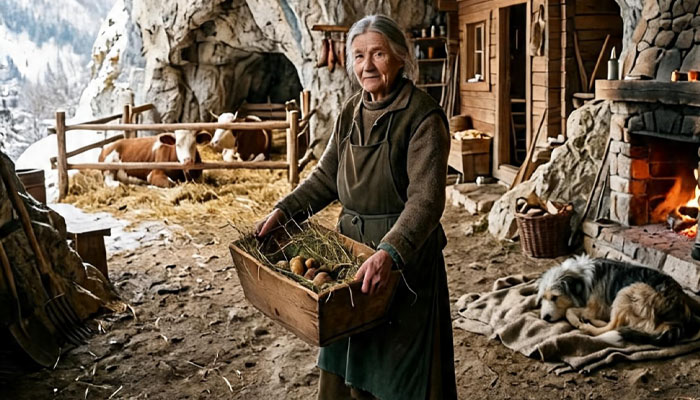
The cave entrance sat behind a cluster of scrub cedar and tall grass bent by frost. It was wider than she remembered, the stone arch sloping inward like a shoulder turned against the weather. She pushed through the brush and stepped inside.

The change was immediate.

Outside, the cold gnawed through her dress and coat. Inside, the air held steady. Not warm exactly, but still. The cave ran deeper than the light reached, opening into a wide back chamber with a floor of hard-packed earth and stone. Her footsteps echoed softly.

No bed.

No food.

No fire.

No door.

Yet Opal stood in that dark hollow and felt the tight band around her chest ease for the first time since Sam’s funeral.

No one could throw her out of stone.

No sister could weep over it and claim she was doing right.

No man could stand on its porch with a rifle and call it his.

Outside, coyotes began calling somewhere far below. Opal sat with her back against the wall and pulled her coat tight. The rock behind her felt ancient and unmoved by human meanness.

Her stomach cramped with hunger.

Her body ached.

Darkness slowly filled the mouth of the cave.

She watched the last strip of daylight fade across the prairie. The first snowflakes of the season drifted down, light and soundless.

Opal Sheridan closed her hand around the wedding ring on her finger and made a decision.

She would not go to town.

She would not beg Cora for mercy.

She would not die in a ditch before winter.

If winter wanted her, it would have to come into the stone and fight for her.

Part 2

The first night in the cave was the longest night Opal had ever known.

Cold did not attack all at once. It crept. It slid under her coat, found the places where her dress was worn thin, settled into her knees and fingers, and waited there. She slept in pieces, waking whenever her own shivering grew strong enough to hurt. Each time she opened her eyes, the cave mouth showed a different shape of darkness. Coyotes called, then went silent. Once, something small skittered near the wall, and Opal gripped her knife until dawn.

Morning came gray and bitter.

She ate half a biscuit and forced herself to save the rest.

Then she began.

The creek below the cliffs still ran beneath a lace of ice. She climbed down to it with the tin cup and drank until her teeth ached. Along the bank she found driftwood caught among stones and roots. Most of it was damp, but some pieces were dry beneath their bark. She gathered what she could carry and climbed back up.

The first load nearly broke her.

The slope was steeper than she remembered. Loose shale slid under her boots. By the time she reached the cave, her lungs burned and her shoulders throbbed. She dropped the wood near the entrance and sat down hard, angry at her own weakness.

Then she stood again.

Every stick was a night alive.

By noon she had made four trips. By dusk she had a small pile of wood, frozen hands, and a plan forming in her mind.

The cave faced east by southeast, which meant the worst northern wind would not blow straight inside. That was mercy. But mercy was not shelter. She needed a barrier at the entrance, something to slow air without sealing smoke. She needed a sleeping platform off the stone floor. She needed dry storage, a way to keep fire heat, and food enough to last beyond the first snow.

The second day, she searched the cliffs for clay pockets and loose rock. She found both. She cut grass with her knife and twisted it into rough bundles. She dragged cedar branches to the cave and leaned them near the entrance, testing how wind moved through them.

The third day, she walked south toward an abandoned survey shack she had seen in summer.

It stood crooked on a rise, no bigger than a stall, its roof half torn away. A dead stove lay inside, rusted through. The door had already been stolen by some other desperate soul. But the walls were made of boards, weathered and gray, and boards were wealth.

Opal pried them loose with a flat stone until her palms blistered. She carried three back the first trip, two the second, one on the third because her strength was failing. When she reached the cave that evening, she leaned against the wall and cried without tears.

Not from sadness.

From fury.

Cora was sleeping in a bed Opal had stuffed with ticking. Virgil was eating potatoes Opal had planted. Smoke rose from Opal’s chimney while she hauled stolen boards like an animal before winter.

She wanted to hate her sister cleanly.

But memory kept interfering.

Cora as a barefoot child running behind her through summer grass. Cora crying when their mother died. Cora writing from Missouri after her first baby was buried with scarlet fever. Cora arriving in Montana hollow-eyed, saying Virgil needed a fresh start and family ought to help family.

Opal had opened her door.

That was the part that burned.

She had opened her door.

On the fourth night, the first storm came.

It announced itself with a low rumble rolling across the basin. Opal woke instantly. For a confused second, she thought of thunder. Then snow hissed across the cave mouth, and wind struck the cliffs with a force that made the cedar branches shudder.

She crawled toward the entrance and looked out.

The world had vanished.

Snow raced sideways through the dark, hard and white and wild. The prairie beyond the cliffs was gone. The lower slope was gone. The sky itself seemed to have come apart.

Opal watched, heart pounding.

Then slowly, she realized something.

At the back of the cave, the air hardly moved.

The storm screamed outside. It clawed at the entrance. It threw snow against the cedars. But the stone swallowed the violence and left a pocket of stillness behind.

The cave worked.

Not enough yet.

But enough to prove her grandmother right.

At dawn, Opal’s new life truly began.

She built the first wall just inside the entrance with cedar poles, shack boards, clay, and grass. It was ugly. It leaned. Gaps showed everywhere. She filled them with mud until her fingers cracked and bled. She left a low opening to crawl through and hung her coat across it until she could find something better.

The second wall she built deeper inside, chest-high at first, then higher, leaving a narrow passage between the two. Trapped air, Grandmother Anya had taught her, could be a blanket. Stone could hold warmth. Clay could seal wind. Smoke wanted a path if you gave it one.

Opal worked until her body moved beyond exhaustion into something harsher and clearer. She stopped measuring days by light and dark. She measured them by improvements.

A shelf.

A stack of dry wood.

A line of stones around the hearth.

A sleeping platform made from survey boards and cedar poles.

The platform was too narrow, and the first night one side collapsed, dumping her onto the ground with a bruise on her hip. She lay there in the dark, too tired to rise, and began laughing. The laugh sounded strange in the cave, rusty and wild.

Then she rebuilt it stronger.

A freighter passed on the trail six days after the storm, his wagon wheels groaning under sacks of flour and tools bound for a settlement beyond Utica. Opal flagged him down from the road.

He looked at her with suspicion first, then pity.

Pity made her spine stiffen.

“I have something to trade,” she said.

From her finger she pulled Sam’s ring.

The freighter’s expression changed. “Ma’am…”

“It’s gold.”

“I know what it is.”

“Then trade fair.”

He shifted on the wagon seat. “For what?”

Her throat tightened, but her voice held. “A hammer. A saw if you have one. Nails. Canvas or tarp. Salt if you can spare it.”

He gave her a cracked-handled hammer, a short saw with three missing teeth, half a coffee sack of bent nails, a torn tarpaulin, and a small twist of salt. More than the ring was worth to him. Less than it was worth to her.

When he placed the ring in his pouch, Opal felt something inside her close.

She had loved Sam Sheridan.

She still loved him.

But memory could not cut wood. Memory could not patch wind. Memory could not keep blood moving in a woman’s fingers when the temperature fell below zero.

That night, using flat stones from the creek, she built the fire pit.

Not a campfire in the middle of the floor. That would smoke her out and waste heat. She dug shallow, lined the hollow with rock, then built a low channel angled toward a crack in the upper wall near the entrance. It took three attempts before the smoke pulled the way she wanted. Twice she coughed until her eyes streamed. Once she had to carry a burning stick outside and stamp it out in snow before the whole cave filled.

But the fourth attempt held.

A small fire burned clean and steady. Smoke rose, drifted along the channel, and escaped. The flat stones around the pit drank the heat. Hours after the flames died, warmth lingered under Opal’s palms.

She smiled for the first time since leaving the cabin.

“Earth remembers,” she whispered.

Winter tightened over Montana.

Cabins across the basin burned through woodpiles fast. Men chopped until their shoulders failed. Women stuffed rags into wall cracks and prayed the roofs would hold. Opal, inside the sandstone, learned the rhythm of stone heat. A small fire in the evening. Coals banked carefully. Ash saved. Stones covered and uncovered depending on the cold.

The cave became more than a hollow.

It became a tool.

It became a body she understood.

But food did not appear because she was clever.

By the third week, her supplies were low enough to count with dread. Flour dust at the bottom of a sack. A strip of salt pork going rancid at the edge. Dried beans from her original store, fewer every night. She set snares near brush and caught nothing for four days. On the fifth, she caught a rabbit and apologized to it before cutting its throat.

Hunger sharpened everything.

It sharpened her hearing, her temper, her memories. She dreamed of the cabin kitchen. Of Cora cutting bread. Of Virgil laughing at Opal’s empty chair.

One evening, after a day of no catch and little wood, Opal sat beside the cooling stones and did the sums in her head.

Even if she caught rabbits.

Even if she traded labor.

Even if the weather allowed trips to the creek.

The cave could keep her warm.

It could not keep her fed through winter.

She leaned her head back against the wall and closed her eyes.

That was when the knock came.

Three hard strikes against the tarpaulin.

Opal’s eyes opened.

No one knew she was here.

Again came the sound.

This time weaker.

She reached for the hammer beside her bed and moved toward the entrance.

“Who’s there?”

For a moment, only wind answered.

Then a man’s voice, barely human, breathed one word.

“Help.”

Part 3

When Opal pulled back the tarp, the man fell into the cave.

He came down heavy, shoulder first, bringing snow and cold with him. For one terrible instant, she thought he had died at her feet. His coat was white with ice. Frost clung to his beard. One eyelid was frozen nearly shut. His lips had gone the color of old ash.

Opal dropped the hammer and dragged the tarp closed behind him.

The wind vanished at once.

That sudden silence always startled her, but now she had no time to notice. She knelt beside the stranger and pressed two fingers against his neck. A pulse beat there, faint but stubborn.

“Don’t you die in my doorway,” she muttered.

He was a big man, broad through the shoulders and heavy with wet wool. Moving him took all her strength. She pulled him by the coat, inch by inch, toward the hearthstones. His boots scraped over the cave floor. Twice she had to stop and breathe. By the time she got him near the fire pit, sweat chilled under her dress.

His hands were white.

Opal knew enough not to shove them near flame. Grandmother Anya’s lessons came back again, stern as scripture. Slow warming. Dry cloth. Warm breath. Never rub frozen flesh hard unless you wanted to kill what still lived.

She built a small fire, not too hot. Heated water until it was barely warm. Cut his gloves away with her knife. Wrapped his hands in strips torn from an old petticoat. Removed his boots, fighting the frozen leather for nearly ten minutes before they came loose. His socks were stiff with ice.

He groaned once.

“That’s right,” she said. “Complain. It means you’re alive.”

She worked until midnight.

The stranger drifted in and out, mumbling in a language she did not know. Norwegian, maybe. Swedish. Some hard northern tongue full of snow and stone. When his breathing steadied, Opal sat back on her heels and realized her own hands were shaking.

Not from cold.

From the fact that another life now depended on the shelter Cora had believed would become her grave.

Near dawn, the man opened his eyes.

They were light gray, bloodshot, and confused.

He looked at the cave ceiling. At the stone walls. At the patched entrance. At Opal sitting beside the fire with a knife in her lap.

“Am I dead?” he rasped.

“No.”

He swallowed. “Then where am I?”

“My place.”

His gaze moved slowly over the walls, the double barrier, the shelves, the fire pit, the stacked wood.

“You built this?”

“Yes.”

“Alone?”

Opal stared at him.

He gave the smallest laugh, then winced. “Forgive me. That was a foolish question.”

“It was.”

His name was Hjalmar Holmberg.

It took Opal three tries to say it properly, and even then he smiled as if she had bent it badly. He was a homesteader south of the cliffs, newly arrived the previous spring with a wagon, three crates of tools, and more optimism than sense. He had built a cabin in a shallow draw, proud of its straight walls and high roof. The first hard storm found every weakness. Snow blew through the cracks. His chimney smoked downward. Damp wood refused to burn. He had gone out searching for help when wind erased the trail.

“Someone in Utica said there was a woman living in the sandstone,” Hjalmar told her the next afternoon, after broth had brought color back to his face. “They said it as a joke.”

Opal fed the fire. “I expect they did.”

“I came because a joke sounded warmer than my cabin.”

“You almost died for a joke.”

“Yes.” He studied the cave again. “But I found a miracle.”

“It’s mud, rock, and work.”

“That is most miracles.”

She did not know what to do with him once he could sit up. Food was already short. One more mouth might kill them both. Yet sending him into the storm weak and half-frozen would be murder.

That evening he asked, “May I stay a few days?”

Opal looked at him across the fire.

“You work,” she said.

He nodded. “Fair.”

He worked.

At first, slowly, because his hands pained him and the frostbite made his fingers clumsy. But as strength returned, Hjalmar proved useful in the practical, quiet way Opal trusted. He did not talk to fill silence. He did not tell her what a woman could or could not build. He studied what she had done, asked questions, listened to the answers, and improved whatever he touched.

He cut the crooked wall supports more evenly. He hauled larger driftwood from the creek. He showed her how to peg boards where nails split them. From his failed homestead he brought a sack of barley, a coffee tin of beans, a coil of rope, and two blankets. The journey took him a full day and left him limping, but when he returned, he dropped the supplies inside the cave with solemn pride.

“Rent,” he said.

Opal nodded. “Accepted.”

With two sets of hands, the cave changed quickly.

They deepened the fire pit and lined more stones around it. They built a second sleeping platform along the opposite wall. They made a table from old boards and two crates. Hjalmar carved pegs into the wall for hanging coats. Opal wove grass mats and laid them between stone and bedding to hold off damp.

She also built a pantry alcove in the coolest part of the cave, sealing cracks with clay and stacking food carefully. Every jar, every twist of salt, every strip of dried meat mattered. Hunger had taught her respect.

Word spread despite her wishes.

At first it came as mockery.

“The cave widow,” people called her.

“Stone-house Opal.”

Men in town laughed that Sam Sheridan’s widow had turned badger. Women shook their heads and said grief had made her strange. Someone claimed she slept beside bones. Someone else said she had a foreign charm to keep from freezing.

Then weather grew harder.

A freighter arrived one evening with one horse limping and his face raw from wind. Opal let him in. He stayed the night, ate barley soup, and left behind half a sack of flour. A young couple traveling toward Fort Benton came next, the wife seven months pregnant and terrified after their wagon wheel cracked. Then an old Blackfeet trader whom Hjalmar knew by sight stopped before a storm and showed Opal where to find chokecherry bark good for tea.

The cave never became crowded at first.

Only useful.

A night here.

A meal there.

A place to wait until wind loosened its grip.

Opal asked no questions until people were warm. She had learned that from being turned out cold. Fear spoke badly when its teeth were chattering. Shame told lies when it was hungry.

One day in January, Eli Mercer, the freighter who had taken her wedding ring, returned with two sacks of oats and a bundle wrapped in canvas.

“I heard what you’re doing here,” he said.

“I’m not doing anything.”

He glanced past her at Hjalmar repairing a shelf and at a sleeping child wrapped near the fire while her parents whispered over coffee.

“Looks like something.”

Eli handed her the bundle. Inside was Sam’s ring.

Opal stared at it.

“I can’t pay you,” she said.

“Didn’t ask.”

“I traded fair.”

“Maybe. But a man shouldn’t profit off a widow’s last gold if he can help it.”

She closed her hand around the ring. It no longer felt like something she needed to survive. It felt like something that could return without dragging her backward.

“Thank you,” she said.

Eli coughed and looked embarrassed. “Storm coming by week’s end. Big one, I think.”

Opal had felt it already.

The land had gone watchful.

Birds vanished from the open sky. The air had a dull weight. Even the horses that passed near the cliffs moved with their heads low, ears twitching. At dusk, the horizon turned a strange yellow-gray behind the mountains.

That night Opal checked everything.

Firewood. Water. Food. Blankets. Smoke channel. Entrance wall. Air gap. Clay seals. Spare tarp. Lamps. Knife. Hammer. Rope.

Hjalmar watched her from the table.

“You think it will be worse than the others?”

Opal stood at the cave mouth and looked across the dark basin.

The prairie was too still.

“Yes,” she said.

“How do you know?”

She listened to the silence where wind should have been.

“The land is holding its breath.”

By morning, a wall of white stood on the western horizon.

And it was moving fast.

Part 4

The storm reached the cliffs before noon.

It did not arrive like ordinary weather. It came like an army.

One moment the prairie lay visible below the sandstone, brown grass rippling under a low sky. The next, the horizon disappeared behind a moving wall of snow so thick it seemed solid. Wind struck first, driving ice pellets ahead of the blizzard. Then the full force hit the cliffs with a roar that made the cave walls tremble.

Inside, Opal had already barred the entrance as tightly as she dared.

“Keep that vent clear,” she told Hjalmar.

He nodded and climbed onto the inner platform, checking the smoke path with a strip of cloth. It fluttered inward, then steadied. Draft was right.

Three travelers were already sheltering with them: Eli Mercer, a schoolteacher named Miss Bell, and a boy of twelve whose father had sent him ahead with a message and then lost sight of him in the blowing snow. The boy sat near the fire trying not to cry.

Opal put a cup of warm broth in his hands.

“What’s your name?”

“Matthew.”

“Matthew, I need you to do an important job.”

His eyes lifted.

“You watch that kettle. When it starts to shake, you tell me before it boils over.”

He nodded solemnly.

Giving frightened people work was as necessary as giving them food.

By afternoon, more came.

A wagon team first, bells dull under packed snow. Hjalmar and Eli fought the entrance open against the wind while Opal held a lantern high. A man stumbled in carrying a little girl whose lashes were white with frost. Behind him came his wife and another child, both wrapped in quilts stiff with ice.

“Inside,” Opal ordered. “No talking until gloves are off.”

The woman tried to thank her and began sobbing instead.

Opal set her by the fire, not too close. “Slow. Warm slow.”

Another knock came before dark.

Then another.

The cave filled with wet wool, fear, horses blowing outside under the lee of the cliff, crying children, whispered prayers, and the steady work of survival. Opal moved through it all with a calm she did not feel.

Boots off.

Blankets there.

No, not near the fire yet.

Water in small sips.

Hang coats on the outer pegs.

Snow packed against the entrance every hour; clear it before it hardened.

Vent checked every half hour.

No one wasted wood.

No one ate without counting.

Hjalmar became her second pair of hands. He lifted what she could not. He kept men from crowding the hearth. He dug snow from the entrance tunnel and returned with his beard frozen white. When one frightened farmer tried to push past Opal and build the fire higher, Hjalmar placed one broad hand on his shoulder.

“She knows this cave,” he said quietly. “You will listen.”

The man listened.

By the second night, twenty-three people sheltered inside the sandstone.

The storm did not weaken.

It screamed over the basin hour after hour, a monstrous sound that erased time. Snow sealed the lower trail. The horses outside were brought into the outer air gap one by one, blindfolded and trembling, because leaving them exposed meant death. The smell worsened. Space narrowed. Tempers frayed.

A woman named Ruth Ann panicked near midnight, clawing at her collar, saying there was no air. Her husband tried to quiet her with shame, which only made her worse. Opal took Ruth Ann’s hands and pressed them against the stone wall.

“Feel that?”

The woman gasped.

“Feel it. Solid, isn’t it?”

Ruth Ann nodded, tears sliding down her cheeks.

“This cave has held for a thousand winters before us. It’ll hold one more.”

“I can’t breathe.”

“Yes, you can. Breathe with me.”

Opal breathed slow until the woman followed.

Across the room, Miss Bell began singing softly to the children. Not a hymn at first, but a counting song. One voice joined. Then another. The sound steadied the room better than any sermon.

On the third morning, the boy Matthew’s father arrived half-dead.

He had tied himself to his horse with rope so he would not fall unnoticed. Hjalmar and Eli dragged him in. Matthew cried out and tried to run to him, but Opal caught him around the shoulders.

“Let us work first.”

“He’s my pa!”

“Then help him by listening.”

The man’s hands were badly frozen. Opal worked over them for hours. Matthew sat close, silent now, learning fear’s discipline. By evening, his father could speak, though pain made him curse softly in apology.

“You saved him,” Matthew whispered.

Opal looked at the boy’s thin face. “Not yet. But he’s fighting.”

The blizzard buried the world.

Inside the cave, food became a calculation repeated three times a day. Barley stretched with water. Beans mashed thin. Salt pork cut into pieces so small they were more memory than meat. Children got first servings. Nursing mothers next. Men who complained were stared into silence by women who did not.

On the fourth night, Deputy Aaron Pike arrived.

He came alone, leading his horse, his face wrapped in a scarf stiff with ice. When he stumbled inside, Opal knew at once something was wrong beyond the ordinary wrongness of the storm.

“Pike,” she said, gripping his arm. “Who’s missing?”

He lowered the scarf.

Ice clung to his mustache. His eyes avoided hers.

“Virgil Bell’s place is dark.”

The cave quieted.

People knew whose place he meant.

Opal’s old cabin.

Cora’s stolen stove.

Virgil’s claimed roof.

Deputy Pike continued, voice rough. “I rode near enough to see part of the south wall down. Chimney smoke gone. No stock in the pen. I called but couldn’t get close. Wind turned my horse.”

Opal said nothing.

The fire popped softly.

Hjalmar looked at her, and in his face she saw the question no one else dared ask.

Would she go?

Cora had turned her out before winter.

Virgil had held a rifle.

They had left her to the prairie with a sack and three hard biscuits.

Now the prairie had come for them.

For a moment, Opal felt the ugly satisfaction of justice. Not the clean kind preached in church, but the dark human kind that whispers, Let them feel it. Let them know. Let them stand outside a closed door.

She hated how good it felt.

Then Miss Bell’s voice broke the silence.

“Is there a child with them?”

Deputy Pike nodded reluctantly. “Cora’s boy. Henry. Eight, maybe.”

Opal closed her eyes.

Cora’s boy had followed her around the barn all summer, asking questions about chickens, stars, and why Aunt Opal could whistle through her teeth. He had given her a crooked drawing of a horse the week before she was thrown out.

Opal opened her eyes.

“Hjalmar,” she said. “Rope. Lantern. Two blankets. Eli, pack hot stones in the small crate.”

Ruth Ann’s husband stood. “No one can ride in this.”

“I’m not riding.”

“You’ll die out there.”

Opal looked at him. “Then stand aside and make yourself useful by keeping that vent clear.”

No one argued after that.

Part 5

The storm hit Opal like a fist the moment she crawled out of the cave.

For one breath, she could not see anything. Snow drove against her face with such force it felt like gravel. The lantern in Hjalmar’s hand burned dim behind its glass, a weak yellow eye in a white world. A rope tied them together at the waist, with Eli behind them and Deputy Pike leading as far as the lower ridge.

The old homestead lay less than four miles away.

In that storm, it might as well have been across an ocean.

They moved by memory, not sight. Down from the cliffs. Across the frozen creek. Along the rise where fence posts made black teeth in the snow when the wind thinned for half a second. Twice Opal fell. Once Hjalmar caught her by the back of her coat before she slid into a drifted wash. The crate of heated stones knocked against Eli’s hip with every step.

No one spoke except to shout direction.

The prairie had become a living thing, blind and furious.

Opal kept one thought in her mind.

Henry.

Not Cora weeping into her apron.

Not Virgil with Sam’s rifle.

Henry with a gap-toothed smile, holding up a drawing and saying, “That’s you on the horse, Aunt Opal. You can tell because of the hair.”

At last, through the blowing white, she saw the cabin.

Her cabin.

The south wall had caved inward near the kitchen. Snow poured through the break. The chimney stood black and useless. One window was gone. The barn door banged loose on one hinge, though the storm nearly swallowed the sound.

Opal’s knees weakened at the sight.

Not because it was destroyed.

Because she had once believed that roof was the only thing between her and the world.

Hjalmar kicked through the drift at the door. It would not open. Eli swung an axe until the wood split near the latch. Hjalmar shouldered it hard, and the door gave.

Inside was colder than the cave entrance.

“Cora!” Opal shouted.

No answer.

They found Virgil first, half-buried under fallen roof boards near the stove. His leg was trapped. His face was gray with pain and cold. The rifle lay several feet away, useless.

He stared at Opal as if she were a ghost.

“You,” he whispered.

“Save your breath.”

Cora was in the bedroom with Henry wrapped inside her coat. She had shoved the bedstead against the broken wall and packed quilts around the boy. Her own hands were bare and blue at the fingertips.

When she saw Opal, her face crumpled.

“I thought you wouldn’t come.”

Opal knelt beside Henry. He was breathing. Too shallow, but breathing.

“I almost didn’t,” she said.

Cora began to sob.

“Not now,” Opal snapped. “Cry later if you live.”

That got her moving.

They worked in brutal urgency. Hjalmar and Eli lifted beams off Virgil while Deputy Pike braced the shifting wall. Virgil screamed once when his leg came free, then fainted. Opal wrapped Henry with the heated stones and blankets, holding one near his chest, one near his feet. Cora could barely stand, but Opal tied a rope around her waist and made her walk because lying down would kill her faster.

Getting back took longer.

Virgil had to be dragged on a door ripped from its hinges. Henry was carried against Hjalmar’s chest beneath both their coats. Cora stumbled so often Opal finally gripped her collar from behind and hauled her forward like a stubborn calf.

Halfway to the cliffs, Deputy Pike’s horse broke loose and vanished into the white.

Nobody chased it.

The cave lantern appeared at last through the storm, held high by Miss Bell at the entrance. People pulled them inside by rope and hands and prayers. The tarp closed behind the last body, and the storm’s roar dulled.

Warmth wrapped around them.

Not comfort. Not yet.

But life.

For the next two days, the cave became hospital, stable, kitchen, church, and judgment hall.

Virgil’s leg was broken in two places. Two toes on his left foot turned black. Cora’s fingers swelled and blistered. Henry woke on the second morning and asked for water. When Opal brought it to him, he blinked at her in confusion.

“Aunt Opal?”

“Yes.”

“Did we die?”

“No.”

“Good,” he whispered, and fell back asleep.

Cora watched from the next pallet, tears sliding silently into her hair.

On the sixth day, the storm finally broke.

Sunlight returned to a world reshaped beyond recognition. The prairie lay under massive drifts. Fence lines vanished. Wagons were buried to their wheels. Chimneys poked from snow like grave markers. Three cabins in the basin had collapsed. Two barns were gone entirely. Livestock froze where they stood. Men who had laughed at the cave stood at its entrance blinking in the clear light, alive because stone had done what lumber could not.

Word traveled as soon as roads reopened.

The sandstone cave had saved twenty-seven people.

Maybe more, depending on how one counted the lives that would have been lost had Opal closed her door.

In the weeks that followed, people came differently.

Not laughing now.

They brought flour, tools, coffee, blankets, lamp oil, nails, smoked meat, medicine, and lumber. They brought apologies awkwardly, like men carrying furniture too large for a narrow door. Some were spoken. Some arrived as stacked firewood. Some as repaired harness. Some as a hand on Opal’s shoulder followed by silence.

The county clerk came in March with Deputy Pike and two witnesses.

He carried a packet of papers in a leather case and looked deeply uncomfortable.

Opal met him outside the cave beneath a sky washed blue by thaw.

“Mrs. Sheridan,” he said, “there has been a review of the homestead transfer filed by Virgil Bell.”

Cora stood nearby, one hand wrapped, two fingers still stiff from frostbite. Virgil was not there. He had been taken east to relatives after losing the blackened toes and much of his pride. He had not thanked Opal. She had not expected him to.

The clerk cleared his throat. “The filing was improper. Your late husband’s improvements and surviving claim rights were not lawfully transferable without your consent. The cabin property remains yours.”

Cora lowered her head.

Opal looked toward the basin. From the cave, she could see the ridge above the old homestead. Smoke rose from its chimney again. Men from town had repaired enough of the south wall to keep the place standing.

For months, she had dreamed of taking it back.

Now the thought felt smaller than she expected.

“That cabin was my home,” Opal said.

The clerk nodded. “Yes, ma’am.”

“But it is not where I live.”

Cora looked up.

Opal turned to her sister.

Cora’s face had changed since the storm. The softness was gone, or perhaps the falseness was. Her eyes looked older, emptied of easy tears. She had spent recovery in the cave, helping with dishes one-handed, mending torn blankets, reading to children when Opal was too tired to stand.

“I wronged you,” Cora said.

Her voice trembled, but she did not cry. That made Opal listen.

“Yes,” Opal said.

“I let Virgil talk me into believing need made it right.”

“Need explains things. It doesn’t wash them clean.”

“I know.”

Opal studied the woman who had been her little sister before sorrow, marriage, fear, and land hunger twisted them both into strangers.

“Henry needs a roof,” Opal said.

Cora closed her eyes.

“So do you. The cabin can serve that purpose for now.”

The clerk frowned. “Mrs. Sheridan, you don’t have to—”

“I know what I don’t have to do.”

Everyone went quiet.

Opal looked back toward the cave entrance, where Hjalmar was fitting a proper timber door into the outer wall. Children’s voices echoed from inside. Someone laughed near the creek. Smoke rose through the stone channel she had built with bleeding hands.

“This place,” she said, “will be registered as a winter refuge. I want the old cabin listed as part of it for storage and overflow when roads are passable. Cora can tend it while she remains.”

Cora stared at her. “Why?”

Opal’s answer took time.

Because revenge would not warm a child.

Because being right was not the same as being free.

Because Opal had spent one winter learning that a closed door could kill more surely than cold.

“Because I know what it is to be turned out,” she said finally. “And I won’t build my life by doing the same.”

Cora covered her mouth.

This time, when she cried, Opal let her.

By the next winter, no one called it the cave widow’s hole.

They called it Stone Haven.

There was a timbered entry now, with a real door and a small window made from salvaged glass. The double walls had been strengthened. A smoke flue lined with stone drew clean. Shelves held labeled supplies. A spring box near the creek kept food cold. Hjalmar had built bunks along the side chamber, and Opal had sewn curtains from flour sacks so families could have a little privacy when fear had already taken everything else.

On the wall near the hearth, she hung a simple board carved by Matthew’s father.

No One Turned Away in Storm.

People said Opal Sheridan had saved the basin.

She did not see it that way.

She had saved herself first.

That was the truth of it. She had been left before winter with almost nothing, and the land had not pitied her. Stone had not softened because she wept. Fire had not burned because she deserved it. She had survived by listening, learning, working, failing, and trying again with cracked hands and an empty stomach.

Then, when others came to her door, she had remembered the cold clearly enough not to pass it on.

One evening, as the first snow of the new season fell over the Judith Basin, Opal stood outside Stone Haven and watched smoke rise from the flue. Behind her, the cave glowed with lantern light. Hjalmar was inside repairing a child’s sled. Cora was stirring stew in the iron pot, thinner now but steadier, with Henry reading beside her. Eli Mercer had arrived with coffee and news from Fort Benton. Two travelers slept in the back chamber, safe from the weather.

The prairie stretched wide and white under the darkening sky.

A hawk circled once above the cliffs before disappearing toward the mountains.

Opal smiled faintly.

The wind began then, sliding over the basin, searching for cracks, testing doors, pressing its cold mouth against every weak place in the world.

But inside the sandstone, the fire held.

And Opal Sheridan, who had once walked away from her stolen home with all she owned in a cloth sack, stood at the entrance of the safest place in the storm and did not move aside until every last traveler had come in from the cold.

Leave a Reply Cancel reply

Your email address will not be published. Required fields are marked *

©2026 Pets n Tales | Design: Newspaperly WordPress Theme