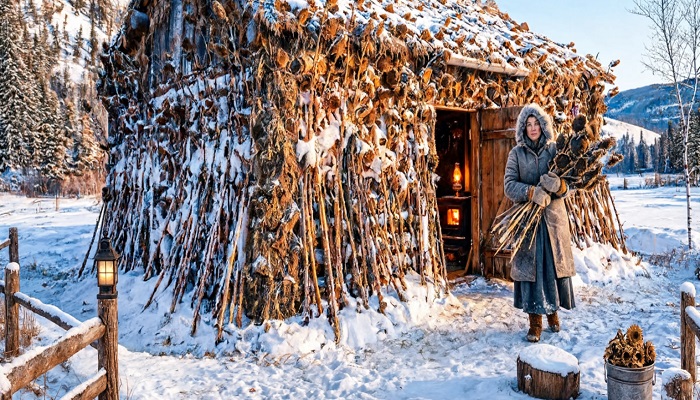
The people of Elk Ridge had a long list of things they considered strange.
A man who kept twelve sled dogs despite never owning a sled.
A widow who talked to her chickens as if they were church elders.
A retired trapper who insisted the mountains could predict storms.
But if anyone asked who was the strangest person in the valley, nearly everyone would give the same answer.
Evelyn Carter.
For six years, Evelyn had lived alone in a tiny cabin on the western edge of the valley, tucked beneath towering mountains and surrounded by endless forests of pine.
She wasn’t unfriendly.
She simply preferred solitude.
The townsfolk saw her occasionally when she came down for supplies. She’d buy flour, lamp oil, salt, and coffee. Then she’d load everything into her wagon and disappear back into the mountains.
But what truly fascinated people wasn’t Evelyn.
It was her cabin.
Every autumn, while everyone else prepared firewood and repaired roofs, Evelyn spent weeks gathering sunflowers.
Thousands of them.
She planted fields of sunflowers throughout the summer. Then after harvest she dried every stalk, every leaf, every flower head.
And instead of storing them away, she attached them to the outside walls of her cabin.
She covered the entire structure.
Walls.
Roof.
Corners.
Even sections around the chimney.
By winter, her cabin looked as if a giant golden sunflower had grown in the middle of the mountains.
The sight was ridiculous.
At least according to the townspeople.
“She’s gone half-crazy.”
“Too much time alone.”
“Maybe she thinks birds will pay rent.”
The jokes never stopped.
Evelyn never answered them.
She simply continued her work every year.
Adding more dried sunflower stalks.
Layer upon layer.
Season after season.
Nobody understood why.
And eventually, nobody bothered asking.
Until the winter everything changed.
That December arrived earlier than usual.
The first snowfall came before Thanksgiving.
By Christmas, drifts stood shoulder-high along the roads.
The old-timers began exchanging worried looks.
Check This Out
Brainberries
Guests That Turned Late-night Show Into Late-night Chaos
Brainberries
Guess Their Job — Most People Get It Wrong
Herbeauty
Feel The Rhythm: 5 Kizomba Dances That Will Move You
Something felt wrong.
The winds arrived from unusual directions.
The temperatures kept dropping.
And the mountain peaks disappeared behind strange walls of dark cloud.
One afternoon, a trapper named Walter Briggs rode into town with alarming news.
“The mountains are growling.”
Nobody laughed.
Walter had survived forty winters.
When he said something was coming, people listened.
“What kind of storm?” someone asked.
Walter stared toward the western peaks.
“The kind people remember for the rest of their lives.”
Three days later, the blizzard arrived.
It began just after sunset.
First came the wind.
Then the snow.
Then came something worse.
The temperature plunged so rapidly that exposed skin froze within minutes.
Visibility vanished.
Roads disappeared.
Fences disappeared.
Entire barns disappeared beneath swirling walls of white.
The storm howled through the valley like a living creature.
Families barricaded themselves indoors.
Lanterns flickered.
Windows rattled.
And throughout the night, fear spread from house to house.
No one could remember conditions this severe.
By morning, the town was trapped.
Every road was buried.
Powerful drifts blocked doors and windows.
Communication with neighboring settlements was impossible.
Then the real problems began.
Several homes lost their heating stoves.
A supply shed collapsed beneath heavy snow.
And the town’s largest woodpile became inaccessible under twenty feet of drifting snow.
People started rationing fuel immediately.
But everyone knew the truth.
If the storm continued another few days, many families would freeze.
Meanwhile, high above the valley, Evelyn Carter stood in front of her sunflower-covered cabin.
Snow whipped across the mountains.
Wind screamed through the trees.
Yet her cabin remained strangely calm.
The dried sunflower walls shivered slightly but held firm.
Inside, the temperature remained comfortable.
The fire burned steadily.
No drafts slipped through cracks.
No frost formed on interior walls.
No dangerous heat escaped.
Evelyn sat beside her stove and listened.
Not to the storm.
To the silence.
The insulation was working.
Just as it always had.
Exactly as she’d intended.
Because the sunflowers were never decoration.
They were protection.
Many years earlier, Evelyn’s father had been a frontier builder.
Most people remembered him as a farmer.
Few remembered he had studied unusual construction techniques.
During harsh winters, he’d experimented with natural insulation.
Corn husks.
Hay.
Straw.
Reeds.
And eventually sunflowers.
He discovered that tightly layered sunflower stalks trapped pockets of air remarkably well.
The dried stems reduced heat loss.
The thick flower heads broke the force of icy winds.
And when arranged properly, the material shed snow surprisingly effectively.
His ideas were dismissed.
People called them foolish.
Then one winter, a terrible storm struck.
His home used half the firewood of neighboring cabins.
After that, Evelyn never forgot the lesson.
Years later, when she built her own mountain cabin, she improved the design.
Every autumn she harvested enough sunflowers to create a thick protective shell around the structure.
The system wasn’t beautiful.
It wasn’t fashionable.
But it worked.
And that was all she cared about.
The blizzard raged for two more days.
Conditions worsened.
In town, supplies dwindled.
Children grew cold.
Elderly residents struggled to stay warm.
Fear turned into desperation.
Then disaster struck.
The Henderson family became trapped when part of their roof collapsed beneath accumulated snow.
Neighbors tried reaching them.
The wind drove them back.
No one could move safely.
People began wondering whether anyone would survive until rescue arrived.
If rescue arrived at all.
On the fourth morning, Evelyn made a decision.
She harnessed her sturdy draft horse, Boone.
Most people would have considered it suicide.
The storm was still raging.
But Evelyn understood the mountains.
And she knew something the town didn’t.
Her cabin could shelter many more people than just herself.
The sunflower insulation made it extraordinarily efficient.
With careful management, dozens of people could stay warm inside.
So she packed food.
Filled water barrels.
Loaded extra blankets.
And headed toward Elk Ridge.
The journey took six exhausting hours.
Snow reached Boone’s chest.
Winds nearly overturned the wagon twice.
Yet somehow they arrived.
When townspeople first spotted Evelyn emerging from the blizzard, they thought they were hallucinating.
The woman everyone considered eccentric had come through conditions nobody else dared challenge.
She climbed down from her wagon.
Snow covered her coat.
Ice coated her mittens.
And her first words were simple.
“Bring everyone who needs warmth.”
At first, people hesitated.
Then another heating stove failed.
And another.
Soon hesitation vanished.
Families gathered belongings.
Children wrapped themselves in blankets.
And a long procession followed Evelyn back toward the mountains.
The trip was difficult.
But the alternative was worse.
The townspeople expected a cramped cabin.
What they found shocked them.
The moment they stepped inside, warm air greeted them.
Not hot.
Not stuffy.
Simply warm.
Comfortably warm.
Despite the brutal temperatures outside.
Children immediately removed gloves.
Elderly residents settled near the stove.
Parents exchanged bewildered glances.
How was this possible?
The cabin should have been freezing.
Instead, it felt safer than many houses in town.
Hour after hour, more people arrived.
Still the temperature remained steady.
The stove consumed surprisingly little wood.
No drafts entered.
No heat escaped.
The sunflower walls absorbed the storm’s punishment.
Outside, the blizzard raged.
Inside, life continued.
Meals were shared.
Stories were told.
Songs filled the room.
For the first time in days, people felt hope.
That night, Walter Briggs stood beside one of the cabin walls.
He examined the layers carefully.
Thousands upon thousands of dried stalks.
Interlocked.
Compressed.
Engineered.
Not random.
Not decorative.
Purposeful.
He finally understood.
“So that’s why.”
Evelyn smiled.
“That’s why.”
Walter shook his head.
“We laughed at you.”
“You did.”
“And you knew this would work?”
“My father taught me.”
Walter stared at the wall again.
“The whole town owes you an apology.”
Evelyn chuckled softly.
“No. The town owes an apology to the sunflowers.”
The storm finally ended two days later.
Sunlight returned.
Blue skies appeared.
The mountains sparkled beneath fresh snow.
When people emerged from the cabin, the valley looked transformed.
Entire roads had vanished.
Fences were buried.
Several buildings had suffered severe damage.
Yet everyone who had taken shelter survived.
Every single one.
News spread quickly.
People told the story across neighboring settlements.
The strange woman with the sunflower cabin.
The blizzard shelter.
The winter miracle.
Visitors began arriving in spring.
They expected some magical secret.
Instead, Evelyn showed them dried stalks and simple engineering.
Air pockets.
Insulation.
Wind resistance.
Common sense.
Nothing magical at all.
That summer, something unusual happened.
Sunflowers appeared everywhere.
Around barns.
Beside sheds.
Along fences.
Across fields.
The people of Elk Ridge suddenly developed a remarkable appreciation for the flowers they once mocked.
By autumn, dozens of homes featured sunflower insulation panels inspired by Evelyn’s design.
Some were small.
Some were elaborate.
But they all existed because one woman had refused to follow the crowd.
Years later, children who hadn’t even been born during the great blizzard would ask why so many cabins in the valley displayed dried sunflowers every winter.
Their parents would smile.
Then they would point toward the mountains.
Toward a modest cabin overlooking the valley.
And they would tell the story.
The story of Evelyn Carter.
The woman everyone thought was foolish.
The woman who ignored ridicule.
The woman who kept growing sunflowers year after year.
Because she understood something the rest of the world had forgotten.
Sometimes wisdom looks strange before it saves lives.
And sometimes the thing everyone laughs at today becomes the very thing they depend on tomorrow.
Whenever winter winds swept through Elk Ridge afterward, the golden sunflower-covered cabins stood proudly against the snow.
A reminder that being different is not the same as being wrong.
And a reminder that one quiet woman had seen the storm coming long before anyone else did.