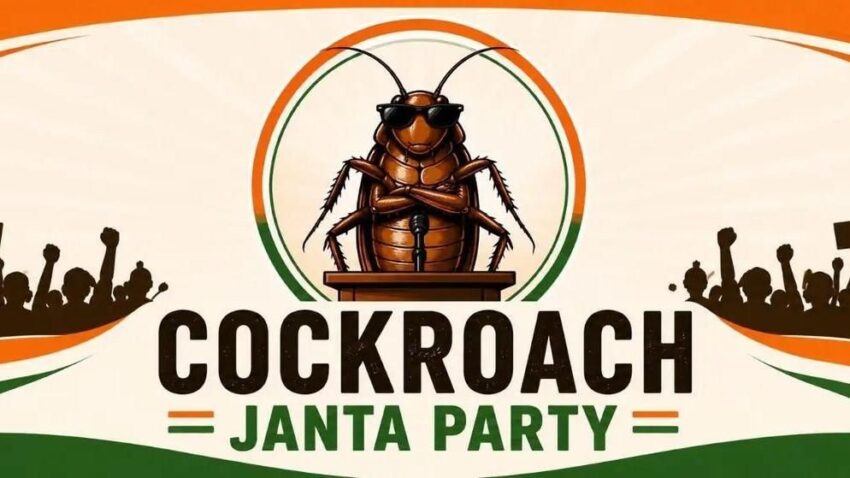
Cockroach Janta Party Gains Popularity in India, Media Launches Campaign Against Movement
New Delhi: Rising unemployment, economic hardships, and a lack of basic public services have left many young Indians increasingly frustrated and disillusioned.
As the Gen Z-led movement known as the Cockroach Janta Party (CJP) gains momentum across the country, sections of the Indian media have begun targeting the group, which has emerged as a vocal critic of the government.
According to a report by Al Jazeera, the Cockroach Janta Party’s manifesto criticizes several institutions, including India’s mainstream media. The movement has also called for the cancellation of licenses held by media groups associated with prominent business tycoons Gautam Adani and Mukesh Ambani.
CJP founder Abhijit Dipke has reportedly refused to engage with major Indian media organizations. Speaking about the issue, Dipke said that there was little point in speaking to media outlets that continue to label the movement as extremist or anti-national.
“If the Indian media keeps portraying us as terrorists, there is no benefit in talking to them,” Dipke said. “For the past 12 years, anyone who questioned the Modi government has been branded anti-national by large sections of the media.”
Following the growing popularity of the Gen Z movement, authorities reportedly suspended the CJP’s account on X (formerly Twitter).
Political analysts say the emergence of the youth-led movement reflects growing dissatisfaction among India’s younger generation and highlights concerns that the current political system has failed to meet their expectations and aspirations.
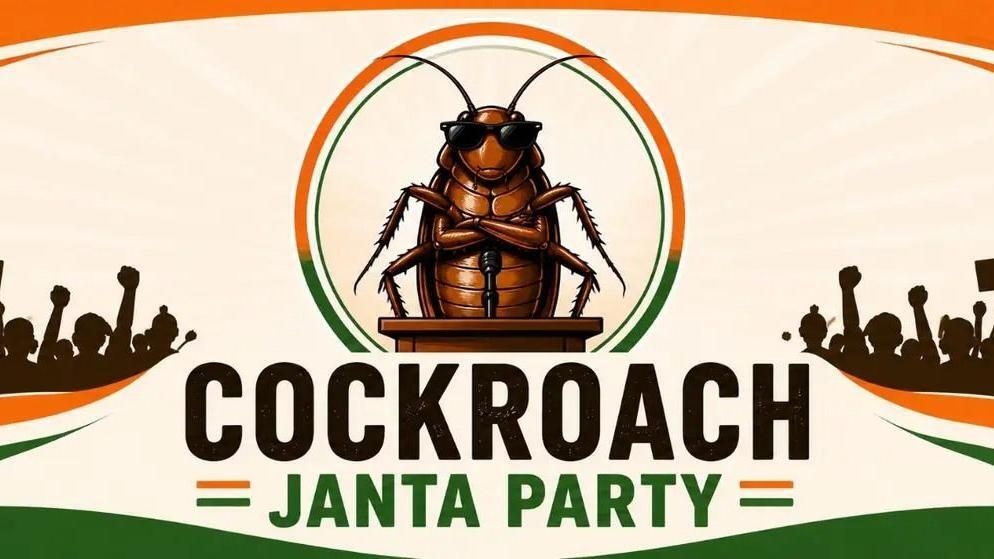
What is India’s “Cockroach Janata Party”?
The satirical campaign “Cockroach Janata Party” (CJP) began on Sunday but quickly attracted widespread attention, with thousands of people expressing interest in joining it.
The movement emerged after remarks allegedly made by India’s Chief Justice Surya Kant during a Supreme Court hearing, in which unemployed youth were reportedly compared to “cockroaches.”
According to the Indian news agency PTI, a bench comprising Chief Justice Surya Kant and Justice Joymalya Bagchi was hearing a petition from a lawyer seeking designation as a senior advocate.
Dismissing the request, the Chief Justice reportedly remarked that society already had enough “parasites” who attack the system and questioned whether the petitioner wished to join them.
He further stated that some young people were like “cockroaches” who could not find employment or establish themselves in any profession. According to reports, he said that some of them ended up in the media, on social media, or became RTI activists and other activists who then began attacking everyone.
Strong Reaction to the Remarks
The comments sparked widespread criticism across India. Political parties, human rights groups, media organizations, and members of civil society described the remarks as inappropriate, dehumanizing, and deeply regrettable.
Speaking to DW, Sujata Madhok, President of the Delhi Union of Journalists (DUJ), said that after targeting workers, the Chief Justice had now turned his attention toward unemployed youth.
She questioned why so many people are active on social media today and noted that many of them are professional journalists. According to Madhok, numerous experienced journalists were pushed out of mainstream media over the past decade because they refused to follow the government line. After losing their jobs, many turned to YouTube, Facebook, Instagram, and other social media platforms to continue working as independent journalists.
Chief Justice Issues Clarification
Following criticism, Chief Justice Surya Kant clarified that his remarks had been misrepresented and that he had not been referring to unemployed youth in general.
He described the interpretation that he had criticized unemployed young people as “completely baseless,” adding that he was proud of India’s current and future human resources and that every young Indian was a source of inspiration to him.
Unusual Membership Conditions of the “Cockroach Janata Party”
The group adopted the abbreviation CJP, which is noteworthy because “CJ” is also commonly used in India as shorthand for “Chief Justice.”
The organization describes itself as a “political, secular, socialist, democratic lazy front of the youth, by the youth, and for the youth.”
According to the Hindustan Times, the group claimed that more than 40,000 people had joined the informal movement within just a few hours of its launch.
The party also announced humorous eligibility criteria for membership. Applicants must be unemployed either by circumstance, choice, or principle. The group clarified that being “lazy” refers only to reduced physical activity.
It further stated that prospective members should remain “always online” for at least 11 hours a day, including bathroom breaks, and should possess the ability to express anger in a “professional manner.” The group emphasized that religion, caste, and gender are not considered during the membership process.
Members of Parliament Express Interest
Two members of India’s Trinamool Congress, Mahua Moitra and Kirti Azad, publicly expressed interest in joining the Cockroach Janata Party.
On Sunday, Kirti Azad posted on X that he wanted to join the party and asked about the eligibility requirements. The group responded by welcoming him and joking that winning the 1983 Cricket World Cup was qualification enough.
Mahua Moitra also posted that she wished to join CJP. The group replied by saying that she was “the voice democracy needs” and welcomed her to the movement.
CJP Says It Supports the Constitution
In a post on X, the group stated that, given its growing support, it expected attempts to discredit it and portray it as anti-social.
The organization stressed that it has complete faith in the Indian Constitution and would always work to protect its values and principles.