The first snow came three weeks too early.
Elias Turner stood at the edge of the logging camp, staring at the gray clouds swallowing the peaks above Blackstone Valley. The wind carried the sharp metallic smell that old mountain men feared more than wolves.
Deep winter.
And it was only October.
“Storm’s turning,” Elias muttered.
Beside him, his brown dog Scout whined softly and pawed at the frozen dirt.
The other men laughed.
“You predicting the end of the world again, Turner?” one logger shouted.
Another spat tobacco into the snow. “Maybe the mountain spirits whispered it to him.”
A few chuckled.
Elias ignored them. For nearly fifteen years he had lived in the Rockies, trapping, hunting, cutting timber, and surviving blizzards that buried cabins whole. He knew the signs better than he knew most people.
The crows had vanished two days ago.
The elk had already migrated lower.
Even the river sounded wrong—slower, heavier beneath forming ice.
He walked into the camp’s mess hall, boots creaking against frozen planks.
Mayor Clayton Reeves sat near the stove drinking coffee with several merchants and foremen. The wealthy men wore thick wool coats and smug expressions. They treated the mountains like something to conquer, not something to respect.
Elias removed his gloves.
“You need to shut the upper road before the next storm.”
Clayton didn’t even look up. “We’ve heard this already.”
“I’m serious. Winter’s arriving early. Not normal early. If supply wagons keep traveling through the pass, people are going to die.”
One merchant snorted. “You got proof besides bird gossip?”
“The temperature dropped fifteen degrees overnight,” Elias replied. “The northern ridge already has six feet of accumulation. Another storm like this and the valley gets trapped until spring.”
Clayton finally raised his eyes.
“You trying to spread panic?”
“I’m trying to keep people alive.”
The mayor leaned back in his chair. “The town survives on trade. If we shut the pass based on your feelings, families lose income.”
Elias clenched his jaw.
“It isn’t feelings.”
One of the foremen slammed his mug down. “You always think you’re smarter than everyone else.”
Scout growled low beside Elias’s leg.
Clayton pointed toward the door. “That’s enough. Folks are already nervous from the storms. I won’t have you stirring fear.”
“You’ll regret ignoring this.”
“And you’ll regret threatening town stability.”
Silence filled the room.
Then Clayton spoke the words that changed everything.
“Maybe it’s time you spent winter somewhere else.”
The men nodded in agreement.
Elias stared at them in disbelief.
“You’re banishing me?”
“For spreading dangerous lies,” Clayton replied coldly.
By sunset, Elias’s small cabin near the river had been stripped of supplies the town claimed he “owed” in taxes. They left him little more than tools, blankets, and his dog.
As darkness fell, Scout barked furiously at the men riding away.
Elias simply stood in the snow.
The mountains howled around him.
Then he looked toward the western cliffs.
There was one place he remembered.
A cave hidden deep within the granite hills.
Years ago, while tracking an injured elk, he had discovered the narrow entrance concealed behind fallen pines. Inside, the cave widened into a dry stone chamber warmed naturally by underground geothermal vents.
Back then, he had called it useless.
Now it might save his life.
“Come on, Scout,” he said quietly.
They disappeared into the mountains before dawn.
The journey took two brutal days.
Snow fell constantly.
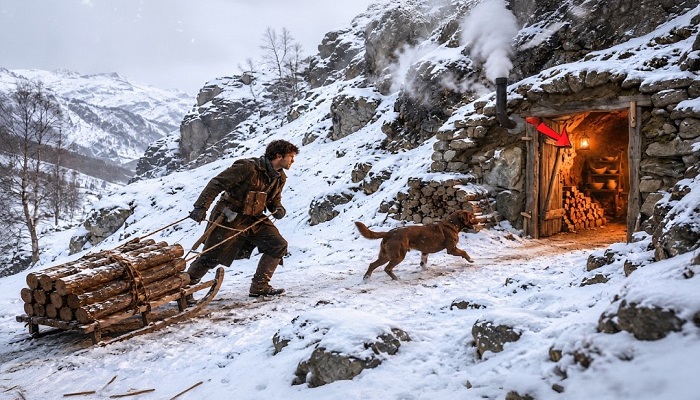
Elias pulled a wooden sled packed with salvaged tools, ropes, blankets, and firewood. Scout ran ahead through drifts, sometimes vanishing completely beneath swirling snow before reappearing again.
The cold bit through Elias’s gloves until his fingers bled.
Still, he pushed forward.
By the afternoon of the second day, they reached the hillside.
The cave entrance barely showed beneath heavy snow and jagged stone. Elias cleared it with a shovel until the old wooden frame he had once built years ago emerged.
Scout barked excitedly.
Warm air drifted from inside.
Elias smiled for the first time in days.
“Well,” he whispered, “guess we found home.”
Inside, the cave was dry and surprisingly spacious. The geothermal warmth rising through cracks in the stone made the air far milder than outside. Not comfortable—but survivable.
Elias immediately got to work.
He reinforced the entrance with timber.
Built shelves into the stone walls.
Created a smoke vent using old metal pipe.
Stacked firewood carefully.
He even carved drainage trenches so melted snow wouldn’t flood the floor.
Scout helped in his own way, carrying small branches and alerting Elias whenever distant animal sounds echoed nearby.
Days passed.
Then weeks.
And the storms grew worse.
Far worse.
Entire forests disappeared beneath white blankets.
Avalanches thundered across the mountains.
The upper road vanished completely.
One evening Elias climbed a ridge overlooking Blackstone Valley.
His stomach dropped.
The town below was nearly invisible beneath snow.
Smoke rose weakly from only a few chimneys.
No wagons moved.
No lanterns glowed on the roads.
“They’re trapped,” he murmured.
Scout whined beside him.
Elias remembered the mocking laughter in the mess hall.
The accusations.
The exile.
Part of him wanted to turn away.
But another part—the stronger part—remembered children living in that valley.
Families.
Old people.
People who didn’t deserve to freeze because arrogant men refused to listen.
By morning he made his decision.
He loaded the sled with firewood, preserved meat, blankets, and medical herbs.
Then he headed toward town.
Blackstone Valley looked like a graveyard.
Snowdrifts buried homes halfway to their roofs. Several cabins had collapsed entirely.
Thin, starving faces stared from windows as Elias passed.
When townspeople recognized him, shock spread immediately.
“It’s Turner…”
“He came back?”
“Dear God…”
At the town square, chaos ruled.
Supplies were nearly gone.
The trading warehouse stood empty.
Children huddled beside weak fires while exhausted mothers wrapped them in curtains and old sacks.
Mayor Clayton Reeves looked ten years older.
The moment he saw Elias, shame flickered across his face.
“You…”
“You underestimated winter,” Elias said flatly.
Clayton lowered his head.
Three people had already frozen to death.
Another six were sick.
And the storms showed no sign of stopping.
“The lower mines collapsed yesterday,” Clayton admitted quietly. “We can’t reach the pass. We can’t hunt. Half the firewood’s gone.”
Elias looked around.
Panic filled every corner of the square.
“How many people?”
“Forty-three.”
Scout barked sharply as another gust of snow swept through town.
Elias took a long breath.
“There’s shelter in the western ridge.”
Clayton blinked. “What?”
“A cave. Warm enough to survive winter. But we move now.”
One man stepped forward suspiciously. “Why would you help us after what we did?”
Elias stared at him.
“Because freezing people don’t care who won arguments.”
For a moment, nobody spoke.
Then an older woman began crying softly.
Within an hour, the evacuation started.
The journey to the cave became a desperate march against death itself.
Snow hammered the valley relentlessly.
Elias led the way with Scout scouting ahead through drifts and hidden ice. Families pulled handmade sleds loaded with children and blankets. Some elderly townspeople had to be carried.
Several times people nearly collapsed.
Each time Elias forced them onward.
“Keep moving!”
A teenage boy stumbled into deep snow.
Elias dragged him free.
A mother lost feeling in her hands.
Elias wrapped them against heated stones from his supply bag.
By nightfall they finally reached the ridge.
When Elias opened the heavy wooden cave door, warm air rolled outward like salvation itself.
Gasps echoed behind him.
Inside, lanterns illuminated stacked firewood, sleeping areas, preserved food, and a glowing stone fire pit.
“It’s… warm,” someone whispered.
Children rushed inside first.
Several adults openly cried.
Scout trotted proudly through the entrance as if he personally owned the place.
For the first time in weeks, people slept without fearing they would die before morning.
Winter became merciless.
Storm after storm buried the mountains.
At one point the snow outside reached nearly twelve feet high.
But the cave endured.
Elias organized food rationing carefully.
He taught men how to reinforce walls and gather safe snowmelt water.
Women helped preserve remaining meat.
Teenagers collected wood from nearby deadfall forests during calmer weather.
The cave slowly transformed into a functioning underground refuge.
And something else changed too.
The townspeople stopped seeing Elias as the strange mountain man they once mocked.
They began seeing him as their reason for survival.
One evening Mayor Clayton approached Elias near the fire.
The older man looked exhausted.
“I was wrong,” he admitted quietly.
Elias kept sharpening his knife.
“I know.”
Clayton swallowed hard. “Pride blinded me.”
“You weren’t the only one.”
The mayor stared into the flames.
“When this winter ends… Blackstone won’t forget what you did.”
Elias finally looked at him.
“I didn’t save people for gratitude.”
“Then why?”
Elias glanced around the cave.
Children slept peacefully beneath blankets.
Families shared soup.
Scout rested beside the fire while a little girl scratched behind his ears.
“Because mountains don’t care about pride,” Elias said softly. “Out here, people survive together—or not at all.”
Clayton lowered his eyes.
For the first time in his life, the mayor truly understood humility.
By February, food supplies became dangerously low.
The storms had destroyed nearly all wildlife migration routes.
Even Elias began worrying.
Then one morning Scout started barking furiously near the cave entrance.
Elias grabbed his rifle and stepped outside.
What he saw made him freeze.
A supply convoy.
Three massive snow wagons pushed through the valley below.
The state rescue teams had finally reached Blackstone.
The surviving townspeople erupted into cheers.
Some collapsed crying from relief.
Rescuers later admitted they expected to find corpses.
Instead they discovered an organized refuge hidden inside the mountain.
Forty people alive.
All because one man prepared when nobody else would.
News spread quickly after winter ended.
Reporters traveled from distant cities to hear the story of the “Mountain Refuge.”
People called Elias a hero.
He hated the attention.
But the town insisted on rebuilding his cabin bigger than before.
This time, nobody laughed at his warnings.
And every autumn after that, when Elias spoke about weather signs, the entire valley listened carefully.
Years later, children who survived that terrible winter still remembered the sight of a lone man pulling a sled through endless snow with a loyal brown dog beside him.
Not running away from danger.
But walking straight into it.
Because sometimes the people called liars are simply the only ones brave enough to speak the truth before disaster arrives.
And sometimes salvation isn’t found in grand cities or powerful leaders.
Sometimes it waits quietly inside a hidden cave in the mountains… built by the very man everyone cast aside.