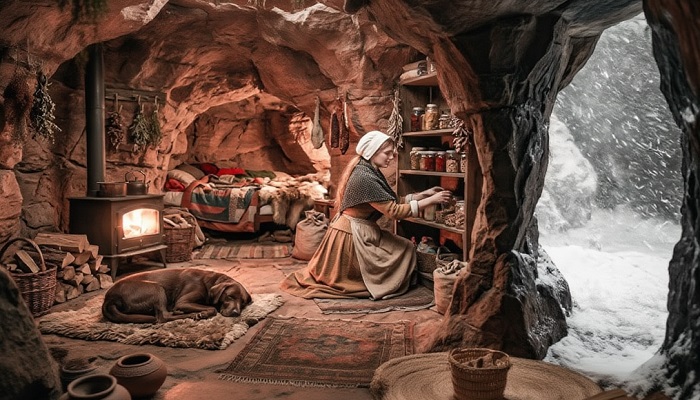
At 17 She Was Cast Out Before Winter — She Secretly Stockpiled Food in a Cave and Beat the Blizzard
Not the soft, drifting kind that children chased with mittened hands. This snow arrived sharp as broken glass, carried on a screaming November wind that rattled windows and buried wagon trails before dawn. Folks in the Montana Territory muttered that winter had come angry.
The first snow came early that year.
And seventeen-year-old Clara Whitmore had nowhere to go.
She stood at the edge of the yard with a canvas sack clutched to her chest while snowflakes tangled in her pale hair. Behind her, the farmhouse door slammed shut hard enough to shake the lantern hanging beside it.
“Don’t come back,” her stepfather barked from inside. “You eat more than you earn.”
The words struck harder than the cold.
Clara stayed still for a long moment, staring at the thin line of smoke curling from the chimney. Warmth lived in that house. Bread lived there. Firelight. But none of it belonged to her anymore.
Inside, she could hear laughter.
Her stepbrothers.
Waiting for supper.
She swallowed against the ache in her throat and turned toward the mountains.
The wind howled behind her like something victorious.
By sunset, her boots were soaked through.
The forest west of Bitterroot Valley stretched dark and endless beneath the storm clouds. Pine trees groaned under gathering snow while the narrow trail disappeared inch by inch.
Clara’s fingers had gone numb hours earlier.
Still, she kept walking.
Because stopping meant freezing.
She carried only what she could fit into one sack: two dresses, a frying pan, a sewing needle, a Bible that had belonged to her mother, and three potatoes wrapped in cloth.
No horse.
No wagon.
No home.
The cold deepened as dusk settled over the mountains. Clara stumbled over hidden stones and nearly fell into a creek glazed with thin ice. Her breathing came ragged now, white clouds spilling from cracked lips.
Then she heard it.
Water.
Not the gentle trickle of a stream, but the roar of falling water echoing through stone.
She pushed through a cluster of snow-heavy cedars and froze.
Ahead stood a narrow waterfall spilling over black rock into a half-frozen pool. Behind the curtain of water, hidden in the cliffside, darkness opened like a doorway.
A cave.
Clara stared at it in disbelief.
The wind screamed across the ridge, shoving icy needles into her face. She looked back once toward the valley below.
No lights.
No shelter.
No choice.
She stepped into the freezing water and pushed through the waterfall.
The cave beyond was larger than she expected.
Dry, mostly.
Cold, certainly—but sheltered from the wind.
The ceiling curved high overhead, blackened in places from old smoke. Someone had once used this place long ago. Near the back wall lay the remains of a broken wooden crate and a rusted lantern.
Clara dropped her sack and sank to her knees.
For the first time all day, silence wrapped around her.
Not safety.
But possibility.
That night she burned pine needles in the rusted lantern and ate half a raw potato while wrapped in both dresses she owned. The stone floor leached warmth from her bones. Sleep came in painful bursts.
By dawn, snow blocked most of the cave entrance.
Clara stared out at the white wilderness beyond the waterfall and realized something terrible.
Winter wasn’t coming.
It was already here.
And unless she found a way to survive, nobody would ever find her body until spring thaw.
The thought should have broken her.
Instead, something hard settled inside her chest.
Fine, she thought.
Then I’ll survive anyway.
The next weeks became a battle against the mountain.
Every morning Clara descended into the forest carrying a rope basket she’d woven from willow branches. She gathered mushrooms from fallen logs, trapped rabbits using bent saplings, and dug edible roots from beneath frozen earth.
She learned quickly because hunger taught quickly.
When she found an abandoned mining camp two miles north, she nearly cried with relief. Most cabins had collapsed, but inside one she discovered treasures: old mason jars, rusted tools, a cracked shovel, and sacks of salt hard as stone.
She carried everything back piece by piece.
By December, the cave had begun transforming.
Wooden shelves lined the walls.
Bundles of dried herbs hung from ceiling beams beside strips of rabbit meat curing in smoke. Clara scrubbed the mason jars clean and filled them with preserved berries, roots, and creek trout she caught beneath the ice.
She even found an old cast-iron stove discarded behind the mining camp.
Dragging it through snow nearly killed her.
But when she finally lit a fire inside it, warmth flooded the cave so suddenly she burst into tears.
Not delicate tears.
Great gasping sobs from somewhere deep and wounded.
Because for the first time since her mother died, Clara had built something that belonged only to her.
One evening, during a heavy snowfall, she heard growling near the entrance.
Clara grabbed the fireplace poker and spun around.
A dog stood just beyond the waterfall.
Thin.
Mud-colored.
One ear torn.
The animal stared at her with exhausted amber eyes.
“Go on,” Clara whispered nervously.
The dog swayed where it stood.
Then collapsed.
Clara approached carefully. The creature’s ribs showed beneath patchy fur. Probably abandoned by hunters. Maybe beaten.
Maybe forgotten like she was.
The dog trembled violently when she carried it inside.
“It’s all right,” she murmured.
She fed it scraps of rabbit and wrapped it in an old wool blanket near the stove.
By morning, the dog refused to leave her side.
She named him Ash.
Winter tightened its grip across Montana.
Storm after storm buried the valley. Travelers disappeared on mountain roads. Entire barns collapsed under snow weight. Folks in town later said it was the worst blizzard season in twenty years.
But inside the cave, Clara endured.
Not comfortably.
Never comfortably.
The cold still found ways inside.
Sometimes ice formed along the cave walls overnight. Sometimes smoke filled the chamber and made her eyes burn. Once, a storm trapped her inside for six straight days with barely enough firewood remaining.
But she adapted.
She stacked extra wood beneath tarps.
Stored melted snow in clay pots.
Learned how to smoke meat properly.
Learned which moss could start fires fastest.
Learned that loneliness could ache worse than hunger if you let it.
So she kept busy.
At night she read her mother’s Bible aloud while Ash slept beside the stove. The sound of her own voice helped keep the darkness away.
Christmas came unnoticed except for the heavy snow and silence.
On New Year’s Eve, Clara climbed onto the cliff above the waterfall and looked down at the valley below. Tiny lantern lights flickered miles away in Bitterroot like fallen stars.
People were celebrating.
Dancing.
Eating.
Living.
And not one of them knew she was alive.
For a moment bitterness rose sharp in her throat.
Then Ash barked behind her, chasing snowflakes across the rocks, and Clara laughed despite herself.
It startled her.
She hadn’t heard herself laugh in months.
By January, rumors spread through the valley about a “mountain ghost.”
Hunters claimed smoke rose from the cliffs after storms. One trapper swore he’d seen lantern light behind the waterfall.
Most folks dismissed it.
Except for Deputy Elias Boone.
Elias was thirty-two, broad-shouldered, and quieter than most men in town. He’d survived two winters alone during railroad work farther north, and he knew what desperation looked like.
So when he spotted footprints near the frozen creek one afternoon, he followed them.
They led straight to the waterfall.
Elias stepped through cautiously, hand near his revolver.
Then stopped dead.
The cave glowed warm with firelight.
Glass jars lined handmade shelves.
Herbs hung drying from wooden beams.
A colorful blanket covered a bed tucked into the rocky wall.
And kneeling beside the stove, wearing a dark shawl with flour dust on her apron, was a young woman staring at him in terror.
Ash exploded into barking.
Clara grabbed the poker again.
“Please leave,” she said immediately.
Elias slowly raised both hands.
“I’m not here to harm you.”
“You shouldn’t have followed me.”
“Probably true.”
Snow hissed beyond the waterfall while silence stretched between them.
Elias took in the shelves of preserved food.
The stacked firewood.
The careful order of everything.
Realization crossed his face.
“You survived out here alone?”
Clara tightened her grip on the poker. “I survived because nobody helped me.”
The words hit harder than accusation.
Elias noticed then how young she truly looked.
Too young for eyes that tired.
He removed his gloves slowly.
“There’s a blizzard coming tonight,” he said. “A bad one.”
“I know.”
“You have enough supplies?”
“Yes.”
Another silence.
Then Ash wandered toward Elias and sniffed his boots.
Traitor.
Elias smiled faintly.
“Well,” he murmured, scratching behind the dog’s ear, “that’s usually the hardest interview.”
Clara almost smiled despite herself.
Almost.
The storm arrived after sunset with terrifying force.
Wind battered the cliffside hard enough to shake snow loose from the cave ceiling. Elias had intended to leave before dark, but the mountain made the decision for him.
“No trail visibility now,” he admitted grimly.
Clara hesitated.
Then pointed toward the stove.
“You can stay until morning.”
Together they reinforced the entrance with extra canvas and stacked wood near the fire. Snow hammered the waterfall outside until the world vanished white.
Hours passed.
They shared rabbit stew from a black iron pot while Ash slept on the rug.
For the first time in months, Clara spoke more than necessary.
She told him about her mother dying of fever.
About her stepfather drinking away the farm money.
About the night she’d been thrown out before winter.
Elias listened without interruption.
When she finished, he stared into the fire a long while.
“You know,” he said quietly, “most grown men wouldn’t survive what you did out here.”
Clara shrugged. “Dying sounded unpleasant.”
He laughed softly at that.
The sound warmed the cave almost as much as the fire.
Near midnight, the blizzard worsened.
A thunderous crack echoed outside.
Clara shot upright.
Avalanche.
Snow and ice thundered across the mountainside with horrifying force. The cave trembled violently. Dust rained from the ceiling.
Then silence.
Heavy.
Wrong.
Elias pushed through the entrance barrier moments later and returned pale-faced.
“The pass is gone,” he said.
“What?”
“Completely buried.”
Clara’s stomach dropped.
That pass connected the valley supply route to three mountain homesteads.
Families.
Children.
Cut off now in the dead of winter.
Elias looked toward the shelves lining the cave walls.
Toward the jars.
The dried meat.
The potatoes stored beneath blankets.
Understanding dawned slowly across Clara’s face.
“You think they’ll starve.”
“I think,” Elias said carefully, “you may be the only reason they don’t.”
The next morning, Clara made a decision that changed everything.
While most people in Bitterroot had hidden indoors waiting out the storms, the seventeen-year-old girl they’d abandoned loaded a sled with preserved food and medicine.
Then she climbed into the blizzard beside Elias Boone.
For three days they crossed buried trails delivering supplies to isolated cabins.
Clara knew where to find hidden game paths.
Where snow crust would hold weight.
Where the wind carved safer routes through the cliffs.
Again and again, families opened their doors expecting death—
And found her instead.
A thin girl in a dark shawl with snow frozen in her hair and determination burning in her eyes.
By the time the storms finally eased, the entire valley knew her name.
Not as the unwanted orphan.
Not as the burden cast out before winter.
But as the girl who beat the mountain.
When spring thaw finally arrived, wildflowers bloomed around the waterfall outside Clara’s cave.
People came often then.
Bringing lumber.
Blankets.
Fresh bread.
Someone even painted a wooden sign near the trail entrance:
WHITMORE PASS SHELTER
Clara stared at it a long time.
“You know,” Elias said beside her, “most folks would’ve left this mountain behind.”
Ash barked happily while chasing butterflies through melting snow.
Clara looked back toward the cave.
At the shelves she’d built with frozen hands.
The stove that had kept her alive.
The rocky alcove bed where she’d cried herself to sleep that first terrible night.
“No,” she said softly.
“This place saved me first.”