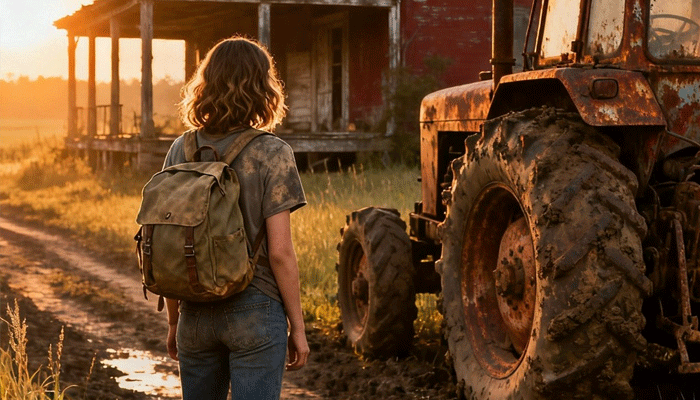
I Left Reform School With Nothing But a Trash Bag, Bought a $100 Farm, and Found the Cash That Proved Everyone Lied
My mother watched me leave reform school with a trash bag in my hand and said, “Don’t come home unless you learned how to disappear.”
Then she turned to my little brother and handed him the keys to my old bedroom.
Twenty-four hours later, I bought a dead farm for one hundred dollars and found $8,400 hidden inside an old tractor.
Not buried in the dirt.
Not tucked behind a wall.
Hidden under the metal seat of a rusted red tractor that hadn’t moved since before I was born.
And the money wasn’t the strangest part.
The strangest part was the note wrapped around it.
CALEB MERCER—IF YOU FOUND THIS, THEY LIED TO YOU.
I stood there in the barn, nineteen years old, wearing state-issued boots, with my prison haircut still fresh on my head and a storm pushing cold rain through the broken roof.
For the first time in two years, nobody was shouting at me.
Nobody was counting down.
Nobody was telling me I was trouble, trash, violent, hopeless, defective, ungrateful, ruined.
Just rain.
Just the smell of old hay.
Just that envelope in my shaking hand.
And my name, written by someone who had known I would come.
I didn’t cry.
Reform school had taught me better than that.
At Stillwater Boys’ Academy, tears were treated like evidence.
Evidence you were weak.
Evidence you were lying.
Evidence somebody could use to make the next day worse.
So I stood very still.
I counted my breathing.
I counted the bills.
Eighty-four hundreds.
Old, clean, folded flat.
Then I read the note again.
CALEB MERCER—IF YOU FOUND THIS, THEY LIED TO YOU.
The handwriting leaned hard to the right, like whoever wrote it had been angry or in a hurry.
There was one more line underneath.
DON’T SELL THE FARM. DON’T TRUST HARLAN VALE.
I didn’t know a Harlan Vale.
Not yet.
But before sunrise, he would be standing in my driveway wearing a black raincoat and offering me ten thousand dollars cash for the land I had just bought for one hundred.
That was when I knew the farm wasn’t dead.
It was hiding something.
The auction had been held behind the county courthouse in Lowden, Kansas, under a gray sky that looked like wet newspaper.
Nobody wanted the farm.
That should have warned me.
The auctioneer didn’t even bother standing on a platform. He leaned against his pickup with a clipboard, calling out parcels like he was reading a grocery list.
“Parcel 17. Mercer Creek Road. Forty-two acres. Abandoned farmhouse. Collapsed well house. One barn. One equipment shed. Tax delinquent. No warranty. No inspection. Minimum bid, one hundred dollars.”
People laughed.
A man in a John Deere cap muttered, “Burn it and salt it.”
Another said, “Ain’t worth the gas to drive out there.”
I stood at the edge of the crowd with my trash bag between my boots.
Inside the bag were three shirts, two pairs of socks, a comb missing teeth, a paperback Bible I never opened, and a folder of release papers that said I had completed a court-ordered residential behavioral correction program.
That was the polite wording.
Stillwater Boys’ Academy had called us residents.
The guards called us animals.
My mother called me proof that bad blood never skips.
I had ninety-six dollars in my pocket when they released me.
The last four dollars came from an old man outside the bus station who bought my academy-issued belt because he said it looked “sturdy.”
That gave me exactly one hundred.
The auctioneer looked right past me.
“Any bids?”
Silence.
A crow landed on the courthouse roof.
“One hundred?” he said. “Anybody? Hundred dollars for forty-two acres and a structure.”
A woman near the front laughed. “Structure? That house is one stiff breeze from being firewood.”
The auctioneer gave a tired smile.
I lifted my hand.
Every head turned.
The man in the John Deere cap looked me up and down.
“Boy, you lost?”
“No, sir,” I said.
“You got money?”
I pulled the folded bills from my pocket.
Four twenties.
Two fives.
Ten ones.
The auctioneer stared at my hand like I’d shown him a dead mouse.
“Name?”
“Caleb Mercer.”
That changed the air.
Not a lot.
Just enough.
The woman stopped smiling.
The man in the cap looked away.
Someone whispered, “Mercer?”
I had heard that tone my whole life.
Like my last name came with a smell.
Like people knew a story about me I had never been allowed to hear.
The auctioneer cleared his throat.
“One hundred to Caleb Mercer. Any other bids?”
Nobody spoke.
“Going once.”
Rain started tapping the courthouse steps.
“Going twice.”
A truck door slammed somewhere down the street.
“Sold.”
The gavel was just the flat of his clipboard against his palm.
That was how I became a landowner.
No applause.
No congratulations.
Just a wet paper deed and the auctioneer telling me the county wasn’t responsible if the roof fell in while I was under it.
I took the deed.
I folded it carefully.
Then I walked nine miles to Mercer Creek Road because I didn’t have bus money anymore.
Nine miles gives a man time to think.
I thought about my mother’s face that morning.
She had come to Stillwater because the state required a family pickup or a signed release waiver.
She arrived thirty minutes late in her church dress, smelling like vanilla perfume and cigarette smoke, with her new husband Leonard waiting in the car.
Leonard didn’t come inside.
He never came inside when things got ugly.
He preferred to sit outside and let my mother do the cutting.
The counselor, Mrs. Pike, sat behind her desk and smiled like she was watching a successful graduation.
“Caleb has completed the program,” she said. “He’ll need structure. Work. A stable home environment.”
My mother laughed once.
Sharp.
“Stable? He put his stepfather through a glass door.”
I looked at the floor.
Leonard had not gone through a glass door.
Leonard had tripped backward after I shoved him off my twelve-year-old brother, Noah.
Noah had been on the kitchen floor with blood under his lip.
Leonard had been raising his belt again.
I was sixteen.
I hit him once.
He fell into the storm door.
The glass cracked.
By the time the police arrived, Leonard was the victim, my mother was crying, Noah was silent, and I was the son everyone had been expecting to become violent eventually.
At Stillwater, the truth didn’t matter.
Only the file mattered.
And my file had been thick before I ever touched Leonard.
Fighting at school.
Stealing food.
Running away twice.
Breaking a boy’s nose behind the gym because he called Noah slow.
A judge looked at the file and saw a pattern.
Nobody looked at Noah’s lip.
Nobody looked at Leonard’s belt.
Nobody looked at my mother’s dry eyes after the ambulance left.
In Mrs. Pike’s office, my mother signed the release papers without reading them.
Then she stood.
“Your things are in the garage,” she said to me. “Don’t come by the house.”
“Noah there?” I asked.
Her mouth tightened.
“Noah needs peace.”
“I want to see him.”
“No.”
“Just five minutes.”
“I said no.”
Mrs. Pike glanced between us.
My mother leaned closer to me, keeping her voice soft.
That was how she hurt people best.
Soft enough that witnesses had to guess.
“You ruin everything you touch, Caleb. Your father knew it. I know it. Noah is finally doing better without you dragging him down.”
My father had died when I was seven.
A grain elevator accident.
At least that was the story.
I remembered boots by the door.
I remembered my mother throwing away his work shirts.
I remembered the way people stopped talking when I came into rooms.
Mostly, I remembered an old red tractor key in his palm.
He had closed my fingers around it the summer before he died.
“Some things look broke because the right person hasn’t fixed them yet,” he’d told me.
I wore that key on a piece of twine under my shirt until Leonard ripped it off me at fourteen and threw it into the burn barrel.
At least, I thought he had.
That memory came back to me as I walked toward the farm.
Rain soaked my academy jacket.
Mud swallowed my boots.
A semi passed and sprayed ditch water up my legs.
I kept walking.
I did not look back toward town.
I did not call my mother.
I did not go to the house where my little brother slept in my old room.
I had one paper deed.
One trash bag.
One hundred dollars gone.
And my name on forty-two unwanted acres.
The farm sat at the end of Mercer Creek Road behind a sagging wire gate.
The mailbox leaned sideways with no door.
The house was two stories, white once, gray now, with half the porch missing and vines crawling through the windows like fingers.
The barn stood behind it, bigger than the house, its roof bowed but not broken all the way through.
Beyond that were fields gone wild with Johnson grass, hedge saplings, and rusted fence posts.
I stood at the gate until the rain ran down my neck.
“Home,” I said.
The word sounded stupid.
So I said it again.
“Home.”
The gate was chained but not locked.
That felt like a test.
I unwound the chain and dragged it open.
The hinges screamed loud enough to scare blackbirds from the cottonwoods along the creek.
Inside the house, the front room smelled like mouse droppings, mildew, and old smoke.
Someone had stripped the copper pipes.
The kitchen cabinets hung open.
There was a mattress in the corner with stuffing ripped out and a raccoon nest in the springs.
On the wall by the stairs, somebody had spray-painted:
MERCER TRASH ALWAYS COMES BACK.
I stared at it for a long time.
Then I set my trash bag down.
I found a broom with no handle in the pantry.
I used it anyway.
That was the first thing I did as a free man.
I swept glass into a pile.
Not because it fixed anything.
Because it was mine.
By dark, I had cleared a corner of the front room, dragged the raccoon mattress outside with a rope, and found three cans of peaches in the cellar that were only two years expired.
I ate one with a screwdriver.
Rain hammered the roof.
Water dripped into four different buckets I had found in the shed.
I slept on the floor with my jacket under my head and the deed folded inside my shirt.
I dreamed of Stillwater.
I dreamed of the white hallway outside Dorm C.
I dreamed of Mr. Briggs, the night supervisor, tapping his baton against his boot and saying, “Count your breaths, Mercer. Men like you survive by counting.”
One.
Two.
Three.
Wake up.
I woke before dawn to headlights coming through the broken front window.
For one second, my body thought I was back at Stillwater.
Lights meant inspection.
Lights meant somebody had decided you did something.
Lights meant stand up, hands visible, don’t talk back.
I rolled to my feet.
Outside, a black Ford pickup idled in the mud.
A man stepped out wearing a raincoat that probably cost more than the farm.
He was tall and narrow, with silver hair combed straight back and a face that looked friendly from far away.
Up close, it wasn’t friendly.
It was practiced.
“Caleb Mercer?” he called.
I stepped onto the porch.
One board cracked under my boot.
“Yes, sir.”
He smiled.
“Harlan Vale.”
I kept my face still.
The note was in my pocket.
DON’T TRUST HARLAN VALE.
He held up both hands like he wanted to show he wasn’t dangerous.
Men who do that usually are.
“I own Vale Agricultural Holdings,” he said. “Land management. Development. Equipment resale. I’m sorry to show up so early, but I heard what happened at auction yesterday.”
“News moves fast.”
“In a town like Lowden? Faster than blood.”
He chuckled.
I didn’t.
His eyes moved over the house, the barn, the fields.
Not with disgust.
With hunger.
“That place is a liability,” he said. “County should’ve condemned it ten years ago.”
“Maybe.”
“I’ll make this easy. Ten thousand cash. Today. You sign a quitclaim deed, I tow off the junk, and you walk away with a fresh start.”
I leaned against the porch post, testing how much weight it had left.
“Why?”
He blinked.
“Why what?”
“Why offer ten thousand for a farm everybody laughed at yesterday?”
His smile widened a little too much.
“Sentiment.”
“For my family?”
“For the county,” he said. “Eyesores hurt everyone.”
“You buy a lot of eyesores before breakfast?”
The smile thinned.
“You’re young. I understand suspicion. The world hasn’t been kind to you.”
That sentence told me he knew about Stillwater.
I watched a drop of rain slide off his sleeve.
“How much do you know about me, Mr. Vale?”
“Enough to know you don’t want to spend your first week of freedom freezing in a condemned house with no money.”
“I spent two years sleeping under cameras with a boy named Travis Kline who sharpened toothbrushes for fun. I can handle cold.”
For the first time, something real moved across Harlan Vale’s face.
I had surprised him.
Good.
He reached into his coat and pulled out a white envelope.
He placed it on the porch rail.
“Ten thousand.”
I didn’t touch it.
“Offer expires when I leave.”
“Then drive careful.”
His jaw tightened.
The rain softened to mist.
For a moment, we stood there listening to his truck engine.
Then he said, “Your father should have taken the offer too.”
My fingers curled around the porch post.
Not much.
Just enough to feel splinters.
“You knew my father?”
“Everybody knew Daniel Mercer.”
“How?”
Harlan looked toward the barn.
That was the first mistake he made.
Only half a second.
But enough.
“He was stubborn,” Harlan said. “Like you.”
“What did he refuse?”
He smiled again, but now it had no warmth at all.
“A way out.”
He picked up the envelope, tucked it back inside his coat, and walked to his truck.
At the door, he turned.
“Old farms eat boys alive, Caleb. Especially boys with records. One accident, one trespassing complaint, one little misunderstanding with the sheriff, and the judge who released you can reconsider your placement.”
There it was.
The shape of the threat.
Not loud.
Not dramatic.
Just paperwork.
Men like Harlan Vale didn’t need to swing fists.
They had forms for that.
I said nothing.
He got in his truck and backed down the drive.
When his taillights vanished beyond the gate, I walked straight to the barn.
The barn doors were swollen shut.
I found a crowbar under a collapsed workbench and pried until the left door gave with a groan.
Dust lifted in the gray morning light.
The barn was full of things people had decided were worthless.
Broken hay rake.
Stacks of cracked wooden crates.
A seed drill with one wheel missing.
Glass jars.
Rotten harness leather.
A refrigerator from the 1950s.
And under a canvas tarp near the back, an old red tractor.
It was smaller than I expected.
Rounded hood.
Faded paint.
Flat rear tire.
Steering wheel cracked like dry skin.
The front badge was dirty, but I rubbed it with my thumb until the letters showed.
MASSEY FERGUSON 35.
My chest tightened.
My father had loved old machines.
He said new machines had computers, but old ones had manners.
If they failed, they told you why.
I pulled the tarp off the rest of it.
A family of mice scattered under the rear axle.
The tractor smelled like grease, dust, and time.
I climbed onto the metal seat.
It shifted under me.
Not loose.
Wrong.
At Stillwater, you learned to notice wrong things.
A bunk that sat half an inch away from the wall meant contraband.
A guard smiling during breakfast meant searches.
A boy too quiet after mail call meant a fight before lights out.
Wrong things kept you alive if you respected them.
I got off the tractor and lifted the seat.
Nothing.
Just rust and bolts.
But when I pressed the underside, the metal flexed.
There was a plate.
A false plate.
I found a screwdriver in a coffee can on the workbench and worked at the screws until my knuckles bled.
The plate dropped into my hand.
Behind it was a flat oilcloth packet sealed with black tape.
Inside was the money.
$8,400.
And the note.
CALEB MERCER—IF YOU FOUND THIS, THEY LIED TO YOU.
DON’T SELL THE FARM. DON’T TRUST HARLAN VALE.
Under the note was a smaller piece of paper.
A receipt.
Lowden County Storage Units.
Unit 12.
Paid through June.
Name on account: Daniel Mercer.
My father.
The receipt was dated three weeks before his death.
I sat down on the barn floor.
Outside, the rain stopped.
Somewhere in the rafters, a bird shifted.
For two years, I had been told my life broke because I was built wrong.
Because I had Mercer anger.
Mercer violence.
Mercer blood.
But that morning, in a barn nobody wanted, with rust dust on my hands and hidden money in my lap, I saw the first crack in the story.
Somebody had left me a trail.
Not my mother.
Not Leonard.
Not the county.
My father.
Or somebody who knew him.
I folded the money back into the oilcloth.
I put $400 in my sock.
I hid the rest inside a cracked feed bin under a pile of bent nails.
Then I put the note in my shirt pocket and went to work.
A secret is only useful if nobody knows you found it.
By noon, I was in Lowden.
I walked because I still didn’t own a vehicle.
Main Street had a diner, a feed store, a hardware store, two churches, one bank, and the kind of silence small towns use when they’re listening.
People looked at my boots.
Then my face.
Then away.
I went into the hardware store first.
The bell over the door rang.
An old woman behind the counter glanced up from a crossword puzzle.
She had white hair in a braid and arms roped with muscle under her flannel shirt.
“What do you need?” she asked.
“Roof patch. Nails. Work gloves. A five-gallon gas can. Cheapest you’ve got.”
She studied me.
“You the Mercer boy?”
“Yes, ma’am.”
“Which one?”
“Caleb.”
Her pencil stopped.
“Well,” she said. “That makes you Daniel’s.”
I waited for the disgust.
It didn’t come.
She stood and limped toward the aisle.
“Your daddy once fixed my grain auger in a hailstorm. Wouldn’t take money. Said I could pay him in peach pie.”
I swallowed.
“Yes, ma’am.”
“You handy?”
“A little.”
“You hungry?”
I didn’t answer fast enough.
She snorted.
“Thought so.”
“I can pay.”
“Didn’t ask if you could pay.”
She pulled supplies from shelves and set them on the counter.
The total came to $63.40.
I gave her one of the hundreds.
Her eyes sharpened.
“Where’d you get that?”
“Sold something.”
“What?”
“A belt.”
“For a hundred dollars?”
“Very sturdy belt.”
For one second, she looked like she might laugh.
Instead she made change.
“Name’s Ruth Bell. Folks call me Miss Ruth if they’ve got sense.”
“Thank you, Miss Ruth.”
She pushed a paper sack across the counter.
Inside were two ham sandwiches wrapped in wax paper.
“I didn’t charge you for those because I didn’t sell them to you.”
“Yes, ma’am.”
“And Caleb?”
I paused at the door.
She nodded toward the street.
“Don’t let Harlan Vale catch you looking scared.”
“I’m not scared.”
“That’s not what I said.”
Outside, I stood under the awning and ate one sandwich in four bites.
Across the street, a sheriff’s cruiser rolled slowly past.
The deputy inside looked at me.
I looked back.
He did not wave.
That afternoon, I patched the worst roof holes, cleared broken glass from the kitchen, and found a hand pump behind the house that coughed brown water for ten minutes before running clear enough to boil.
At dusk, a pickup rattled up the drive.
I set the hammer down within reach.
A girl my age climbed out carrying a cardboard box.
Not girl.
Woman, maybe.
Hard to tell from twenty yards away.
She wore muddy jeans, a Carhartt jacket, and her dark hair tucked under a ball cap that said BELL HARDWARE.
Miss Ruth’s family.
She stopped near the porch.
“You Caleb?”
“Yes.”
“I’m Nora Bell. Grandma sent a box.”
I didn’t move.
“What’s in it?”
She lifted an eyebrow.
“Food. A lantern. Coffee. Unless you consider those weapons.”
“I’ve seen coffee used as a weapon.”
That time, she smiled.
Just a little.
She set the box on the porch but did not step closer.
Smart.
People who rush kindness usually want something for it.
“My grandma says Daniel Mercer was a decent man,” Nora said.
I looked past her toward the fields.
“People keep saying his name like I should know what he was to them.”
“You don’t?”
“He died when I was seven.”
“Right.”
Her face changed.
Not pity.
Calculation.
Like she was deciding which truth could be safely handed to me.
“What?” I asked.
She shook her head.
“Nothing.”
“You drove out here after dark for nothing?”
“My grandma told me to.”
“And you always do what she says?”
“When she uses the quiet voice? Yeah.”
A dog barked far away.
Nora glanced at the barn.
“You going to sell to Vale?”
“No.”
“Good.”
“Why?”
She looked back at me.
“Because he never offers money unless he expects to make ten times more.”
“That’s business.”
“No,” she said. “Business leaves something standing.”
Then she got in her truck and drove away.
I watched until the taillights disappeared.
Inside the box were two jars of soup, a lantern, matches, coffee, a blanket, and a folded note from Miss Ruth.
Eat before pride kills you.
I laughed once.
It sounded strange in the empty house.
That night, I slept with the hammer beside my hand.
At 2:13 a.m., someone walked across my porch.
The board by the door had a split in it.
I knew because I had stepped on it all afternoon.
It made a sharp little pop.
That sound woke me.
My eyes opened.
I did not move.
Another step.
Slow.
Then the doorknob turned.
I had wedged a kitchen chair under it.
The chair creaked.
The knob stopped.
A whisper outside.
Male.
Then a thin beam of light passed across the broken window frame.
Not a flashlight.
Phone light.
Amateur.
At Stillwater, boys who sneaked around after lights out always made two mistakes.
They breathed too hard.
They forgot floors talked.
I rolled silently toward the wall, picked up the hammer, and waited.
Glass crunched outside.
The phone light slid into the room through the window.
A hand followed.
Searching for the latch.
I stood, stepped forward, and brought the hammer down hard on the windowsill an inch from his fingers.
The hand vanished.
A man cursed.
I kicked the bottom of the wall under the window.
Hard.
The rotten siding cracked outward.
Someone stumbled off the porch.
I went out the back door and around the side of the house barefoot.
Two figures were running toward the drive.
One was short and heavy.
The other tall and limping.
“Tell Vale he should hire quieter men,” I called.
They froze.
Only for half a second.
Then they ran faster.
A truck started beyond the gate and tore away without headlights.
I stood in the wet grass until the engine faded.
Then I went back inside, lit the lantern, and checked the room.
Nothing taken.
Because they hadn’t gotten in.
Or because they weren’t there for the house.
I looked through the broken back window toward the barn.
The door stood open.
I grabbed the lantern and ran.
The feed bin was undisturbed.
The tractor was untouched.
But the old workbench drawer hung open.
I had not opened that drawer.
Inside was a single clean rectangle in the dust.
Something had been there for years.
Now it was gone.
I slept no more that night.
At sunrise, I took the receipt for Unit 12, tucked the $8,000 under my shirt, and walked into Lowden.
The storage place sat behind the car wash, fenced with chain-link and topped with barbed wire that sagged in three places.
The office was a metal shed with a soda machine out front.
A man with a beard and suspenders sat behind the desk watching a hunting show.
He didn’t look up.
“Need a unit?”
“I need to access one.”
“Name?”
“Daniel Mercer.”
Now he looked up.
“You ain’t Daniel.”
“No, sir.”
“Daniel’s dead.”
“Yes, sir.”
“You got papers?”
I placed the receipt on the counter.
He looked at it.
Then at me.
Then at the receipt again.
“This is old.”
“Paid through June.”
“June twenty years ago.”
I said nothing.
He scratched his beard.
“Unit 12 was cleared.”
My stomach tightened.
“When?”
He leaned back.
“Long time.”
“By who?”
“Don’t remember.”
“You keep records?”
“Some.”
“Can I see them?”
“No.”
I placed one hundred-dollar bill on the counter.
His eyes went to it.
Then back to me.
“That a bribe?”
“No, sir. That’s me paying any storage fees still attached to my father’s account.”
“There ain’t no fees.”
“Then it’s payment for your time looking for old records.”
He watched me for a long moment.
Then he took the bill.
“Wait here.”
He disappeared through a door behind the desk.
On the TV, a man whispered about wind direction while aiming at a deer.
I counted breaths.
One.
Two.
Three.
The storage man returned with a dusty banker’s box.
“Unit 12,” he said. “Rented by Daniel Mercer. Cleared two days after his accident.”
“By who?”
He flipped through papers.
“Harlan Vale.”
My mouth went dry.
“He had authorization?”
“Paper says yes.”
“Signed by my father?”
He turned the page around.
The signature read Daniel Mercer.
But I had seen my father’s handwriting on the note.
This wasn’t it.
This signature was too round.
Too careful.
Forged by someone copying a name, not writing one.
“What was in the unit?” I asked.
“Inventory says farm tools, boxes, tractor parts, personal documents.”
“Who witnessed the release?”
He looked at the paper.
“Deputy Leonard Pike.”
The room narrowed.
Leonard Pike.
My stepfather.
My mother’s husband.
The man I had been sent away for shoving.
Back then, he had been Deputy Pike.
Now he worked courthouse security after a back injury he complained about whenever anyone needed him to lift something.
Harlan Vale and Leonard Pike had cleared my dead father’s storage unit two days after he died.
Then Leonard married my mother three years later.
That was not a twist.
That was a door opening.
I folded my hands so the storage man wouldn’t see them shake.
“Can I get a copy?”
He hesitated.
I placed another hundred on the counter.
“For your copy machine.”
He gave me one page.
Only one.
But it was enough.
Outside, I stood in the alley between the storage office and the car wash.
Soap mist drifted over the pavement.
I read the paper three times.
AUTHORIZED RELEASE OF CONTENTS.
Daniel Mercer signature.
Harlan Vale signature.
Deputy Leonard Pike witness.
Date: September 14.
My father died September 12.
A dead man had signed away his storage unit.
The car wash roared beside me.
For a moment, I saw my mother’s face in Mrs. Pike’s office.
Your father knew it.
I know it.
I wondered which part she knew.
I walked back to the farm by the long way, staying off the main road.
By afternoon, heat lifted steam from the ditches.
My socks rubbed blisters into both heels.
I didn’t care.
I had survived worse pain for less useful reasons.
When I reached the farm, a county truck was parked in my drive.
Not Harlan’s.
White with a seal on the door.
LOWDEN COUNTY CODE ENFORCEMENT.
A man in khakis stood on my porch taking photos.
He had a clipboard.
Of course he had a clipboard.
Men like Harlan Vale loved clipboards.
They made cruelty look organized.
“Can I help you?” I called.
The man turned.
“Caleb Mercer?”
“Yes.”
“Dale Bonner. Code office. We received a complaint.”
“About what?”
“Unsafe structure. Illegal occupancy. Open well hazard. Improper waste storage.”
“I’ve owned it two days.”
“That doesn’t exempt you.”
“No, sir. It explains why the porch still looks like it did when the county sold it to me.”
He frowned.
“You living here?”
“Yes.”
“No certificate of occupancy.”
“It’s a farmhouse, not a shopping mall.”
His pen paused.
“Watch your tone.”
I walked closer, slow.
Not angry.
Angry gives men with clipboards a gift.
“I’m asking for the rules,” I said. “Put them in writing. Tell me what has to be fixed and how long I have.”
He looked disappointed.
Maybe he wanted me to yell.
Maybe he wanted to write “combative” in his notes.
“Seven days to secure openings, mark the well, remove exterior debris, and demonstrate sanitary water access.”
“Fine.”
“Failure means condemnation.”
“Fine.”
“And if the property is condemned, occupancy is prohibited.”
“I understand.”
He snapped more pictures.
Then he looked toward the barn.
“What’s in there?”
“Junk.”
“I’ll need to inspect.”
“No, sir.”
His eyebrows lifted.
“Excuse me?”
“The barn wasn’t in your complaint list. Unless you have a warrant or specific safety citation from a visible exterior hazard, you can stand where you are.”
Dale Bonner stared at me.
That was something Stillwater had given me too.
Not education.
Not kindness.
Policy.
I had read every rulebook I could get my hands on because rules were the only weapons boys like me could touch without getting punished.
Bonner’s mouth tightened.
“You some kind of lawyer?”
“No, sir.”
“Then don’t talk like one.”
“Put the violations in writing.”
He tore a sheet from his clipboard and handed it to me.
As he walked to his truck, he said, “A smart kid would take Vale’s offer.”
I folded the paper.
“A smart county wouldn’t sell condemned property then punish the buyer for owning it.”
He got into the truck without answering.
That evening, Nora Bell came back.
This time she brought two sawhorses, a roll of caution tape, a coil of rope, and a dog.
The dog was yellow, old, and missing half an ear.
“He bites?” I asked.
“Only men who deserve it,” she said.
The dog looked at me and sneezed.
“Name?”
“Sherman.”
“Man or dog?”
“Both, but the dog listens better.”
She unloaded the sawhorses.
“Grandma heard Bonner came out.”
“Town talks fast.”
“Town talks loud when Vale wants it to.”
I took the rope.
“I can pay for this.”
“You keep saying that like money is the only way people keep score.”
“It usually is.”
“Then you’ve been around cheap people.”
We marked the old well with sawhorses and caution tape.
We boarded the broken lower windows with warped plywood from the shed.
Nora worked without asking too many questions.
I respected that.
When we finished, the sun had dropped behind the cottonwoods.
The farmhouse looked less abandoned.
Not good.
Not safe.
But less like it had already surrendered.
Nora wiped sweat from her forehead.
“You found something, didn’t you?”
I held still.
“What makes you say that?”
“You didn’t look like a guy protecting a hundred-dollar farm from code enforcement. You looked like a guy protecting a witness.”
I almost smiled.
“What does that mean?”
“My dad was a public defender before he died. He used to say people guard places differently depending on what they think is inside.”
“Your dad knew my father?”
“Everybody decent did.”
“Not everybody says he was decent.”
“No,” she said. “Everybody loud says he was crazy.”
That word hit harder than I expected.
Crazy.
I had heard it used around my father in whispers.
Daniel Mercer got paranoid.
Daniel Mercer accused important people.
Daniel Mercer drank too much.
Daniel Mercer drove angry.
Daniel Mercer caused his own accident.
“What did he accuse people of?” I asked.
Nora looked toward the road.
Then back at me.
“You really don’t know?”
“No.”
She leaned against the truck bed.
“About a year before he died, your dad claimed Harlan Vale was buying tax-delinquent farms through pressure. Letting them rot. Driving families out. Then flipping the land when the county approved water district expansion.”
“That legal?”
“Some of it. Maybe. But your dad said Vale was using forged liens and inside help.”
“Inside county?”
“And sheriff’s office.”
Leonard.
I said nothing.
Nora watched me carefully.
“Your dad went to Topeka with papers. Came back quiet. Three weeks later, he was dead.”
“How did he die?”
She frowned.
“The grain elevator.”
“What exactly happened?”
“They said he climbed into a bin alone after hours. Auger started. Nobody knew why.”
I had been seven.
All I remembered was adults whispering and my mother sitting at the kitchen table with her lipstick perfect.
“Who found him?”
Nora’s voice dropped.
“Leonard Pike.”
The field went very still.
Sherman the dog stopped sniffing and looked toward the road.
Nora noticed.
“What?”
I followed the dog’s gaze.
Dust rose beyond the gate.
A sheriff’s cruiser turned in.
Not slowly this time.
Deliberately.
Nora straightened.
The cruiser stopped behind her truck.
A broad man got out.
Tan uniform.
Mirrored sunglasses.
One hand resting near his belt.
Not on his gun.
Near it.
He had Leonard’s posture.
A man who wanted the world to remember he had permission.
“Evening,” he said.
Nora muttered, “Deputy Coyle.”
“Miss Bell.” He nodded, then looked at me. “Caleb Mercer.”
“Yes, sir.”
“We had a report of stolen cash being passed in town.”
Nora’s eyes flicked to me.
I kept my face empty.
“Stolen from where?” I asked.
“Investigation ongoing.”
“You have a warrant?”
He smiled.
“Always the first question with your kind.”
“My kind asks because your kind shows up without one.”
Nora inhaled softly.
Coyle took off his sunglasses.
He had pale eyes and a red mark on his cheek where old acne had scarred.
“You got a mouth.”
“I’ve got a deed too.”
“I can search plain view.”
“Then enjoy the view.”
He stepped closer.
“You carrying cash?”
“Are you?”
His smile disappeared.
Nora stepped between us slightly.
“Deputy, unless Caleb is being detained, we’re in the middle of securing code violations.”
Coyle looked at her.
“Your grandma know you’re out here alone with him?”
Nora’s expression went cold.
“My grandma knows how to use a shotgun and vote in county elections.”
For a second, I thought Coyle might push it.
Then his radio crackled.
He glanced back at the cruiser.
“Stay available, Mercer.”
“For what?”
“For when people start remembering what you are.”
He got in and left.
Only when the dust settled did Nora speak.
“You do have cash.”
“I found it.”
“Where?”
I looked at the barn.
She followed my eyes.
“Caleb.”
“I didn’t steal it.”
“I didn’t say you did.”
“But you wondered.”
“I wondered how bad this is.”
I pulled the note from my pocket and handed it to her.
She read it.
Her face lost color.
“Where was this?”
“In the tractor.”
She read it again.
“Who wrote it?”
“I don’t know.”
“Could be your dad?”
“No. Handwriting matches his old storage receipt? Maybe not. But the signature on the storage release was forged.”
“What storage release?”
I handed her the copied page.
She read that too.
By the time she finished, the sun was gone.
The first stars had come out above the ruined roof.
Nora whispered, “You need to hide this somewhere that isn’t here.”
“I already hid most of the money.”
“I don’t mean money.”
She held up the papers.
“I mean proof.”
That night, we drove to Bell Hardware.
Miss Ruth locked the front door behind us, pulled the shade, and put coffee on without asking whether anyone wanted it.
Nora laid the note and storage release on the counter.
Miss Ruth read both under a green banker’s lamp.
Her face did not change.
That scared me more than surprise would have.
She had been expecting the world to be ugly.
“Daniel was right,” she said.
I leaned forward.
“About what?”
Miss Ruth looked at Nora.
Nora shook her head slightly.
Miss Ruth ignored her.
“I’m old. I don’t have time to protect grown people from truth they should’ve told years ago.”
She turned to me.
“Your daddy came to me two days before he died. Asked me to notarize copies of land records.”
“What records?”
“Water easements. Tax liens. Something about Mercer Creek.”
“Do you have copies?”
“No.”
My stomach dropped.
“Why?”
“Because I told him to bring them back in the morning. He never did.”
“Then how do you know it matters?”
Miss Ruth walked to the back room.
She returned with a small metal cash box.
From inside, she removed a key.
Old brass.
Bent slightly.
She placed it on the counter.
My breathing stopped.
It wasn’t the tractor key from my childhood.
But it hung on the same kind of twine.
“Daniel left this with me,” she said. “Told me if anyone came asking after his papers, I should say I had nothing. Told me if his boy ever came back and had enough sense not to sell, I should give it to him.”
I stared at the key.
“What does it open?”
“I don’t know.”
“How long have you had it?”
“Eleven years.”
“Why didn’t you give it to my mother?”
Miss Ruth’s eyes hardened.
“Because he told me not to.”
The coffee maker hissed behind us.
Nora folded her arms.
“Grandma, why didn’t you tell me?”
“Because your face is too honest.”
Nora looked offended.
“It is not.”
“It absolutely is.”
I picked up the key.
Stamped into the metal were three numbers.
Not Unit 12.
Not a tractor.
Not a house key.
Miss Ruth tapped the storage release.
“Harlan and Leonard took Unit 12. Maybe your daddy planned for that.”
“He had another unit?”
“Maybe. Or a lockbox. Or a gate. Or something on the farm.”
“Why leave money in the tractor?”
Miss Ruth looked at me for a long time.
“To see what kind of man found it.”
I didn’t understand.
She continued.
“A desperate fool would run with the cash. A scared boy would sell the land. A greedy one would flash it around. But a Mercer with Daniel’s blood would ask why the money was hidden instead of spent.”
I closed my fist around the key.
“I’m not my father.”
“No,” Miss Ruth said. “You’re what’s left of him.”
I slept in the hardware store basement that night because Miss Ruth said only idiots return to obvious places after deputies start sniffing.
She gave me a cot between paint cans and Christmas decorations.
Nora tossed me a clean towel and a sweatshirt that said LOWDEN LIONS BASEBALL.
It was too big.
I wore it anyway.
The basement smelled like dust, motor oil, and cardboard.
Better than the reform school.
At Stillwater, night had sounds.
Coughing.
Crying into pillows.
Guards walking.
Keys.
Always keys.
In Miss Ruth’s basement, there was only the hum of a freezer and Sherman snoring beside the stairs.
I lay awake holding the brass key.
At 4:30 a.m., I remembered something.
The mailbox.
The mailbox at the farm had no door, but I had seen faded numbers on the side when I first walked in.
Not the address.
Something scratched into the metal.
I sat up.
Sherman opened one eye.
“Don’t judge me,” I whispered.
He sighed like he already had.
By sunrise, Nora was driving us back to the farm in her truck, coffee balanced between her knees.
Miss Ruth had refused to come.
Not because she was afraid.
Because, as she put it, “Somebody needs to be alive to call the lawyer.”
We parked on the road and walked in through the trees along the creek.
The farm looked different from behind.
Less like a ruin.
More like it had been waiting with its back turned.
The mailbox stood near the gate, bent and rusted.
I wiped mud from the side.
Scratched under the flaking paint were three numbers.
Nora crouched.
“That’s weird.”
The brass key did not fit the mailbox.
Of course it didn’t.
The mailbox had no lock.
But inside, under a nest of leaves, my fingers found a strip of metal welded to the back wall.
Not factory.
My father’s work.
Stamped into it was an arrow.
Pointing down.
We dug under the mailbox post with an old tire iron.
Six inches down, the iron hit metal.
Nora and I cleared dirt with our hands until a small lockbox emerged, wrapped in tar paper and sealed in a plastic feed sack.
The brass key fit.
Inside was a photograph.
Not papers.
Not a map.
One photograph.
My father stood beside the red tractor in the barn.
Younger.
Leaner.
Smiling like he had just beaten a storm.
Beside him stood a woman I didn’t know.
She had short blond hair, a denim jacket, and a baby on her hip.
On the back, in my father’s handwriting:
JUNE 18, 2006.
IF THEY ERASE HER, START WITH ELLIS RIDGE.
Nora read it over my shoulder.
“Who is she?”
“I don’t know.”
“Is that baby you?”
I stared at the child.
Dark hair.
Round face.
Maybe.
Maybe not.
The baby looked too young if the date was right.
I would have been one.
The child in the picture looked smaller.
“Ellis Ridge,” Nora said. “That’s north of here.”
“What’s there?”
“Old quarry. Some houses. Vale bought most of it.”
Of course he had.
A truck engine sounded on the road.
We froze.
Through the trees, I saw a white county truck slow near the gate.
Bonner.
Behind him came a black Ford.
Harlan Vale.
Nora whispered, “We need to move.”
I shoved the photo inside my shirt and buried the empty lockbox fast, not as deep, just enough.
We slipped along the creek bed, crouching under low branches.
Voices carried from the driveway.
Bonner: “He had this boarded yesterday.”
Harlan: “Then he had help.”
Bonner: “We can condemn by Friday.”
Harlan: “Friday is too late.”
The words stopped me.
Nora grabbed my sleeve.
I didn’t move.
Harlan’s voice came again, lower.
“Check the barn. If he opened that tractor, I want to know before Pike does.”
Pike.
Not Leonard.
Pike.
My stepfather was still involved.
Nora tugged harder.
We moved.
Behind us, the barn door groaned.
We followed the creek until the farm disappeared behind trees.
Only then did Nora speak.
“Ellis Ridge?”
“Yes.”
“You sure?”
“No.”
“Good. I hate when people are sure about walking into traps.”
But she drove there anyway.
Ellis Ridge sat twelve miles north, where the land rose into limestone shelves and scrub oak.
Most of the houses were abandoned or bulldozed.
Vale Agricultural signs stood on fence posts.
PRIVATE PROPERTY.
FUTURE DEVELOPMENT.
NO TRESPASSING.
Nora parked behind a closed bait shop and killed the engine.
“This is as far as we drive.”
“You’ve done this before?”
“My dad used to bring me fishing out here. Before Vale bought the creek access.”
We walked along an old gravel lane grown over with weeds.
Heat buzzed in the trees.
Grasshoppers snapped away from our boots.
After half a mile, we found the quarry.
A limestone bowl filled with green water.
On the far side stood three concrete storage buildings with rusted metal doors.
Each door had a number painted in black.
Nora whispered, “You have got to be kidding me.”
The brass key shook in my hand.
Not fear.
Adrenaline.
There is a difference.
Fear scatters you.
Adrenaline sharpens you.
At Stillwater, panic got boys hurt.
Control got them through.
I listened.
No engines.
No voices.
No birds either.
That bothered me.
Door 127 had an old padlock.
The key turned.
Inside, the air was cool and stale.
Nora lifted her phone light.
The room was small, maybe ten by twelve.
Empty except for a metal filing cabinet, a wooden chair, and a child’s blue backpack hanging from a nail.
The backpack had dust on it.
Old dust.
Nora stayed by the door.
I opened the filing cabinet.
Empty.
Second drawer.
Empty.
Third drawer.
Stuck.
I pulled.
Nothing.
Nora handed me a pry bar from beside the wall.
The drawer gave with a metal scream.
Inside was a cassette tape, a manila folder, and a toy fire truck.
I knew that fire truck.
Red paint chipped on the ladder.
One wheel missing.
My father had given me one just like it.
Maybe every boy had one.
Maybe I was trying to make ghosts line up with facts.
The folder held three pages.
Page one: a birth certificate.
Name: Caleb Daniel Mercer.
Mother: Laura Anne Mercer.
Father: Daniel Ray Mercer.
Nothing strange.
Page two: another birth certificate.
Name: Noah James Mercer.
Mother: Laura Anne Mercer.
Father: blank.
My mouth went dry.
Noah.
My little brother.
Father blank.
Page three was a notarized statement.
I read it once.
Then again.
Then the letters stopped behaving like letters.
I, Daniel Ray Mercer, state under oath that Leonard Pike threatened my family on May 22, 2006, after I refused to transfer water rights attached to the Mercer Creek parcel. I further state that my wife, Laura Mercer, has been pressured and coerced by Deputy Pike and Harlan Vale regarding debts I did not incur. If harm comes to me, review all signatures filed after this date.
Nora stood beside me now.
“Oh my God,” she whispered.
I kept reading.
Attached evidence stored separately.
Witness: Ellen Brooks.
Ellen.
Maybe the woman in the photograph.
If they erase her, start with Ellis Ridge.
I opened the backpack.
Inside was a child’s sweatshirt, a cracked plastic cup, and a sealed envelope.
On the envelope was written:
FOR CALEB WHEN HE STOPS BELIEVING HE’S THE BAD ONE.
That did it.
Not tears.
Not yet.
But something behind my ribs gave way.
Because I had believed it.
Not all the time.
Not in the bright parts of me.
But at night, under Stillwater’s buzzing lights, after enough men told me I was violent, after enough papers called me unstable, after enough family silence made me feel like a disease, some part of me had believed I was born wrong.
I had believed I ruined the family.
I had believed Noah needed protection from me.
I had believed my father died careless, my mother survived bitter, and Leonard stepped in because somebody had to.
But paper has weight.
Ink has weight.
A dead man’s warning has weight.
I held that envelope and felt the story of my life shift one inch to the left.
Not enough to free me.
Enough to show the lock.
I opened it.
Inside was a letter.
My father’s handwriting.
Caleb,
If you are reading this, I failed to keep the wolves from the porch.
I need you to know this first.
You were never the danger in our house.
You were the one who noticed danger before anyone else admitted it was there.
That is going to make lonely years for you.
I am sorry.
Your mother is scared. Scared people can become cruel when someone offers them safety at a price. I don’t know what she’ll choose by the time you’re old enough to ask. I pray she chooses you boys. If she doesn’t, don’t spend your life begging a locked door to become a home.
Protect Noah if you can.
But do not let them use Noah to make you reckless.
That line stopped me.
Do not let them use Noah to make you reckless.
I read it again.
Do not let them use Noah to make you reckless.
My father had known me.
Not as a file.
Not as a problem.
As a boy who would run into fire if Noah coughed on the other side.
I kept reading.
There is money in the tractor. Not enough to solve everything. Enough to test whether the farm found you before Vale did.
The farm matters because the water rights matter.
The papers matter because they forged my name.
The woman in the photo is Ellen Brooks. She saw Pike and Vale at the elevator the night before my accident. If she is alive, she is in danger. If she is dead, someone made her disappear from the record.
Trust Ruth Bell.
Trust the land.
Trust old machines more than polished men.
And Caleb—
The next line had been pressed so hard the pen nearly tore through the paper.
If they call you violent for standing between a belt and your brother, let them.
A good man is not harmless.
A good man knows exactly when to become a wall.
I closed my eyes.
The concrete room disappeared.
I saw Noah at twelve, curled on the kitchen floor.
I saw Leonard’s belt.
I saw my own hand shove him away.
For two years, that moment had been used as a cage.
My father had just opened it.
Nora touched my arm.
“We need to copy all of this.”
Footsteps crunched outside.
Not close.
But coming.
Nora killed her phone light.
We stood in darkness.
A man’s voice echoed near the quarry.
“You sure the kid came this way?”
Another answered.
“Truck’s by the bait shop.”
Coyle.
The deputy.
Nora barely breathed.
I slid the papers under my shirt.
She pointed toward the back wall.
There was a narrow ventilation opening near the floor, half-covered by weeds outside.
Too small for most men.
Maybe not too small for us.
The door handle turned.
Locked.
A fist hit metal.
“County sheriff’s office,” Coyle called. “Open up.”
Nora looked at me.
I looked at the vent.
“Go,” I mouthed.
She shook her head.
I picked up the metal chair and wedged it under the door handle.
Then I kicked the filing cabinet over.
It crashed loud enough to make Coyle curse.
“What the hell?”
I grabbed Nora’s hand and pulled her to the vent.
The first shot hit the padlock outside.
Not a gunshot.
Bolt cutters.
Metal snapped.
We crawled.
Limestone scraped my elbows.
A nail tore my sweatshirt.
Behind us, the door burst open.
Light filled the room.
“Back!” Coyle shouted.
We slid out into weeds behind the building.
Nora rolled first.
I came after her, landing hard on my shoulder.
No time.
We ran downhill toward the quarry water.
“Hey!” a man yelled.
Something cracked.
This time it was a gunshot.
The sound slapped the limestone walls and came back twice.
Nora stumbled.
I caught her.
“Hit?”
“No.”
We reached the water’s edge.
No path left.
Just quarry lake below.
Maybe twenty feet.
Maybe more.
Behind us, boots slid on gravel.
Coyle shouted, “Stop right there!”
I looked at Nora.
She looked at the water.
“You swim?” I asked.
“I fish.”
“Close enough.”
We jumped.
Cold swallowed me whole.
The papers under my shirt felt like stones.
I kicked hard, one arm around the folder, one hand clawing upward.
I broke the surface beside Nora.
She coughed once but didn’t scream.
Smart girl.
We swam under the limestone ledge where shadows hid the water.
Above us, Coyle’s voice echoed.
“Where’d they go?”
Another man said, “They jumped.”
“Find them.”
We stayed under the ledge with only our noses above water.
My lungs burned.
Nora’s hand found my sleeve and held tight.
For ten minutes, men moved above us.
Rocks rolled.
Branches snapped.
A flashlight beam skimmed the water twice.
Then engines started.
Drove off.
We waited longer.
When we finally climbed out on the far side, my hands were numb and the folder was soaked at the edges.
But the letter was still readable.
So were the birth certificates.
So was my father’s statement.
Nora lay on her back in the weeds, breathing hard.
“Your life is exhausting,” she said.
“Only since yesterday.”
“That is not comforting.”
I laughed.
A real laugh.
It came out broken, but it was real.
Then I remembered the gunshot.
The laugh died.
“They’ll say we trespassed,” Nora said.
“They’ll say I stole something.”
“They’ll say I ran.”
“They’ll say whatever Vale needs.”
I wrung water from my sleeve.
“Then we stop letting them write first.”
We walked three miles through brush before reaching a county road.
Nora flagged down a mail carrier named Dennis who knew Miss Ruth and asked no questions after seeing Nora soaked and bleeding from one elbow.
He drove us to the hardware store in silence.
Miss Ruth took one look at us and locked the door again.
“Basement,” she said.
Nora spread the wet papers across a worktable while Miss Ruth brought towels.
I stood near the stairs dripping onto the concrete.
My body had started shaking now that the danger had passed.
That annoyed me.
Miss Ruth saw.
“Sit down before you fall down.”
“I’m fine.”
“Boys who say that are usually two minutes from face-planting.”
I sat.
She read my father’s letter.
Then the statement.
Then Noah’s birth certificate.
Her mouth pulled tight.
“Ellen Brooks,” she said.
“You know her?”
“She worked county records. Quiet woman. Smart. Had a laugh like a screen door slamming.”
“What happened to her?”
Miss Ruth did not answer right away.
Nora looked up.
“Grandma.”
“She left town after Daniel died,” Miss Ruth said.
“Where?”
“Nobody knew. That was the point.”
“Could she still be alive?”
“Maybe.”
The bell over the front door rang upstairs.
All three of us froze.
Miss Ruth held a finger to her lips.
The bell rang again.
Then a man’s voice called, “Ruth? Open up.”
Leonard.
I knew his voice before my mind attached a name.
A smooth voice.
Always a little tired.
Always disappointed in you.
Miss Ruth whispered, “Back room. Now.”
Nora grabbed the papers.
I stayed still.
Leonard knocked harder.
“Ruth, I know you’re in there.”
Miss Ruth pointed at me with murder in her eyes.
Move.
I moved.
Nora and I slipped into the basement storage room behind a shelf of paint thinner.
A vent in the ceiling carried sound from the store.
Miss Ruth unlocked the front door.
“Leonard Pike,” she said loudly. “You better have a warrant or a heart attack. Otherwise I’m closed.”
Leonard gave a soft laugh.
“Still charming.”
“Still useless?”
“I’m looking for Caleb.”
“Try his mother.”
“He’s not there.”
“Shocking.”
A pause.
Then Leonard’s voice lowered.
“He’s mixed up in something he doesn’t understand.”
Miss Ruth snorted.
“That’s what guilty men call evidence.”
“You always did like Daniel too much.”
“And you always did stand too close to women who didn’t like you.”
Nora covered her mouth to keep from making a sound.
Leonard’s tone changed.
“Careful, Ruth.”
“Old bones break easy. I know. You planning to help?”
“Caleb stole money.”
“From who?”
“An old investigation.”
“Money from an investigation hidden in a tractor on a farm your friend wants? That story come with a banjo?”
Leonard was quiet.
Then he said, “He’s dangerous.”
There it was again.
The old word in a new coat.
Dangerous.
“He was dangerous at sixteen,” Leonard continued. “Put me through a door because he couldn’t control himself.”
My hands curled.
Nora looked at me.
Her eyes said, Don’t.
My father’s letter said, Do not let them use Noah to make you reckless.
I breathed.
One.
Two.
Three.
Miss Ruth’s voice turned icy.
“I saw Noah Pike at church the Sunday after that. Lip split. Wrist bruised. Don’t rewrite history in my store.”
“He fell.”
“Of course he did. Children around men like you always fall.”
A sharp silence.
Then Leonard said, “You don’t know what Daniel dragged us into.”
“No. But I’m starting to smell it.”
“Tell Caleb to bring me what he found.”
“Why?”
“Because if Harlan finds him first, I can’t help.”
That surprised me.
Not the words.
The sound under them.
Fear.
Leonard Pike was afraid of Harlan Vale.
Miss Ruth heard it too.
“You trying to save the boy or yourself?”
Leonard exhaled.
“Those aren’t separate right now.”
The bell jingled again.
He left.
Miss Ruth locked the door.
Nobody moved for a full minute.
Then Nora whispered, “Well, that was horrifying.”
I stepped out from behind the shelf.
My pulse had slowed.
Not because I was calm.
Because the map had changed.
Leonard wasn’t just a villain standing beside Harlan.
He was a man caught in the same machine, maybe by greed, maybe by fear, maybe by both.
That didn’t make him innocent.
It made him useful.
I looked at Miss Ruth.
“Where’s Noah?”
She frowned.
“With your mother, I assume.”
“No,” I said. “Leonard said those aren’t separate. If this is moving now, Harlan will use whatever pressure works fastest.”
Nora’s face changed.
“Noah.”
I was already heading for the stairs.
Miss Ruth blocked me with one hand.
“You run blind, they win.”
“That’s my brother.”
“And that is exactly why your father wrote what he wrote.”
I stopped.
The words hit like a slap.
Do not let them use Noah to make you reckless.
Miss Ruth held my eyes.
“You don’t go alone. You don’t go angry. You don’t go without copies.”
So we made copies.
Not on the store machine.
On three machines.
Miss Ruth copied the papers at the insurance office through a back door.
Nora scanned them with her phone and sent them to an email account under a fake name.
I wrote the key facts by hand on the back of a hardware receipt and hid it under the insole of my boot.
Then we drove to my mother’s house.
I had not seen it in two years.
Same green shutters.
Same cracked driveway.
Same porch swing my father had hung.
Different truck outside.
Leonard’s.
My mother opened the door before we knocked.
She looked older.
Not softer.
Her hair was still perfect. Her lipstick still neat. Her eyes still moved first to my clothes, then to my face, then behind me, checking who might be watching.
“Caleb,” she said.
Not son.
Not baby.
Not thank God.
Just Caleb.
“Where’s Noah?”
Her mouth tightened.
“You can’t come here.”
“Where is he?”
“He’s at school.”
“It’s July.”
“He’s with friends.”
“Noah doesn’t have friends who pick him up before eight in the morning.”
Her eyes flicked.
One small movement.
To the right.
Toward the hallway.
He was there.
I stepped forward.
She blocked the door.
“Don’t make me call Leonard.”
“Leonard came looking for me at Bell Hardware.”
That shook her.
Only a little.
Enough.
“What did you find?” she asked.
Not Where have you been?
Not Are you okay?
What did you find?
Nora shifted beside me.
My mother noticed her.
“You brought an audience.”
“I brought a witness.”
My mother’s face hardened.
“You always did enjoy humiliating this family.”
I looked at her hands.
No wedding ring.
That was new.
A pale mark where it had been.
“Why did Dad leave a statement about Leonard and Vale?”
Her lips parted.
Then closed.
For a moment, I saw fear underneath the polish.
Then she rebuilt herself.
“Your father was sick.”
“No.”
“He drank.”
“No.”
“He imagined things.”
“No.”
My voice stayed level.
That angered her more than shouting would have.
“He thought everyone was against him,” she snapped. “He thought Harlan wanted the creek. He thought Leonard was threatening us. He thought papers were forged. He filled your head with poison before you were old enough to know better.”
“He died when I was seven.”
“And still ruined you.”
There it was.
Her real grief.
Not for him.
For the life she thought she deserved before his trouble interrupted it.
A sound came from the hallway.
A floorboard.
I looked past her.
“Noah,” I said.
My brother stepped into view.
He was fourteen now.
Tall and thin.
Hair too long.
One sleeve pulled down over his wrist.
When he saw me, his face changed so fast it hurt.
Hope.
Then fear.
Then the blank mask kids wear when adults punish hope.
“Hey, buddy,” I said softly.
His throat moved.
“Caleb.”
My mother turned.
“Go to your room.”
He didn’t.
That one tiny disobedience felt bigger than thunder.
“Are you okay?” I asked.
Noah looked at my mother.
She gave him a warning with her eyes.
He nodded.
Lie.
I knew his lies.
I had taught him some of them.
Good lies for bad houses.
“I’m okay,” he said.
I didn’t push.
Not there.
Not with her standing close enough to twist anything.
Instead I said, “Remember the fire truck Dad gave me?”
Noah blinked.
“What?”
“The toy one. Red. Missing a wheel.”
His eyes sharpened.
That was the thing about Noah.
People called him slow because he took time to answer.
They never understood he was storing everything.
“I remember,” he said.
“Do you still have the drawing he made of it?”
My mother’s head snapped toward him.
Noah’s face went pale.
Bingo.
He had something.
“I don’t know,” he whispered.
My mother turned back to me.
“Leave.”
I held her gaze.
“You helped Leonard clear Dad’s things?”
“I said leave.”
“Did you sign anything after he died?”
Her face went white with rage.
“You ungrateful little criminal.”
Nora stepped closer.
“Ma’am, we should go.”
My mother looked at her.
“You think you know him? Wait. He’ll turn on you too.”
Nora smiled without warmth.
“Funny. Everyone who warns me about Caleb seems terrified of what he remembers.”
My mother slapped her.
Fast.
Hard.
Nora’s head turned with the impact.
For one second, nobody moved.
Noah made a small sound.
My mother realized what she had done in front of a witness.
I stepped between them.
Not touching her.
Not yelling.
Just there.
A wall.
My mother stared at me like I was still sixteen.
Like she wanted me to shove.
Like she needed me to become the story.
I didn’t.
I took Nora’s hand.
“We’re leaving,” I said.
Behind my mother, Noah’s eyes filled with panic.
I looked at him.
“Count your breaths,” I said.
His face changed.
He remembered.
When Leonard yelled, when Mom cried, when the house got sharp, I used to crawl under Noah’s bed and whisper numbers with him until it passed.
One.
Two.
Three.
My mother slammed the door.
Nora and I stood on the porch.
Her cheek was red.
“You okay?” I asked.
“Your mom hits like a church lady with secrets.”
“I’m sorry.”
“She proved more than she hurt.”
We walked to the truck.
As Nora started the engine, the front curtain moved.
Noah stood behind it.
He pressed one hand to the glass.
Two fingers.
Then seven.
Then one.
Not 127.
Nora saw it too.
“What’s 271?”
“I don’t know.”
Noah tapped again.
Two.
Seven.
One.
Then he looked over his shoulder and vanished.
We drove away before Leonard came back.
By the time we reached the end of the block, my pulse was steady but my mind was moving fast.
127 had led to the quarry.
271 could be anything.
Address.
Locker.
Page number.
Bible verse.
Tractor part.
Miss Ruth’s hardware store had old county plat maps rolled in a barrel near the back.
We spread them across the counter.
Mercer Creek Road.
Ellis Ridge.
Lowden.
Water district.
No parcel 271.
Nora searched online.
Miss Ruth called two people and threatened one of them with “remembering what your daddy did at homecoming in 1978” until he checked old county records.
Nothing.
Then Sherman solved it.
The dog wandered under the counter, sniffed my wet shoes, and sneezed on the copied birth certificate.
Noah James Mercer.
Father: blank.
File number in the corner: 2006-271.
Nora pointed.
“271.”
Noah hadn’t been giving us a place.
He was giving us a file.
His own birth record.
Why?
I looked again.
Mother: Laura Anne Mercer.
Father: blank.
But Noah had been born in November 2006.
Five months after my father’s statement.
One year before my father died.
If Daniel wasn’t listed as father, why had Noah been raised as his son?
And why did Leonard become so interested in my family before Noah was born?
Miss Ruth read my face.
“Careful.”
I looked at her.
“Noah might be Leonard’s.”
Nobody spoke.
Nora’s voice softened.
“That doesn’t change him being your brother.”
“No,” I said. “It changes why Leonard stayed close.”
Miss Ruth pulled the paper toward her.
“There may be an amended birth certificate.”
“Where?”
“County records.”
Nora shook her head.
“Vale owns half the county records without owning them.”
“Then we don’t ask the county,” I said.
“Who do we ask?”
I looked at the notarized statement.
Witness: Ellen Brooks.
The woman in the photo.
County records employee.
Possibly disappeared.
Maybe alive.
Maybe the only person who knew why Noah’s file mattered.
“We find Ellen.”
Miss Ruth closed her eyes.
“I was afraid you’d say that.”
“How?”
She opened the cash register drawer and removed a phone book so old the cover had faded yellow.
From between the pages she pulled a Christmas card.
No return address.
Just a snowy barn on the front.
Inside was written:
Still breathing. Don’t tell anyone who asks.
E.B.
The postmark was from Pine Hollow, Missouri.
Four years ago.
Nora stared.
“Grandma.”
Miss Ruth shrugged.
“I said nobody knew. I didn’t say I knew nothing.”
Pine Hollow was three hours away.
We had no car we could use safely, no lawyer yet, and men with badges looking for me.
So we did the last thing Harlan Vale expected.
We went back to my farm.
Not because it was safe.
Because it was mine.
Because every time they chased me away from it, they revealed what they wanted.
Because my father had hidden money in the tractor, a key in the ground, papers in a quarry, and maybe something else where polished men forgot to look.
Old machines.
Trust old machines more than polished men.
At dusk, Nora dropped me at the creek line and kept driving so anyone watching the road would follow her truck.
I moved through the trees alone.
The farm was quiet.
Too quiet.
The barn door was open again.
Inside, the tractor sat under a slice of orange light from the broken roof.
The false plate under the seat was still off.
The feed bin had been kicked over.
Nails scattered across the dirt.
They had found where I hid the money.
Or thought I had.
I smiled.
I had moved the $8,000 to Miss Ruth’s freezer under three bags of okra.
In the barn, somebody had ripped drawers out, turned crates over, smashed jars.
But they had not touched the tractor engine.
People like Vale looked for papers.
Men like my father hid truth in machines.
I lifted the hood.
The engine was dusty but complete.
Fuel lines cracked.
Battery gone.
Wires chewed.
I checked the air cleaner.
Nothing.
Toolbox mounted near the fender.
Empty.
Under the dash, behind the gauge cluster, my fingers found tape.
Old tape.
I peeled it loose and pulled out a small metal cylinder no longer than my thumb.
A film canister.
Inside was a rolled strip of microfilm.
I stared at it.
Not because I knew what was on it.
Because I knew what it meant.
My father had expected paper to be stolen.
So he made something smaller.
Harder to see.
Harder to burn.
A board creaked behind me.
I turned.
Leonard Pike stood in the barn doorway.
No uniform.
No gun visible.
Just jeans, work boots, and the face of a man who hadn’t slept.
“Don’t run,” he said.
I put the film canister in my mouth.
His eyes widened.
“Caleb.”
I bit down lightly, not enough to damage it.
Enough to show him.
He held up both hands.
“I’m not here for Harlan.”
I took the canister from my mouth but kept it in my fist.
“You cleared my father’s storage unit.”
His face tightened.
“Yes.”
“You forged his signature?”
“No.”
“Witnessed it.”
“Yes.”
“After he was dead.”
Leonard looked at the dirt floor.
“Yes.”
The barn seemed to breathe around us.
“Why?”
“Because Harlan had me.”
“With what?”
He laughed once, empty.
“With everything. Debt. A shooting complaint from when I was a deputy. Your mother. Noah.”
My fist closed harder around the canister.
“What about Noah?”
Leonard looked up.
For the first time since I’d known him, he didn’t look smug.
He looked stripped.
“Noah is my son.”
The words landed.
Not like surprise.
Like confirmation of a sound I had been hearing through walls for years.
“Does he know?”
“No.”
“Does my mother?”
“Yes.”
“Did my father?”
Leonard swallowed.
“Yes.”
I stepped toward him.
He flinched.
Good.
I stopped.
Bad men expect violence because it helps them understand the world.
I gave him none.
“What did you do to my father?”
His eyes filled with something that wanted to be guilt but had lived too long as fear.
“I didn’t kill Daniel.”
“But you helped cover it.”
“I helped Harlan take the papers.”
“Why?”
“Because Harlan said if Daniel’s accusations went public, he’d make sure Laura lost the house, I lost my job, and Noah—”
He stopped.
“Noah what?”
Leonard’s face twisted.
“He said Noah would grow up knowing what his mother was. What I was. He said Daniel would take both boys and leave Laura with nothing.”
“And you believed him?”
“I believed Daniel would win.”
That was the first honest thing he had said.
Not “I was scared.”
Not “I had no choice.”
I believed Daniel would win.
So Leonard had chosen the side he thought would survive.
Men like that didn’t follow evil because they loved it.
They followed it because it looked safer.
“Why are you here?” I asked.
Leonard looked toward the open barn door.
“Because Harlan is done waiting. He filed an emergency petition this afternoon. Says you’re unstable, in possession of stolen evidence, trespassing, threatening county officials.”
I almost laughed.
“That’s fast.”
“He already had most of it drafted.”
“Of course.”
“He’s going to have you picked up tonight.”
“By Coyle?”
“Yes.”
“And then?”
“You go back into custody pending review. The farm gets condemned. Harlan buys it through county remediation. Anything on the property disappears.”
The plan was clean.
Paper clean.
“What do you want?” I asked.
Leonard reached into his jacket.
I shifted.
He froze.
Slowly, he pulled out a folded envelope and tossed it onto the dirt between us.
“That’s Ellen Brooks’ last known address.”
“Miss Ruth has Pine Hollow.”
“She moved.”
“How do you know?”
“Because I’ve been sending money.”
The words hit Nora’s voice in my head.
Your face is too honest.
Leonard’s face wasn’t honest.
But fear can drag truth out of dishonest men when the bill comes due.
“Why would you send Ellen money?”
He looked away.
“Because she kept quiet.”
“You bribed her.”
“At first.”
“And later?”
His jaw worked.
“Later because she had cancer.”
I didn’t expect that.
It did not soften him.
It complicated the ground under him.
“Is she alive?”
“As of last month.”
“Where?”
“In the envelope.”
I didn’t pick it up.
“Why give this to me now?”
“Because Harlan sent men to move her tonight.”
Cold moved through me.
“Move her where?”
“I don’t know.”
“Alive?”
Leonard didn’t answer.
That was answer enough.
A vehicle turned onto the road beyond the trees.
Then another.
Headlights swept across the barn wall.
Leonard whispered, “You need to go.”
“Why warn me?”
He looked at me then.
And for one second, I saw the man behind all his lies.
Small.
Mean.
Terrified.
But maybe not entirely empty.
“Because Noah asked me if I killed your dad.”
The headlights got brighter.
Leonard stepped back.
“And I couldn’t answer fast enough.”
A voice shouted outside.
“Sheriff’s office!”
Coyle.
Leonard’s face went pale.
“He wasn’t supposed to be here yet.”
I picked up the envelope.
Then I climbed onto the tractor.
Leonard stared.
“What are you doing?”
I reached under the dash and pulled two wires together.
Nothing.
Coyle shouted again.
“Caleb Mercer, come out with your hands visible!”
I checked the fuel shutoff.
Open.
Old diesel in the tank, maybe.
Probably bad.
Maybe enough.
My father’s voice came back.
Old machines tell you why.
The Massey’s battery was gone, but I had seen a crank handle clipped behind the seat earlier.
I grabbed it and jumped down.
Leonard whispered, “That thing hasn’t run in twenty years.”
“No,” I said, fitting the crank into the front. “It’s been waiting.”
First turn.
Nothing.
Second.
A cough.
Outside, footsteps approached the barn.
Third turn.
The engine kicked back hard enough to jar my shoulder.
Pain flashed white.
I didn’t stop.
I adjusted the throttle.
Fourth turn.
The old Massey coughed, spat black smoke, and roared awake like something dragged out of a grave in a terrible mood.
Coyle yelled.
I climbed into the seat.
Leonard stumbled aside.
The barn filled with smoke.
I dropped the tractor into gear.
The door wasn’t fully open.
That became its problem.
The Massey lurched forward and smashed through the rotten barn door, ripping one side off the hinges.
Deputies jumped back.
One fell in the mud.
Coyle raised his gun.
Then lowered it because the tractor’s headlights, somehow still working weak and yellow, washed over his face and made every witness see him aiming at an unarmed nineteen-year-old on an antique farm tractor.
I drove straight toward the creek.
Not fast.
The tractor couldn’t do fast.
But it did stubborn beautifully.
Bullets would stop a man.
Paper would stop a boy.
But a forty-year-old diesel with a reason?
That took effort.
I heard shouting behind me.
A cruiser started.
The field was rough, but the Massey crawled over ruts like it remembered every inch of the land.
At the creek, I jumped off, left it idling, and slid down the bank with the envelope and film canister in my pockets.
Nora was there.
Of course she was.
She stood under the cottonwoods holding Sherman’s leash and looking furious.
“You were supposed to meet me by the road,” she whispered.
“I improvised.”
“You stole your own tractor?”
“Borrowed.”
“It has no license plates.”
“It’s a tractor.”
Sherman sneezed.
Behind us, deputies shouted near the field.
Nora pulled me into the trees.
We moved fast.
Not toward town.
Not toward the road.
Toward the old railroad grade Miss Ruth had told us about.
A mile in, we found her waiting in a borrowed minivan with the lights off.
She looked at my mud-covered clothes, bleeding knuckles, and wet envelope.
Then she looked past me.
“Where’s my tractor?”
I blinked.
“Your tractor?”
“Daniel sold me half interest in that Massey for one dollar in 2006. I have a receipt.”
Even Nora stared.
Miss Ruth shrugged.
“Never know when you’ll need a getaway tractor.”
We got in.
She drove without headlights for two hundred yards before turning them on.
Nobody spoke until we reached the highway.
Then Miss Ruth said, “Where?”
I opened Leonard’s envelope.
Inside was a motel receipt, a handwritten address, and a photo of a woman with short gray hair sitting in a wheelchair near a window.
Ellen Brooks.
Address: 44 Briar Lane, Ash Grove, Missouri.
Not Pine Hollow.
Ash Grove.
Four hours away.
Also inside was a note in Leonard’s handwriting.
Harlan knows she has the original elevator tape.
Nora read it over my shoulder.
“What elevator tape?”
I held up the microfilm canister.
“Maybe not the same tape.”
Miss Ruth gripped the wheel harder.
“We need a lawyer.”
“We need Ellen first,” I said.
“We need both.”
“We don’t have time for both.”
Miss Ruth glanced at me in the mirror.
“You sound like your father.”
“Is that good?”
“Usually expensive.”
At a gas station outside the county line, we stopped long enough to change shirts, clean Nora’s elbow, and call the only lawyer Miss Ruth trusted.
His name was Arthur Gaines.
He answered on the fifth ring sounding drunk or asleep.
Miss Ruth said, “Arthur, it’s Ruth Bell. Daniel Mercer’s boy found the papers.”
The line went quiet.
Then Arthur said, “Where is he?”
“With me.”
“Is he alive?”
“For now.”
“Keep him that way. Don’t go home. Don’t go to police. Don’t use your cards.”
Miss Ruth looked at me like, See?
Arthur continued, “I’ll file an emergency preservation motion in the morning.”
“Morning may be too late,” I said.
Another silence.
Then Arthur asked, “Is this Caleb?”
“Yes, sir.”
“Your father once saved me from losing my farm because I was too proud to read a contract. I owe him. Listen carefully. Evidence matters, but custody matters more. If they get you detained before we file, everything becomes harder.”
“They’re moving Ellen Brooks tonight.”
Arthur cursed softly.
“Then get to her. But understand this—if Ellen has what Daniel thought she had, Harlan Vale won’t just try to scare you anymore.”
“What will he do?”
Arthur didn’t sugarcoat it.
“He’ll make you disappear in a way that looks like your own fault.”
I looked at my reflection in the gas station window.
Short hair.
Bruised cheek from the quarry.
Mud on my jaw.
A boy built perfectly for a fake story.
Runaway reform kid steals money and vanishes.
Troubled teen attacks deputy.
Unstable son repeats father’s paranoia.
They had been writing my ending since I was seven.
I was done handing them pens.
We drove through the night.
Kansas flattened behind us.
Missouri rose in dark hills and black trees.
Nora slept against the window for twenty minutes, then woke like she had been caught doing something wrong.
Miss Ruth drank gas station coffee so bitter it smelled like punishment.
I stayed awake.
The microfilm canister sat in my pocket.
The letter from my father rested inside my shirt.
Leonard’s note burned in my mind.
Harlan knows she has the original elevator tape.
I thought about my father at the grain elevator.
Climbing into a bin after hours.
Auger starting.
Leonard finding him.
Vale taking papers.
My mother saying he was sick.
I thought about Noah behind the curtain, tapping 271 against the glass.
Still helping me.
Still trapped.
At dawn, we reached Ash Grove.
Briar Lane was a narrow street lined with small houses and wet lawns.
Number 44 had yellow siding, a wheelchair ramp, and a bird feeder shaped like a church.
A black SUV sat across the street.
Engine running.
Tinted windows.
Miss Ruth drove past without slowing.
Nora whispered, “Vale’s?”
“Maybe.”
We turned the corner.
Miss Ruth parked behind a closed daycare.
“What now?” Nora asked.
I looked at the houses.
At the yards.
At the trash bins near the curb.
At the black SUV in the side mirror.
Men watching a front door usually forget back fences.
“Now we don’t use the ramp.”
We moved through three backyards, apologized silently to one angry terrier, and reached Ellen Brooks’ rear porch.
The back door had a small window.
Inside, a kitchen light was on.
I knocked once.
No answer.
I knocked again.
A woman’s voice said, “I have a gun.”
Miss Ruth called softly, “Ellen, it’s Ruth Bell.”
Silence.
Then the lock clicked.
The door opened three inches on a chain.
One gray eye stared through the gap.
Then widened.
“Ruth?”
“Still breathing,” Miss Ruth said.
The chain came off.
Ellen Brooks was thinner than in the photo Leonard had carried.
Her hair was white now, not blond.
A scarf covered her head.
Her hands shook on the wheelchair rims, but her eyes were sharp enough to cut wire.
She looked at me.
For a moment, she couldn’t speak.
Then she whispered, “Daniel’s boy.”
“Yes, ma’am.”
She covered her mouth.
Not dramatic.
Not loud.
Just a woman struck by a ghost wearing borrowed clothes.
“You look like him around the eyes,” she said.
“People keep saying that.”
“They mean the part that doesn’t move when men lie.”
Nora shut the door behind us.
Miss Ruth pointed toward the street.
“Black SUV.”
Ellen nodded.
“Since last night.”
“You have the elevator tape?” I asked.
Ellen’s eyes moved to me.
Direct.
Measuring.
“Did you find the tractor money?”
“Yes.”
“Did you sell the farm?”
“No.”
“Did you hurt Leonard Pike when he came crawling?”
“No.”
Her mouth twitched.
“Daniel raised you better than this town deserved.”
I pulled out the letter.
Her hand shook harder when she saw it.
“He wrote that in my kitchen,” she said. “He knew he was almost out of road.”
“What happened to him?”
She looked toward the front window.
The black SUV idled outside.
“What happened is Harlan Vale made a county out of hungry people and called it business.”
She rolled her chair toward the hallway.
“Help me.”
I followed.
In her bedroom, under a stack of quilting magazines, she had a small safe.
“Combination is Daniel’s death date,” she said.
I entered 0912.
The safe opened.
Inside were two VHS tapes, a cassette, a flash drive, and a thick envelope sealed in plastic.
Nora stared.
“You kept all this for twenty years?”
Ellen looked at her.
“Honey, I worked county records for thirty-four years. I kept things because men in suits kept asking me not to.”
She handed me the plastic envelope.
Inside were original documents.
Water rights.
Lien releases.
Copies of forged signatures.
My father’s complaints.
Photos of Harlan Vale and Leonard Pike outside the grain elevator the night before the accident.
And a sworn statement from Ellen.
I saw my father’s name.
Daniel Mercer.
Then Harlan’s.
Then Leonard’s.
Then my mother’s.
I stopped.
My mother had signed something.
Not after my father died.
Before.
A debt acknowledgment.
A lien against the farm.
Her signature.
Real.
Ellen watched me read it.
“She was scared,” Ellen said.
“That’s what everyone says.”
“It can be true and not enough.”
I folded the paper.
“Did she know they were going to kill him?”
Ellen closed her eyes.
“No.”
“Did she help them?”
“She told Harlan where Daniel kept his copies.”
That was not murder.
It was not innocence either.
Outside, a car door closed.
Nora moved to the window.
“Two men.”
Miss Ruth took the VHS tapes and shoved them into her coat.
Ellen grabbed my wrist.
“The original elevator tape is not here.”
“What?”
Her grip tightened.
“I moved it after Leonard visited last month.”
“Where?”
She looked at Miss Ruth.
Then at me.
“Back where Daniel told me it would be safest.”
The front door shook under a hard knock.
A man called, “Ms. Brooks? We’re here for your medical transport.”
Ellen smiled without humor.
“I don’t have medical transport.”
Miss Ruth whispered, “Back door.”
Nora was already there.
But through the kitchen window, I saw another man stepping into the backyard.
They had learned.
Not enough, though.
Sherman growled low.
Miss Ruth looked at the dog.
“Absolutely not.”
Sherman ignored her and launched himself at the back door, barking like a much younger, much larger animal.
The man outside startled and slipped on the wet porch step.
That bought us six seconds.
Sometimes six seconds is a lifetime.
I grabbed Ellen’s wheelchair handles.
Nora opened the side door to the carport.
Miss Ruth threw a flowerpot through the neighbor’s garage window.
An alarm screamed.
Lights came on across the street.
The front door burst inward.
A man shouted.
I pushed Ellen down the ramp into the carport while Nora swung a garden rake into the knees of the man coming from the back.
He went down cursing.
Miss Ruth opened the minivan side door.
“Move!”
We got Ellen inside.
Nora dove in after her.
I slammed the door.
A man grabbed my jacket from behind.
I twisted out of it and left him holding empty fabric.
Then Miss Ruth hit reverse.
The minivan smashed into a trash bin, clipped the black SUV’s front bumper, and roared down Briar Lane with Sherman barking triumphantly from the back seat.
Ellen was laughing.
Not because it was funny.
Because sometimes terror and freedom come out the same way.
Miss Ruth looked at her in the mirror.
“You always did enjoy drama.”
Ellen wiped her eyes.
“I’ve had cancer for two years, Ruth. This is the most fun I’ve had since chemo made Reverend Willis faint.”
Nora looked at me.
“You attract insane women.”
“Seems useful.”
Behind us, the black SUV turned hard onto the road.
Miss Ruth’s minivan was not built for pursuit.
It had a cracked windshield, a church parking sticker, and a steering wheel cover with sunflowers.
The SUV had horsepower.
But Miss Ruth knew how to drive like a woman who had spent seventy years refusing to arrive dead.
She took alleys.
Cut through a grocery store loading zone.
Ran one red light after checking both ways.
Then pulled into a funeral home parking lot and drove straight into the open garage beside a hearse.
A young man in a black suit dropped a clipboard.
Miss Ruth rolled down her window.
“Morning, Tyler. We’re borrowing your wash bay.”
Tyler looked at the street.
Then at her.
Then at me.
Then at Ellen in the wheelchair.
“Is this illegal?”
Miss Ruth said, “Only if you ask follow-up questions.”
Tyler closed the garage door.
The SUV sped past outside.
No one breathed.
Then Ellen whispered, “I need a cigarette.”
Nora said, “You have cancer.”
Ellen shrugged.
“I also have attempted kidnappers. Rank the problems.”
We stayed hidden in the funeral home until Arthur Gaines called.
Miss Ruth put him on speaker.
“I filed,” Arthur said. “Emergency preservation order for Mercer Creek parcel, Daniel Mercer documents, Lowden County land transfers involving Vale Agricultural Holdings, and any records tied to Leonard Pike.”
“Will it hold?” Miss Ruth asked.
“For about five minutes if the judge is dirty. Longer if he’s scared of headlines.”
“I have Ellen Brooks,” I said.
Arthur went silent.
Then, carefully, “Alive?”
Ellen leaned toward the phone.
“Disappointed?”
Arthur made a sound between a laugh and a sob.
“Ellen, you stubborn old crow.”
“Arthur, you still owe me twenty dollars from 1999.”
“And I’ll pay it if we survive the week.”
I said, “She says the elevator tape is hidden back where my father said it would be safest.”
Arthur asked, “Ellen?”
Ellen looked at me.
Then said, “Daniel hid the final copy on the Mercer farm.”
Everyone looked at me.
My farm.
Of course.
“Where?” I asked.
Ellen shook her head.
“He didn’t tell me exactly. He said, ‘If they tear the house apart, they won’t find it. If they search the barn, they won’t find it. If Caleb remembers what I taught him, he will.’”
My father had taught me machines.
Counting.
Listening.
Fixing what others called broken.
The tractor?
No.
They had searched it.
I had searched it.
But maybe not all of it.
Arthur’s voice turned urgent.
“Caleb, listen to me. Do not go back alone.”
“I won’t.”
Miss Ruth snorted.
“He’s lying.”
“I am not,” I said.
Nora looked at me.
I adjusted.
“I probably won’t.”
Arthur groaned.
“Daniel’s blood, all right.”
Ellen reached for my hand.
Her skin was paper-thin.
“Your father loved you,” she said. “He talked about you like you were proof the world still had a chance.”
I looked away.
That sentence went somewhere too deep to answer.
For two years, every adult in power had described me like a warning label.
Violent.
Difficult.
High risk.
Unstable.
My father had called me proof.
I wanted to hold that word.
I didn’t have time.
Because Nora’s phone buzzed.
She looked down.
Her face changed.
“It’s from an unknown number.”
She showed me the screen.
A photo.
Noah.
Sitting in the back seat of a car.
His face pale.
His hands zip-tied.
Under the photo was one line.
BRING WHAT DANIEL HID, OR YOUR BROTHER GOES WHERE YOUR FATHER WENT.
The room tilted.
My hand closed around the phone.
For half a second, the old fire rose in me.
The one Leonard had counted on.
The one Stillwater had punished.
The one my mother had feared and used.
Then my father’s words came back.
Do not let them use Noah to make you reckless.
I breathed.
One.
Two.
Three.
I handed the phone to Arthur through Miss Ruth’s speaker like he could see it.
“They took Noah,” I said.
Arthur’s voice sharpened.
“Caleb—”
“I know.”
Nora stepped closer.
“What do we do?”
I looked at Ellen.
At Miss Ruth.
At Nora.
At the papers.
At the tapes.
At the tiny film canister in my palm.
Then I looked toward the west, where my $100 farm waited with a dead man’s final secret hidden somewhere in its bones.
“We go back,” I said.
Nobody argued this time.
By sunset, we were on the road again.
Ellen stayed with Arthur’s paralegal in a safe place he refused to name out loud.
Miss Ruth drove.
Nora sat beside me.
Sherman slept with his head on my boot.
In my lap, I held the photo of my father beside the tractor.
I studied every inch.
The hood.
The tires.
The barn beams behind him.
The woman with the baby.
The way my father’s left hand rested not on the tractor, but on the rear fender near the work light.
His fingers pointed down.
Not naturally.
Deliberately.
Trust old machines more than polished men.
At the farm, the Massey still sat near the creek where I had abandoned it.
Deputies had gone.
Maybe chasing other leads.
Maybe setting a trap.
The barn door hung broken.
The house looked darker than before.
Miss Ruth parked in the trees.
“No hero nonsense,” she said.
“Yes, ma’am.”
“You hear me?”
“Yes, ma’am.”
“Because men like Harlan don’t need you dead. They just need you stupid.”
“I know.”
Nora touched my arm.
“Caleb.”
I looked at her.
She didn’t say be careful.
People say that when they have nothing useful left.
Instead she handed me a small flashlight, a pocketknife, and the copy of my father’s letter sealed in plastic.
“Remember who wrote first,” she said.
I nodded.
Then I went to the tractor.
The rear fender work light was cracked.
I unscrewed the housing.
Nothing.
I checked under the fender.
Mud.
Rust.
A wasp nest.
No tape.
No compartment.
I looked at the photo again.
My father’s hand.
Pointing down.
Below the fender was the rear tire.
Flat.
Old.
Weather-cracked.
Men had searched the barn.
Searched the seat.
Searched drawers.
No one searches inside a tire unless they know old farmers use tires like vaults.
I got the jack from the barn.
It took twenty minutes to lift the rear axle.
Another ten to break the first lug nut loose.
Sweat ran down my neck.
Nora kept watch.
Miss Ruth stood by the tree line holding a shotgun she claimed was older than sin and twice as reliable.
The tire came off heavy and stubborn.
I rolled it into the barn and pried at the rim.
Inside, wrapped in inner tube rubber, was a metal box no larger than a lunch pail.
My hands went cold.
The box had no lock.
Just wire twisted through the latch.
I cut it.
Inside was a VHS tape in a plastic case.
Written on the label:
LOWDEN ELEVATOR SECURITY—SEPT 11.
Below it, in my father’s handwriting:
WATCH BEFORE YOU TRADE.
Under the tape was one more envelope.
This one had my name.
Not Caleb.
Not son.
Cal.
Nobody had called me Cal since my father died.
I opened it.
Inside was a single Polaroid.
My father sitting at our old kitchen table.
Noah as a baby in his arms.
Me beside him, missing two front teeth, grinning.
On the back, he had written:
THEY CAN TAKE LAND, MONEY, EVEN NAMES.
DON’T LET THEM TAKE YOUR BROTHER.
A phone rang.
Not mine.
Nora’s.
Unknown number.
She answered and put it on speaker.
For three seconds, only static.
Then Noah’s voice came through, thin and shaking.
“Caleb?”
I stepped toward the phone.
“Noah. I’m here.”
A breath.
Then he whispered, “I’m sorry.”
“For what?”
“They made me tell them.”
My blood cooled.
“Tell them what?”
Noah began to cry quietly.
Not loud.
Not dramatic.
Like he was trying not to be heard.
“They asked what Dad taught you. About hiding things. About tractors. About counting.”
Behind his voice, someone else breathed.
Then Harlan Vale came on the line.
Smooth.
Practiced.
Almost kind.
“Hello, Caleb.”
I looked down at the VHS tape in my hand.
“Where’s my brother?”
“Safe for the next thirty minutes.”
Miss Ruth raised the shotgun slightly toward the dark fields.
Nora’s face went white.
Harlan continued, “You found the tire box. Good. Daniel always did overestimate old iron and underestimate frightened people.”
I said nothing.
“Bring the tape to the grain elevator,” he said. “Alone.”
“No.”
A pause.
Then Noah made a sharp sound of pain.
Nora grabbed my arm.
My vision narrowed.
But my voice stayed flat.
“Touch him again and I burn the tape on a livestream.”
Harlan laughed softly.
“You don’t have the signal for that out there.”
“No,” I said. “But Nora does. And Miss Ruth has already sent copies of everything else to Arthur Gaines. You’re not negotiating with a scared boy in a broken house anymore.”
The silence that followed was the first good sound I had heard from Harlan Vale.
When he spoke again, the polish was gone.
“Thirty minutes. Elevator. Bring the original. Or Noah becomes the kind of tragedy this county already knows how to explain.”
The call ended.
For a moment, the farm was silent.
Then from inside the old farmhouse, above us, where nobody had been standing a second before, a floorboard creaked.
Nora turned toward the broken second-story window.
A small red light blinked in the darkness.
A camera.
Watching us.
Then another red light blinked in the barn rafters.
And another under the porch roof.
Miss Ruth whispered, “Caleb…”
My phone buzzed.
A new message.
No photo this time.
Just a live video link.
I opened it.
The screen showed Noah tied to a chair inside the old Lowden grain elevator.
Behind him stood Leonard Pike.
His face was bruised.
His hands were bound too.
And on the concrete wall behind them, painted in fresh black letters, were five words that made the $100 farm suddenly feel like the smallest secret my father had left behind.
DANIEL MERCER IS NOT DEAD.