Then she heard her father’s voice in memory.
Every building hides a secret, Em. The question is whether you’re desperate enough to find it.
arrow_forward_iosRead more
That afternoon she bought a folding shovel, work gloves, concrete patch, a used steel cellar door from a salvage yard, and soundproof foam from a music store in Glendale. The clerk asked if she was building a recording booth.
“Something like that,” Emily said.
Every night after her shift, from 1:00 to 4:00 in the morning, she dug.
The first night blistered her palms.
The third night tore them open.
By the tenth night, her lower back hurt so badly she had to crawl into bed and sleep on her side.
By the twentieth, she had learned to wrap her hands like a boxer. She had also learned how to move dirt out in canvas grocery bags, a little at a time, dumping it behind construction sites and beneath freeway overpasses where nobody cared about one more pile of displaced earth.
She did not know why she kept going at first.
She only knew that each strike of the shovel made her feel less like a victim and more like a witness to her own survival.
On the thirty-fourth night, she sat in the half-finished pit and cried for the first time since her father’s funeral.
Not because she was broken.
Because she was building.
For three years in Linda’s house, she had lived by someone else’s permission. Before that, her father’s disgrace had decided how strangers looked at her. Employers decided she was too risky. Victor decided she was disposable. Linda decided fear mattered more than blood.
This was hers.
No one had told her to dig. No one had approved the blueprint. No one had stood beside her, promising safety with words they might later abandon.
Emily Carter was not waiting to be rescued.
She was carving rescue into the earth.
On the fortieth night, the dugout was finished.
It was small, ugly, cramped, and perfect.
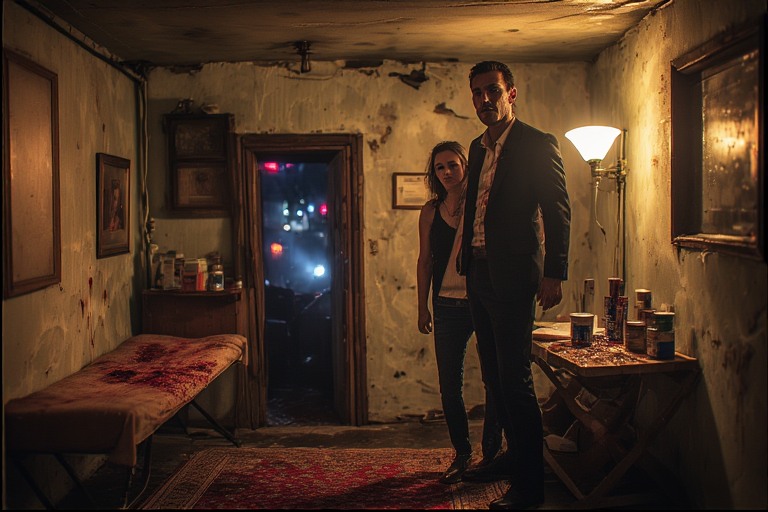
She reinforced the walls, installed the steel hatch beneath a rug, set up a cot, stored medical supplies, water, canned food, a flashlight, and the old laptop she used for job applications that never became jobs. Then she sat on the floor, covered in dust and sweat, and smiled into the silence.
She did not know then that the room would save a mafia boss.
Discover more
Family
Doors & Windows
door
She did not know it would become a courtroom, a hospital, a confessional, and a grave for the life she had been forced to live.
She only knew she finally had a place nobody could take from her.
Loneliness settled after that, but loneliness became easier inside a life that had a secret.
During the day, Emily slept. At night, she worked. In the hours between, she studied old accounting textbooks borrowed from the public library, trying to keep her mind sharp enough for the future she still refused to surrender.
Then she met Arthur Bell.
He lived upstairs, in Apartment 2C, and looked like a man the world had misplaced. He was seventy-two, thin, white-haired, and always dressed in shirts buttoned carefully to the throat. Emily first noticed him struggling with grocery bags on the stairwell.
“Let me take those,” she said.
He looked startled. “People don’t usually offer.”
“I’m not usually people.”
He gave her a small smile. “No. I suppose you’re not.”
His apartment smelled of coffee, dust, and old paper. Books lined every wall. The framed photographs on his desk had been turned face down.
When she introduced herself, his expression changed.
“Carter?” he asked. “Daniel Carter’s daughter?”
Emily’s shoulders tightened.
“Yes.”
Arthur stared at her for a long moment, then said, “Your father was framed.”
The room seemed to tilt.
Emily gripped the back of a chair.
“What did you say?”
“I said your father was framed. I worked forensic accounting for the FBI for thirty-three years. I reviewed pieces of his case before I was pushed out. The numbers were wrong. Not mistaken. Wrong on purpose.”
Emily sat down because her knees had stopped being reliable.
“Who did it?”
Arthur’s face hardened. “I never got close enough to prove it. Someone buried the audit trail, and after I asked too many questions, I was retired early for a supposed internal error.”
Emily stared at him.
“You believe him?”
“I believe ledgers,” Arthur said. “And the ledger did not condemn your father. Men did.”
That was how the old man became her teacher.
Every afternoon before her shift, Emily climbed the stairs to Apartment 2C. Arthur taught her how to follow shell companies, how to identify layered transfers, how to read suspicious timing, how to spot money that had been cut into pieces to hide its original shape.
“Fraud is never invisible,” he told her. “It’s only counting on everyone being too lazy or too scared to look closely.”
Emily looked closely.
A week later, she found Bear behind the laundromat.
He was a massive gray mastiff with one torn ear, ribs showing, and eyes so tired they seemed almost human. Someone had tied a rope around his neck too tightly and left him beside the trash bins.
Emily knelt slowly.
“I don’t have much,” she whispered. “But I know what it feels like to be thrown away.”
Bear did not growl. He trembled.
She brought him home, cleaned his wound, fed him rice and canned chicken, and let him sleep beside the hatch. From that night on, Bear guarded the dugout like he understood that some doors were sacred.
So the family formed quietly: a ruined woman, a discarded old investigator, and an abandoned dog.
No blood.
No ceremony.
Only need, loyalty, and the kind of love people build after discovering that blood relatives can still leave you outside.
Then Linda texted.
Victor is in San Francisco until Friday. Your father’s boxes are still in the garage. Come tonight if you want them. I can’t promise another chance.
Emily read the message three times.
Arthur watched her face from across his kitchen table.
“You’re going,” he said.
“My father’s files might be there.”
“Then you’re definitely going.”
Bear rose as if ready to follow.
Emily touched his head. “Not this time, boy.”
Arthur handed her a small recorder.
“Put this in your pocket.”
“I’m not trying to trap my aunt.”
“No,” he said. “But you may discover someone else trapped you first.”
The Pasadena house looked unchanged when Emily arrived. Same roses. Same polished windows. Same porch light. The sight of it made her chest tighten, but not with longing. A house stopped being home when you had to ask permission to breathe inside it.
Linda opened the door.
Her face had aged in months.
“Quickly,” she whispered. “Please.”
Emily went straight to the garage.
Her father’s boxes sat beneath an old tarp. She opened them one by one: tax books, notebooks, family photographs, yellow legal pads covered in Daniel’s neat handwriting.
At the bottom of the last box, she found his old copy of Financial Crimes and Forensic Trails.
The spine felt too thick.
Her breath caught.
Emily pulled at the lining. A small USB drive dropped into her palm.
Behind her, Linda whispered, “What is that?”
Emily closed her fist.
“Something Dad wanted me to find.”
Linda’s face went pale.
“Emily, Victor said your father became unstable near the end. He said if you ever found anything, you shouldn’t—”
Emily turned.
“Victor told you that?”
Linda’s silence answered.
For the first time, Emily saw the outline of the cage her aunt had been living in. It did not excuse Linda’s cowardice, but it explained the shape of it.
“I have to go,” Emily said.
“Did Daniel really leave something?”
“Yes.”
Linda’s eyes filled.
“Then I hope it saves you.”
Emily almost said, It should have saved him.
Instead she walked out carrying the box.
Back in the dugout, with Bear pressed against her leg and Arthur sitting beside her on a crate, Emily plugged in the USB drive.
There were spreadsheets, scanned bank statements, emails, account maps, screenshots, and one unsent letter.
For Emily.
She opened it.
My Em,
If you are reading this, I failed to come home.
I know what they will say about me. I know they will call me a thief. Do not spend your life trying to convince people with tears. Tears evaporate. Records remain.
I found a laundering network inside Westhaven. I believe Victor Hale helped build it. I do not yet know who protects him, but I know money moved through accounts tied to the Moretti organization and several public contracts.
Trust no apology that arrives after exposure.
Follow the money until it gets tired.
I love you more than my own name.
Dad.
Emily covered her mouth with both hands.
Arthur removed his glasses and wiped his eyes.
Bear whined softly.
For five years, Emily had carried a disgrace that did not belong to her. That night, in the cramped underground room beneath a dying building, the disgrace changed shape. It became evidence. It became purpose.
“I’m going to clear him,” Emily said.
Arthur nodded.
“Yes,” he said. “And whoever destroyed him is going to learn that daughters can read ledgers too.”
Across Los Angeles, another man was already reading Victor Hale’s name.
Discover more
Family
Doors & Windows
doors
Dominic Russo sat in the private basement office beneath a seafood restaurant in San Pedro, scrolling through a report on a tablet. He was thirty-four, heir to the Russo family, and feared by people who never put his name in writing.
His reputation was simple: controlled, ruthless, impossible to buy.
But reputations were often edited for convenience.
Dominic had rules. No children. No women. No elderly. No drugs in neighborhoods his family controlled. No trafficking. No debt collected from hospital beds. These rules did not make him good. He knew that. They made him less monstrous than men who had no rules at all.
His financial chief, Marco Bellini, entered without knocking.
“Victor Hale is moving money again,” Marco said.
Dominic looked up. “For Moretti?”
“Yes. And there’s something else. Hale’s wife had a niece living with them. Emily Carter.”
Dominic’s eyes narrowed. “Daniel Carter’s daughter?”
“You know the case?”
“I know Daniel Carter was too careful to steal that stupidly.”
Marco placed a folder on the desk.
“She was thrown out two months ago. Works nights at a laundromat in Boyle Heights. Basement apartment. No assets. No contacts except an old man upstairs.”
Dominic opened the folder.
A surveillance photo showed Emily leaving the laundromat at dawn, hair tied back, face pale with exhaustion, a large gray dog beside her.
“She looks harmless,” Marco said.
Dominic studied the photo longer than necessary.
“No,” he said. “She looks underestimated.”
A week later, Marco returned with a strange report.
“She’s digging under her apartment.”
Dominic paused.
“Digging?”
“Every night. Same hours. One to four. Our man heard scraping. No visitors. No crew.”
Dominic leaned back.
“She’s making a hideaway.”
“How do you know?”
“Because people with nowhere to run eventually build somewhere to disappear.”
Marco watched him carefully. “You want us to intervene?”
“No. Watch. Don’t touch her.”
“Why?”
Dominic’s eyes remained on Emily’s photo.
“Because Victor Hale ruined her father, and now she’s digging a room under the city. That kind of person either breaks completely or becomes dangerous.”
“And if she becomes dangerous?”
Dominic closed the folder.
“Then I want to know whether she’s dangerous to my enemies.”
The first time Emily entered Dominic’s world, she did not know it.
The laundromat books were wrong.
Mr. Alvarez called her into the back office around 2:30 one morning, sweating through his shirt.
“Emily, you’re good with numbers, right?”
She looked at the screen.
The accounting software showed deposits, cash expenses, vendor payments, and one recurring service invoice that did not behave like a normal invoice. The amounts were split, rounded oddly, and routed through three accounts before returning as “maintenance reimbursement.”
Emily stared for twenty seconds.
“This isn’t an error,” she said.
Mr. Alvarez swallowed. “Can you fix it?”
“That depends what you mean by fix.”
“Make it not look like a problem.”
Emily looked at him. “It is a problem.”
His hands shook.
“Please.”
Emily should have walked away. She knew that.
But survival had already taught her morality was easier when rent was paid and refrigerators were full. She also knew that if authorities came, Mr. Alvarez would take the blame for a system he clearly did not understand.
So she sat down and corrected the visible books without destroying the trail. She made the laundromat clean enough to pass a lazy inspection, but she kept a private copy of every suspicious route on her flash drive.
Arthur smiled when she told him.
“That,” he said, “is how honest people survive dirty rooms.”
Three days later, Marco Bellini came to the laundromat.
Discover more
door
family
Door
He wore a charcoal suit too expensive for a man doing laundry at 1:00 a.m. He asked Mr. Alvarez one question, then walked straight to Emily.
“How long did it take you to find the invoice trail?” he asked.
Emily folded a towel.
“What invoice trail?”
Marco almost smiled.
“The one you corrected without erasing.”
Emily looked at him then.
“Long enough to know it belonged to someone above Mr. Alvarez.”
“Twenty minutes?”
“Twelve.”
His expression changed.
“Who taught you?”
“My father.”
“Daniel Carter?”
Emily’s hands went still.
Marco nodded once. “Someone wants to meet you.”
“Tell someone I’m busy.”
“He doesn’t usually ask twice.”
“I don’t usually answer threats.”
This time Marco did smile.
“I see why he’s curious.”
Two nights later, Emily sat across from Dominic Russo in a nearly empty Italian restaurant in downtown Los Angeles.
He did not offer small talk.
He pushed a folder toward her.
“Find the leak,” he said.
Emily did not open it.
“I don’t work for criminals.”
Dominic looked at her calmly. “You work for a laundromat that moves my money.”
“I work for rent.”
“That is usually how the world buys decent people.”
Emily stood.
Dominic said, “Victor Hale framed your father.”
The sentence struck like a slap.
Emily stayed standing.
Dominic continued, “He launders money for Carlo Moretti. He helped set up the network your father found at Westhaven. You have pieces. I have pieces. Together, we may have enough.”
Emily sat slowly.
“What do you want?”
“Your eyes on my numbers. There’s a leak inside my organization. Moretti knows things he shouldn’t. Find that leak, and I will give you access to every file I have on Hale.”
“And when I find enough to clear my father?”
“I help make it public.”
Emily studied him.
“Why would a man like you care whether my father’s name is clean?”
Dominic’s jaw tightened almost invisibly.
“My father was betrayed by men who ate at our table. Betrayal is a language I understand.”
“That isn’t an answer.”
“It’s the only honest one you’re getting tonight.”
Emily opened the folder.
Twenty-seven minutes later, she slid it back.
“You have three leaks,” she said. “Not one. Page four is sloppy. Page nine is clever. Page sixteen is arrogant.”
Dominic leaned forward.
“Names.”
“Elias Grant, Paul Santoro, and whoever controls the charity account under your sister’s school.”
The room went quiet.
Marco looked at Dominic.
Dominic’s expression did not move, but something cold entered the air.
“My sister,” he said softly, “is not in this.”
“Her school account is. Someone is using it as a message board.”
Dominic stared at Emily for a long time.
Most people would have filled the silence. Emily did not. She had learned long ago that silence made powerful men reveal themselves.
Finally Dominic said, “Work for me.”
“No.”
“Name your price.”
“My father’s name cleared. Victor exposed publicly. No bodies left in my path because of evidence I give you.”
Dominic’s eyes sharpened.
“You think you can dictate terms in my city?”
Emily closed the folder.
“No. I can walk out of your restaurant with information you clearly missed.”
Marco coughed into his fist to hide a laugh.
Dominic looked at him, then back at Emily.
For the first time, something like respect touched his face.
“Fine,” he said.
That one word changed the architecture of her life.
Emily became a ghost analyst.
By day, she studied with Arthur. By night, she worked at the laundromat. In the hours when most people slept, she sat in her hidden dugout with Bear beside her and traced money through networks that stretched from construction firms to shell charities, from import warehouses to political donations.
Dominic sent files through encrypted channels.
Emily sent back answers.
At first, he treated her like a useful tool.
Then like a strategist.
Then like someone whose judgment mattered.
He also insisted she learn to defend herself.
In a warehouse gym near Vernon, he showed her how to break a wrist grip, how to move her weight, how to use her elbow instead of her fist.
“You don’t fight to win,” he told her. “You fight to leave.”
Emily wiped sweat from her forehead.
“Do you teach all your accountants this?”
“No.”
“Why me?”
Dominic stepped back.
“Because you keep standing in rooms where men want you afraid.”
She looked at him carefully.
“That sounded almost like concern.”
“It wasn’t.”
“Good,” Emily said. “I’d hate to think you were getting sentimental.”
Marco, watching from the corner, laughed out loud.
Dominic did not, but his mouth came close.
Two months later, the war came to her door.
At 2:18 in the morning, Emily was in the dugout reviewing transfers tied to Hale when her phone vibrated.
Marco.
His voice came through ragged.
“Dominic’s hit. Safe houses are burned. Moretti bought Grant and Santoro. We don’t know who else. He needs somewhere nobody knows.”
Emily looked at the hatch above her.
The room she had built for herself.
The door no one had a key to.
“Send his location.”
“Emily, no. If they follow him—”
“Send it.”
Marco breathed hard for one second.
Then the coordinates arrived.
She found Dominic in an industrial alley near the river, leaning against a brick wall, one hand pressed to his side. Blood darkened his shirt. His face was gray beneath the streetlight.
He looked at her old Toyota and frowned.
“This is a terrible rescue vehicle.”
“Then bleed on the sidewalk.”
He dragged himself into the passenger seat.
As she drove through back streets, he watched her check mirrors, avoid major intersections, and turn off headlights in an alley where cameras had been broken for months.
“You planned this route,” he said.
“I planned many routes.”
“To save me?”
“To save myself. You’re borrowing one.”
He gave a weak laugh, then winced.
At her apartment, Bear stood in front of the hatch and growled until Emily said, “Mine.”
The dog stepped aside.
Dominic looked at the steel door beneath the rug.
“You really dug a hole under your floor.”
“Dugout,” she corrected.
“Of course.”
She helped him down, sealed the hatch, and opened the medical kit.
“Shirt off.”
Dominic raised an eyebrow despite the pain.
“You give orders now?”
“In this room? Yes.”
He obeyed.
The wound was ugly but not fatal. A blade had caught his side, deep enough to bleed, shallow enough to miss the worst places. Emily cleaned it with alcohol. He inhaled sharply but did not move.
“You’re steady,” he said.
“I shook for years. I got tired of it.”
“Everyone fears something.”
Emily wrapped the bandage tight.
“I’m afraid I’ll die before my father gets his name back.”
Dominic’s gaze lowered.
“And you?”
She expected him to deflect.
Instead he said, “I’m afraid I’ll fail my sister the way I failed my mother.”
Emily paused.
Dominic stared at the concrete wall.
“My mother died getting me and Sofia out of our house the night my uncle betrayed my father. I was twelve. Sofia was a baby. I remember hiding under a laundry table with my hand over her mouth so she wouldn’t cry.”
Emily taped the bandage.
“That’s why you have rules.”
His eyes returned to her.
“That’s why I pretend rules make me different.”
Emily did not comfort him. Empty comfort was an insult to pain.
She only said, “Sleep. I’ll find who sold you.”
He lay down on the cot. Bear settled between him and the ladder, still suspicious.
Emily worked.
For four hours, she traced payments through dummy vendors, school accounts, construction retainers, and one church restoration fund. By dawn, she had the names.
Elias Grant.
Paul Santoro.
And Father Michael Lane, the priest who ran the foundation connected to Sofia’s school.
When Dominic woke, Emily handed him coffee.
“You’re going to hate this,” she said.
He read the report.
The coffee remained untouched.
“Father Lane baptized Sofia,” he said.
“He also sold her schedule to Moretti.”
Dominic closed his eyes briefly.
Betrayal had a particular silence. Emily knew it well. It was not loud. It was the absence of any sound the heart could trust.
“I’m sorry,” she said.
Dominic opened his eyes.
“No. You’re accurate. That matters more.”
Then he looked around the dugout again, at the lamp, the cot, the stacked cans, the dog, the woman who had built safety because no one had offered it.
“I trust Marco,” he said. “But I trust you more.”
“Why?”
“You have nothing to sell.”
Emily thought of Bear, abandoned and loyal because loyalty was all he had left.
“Neither did my dog.”
Dominic almost smiled.
“Then I’m in good company.”
The false ending came quickly.
Dominic disappeared back into his world. Grant and Santoro vanished from his organization. Father Lane was quietly exposed through legal channels so Sofia’s school would not become a battlefield. Emily received the files Dominic promised.
For a week, she believed they had turned a corner.
Then Sofia Russo was taken.
She was seventeen, shy, protected, and the only person Dominic loved without armor. Moretti’s men grabbed her outside a private tutoring center in Santa Monica.
Dominic called Emily himself.
His voice was colder than she had ever heard it.
“They have my sister.”
Emily was already opening her laptop.
“I need the ransom channel.”
“No. You stay out of this.”
“They’ll use money. They always do.”
“Emily.”
His tone was warning.
Hers was worse.
“Send me the channel or lose time arguing while your sister is terrified.”
He sent it.
The ransom demand came through a crypto wallet, then shifted across three exchanges and into a charity shell. Emily followed in real time, Arthur beside her, both of them working in the dugout while Bear paced.
Arthur pointed at the screen. “There. They made a mistake.”
Emily leaned closer.
A small transaction had bounced through a vendor used by Victor Hale.
Her pulse changed.
“Hale is helping Moretti.”
Arthur’s face went still.
“Then this is bigger than Sofia.”
“No,” Emily said, already typing. “Right now Sofia is the point. We pull the string after she’s safe.”
She found the location through a utility deposit attached to the shell account: a warehouse in Commerce registered under a dead man’s name but paid through Hale’s network.
Dominic wanted her to stay behind.
Emily did not argue. She understood the reason under his command. He was not dismissing her. He was afraid.
So she gave him the address, the building plan, the guard schedule, and one final instruction.
Discover more
Door
family
Doors & Windows
“Don’t go through the front. They want you emotional.”
“I am not emotional.”
“You’re her brother,” Emily said. “That makes you emotional whether your face admits it or not.”
Three hours later, Dominic carried Sofia down into Emily’s dugout.
The girl was shaking so hard her teeth clicked. Her wrists were bruised from plastic ties. Dominic had blood on his sleeve that did not seem to be his.
Sofia saw Emily and whispered, “You’re the woman from the computer.”
Emily knelt so they were eye level.
“I’m Emily.”
“You saved me?”
“Your brother saved you. I found the door.”
Sofia looked around the small room, confused and terrified.
“What is this place?”
Emily glanced at the concrete walls.
“It’s where people come when the world gets too loud.”
Bear walked over and laid his huge head in Sofia’s lap.
The girl broke.
She wrapped both arms around the dog and sobbed into his fur.
Dominic stood near the wall, watching his sister cling to an abandoned mastiff in a secret room built by an abandoned woman. Something in him shifted then. Emily saw it but did not name it. Some changes died when spoken too soon.
After Sofia slept, Emily kept working.
The rescue had cracked open Moretti’s system. In the chaos, one server remained exposed for eleven minutes. Emily used every second.
She found Victor Hale everywhere.
Not just as a lawyer.
As architect.
He had introduced bribed witnesses, moved payments to false auditors, arranged shell accounts, and supplied names of vulnerable people inside Dominic’s organization. Then she found the file marked CARTER.
Emily stopped breathing.
Arthur leaned over her shoulder.
Inside were the payments made five years earlier to four witnesses in her father’s case. There were draft affidavits created before the witnesses claimed to come forward. There were forged internal memos. There was an email from Victor to a Westhaven executive.
Carter is too close. Once the funds are assigned to his credentials, no one will listen to him again.
Emily read the line three times.
Her father had not been careless.
He had been chosen.
Arthur sat back, grief and fury fighting across his old face.
“There it is,” he whispered.
Emily’s hands did not shake.
That surprised her.
Maybe rage, when it finally became useful, stopped trembling.
Dominic came down the ladder an hour later.
Sofia was asleep on the cot. Bear guarded her.
Emily turned the laptop toward him.
“I found Hale.”
Dominic read.
His face darkened.
“You want him brought to me.”
“No.”
Dominic looked up.
Emily’s voice was calm.
“I want him alive, terrified, and speaking into a recorder.”
Victor Hale came to the apartment building three nights later.
Not by choice.
Dominic’s men had found him trying to board a private flight from Van Nuys. He arrived in a wrinkled suit, face swollen with fear, wrists zip-tied, his expensive shoes dusty from whatever unpleasant place he had been held.
Emily waited in the main room, not the dugout.
Arthur stood behind her. Bear stood beside her. Dominic leaned against the wall, silent.
Victor saw Emily and almost laughed from shock.
“You?” he said. “This is absurd.”
Emily looked at the man who had called her father a thief, handed her an envelope, and thrown her into the street.
“Yes,” she said. “It is.”
Victor turned to Dominic.
“Mr. Russo, whatever she told you, she’s unstable. Her father was unstable too. I tried to help her family.”
Dominic said nothing.
Emily opened the laptop.
“Five years ago, you bribed four witnesses to lie in court.”
Victor’s face changed.
Only for half a second.
But enough.
“You forged documents using my father’s credentials,” Emily continued. “You routed Westhaven laundering losses into his department, then arranged for him to discover just enough to panic. When he confronted you, you moved first.”
Victor swallowed.
“Emily, you don’t understand the forces involved.”
“No,” she said. “You don’t understand daughters.”
He looked at Arthur.
“And who is this? Another bitter old man feeding delusions?”
Arthur stepped forward.
“Former FBI forensic accounting division. The bitter old man who warned Internal Review five years ago that Daniel Carter’s case had been manufactured.”
Victor’s mouth went dry.
Dominic finally spoke.
“You’re going to confess.”
Victor let out a desperate laugh.
“To you? A criminal?”
“No,” Emily said. “To me. To lawyers. To federal agents. To the press. To everyone who repeated your lie because it was easier than checking the math.”
Victor stared at her.
Then, slowly, he lowered himself to his knees.
Not in front of Dominic.
In front of Emily.
“Please,” he whispered. “I can pay. I can give you anything. Money. Property. A new life.”
Emily looked down at him.
“You already gave me a new life.”
Hope flickered in his eyes.
She continued, “You threw me out of the old one.”
Victor bowed his head.
“I’m sorry.”
The words floated between them, pale and useless.
Emily thought of her father dying in a prison cell, believing his daughter would carry his shame. She thought of Linda crying in hallways but never opening doors. She thought of the forty nights underground, the blood in her gloves, the room she had dug because no one had protected her.
“Don’t apologize to me,” Emily said. “Apologies are what guilty people offer when truth becomes expensive.”
Victor began to cry.
“I had no choice.”
Emily’s voice sharpened.
“You had a choice every day my father sat in prison. You had a choice every time I served dinner in that house while you watched me carry the name you ruined. You had a choice when you gave me thirty-two hundred dollars and called it mercy.”
Victor’s shoulders shook.
“What do you want?”
“The truth,” she said. “All of it.”
He gave it.
Maybe because Dominic scared him. Maybe because Emily did. Maybe because cowards often mistake exposure for death and confession for oxygen.
Whatever the reason, Victor Hale confessed to bribing witnesses, forging evidence, laundering money through Westhaven contracts, and helping Moretti compromise Dominic’s network. He gave names, dates, account numbers, law firms, shell companies, and the location of backup files hidden beneath the respectable surface of his life.
Everything was recorded.
Everything was copied.
Everything went public.
Los Angeles woke to headlines that ripped open five years of lies.
DISGRACED CFO CLEARED AFTER DAUGHTER UNCOVERS FINANCIAL FRAME-UP.
Discover more
doors
door
Family
PROMINENT ATTORNEY LINKED TO LAUNDERING NETWORK AND FALSE TESTIMONY.
DANIEL CARTER’S CONVICTION UNDER REVIEW AFTER BOMBSHELL CONFESSION.
The public did what the public always did. It gasped at a fire it had helped feed.
People who once whispered about Emily’s father now posted sympathy. Former colleagues claimed they had always had doubts. News anchors said Daniel Carter’s name with solemn respect.
Emily did not care about most of them.
She cared about one grave.
One week after the headlines broke, she went to Forest Lawn with white lilies and her father’s old forensic accounting book.
His headstone was simple.
DANIEL CARTER
BELOVED HUSBAND AND FATHER
For years, Emily had not been able to visit. Grief was one thing. Injustice was another. Grief asked you to mourn the dead. Injustice asked you to keep fighting while everyone told you to move on.
She knelt and placed the flowers down.
“I found it, Dad,” she whispered. “I followed the money until it got tired.”
Wind moved through the cemetery trees.
Her tears came quietly.
Not the old tears that begged the world to change. These were different. These were the tears of someone setting down a weight she had carried so long her body had mistaken it for bone.
Footsteps sounded behind her.
She turned.
Dominic stood a few yards away in a black coat, hands in his pockets, expression unreadable.
“You didn’t have to come,” Emily said.
“I know.”
That was all. No speech. No performance.
Just presence.
And after a life full of people who apologized while leaving, presence felt like a miracle.
Two years later, Emily Carter stood in the kitchen of her own small house in Pasadena, not far from the neighborhood where she had once been thrown away.
She had bought the house herself.
Not with Dominic’s money. Not with hush money. Not with charity.
With her own salary as managing partner of Carter Bell Financial Integrity, a firm she had founded with Arthur to investigate fraud for whistleblowers, widows, small businesses, and people too poor to be believed.
Discover more
Door
Doors & Windows
family
Arthur lived in the guest room now. His health had weakened, but his mind remained sharp. Every morning, he sat in the garden with coffee and shouted corrections through the open window.
“Emily, if you call that a clean audit, I’m leaving this house immediately.”
“You say that every week,” Emily called back.
“And one day I’ll mean it.”
Sofia, now nineteen and studying finance at UCLA, came by twice a week for lessons. She said Emily explained numbers like they were living things.
Dominic’s empire changed too.
Slowly. Carefully. Not magically.
There were businesses he shut down, men he cut loose, money streams he cleaned, and habits he had to unlearn. Emily did not pretend he became innocent overnight. Life was not a fairy tale, and men with blood on their past did not become saints because a woman loved them enough to correct their books.
But he changed direction.
That mattered.
One autumn evening, Emily returned to the old basement apartment for the last time.
The building was scheduled for demolition. Developers had bought the block. The laundromat was already closed. The liquor shop windows were boarded up. The hallway smelled the same, though: dust, old smoke, and tired lives.
Dominic came with her.
So did Sofia.
Arthur refused because stairs annoyed him. Bear could not come because Bear had been gone for six months.
He had died peacefully in Emily’s garden, old and loved, with his huge head in her lap. She buried him beneath a lemon tree and placed a stone there.
HE FOUND ME WHEN I NEEDED TO BE FOUND.
Now Emily stood in the empty apartment and pulled back the old rug.
The steel hatch remained.
Dominic looked at it quietly.
“Still works?” he asked.
Emily smiled faintly.
“Of course.”
She opened it.
The dugout smelled of concrete, dust, and memory. The cot was gone. The laptop was gone. But the walls still held marks from her shovel, uneven lines where a desperate woman had carved safety out of dirt.
Sofia descended first. Then Dominic. Emily followed.
For a while, no one spoke.
Sofia touched the wall.
“This room saved my life,” she said.
Emily looked at the small space.
“It saved mine first.”
Dominic turned toward her.
Then, without warning, he knelt.
Emily froze.
For one wild second, she thought he was proposing. The thought was so absurd in that dusty hole beneath a condemned building that she almost laughed.
But Dominic reached into his coat and took out not a ring, but a folded document.
“What is that?” she asked.
“The deed.”
“To what?”
“This building.”
Emily stared at him.
“Dominic.”
“I bought it before the developers could finish the transfer.”
Her eyes narrowed. “Why?”
He looked around the dugout.
“Because this shouldn’t become luxury parking.”
Sofia smiled through tears.
Dominic held out the deed.
“I want to turn the building into a shelter. Temporary housing, legal aid, financial counseling, protection for women who have nowhere safe to go. Your firm can run the money side. Arthur can yell at everyone. Sofia wants to volunteer.”
Emily could not speak.
Dominic remained on one knee, not like a king, not like a crime boss, but like a man finally understanding that power meant nothing unless it could build a door for someone else.
“I spent most of my life making people fear rooms underground,” he said. “You made one that saved people. Teach me how to build that instead.”
Discover more
Family
door
doors
Emily looked at the deed, then at the walls, then at the hatch above them.
Once, she had dug this place because the world gave her no shelter.
Now the same place would become the beginning of shelter for others.
She took the deed.
“You understand I’ll control the accounts.”
Dominic’s mouth curved.
“I assumed.”
“And Arthur will audit everything.”
“I fear him more than federal prison.”
Sofia laughed.
Emily wiped her eyes before the tears could fall too far.
“What should we call it?” Sofia asked.
Emily looked at the shovel marks in the wall.
She thought of her father. Of Arthur. Of Bear. Of Sofia sobbing into gray fur. Of Dominic bleeding on her cot. Of Victor kneeling where guilt had finally found the floor. Of Linda, who had cried instead of fighting, and the version of Emily who had walked into sunlight with one suitcase and no idea that survival had already begun.
“The Carter Door,” Emily said.
Dominic nodded.
“A good name.”
“No,” Emily said softly. “A necessary one.”
Months later, when the shelter opened, the first woman who arrived was twenty-three, pregnant, and carrying all her belongings in a backpack. She stood at the entrance with the same expression Emily remembered from her own reflection years earlier: exhausted, ashamed, afraid to hope.
Emily opened the door herself.
The young woman looked down.
“I don’t have money.”
Emily stepped aside.
“You don’t need money to be safe tonight.”
The woman began to cry.
Emily did not rush her. She knew tears had their own work to do.
Behind her, Arthur argued with a volunteer about receipt categories. Sofia carried blankets upstairs. Dominic stood in the hallway, speaking quietly to a contractor about adding better locks. In the garden, beneath the lemon tree they had transplanted from Emily’s house, Bear’s small stone marker caught the afternoon light.
Emily looked once toward the basement stairs.
The old dugout was still there. Clean now. Reinforced. Preserved behind glass as the heart of the shelter.
Visitors would ask why anyone would keep a hole in the ground.
Emily would tell them the truth.
Sometimes a hole is not a grave.
Sometimes it is the first room a person builds after deciding not to die.
And sometimes, if enough love and courage are carried back into it, the place where one woman hid from the world becomes the door through which many others finally step back into it.
THE END