Nobody in Black Hollow, Colorado ever said the word banished.
They didn’t have to.
In towns like Black Hollow, people could exile you with a silence far colder than any winter.
When Evelyn Carter walked through the muddy main street with her six-year-old son, Noah, and an old golden retriever limping at her side, doors closed before she reached them. Curtains shifted. Voices lowered.
And every face carried the same expression:
She should’ve left months ago.
At twenty-nine, Evelyn looked older than her years. Her chestnut hair was usually tied back with whatever cloth she could find. Her hands were rough from labor, her boots stitched together so many times they barely resembled boots at all.
She had once been the schoolteacher.
She had once laughed easily.
She had once had a husband.
Then Daniel Carter disappeared into the mountains during a spring hunting trip and never came home.
No body.
No proof.
Only rumors.
Some whispered he’d run away.
Others whispered something worse—that Evelyn knew more than she admitted.
And in small towns, suspicion was a sentence.
For two years she worked any job people would give her—cleaning barns, hauling lumber, washing dishes in the diner—but eventually even pity dried up.
By the beginning of November, no one would hire her.
No one would feed her.
And no one wanted her in Black Hollow.
So when the town council called her to the old church, Evelyn already knew.
Mayor Thomas Briggs folded his hands on the table.
He never looked her in the eye.
“We’ve discussed your situation.”
Evelyn stood straight.
“My situation,” she repeated.
The men shifted awkwardly.
One of them cleared his throat.
“Winter’s coming.”
She said nothing.
Briggs continued.
“There’s an old miner’s cave up on Raven Ridge.”
Evelyn blinked once.
“What?”
“It’s dry.”
Another man added quickly—
“Some wood left there too.”
A third avoided her eyes.
“Enough to… get by.”
Evelyn looked from face to face.
And then she understood.
Not help.
Not shelter.
Not kindness.
A burial place with walls.
Her voice turned cold.
“You’re sending my son into the mountains to die.”
Briggs finally looked up.
“That’s not what anyone wants.”
“Then what do you want?”
No one answered.
Little Noah squeezed her hand.
The dog, Scout, growled softly.
Finally Briggs muttered—
“You’re out of options.”
Evelyn stared at them for several seconds.
Then she nodded once.
“Then so are you.”
She turned and walked out.
The cave sat nearly three miles above town.
Steep.
Rocky.
Merciless.
By the time Evelyn, Noah, and Scout reached it, darkness had begun swallowing the ridge.
Noah’s little legs trembled.
“Mama…”
“We’re almost there.”
Scout barked once.
And then they saw it.
A jagged opening in the stone.
Hidden behind pines.
Large enough to swallow a wagon.
Inside, the air was cold but dry.
Wooden beams—old mining supports—still held portions of the ceiling.
A shallow underground spring trickled through one side.
A pile of ancient firewood sat in the corner.
And deeper inside…
Space.
Far more space than she expected.
Noah looked around.
“It’s… big.”
Evelyn forced a smile.
“Then we make it home.”
The first week nearly broke them.
Cold nights.
Thin soup.
Frozen fingers.
Smoke in their eyes.
Scout hunted rabbits when he could.
Evelyn collected moss, roots, mushrooms.
She patched cracks with mud.
Built shelves from old mining planks.
Moved stones.
Dug trenches.
Redirected spring water.
By the second week, Noah stopped crying at night.
By the third, the cave began changing.
What once looked like a tomb slowly became something else.
Something alive.
Evelyn remembered stories her father told her about underground farms built during the Depression.
Warm earth.
Natural insulation.
Hidden springs.
She began experimenting.
She dug garden beds.
Mixed ash, soil, compost.
Planted the few lettuce seeds she’d kept sewn inside her coat.
Then herbs.
Then carrots.
Then potatoes.
Every drop of water mattered.
Every inch of sunlight from the cave entrance was studied.
Every stone found purpose.
And somehow…
Tiny green shoots appeared.
Noah screamed with joy.
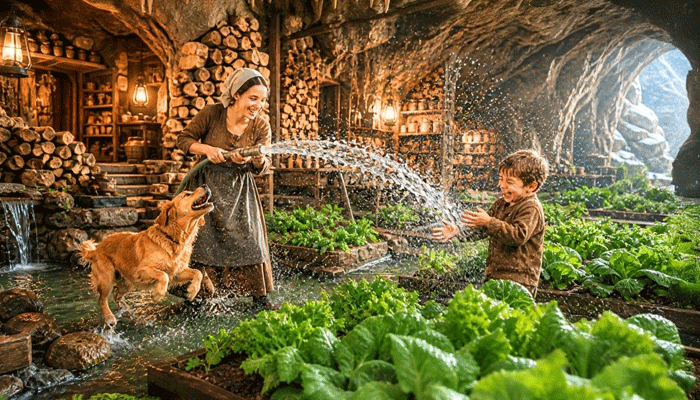
Scout barked and jumped through the spray of water as Evelyn irrigated the beds using a hose she built from stitched animal hide and hollow reeds.
For the first time in years—
Evelyn laughed.
By December, Black Hollow forgot about them.
At least, they thought they did.
Then the storm warnings came.
The old hunters said it would be bad.
The radio from Denver said—
“Historic snowfall.”
But no one expected eight feet.
Not even close.
It started at midnight.
Wind.
Then ice.
Then snow.
By dawn, roofs groaned.
Trees snapped.
Roads vanished.
Power lines disappeared under white mountains.
Families in Black Hollow burned through firewood twice as fast as expected.
Pipes froze.
Animals died in barns.
And the roads out—
gone.
Completely buried.
By the third day—
panic.
By the fourth—
food rationing.
By the fifth—
people stopped pretending everything was fine.
Mayor Briggs stood in the church looking at terrified faces.
Then someone asked the question nobody wanted to say.
“What about the ridge cabins?”
Another man shook his head.
“Gone.”
“And the miners’ routes?”
“Buried.”
Silence.
Then old Harold Jenkins, the oldest man in town, slowly stood.
His voice cracked.
“The cave.”
Everyone turned.
Harold looked straight at Briggs.
“You sent Carter up there.”
Briggs swallowed.
Harold continued.
“If anyone’s alive in these mountains…”
He pointed toward Raven Ridge.
“It’s her.”
The rescue party left at dawn.
Six men.
Snowshoes.
Axes.
Rope.
And fear.
The drifts stood taller than horses.
Trees disappeared halfway up their trunks.
Every step felt like drowning.
After eight brutal hours—
they found the cave.
Smoke curled from the entrance.
Warm smoke.
Alive smoke.
The men stared.
Briggs whispered—
“My God…”
Harold pushed forward.
Then they stepped inside.
And froze.
Not from cold.
From shock.
Lanterns glowed warmly from wooden beams overhead.
Stone pathways lined rows of thriving vegetables.
Lettuce.
Herbs.
Root crops.
Water channels sparkled under lantern light.
Firewood stacked neatly.
Shelves of dried meat.
Jars.
Medicinal plants.
And in the center—
Evelyn.
Spraying water across lush garden beds.
Scout leaping through the spray.
Noah laughing as he tried to catch droplets.
The whole cave shimmered like something from another world.
For several seconds—
no one spoke.
Then Noah saw them.
“Mom!”
Evelyn turned.
Her smile vanished.
Her eyes hardened.
Briggs removed his hat.
“We…”
His voice failed.
Evelyn set the hose down.
“You what?”
Harold stepped forward.
“We need help.”
Scout growled.
Evelyn looked at every face.
Men who had looked away.
Men who had voted.
Men who had sentenced her.
Outside—
wind screamed like a living thing.
Inside—
only dripping water.
And one impossible choice.
Noah tugged her sleeve.
“Mama…”
She looked down.
He whispered—
“People are cold.”
Evelyn closed her eyes.
For one long moment.
Then opened them.
And nodded.
“Bring everyone.”
Briggs stared.
“What?”
She pointed deeper into the cave.
“There’s room.”
By nightfall—
forty-three people filled the cavern.
Children.
Grandparents.
Farmers.
Mothers.
Babies.
The sick.
The injured.
The ashamed.
Evelyn organized them without hesitation.
Sleeping areas.
Cooking stations.
Water collection.
Fire rotation.
Food rationing.
Garden protection.
Scout patrolled like a soldier.
Noah became every child’s hero.
And for the first time—
Black Hollow worked together.
Not because of fear.
But because of her.
Weeks passed.
The storm never let up.
But nobody died.
Not one.
Because the woman they gave a cave to die in…
had turned it into life.
On Christmas morning—
Mayor Briggs stood before everyone.
His hands shook.
“Some debts can’t be repaid.”
He looked at Evelyn.
“But they can be confessed.”
He swallowed hard.
“I was wrong.”
Silence filled the cavern.
Then Harold stood.
Then another.
Then another.
Until the entire town stood.
Briggs removed the mayor’s badge.
And placed it on the stone table.
“Black Hollow survived because of Evelyn Carter.”
He looked around.
“And if anyone should lead this town…”
He turned back toward her.
“It’s the woman we tried to bury.”
Evelyn stared at the badge.
Then at Noah.
Then at Scout.
And finally at the people who had once abandoned her.
She smiled faintly.
Not because they deserved forgiveness.
But because winter had taught them something stronger than pride.
Sometimes…
the place meant to be your grave—
becomes the shelter that saves everyone.