“Then no one around here knows whether it can be done.”
Scout barked once, tail thumping against the bark-covered pile.
Mara set the cedar round back on the stack. “Tomorrow morning, we start cutting.”
They began before dawn.
Mara swung the axe until blisters opened across her palms and blood slicked the handle. Nell stripped bark with their drawknife because bark held moisture, and moisture meant rot. They sorted cedar first, then poplar when cedar ran thin, then anything dry and sound enough to trust. Each round had to be close in length. Each one had to be debarked, stacked, and covered. Each one represented a few more inches between life and death.
By the end of the first week, their hands looked like butchered meat.
By the end of the second, Mara’s shoulders burned so badly she could not lift her arms without clenching her teeth.
By the end of the third, the first visitor arrived.
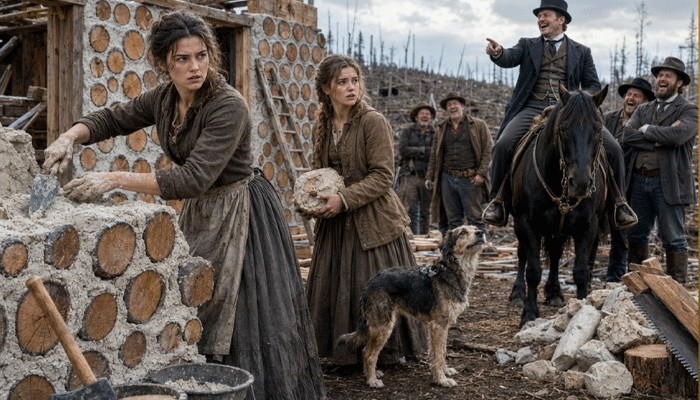
Jonas Dale, the blacksmith from the settlement six miles north, rode into their clearing on a gray mare and watched without speaking. He was a lean man with smoke-darkened hands and burn scars on both forearms. His eyes moved from the cedar posts Mara had sunk into the ground to the partial wall Nell was building along the south side.
The wall looked strange even to Mara. Short rounds of wood, ends facing out, lay in beds of pale gray mortar. Between the inner and outer mortar lines, Nell packed a dry mixture of sawdust and lime, leaving trapped air in the center of the wall.
“So it’s true,” Jonas said.
Mara set down the round she was carrying. “Depends what you heard.”
“They’re calling it the woodpile house.”
Nell’s mouth tightened.
Jonas dismounted. “They say two Bell girls are stacking firewood and calling it a cabin.”
“They say a lot,” Mara replied.
“What do you say?”
Mara wiped her forehead with the back of her wrist. “I say if you came to laugh, laugh quick. We’re losing daylight.”
The corner of Jonas’s mouth twitched, but he did not laugh. Instead he walked to the wall and touched the mortar with two fingers. He pressed his palm against the sun-warmed face of it. Then he moved to the shaded inner side and touched again.
His expression changed.
Nell noticed. “What?”
“It holds heat,” he said.
“That is the point,” Nell answered, unable to keep pride from her voice. “Solid stone carries cold. Dead air resists it. The sawdust holds pockets of air. The thick wall slows everything down.”
Jonas looked at her properly then, not as a child, not as a curiosity, but as someone whose mind had done work worth respecting.
“You figured that out?”
“My grandmother knew the old way. We adjusted what she remembered.”
Mara expected him to warn them, lecture them, repeat Caleb Mercer’s sentence in a different voice.
Instead, Jonas reached into his saddlebag and pulled out a sack of potatoes and a wrapped slab of salt pork.
Mara’s throat tightened so suddenly she had to look away.
“We can’t pay,” she said.
“You can in spring.”
“And if we don’t live until spring?”
Jonas glanced at the strange wall again. “Then I’ll tell my late wife I tried to help two stubborn girls who reminded me of her.”
Nell lowered her eyes. “Thank you, Mr. Dale.”
“My son Levi wants to come see this,” Jonas said. “He likes knowing how things work.”
Mara almost refused. More eyes meant more talk. More talk meant more men riding out to watch the freak show.
But Nell said, “Send him. If he wants to learn, we’ll teach him.”
Jonas nodded. Before mounting, he looked toward town. “Silas Crane is taking bets at the store.”
Mara’s jaw tightened. “On what?”
“Whether the woodpile house collapses before Christmas.”
“How much?”
“Twenty dollars.”
Twenty dollars. Five times all the money they owned in the world.
Nell’s face drained of color.
Mara picked up another cedar round and pressed it into the mortar. “Tell Mr. Crane to keep his money ready.”
Jonas studied her with something close to amusement. “For what?”
“For the day he has to swallow it.”
Silas Crane came three weeks later.
By then the walls were chest-high on three sides and the fourth had begun. The frame stood square despite its crooked posts. Mara had built a block-and-tackle rig from rope, a salvaged pulley, and a high oak limb, using leverage to raise beams no woman was supposed to lift. The day the first beam seated properly, she had sat in the dirt and cried from exhaustion while Nell pretended not to see.
Silas arrived with five men behind him, all on horseback, all wearing the loose smiles of people expecting entertainment.
He owned the general store, the grain scales, the best team for hire, and more debts than anyone liked to admit. He was a careful man, always clean, always polite, always standing close enough to desperation to profit from it.
He walked around the walls slowly.
“Well,” he said. “I’ve seen barns, cabins, sheds, and chicken coops. Never seen a woman build herself a tomb with this much effort.”
The men laughed.
Mara kept working.
Silas stopped near the door opening. “You know, your father paid too much for this land.”
Mara’s hand paused, then continued smoothing mortar. “You didn’t know my father.”
“I knew his mistake. Cutover land. No timber. Hardly worth taxes.”
“Yet you rode all the way here to look at it.”
His smile thinned. “I rode here to make an offer.”
Nell looked up.
Mara did not.
“Eight dollars,” Silas said. “Cash. Twice what you have now, I hear. Enough to get you back to Milwaukee before winter locks the roads.”
Mara straightened slowly. “My father paid twelve.”
“Your father bought hope. Hope depreciates fast.”
One of the men chuckled.
Silas stepped closer. “Think, Mara. When this wall cracks, when your mortar freezes, when the roof caves under snow, this land will go for back taxes. You’ll get nothing. I’m offering mercy.”
“Mercy usually costs the giver something.”
His eyes hardened for a fraction of a second. Then the storekeeper’s smile returned.
“You are young. Pride feels like courage when you haven’t buried anyone because of it.”
Mara’s voice dropped. “I buried both my parents this summer, Mr. Crane. Don’t explain graves to me.”
The laughter behind him died.
Silas looked at Nell, softer now, changing tactics. “Your sister is gambling with your life.”
Nell stood, mortar on her skirt, hair coming loose from its pins. “No. She’s fighting for it.”
Silas’s polite mask cracked just enough for Mara to see the anger underneath.
“Twenty dollars,” he called to the men behind him, still watching Mara. “I’ll bet twenty more this pile falls before New Year’s.”
Nobody answered immediately.
Then one man said, “I’ll take five against you.”
Silas turned. “Against me?”
The man shrugged. “Walls are still standing.”
Another said, “I’ll take five too.”
Mara saw the change before Silas did. The men had come to laugh, but the walls had unsettled them. Mockery required certainty. The cabin had introduced doubt.
Silas’s face darkened.
“Fine,” he said. “Lose your money.”
Before he rode off, his gaze fell on the creek line, where gray limestone showed through the earth. For a heartbeat, Mara saw calculation flicker in his eyes.
Then he smiled again and tipped his hat.
“Winter will settle this.”
After he left, Nell stood very still.
“What is it?” Mara asked.
“He looked at the creek.”
“So?”
“Not like a man seeing rocks. Like a man recognizing something.”
Mara followed her sister’s gaze.
The limestone outcropping glowed pale in the afternoon light. Without it, there would be no mortar. Without mortar, no walls. Without walls, no cabin.
And if Silas Crane had known the limestone was there before they did, then his offer had not been mercy.
It had been a purchase.
For the first time, Mara wondered whether their worthless land was not worthless at all.
October punished them.
Cold rain came for three days and turned the clearing into mud. Mortar would not cure. Wood would not dry. Their third lime kiln collapsed in the wet, destroying two days of work and a quarter of their supply. Mara stood in the rain looking at the ruined heap until despair rose like black water inside her.
Nell found her there.
“We’re short,” Mara said.
“How short?”
“Three days of mortar. Maybe four.”
“Then we burn more lime.”
“The wood is soaked.”
“Then we cover it.”
“The ground is freezing.”
“Then we dig before it hardens.”
Mara turned on her. “You think I don’t know that? You think I’m standing here because I enjoy the view?”
Nell did not flinch. “I think you’re standing here because for one minute you believed Silas Crane.”
Mara’s anger faltered.
“He wants us to fail,” Nell said. “Caleb expects us to fail. Half the county expects us to fail. Are you going to help them?”
Mara’s eyes burned, and not from the rain.
“I’m tired.”
“I know.”
“I am so tired I forget words sometimes.”
“I know.”
“My hands wake me up at night.”
“I know.”
“If this doesn’t work, I killed you.”
Nell stepped closer. “No. If we had gone back to Milwaukee, hunger might have killed us. If we dug a wet hole in a hill, fever might have killed us. If we do nothing, winter kills us for certain. This cabin is not the danger, Mara. It is the only argument we have left.”
Mara covered her face with both hands.
Scout pushed his wet nose against her wrist.
For some reason, that broke her. She laughed once, a raw sound that was almost a sob.
Nell smiled faintly. “Good. Now pick up the shovel.”
They rebuilt the kiln smaller and roofed it with bark. They fed it all night in shifts, eyes stinging from smoke, faces hot while their backs froze. By dawn they had lime. Not enough, but some.
Enough became their religion.
Enough wood to finish one more course.
Enough mortar if they stretched it thin.
Enough daylight if they skipped supper.
Enough strength if they did not think past the next hour.
Levi Dale came whenever his father could spare him from the forge. He was eighteen, awkward, earnest, and full of questions that Nell answered with increasing patience.
“Why do the ends face out?” he asked.
“End grain sheds water better,” Nell said. “Side grain drinks it.”
“Why sawdust in the middle?”
“Because cold travels through solid mass. Air slows it.”
“How do you know?”
“We don’t.”
Levi looked startled.
Mara laughed without humor. “That’s the first honest engineering lesson you’ll ever get.”
Nell gave her a look, then turned back to Levi. “We test as we go. We watch where the mortar cracks. We change the mix. We learn before winter finishes grading us.”
Levi grinned. “My father says you two could teach at a college.”
Mara snorted. “Your father needs spectacles.”
But after Levi left that evening, carrying a written mix ratio Nell had scratched on birch bark, Mara noticed her sister smiling.
“What?” Mara asked.
“Nothing.”
“That face isn’t nothing.”
Nell tied the birch-bark notes into a bundle. “He listens like what I say matters.”
“It does matter.”
“To you.”
“To him too, apparently.”
Nell’s cheeks colored. “Don’t start.”
Mara lifted both hands. “I said nothing.”
“You said everything with your eyebrows.”
It was the closest they had come to ordinary sisterhood in months.
Then November arrived with ice in the water bucket.
The north wall remained unfinished.
The north wall mattered most. It faced the worst wind. Mara had saved it for last because by then they would be better builders. Now she wondered whether that logic had been fatal. Lime mortar needed time to cure. If it froze too soon, it could crumble. The forecast was not written anywhere, but every old-timer’s face said the same thing: winter was early and hungry.
They worked eighteen hours a day.
On November 10, with dusk bleeding across the stumps and the first stars appearing over the black trees, Mara set the final cedar round into the final course. Nell pressed mortar around it with both hands.
Neither sister spoke.
The cabin stood.
Four walls, twelve by sixteen feet. A cedar-shake roof. A dirt floor. Oiled paper instead of glass. A plank door hung on leather hinges cut from Mara’s pack strap. A stone chimney built with the last of the lime.
No stove.
That was the problem that nearly defeated them.
A cabin without heat was only a box. The cheapest stove at Silas Crane’s store cost ten dollars. They had seventy-three cents.
Mara found a damaged box stove for sale from a family leaving Wisconsin for relatives back east. It was rusted, cracked along one seam, and small enough to carry if desperation made a person foolish.
“Three dollars,” the man said.
“I have seventy-three cents,” Mara said, “and I can work the rest in spring.”
The man looked at her cracked hands and hollow cheeks. His expression said he was not confident spring would find her alive.
“Three dollars,” he repeated.
Across the store, Silas Crane leaned on the counter, watching.
Mara felt the whole room waiting for her to fail.
Then Jonas Dale spoke from the doorway. “I’ll guarantee her labor.”
Silas’s head turned sharply.
Jonas set down a sack of flour. “Three days at my forge come spring. If she doesn’t live, I work them myself.”
The departing man considered. A living blacksmith’s guarantee outweighed a dead girl’s promise.
“Done.”
Silas smiled, but his eyes were cold. “Generous, Jonas.”
“No,” Jonas said. “Practical. I’ve seen the walls.”
Mara carried the stove home through frozen mud, the iron biting into her shoulders. Levi met her halfway with a handcart, breathless, scolded her for not asking help, then fell silent when he saw her face.
“I can pull it,” he said.
“I can pull my half.”
“You don’t have to prove something every minute.”
Mara looked at him. “Yes, I do.”
Levi had no answer for that.
On November 15, they lit the stove.
Smoke drew clean through the chimney. Flame caught. Heat spread.
Slowly, impossibly, the walls began to warm.
Nell sat on the dirt floor with Scout’s head in her lap and cried quietly. Mara stood in the center of the cabin and pressed her palm to the cordwood wall. Warm inside. Cold outside. Between the two, sixteen inches of wood, lime, sawdust, labor, memory, stubbornness, and four dollars.
“We did it,” Nell whispered.
Mara wanted to say yes.
Instead she looked at the roof, the chimney, the thin door, the oiled-paper window, the wall whose mortar had been stretched too far.
“We closed it,” she said. “Winter decides if we built it.”
Christmas came.
The woodpile house did not fall.
Snow buried the stumps. The world shrank to cabin, woodpile, creek, and sky. Caleb Mercer did not visit. Silas Crane did not either, though Levi brought word that Silas had stopped taking bets where Jonas could hear him.
The cabin held at forty-eight degrees when the outside temperature fell below zero. Not comfortable. Not soft. But alive.
Then January 7 came warm.
That was the trick of it.
The morning felt merciful. Snow dripped from the roof. The air rose above freezing. Mara went outside to split wood while Nell gathered bark kindling near the brush line. Scout nosed through the slush, delighted by smells released from ice.
At two in the afternoon, the horizon disappeared.
One moment the sky was bright.
The next, a white wall came roaring from the northwest, erasing trees, stumps, woodpile, sister, dog, and world.
“Mara!” Nell screamed.
The wind tore her voice apart.
The temperature dropped so fast Mara felt it like a door slamming. Wet snow became ice against her face. She could not see her own hands. She turned toward where the cabin should be and stumbled blindly, one arm out, breath freezing in her scarf.
Scout barked somewhere to her left.
She followed the sound and struck wood with her shoulder. The door frame. She clawed at the rope latch and fell inside.
Nell was not there.
Scout was not there.
Mara’s terror became clean and sharp. She tied their fifty-foot beam rope to the door frame, knotted it around her waist, and plunged back into the storm.
The wind hit her like an animal.
She counted knots with gloved hands.
One. Two. Three.
“Nell!”
Nothing.
Four. Five. Six.
Snow filled her eyes. The cold burned the skin around them. Her lungs seized.
Seven. Eight. Nine.
Scout appeared from the white, fur crusted with ice, teeth clamped around Mara’s sleeve. He pulled. Mara followed.
Nell lay half-buried near a stump, one arm twisted beneath her. Blood stained the snow around her sleeve.
“No,” Mara breathed.
Nell groaned.
Alive.
Mara hooked both arms under her sister’s shoulders and dragged. Nell was dead weight. The wind fought every inch. Scout barked and circled, then ran ahead to the rope, as if showing the way. Mara hauled hand over hand.
Ten knots.
Eight.
Five.
Her muscles failed in pieces. First her shoulders, then her back, then her thighs. She kept moving because the rope moved beneath her hands and the cabin existed at the other end of it.
Three knots.
Two.
The door appeared like a miracle.
She fell through it with Nell and Scout, slammed the door, and lay gasping while the storm hammered the walls.
Inside, the stove had burned low. The thermometer Levi had given them read thirty-eight degrees. Cold, but above freezing.
Mara bound Nell’s arm with torn cloth. The cut was deep but the bone seemed whole. Nell drifted in and out, muttering their mother’s name. Mara fed the stove carefully, terrified of burning wood too fast. Their main pile sat thirty feet outside. In clear weather, thirty feet was nothing. In that blizzard, it might as well have been Milwaukee.
By midnight the outside temperature had fallen past twenty below.
The wind drove snow against the north wall until the cabin groaned.
Mara sat awake with one hand on Nell’s forehead and the other near the stove door. Every groan made her look at the stretched mortar in the north wall. That was the weak place. The wall built too fast. The wall built with thin mortar. The wall Silas Crane had pointed at when he said winter would settle this.
At dawn, the firewood inside was almost gone.
Nell woke pale and shaking. “Go.”
“No.”
“If the fire dies, we both die.”
“You can’t even sit up.”
“I don’t need to sit up. I need you to stop arguing.”
Mara stared at her sister.
Nell managed a weak smile. “Mother taught me well.”
Mara tied the rope again.
Outside, the cold was beyond weather. It was a force with teeth. She followed the rope to the woodpile, found logs by touch, loaded her arms, and turned back. Halfway to the cabin, her boot caught under a hidden root. She fell hard. Wood scattered into the white.
For one second, she stayed down.
The snow under her cheek felt strangely soft. The pain in her body dulled. She understood, with frightening clarity, why people gave up in storms. Death did not always come like violence. Sometimes it came like rest.
Then she saw Silas Crane in her mind, smiling behind his counter.
She saw him buying their land for taxes.
She saw Caleb Mercer shaking his head over two frozen bodies and saying he had warned them.
She saw Nell alone beside a dying stove.
Mara pushed herself up.
“No,” she said into the storm.
She found three logs by touch. Not five. Three. Enough.
Always enough.
For three days, the blizzard tried to kill them.
Mara made five trips to the woodpile, each one shorter and more dangerous than the last. Nell’s fever rose, then broke. Scout lay against her side when Mara went out, keeping her warm with his body. The north wall groaned but held. Snow buried the cabin nearly to the window. The stove smoked once when wind forced air down the chimney, and Mara spent twenty panicked minutes clearing the draft from inside with a pole while Nell coughed and prayed.
On the third night, something struck the door.
Mara grabbed the axe.
Again: pounding.
A voice, barely human under the wind. “Help!”
Mara froze.
Nell lifted her head. “Did you hear that?”
The pounding came again.
Mara opened the door against a shove of snow and found Caleb Mercer on his knees.
His beard was white with ice. His right hand was blackening at the fingertips. Beside him, tied to his waist with rope, was his wife, Ruth, half-conscious and shaking violently.
Mara dragged them in.
Caleb collapsed near the stove, eyes moving slowly around the room, taking in the walls, the heat, the two sisters alive inside the cabin he had called their grave.
“My barn roof went,” he rasped. “Then the kitchen wall cracked. We tried for Jonas’s place. Lost the road.”
“How did you find us?” Mara asked.
Caleb swallowed. “Your chimney smoke. And the dog.”
Scout barked once, as if confirming his role in the rescue.
Nell, pale but alert, pointed with her good hand. “Get Mrs. Mercer closer to the stove.”
Mara stripped off Ruth’s frozen outer layers and wrapped her in blankets. Caleb tried to help, but his fingers would not work.
He stared at his hands.
Then at Mara.
“I was wrong,” he said.
Mara had imagined that sentence many times. In her imagination, it had tasted sweet.
In reality, it only made her sad.
“You were afraid,” she said.
“I was certain.”
“That too.”
The storm ended the next morning.
Silence came first. Then weak light. Then a world buried under drifts so high the cabin door had to be shoveled open from the inside.
By afternoon, men from the settlement began searching for survivors. Jonas and Levi came first, half-mad with worry. Levi nearly crushed Nell in an embrace before remembering her injured arm. Jonas stood in the doorway, saw Caleb Mercer alive by the stove, and understood more than anyone needed to explain.
Later came others.
Men who had laughed.
Men who had bet.
Men who had told their wives the Bell girls were building a fancy coffin.
They stepped into the cordwood cabin one by one and removed their hats without being asked.
Outside, the thermometer had fallen to forty-one below during the worst of the storm. Inside, even with two extra people and a stove fed only twice a day, the cabin had never dropped below thirty-six degrees.
Thirty-six was not comfort.
Thirty-six was survival.
Silas Crane arrived last.
He came on the fourth day after the blizzard, when the road had been partly broken and the dead were being counted across the county. He wore a fur-lined coat and the careful expression of a man prepared to offer condolences and collect advantage.
Instead he found Mara splitting wood beside a cabin still standing.
Caleb Mercer was there too, his frostbitten hand wrapped in cloth. Jonas Dale stood near the chimney. Levi was helping Nell, whose wounded arm was bound but healing, carry kindling from a cleared stack.
Silas stopped.
Mara set her axe in the stump. “Looking for bodies?”
His face tightened. “I came to see if you needed supplies.”
“On credit?”
“Of course.”
Jonas snorted.
Silas ignored him and looked at the walls. He walked close, pressing his gloved hand to the mortar. “Interesting.”
Nell watched him. “You knew.”
Silas turned. “Knew what?”
“The limestone. You knew it was here.”
The clearing went quiet.
Mara looked from her sister to Silas. “Nell.”
But Nell did not stop. Fever had left her weak, not timid.
“You didn’t want our land because it was worthless,” she said. “You wanted it because you thought it was useful. You looked at the creek the day you offered eight dollars. I saw you.”
Silas smiled. “A girl with a fevered arm sees many things.”
Levi stepped forward. “She doesn’t have fever now.”
Nell’s voice strengthened. “You knew the railroad survey might come through the ridge. You knew burned lime would be valuable if settlers kept building. You thought two orphan girls would freeze, and then you could buy the land cheap.”
Silas’s eyes flicked toward Caleb, then Jonas, then the other men.
That flicker was the confession.
Caleb Mercer’s face hardened. “Is that true?”
Silas gave a small laugh. “This is childish.”
Mara stepped closer. “No. Childish is betting money on whether hungry girls die before Christmas.”
A few men looked down.
Silas’s voice cooled. “Careful, Miss Bell. I extend credit to half the families in this county.”
“And now half the county knows why.”
The sentence landed harder than Mara expected. Not because it was clever, but because it gave people permission to admit what they already knew. Silas had not broken a law. He had done something worse in a frontier settlement: he had shown he could profit from neighbors and still call it business.
Jonas said, “I’ll settle any debt of mine by spring and buy elsewhere.”
Caleb added, “Same.”
Another man said, “Me too.”
Silas’s face flushed.
Mara did not smile. Victory felt too expensive for that.
“You offered eight dollars for my father’s land,” she said. “Today I’ll offer you the same for your twenty-dollar bet.”
A laugh moved through the men.
Silas looked at her with open hatred.
Nell stepped beside Mara. Scout came too, standing between the sisters and the storekeeper, ears forward.
The woodpile house had changed something. Not just the weather. Not just the bet. It had rearranged what people believed strength looked like.
Silas turned and walked back to his sleigh.
He did not apologize.
He did not need to.
His silence was smaller than an apology and more permanent.
Spring came slowly.
Caleb Mercer returned in April with his frostbitten hand still stiff. He brought glass for the window, two proper hinges, and a sack of flour.
Mara met him outside.
“We can pay for none of that.”
“I know.”
“We don’t take charity.”
“I know that too.” He looked at the cabin wall, then at the thawing ground. “My kitchen wall has to be rebuilt. I was thinking short wood might work.”
Mara studied him.
Caleb shifted like a boy caught stealing apples. “If you’d be willing to show me.”
Nell, standing in the doorway with her arm healed but scarred, smiled. “We charge one sack of flour for the first lesson.”
Caleb blinked.
Mara nodded solemnly. “And hinges.”
For the first time since they had known him, Caleb Mercer laughed.
By summer, three more cordwood buildings stood in the county. By the next year, there were seven. Settlers with cutover land came to learn how to build with what the lumber companies had left behind. Poor families came because they could not afford mill boards. Widows came because short rounds could be lifted without a crew. Men came too, though some pretended they were only curious until Nell handed them a trowel.
Jonas Dale repaired their stove properly and refused payment beyond Mara’s promised work at the forge. Levi came often enough that everyone noticed, though he still claimed he was studying mortar mixtures. Mara let him claim it until one evening, two years later, when he stood beside the cedar tree they had planted for Scout’s shade and asked if she would ever consider building a larger house with him.
Mara looked at Nell.
Nell looked at Levi.
Scout looked at the supper pot.
“Only if it has cordwood walls,” Mara said.
Levi grinned. “I wouldn’t dare suggest anything else.”
They married in the spring, in a small church service where Caleb Mercer cried and blamed the smoke from the stove, though there was no stove burning. Nell stood beside Mara, her scar visible below her sleeve, her face bright with the quiet pride of someone who had helped build not only a cabin, but a future.
Silas Crane never admitted he had been wrong.
But he never offered eight dollars for the land again.
Years later, when travelers passed through Oconto County, they sometimes stopped at the little cordwood cabin that had become a workshop, spare room, and emergency shelter. They would run their hands over the round cedar ends and ask who had built such strange walls.
Folks would point toward the larger house up the rise and say, “The Bell sisters.”
If the traveler laughed, someone would add, “Careful. Those walls held through forty-one below when better houses failed.”
And if the traveler still doubted, Nell would sometimes step out with a trowel in her hand and say, “Walls are like people. The strongest ones are not always made from the biggest pieces. Sometimes they hold because every small piece knows exactly where it belongs.”
Mara liked that answer.
It sounded like their life.
Two orphan girls.
Four dollars.
A dead father’s dream.
A dog found on the road.
A wall of short wood everyone called worthless.
A winter that came to prove the experts right and failed.
In the end, the critics did fall silent.
Not because Mara Bell shouted louder.
Because her walls kept standing.
THE END