Jack Mercer had paid more for a pair of boots than he paid for the house.
Three hundred dollars.
That was all it took to win the county tax auction on a cold Friday morning in Hartley County, Kentucky, where the courthouse smelled like floor wax, old paper, and burnt coffee. The auctioneer had barely looked up when he read the parcel number.
“Lot 18-B. Old cave residence off Cedar Hollow Road. No utilities confirmed. No road maintenance. No warranty. Opening bid, three hundred.”
Jack raised his hand.
Nobody else did.
A woman in the front row laughed under her breath. A man in a seed-company cap turned around, looked Jack over, and shook his head like he had just watched somebody buy a sack of rattlesnakes.
“Sold,” the auctioneer said. “To the gentleman in the brown jacket.”
That was how Jack Mercer, former Army Ranger, widower, and owner of one old German shepherd named Boone, became the legal owner of a cave house nobody in Hartley County wanted.
At least, nobody admitted they wanted it.
Jack didn’t care what they thought. He had come home from war with a limp in his left knee, a ringing in his ears that never fully went away, and a need for quiet so deep it felt like hunger. He had tried living in town for six months after leaving the VA hospital in Lexington. He had rented a small apartment over a barber shop, but the traffic lights changed too loud, the Friday-night motorcycles sounded too much like incoming fire, and the neighbor’s television bled through the wall until two in the morning.
He wanted stone, trees, distance, and a door he could lock.
The cave house sounded ridiculous, sure. But it was real. The county listing had shown two grainy photos: a limestone bluff, a crooked front porch, and a wooden door set into the rock like something out of a frontier ghost story. Somebody, decades ago, had turned part of the cave into a home. Jack had seen stranger things in Afghanistan. Men could make shelter out of almost anything if they were stubborn enough.
Boone sat beside him in the truck outside the courthouse, watching the people come and go.
The dog had one white patch on his chest, one torn ear, and eyes that seemed to understand things before Jack did. Boone had never been officially a military dog, but Jack had rescued him from a roadside ditch outside Fort Campbell two years earlier, and the dog had become better medicine than anything with a prescription label.Dogs
Jack climbed into the truck and slapped the folded deed on the dashboard.
“Well, buddy,” he said, “we own a cave.”
Boone sneezed.
“Yeah,” Jack said. “That’s about how I feel.”
Cedar Hollow Road was twelve miles from town, then three more down a gravel lane the county no longer graded. The late October woods crowded close on both sides, red oak and hickory dropping leaves over the hood of Jack’s old Ford. The truck bounced through ruts deep enough to swallow a tire. Twice, Jack had to get out and drag fallen branches aside.
Discover more
Dog
dog’s
dog
By the time the bluff appeared, the sun was leaning west and the shadows had gone blue.
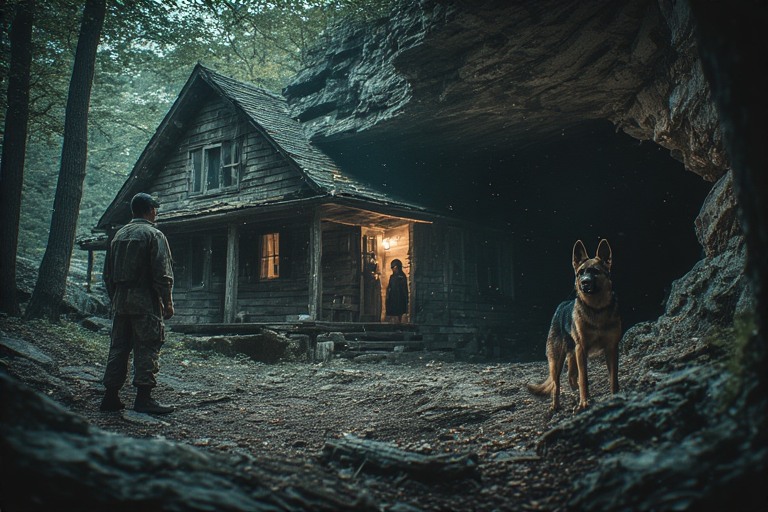
The cave house sat at the base of a limestone wall that rose sixty feet above the hollow. Vines hung down like old ropes. The front porch sagged but still stood. Two windows, dusty and cracked, looked out from a wooden facade built across the cave mouth. A rusted rain barrel leaned against the wall. The place looked abandoned, forgotten, and stubbornly alive.
Jack cut the engine.
For a moment, he just listened.
No traffic. No voices. No hum of town. Only wind in dry leaves and water dripping somewhere deep in the rock.
Boone stood in the passenger seat, ears high.
“What do you think?” Jack asked.
The dog didn’t bark. He stared at the front door.Dogs
Jack took the county key from his pocket. It was old brass, tagged with faded tape. He stepped onto the porch, testing each board before trusting it. Boone moved beside him, silent as smoke.
The key worked on the second try.
The door opened with a groan.
Cold air breathed out.
Jack shined his flashlight inside and saw a room carved half by nature, half by human hands. The front wall and floor were wooden, but the back and ceiling were stone. There was an old iron stove, a table with one broken leg, shelves lined with dust, and a narrow doorway leading deeper into the cave.
“Home sweet home,” Jack muttered.
Boone stepped in, sniffed once, and froze.
The hair rose along his spine.
Jack noticed immediately. Boone wasn’t a nervous dog. He didn’t spook at thunder, gunshots, or strangers. If his hackles were up, there was a reason.
“What is it?”
Boone moved forward, nose low, not toward the stove or shelves, but toward the back of the room. There, a line of old cabinets had been built against the rock wall. The dog sniffed along the bottom, then stopped at a tall pantry cupboard.
He whined.
Jack’s hand went instinctively to his hip, where he no longer carried a service weapon. He had a pocketknife, a flashlight, and a tire iron in the truck. That was all.
“Easy,” he whispered.
Boone scratched once at the base of the cupboard.
A soft sound came from behind it.
Not a mouse.
Not dripping water.
A cough.
Jack stopped breathing.
Boone growled, low and steady.
“Hello?” Jack called.
Silence.
He angled the flashlight along the cupboard. It was old but solid, built from pine boards darkened by age. Scrape marks scarred the floor in front of it, faint but fresh enough to show pale wood under the dust.
The cupboard moved.
Just an inch.
Jack stepped back.
“Who’s there?”
A child’s voice answered from behind the wall.
“Don’t let him take us.”
Jack felt the words hit him harder than any threat could have.
He lowered the flashlight.
“I’m not here to take anybody,” he said. “My name’s Jack. I bought this place at auction.”
There was a whisper, then another cough.
A woman’s voice followed, thin with fear. “Please leave.”
Jack looked at Boone. The dog’s growl had stopped. He was still alert, but his tail had lowered.Dogs
“How many of you are back there?” Jack asked.
No answer.
“I’m not going to force the door,” Jack said. “But if somebody’s hurt, I can help.”
A long silence passed.
Then the cupboard shifted again. It scraped outward, slow and heavy, revealing a black seam in the rock behind it. A hidden door, cut into the limestone and fitted with boards on the inside, opened just wide enough for one frightened eye to appear.
A woman looked out.
She was maybe thirty-five, though exhaustion made her seem older. Her brown hair was tied back with a strip of cloth. Her cheek was bruised yellow at the edge, nearly healed but not forgotten. Behind her, Jack saw the pale face of a boy no more than eight.
Boone sat down.
The woman saw the dog and almost cried.
“Is he safe?” she asked.
“Safer than most people,” Jack said.
The boy pushed closer. “His name Boone?”
Jack looked down, surprised. “How did you know that?”
The boy pointed weakly. “You said it on the porch.”
Jack nodded. “That’s right.”
The woman opened the hidden door a little wider, but she kept one hand behind her back. Jack didn’t need to see the weapon to know she had one. A knife maybe. A hammer. Something she had decided would be enough if fear gave her strength.
“My name is Claire Whitcomb,” she said. “This is my son, Eli. We didn’t break in. This is our home.”
Jack glanced around the dusty front room.
“The county sold it for back taxes.”
Claire’s face tightened. “No. They stole it.”
That was the first time Jack understood his three-hundred-dollar bargain might cost more than money.
He didn’t ask them everything at once. Fear didn’t work that way. He had learned overseas that terrified people told the truth in pieces, and if you pushed too hard, they shut down.
He asked if they needed food.
Claire hesitated, then nodded.
Jack went to the truck, brought back two bottles of water, a pack of crackers, beef jerky, and two apples from the grocery bag behind the seat. Eli ate like he was trying not to look hungry. Claire took only a little and watched Jack the entire time.
The hidden room behind the pantry was larger than Jack expected. It wasn’t part of the official listing. A narrow passage opened into a dry chamber with a mattress, two lanterns, plastic storage bins, and blankets hung to block drafts. Somebody had lived there recently and carefully.
There were children’s books stacked against the wall. Canned food lined a stone shelf. A battery radio sat beside a half-burned candle. A photograph was taped above the mattress: Claire, Eli, and a bearded man in a denim jacket, standing in front of the same cave house during summer.
“My husband, Aaron,” Claire said when she saw Jack looking. “He built most of the front room. His grandfather started it.”
“Where is he?”
She looked away.
“Gone.”
Jack knew that word. It could mean dead. It could mean missing. It could mean something worse, because uncertainty kept a person dying every day.
Claire finally told him the story in a voice so controlled it seemed ready to break.
The cave house had belonged to the Whitcomb family for seventy years. Aaron’s grandfather had bought the bluff after World War II and carved the place out as a hunting cabin. Over time, the family added a front wall, a stove, a cistern, shelves, and a sleeping loft. It was never fancy, but it was theirs.Family
Aaron had grown up there. Claire had moved in after they married. Eli had taken his first steps on the porch.
Then Hartley Stone & Gravel began buying land along Cedar Hollow.
“They wanted the whole ridge,” Claire said. “Said there was a vein of limestone worth quarrying. Aaron refused. He said blasting the bluff would collapse the spring tunnels and poison half the creek.”
“Who owns the company?” Jack asked.
“Martin Voss.”
Jack had heard the name at the courthouse. The woman who laughed at the auction had whispered it to the man beside her.
Voss always gets what he wants.
Claire continued.
Aaron started collecting records. Old surveys. Water tests. Deeds. He believed the quarry permits were based on false maps that erased the spring running under the bluff. He went to the county. He went to the state. Nothing happened.
Then he disappeared.
“Six months ago,” Claire said. “His truck was found at the overlook. Sheriff’s office said he probably ran off. People believed it because money had been tight.”
“You don’t believe it.”
“My husband would walk through fire before leaving Eli.”
The boy kept his eyes on Boone and said nothing.
Claire said after Aaron vanished, the pressure got worse. Notices appeared claiming unpaid taxes, though she had receipts. A county clerk told her the land had been reclassified and penalties added. Then someone broke into the cave house while she and Eli were in town. They didn’t steal the television or tools. They took Aaron’s files.
“Three weeks later, somebody set fire to our truck,” she said. “After that, I stopped sleeping in the front room. Then I stopped letting anybody know we were here.”
Jack thought of the hidden pantry, the scrape marks, the boy’s cough.
“How long have you been hiding back there?”
“Twenty-six days.”
Jack swore under his breath.
Claire flinched.
“Not at you,” he said. “At them.”
“I tried calling a lawyer in Louisville,” she said. “I left messages. I don’t know if they got them. Our phone was cut off. The sheriff’s deputy who came out here told me if I made trouble, Eli would end up in foster care while they sorted it out.”
“What deputy?”
“Darren Pike.”
Jack remembered a heavyset man in uniform leaning against the courthouse wall that morning, watching bidders leave.
Boone suddenly stood.
His ears turned toward the front room.
Jack heard it too.
An engine.
Claire grabbed Eli and pulled him close.
“No,” she whispered. “No, no, no.”
Jack moved to the crack between the cupboard and wall. Through the dusty front window, he saw headlights bouncing through the trees. A white county sheriff’s SUV rolled into the clearing, followed by a black pickup with chrome rails.
Claire’s face went white.
“That’s Pike,” she said. “And Voss.”
Jack looked at her. “Did they know I was coming today?”
“The county knew. Everybody knows everything here.”
Boone growled again.
Jack closed the hidden door and shoved the pantry cupboard back into place from the outside. He had just enough time to brush dust across the scrape marks with his boot before fists pounded on the front door.
“County Sheriff’s Office,” a man called. “Open up.”
Jack opened the door halfway.
Deputy Darren Pike stood on the porch, thumbs hooked in his belt, belly pressing against his tan uniform shirt. Behind him stood Martin Voss, tall and silver-haired, wearing a waxed canvas jacket that looked too clean for the woods.
“You Mercer?” Pike asked.
“That’s right.”
Pike looked past him. “Mind if we come in?”
“Yes.”
The deputy blinked. “Excuse me?”
“I said yes, I mind.”
Voss smiled like he had expected that. “Mr. Mercer, I’m Martin Voss. I own most of the surrounding property. We heard somebody bought this parcel, and we wanted to welcome you.”
“Welcoming committee usually brings pie,” Jack said.
Pike’s eyes narrowed.
Voss chuckled softly. “Fair enough. This place can be dangerous. Unstable rock. Trespassers. Vagrants. We’ve had trouble out here.”
“Is that so?”
Pike stepped closer. “You seen anyone around?”
Jack could feel Claire and Eli behind the wall like a second heartbeat.
“No.”
Boone moved to Jack’s side. He didn’t bark. He simply looked at Pike.
The deputy shifted his weight.
“Dog friendly?” Voss asked.
“Depends who he’s judging.”
Voss’s smile thinned.
Pike took a folded paper from his pocket. “Property may still be subject to county inspection.”
“Come back with a warrant.”
“This ain’t the city, soldier.”
Jack’s voice stayed flat. “That’s good. I never liked cities.”
For a moment, nobody moved.
Then Voss put a hand on Pike’s shoulder.
“No need to start off poorly,” Voss said. “Mr. Mercer, this parcel is more burden than benefit. No power, bad access, possible structural liability. I’m prepared to offer you two thousand dollars for your interest. Tonight. Cash.”
Jack stared at him.
He had owned the place for less than six hours, and Voss was offering almost seven times what Jack paid.
“No.”
“Five thousand,” Voss said.
Pike looked surprised, then covered it.
Jack understood then. This wasn’t about helping a foolish veteran unload bad land. Voss needed the cave house. Needed it quickly. Needed it before Jack looked too closely.
“Not for sale.”
Voss’s eyes cooled.
“You should think carefully. Men come home from war wanting peace. They don’t need county lawsuits, rock slides, or squatters making trouble.”
The word squatters hung in the cold air.
Boone took one step forward.
Pike’s hand dropped toward his sidearm.
Jack’s body changed before his mind did. His shoulders squared. His bad knee bent slightly. His voice dropped.
“Don’t.”
Pike froze.
Voss studied Jack for a long second, then turned away.
“We’ll talk again.”
They left after that. The SUV and pickup backed out, tires grinding over gravel. Jack watched until their lights vanished between the trees.
Only then did he move the pantry.
Claire was shaking so hard she could barely stand.
“They’ll come back,” she said.
“Yes,” Jack replied. “They will.”
“You should leave.”
“This is my house now too.”
She stared at him.
Jack looked at Eli, who had one hand buried in Boone’s fur.
“And I don’t like people threatening kids in my house.”
That night, Jack did not sleep.
Claire and Eli stayed in the hidden chamber, but Jack moved his bedroll into the front room, facing the door. Boone lay beside him, head on paws, eyes open.
The cave made sounds after dark. Water ticked in distant cracks. Wind pressed against the wooden front. Somewhere deep inside the limestone, air moved through unseen tunnels with a low, hollow breath. It was the kind of place that could make a person believe in ghosts.
Jack believed in men.
Men had done this. Men had stolen records, forged tax notices, and frightened a mother and child into hiding behind a pantry. Men had made Aaron Whitcomb vanish.
Ghosts were not the problem.
At dawn, Claire brewed coffee on the iron stove with water from the cistern. Jack drank it black. It tasted like smoke and tin and heaven.
“We need proof,” he said.
Claire sat across from him. Eli was still asleep in the hidden room with Boone guarding the entrance.
“Aaron had proof,” she said. “They took it.”
“Not all of it.”
“How do you know?”
“Because a man like your husband doesn’t collect evidence against powerful people and keep only one copy.”
For the first time, something like hope crossed her face.
They searched the cave house after breakfast.
Jack started with the front room while Claire checked old hiding places Aaron used as a boy. They found rusty tools, cracked jars, a mouse nest inside a boot, and a cigar box full of fishing lures. Nothing useful.
Boone found the first clue.
He stood near the old iron stove and sniffed the floorboards beneath it. Then he pawed at a warped plank.
Jack knelt. The plank was loose, but not by accident. Someone had cut it short and darkened the edges with ash to hide the seam. He pried it up with his pocketknife.
Underneath was a metal ammunition box wrapped in oilcloth.
Claire made a sound and covered her mouth.
Inside were tax receipts, copies of survey maps, a thumb drive sealed in plastic, and a handwritten note.
Claire unfolded it with trembling fingers.
If you’re reading this, I had to hide the duplicates. Don’t trust Pike. Don’t trust anyone from Voss’s office. The spring line is under the house. The old map is wrong on purpose. C.W. knows the rest.
Aaron.
Claire pressed the note to her lips.
Jack picked up one of the maps. It showed Cedar Hollow, the bluff, and a blue line running beneath the cave house toward Willow Creek. Beside it were handwritten measurements and dates.
“Who’s C.W.?” Jack asked.
Claire wiped her eyes. “Cora Whitcomb. Aaron’s grandmother. She’s in a nursing home in Pikeville.”
“Can she talk?”
“Some days. Some days she thinks Eisenhower is still president.”
Jack looked toward the door. “We need to see her.”
Claire shook her head. “Pike will be watching the road.”
“Then we won’t take the road he expects.”
The old survey map showed more than property lines. It showed an abandoned mining trail that crossed the ridge and came out near Route 11, five miles north of town. It had not been used in years, but Jack’s truck had four-wheel drive and bad paint. A few more scratches wouldn’t hurt it.
They left before noon.
Claire wore one of Jack’s spare ball caps and kept low in the passenger seat. Eli sat in the back with Boone, wrapped in an old Army blanket. Jack drove the mining trail slow, sometimes barely faster than walking, while branches scraped both sides of the Ford.
Twice they had to stop so Jack could clear rocks. Once they crossed a dry creek bed and the truck tilted so sharply Claire gasped. Boone simply leaned into Eli and kept him steady.
They reached the highway unseen.
The nursing home in Pikeville sat behind a Methodist church and a Dollar General. It had pumpkins by the entrance and a sign advertising bingo night. Jack parked near the back.
Cora Whitcomb was ninety-one years old and weighed almost nothing, but her eyes were sharp when Claire said Aaron’s name.
“My boy found it,” Cora whispered. “Didn’t he?”
“Found what, Grandma?” Claire asked.
“The lie.”
Jack pulled a chair close. “Mrs. Whitcomb, we need to know what Aaron found.”
Cora looked at him suspiciously. “Who are you?”
“Jack Mercer. I bought the cave house at auction.”
Her thin hand shot out and gripped his wrist with surprising strength.
“You give it back.”
“I’m trying to help.”
“Men always say that before they take land.”
Jack didn’t pull away.
“My grandfather lost his farm in Tennessee to a bank paper he couldn’t read,” he said quietly. “My father spent his whole life angry about it. I’m not here to take yours.”
Cora watched him for a long moment.
Then she released his wrist.
“In 1953,” she said, “the county made two maps. One for the people, one for the men with money. The spring was on ours. They moved it on theirs.”
“Why?”
“Because you can’t blast above a protected spring. Not legally. Not if it feeds the creek and farms below. My husband knew. He kept the original survey.”
Claire leaned forward. “Where is it?”
Cora smiled faintly. “Where stone remembers.”
Claire closed her eyes in frustration, but Jack caught the phrase.
“Where stone remembers,” he repeated. “Is that in the cave?”
Cora nodded. “Behind the names.”
“The names?” Claire asked.
But Cora was fading. Her gaze drifted to the window.
“Tell Aaron supper’s ready,” she murmured. “He’ll be late from the ridge.”
They left with more questions than answers, but Jack didn’t feel empty-handed. Old people hid things in phrases. Soldiers did too. Where stone remembers. Behind the names.
Back at Cedar Hollow, the cave house felt different. No longer just abandoned stone and timber. It felt like a witness.
They searched the walls.
At first Jack saw nothing but limestone. Then, near the sleeping loft, Eli pointed to a shadowed section behind a hanging quilt.
“There are scratches,” he said.
Jack shined the flashlight.
Names had been carved into the stone, some deep, some barely visible.
Whitcomb 1947
Cora & James 1951
Aaron 1989
Claire 2012
Eli’s First Fish 2023
Claire touched the last one and swallowed hard.
Behind the names, a thin vertical crack ran through the limestone. Not natural. Too straight.
Jack pressed along the wall until something shifted. A flat stone panel, cut and fitted with impossible patience, loosened under his hand. Together, he and Claire eased it out.
Behind it was a hollow space.
Inside lay a rolled canvas tube.
Claire opened it on the table.
The paper inside was old, yellowed, and brittle around the edges, but the ink remained clear. It was the original county survey from 1953, stamped and signed, showing the spring line running directly beneath the cave house. Attached to it was a notarized easement giving the Whitcomb family permanent water rights and restricting blasting within a wide radius of the bluff.Family
Jack let out a slow breath.
“That’s why Voss wants the house.”
Claire nodded. “Without this, he can claim the spring is farther east. With it, his quarry permit dies.”
“There’s more,” Jack said.
At the bottom of the tube was a cassette tape, wrapped in wax paper.
Claire stared at it. “Aaron’s old recorder used tapes. He said digital could be changed, but tape had a soul.”
Jack almost smiled. “Sounds like him.”
They had no tape player.
But Eli did.
He vanished into the hidden room and returned with a small red-and-silver cassette player, the kind sold at yard sales and forgotten in drawers. One corner was cracked. He handed it to his mother.
“Dad gave it to me,” he said. “For stories.”
Claire inserted the tape with unsteady hands and pressed play.
Static hissed.
Then Aaron Whitcomb’s voice filled the cave.
“This is Aaron Whitcomb. It’s May twelfth. I’m recording this in case something happens to me.”
Claire bent forward like she had been struck.
The tape continued.
“I met Deputy Pike at Miller’s Gas because he said he had information about the tax records. He told me Voss paid to have the parcel reclassified and backdated. Pike said if I signed a sale agreement, they’d leave Claire and Eli alone. I refused. He said accidents happen in hollows.”
There was a pause. A car door slammed somewhere in the recording.
Aaron’s voice came back lower.
“If I don’t come home, look under the stove for copies. Grandma knows where the original is. Don’t trust the courthouse file. It’s been switched.”
Another voice appeared on the tape, muffled but clear enough.
“You should’ve taken the money, Aaron.”
Claire whispered, “Pike.”
Then a hard sound. A struggle. The recorder scraped against something. Aaron shouted. Another man cursed. The tape crackled violently.
Then silence.
Claire covered her face.
Eli stood frozen.
Jack reached over and stopped the tape before it could run out.
For a while, nobody spoke.
The cave seemed to hold the last echo of Aaron’s voice in its stone throat.
Finally, Claire said, “He didn’t leave us.”
“No,” Jack said. “He didn’t.”
“What do we do now?”
Jack looked at the survey, the tape, the receipts, the thumb drive.
“We get this somewhere Pike can’t bury it.”
“My lawyer never called back.”
“Then we go bigger.”
“How?”
Jack took out his phone. No signal. He expected that.
“In the morning, I’ll drive to Lexington. VA hospital has a social worker who helped me when I got out. Her brother is a federal prosecutor.”
Claire stared at him. “You think they’ll listen?”
“With that tape? Yes.”
They did not make it to morning.
At 1:17 a.m., Boone woke Jack with one hard bark.
Jack came off the bedroll instantly.
Outside, engines moved without headlights.
“Claire,” he whispered.
She was already up, grabbing Eli.
Jack killed the lantern. Darkness swallowed the front room. Through the window, he saw shapes moving among the trees.
Not one vehicle.
Three.
Men’s voices carried in the cold.
“Get the door.”
“Check the back.”
“Voss said no fire unless we have to.”
Jack’s mind went still in the way it used to before bad things happened.
Claire clutched the canvas tube and metal box.
“There’s another way out,” she whispered. “Through the spring tunnel. Aaron showed me once, but it’s tight.”
“Take Eli.”
“What about you?”
“I’ll slow them down.”
“No.”
“Claire.”
She looked at him and saw something in his face that ended the argument.
Jack wasn’t looking for a fight. But if violence came through the door, he would make sure it found him first and the child last.
He shoved the pantry aside, opened the hidden door, and handed Eli his small backpack.
“Stay with your mom,” Jack said. “Keep one hand on the wall. Don’t run unless she tells you.”
Eli’s eyes filled with tears. “What about Boone?”
Boone pressed against the boy once, then returned to Jack’s side.
“He’s staying with me for now,” Jack said. “He’ll find you.”
Claire gripped Jack’s arm. “The tunnel comes out by the creek, below the old footbridge.”
“I’ll meet you there.”
The front door exploded inward before she could answer.
Jack pushed the pantry shut.
A flashlight beam swept the room.
Deputy Pike stepped through first, wearing no hat, holding a shotgun low. Two men followed with crowbars. Martin Voss entered last, calm and clean as ever.
Jack stood near the stove, empty hands visible.
Pike smiled. “Told you we’d talk again.”
Jack said nothing.
Voss looked around. “Where are they?”
“Who?”
Pike crossed the room and hit Jack across the face with the shotgun stock.
Pain flashed white. Jack staggered but stayed upright. Boone lunged forward, barking, teeth bared.
“Call him off!” Pike shouted, raising the gun.
“Boone,” Jack said.
The dog stopped, trembling with fury.Dogs
Voss walked to the pantry and studied the floor.
“You moved it,” he said.
Jack wiped blood from his mouth. “Moved what?”
Voss nodded to the men. They grabbed the pantry and dragged it aside.
The hidden door stood exposed.
Pike cursed.
“Where’s the woman?”
Jack shrugged.
Pike hit him again, harder. Jack dropped to one knee.
Boone snarled.
Voss crouched by the hidden entrance. “They went into the tunnels.”
One of the men backed away. “I ain’t going in there. Whole ridge could fall.”
“They have the documents,” Voss snapped.
Pike turned to Jack. “What documents?”
Jack laughed once, despite the blood in his mouth.
That made Pike angry.
He grabbed Jack by the jacket and hauled him up.
“You think this is funny?”
“No,” Jack said. “I think you’re scared.”
Pike’s face changed.
Outside, one of the men shouted. “Creek side! I heard something!”
Voss pointed. “Go.”
Pike shoved Jack toward the wall. “You stay right here.”
But Boone had already moved.
The dog shot through the hidden doorway into the dark tunnel.Dogs
“Boone!” Jack shouted, but he knew it was no use.
The dog had chosen.
Pike and one man ran outside toward the creek. Voss stayed behind with the other man, who held a crowbar like he hoped not to use it.
Jack leaned against the stone, breathing hard, listening.
There were moments in war when the world narrowed to sound: boots, breath, metal, distance. Cedar Hollow became that kind of world.
Far off, Claire screamed.
Jack moved.
The man with the crowbar swung, but Jack stepped inside the arc, drove his shoulder into him, and slammed him against the stove. The crowbar clattered to the floor. Jack’s knee screamed, but he ignored it. Voss reached into his jacket.
Jack grabbed the crowbar and knocked Voss’s hand aside. A pistol fell to the floor and skidded under the table.
Voss stared at him, shocked.
Jack hit him once in the stomach with the butt of the crowbar. Voss folded and dropped.
Jack didn’t wait.
He ran outside.
Moonlight silvered the hollow. Flashlights bobbed near the creek. Jack heard Pike yelling, Eli crying, Boone barking like thunder.
He followed the sound downhill.
At the old footbridge, Claire stood with her back against a sycamore tree, clutching the document tube. Eli was behind her. Pike had one hand tangled in Boone’s collar and the other trying to bring his shotgun around. Boone had clamped his jaws around Pike’s sleeve, not his flesh, holding him in place with terrifying strength.
The second man was on the ground, groaning.
Jack stepped from the trees.
“Let go of the dog,” he said.Dogs
Pike twisted toward him. “I’ll shoot him.”
“No, you won’t.”
“You don’t know that.”
Jack moved closer.
Pike’s face shone with sweat. “Stay back!”
Then the woods filled with lights.
Not flashlights.
Headlights.
A woman’s voice shouted from above the creek bank.
“State Police! Drop the weapon!”
For one impossible second, nobody moved.
Then Pike released Boone and raised his hands.
Boone backed away and ran to Eli.
Three state police cruisers and two county vehicles from the neighboring jurisdiction rolled into the clearing. Behind them came a battered Subaru, and from it stepped a woman in a navy coat.
Claire stared.
“Ms. Delgado?”
The woman nodded. “I got your messages. All of them. I’m sorry I was late.”
Claire began to cry.
Jack lowered the crowbar.
Later, he learned what had happened.
Claire’s Louisville lawyer, Maria Delgado, had been out of state caring for her mother. When she returned and heard Claire’s messages, she tried calling back, got no answer, then drove to Hartley County herself. At the courthouse, a clerk quietly warned her that Deputy Pike had been asking about her. Maria did not go to the sheriff. She called the Kentucky State Police and a federal contact who specialized in public corruption.
Then she came to Cedar Hollow and saw the vehicles heading down the old road with their headlights off.
The night ended with Pike in handcuffs, Voss on a stretcher complaining of chest pain, and three hired men face-down in wet leaves. The pistol under the table was recovered. So was Pike’s shotgun. So was the cassette tape, the original survey, the tax receipts, and the thumb drive Aaron had hidden.
But the hollow had one more secret.
At sunrise, Boone found it.
The state police were photographing the cave house when Boone wandered toward a sinkhole fifty yards east of the bluff. Eli followed him, though Claire told him not to go far. The dog sniffed around a pile of loose rock, then began barking.Dogs
Jack knew that bark.
Not danger.
Discovery.
He limped over, followed by two troopers. Boone pawed at a depression beneath tangled vines. There, half-hidden under leaves and stone, was a rusted license plate.
Claire saw it and stopped.
“That’s Aaron’s truck plate,” she whispered.
The troopers moved carefully. Under the vines, they found a narrow washout that dropped into an old drainage cut. At the bottom, partly covered by rockfall, was the crushed roof of a pickup truck.
Claire did not scream.
She simply sat down on the ground as if her bones had disappeared.
Jack knelt beside her while Eli buried his face in Boone’s neck.
No one said what they had found. They didn’t need to.
Aaron had not run.
Aaron had not abandoned his family.Family
Aaron had been pushed off the old service road, and the hollow had kept the truth until the right dog came along.
The investigation took months.
Hartley County became a place reporters suddenly knew how to find. They parked vans outside the courthouse and stood in front of the old brick steps talking about forged tax records, illegal quarry permits, missing evidence, and a veteran who had bought a cave house for three hundred dollars.
Jack hated the cameras. He refused every interview except one short statement.
“Claire Whitcomb and her son are the story,” he said. “So is Aaron. I just opened a door.”Dogs
But people in town knew better.
They knew he had done more than open a door.
He had stood in it.
Deputy Pike took a plea after investigators found payments from a shell company tied to Voss. Martin Voss fought longer, hiring expensive lawyers and pretending to be a respectable businessman caught in a misunderstanding. But the tape, the forged filings, and the original survey did what truth sometimes does when it survives long enough.
They crushed him.
The quarry permit was revoked. The spring under the bluff was protected. Hartley Stone & Gravel went bankrupt before Christmas.
The county tax sale was voided by court order. The cave house legally returned to Claire and Eli Whitcomb.
Jack expected that to be the end of his ownership.
He packed his bedroll, loaded his tools into the Ford, and tried not to feel the loss too sharply. He had only owned the place a short time. He told himself that was all.
But the hollow had become quiet in a way his apartment never had. The stone remembered fear, yes, but it also remembered courage. It remembered Aaron’s voice, Claire’s strength, Eli’s small hand in Boone’s fur.
On a bright January morning, Claire found Jack fixing the porch steps.
“You don’t own those anymore,” she said.
Jack looked up. “I know.”
“Then why are you fixing them?”
“Because they’re broken.”
She smiled for the first time without sadness hiding behind it.
Eli came out carrying a folded piece of paper.
“We made you something,” he said.
Jack took it.
It was not a drawing. It was a deed.
Claire cleared her throat. “There’s an acre west of the bluff. Separate parcel. Aaron bought it years ago from a neighbor. It has no house, no well, and no value to anybody who doesn’t like sleeping near coyotes.”
Jack looked at her.
“I can’t take your land.”
“You’re not taking it. I’m selling it.”
“For what?”
Claire held out her hand.
“Three hundred dollars.”
Jack stared.
Eli grinned. “That’s what cave houses cost around here.”
Jack laughed then, a real laugh, rusty from disuse.
He paid her in cash from his wallet.
By spring, Jack had built a small cabin on the west acre with salvaged lumber, a tin roof, and a porch facing the creek. He ran a woodstove pipe through the roof and hung a flag beside the door. Boone claimed the sunny patch near the steps as his kingdom.
Claire and Eli kept the cave house.
They cleaned the front room, replaced the cracked windows, and painted the door blue because Eli said houses that survived bad men deserved happy colors. Aaron’s photograph stayed on the stone shelf, beside the cassette player and the old survey sealed in glass.
On Saturdays, neighbors drove out with food, tools, and apologies. Some came because they had believed lies. Some came because they had been too scared to ask questions. Claire accepted help but not pity.
Jack watched her rebuild one board at a time.
In June, Hartley County held its first Cedar Hollow Spring Day beside the creek. It started small: a church grill, folding tables, kids chasing each other with paper cups of lemonade. Someone brought a fiddle. Someone else brought peach cobbler. The mayor gave a speech that was too long, and nobody listened much.
Near sunset, Eli stood on the porch of the cave house and carved a new line into the limestone wall under the old family names.Family
Boone Found Us 2026
Jack stood beside Claire and watched the boy work.
“You sure about that?” Jack asked. “He’ll get a big head.”
Claire looked down at Boone, who was asleep on Jack’s boot.
“He earned it.”
The hollow filled with evening light. Water moved under the bluff, clear and steady, running through stone older than any deed, any lie, any man who thought money could own everything.
Jack had come there looking for an empty place.
He had found a hidden family, a buried crime, and a truth the town had been afraid to face.
But more than that, he had found something he didn’t know he was still allowed to want.
A home.
THE END