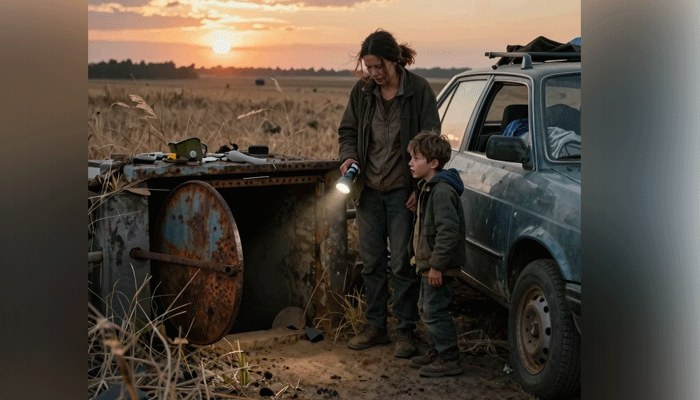
The first thing Caleb said when the steel door groaned open was, “Mom, it’s so dark in here.”
Mara Whitaker stood with one hand on the rusted ladder and the other gripping her son’s backpack, trying not to let him hear how fast she was breathing. The door above them was round, heavy, and cold even in the late-summer heat. It had been buried beneath a square of dead weeds and a warped plywood cover until the county auction man showed her where to pull.
Now it was open.
A black hole waited under their feet.
Mara had seen basements before. She had slept in laundry rooms, church shelters, and the back seat of a dying Toyota Corolla. She had lived in cheap apartments where the windows stuck and the radiators screamed all night. But this place was different. The air rising out of it smelled like metal, dirt, and old rain.
Caleb pressed against her side. He was eight years old, skinny from a summer of dollar-menu dinners and peanut butter sandwiches, with a mop of brown hair he kept pushing out of his eyes. His voice had been brave all morning, but now it had gone small.
“Are we really living down there?” he whispered.
Mara looked across the flat, empty Kansas land around them. The nearest paved road was half a mile away. The nearest town, Fairlake, had one grocery store, one diner, a gas station, a feed store, and a county office that had sold her this abandoned underground bunker for eight hundred dollars because nobody else wanted it.
Behind her, their Corolla sat beside the fence, packed so full that clothes pushed against the back window. A blue tarp covered the trunk where rain leaked in. Everything she and Caleb owned was in that car: two duffel bags, a cracked tablet, three blankets, a pan, a box of school papers, and a framed picture of Caleb as a baby that Mara refused to throw away no matter how often she had to choose between gas and food.
They had nowhere else to go.
So Mara forced herself to smile.
“We’re just taking a look,” she said. “Like explorers.”
Caleb did not smile back. “Explorers have flashlights.”
“We have flashlights.”
“One flashlight,” he said. “And it flickers.”
Mara pulled the flashlight from her jacket pocket and hit it against her palm. A yellow beam sputtered on, weak but steady enough to show the first few rungs of the ladder disappearing down a concrete shaft.
“See?” she said. “Explorer-grade.”
Caleb gave her the look he had learned too young, the look that said he knew when she was pretending.
Mara climbed down first.
Every rung complained beneath her sneakers. Rust flaked under her palms. The air grew cooler as she descended. Ten feet. Fifteen. Twenty. Her flashlight beam jumped across curved concrete walls, old bolts, spiderwebs, and streaks where water had seeped through years before.
When her feet touched the floor, the sound echoed in a way that made the space feel bigger than she expected.
“Okay,” she called up. “Come slow. I’m right here.”
Caleb lowered himself carefully, backpack thumping against the ladder. He was afraid of heights, afraid of the dark, and lately afraid of men in uniforms, landlords, and anyone who knocked too hard on a door. Mara hated that. She hated that the world had taught him to flinch before it had taught him long division.
When he reached the floor, he grabbed her hand.
The flashlight showed a narrow entry tunnel leading deeper underground. The walls were concrete. The ceiling was low enough that Mara, at five foot six, felt the need to duck. On the left wall, faded yellow letters read: CIVIL DEFENSE SHELTER 1962. Beneath that someone had written in black marker many years later: KEEP OUT, LYLE.
“Who’s Lyle?” Caleb asked.
“No idea.”
“Do you think he’s still here?”
“No,” Mara said too quickly. “This place has been empty for years.”
The auction man, Mr. Dawes, had told her that the property used to belong to an old farmer named Silas Boone. Silas had built the bunker during the Cold War, then used it for storage after the fear faded. When he died with unpaid taxes and no close family willing to claim the land, the county took it. Aboveground there was almost nothing: one acre of scrub, a fence that leaned like it was tired, and a concrete hatch hidden beneath weeds.
Everyone at the auction had laughed when the bunker came up.
“Underground headache,” one man muttered.
“Flooded, probably,” said another.
“Full of rats,” said a woman in a red visor.
Mara had not planned to bid. She had gone to the county auction because Mr. Dawes said sometimes old trailers or sheds sold cheap. She had five hundred dollars in cash from cleaning motel rooms, two hundred from pawning her wedding ring, and one hundred hidden in Caleb’s old lunchbox. Eight hundred dollars was everything.
Then the auctioneer said the bunker had no house, no plumbing guarantee, no electricity guarantee, and no refund.
Nobody bid.
Mara thought of the shelter list with a three-week wait. She thought of the apartment manager in Wichita who had changed the locks after her hours were cut. She thought of the motel clerk saying, “Checkout is eleven, ma’am,” while Caleb pretended not to cry.
She raised her hand.
The auctioneer blinked. “Eight hundred?”
Mara nodded before fear could stop her.
“Sold.”
And now here they were, underground.
The tunnel opened into a main room about the size of a small apartment living room. Mara swept the flashlight across the space. There were metal shelves along one wall, empty except for dust and a few jars with rusted lids. A narrow cot leaned folded in the corner. An old desk sat under a ventilation pipe. Two green chairs faced each other like people who had been waiting decades to finish a conversation.
Caleb stepped behind her. “It’s creepy.”
“It’s sturdy,” Mara said.
“That’s what grown-ups say when something is creepy.”
She laughed despite herself. The sound came back at them from the walls, softer than she expected.
There were two smaller rooms off the main chamber. One held a chemical toilet behind a curtain stiff with age. The other had stacked crates, a broken radio, and an old hand pump connected to a pipe. Mara’s hope rose when she saw the pump, then sank when she tried it and heard only a dry cough from somewhere below.
The place was cold, dirty, and strange.
But it had walls.
It had a door.
It was theirs.
Mara set the flashlight on the desk, beam pointing upward. Shadows stretched across the ceiling.
Caleb walked to the cot and touched it with one finger. “Do you think we can make it nice?”
The question nearly broke her.
She wanted to say yes with the confidence of a mother in a movie, the kind who always found a way. But Mara was tired. Not regular tired. Not end-of-a-long-day tired. She was tired all the way down to the place where hope lived.
Still, Caleb was watching her.
“We can make anything nice,” she said. “Remember the motel room with the orange carpet?”
He nodded. “We put up the dinosaur blanket.”
“And it became a dinosaur cave.”
“That room had a TV.”
“This place has mystery.”
“I’d rather have cartoons.”
Mara smiled. “Fair.”
They carried down the first load before sunset: blankets, canned food, bottled water, Caleb’s school bag, the pan, two towels, and a plastic bin with their important papers. Mara left most of the heavy things in the car. She wanted to inspect the bunker before moving everything in.
The hatch door was hard to close from inside, but she managed it after finding a chain and pulley system mounted near the ladder. When the steel disk settled over them, the darkness became total.
Caleb made a sound in his throat.
Mara clicked the flashlight on again.
“It’s okay,” she said. “We’ll keep the hatch open when we’re awake. Tonight we close it for safety.”
“Safety from what?”
From men who saw a woman and a child sleeping in a car and slowed down.
From police officers telling them they couldn’t park overnight.
From rain.
From anyone who thought poor meant available.
“From weather,” Mara said.
Caleb looked at her, not believing all of it, but accepting enough.
They ate canned ravioli cold because Mara was too nervous to light the small camp stove underground. Caleb made a face but ate every bite. Afterward, Mara spread blankets over the cot mattress and shook out the dinosaur blanket with faded green T. rexes. Caleb crawled under it fully clothed.
“Will you sleep?” she asked.
“Maybe.”
“I’ll be right here.”
“Don’t go up without me.”
“I won’t.”
He closed his eyes, then opened them again. “Mom?”
“Yeah?”
“What if we made a sign?”
“What kind of sign?”
“For outside. Like, ‘Whitaker Bunker.’ So people know it’s ours.”
Mara swallowed hard. “That sounds official.”
“With lightning bolts.”
“Of course. Every good bunker sign needs lightning bolts.”
He smiled faintly and finally turned onto his side.
Mara sat in one of the green chairs and listened until his breathing steadied. Then she let her own face fall.
Eight hundred dollars.
She had bought darkness, dust, and a locked steel door.
The sensible part of her mind screamed that she had made a terrible mistake. Caleb needed a bedroom, sunlight, a school routine, a dentist, fresh fruit, clean socks. Not a Cold War bunker with a dead hand pump and a toilet that might poison them both.
But the other part of her—the part that had survived her husband leaving, her mother dying, the eviction, the motel, the hunger, the stares—looked around and saw something different.
No rent.
No landlord.
No one banging on the door because she was late.
No one telling Caleb to keep quiet because walls were thin.
She took the flashlight and began searching.
She checked shelves first. Mostly junk. A cracked mason jar full of screws. A tin of buttons. Old newspapers from the 1980s. A box of candles melted into one gray lump. A stack of National Geographic magazines curled from dampness.
In the storage room, she found two sealed five-gallon water jugs. The dates printed on them were so old she did not trust them to drink, but she set them aside for washing. She found a metal toolbox with a hammer, pliers, a wrench, and a roll of electrical tape so stiff it might have been stone. She found three cans of peaches with labels faded white.
Then she found the locked cabinet.
It stood behind the crates, half hidden under a tarp. It was waist-high, steel, painted army green. The padlock on it was newer than everything else, brass instead of rusted iron.
Mara knelt in front of it.
The lock did not look ancient. It looked used.
Her stomach tightened.
Maybe somebody still came here.
Maybe Lyle.
She shined the flashlight around the room as if a man might be standing in the corner, smiling in silence. Nothing moved.
She tried the cabinet handle. Locked.
She searched the crates for a key, then the desk drawers, then under the cot. Nothing.
At the desk, she opened the center drawer and found a brittle envelope, empty, and a pencil sharpened to a deadly point. In the right drawer, she found a small spiral notebook.
Most pages were blank. The first page had one sentence written in shaky blue ink:
If Lyle comes asking, tell him the dark keeps better secrets than blood.
Mara stared at it for a long time.
Then a noise came from above.
Not loud.
A scrape.
Mara froze.
Caleb slept on.
Another scrape.
Something moved over the hatch.
Mara snapped off the flashlight.
Darkness swallowed everything.
For a few seconds, she heard only Caleb breathing and her own heartbeat. Then came a muffled voice from above, too distorted by steel and earth to understand.
A second voice answered.
Men.
Mara rose slowly from the chair, one hand reaching blindly for the hammer in the toolbox. Her fingers closed around the handle.
The hatch chain rattled.
Caleb woke instantly. “Mom?”
She crossed the room in two steps and covered his mouth gently.
“Quiet,” she breathed into his ear.
His eyes widened in the dark. He nodded against her palm.
The hatch did not open. Whoever stood above either did not know how the pulley worked or had not found the handle beneath the weeds. But they were there. Walking. Scraping. Searching.
A beam of light cut through a narrow crack near the hatch rim. It swept once, vanished, returned.
Mara held the hammer so tightly her knuckles ached.
A man’s voice came clearer now.
“Door’s open. Told you somebody bought it.”
Another voice: “County records said a woman.”
“Then she’ll sell.”
“What if she don’t?”
A pause.
Then the first man laughed. “Everybody sells when they get scared enough.”
The footsteps moved away.
Mara did not breathe until the voices faded completely.
Caleb trembled under her hand. She removed it and pulled him into her arms.
“Who were they?” he whispered.
“I don’t know.”
“Are they coming back?”
Mara wanted to lie.
Instead, she said, “Not tonight if we stay quiet.”
They sat in the dark until Caleb fell asleep against her. Mara stayed awake until dawn, hammer in hand, staring at the place where the ladder disappeared upward.
At first light, she opened the hatch carefully.
The land above was empty.
But the plywood cover had been dragged aside. Fresh tire tracks cut through the weeds near the fence, wide and deep. Someone had driven close to the bunker in the night and left.
On the hatch itself, written in white chalk, were three words:
NOT WORTH DYING.
Mara stared at the message until the sun warmed the back of her neck.
Then she did something she had not expected.
She got angry.
Not scared. Not beaten down. Angry.
She had spent years apologizing for needing help. Apologizing for being behind. Apologizing when Caleb’s shoes were worn, when her card declined, when she asked for one extra day. She had become fluent in shrinking. But this place—dark, ugly, and strange as it was—belonged to her now.
She had the county deed folded in a plastic sleeve.
Her name was on it.
Mara Louise Whitaker.
The men could write whatever they wanted.
She was not leaving.
By noon, she had driven into Fairlake and bought two more flashlights, batteries, a broom, trash bags, peanut butter, bread, apples, and a cheap combination lock. The money left in her wallet came to forty-three dollars and twelve cents.
At the diner, while Caleb ate a grilled cheese she could barely afford, Mara asked the waitress about Silas Boone.
The waitress, a woman in her sixties named Darlene, stopped wiping the counter.
“You bought Boone’s bunker?” she asked.
Mara nodded.
Darlene looked toward the front window as if the name might summon someone. “Honey, that place has a bad smell on it.”
“You mean mold?”
“I mean family.”
Caleb paused with his sandwich halfway to his mouth.
Darlene leaned closer. “Silas was harmless. Strange, but harmless. Kept to himself. Came in every Friday for meatloaf, tipped two dollars no matter what the bill was. Had a nephew named Lyle Boone. Mean boy, mean man. Always thought the old man had money hidden somewhere.”
“Did he?”
Darlene gave a humorless laugh. “Around here, everybody thinks somebody has money hidden. Mostly what people got hidden is shame.”
“Do you know who owns the land around the bunker?”
“Company out of Topeka bought most of the old farms west of town. Planning some storage facility or solar farm or whatever men in clean shirts call it when they ruin a view. Your acre sits right in the middle of what they want.”
Mara’s stomach tightened. “Who runs it?”
“Local face is Grant Voss. Realtor, developer, church donor when there’s a camera nearby. Drives a black pickup. Smiles like a knife.”
Caleb whispered, “That sounds like a villain.”
Darlene glanced at him and softened. “Sometimes villains wear polo shirts, sweetheart.”
Mara thought of the chalk message.
“Does Grant Voss know Lyle Boone?” she asked.
Darlene’s mouth flattened. “Everybody with dirty business knows Lyle.”
When Mara returned to the bunker, a black pickup was parked by the fence.
A man leaned against it, arms crossed, sunglasses hiding his eyes. He was tall, broad, and dressed in pressed jeans and a white shirt too clean for the dust around him. His hair was silver at the temples, his boots expensive.
Mara told Caleb to stay in the car.
The man smiled as she approached.
“Ms. Whitaker,” he said. “Grant Voss.”
She stopped ten feet away. “You were here last night?”
He put a hand to his chest, pretending offense. “Last night? No, ma’am. I don’t make social calls after dark.”
“Somebody did.”
“Kids, probably.”
“Kids wrote a death threat?”
His smile thinned. “This county has a sense of humor.”
“I don’t.”
“So I see.” He pushed off the truck. “I’ll get right to it. You bought a problem yesterday. I’d like to solve it for you.”
“My problem doesn’t need you.”
“Oh, I think it does. That bunker isn’t safe. No proper ventilation. No certified water. Liability issues. A woman with a child can’t live underground.”
Mara felt heat rise in her face. “A woman with a child can live where she owns.”
Voss removed his sunglasses. His eyes were pale blue and cold. “Ownership is a complicated word.”
“Not on a deed.”
“I admire spirit,” he said. “Truly. But spirit won’t fix concrete. It won’t install plumbing. It won’t keep the county from condemning the property if someone files a concern.”
“Would that someone be you?”
He smiled again. “I’m offering you fifteen hundred dollars. Cash. Nearly double what you paid. You and your boy can get a motel for a few weeks, figure out something better.”
Mara thought of the motel clerk. Checkout is eleven, ma’am.
“No.”
“Think carefully.”
“I did. No.”
His jaw moved once, like he was biting down on something. “You don’t know what you’re sitting on.”
“A bunker.”
“A lawsuit. A hazard. A piece of land surrounded by people with deeper pockets and more patience than you have.”
Mara stepped closer despite herself. “You don’t know how patient I am.”
For the first time, his expression changed. Not much. Just enough for her to see irritation.
Then Caleb opened the car door.
“Mom?”
Mara turned. “Stay inside.”
Voss looked at Caleb and sighed theatrically. “Son, I hope your mother makes smart decisions.”
Caleb stared back. “She does.”
Voss’s smile disappeared.
He got into his truck. Before driving away, he lowered the window.
“Offer expires tonight,” he said. “After that, things get official.”
Dust rose behind him as he left.
Mara stood in the heat, shaking.
Caleb came to her side. “What does official mean?”
“It means adults use paper to be mean.”
“Can we fight paper?”
Mara looked at the bunker hatch. “We can try.”
That afternoon, they cleaned.
Fear turned Mara into motion. She swept dust from the main room, wiped shelves, dragged old crates into piles, and opened every container she could find. Caleb became chief inspector, announcing each discovery with more importance than it deserved.
“Three batteries, dead.”
“Mouse skeleton, gross.”
“Beans, expired before I was born.”
“Rope, maybe useful.”
“Creepy mask, definitely haunted.”
The “mask” was an old gas mask with cracked rubber. Caleb refused to touch it, so Mara placed it on a high shelf facing the wall.
The locked cabinet remained.
Mara tried the brass padlock with pliers. It held. She struck it with the hammer until her arm hurt. It still held.
“Maybe it’s treasure,” Caleb said.
“Maybe it’s tax records.”
“What’s worse?”
“Depends who you ask.”
By evening, the bunker looked less like a tomb and more like an extremely strange camping spot. Mara hung a battery lantern from a pipe, spread blankets over the cot, set food on one shelf and tools on another, and taped Caleb’s dinosaur drawing to the wall.
He stood back, studying it.
“Better,” he decided.
“High praise.”
“But still dark.”
“We’ll get more lights.”
“When?”
Mara’s smile faltered. “Soon.”
After dinner, she made Caleb practice climbing the ladder twice in case they needed to leave quickly. Then she chained the hatch from inside and set the new combination lock through the interior latch as extra security.
At nine, Caleb fell asleep with the flashlight beside his pillow.
At ten, Mara sat at the desk with Silas Boone’s notebook open in front of her.
If Lyle comes asking, tell him the dark keeps better secrets than blood.
She turned the page again and again, hoping invisible writing might appear. Nothing. She checked the back cover. A grocery list: coffee, lamp oil, dog food, nails. Beneath it, in the same shaky handwriting:
Seven steps from where the sun can’t follow.
Mara frowned.
She read it twice.
Seven steps from where the sun can’t follow.
A riddle? A warning? Old man nonsense?
She stood and walked to the ladder. From the bottom, she took seven steps into the tunnel. The seventh step placed her near the faded Civil Defense lettering.
She shined the flashlight over the wall. Nothing but concrete.
She tried again from the main room entrance, seven steps inward. That put her beside the desk.
She checked behind it.
Nothing.
She tried from the storage room door, from the toilet curtain, from the cot.
At the seventh step from the cot, her foot landed on a section of floor that sounded different.
Hollow.
Mara dropped to her knees.
The concrete floor there was covered with dust and a thin rubber mat she had assumed was stuck in place. She peeled it back slowly. Beneath it was a square metal panel with a small recessed ring.
Her heart began pounding.
She pulled the ring.
The panel lifted with a soft groan.
Underneath was a shallow compartment.
Inside sat a metal cash box.
Mara stared at it so long that her knees began to ache.
She lifted the box out. It was heavy, painted black, and locked with a small keyhole. Unlike the cabinet padlock, this lock was old and weak. Two strikes with the hammer broke it.
Inside were bundles of cash wrapped in rubber bands.
Mara stopped breathing.
There were twenties, tens, fives, and a few hundred-dollar bills, old but real. Under the money lay a folded sheet of paper.
Her hands shook as she counted.
Seven thousand three hundred forty dollars.
$7,340.
Not millions. Not enough to buy a house outright. Not enough to erase every problem.
But to Mara, sitting in a bunker with forty-three dollars to her name, it looked like a miracle.
Caleb woke as she finished counting.
“Mom?” He sat up. “Are we rich?”
Mara laughed, then cried, then laughed again, covering her mouth so the sound would not turn wild.
“No, baby,” she said. “But we might be able to breathe.”
He climbed out of bed and came to sit beside her. “Where did it come from?”
Mara unfolded the paper.
The handwriting matched the notebook.
To whoever finds this, if you found it by counting seven steps, then you listened better than my own blood ever did.
This money is not stolen. It is what I saved from selling tools, scrap, and my old Ford after I stopped trusting banks and relatives. Lyle thinks there is more. There is not. He wants what he did not earn.
Use this if you need it. Fix the pump. Fix the vent. Fix the door. A shelter is no good if it only hides you. It ought to help you stand.
If Lyle comes, do not open for him.
—Silas Boone
Caleb leaned against her shoulder. “He left it for us?”
“He left it for whoever needed it.”
“That’s us.”
Mara looked around the bunker. The place seemed different now. Not less dark, exactly, but less empty.
She held the letter to her chest and whispered, “Thank you, Silas.”
The next morning, Mara drove to the Fairlake Bank & Trust with the money hidden beneath the passenger seat and Caleb’s backpack on top of it.
She deposited six thousand dollars and kept $1,340 in cash. The teller looked at her wrinkled clothes, her tired eyes, and the old bills, but said nothing after Mara showed the county deed and explained she had found savings on property she owned. The teller filled out paperwork. Mara signed everything with a hand that still trembled.
Then she went to work.
She bought a prepaid phone with enough minutes to call contractors, the county office, and the school. She paid for a local handyman named Pete Alvarez to inspect the bunker ventilation. She bought LED lanterns, a small solar charger, cleaning supplies, a used camp toilet system, and a metal security bar for the hatch. She paid two weeks in advance at a campground bathhouse so she and Caleb could shower there every evening until the bunker had proper washing water.
When she returned to the property, Grant Voss’s black pickup was there again.
This time, a second man stood beside him.
Mara knew without being told that he was Lyle Boone.
He was shorter than Voss, with a sunken face, greasy hair, and arms roped with old muscle. He wore a sleeveless shirt despite the dust and heat. A cigarette hung from his mouth unlit.
Caleb whispered, “Bad guys.”
“Stay in the car,” Mara said.
“But—”
“Caleb.”
He stayed.
Mara walked toward the men.
Voss spoke first. “Ms. Whitaker. I expected a call.”
“I was busy.”
“Reconsidering?”
“Fixing my property.”
Lyle Boone laughed. It was a dry, ugly sound. “Your property.”
Mara looked at him. “You’re Lyle.”
“And you’re the lady squatting in my uncle’s hole.”
“I bought it from the county.”
“County stole it.”
“Then take it up with the county.”
His eyes narrowed. “You find anything down there?”
Mara kept her face still. “Dust.”
“Don’t lie to me.”
Voss raised a calming hand. “Lyle.”
“No,” Lyle snapped. “She’s been down there all night. She found something.”
Mara felt fear flicker, but the memory of Silas’s letter steadied her.
“If you’re looking for old cans and mouse bones, help yourself after you get a warrant.”
Lyle stepped toward her. “My uncle was a thief.”
“He sounded like a man who wanted to keep thieves away.”
His face darkened.
Voss moved between them, still smiling, though his eyes had hardened. “This doesn’t need to be unpleasant. My offer is now two thousand.”
“No.”
“Three.”
“No.”
“Ms. Whitaker, you are unemployed, homeless, and responsible for a minor child. I know because people talk. How long do you think it will take for Family Services to become interested in a child living underground?”
The words hit like a fist.
Mara’s knees almost weakened.
Lyle smiled around his cigarette.
Voss continued softly. “Take the money. Leave town. Give your son a chance.”
For one second, Mara saw herself from the outside: dirty jeans, cheap shoes, a woman standing in a field with no house behind her. She imagined a caseworker asking where Caleb slept. She imagined losing him not because she did not love him, but because poverty made love look like neglect to people with clipboards.
Then Caleb got out of the car.
He did not come to her. He stood beside the open door, small and pale but upright.
“My mom gives me a chance every day,” he said.
Mara’s eyes burned.
Voss glanced at him, annoyed. “This is grown-up business.”
Caleb lifted his chin. “Then act grown.”
For a moment, nobody spoke.
Then Lyle lunged toward the car.
Mara moved without thinking. She grabbed the hammer from the back pocket of her jeans—she had started carrying it there since the night voices came—and held it out.
“Touch him and see what happens.”
Lyle stopped.
Voss’s expression went flat. “Threatening people won’t help you.”
“Neither will trespassing,” Mara said. “Leave.”
Voss looked at Lyle, then back at Mara. “You’ll regret this.”
“I’ve regretted worse.”
The men left.
Mara waited until the truck vanished before lowering the hammer.
Caleb ran to her. She hugged him too hard.
“You were supposed to stay in the car,” she said.
“You were supposed to not fight villains alone.”
“I’m the mother.”
“I’m the kid. Kids help in stories.”
“This isn’t a story.”
He looked toward the bunker hatch. “It kind of is.”
That evening, Pete Alvarez came to inspect the bunker.
He was a round, cheerful man with a gray beard, two tool bags, and a habit of talking to pipes like they were stubborn animals. Darlene from the diner had recommended him, saying, “Pete won’t cheat a widow, an orphan, or a stray dog, and you’re close enough to all three.”
Pete descended into the bunker, looked around, and whistled.
“Well,” he said, “I’ve seen worse.”
Mara almost laughed. “Really?”
“No.” He grinned. “But I’ve said it.”
He checked the ventilation pipe, the hatch seal, the hand pump, the drainage channel, and the old wiring. He told her what was urgent and what could wait. Ventilation first. Water second. Wiring later. He showed her how to test airflow with a strip of tissue, how to keep the hatch cracked safely when cooking, and where moisture was entering near the storage room.
“Can it be safe?” Mara asked.
Pete looked at Caleb’s dinosaur drawing taped to the wall. “Safe enough if you respect it. Dry enough if we work. Home enough if you decide it is.”
Mara felt something loosen in her chest.
“How much?”
Pete scratched his beard. “Materials and labor for the vent repair, pump inspection, hatch reinforcement… I can start at nine hundred. More if the pump is shot.”
Mara nodded. Before finding the money, nine hundred might as well have been the moon. Now it was still frightening, but possible.
Pete studied her. “Voss been around?”
“Yes.”
“Figured.”
“You know him?”
“I know the kind of man who smiles at auctions.” Pete closed his tool bag. “Document everything. Keep receipts. Take pictures. If he calls the county, you want proof you’re making improvements.”
Mara did exactly that.
For the next week, her life became work.
She cleaned motel rooms from six in the morning until noon, leaving Caleb at the small summer program run by Fairlake Baptist Church. She ate crackers in the car, then returned to the bunker to help Pete when he needed an extra pair of hands. She hauled trash to the dump. She scrubbed walls with vinegar. She learned the difference between a vent cap and a backdraft damper. She filled out school enrollment forms. She took pictures of every repair.
Caleb helped too. He labeled shelves with masking tape: FOOD, TOOLS, LIGHTS, IMPORTANT STUFF, MOM’S BORING PAPERS, CALEB’S AWESOME THINGS. He taped glow-in-the-dark stars above the cot. He made the promised sign on cardboard: WHITAKER BUNKER, with lightning bolts.
The first night the new LED lantern lit the main room bright enough to see every corner, Caleb spun in a circle.
“It’s not dark anymore,” he said.
Mara leaned against the desk, exhausted and filthy. “No?”
“It’s weird. But not dark.”
That became the highest compliment anything could receive.
The bunker was weird, but not dark.
Fairlake noticed them.
Darlene slipped extra fries into Caleb’s takeout. Pete charged less than he should have and pretended not to. The librarian, Mrs. Haskell, found Caleb a stack of books about space, storms, and underground animals. The school secretary helped Mara apply for free lunches without making her feel small.
But Voss noticed too.
A county inspector came on a Thursday.
He was polite but stiff, carrying a clipboard. Voss had filed a safety concern alleging that a child was living in an “uninhabitable military structure.” Mara showed him the deed, repair receipts, ventilation work, water storage, fire extinguisher, battery lights, and the campground shower arrangement. Pete happened to stop by during the inspection and explained the improvements in technical detail until the inspector’s eyes glazed.
Finally, the inspector said, “This is unusual.”
Mara almost smiled. “Yes, sir.”
“But I can’t say it’s illegal for temporary shelter, given the property status and ongoing repairs. I’ll file my report.”
After he left, Mara sat on the hatch rim and cried from relief.
That night, someone threw a rock through the Corolla’s windshield.
Caleb woke to the crash and screamed.
Mara ran up the ladder with the flashlight and hammer. The car sat under the moonlight, glass glittering across the front seats. A paper was tucked under the windshield wiper.
Last chance.
Mara called the sheriff.
Deputy Erin Cole arrived twenty minutes later. She was younger than Mara expected, with tired eyes and a calm voice. She took pictures, bagged the note, and listened while Mara explained Voss, Lyle, and the threats.
“Do you have proof they did this?” Deputy Cole asked.
“No.”
“Any cameras?”
“No.”
The deputy looked around the empty land. “You need some.”
“I need a windshield first.”
Deputy Cole gave her a card. “Call me if they come back. And Ms. Whitaker? Don’t let anyone lure you out here alone at night. People do stupid things over land.”
Mara almost said, It’s only one acre.
But she knew better now.
It was not the size of the land.
It was the fact that she had said no.
The broken windshield cost more than she wanted to spend. Every repair, every meal, every gallon of gas made the $7,340 shrink. By the end of the second week, after Pete’s work, supplies, the windshield, school clothes, and overdue car insurance, Mara had less than three thousand left.
Still, the bunker improved.
The hand pump, miraculously, was not dead. Pete replaced cracked seals and flushed the line. The water tested non-potable at first, but clean enough for washing after filtration. Mara kept bottled water for drinking and used pump water for cleaning. The hatch had a new interior brace. The storage room stayed drier after Pete sealed a crack. The main room smelled less like old metal and more like lemon cleaner, peanut butter, and Caleb’s crayons.
On Caleb’s first day of school in Fairlake, he wore new sneakers and a blue shirt with a rocket on it. Mara brushed his hair at the bunker desk.
“What if they ask where I live?” he said.
“Tell them west of town.”
“What if they ask if it’s a house?”
Mara paused.
“Tell them it’s a work in progress.”
He considered this. “Everything is a work in progress.”
“That’s right.”
“Even people?”
“Especially people.”
He hugged her before getting out of the car at school. She watched him walk inside, shoulders tense but head high. Then she drove to the motel and cleaned rooms until her back burned.
At noon, she found a message on her prepaid phone.
Unknown number.
You should have taken the money. Ask Silas what happens to people who don’t share.
Mara stared at the screen.
Silas was dead.
But Lyle knew about the money, or thought he did. Maybe he had watched the bank. Maybe the teller had talked. Maybe Voss guessed from the repairs. However he knew, the threat felt closer now.
She drove to the diner instead of the bunker.
Darlene saw her face and poured coffee without asking.
“What did they do?”
Mara showed her the message.
Darlene read it and swore under her breath. “That Boone boy always was poison.”
“What happened between him and Silas?”
Darlene looked toward the kitchen, then lowered her voice. “Lyle’s father died young. Silas tried to help raise him. Gave him work, money, second chances. Lyle stole tools, sold fuel, forged checks. Finally Silas cut him off. After that, Lyle started telling everyone the old man had a fortune underground.”
“Did he?”
“Silas had enough to live. Not a fortune.”
Mara thought of the $7,340. A fortune depended on how hungry you were.
Darlene continued, “A month before Silas died, he came in with a bruised cheek. Said he fell. Nobody believed him. Then he stopped coming Fridays. Two weeks later, mail piled up, sheriff checked, found him dead in his kitchen.”
Mara’s skin went cold. “How did he die?”
“Heart, they said. He was old.” Darlene’s mouth tightened. “But fear can squeeze a heart too.”
Mara folded the phone in her hands. “What do I do?”
“You keep Deputy Cole close. You keep records. And you don’t go soft when men like that start acting desperate.”
That night, Mara read Silas’s letter again.
A shelter is no good if it only hides you. It ought to help you stand.
She wondered if he had known someone like her would find it. Someone cornered. Someone needing not just money, but permission to fight.
Mara taped the letter inside the desk drawer, under the tray, where Caleb would not accidentally tear it. Then she took photos of it. She photographed the cash box, the compartment, the notebook page, the chalk threat still faintly visible on the hatch, the broken windshield, every receipt, every message.
She made copies at the library and put them in separate envelopes.
One went into the bunker.
One went into the Corolla.
One she gave to Darlene.
“Just in case,” Mara said.
Darlene did not ask just in case of what. She tucked the envelope beneath the diner register.
Three nights later, the storm came.
It rolled over Fairlake after midnight, shaking the flat land with thunder. Rain hammered the hatch so hard it sounded like gravel pouring from the sky. Caleb woke and climbed into Mara’s cot, pretending it was for warmth.
The bunker held.
For the first time in months, Mara listened to bad weather without wondering whether the car roof would leak on Caleb’s face.
Then the hatch chain rattled.
Mara opened her eyes.
Thunder boomed.
The chain rattled again.
Not wind.
Someone was outside.
She slipped from the cot, grabbed the flashlight and hammer, and motioned for Caleb to stay silent. He sat up, pale in the lantern glow.
A metallic clank echoed down the ladder shaft.
Then a voice shouted through the storm.
“Open up!”
Lyle.
Mara’s mouth went dry.
Another clank. He was hitting the hatch with something.
“Open the door, you thief!”
Mara climbed halfway up the ladder, keeping below the hatch.
“Get off my property!” she shouted.
“You got what’s mine!”
“I called the sheriff!” she lied.
“Liar!”
A heavier blow shook the hatch.
Caleb whimpered below.
Mara looked at the new brace Pete had installed. It held. But would it hold forever? She climbed down, grabbed her phone, and dialed Deputy Cole.
No signal.
The bunker that protected them also cut them off.
Another blow.
The hatch shifted a fraction.
Mara’s mind raced. She could wait and hope the brace held. She could try to climb out and run through the storm with Caleb. She could scream into concrete until nobody heard.
Then she remembered the old radio.
It sat in the storage room, broken, she thought. Pete had laughed at it and said, “That thing probably talked to Eisenhower.” But beside it was a hand-crank emergency transmitter, part of the old Civil Defense setup. Pete had said he doubted it worked, but the antenna line still ran up the vent stack.
Mara ran to the storage room.
The radio was heavy, olive green, with knobs that resisted her fingers. She turned the crank. It squealed. A small needle jumped.
“Mama!” Caleb cried as another strike rang out.
“I’m here!”
She cranked harder. Static burst from the speaker.
Mara twisted knobs, desperate. “Hello? Can anyone hear me? This is Mara Whitaker west of Fairlake. Someone is breaking into my shelter. I have a child. Please, if anyone hears this—”
Static.
She cranked until her arm burned.
“Please!”
A voice crackled through.
“—repeat location?”
Mara nearly dropped the handset.
“West of Fairlake! Old Boone property! Underground bunker off County Road 6! A man is trying to break in!”
The signal snapped, hissed, returned.
“Stay inside. Help coming.”
Mara sobbed once, then ran back to the main room.
The hatch brace screamed as Lyle struck again.
“Give me the box!” he shouted. “I know you found it!”
Caleb crawled under the desk, clutching the dinosaur blanket.
Mara stood at the base of the ladder with the hammer in both hands.
“You’re not coming in,” she said, though he could not hear her.
The next blow broke something.
The hatch lifted an inch. Rainwater spilled through the gap.
Lyle laughed.
Mara climbed two rungs, raised the hammer, and struck the hatch edge from inside with everything she had. The metal rang like a bell. Lyle cursed and dropped whatever tool he was using.
“You crazy—”
Red and blue lights flashed faintly through the crack.
A siren cut through the storm.
Lyle swore again. Footsteps splashed away from the hatch.
Mara climbed higher, but did not open it.
Voices shouted above.
“Sheriff’s office! Stop!”
A crash. A grunt. More shouting.
Then silence except for rain.
Deputy Cole’s voice came through the hatch. “Ms. Whitaker? You okay down there?”
Mara’s legs almost gave out.
“We’re okay!”
“Is your son okay?”
“Yes!”
“We have Lyle Boone in custody. Sit tight while we secure the scene.”
Caleb crawled out from under the desk. “Did we win?”
Mara climbed down and pulled him close.
“For tonight,” she said.
By morning, Lyle was in jail for trespassing, attempted breaking and entering, threats, and assaulting an officer after he swung a crowbar at Deputy Cole in the rain. Grant Voss denied knowing anything about it.
But Lyle talked.
Men like Lyle often thought talking made them powerful. In a holding cell, angry and hungover, he told Deputy Cole that Voss had promised him ten thousand dollars if he could scare Mara off the property. He said Voss believed the bunker sat above an old access route to a buried utility line, making the acre critical for his development plans. He said Voss had told him to search for any cash Silas left, because “a broke woman with money gets ideas.”
Deputy Cole could not tell Mara all the details, but enough came out.
Voss was investigated for harassment, conspiracy, and fraud connected to other land deals. People in Fairlake who had been afraid of him began telling stories. An elderly couple pressured into selling. A widow whose fence was cut. A farmer whose well road was blocked. One no became many.
The county put Voss’s development permits on hold.
Darlene called it “the prettiest paperwork I ever saw.”
Mara did not become rich.
There was no secret vault behind the cabinet, no gold bars, no million-dollar treasure hidden deeper underground. When Deputy Cole obtained permission to cut open the locked cabinet as part of the investigation, they found old photographs, Silas’s military discharge papers, several letters from his sister, and a coffee can full of wheat pennies Caleb thought were treasure anyway.
There was also one photograph of Silas as a young man standing beside the bunker hatch, smiling proudly in the sun. On the back, he had written:
Built for the end of the world. Hope it becomes the start of one instead.
Mara framed it in a dollar-store frame and placed it on the bunker desk.
The $7,340 did what Silas had intended.
It helped them stand.
By October, Mara had steady work cleaning rooms and weekend shifts at the diner. Darlene trained her on the register and said she had “the look of a woman who could handle breakfast rush and minor disasters.” Pete helped install a safer aboveground vent housing and a small solar panel that charged their lights. The campground owner, hearing their story from everyone except Mara, gave them a reduced monthly rate for showers until winter.
Caleb settled into school. He made one friend, then two. He checked out books from the library and told his class that he lived in “a historical underground structure,” which made the other kids jealous until he admitted there was no Wi-Fi.
The bunker became cleaner, warmer, and unmistakably theirs.
Mara painted the main room walls a soft cream color that reflected the lantern light. Caleb chose blue for the storage room door. They hung curtains over the toilet area, laid down thrift-store rugs, and stacked milk crates into shelves for books. The air still smelled faintly of concrete after rain, and the ladder was still annoying with grocery bags, but the fear began to drain out of the place.
One Saturday afternoon, Mara and Caleb stood outside in bright sun, painting a real wooden sign Pete had cut from scrap.
WHITAKER BUNKER
Caleb added lightning bolts in yellow.
Darlene brought lemonade. Pete brought screws. Deputy Cole stopped by during patrol and pretended she had not come just to see the sign.
Mara stepped back and looked at it.
A year earlier, she would have been embarrassed to claim such a strange home. She would have worried what people thought. She would have heard Voss’s voice saying a woman with a child can’t live underground.
But now she saw what Caleb saw.
A beginning.
A place nobody had given them.
A place they had fought for.
That evening, after everyone left, Mara cooked soup on the camp stove near the open hatch while Caleb did homework at the desk below. Sunlight slanted down the ladder shaft in a golden square, touching the concrete floor.
“Mom?” Caleb called.
“Yeah?”
“It’s not dark in here anymore.”
Mara looked down at him.
He sat under glow-in-the-dark stars, beside shelves labeled in his crooked handwriting, in a room lit by a lamp powered by the sun. His face was still too thin, his childhood still carrying more storms than any child deserved, but his eyes were bright.
“No,” Mara said. “It’s not.”
Later, after he slept, Mara opened the desk drawer and took out Silas’s letter.
She had read it so often she nearly knew it by heart.
Use this if you need it. Fix the pump. Fix the vent. Fix the door. A shelter is no good if it only hides you. It ought to help you stand.
Mara folded it carefully and placed it back.
Then she took out a fresh notebook.
On the first page, she wrote:
If someone finds this years from now, I hope they know this place saved us.
She paused, listening to the quiet hum of the vent, Caleb’s breathing, and the soft night wind moving over the hatch above.
Then she added:
Not because it was perfect. Because it was ours.
Mara closed the notebook and turned off the lamp.
For the first time in longer than she could remember, the darkness did not feel like danger.
It felt like rest.
THE END