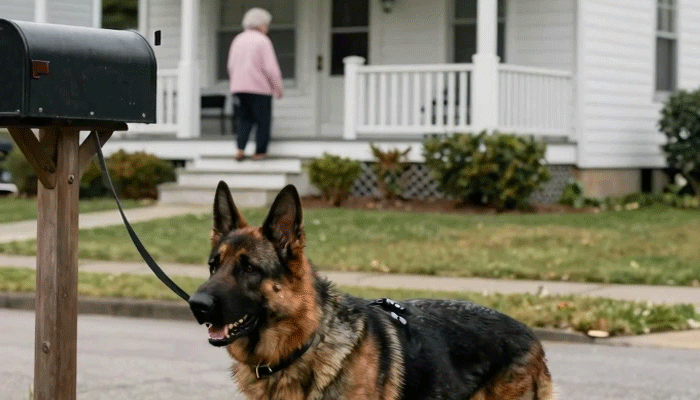
I used to believe danger announced itself.
A scream. A gunshot. A stranger running where nobody should run. After twelve years in the Marines, I trusted noise. Noise gave you direction. Noise gave you permission to act.
But the thing that saved Mrs. Margaret Caldwell’s life was not noise.
It was silence.
My name is Caleb Rourke, and every morning at 9:15, I ran the same four-mile route through a quiet neighborhood outside Wilmington, North Carolina. My German Shepherd, Ranger, ran beside me like a shadow with teeth. He had been with me since my last year in uniform, and he knew the route as well as I did.
At exactly 9:15, we passed Mrs. Caldwell’s white house on Birch Lane.
She was seventy-eight, maybe eighty, always dressed like she expected company: cardigan buttoned, gray hair pinned, slippers on the porch. Every morning, she walked to the mailbox, opened it, looked inside, stood still for three seconds, closed it, and went back in.
I never knew why.
At first, I thought she was waiting for a letter. Then I thought maybe it was just loneliness. Eventually, it became part of my own routine. She would lift two fingers. I would nod. Ranger would glance over, ears up, like he was checking attendance.
Then one Tuesday, she was not there.
I noticed, but I kept running.
People sleep in. People get doctor appointments. People visit family.
On Wednesday, she was missing again.
Ranger slowed near her driveway, nose high, body tight. I tugged the leash and told myself not to be dramatic.
By Thursday, when the porch stayed empty for the third morning, Ranger stopped completely.
He did not bark.
He growled low in his chest, staring at the front window.
That sound pulled me backward through every patrol I had ever walked. Dogs do not invent concern. They read what we miss.
I crossed the lawn and knocked.
No answer.
I called out through the door.
Nothing.
The mailbox was full. That was wrong. The newspaper from Tuesday still lay under a bush. That was worse. Through the side window, I saw a chair tipped over in the kitchen and something white scattered across the floor.
A broken teacup.
I should have called police and waited.
Instead, I forced the back door.
Inside, the house smelled of cold tea, dust, and fear.
Then Ranger found a dark stain beside the hallway rug, lifted his head, and pulled toward the back gate.
That was when I realized Mrs. Caldwell had not disappeared.
She had been taken.
And the quietest woman on Birch Lane had left behind a trail only a retired Marine and one stubborn dog were meant to follow.
I called 911 from her kitchen, gave the address, and told the dispatcher there were signs of forced entry and a possible abduction. She told me to wait outside.
I did not.
That may sound reckless, and maybe it was. But there are moments when training does not ask for permission. It simply wakes up.
Ranger moved through the backyard with his nose low, tracking something past the garden shed, through a broken section of fence, and into the drainage path behind the houses. Mrs. Caldwell’s neighborhood backed up to old commercial land—empty lots, storage buildings, and a condemned warehouse nobody had used since before I moved there.
Halfway down the path, I found her scarf snagged on a rusted wire.
Blue wool.
I had seen her wear it every winter morning.
My stomach turned cold.
I updated dispatch, but I kept moving. Sirens were still far away, and whoever had taken her had already had a head start.
Ranger led me to a brick utility building behind the abandoned warehouse. One side door was cracked open. Fresh tire marks cut through the dirt. I heard voices inside.
Three men.
One angry. One nervous. One trying to sound in charge.
Then I heard Mrs. Caldwell.
Her voice was thin but steady. “You boys are running out of time.”
One of the men laughed. “Lady, nobody even knows you’re gone.”
I looked at Ranger.
He looked at me.
He knew.
I slipped through the side entrance and saw her tied to a metal chair near the loading bay. Her cheek was bruised. Her hands were bound. But her eyes were clear, and when she saw me, she did not look surprised.
That bothered me more than the blood.
The first man came around a stack of crates with a pistol low in his hand. Ranger moved before I did, hitting him from the side and driving him into the wall. The weapon clattered across the concrete.
The second man charged me with a crowbar. I stepped inside the swing, broke his balance, and put him down hard enough that he stopped wanting to fight.
The third ran for Mrs. Caldwell.
That was his mistake.
I reached him before he reached her, slammed him into the loading door, and held him there until he dropped the knife in his hand.
By the time police arrived, Ranger was standing between Mrs. Caldwell and everyone else, teeth showing, refusing to let even the officers close until I told him it was safe.
An EMT cut the tape from her wrists.
I knelt beside her. “Ma’am, who were they?”
Mrs. Caldwell looked toward the warehouse windows, then back at me.
“My son uncovered something he was not supposed to find,” she said. “And I knew one day they might come looking for me.”
I stared at her.
She gave me the saddest smile I had ever seen.
“That is why I went to the mailbox every morning.”
At first, I thought the shock was making her confused.
People say strange things after trauma. They connect dots that do not belong together. They turn ordinary habits into symbols because fear needs meaning.
But Mrs. Caldwell was not confused.
She was the calmest person in that warehouse.
At the hospital, after doctors cleaned the cut near her temple and confirmed nothing was broken, two detectives came into the room. I stayed near the door with Ranger lying at my feet. Mrs. Caldwell asked me not to leave.
Then she told us the truth.
Her son, Daniel Caldwell, had been a financial systems analyst for a private contractor that handled payment records for several defense-adjacent companies. Two years earlier, he found evidence that money was being moved through fake vendor accounts. Not small money. Millions. Possibly more.
Daniel copied files. He contacted a federal investigator. Then he died in what was officially called a late-night highway accident.
Mrs. Caldwell never believed that.
Before he died, Daniel had given her a drive hidden inside an old fountain pen. He told her not to open it, not to mail it, and not to trust anyone who came asking about his work. He also told her one more thing.
“Mom, if you ever feel watched, become predictable. Make your absence louder than your presence.”
So she did.
Every morning at 9:15, Mrs. Caldwell walked to the mailbox. She did it in rain, wind, summer heat, and winter cold. Not because she expected a letter. Not because she had nowhere else to go. She did it because she had turned herself into a living signal.
If she appeared, she was safe.
If she vanished, someone was supposed to notice.
For years, nobody understood.
Except maybe Ranger.
I asked her why she never told the police.
She looked at the detective beside her bed. “My son tried official channels first.”
Nobody argued.
The men who took her were not criminal masterminds. They were hired pressure. Their job was to scare her, search the house, and recover whatever Daniel had left behind. They had not expected an old woman to design her own alarm system out of habit. They had not expected a retired Marine to run past her porch every morning. And they definitely had not expected a German Shepherd to care about a missing wave.
The pen was found later in a sewing box beneath folded tablecloths. Federal agents took it. Weeks passed before I heard anything else, but eventually, arrests were made in three states. Shell companies were frozen. Names appeared on the news, though Mrs. Caldwell’s did not.
She preferred it that way.
When she came home, the neighborhood changed.
People who had lived twenty yards from her for years suddenly brought casseroles, flowers, and offers to fix the broken fence. She thanked them kindly but did not pretend not to understand the timing.
Kindness after a crisis is still kindness. But attention before one is better.
I kept running every morning.
At 9:15, Mrs. Caldwell returned to her porch. The first time she walked to the mailbox again, half the street watched through curtains and kitchen windows. She opened the little metal door, looked inside, stood still for three seconds, then turned toward me.
This time, she did not just lift two fingers.
She smiled.
Ranger pulled me across the sidewalk and sat at her feet. She rested one hand on his head, and for a moment, the whole street felt less careless than it had before.
A month later, I installed a new porch camera for her. My neighbor fixed her gate. A retired nurse across the street started checking on her every evening. None of it was dramatic. None of it made headlines.
But that was the lesson Mrs. Caldwell left with me.
Most people do not disappear all at once. First, their routines change. Their curtains stay closed. Their newspapers pile up. Their porch light burns at noon. Their dog stops barking. Their chair is empty at church. Their wave is missing from the morning.
We call those things small.
They are not.
They are the first language of trouble.
I used to think being a Marine meant running toward danger when it exploded. Now I think it also means slowing down when something ordinary feels wrong.
Because Mrs. Caldwell did not need a miracle.
She needed someone to notice.
And maybe that is the kind of rescue all of us can practice, long before sirens arrive.
If this story made you think of a neighbor, comment “noticed,” share it, and follow for more true-feeling American stories.