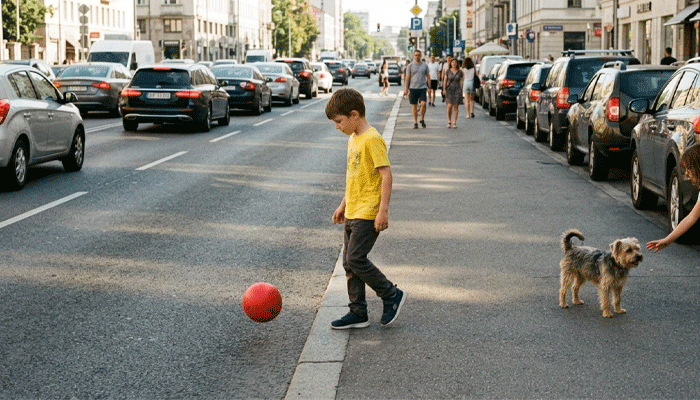
On a bright afternoon along a busy city sidewalk, a photographer captured what seemed like an ordinary slice of urban life: children playing, pedestrians strolling, cars inching along a sunlit street. The scene felt familiar—almost timeless. A young boy in a yellow shirt stood near the curb, a red ball bouncing just ahead of him. Nearby, another child interacted with a small dog, their quiet moment framed by parked cars and passing traffic.
At first glance, nothing about the images suggested anything extraordinary. Yet within days, these photos would spread across social media with a dramatic caption: a stray dog had supposedly leapt into action to save a child from running into traffic. The story was irresistible—a homeless animal turned hero, a split-second act of instinct, and a heartwarming ending where the dog finds a forever home with the very family it saved.
It was the kind of story people wanted to believe.
But as the images circulated more widely, a closer look began to tell a different story—one less sensational, but far more revealing about how quickly narratives can take shape in the digital age.
A Closer Look at the Scene
The first image shows a child focused on a bouncing red ball. He appears relaxed, mid-play, his posture casual rather than urgent. The ball is still firmly on the sidewalk, not yet entering the street. There’s no sign of panic, no sudden lunge, no indication that he is about to sprint into traffic.
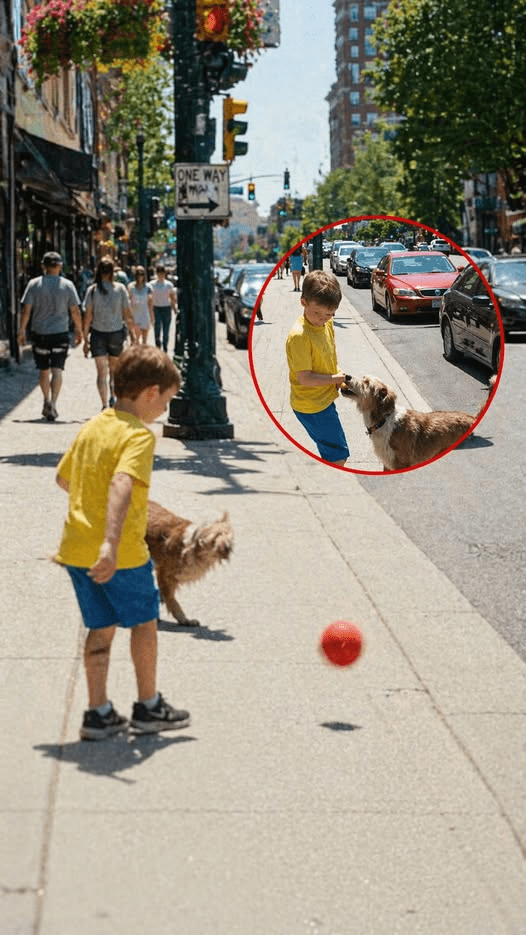
In the second image—often highlighted in viral posts—a small dog stands facing another child. The boy’s hand is extended toward the dog, suggesting interaction rather than interruption. The dog’s stance is calm, even curious. There’s no visible tension in its body language: no bracing, no aggressive positioning, no attempt to block or redirect movement.
Traffic moves steadily in the background, but nothing suggests an imminent collision or near miss. The spacing between the curb, the children, and the vehicles appears sufficient. The moment, while lively, lacks the visual cues typically associated with emergency or intervention.
And yet, the story persisted.
The Anatomy of a Viral Narrative
So how did a quiet street scene become a tale of bravery and rescue?
Part of the answer lies in how people interpret images. A photograph freezes a moment in time, but it doesn’t explain what came before or after. That gap invites imagination—and, often, embellishment.
In this case, the narrative followed a familiar emotional arc:
These elements are powerful because they resonate deeply. Stories of animals protecting humans tap into a long cultural tradition of loyalty and heroism. Add a child into the mix, and the emotional stakes rise even higher.
But emotional resonance doesn’t guarantee factual accuracy.
What the Photos Actually Suggest
When viewed without the overlay of a dramatic storyline, the images depict something far simpler—and perhaps more authentic.
A typical urban environment where life unfolds in small, unscripted moments
There is no clear sequence indicating that the dog moved to stop the boy. No visual evidence suggests urgency or danger. Instead, the interaction appears gentle, even routine.
In other words, the photos capture a moment of coexistence, not crisis.
Why We Believe What We Want to Believe
The rapid spread of the “hero dog” story highlights a broader phenomenon: people are more likely to share content that makes them feel something strong—especially joy, relief, or admiration.
In a digital landscape crowded with information, emotional stories cut through the noise. They are shared quickly, often without verification, because they offer something rare: a sense of goodness.
But that speed comes at a cost.
When stories are accepted at face value, nuance is lost. Reality becomes secondary to narrative. And ordinary moments—like a child playing with a dog—are transformed into something they were never meant to be.
The Unexpected Truth
Ironically, the most surprising element of this story isn’t that a dog saved a child—it’s that nothing dramatic happened at all.
And yet, that realization carries its own kind of weight.
Because what the images actually show is something quieter, but still meaningful: a shared moment between humans and animals in a public space. A glimpse of trust. A fragment of everyday life that doesn’t need embellishment to be valuable.
The dog didn’t have to be a hero to matter.
The Real Takeaway
In the end, the viral story says more about us than it does about the scene itself.
It reveals:
Our willingness to accept a compelling story without questioning its source
But it also offers an opportunity—to pause, to look more closely, and to appreciate reality as it is.
Because sometimes, the truth isn’t dramatic.
It’s just real.
A Different Kind of Appreciation
There’s still something worth celebrating in these images, even without the hero narrative.
A child felt safe enough to play near the street.
A dog felt comfortable enough to approach a stranger.
A photographer noticed the moment and chose to capture it.
These are small things—but they add up to something genuine.
And in a world where stories are often exaggerated for impact, authenticity can be just as powerful.
Final Thoughts
The story of the “dog who saved a boy” may not hold up under scrutiny, but it leaves behind a different lesson—one that lingers longer than a viral headline.
Not every meaningful moment needs to be extraordinary.
Sometimes, the most honest stories are the ones that don’t try to be anything more than what they are: a snapshot of life, unfiltered and unscripted.
And maybe that’s enough.