If you’ve ever lived on a quiet suburban street, the kind where mornings begin with sprinklers ticking rhythmically over trimmed lawns and evenings settle into a soft chorus of cicadas, then you already understand the illusion—how peace can look so complete from the outside that no one thinks to question what might be quietly unraveling beneath it. That was Ridgeway Lane in Brookhollow, Ohio, a place where people waved from driveways, where mailboxes matched the color of front doors, and where, for the longest time, no one noticed the small, quiet girl who walked a three-legged dog like it was the only thing tethering her to the world.
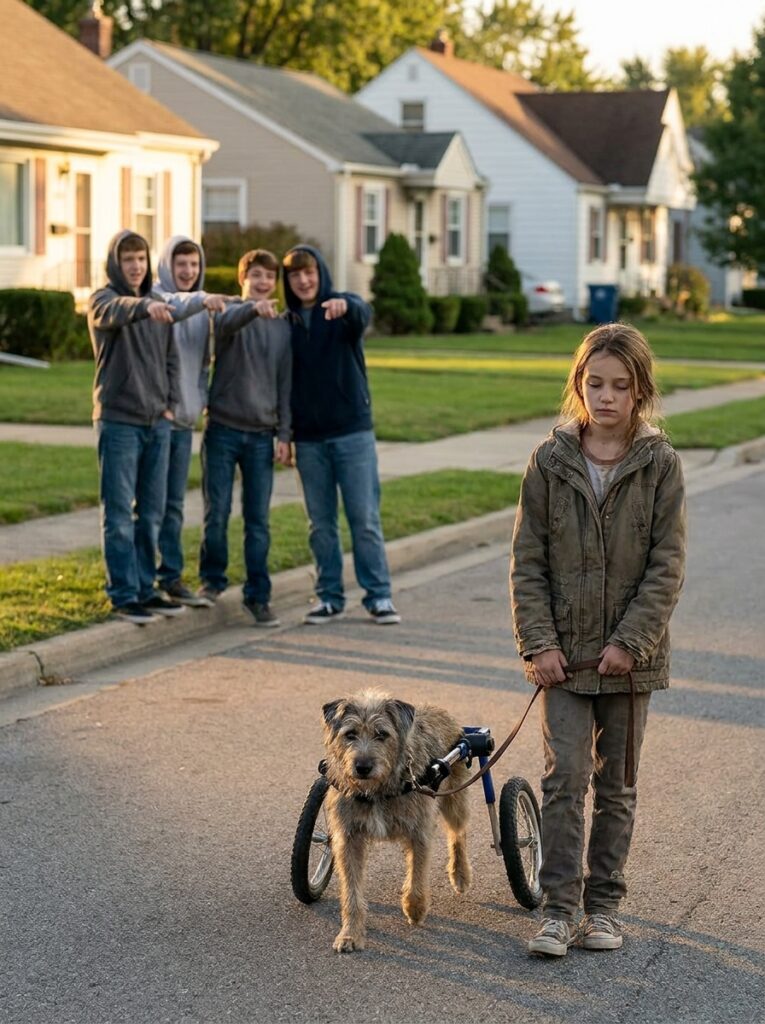
Her name was Eliza Rowan, and at ten years old, she had already learned how to make herself invisible.
It hadn’t always been that way. Before the accident—before the late-night phone call that shattered whatever version of normal her family once had—Eliza had been loud in the way children are supposed to be. She laughed too easily, asked too many questions, followed her father around the house like a shadow that talked back. But grief, especially the kind that arrives suddenly and without explanation, has a way of rearranging a child from the inside out. After her father died in a collision on an icy interstate, Eliza didn’t just lose him; she lost the version of herself that existed in a world where he was still alive.
Her mother didn’t stay long after that. Not physically—she was still there, technically—but emotionally, she drifted somewhere unreachable, swallowed by her own kind of silence. Within a year, Eliza had moved in with her grandfather, Thomas Rowan, a retired machinist with calloused hands and a quiet patience that felt steady in a way nothing else did anymore.
The house he lived in wasn’t large, but it carried history in its walls. Old photographs lined the hallway, most of them faded at the edges, moments frozen from a time when the world seemed simpler. Eliza didn’t ask about them. She didn’t ask about much anymore.
Except for Milo.
Milo wasn’t the kind of dog people usually noticed at first glance. His coat, once golden, had dulled into uneven shades of tan and cream, and his body bore the marks of a life that hadn’t been kind to him. He had been found on the side of a rural road, injured badly enough that one of his hind legs could never fully recover. The local rescue group had done what they could, fitting him with a makeshift wheelchair—metal rods, small rubber wheels, and fabric straps that looked like they had been stitched together more out of hope than precision.
To most people, Milo looked broken.
To Eliza, he looked like survival.
Every afternoon, just as the sun began to soften and the heat of the day gave way to something more forgiving, she would take him out. The leash in her small hand, his wheels rolling beside her, clicking gently against the pavement. They didn’t go far—just up and down Ridgeway Lane, past the same houses, the same parked cars, the same carefully maintained hedges—but for those few minutes, something inside her loosened. The silence in her chest didn’t feel quite as heavy.
That might have been enough, if the world had left them alone.
But it didn’t.
It started the way these things often do—with laughter. Not the kind that invites you in, but the kind that pushes you out. A group of boys, older by a few years, had begun gathering near the corner where Ridgeway met the main road. They had bikes, loud voices, and the kind of careless confidence that comes from never having been told “no” in a way that mattered.
At first, they just watched.
Then they commented.
“Hey, look at that thing,” one of them had said, pointing at Milo’s wheelchair like it was a spectacle.
Another mimicked the sound of squeaky wheels, dragging it out in an exaggerated, mocking tone.
Eliza kept walking.
She always kept walking.
Her grandfather had told her once, in that steady voice of his, that not every fight needed to be fought out loud. “Some people,” he said, “are just noise. You don’t have to become noise with them.” She held onto that, even when the laughter followed her down the street, even when it echoed in her ears long after she had gone back inside.
But noise, when left unchecked, has a way of turning into something sharper.
The boys began to block the sidewalk. Not aggressively at first—just enough to force her to step into the grass, to navigate around them while they watched with smirks that felt too deliberate to be accidental. Then came the names. Not directed at her, not directly, but loud enough that she couldn’t pretend she didn’t hear them.
“Scrap dog.”
“Half-dog.”
“Why doesn’t it just die already?”
Eliza never responded.
She just tightened her grip on the leash and kept moving.
Milo, for his part, seemed unaware of the words. He moved with the same quiet determination, his wheels turning, his body adjusting with each step. If he felt pain, he didn’t show it. If he remembered whatever had happened to him before, he didn’t carry it in a way that slowed him down.
That was what Eliza loved most about him.
He didn’t ask why things were the way they were.
He just kept going.
The afternoon everything broke felt, at first, like any other.
The sky was clear, the air warm but not oppressive, and the street carried that familiar hum of distant lawnmowers and passing cars. Eliza and Milo had made it halfway down the block when she saw them.
The boys were already there.
Waiting.
There’s a particular kind of stillness that settles over a moment just before it turns. It’s subtle, almost unnoticeable, but once you’ve felt it, you recognize it instantly. Eliza felt it then, tightening in her chest as her steps slowed.
She could have turned back.
Part of her wanted to.
But she didn’t.
Instead, she kept walking, her eyes fixed somewhere just beyond them, as if that might somehow make them less real.
It didn’t.
One of the boys stepped forward, his bike falling to the ground behind him with a careless clatter.
“Where do you think you’re going?” he asked, his tone light but edged with something harder.
Eliza didn’t answer.
She tried to move around him.
Another boy shifted, blocking her path.
“Come on,” he said, crouching slightly to get a better look at Milo. “Let’s see how this thing works.”
Her grip on the leash tightened.
“Please don’t,” she said, her voice so quiet it almost disappeared into the air.
It should have been enough.
It wasn’t.
The kick came suddenly, without warning.
A sharp, violent motion that connected with the side of Milo’s wheelchair.
The sound it made—plastic cracking, metal bending—cut through the air in a way that felt wrong, like something breaking that wasn’t supposed to.
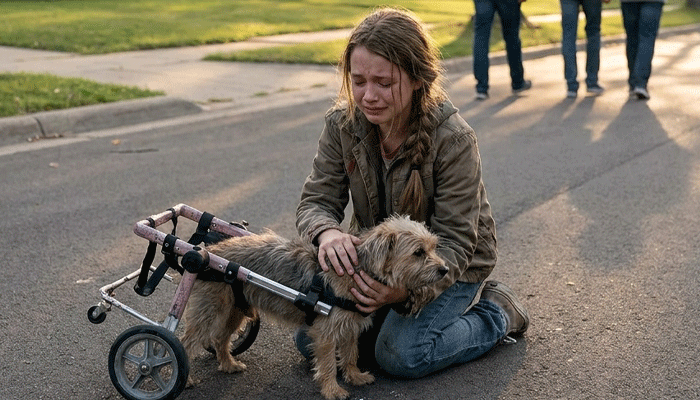
Milo yelped, his body twisting as the structure supporting him collapsed. He fell sideways, tangled in straps and twisted wheels, confusion and pain flashing through his movements.
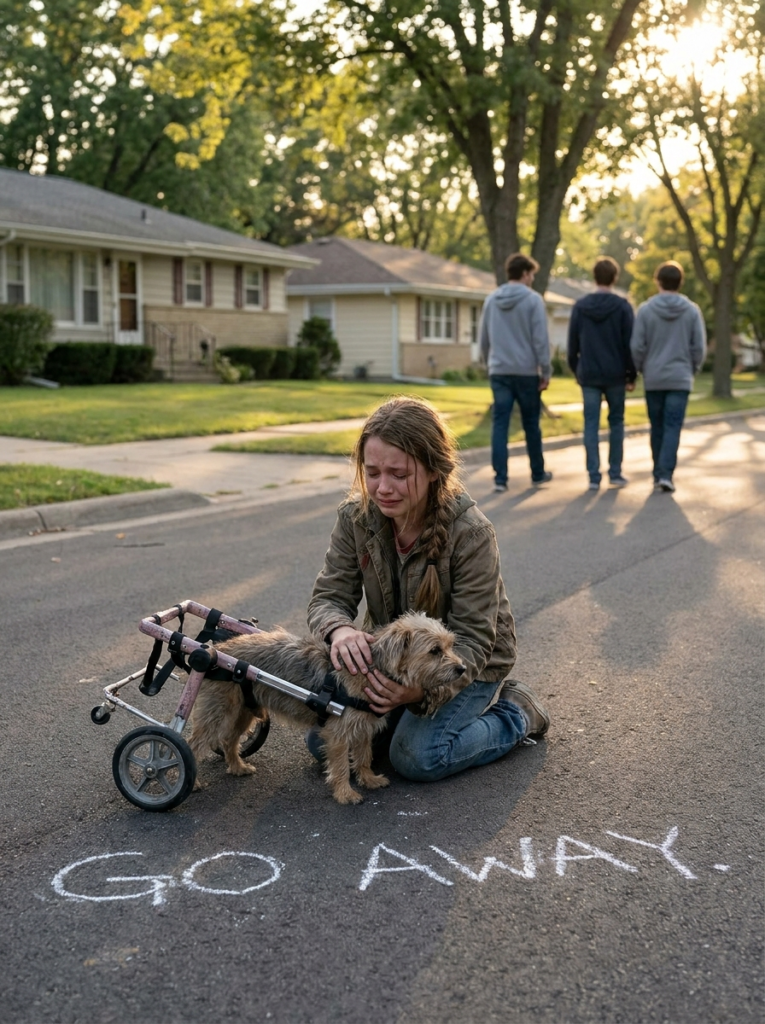
Eliza dropped to her knees instantly.
“No—no, it’s okay, I’ve got you, I’ve got you,” she whispered, her hands shaking as she tried to untangle him, her fingers fumbling against buckles that no longer aligned the way they were supposed to.
Behind her, the boys laughed.
One of them picked up a piece of chalk from the ground—where it had come from, she didn’t know—and began to write on the pavement beside them. The letters were large, uneven, pressed into the concrete with deliberate force.
GO AWAY.
Eliza saw it.
She didn’t react.
Not outwardly.
She just kept working, her focus narrowed entirely to Milo, to freeing him, to making sure he was okay.
“Maybe she’ll listen if we write it bigger,” another boy said.
“Or maybe she just doesn’t get it,” the first replied.
Eliza didn’t argue.
Didn’t shout.
Didn’t cry—not in a way they could see.
When she finally managed to lift Milo into her arms, his body trembling against hers, she stood slowly. The broken pieces of the wheelchair lay scattered across the pavement, useless now, beyond anything she knew how to fix.
She didn’t look at the boys.
She didn’t look back at all.
She just walked.
The distance home felt longer than it ever had before. Each step carried the weight of something heavier than the dog in her arms—something that pressed down on her chest, made it harder to breathe.
By the time she reached the house, her vision had blurred.
She didn’t remember unlocking the door.
Didn’t remember stepping inside.
Only that she ended up in her room, the door closed, Milo curled beside her on the bed, and the silence returning in a way that felt deeper than before.
That night, she didn’t speak.
Not to her grandfather.
Not to anyone.
Thomas Rowan didn’t force it.
He had lived long enough to understand that some silences needed space before they could be broken. Instead, he went to the living room, where the broken pieces of the wheelchair had been placed carefully on the floor, and he studied them for a long time.
His hands, steady despite their age, picked up one of the bent metal rods.
He turned it over, examining the fracture.
Then he set it down.
Reached for the phone.
And made a call.
He didn’t explain much.
He didn’t have to.
“Name’s Tom Rowan,” he said when the line connected. “I was told you’re still in touch with some of the guys. I need a favor. Not for me—for my granddaughter. And a dog.”
There was a pause on the other end.
Then a simple response.
“Tell me what happened.”
By morning, Ridgeway Lane woke up expecting the usual.
What it got instead was something no one there had ever seen before.
At exactly nine o’clock, the sound began.
Low at first.
Distant.
A rhythmic thud that didn’t belong to passing cars or construction work.
It grew steadily louder.
More defined.
Boots.
Marching.
Eliza heard it from her room.
At first, she thought she was imagining it. But as the sound pressed through the walls, vibrating faintly beneath her feet, she sat up, Milo lifting his head beside her.
Curiosity, hesitant but undeniable, pulled her toward the window.
She pulled back the curtain.
And froze.
The street was full.
Not crowded in the chaotic sense, but filled with a kind of deliberate presence that carried weight.
Men and women stood in formation, their postures straight, their expressions composed. Some wore old jackets marked with faded insignias, others simple clothes that couldn’t quite hide the discipline in the way they carried themselves. Beside them were dogs—large, alert, trained—moving with quiet precision.
At the front stood a man with graying hair and a slight limp, his hand resting lightly on the head of a black German Shepherd.
Thomas was already at the door.
He opened it before they could knock.
The man stepped forward.
“Mr. Rowan?” he asked.
Thomas nodded.
“You called.”
A brief silence passed between them, filled with understanding that didn’t need to be spoken aloud.
“They hurt her,” Thomas said finally, his voice steady but tight.
The man’s gaze shifted, landing on Eliza as she appeared hesitantly in the doorway, Milo cradled in her arms.
For a moment, everything stilled.
Then a woman stepped forward from the group, carrying something wrapped carefully in thick canvas.
She knelt on the porch.
Unwrapped it slowly.
What she revealed wasn’t just a replacement.
It was something entirely different.
The frame was sleek, reinforced, built from materials that spoke of durability rather than improvisation. The wheels were larger, designed for stability across uneven ground. The harness looked comfortable, secure, tailored with a precision that suggested experience.
On the side, engraved neatly into the metal, was a single word.
MILO.
Eliza’s breath caught.
The woman looked up at her, her expression softening.
“We figured he deserved something that could keep up with him,” she said gently.
They helped her fit Milo into it.
At first, he hesitated, his body adjusting to the unfamiliar structure.
Then he shifted his weight.
Tested it.
And moved.
Smoothly.
Easily.
Stronger than before.
He took a few steps, then a few more.
And then, as if something inside him had been waiting for exactly this moment, he ran.
Not the uneven, careful movement Eliza had grown used to.
But a run.
Free.
Fast.
Alive.
Eliza laughed.
It came out suddenly, breaking through her like something that had been trapped for far too long. She ran after him down the driveway, her voice following, no longer quiet, no longer hidden.
Behind her, the line of veterans watched.
Not with pride.
Not exactly.
But with a quiet satisfaction that comes from knowing you showed up when it mattered.
And from that morning on, Ridgeway Lane was never quite the same again.
Because sometimes, the world doesn’t change through grand gestures or loud declarations.
Sometimes, it changes because a single call is answered.
Because a group of people decides that cruelty doesn’t get the last word.
And because a quiet girl, who once believed she had to disappear to survive, learns—slowly, steadily—that she was never meant to face the world alone.
Lesson:
Kindness is not passive, and silence in the face of cruelty allows harm to grow unchecked. Real strength lies not only in enduring pain but in choosing to stand up—whether for yourself or for someone who cannot yet stand on their own. One act of protection, one moment of courage, can ripple outward and rebuild a life that was quietly falling apart.