There’s a particular kind of silence that lives in the Georgia marshlands, and if you’ve never stood inside it—really stood there, not as a tourist but as someone who has nowhere else to be—you might mistake it for peace, when in truth it’s something far more unsettling, something that feels like the land itself is listening, waiting, deciding what it will keep and what it will give back.
On the afternoon everything broke open, the air hung thick and unmoving over the Blackwater flats outside Savannah, the kind of humidity that doesn’t just cling to your skin but seeps into your lungs until breathing feels like work. Deputy Callum Reyes stood at the edge of the marsh with his hands resting on his hips, though the posture was more habit than confidence, because there was nothing about the situation unfolding in front of him that allowed for certainty, and beside him, sitting with a stillness that didn’t belong to any ordinary animal, was Atlas—a retired K9 whose body had already begun surrendering to time, though his eyes, sharp and unblinking, suggested something in him had not yet agreed to that ending.
“Cal,” Detective Ronan Hale muttered from somewhere behind him, his voice low, edged with the kind of realism that comes from years of seeing how these things usually end, “we need to start thinking about recovery, not rescue. That mud out there doesn’t play fair, and you know it.”
Cal didn’t answer right away, because answering would mean accepting the premise of the statement, and he wasn’t ready for that, not while the sound of a woman breaking apart carried across the grass behind them, raw and jagged and relentless. Marissa Cole had been screaming her daughter’s name for nearly ten minutes straight, her voice collapsing into hoarse fragments that no longer sounded like language so much as pure instinct, the kind of sound a human makes when something irreversible is happening right in front of them and they can’t reach it.
“She’s eight,” Cal said finally, his voice quieter than he intended. “Eight years old, chasing a damn heron. That’s all it was. One second she’s there, next second she’s not.”
Ronan exhaled slowly, dragging a hand down his face. “That stretch is called Widow’s Mouth for a reason. The ground looks solid until it isn’t, and once it takes you, it doesn’t negotiate. You send that dog in—” he nodded toward Atlas “—you’re not rescuing anyone. You’re just doubling the body count.”
Cal looked down at Atlas then, really looked, and what he saw wasn’t a liability or a risk assessment or a retired unit that should have been turned in weeks ago. What he saw was the last living thing that still connected him to a life that had already slipped out from under him once. Atlas had belonged to Lena—Cal’s partner, his wife, the one person who had known how to steady him when everything else tilted—and when cancer took her two years earlier, the house they had shared didn’t just become quiet, it became hollow, as if sound itself had decided it no longer belonged there. Atlas had been the only one who stayed, the only one who seemed to understand that grief wasn’t something you moved past so much as something you carried differently over time.
“Find her,” Cal murmured, unclipping the lead with hands that were steadier than he felt. “Just find her.”
Atlas didn’t hesitate. He moved.
The marsh swallowed him almost immediately, tall reeds closing in around his body until only the occasional flick of movement gave away his path, and beyond that living curtain, somewhere deeper where the ground softened into something treacherous and hungry, a child was disappearing in slow motion.
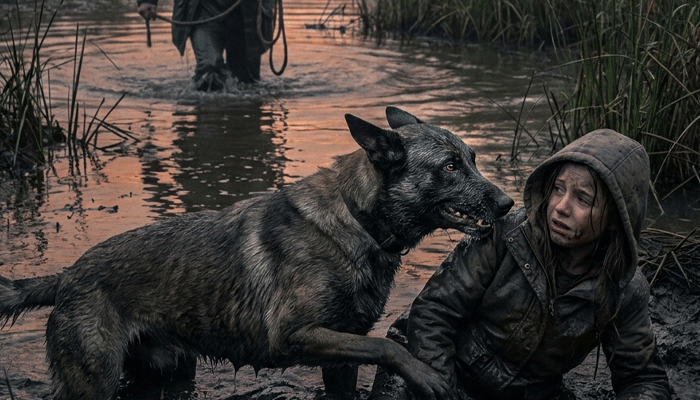
Her name was Ivy Cole, though in that moment names didn’t matter much, because everything that defined her—her bedroom painted in uneven shades of yellow, the stack of books she never finished, the way she always ran ahead instead of walking—felt impossibly far away from where she was now, suspended in a cold, tightening grip that didn’t behave like anything she had ever known. The mud had already climbed past her waist, pressing in from all sides with a slow, deliberate force that made every attempt to move feel like fighting against something alive, something patient, something certain it would win eventually.
She had tried screaming at first, but the sound didn’t carry the way she expected, swallowed almost immediately by the thick air and the dense vegetation, and after a while, even that became difficult, because panic burns through oxygen faster than you realize, leaving behind a kind of hollow dizziness that makes everything feel distant and unreal. The worst part wasn’t the sinking itself—it was the way it happened so quietly, inch by inch, without the drama you might expect from something that lethal.
When she heard the movement in the grass, her first thought wasn’t rescue.
It was something worse.
The stories adults tell about marshes tend to linger in a child’s imagination longer than they should, and for a brief, paralyzing second, Ivy was certain something ancient and scaled was about to surface in front of her, something that belonged more to the water than to the world she understood. But what stepped through the reeds instead wasn’t a monster.
It was a dog.
He didn’t look heroic. He looked tired. His coat, once probably sleek and sharp, was dulled by age and streaked with mud, his breathing heavy, controlled but labored in a way that spoke of limits he had already pushed too many times. And yet, the moment his eyes met hers, something shifted—not in the marsh, not in the physics of the situation, but in her, because there was recognition there, not of identity but of intent.
“You came,” she whispered, though she didn’t know why she said it.
Atlas didn’t bark. He assessed.
He moved along the edge first, testing the ground with careful precision, reading the surface the way only a trained K9 could, mapping stability through instinct and experience. The problem was immediate and obvious: there was no path that would hold his weight all the way to her. The marsh between them wasn’t just unstable—it was actively collapsing, turning from mud into something closer to liquid with every passing second.
And beneath that, something worse was happening.
The tide was turning.
Back on the embankment, Cal saw it before anyone said it aloud—the subtle shift in the outer channels, the thin ribbons of water beginning to creep inward, feeding into the low pockets where the marsh dipped and pooled. In less than twenty minutes, the area Ivy was trapped in would no longer be mud.
It would be current.
“Atlas,” Cal whispered under his breath, though the dog couldn’t hear him.
Out in the marsh, Atlas stopped searching.
He made a decision.
The leap wasn’t dramatic. It wasn’t cinematic. It was calculated and desperate at the same time, the kind of movement that comes from knowing there are no good options left, only necessary ones. When he landed, the ground gave immediately, swallowing his back legs halfway to the joint, but he didn’t stop, didn’t hesitate, pushing forward with a force that bordered on reckless, because hesitation would have been the same as surrender.
By the time he reached her, the mud had climbed to Ivy’s chest.
“Don’t go,” she said, her voice cracking, though she hadn’t realized she was afraid of being left alone until that moment.
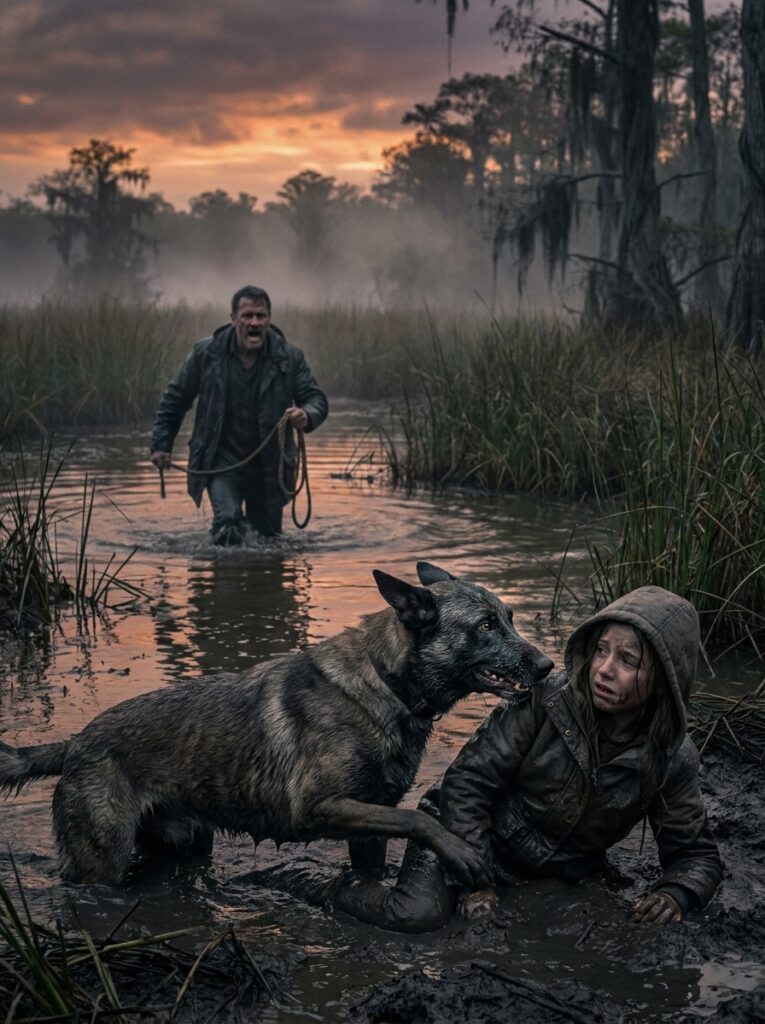
Atlas pressed forward, his body sinking deeper, and then he did something that looked almost strange from a distance but made perfect sense in its execution: he dipped his head beneath the surface, disappearing for a fraction of a second before reemerging with his jaws locked onto the thick collar of her jacket.
The pull that followed wasn’t clean.
It wasn’t graceful.
It was violent in a way that hurt.
Ivy cried out as the suction fought back, as if the earth itself had tightened its grip in response, unwilling to give up what it had already claimed, and Atlas, his muscles trembling under the strain, began to lose ground himself, his body inching downward even as he tried to lift her up.
On the shore, Marissa collapsed to her knees, her hands clasped together in a prayer that had long since abandoned structure, while Cal stood frozen in that terrible space between action and consequence, knowing that one wrong move could collapse the entire section of marsh and take them both under.
“Come on,” he whispered, his voice barely audible. “Just one more.”
Atlas twisted.
It was a maneuver drilled into him years ago, something designed for extraction under unstable conditions, a full-body torque that traded efficiency for force, and for a brief, impossible second, it worked—the mud broke its seal with a wet, resisting sound, and Ivy’s upper body surged free.
But the victory was incomplete.
Because the tide arrived at the same time.
Water rushed in, cold and fast, transforming the environment from a trap into something far less predictable, lifting them just enough to break the suction entirely while introducing a new danger that was, in many ways, worse.
They were no longer stuck.
They were drifting.
What followed happened too quickly for thought to keep up.
Cal moved before anyone could stop him, stripping off gear he wouldn’t need, grabbing the first length of rope someone shoved toward him and tying it off with hands that remembered procedures even if his mind didn’t, and then he was in the water, forcing his way through resistance that felt almost solid, eyes locked on the shape ahead of him that dipped lower with every passing second.
Atlas was failing.
Not dramatically, not with a sudden collapse, but in small, measurable losses—the angle of his head dropping, the tension in his body fading, the grip of his jaw loosening by degrees that only someone who knew him would recognize as the edge of exhaustion.
“I’ve got you,” Cal said when he reached them, though the words were as much for himself as they were for the dog.
The rope went taut.
The world narrowed.
And somehow, through force and friction and something that had nothing to do with logic, they made it back.
The hospital smelled nothing like the marsh, and yet Cal couldn’t shake the sensation that he had carried it in with him, that the mud and the water and the weight of those four minutes had embedded themselves somewhere deeper than skin. Atlas lay on the table under harsh white light, surrounded by machines that translated life into numbers, and for the first time since the rescue, Cal allowed himself to feel the full weight of what had almost been lost.
“He shouldn’t have survived that,” the surgeon said at one point, not unkindly, just honestly. “And if he does pull through, he won’t be the same.”
Cal nodded.
He understood.
Because neither would he.
Months later, when Atlas moved across the yard on a wheeled harness, slower but no less determined, and Ivy sat nearby tossing a ball she knew he might not always reach, the moment in the marsh didn’t feel like a miracle anymore.
It felt like a decision.
One made by a dog who understood something most people forget.
Life Lesson
Sometimes the ones we assume are too old, too broken, or too far past their prime are the very ones who understand sacrifice the best, because they no longer measure life by what they might lose but by what they can still give. And in moments where fear tells us to wait, to calculate, to accept the worst, it’s often loyalty—irrational, stubborn, deeply human loyalty—that changes the outcome. Survival, in the end, is rarely about strength alone; it’s about who refuses to let go when everything else already has.