My name is Ethan Parker, and the first flood took my daughter so cleanly that for five years afterward I could hear water before I could think.
People in Riverton called it a tragedy, an act of God, one of those terrible weather nights Texas occasionally throws at a town like a punishment no one feels individually responsible for. That language always sounded lazy to me. God didn’t stand on my porch and watch a yellow rain boot spin away downstream. God didn’t freeze my legs to the boards while my little girl disappeared in brown water that moved faster than love. The river did that. And I let it happen slowly enough to remember every second.
So I built my life around not being helpless again.
Sandbags stacked by the shed. Two battery radios always charged. An aluminum boat chained under the carport. Flood maps laminated and marked. Neighbors liked to call it preparedness. I knew better. It was penance with practical uses.
That night the storm over Trinity Bend sounded too much like the old one.
Rain came down in solid sheets, pounding the roof so hard the house seemed to breathe with it. Water had already reached the porch steps by the time I stepped outside. The whole river had swollen beyond shape, not a channel anymore but a moving field of mud, lumber, trash, dead brush, propane tanks, all of it shoved together by current strong enough to insult anything human built near it.
I was standing there trying not to drift backward into memory when I saw the plank.
At first it looked like more flood debris, one more board spinning in the current. Then it shifted under the weight on it, and my chest locked.
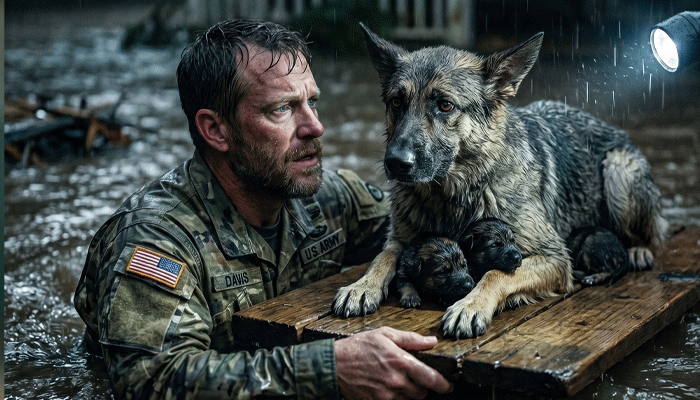
A gray-and-white German Shepherd mother was clinging to it.
Her ribs showed through soaked fur. Her paws kept slipping, then catching again. Beneath her chest, tucked into the one dry pocket left on the wood, were two tiny puppies pressed into her body so hard they looked like they were trying to disappear into her.
The mother dog made a low broken sound that didn’t feel like begging. It felt like refusal. I won’t let them go. Not yet. Not while I’m still here.
That sound reached somewhere in me I had been keeping boarded up.
Every instinct said stay on the porch. Floodwater doesn’t care how guilty a man feels. It just takes the next thing within reach. I measured current, distance, angle, debris. Then I measured the memory I’d have to live with if those puppies slipped under while I watched.
Before I could move, headlights tore through the rain.
Officer Nora James stepped out of her cruiser already carrying rope and a throw bag, like she had come expecting the worst and didn’t intend to negotiate with it. She looked at the dogs once, then at me, then said the one thing I needed and hated to hear.
“You’re not going in alone.”
She anchored the rope to my porch post and clipped it around my waist with hands steadier than mine. I stepped into the water and let the cold hit me hard enough to replace memory with task. The current wanted my legs immediately. I used a gaff hook to snag the plank, pulling inch by violent inch while the mother dog snarled once, reflex only, then went still when I told her, “Easy. I’ve got you.”
Together, Nora and I hauled the plank to the porch.
She wrapped the puppies in towels and got them into a flotation bag while the mother climbed after them, shaking so badly I thought she’d collapse. She didn’t. Not until her nose touched both pups.
I was still catching my breath when the mother’s head snapped toward the darkness downstream.
Then she barked.
Sharp. Urgent. Different.
I followed her gaze and saw a shape clinging to a fence post in the flood.
A man’s voice came through the rain.
“Help! Please—HELP!”
I looked at Nora. She looked back the way professionals do when the answer is already obvious and all that remains is whether your body can survive what your conscience has accepted.
And the worst part was this:
the river had just given me another life to lose.
The first rescue had broken the freeze in me. The second one tested whether that break would hold.
The man on the fence line was about forty yards downstream, maybe a little more, hard to tell in floodlight glare and rain. Water hammered the chain-link barrier hard enough to bend whole sections inward, and he had both arms wrapped through the mesh while the current tried to peel him off from the waist down. If that fence failed, he’d be gone before either of us got halfway to him.
Nora saw the same math I did.
“No boat,” she said. “Too much debris. It’ll flip.”
I nodded.
That left rope, footing, and bad choices.
The mother dog was standing now despite exhaustion, body still over the puppies, but all her attention had shifted to the man downstream. That should have struck me as strange and didn’t fully register until later. At the time it only felt like urgency with fur on it.
Nora reset the anchor, doubled the line, and tied a secondary belay around my chest this time instead of the waist alone. “You lose your feet,” she said, “you roll with the current until I pull. Don’t fight the rope.”
It sounded like instruction. It was also mercy. People who know water know you don’t win arguments with it.
I stepped back in.
The cold hit harder the second time because now my body knew what was waiting. Every stride downstream was a negotiation with mud, submerged steps, and the pull of current against my knees. I kept low, using the gaff hook for reach and balance, while Nora fed line and shouted distance corrections through the rain. Behind us, the shepherd barked once more, then stopped—as if she understood that too much noise helps panic and not much else.
When I got close enough to the fence, I saw the man more clearly.
He was thin, maybe mid-thirties, Hispanic, soaked to the bone, face split open at the brow, right shoulder hanging wrong. Not a looter. Not some fool who had underestimated a flash flood while trying to save a cooler. His boots were work boots. His hands were torn bloody from wire. He had been fighting to stay there a long time.
“Name?” I shouted.
He coughed river water and said, “Mateo.”
“Can you let go with one hand?”
His expression told me what the question had cost him already.
“No.”
Fair enough.
I got the hook through the fence, braced my shoulder against the current, and clipped the rescue loop around his torso one-handed while he kept clinging with everything else he had left. Twice debris slammed into my legs hard enough to light old pain up my spine. Once something big hit the fence below us and the whole panel groaned like it was reconsidering being attached.
“Pull on my mark!” I yelled to Nora.
Mateo looked past me then, not at the porch, not at safety, but at the German Shepherd mother.
His mouth opened in recognition.
That mattered.
“Move now!” Nora shouted.
I cut his grip with my own hands because sometimes waiting for another man to let go is how both of you drown. The line snapped tight. He swung half sideways into me. We both went under to the shoulders, came up blind and choking, then started moving in ugly jerks toward the porch while Nora hauled with everything she had and the current argued every inch.
We got him in.
Barely.
Mateo collapsed across the steps coughing water and blood while Nora checked his shoulder, and I stood there in the rain shaking from cold, adrenaline, and something meaner than both. The mother shepherd had come to him now, not threatening, not fearful, just urgent—nose pressing at his face, then back to the puppies, then to him again. Recognition was no longer a possibility. It was fact.
“You know this dog?” I asked.
Mateo looked at her and started crying before he answered.
“She was mine,” he said.
That changed the night all over again.
The mother’s name was Sable. The puppies were hers. Mateo had worked at a property upriver that officially operated as a storm-damaged salvage kennel for displaced dogs after flood events and wildfire evacuations. Unofficially, he said, they used those disasters to collect animals that owners would never find again—purebred dogs, breeding stock, puppies, any animal valuable enough to resell once chaos made paperwork soft. Sable had belonged to his daughter before the owners took over the operation. When Mateo found out they were planning to move her and the litter before dawn, he tried to get them out. They caught him, beat him, and dumped him into the flood expecting the river to do the rest.
Nora and I looked at each other then with the same thought arriving at once.
This wasn’t overland misfortune.
It was crime wearing a disaster’s mask.
Then Mateo grabbed my sleeve with surprising strength and said the part that turned everything urgent again.
“There are more dogs,” he whispered. “Cages. In the old feed mill.”
The flood outside kept rising.
The shepherd pressed harder against the porch boards where her puppies lay wrapped in towels.
And suddenly what had started as one rescue, then two, had widened into something much worse:
a storm was giving cover to people upstream who were using disaster to erase living property, and somewhere in the dark beyond the river sat a building full of animals that wouldn’t survive if the water reached them before we did.
The old feed mill sat less than a mile upriver, which in normal weather meant five minutes by truck.
In flood conditions it meant choosing which roads were only underwater and which roads were gone.
Mateo could barely sit upright. Nora wanted him transported immediately, which was correct, but his story had already done what stories like that do to people with consciences that still function—it made inaction feel like complicity. The county rescue net was overloaded. Dispatch had boats tied up farther east with trapped families and submerged vehicles. If we waited for a full official animal response, that mill would either be underwater or cleaned out by the time anyone got there.
Nora made the decision before I could.
“I’ll call it in and get whatever I can moving,” she said. “You take the boat.”
That was insane.
It was also right.
The aluminum boat I kept under the carport had always felt like superstition wearing metal. I maintained it because the last flood had taught me what regret sounds like. That night, for the first time, it had a use bigger than memory. We loaded bolt cutters, extra rope, blankets, pry bars, two life jackets, and one flood lantern. Ranger—because every story I’ve ever lived with dogs seems to need one more—was not part of my life here. The shepherd mother, Sable, stayed on the porch with her puppies because even she understood some rescues require staying alive where you are.
I took Nora with me anyway. She said she wasn’t asking permission.
The run upriver was ugly.
Floodwater turns familiar ground into lies. Fence lines become currents. Road crowns vanish. Trees appear where lanes should be. Twice we scraped over submerged debris I could feel more than see. Once the boat slewed broadside hard enough that Nora slammed her shoulder into the rail and swore like a professional. The rain had eased, but the water was still working with all the cruelty momentum builds when gravity gets involved.
The feed mill emerged out of the dark in pieces—a roofline, a loading chute, then the full hulking shape of an old agricultural building taking on floodwater through the lower bays. One security light flickered on a side generator. Good sign for crime, bad sign for anything honest.
We heard the dogs before we reached the wall.
Dozens.
Not coordinated barking. Panic. Metal scratching, high yelps, low-throated barking from bigger dogs trying not to lose their minds in the dark. I tied off under the south ramp while Nora checked her sidearm and muttered, “If this man lied to us, I’m still arresting him later.”
“He didn’t lie.”
I knew because the sound inside was too specific to fake.
The side door was chained from the outside. That told us everything. Legitimate rescue operations don’t lock animals into rising water. Bolt cutters fixed the chain. The smell inside nearly took me back a step—wet fur, feces, bleach, standing water, fear. Row after row of cages. Shepherds, pit mixes, hounds, expensive-looking doodles someone was probably already missing, two hunting dogs with tracking collars cut off, a nursing boxer, more puppies than any legal holding site had business concealing during an evacuation night.
And in the office above the kennel floor, men were moving.
Three of them.
One was loading files into a plastic drum. One had a pistol. The third held a catch pole and looked more annoyed than scared, which told me he thought flood conditions were still on his side.
Nora identified herself. That ended negotiation.
What followed wasn’t heroic. It was wet, close, and mean. One man tried to torch the paperwork drum and got tackled into the office wall before the flame took. Another ran for the back ladder and slipped in runoff on the metal rungs hard enough to remove his own luck from the equation. The third pulled the pistol and pointed it at me instead of Nora, which was a mistake a lot of bad men make around women in uniform right before they learn the floor is not loyal to them. She dropped him clean.
Then came the real work.
Unlocking cages.
Moving animals.
Choosing order in panic.
The lower kennels were already taking water at paw level. We worked bay by bay, cutting latches, leashing what we could, carrying what we couldn’t, loading the first boat until it looked like a floating argument against human decency. One deputy boat arrived twelve minutes later, then county animal control, then volunteers, then too many flashing lights for the kind of town Riverton usually is. By dawn, the feed mill had coughed up forty-three dogs, six cats, records showing fraudulent “storm recovery” intake, forged transfer papers, and enough unregistered microchip removals to break even the calmer investigators’ voices.
Mateo’s story checked out.
More than checked out.
The men running the mill had been using flood and wildfire events to collect animals under emergency authority, then laundering them through sham rescue paperwork, breeders, and out-of-state sales. Disaster made owners desperate, records messy, and reunification easier to delay than explain. Sable and her puppies were only the ones who got away.
That should have been the ending.
But grief doesn’t waste opportunities for symmetry, and the river still had one more thing to say to me.
At sunrise, after the last cage was emptied, I walked back to my porch where Sable lay curled around her puppies in dry towels. She lifted her head when she saw me, not friendly, not tame—just measuring. Then she rested her chin again because the world had finally offered her one quiet hour.
I looked at the river behind her and realized my hands weren’t shaking anymore.
Not because I was healed. That’s too neat.
Because five years earlier, when the water took my daughter, I had stood on a porch and frozen until memory built a house inside me. This time I had moved. Then moved again. Then again. A dog mother on a plank started it. A woman in uniform steadied it. A man on a fence forced it farther. By the end of the night, I had saved what I could and lost nothing else to hesitation.
That matters, even when it doesn’t undo anything.
People around town later called me brave. They were wrong in the ordinary way people are wrong about rescue. I wasn’t brave first. I was cornered by conscience until movement became easier than carrying stillness one more year.
The part that still bothers me is in the paperwork.
The feed mill had valid temporary disaster intake credentials signed three months earlier by a regional animal-services administrator who swore he believed the operators were legitimate. Maybe that’s true. Maybe he was careless. Maybe he was paid. I don’t know yet. What I do know is this: systems don’t become useful to predators by accident. Someone opens the gate, signs the line, looks away, delays the complaint.
So when people retell that storm, they like the simple version. Veteran rescues dog family, then helps save a man, then uncovers an animal trafficking ring during the flood. Clean. Emotional. Useful.
But the truth is rougher.
The river didn’t just bring me a second chance.
It delivered evidence.
And somewhere above the men at that feed mill, somebody in a dry office had helped make sure suffering could be processed as paperwork until the water exposed it.
Do you think the feed mill operators acted alone—or were they only the visible edge of a bigger system cashing in on disaster? Tell me below.