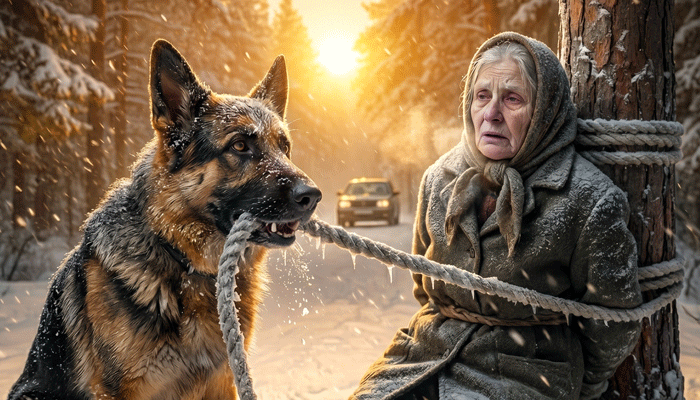
My name is Koda, and the Siberian forest teaches you early that silence is not peace. Silence is what comes before teeth, before snow breaks under boots, before death decides whether it will pass you by or stop to investigate.
That night the cold was so hard it felt sharpened. The old ranger thermometer nailed to a birch trunk outside the abandoned line shack read minus seventy-one Celsius, and even I could smell the danger in the air before I felt it in my paws. Frost makes the world clean in the way a lie looks clean. It smooths edges. Buries tracks. Covers cruelty under white until only scent tells the truth.
I knew these woods. I had run them for years, first with my handler during rescue drills, later alone after he never came back from the southern ridge. He had taught me the things humans think they invented: patience, pattern, and the difference between a lost person and a hidden one. Lost people smell like confusion. Hidden people smell like fear pressed down under force.
That was what I found beneath the snow and pine.
Human fear. Rope fibers. Cold skin. Blood slowed almost to memory.
I followed it through drifts and deadfall to a clearing where the moonlight turned the crusted snow into broken glass. There, kneeling against a larch tree, was Irina Petrovna.
I knew her at once. She lived near the logging road in a crooked cottage with blue shutters and always saved bread crusts in her coat pocket for me even when winter made food precious. She used to laugh when I took the bread gently from her fingers, and her laugh smelled warm, like the inside of ovens and old wool.
Nothing about her smelled warm now.
She was tied upright with rope frozen stiff as antler, her hands purple, knees sunk into the crust, body leaning at an angle that told me strength had already been leaving her for a while. Her face had gone quiet in the dangerous way human faces do when they are beginning to surrender to cold from the inside. I pushed my muzzle against her sleeve and made one sound—small, just enough to pull her back if any part of her was still choosing the world.
Her eyelids twitched.
“Good… boy,” she whispered.
The words came apart in the air before they fully reached me.
I went for the rope.
Ice burned my gums when I bit down. The fibers were stiff, bitter, and full of the metallic taste of frozen sap and human hands. I pulled until my jaw hurt. Chewed. Shifted. Pulled again. Each strand that loosened felt smaller than the time slipping out of her body. Irina couldn’t help me. She barely moved except for one shiver that passed through her like something trying and failing to return.
Then I heard the engine.
Far off at first. Low and steady. Not the casual wandering of a lost driver. Not the lazy confidence of hunters. This was deliberate, measured, approaching the clearing by the old road cut like someone already knew where the night had been left unfinished.
My ears snapped up, but I did not leave the rope.
Machines do not come this deep after dark for kindness.
I kept biting, kept pulling, and at last felt one knot shift enough for her weight to sag hard against the tree. Good. Not free. But closer.
The engine got louder.
And as snow lifted in small devils through the clearing and Irina’s breath grew thinner against my cheek, one thought hammered in me harder than the cold:
whoever tied her here had trusted winter to do the killing—so if that engine was coming back, it meant winter had failed them, and now they meant to finish the work themselves.
The rope finally gave on the third knot.
Not cleanly. Nothing in that forest came clean. It snapped in wet fibers against my teeth, and Irina folded sideways into the snow with the helpless weight of someone whose body had already started leaving before permission was granted. I caught her coat in my jaws and dragged until her shoulder cleared the base of the tree. It was not enough to save her. It was enough to begin.
The engine was close now.
I could smell fuel under the cold, old oil, men, tobacco, damp wool, and metal. Two men at least. Maybe three. Their vehicle was heavy, not the light skipping bounce of a snowmobile but something larger moving carefully over the logging ruts. They weren’t searching. They were returning.
Irina tried to speak when I pushed my nose under her hand.
“Home,” she breathed.
That was all.
Her house was too far. The line shack was closer.
I had used it before, years ago, when my handler trained me to signal from the stove pipe using emergency flares sealed in the wall box. That memory came back all at once—not as words, but as sequence. Drag. Shelter. Heat. Flare. Humans always forget how much dogs remember when memory is tied to purpose.
I seized Irina’s coat sleeve and pulled.
The first yard was terrible. Her boots caught under the crust and her body moved in jerks that made her moan once in a voice so thin I nearly stopped just to listen for life. But stopping was what the men in the engine would want. I leaned lower, dug harder, and dragged her toward the shadow line of the trees.
Headlights washed pale through the clearing behind us.
Voices followed.
“Check the tree,” one said.
A second voice answered, annoyed rather than worried. “She couldn’t have gone far.”
That told me more than fear ever could. They spoke like owners of an outcome, not men surprised by one. They had left her for dead and come back to confirm the weather had obeyed.
I got Irina into the timber just as the beam swept the place where she had been kneeling. The rope still hung there, cut and frayed. One man cursed. Another crashed through brush in my direction.
I did not run in a straight line.
My handler taught me that too. Straight lines are for animals who want to be caught by men who think like roads.
I dragged Irina across the lee side of a deadfall, through powder deep enough to cover the scrape trail, then into the narrow gully leading to the old line shack. Her breathing came ragged now, barely there. Twice I stopped to push my muzzle hard under her chin until she made some sound back at me. Not because I understood medicine the way humans do. Because I understood vanishing, and she was getting close to it.
The shack appeared at last under a ridge of ice-coated fir, leaning but still standing.
The door was stuck half shut. I forced it open with my shoulder and dragged Irina inside onto the warped plank floor. The room smelled like old smoke, mice, rust, and a memory of men who had once used it for weather instead of murder. In the back wall, behind the stove, was the metal emergency box.
Still there.
I clawed it open and knocked out the contents. A flare tube. Two old packets. One tin of matches sealed in wax.
Outside, the men were spreading.
I heard one circle toward the rear wall. Another kicked at the drift near the doorway. They had seen the drag line by then. Their breathing carried that sharp scent humans get when surprise turns quickly into anger.
Inside, I needed fire.
Not for warmth first. For signal.
The chimney pipe still rose through the roof. If I could get the stove open and the flare lit, the red line would cut the night above the trees and maybe reach the road, maybe reach the old foreman’s cabin, maybe reach anyone with eyes and courage enough to move.
I knocked the stove door wide, seized the flare tube in my teeth, and dragged it toward the opening just as a boot struck the outer door hard enough to shake frost from the beams.
One man shouted, “Open it!”
Irina did not move.
I dropped the flare, scraped at the match tin until it popped, and in the thin second before the latch started giving way, the training my handler had buried in me all those winters ago returned with perfect clarity.
If I could get one red flare through that chimney, winter would stop being their accomplice.
And the night would finally belong to witnesses.
The flare lit on the second strike.
Sulfur, smoke, sudden red fire—so bright it cut the shack into sharp pieces and painted Irina’s face the color of blood returning. I clamped the tube in my teeth, shoved it into the iron belly of the stove, and the old pipe carried the flame upward in a roaring rush. A heartbeat later, a red spear split out through the chimney and burned into the Siberian dark above the trees.
Outside, the men swore.
One kicked the door again. Another shouted, “Now!”
The latch tore free.
I met the first one before he fully understood what had changed.
He came in bent low against the cold, expecting weakness, darkness, and a dying old woman. Instead he found me moving full into his legs. I hit below the knee, took him sideways, and his shoulder slammed into the stove hard enough to scatter sparks. He screamed once. Good. Noise was useful now. Noise meant panic. Panic meant delay.
The second man raised something metal—crowbar, maybe rifle stock, maybe just whatever cowards carry when they expect their victims already half dead. I went for the hand, not the weapon, because that is what my handler taught me when rescue and fighting became the same task. Break motion first. Then space. Then teeth if needed.
He got the tool down once across my flank. Pain burst hot and white, but not deep enough to stop me. I took his wrist and felt cloth, skin, blood, and the ugly fast taste of fear when he realized the dog in the line shack was not going to run from a man who tied old women to trees.
Behind us, Irina made a sound.
Alive.
Still alive.
That mattered more than winning.
Then came the thing the men had not expected from the flare.
An answering horn from down the logging road.
Not close, but coming fast.
Villagers.
Maybe the foreman’s son. Maybe the winter patrol from the depot. Maybe simply men and women who knew what a red emergency flare over the trees meant because out here only fools ignore that color in weather like this.
The second attacker heard it too and tried to back out. I let him. Predators lose shape once they understand witnesses are approaching from directions they do not control.
The first one, the one I’d driven into the stove, tried to crawl for the door with one boot dragging wrong. His hat had fallen off. His face hit moonlight long enough for me to know him.
Sergei Malenkov.
Local timber broker. Drunk liar. Thin smile. Man who had once kicked snow at me outside Irina’s gate when she fed me bread and told him to go home. So now I knew at least one reason for her place at that tree. Land, probably. Papers. Firewood rights. Old people get tied to cold when younger men want signatures dressed up as inheritance.
By the time the first sled lights cut through the pines, the second man had fled into the dark and Sergei was too hurt to stand. Three villagers came through the door with axes, lanterns, and the look people wear when they arrive expecting death and are offended to find murder still in progress. Behind them came Pavel from the road crew with blankets, and behind him old Anya from the depot, who knelt by Irina so fast you’d think age only mattered in warm weather.
They carried her out alive.
That sentence matters most.
Alive, though barely. Frozen badly, lungs weak, hands damaged, but alive enough to whisper Sergei’s name before the sled reached the road. That did the rest. Once a living victim names her killer in a village where everyone already half suspects the same men, silence doesn’t hold the same shape anymore.
They found the second man two days later near the river cut, half-frostbitten and begging to be taken somewhere warmer than the holding shed. Men who trust winter as a weapon rarely imagine they might end up negotiating with it themselves.
Irina lived through the night, then the next, then another.
She never walked quite right after that. Her hands kept the memory of the rope. But she lived long enough to tell what happened clearly: Sergei and his cousin had been pressuring her to sign over logging access through her land. She refused. They came after dark, dragged her to the clearing, tied her there, and left the forest to finish their courage for them.
As for me, people in the village started calling me a hero after that.
I don’t like the word.
Heroes are tidy things humans build after danger has passed. What I was that night was simpler. I was a dog who remembered his work, recognized a woman who had once been kind, and refused to let winter become a murderer’s accomplice.
Still, one thing remained with me more than the blood or the fight or even the red flare itself.
When they searched Sergei’s truck, they found not only rope and vodka and a crowbar, but folded deeds, survey maps, and three other names circled in pencil—three other old landowners living alone out on the road edges, all of them difficult to pressure, all of them inconveniently alive.
That means Irina was not the only one.
She was just the one winter did not manage to keep.
So when people tell this story now, they tell it with the flare, because fire in snow makes memory easy. They say the red light through the chimney changed everything, and that part is true.
But the real change began earlier.
It began when one small act of kindness—bread crusts saved in a coat pocket—came back years later as the only reason a dog stopped in the right clearing on the right night and chose not to walk away.
And if I had been ten minutes later, the forest would have kept the secret exactly as the men intended.
Do you think Sergei acted alone for the land—or was Irina only the first target in a wider plan winter was supposed to hide? Tell me below.