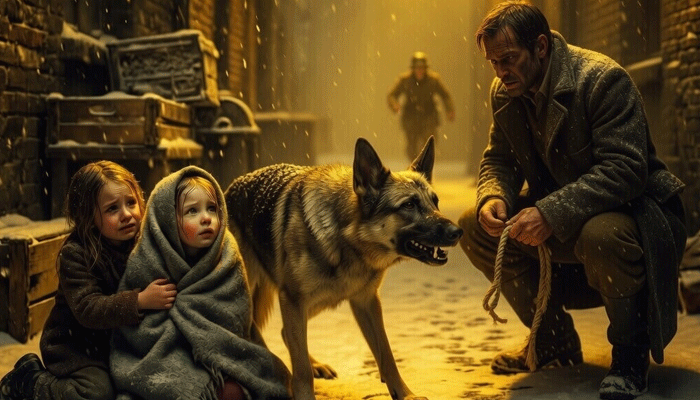
My name is Nora Hale, and if I had taken the long road home that night, the child behind the bakery probably would have died before anyone knew she was there.
That thought has lived in me ever since, because accidents make cleaner memories than choices do. If winter had found her alone, people in Vindelbrot would have called it tragic. They would have said the cold was merciless, the snow too deep, the night too cruel. They would have shaken their heads, looked down, and let the weather carry the blame the way weather often does in towns that prefer human evil to stay unnamed.
But the weather was not what I found in that alley.
I was nineteen then, born and raised in Vindelbrot, and old enough to know that mountain towns keep two kinds of silence. One is the ordinary kind—snow muting rooftops, shops shutting early, smoke curling low over chimneys, everyone protecting heat. The other is the silence that forms when people know something is wrong but haven’t yet decided whether speaking is safer than looking away.
That night the streets were narrow white corridors and the wind kept worrying the corners of buildings like it wanted in. My little brother had a fever burning hot enough to frighten my mother, and the pharmacist lived two blocks closer if I cut behind the old bakery. I knew better than to use that lane after dark. Everyone did. But medicine in my coat pocket felt more urgent than caution, and that is how bad nights usually win their first argument.
I heard the voice before I saw the dog.
“Hup! Hup! Hup! Hup!”
Not playful. Not angry. Strained.
Then he came out of the snow as if the storm had been trying and failing to hide him. Broad chest, black-and-tan coat gone muddy along the legs, a rope dragging behind him like the tail end of somebody else’s mistake. He didn’t bark at me. He just looked—hard, direct, trembling—and then glanced back toward the alley.
Come on.
That is what his body said.
I followed because some requests feel older than reason.
The alley smelled wrong the deeper I went. Chemical, damp wool, iron, the faint sourness of fear. Against the brick wall, half-buried in drifted snow, lay what I first thought was a pile of soaked blankets. Then it moved. A thin paper-whimper slipped out, and the world in me narrowed immediately.
A child.
No older than three.
Wrapped tight, cheeks gray with cold, lashes iced over, barely making enough sound to prove she still belonged among the living.
The dog’s tag read Bruno. He nudged the little bundle once with desperate gentleness, then looked at me as if he had been carrying this moment in his body until he found the right human to hand it to.
I dropped to my knees and started pulling the blankets apart with hands that shook harder than the wind.
Then I heard the boot scrape.
A man stepped into the alley close enough that I smelled tobacco and wet wool before I fully turned. He lifted his hands the way people do when they want calm to travel faster than truth.
“It’s okay,” he said softly. “I’m here.”
But softness that real never lives in eyes that empty.
Bruno moved between us instantly, teeth bared.
That was when I saw the rope behind him clearly—knotted, frayed, cut clean through.
Not lost.
Not stray.
Tied up.
And standing there with a freezing child in my arms and Bruno blocking the man who claimed to help, I realized the worst part of the night wasn’t that I had found her.
It was that someone else had clearly expected no one would.
The first lie he told me was in his voice.
“It’s okay,” he said again, softer this time, as though repetition might make it true. “That’s my niece.”
No frightened uncle looks at the dog first.
That is something I learned in the next two seconds.
His eyes flicked to Bruno before they flicked to the child in my arms, and the look he gave the dog was not relief, not worry, not even surprise. It was annoyance. The sharp, private irritation of a plan interrupted by an animal that had refused to stay tied.
Bruno saw it too. His growl lowered until I could feel it more than hear it.
The man took one careful step closer. “You shouldn’t be out here with her in this weather,” he said.
I tightened my grip on the little girl. She weighed almost nothing, which scared me more than blood would have. Children that small are supposed to feel inconveniently alive when you lift them. She felt like damp blankets and disappearing time.
“What happened to her?” I asked.
He smiled without showing teeth. “Family matter.”
That answer cleared something in me.
Not courage. Just certainty. There are sentences that close doors as soon as they are spoken. Family matter, said that way, means: I expect you to retreat. I expect the town to help me by not naming what this is.
Bruno shifted his stance, square between us now. The cut rope dragged behind him like evidence too obvious for either of us to ignore. I glanced down the alley. Snow packed the exit behind the bakery. One weak lamp at the far street mouth. No one else. No easy help.
The man saw the calculation on my face and decided to press.
“She wandered,” he said. “Dog must’ve dragged her stuff around. Give her to me.”
He held out his arms.
The little girl made a sound then—not a cry exactly, just a broken hitch in her breathing—and curled deeper into my coat. Even half-frozen, she leaned away from him.
That mattered more than anything he had said.
People think children that cold stop choosing. Sometimes they choose with the only muscles still listening.
“I’m taking her to Dr. Feld,” I said.
His expression changed. Not much, but enough. The gentle tone dropped its costume for a second and something ugly showed underneath. “No,” he said. “You’ll hand her over.”
Bruno lunged half a step.
Not to bite. To warn.
The man flinched, then swore. “Get away! Shoo! Kill ya! Get out! Scram!”
So that was who had been shouting in the snow.
Not afraid of the dog.
Afraid of what the dog might bring back.
I moved before he could reset. Turned sideways, kept the child high against my chest, and backed toward the mouth of the alley while Bruno matched me perfectly. That dog did not need commands. He understood his job now: barrier, delay, witness.
The man reached inside his coat.
For one terrible second I thought gun.
It was only a phone.
He looked at the screen, muttered a curse, and stepped aside just enough to make room rather than block me fully. That was worse. It meant he wasn’t alone in this decision. He was checking timing with someone else.
I got to the street and ran.
Or tried to. Snow makes panic heavy. My boots slipped. The child in my arms seemed too light and too limp. Bruno stayed glued to my side, limping slightly now that I could see him properly. Old cut on the flank. Fresh abrasion around the neck where the rope had burned him. He had fought free and come looking for help.
At Dr. Feld’s house, I hammered the bell with my elbow until the porch light snapped on. He opened the door in wool socks, took one look at me, then at the child, and pulled us inside without asking permission from the night.
The little girl was hypothermic, dehydrated, sedated lightly—Feld recognized it from her pupils and the slack delay in her breathing. Sedated. That landed like ice in my stomach. Not wandered. Not hidden by panic. Prepared.
While Feld worked, I told him about the alley, the man, the dog, the rope.
He went still at one name.
I hadn’t told him any.
So I asked, “Who did you think of?”
He looked toward the window before answering. “Otto Brenner.”
Everyone in Vindelbrot knew Brenner in the way mountain towns know dangerous men without ever calling them that in daylight. Wood hauler. seasonal labor broker. drank hard, smiled wrong, did jobs for families who preferred not to sign their own uglier paperwork.
Bruno, lying by the stove now, lifted his head at that name and gave one short, hard huff.
Confirmation.
That was when Dr. Feld said the second thing that changed the night.
“This isn’t the first child report that vanished before it became official.”
The room seemed to narrow around the stove heat.
Not the first.
Which meant the girl I carried out of the snow had not just survived one bad man.
She had fallen through a crack someone in town had either made or learned to ignore.
The little girl’s name was Elsa Marin, and by dawn the whole town was pretending it had never heard of her.
That is the crueler version of small places people don’t write postcards about. Everybody knows everybody until knowledge becomes expensive. Then memory goes soft around the edges. Faces get “uncertain.” Last sightings become “might have been.” Men like Otto Brenner live comfortably inside that blur.
Dr. Feld kept Elsa alive through the worst of the night with heat, sugar water, and the kind of hands old country doctors develop because distance teaches them that help is often something you become before it arrives. Bruno never left the rug beside her chair. Even asleep, or whatever damaged version of sleep dogs allow themselves when danger is unfinished, he kept one eye half-open toward the door.
At first light, Feld sent me to wake Pastor Levin, not the constable.
That told me more than any speech would have.
If a town doctor trusts a pastor before the law when a sedated child is found freezing behind a bakery, the problem is no longer one man in an alley. It is structure. It is whose knock people fear and whose signature disappears things after breakfast.
Pastor Levin came, then the schoolmistress, then old Marta from the boarding house who had seen Bruno tied behind Brenner’s truck two days earlier and said nothing because “it wasn’t my business.” She cried when she said it. Good. Shame is useful when it arrives before burial does.
The constable, Rolf Merten, arrived last and already too prepared.
He called the case “a misunderstanding” before examining the rope burns on Bruno’s neck. He suggested Elsa had been hidden from a custody dispute. He said winter does strange things to stories. That sentence almost made me hit him. Instead I watched Bruno.
Dogs tell the truth with their bodies long before people choose sides with their mouths. When Merten stepped toward Elsa’s bed, Bruno stood up, head low, not barking, just showing teeth in a line so steady it made the room feel suddenly honest. Feld asked the constable to leave the child alone. Merten smiled. Wrong again.
Then Pastor Levin asked him, very quietly, why a three-year-old in a custody misunderstanding would be sedated and wrapped behind a bakery in a lane known only to delivery drivers and night laborers.
Merten had no answer.
Which was answer enough.
Brenner ran before noon.
Not far. Men like him rarely imagine the whole mountain turning at once. He took the logging road east in a truck seen by two snow-plow men and a widow with sharp eyes who had once been too frightened to identify him in a theft case. By then Bruno had already been given Elsa’s blanket to scent, and when the volunteers gathered at Feld’s yard, no one needed convincing anymore about who was leading.
That is how the search became different from the usual kind.
It was not villagers helping the law.
It was villagers moving because the law had finally made itself suspect.
Bruno led us up the old timber route, through half-frozen ruts and wind-packed drifts, to a trapper’s hut near the ravine. There we found Brenner’s truck, one other set of boot prints, forged transit papers, children’s cough syrup, two dolls, and a ledger with three names besides Elsa’s. Girls. Ages. Payment notes. Route markings toward the southern pass.
By the time the constable reached the hut, the pastor had already seen the ledger and the schoolmistress had copied the names into her own prayer book. Smart woman. Paper survives differently when spread among the righteous.
Brenner was caught before nightfall because Bruno found him where he had tried to burrow into an abandoned charcoal pit, half-frozen and still cursing the dog before the villagers dragged him up by the arms. But Brenner was not the end of it. He never had been. The second set of prints at the hut belonged to Constable Merten’s cousin, a cart driver who had made winter deliveries across three districts for years. And the ledger entries linked to missing-child notices two valleys over that had all somehow stalled before formal investigation.
That was the real rot.
Not one monster.
A route.
A quiet business using winter, remoteness, and the politeness of mountain towns to make children movable and old witnesses uncertain.
Elsa lived. That outranks everything else.
She remembered little clearly, which may be mercy. Enough to fear wet wool. Enough to cry at Brenner’s name. Enough to fall asleep with one hand buried in Bruno’s coat and refuse comfort from anyone else for days. Bruno accepted all of it like duty. Like perhaps he had already decided that once a child is found, she belongs to the side of warmth until she can choose the world again for herself.
People later said Bruno was brave.
He was.
But bravery wasn’t the only thing that saved Elsa. So did interruption. So did suspicion. So did a doctor who trusted the wrong people less than the right ones. So did a pastor who understood that gentleness without backbone is just surrender with good manners.
And me?
I still think about the alley.
About how close I came to believing the first soft voice that said, “It’s okay, I’m here.”
That is the thing I want remembered, because winter stories make it too easy to blame weather.
The snow did not sedate Elsa.
The cold did not cut Bruno’s rope.
The night did not tell lies in a careful human voice.
Men did that.
And if Bruno had not chosen me in the snow, the town would likely have found only a body by morning and called it heartbreak instead of evidence.
There was one last detail in the ledger that no one could explain cleanly.
Beside Elsa’s name was a red mark, small and slanted, next to the word delayed.
Which means somebody expected her to have been moved earlier and was angry she had not been.
So now the question that keeps me awake is not whether Otto Brenner was guilty.
He was.
The real question is this:
Was Brenner only the hand in the alley—or part of a larger route of people who had already marked other children for winter to hide next?
Do you think the town stopped one man—or uncovered the edge of something much bigger? Tell me below.