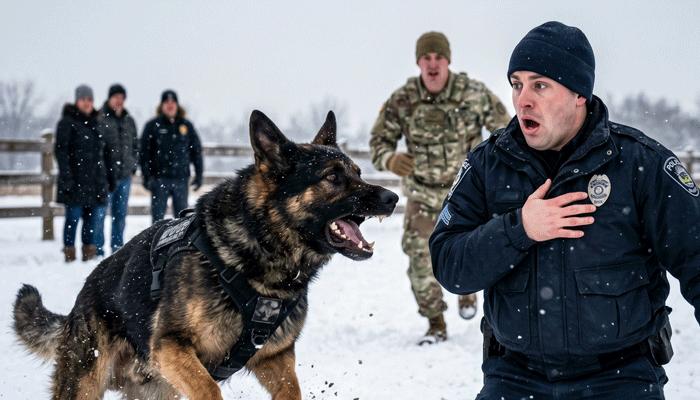
My name is Ethan Cross, and by the time I walked into Cold Valley Recovery Center with a German Shepherd puppy in my arms, I had already learned that the most dangerous thing about trauma is how quickly institutions start calling it inconvenience.
Cold Valley sat out in rural Montana where the land looked wide enough to hold any pain you brought to it and remote enough to make paperwork sound merciful from a distance. The facility handled military K9 recovery, washouts, transitional placements, behavioral evaluation—clean words for damaged dogs and the humans tired of deciding what they still deserved. My old teammate Jordan Hale had called two nights earlier and used the tone men like us reserve for situations already beyond ordinary help.
“He’s the smartest dog we’ve ever had,” Jordan said. “And the most broken.”
That got my attention.
So did the sentence after it.
“If you don’t come now, they’re going to kill him.”
When I stepped into the main bay, the first thing I heard was metal screaming.
A massive sable German Shepherd slammed himself into a steel kennel door hard enough to shake dust from the rafters. Trainers backed away. One of them swore. Another shouted for the vet. Someone farther down the row said the phrase every decent handler hates hearing spoken too casually:
“Euthanasia protocol.”
The dog in the kennel was Ranger.
He was bigger than most working Shepherds, shoulders heavy, eyes lit with the kind of terror civilians mistake for aggression because fear looks violent once it no longer has room to run. He hit the bars again, teeth bared, not because he wanted out into the room, but because something in his body believed the steel itself had turned lethal.
I didn’t flinch.
Not because I’m made of stone. Because I knew that look. Men wear it too, sometimes.
Jordan met me halfway down the aisle, exhaustion all over him. “Bomb detection,” he said quietly, nodding toward Ranger. “Overseas. Lost his handler in an explosion. Any sharp metal impact and he goes right back there.”
That explained the panic.
It didn’t explain the timing.
A rigid man in uniform stepped out from the office corridor before I could say anything else. Captain Bryce Caldwell had the kind of face institutions trust because it looked like it had been carved out of policy and sleep deprivation. He took one glance at Milo—the lopsided-eared puppy in my arms—then at Ranger, then at me, and spoke like he was handing down weather.
“You’ve got seventy-two hours,” he said. “If he doesn’t show measurable stability, we end this. He’s a liability.”
Not a dog.
Not a veteran partner.
Not a survivor.
A liability.
I set Milo down at a safe distance because something in me had already decided that whatever happened next needed to begin honestly. The puppy trotted forward on oversized paws, all curiosity and soft foolish courage, then froze when Ranger lunged at the bars. The kennel rattled. Trainers cursed again. But Milo didn’t run.
He sat.
Tiny body. Crooked ears. Head tilted.
Waiting.
The room missed it because they were all still watching the bigger dog.
I didn’t.
For half a second—less, maybe—Ranger’s growl faltered. Not softened. Interrupted. Like some older part of him had seen the puppy and been forced to choose, however briefly, between panic and recognition.
That was enough for me.
“I’m staying,” I said.
Captain Caldwell’s jaw tightened. “Then don’t fail.”
He walked away.
That night, after the center quieted and the storm pushed against the outer walls, I sat alone near Ranger’s kennel while Milo slept curled against my boot. That was when I saw them: fresh dents on the gate that did not match the day’s impacts, newer than the rest, and a smear of fine metal dust near the latch like someone had been striking the bars from the outside after hours.
I touched the dust, looked at the dog shaking himself back into stillness, and felt something go cold in me.
Because a traumatized bomb dog can break himself by accident.
But fresh impact marks from the wrong side of the door mean something worse:
someone in Cold Valley wasn’t just failing Ranger.
Someone was pushing him toward the edge and waiting for the paperwork to call it mercy.
I stayed awake that first night to listen.
That is something war leaves you with if it leaves you with enough of yourself to still be useful afterward. You learn the difference between ordinary building sounds and intentional ones. Heating vents tick. Old wood settles. Kennels sigh with restless bodies and dream kicks. But metal struck with purpose carries a different message. It doesn’t ask whether you’re listening. It counts on you being too tired to matter.
At 1:13 a.m., I heard it.
One sharp hit.
Then another.
Not loud enough to wake the whole bay. Just precise enough to travel.
Milo lifted his head from my boot and gave one tiny questioning sound. Ranger exploded against the kennel before the third strike even landed. He slammed the gate so hard the frame shrieked. Trainers down the hall shouted. Lights snapped on. And by the time Jordan came running in, the person who had caused it was already gone.
But not cleanly.
I moved to the side corridor and found a maintenance mallet tucked halfway under a laundry cart, its rubber head dusted with fresh gray metallic powder. Not dropped in panic. Staged in haste.
Jordan saw my face and understood enough not to pretend coincidence.
“Who has access after lights-out?” I asked.
He hesitated. That annoyed me more than a lie would have.
“Handlers, veterinary staff, security, command.”
Too many.
Ranger was still shaking in the kennel, front paws bloody where he’d hit the bars trying to outrun the sound. I knelt outside the door, stayed low, didn’t speak immediately. When panic is wearing a dog like that, words are mostly for humans who need to feel they’re contributing. Presence matters more. Breath. Shape. Distance. Milo, impossibly, waddled up beside me and laid down with his little chin on my boot like he was participating in a ritual no one had explained to him but he believed in anyway.
Ranger’s eyes found the puppy first.
Then me.
He was not calm. Not close.
But he stopped throwing himself at the steel.
That bought us thirty seconds, maybe forty. Enough for the vet to sedate lightly. Enough for me to see where the damage ended and the pattern began.
The next morning I started where institutions hate being examined: schedules.
Which staffers were on duty every time Ranger “regressed”? Who logged the incidents? Who recommended formal behavioral failure language? Who signed Caldwell’s stability clock? It turned out the dog’s worst breakdowns aligned too neatly with the same handful of overnight supervision blocks—especially those handled by Sergeant Neil Burrows, a transfer-security NCO with polished boots, controlled posture, and the kind of dead gaze men develop when they stop seeing suffering as expensive.
Burrows disliked me immediately.
That was useful.
Predators are often easier to read when you interrupt a process they thought had already been socially approved. He called Milo “a distraction,” called my overnight presence “informal interference,” and referred to Ranger twice as “that animal” in front of Jordan. On the third time, I looked at him long enough that he corrected himself to “the K9” without ever apologizing.
Then Jordan handed me something even better.
An old internal evaluation from Ranger’s original handler, Staff Sergeant Lucas Vane—dead in the explosion overseas. Buried in the notes was a sentence underlined twice: Ranger alerts strongest to altered metallic residue after tampering drills. He does not just detect explosives. He detects interference.
That changed everything.
Because now the fresh mallet dust and the exterior dents meant more than sabotage of a traumatized dog. Ranger may have been reacting not only to remembered metal impacts—but to trace compounds or altered odors associated with the same kind of tampering his dead handler once trained him to notice.
I went back to the kennel gate.
Ran a cloth over the impacted section. Then another over the latch housing. Both picked up the same fine residue. Not standard steel powder alone. Something chemical threaded through it. Machine oil, yes, but also a faint nitrated smell I knew from places I had no interest in remembering at breakfast.
When I asked the facility vet to test it, she looked at Burrows before she answered me.
That was answer enough.
So I stopped asking permission.
That evening I put Milo’s crate in Ranger’s bay line, sat with both dogs through chow, and waited. At 8:42 p.m., Burrows walked past the row, saw me still there, and didn’t bother hiding his irritation.
“Some dogs can’t be saved,” he said.
“No,” I told him. “Some are made to look unsavable.”
He held my gaze one second too long.
That was when I knew the fight at Cold Valley was no longer about whether Ranger could heal.
It was about what he had smelled, what he remembered, and why somebody in that facility needed his trauma to stay louder than his usefulness.
Burrows made his mistake on the third night.
Until then he had been careful in the way institutional men usually are when they think hierarchy will do half the concealment for them. Deny. Delay. Smirk. Let the unstable dog look unstable long enough and nobody asks why the gate keeps getting hit from the wrong side. But pressure changes people. Captain Caldwell’s seventy-two-hour deadline was closing, Jordan had started watching logs instead of just signing them, and Milo’s impossible presence next to Ranger had begun doing something that no report could comfortably classify.
It was giving the big dog a future shape smaller than fear.
Ranger had not transformed. That would have been sentimental nonsense. He still startled hard at metallic shock. Still panted through nighttime stress. Still flinched when doors slammed too sharply. Trauma does not evaporate just because someone decent sits nearby. But he had stopped self-destructing on command. He watched Milo. He waited for me. He chose, increasingly, to orient toward something living instead of only toward the trapped explosion looping in his nervous system.
That was what threatened Burrows.
Because once Ranger stopped looking irredeemable, the center would have to explain why they had been so ready to kill him.
So Burrows came back after hours.
This time I was ready.
I left the aisle dark except for the red night lamps, settled Milo under a blanket at the far bench, and waited in the equipment room with Jordan and the vet, Dr. Lena Park, who finally stopped looking at command before answering direct questions and instead chose the ancient honorable path of not helping liars feel professionally comfortable.
At 12:07 a.m., Burrows entered the kennel row carrying the same rubber mallet.
At 12:08, he struck the bars once.
Ranger jolted awake, body surging, but instead of smashing himself into panic immediately he looked—first at Milo, then at the aisle, then at Burrows. The difference was small. It was enough.
At 12:09, Burrows raised the mallet again and muttered, “Come on, you useless bastard.”
That line ended him more effectively than any confession would have.
We stepped out before the second strike landed.
Jordan took the mallet. I took Burrows. Dr. Park took the residue samples directly from his gloves and the gate while nobody had time to invent chain-of-custody creativity. Burrows didn’t fight much. Men like him often don’t once the performance space collapses. He tried the usual first—training stimulus, behavioral testing, command-authorized stress exposure. That explanation lasted until Jordan demanded paperwork and Burrows had none.
Then Caldwell arrived.
That was the surprise.
Not that he came. That he looked furious in the wrong direction. For a heartbeat I thought he was going to bury it. Institution over animal. Chain over truth. I had already prepared myself for that. Instead he looked at the gate, at Burrows, at the samples in Park’s hands, and then at Ranger, who had gone rigid but had not thrown himself at the steel.
Caldwell asked one question.
“What did the dog smell?”
Dr. Park answered before anyone else could contaminate it. Trace explosive residue transfer compounds. Not enough to make a device. Enough to trigger an old bomb-detection pattern in a dog whose handler died in an explosion. Enough to turn metal impact into total-body memory.
That was when the room finally became honest.
Burrows had not just been provoking a traumatized K9 because he enjoyed cruelty, though he clearly did not suffer from an excess of conscience. He had been trying to discredit Ranger because Ranger had alerted twice, weeks earlier, on transfer crates moving through Cold Valley under military disposal paperwork. Crates Burrows and an outside contractor claimed contained training scrap and damaged gear. Ranger’s alerts complicated the paperwork. His meltdowns made his alerts easy to dismiss.
That is the filthiest trick in any broken system: make the witness look unstable enough and their accuracy becomes administratively inconvenient.
The follow-on investigation widened fast. The crates contained diverted demolition components and restricted parts moved through recovery channels no one expected a broken bomb dog to challenge credibly. Cold Valley had become a quiet lane for things it should never have touched, and Burrows needed Ranger euthanized not because the dog was dangerous—but because he was still too good at his job.
Captain Caldwell suspended the euthanasia clock on the spot.
He also did something I did not expect and may never fully forgive him for not doing sooner: he admitted, quietly, that he had seen enough irregularities to worry but had mistaken Ranger’s instability for the central problem rather than the cover someone else was using. That may not sound like much. In command language, it was close to confession.
As for Ranger, the ending was not miraculous.
It was better.
He lived.
He stayed.
And over the next months, he relearned what the bars could and could not mean. Milo helped in the ridiculous way only puppies can help—by refusing to carry fear with any dignity at all. Ranger watched him trip over his paws, steal blankets, sleep belly-up beside danger, and somehow the older dog began choosing curiosity often enough that panic no longer owned every room first.
People later told the story wrong on purpose because simple stories sell better.
They said a Navy veteran saved a broken K9 with compassion and a puppy.
That happened.
But it leaves out the darker truth that matters more: Ranger didn’t just need kindness. He needed someone to notice he was being used. The difference is everything. Plenty of wounded creatures are labeled hopeless when the real problem is that their pain is convenient to someone else.
I still think about Burrows saying, “Come on, you useless bastard.”
Not because it was cruel.
Because it was revealing.
He wasn’t speaking to chaos. He was speaking to a witness he needed to perform collapse on schedule.
And there is one loose end that never sat right with me.
One of the seized transfer manifests from Cold Valley referenced two previous K9 removals from other facilities under the same disposal contractor. Both dogs were listed as behaviorally unsafe. Both were euthanized within days of unexplained alert anomalies on shipment rows.
That means Ranger may not have been the first smart dog someone tried to break into paperwork.
He may have just been the first one a puppy interrupted long enough for people to see what was really happening.
Do you think Burrows acted alone—or was Ranger only the surviving witness in a larger system using “unstable” dogs to hide dirty movement? Tell me below.