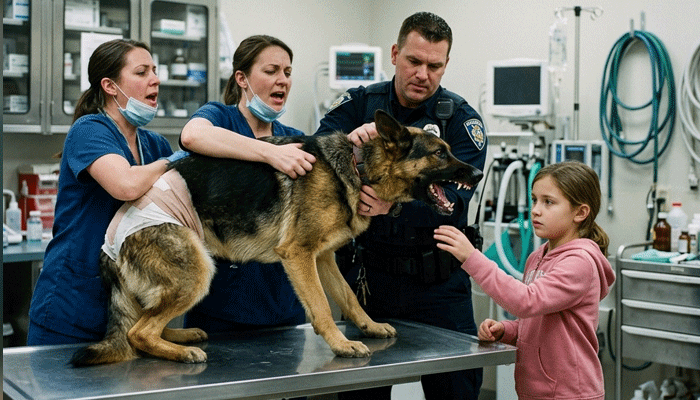
My name is Connor Hale, and the night my police dog was bleeding out on a steel table, I thought I was about to lose the last steady thing left in my life.
His name was Rex. Belgian Malinois. State police K9. Fast, disciplined, fearless, and stubborn in exactly the ways that made him good at the job and impossible to replace. We had been serving together for almost two years, and in all that time, I had never seen him afraid of anything. Then he took a bullet meant for me during a warehouse arrest gone bad, and suddenly the toughest partner I had ever known was thrashing in pain under fluorescent lights while three veterinary surgeons backed away because he would not let anyone touch him.
He was not being vicious out of temperament. He was terrified, confused, and running on pure instinct. Blood covered the table. His breathing turned shallow, then wild. Every time a doctor got close, he snapped, twisted, and nearly tore out the IV line they were trying to place. One more bad movement and we could lose him before surgery even began.
I was shouting his name, trying to anchor him with my voice, but panic had already taken him too far.
That was when my daughter arrived.
Her name is Ellie. Seven years old. Small, serious, and silent for almost three years after the car crash that killed my wife, Laura. Ellie survived that wreck physically, but something inside her shut down in the woods where rescuers found her two days later. Since then, she had spoken through drawings, nods, and the kind of watchful eyes no child should have. I never asked her to relive that night. I was too busy surviving it myself.
My sister had brought her to the clinic because there had been no time to find a sitter and no way to explain why I was not coming home. I turned to tell her to stay back, because Rex looked dangerous and this was no place for a child. But Ellie kept walking.
The room froze.
She went straight to the table, looked into Rex’s eyes, and laid her hand gently on the scar torn across his left ear—the old crescent-shaped mark I had noticed when I adopted him from a regional service-dog program but never knew the origin of. Rex stopped fighting. Completely. His whole body softened under her touch like he had been waiting for her.
Then Ellie did something no one in that room was prepared for.
She spoke.
Not loudly. Not dramatically. Just one quiet word that hit me harder than the gunshot ever had.
“Scout.”
That was not Rex’s training name. It was not any name in his file. But the second she said it, I felt the floor shift under me. Because in the police report from the night Laura died, there had been one detail buried deep in the rescue notes: when search teams found Ellie in the freezing woods forty-eight hours after the crash, they reported signs that some animal had stayed curled against her body to keep her warm.
And now my daughter was looking at my dying K9 partner like she had known him long before I ever did. Who was this dog really—and what had he done for my family before he became mine?
The surgeons moved the second Rex went still.
Dr. Mara Levin slid in from the left, placed one careful hand near his shoulder, and nodded to her team. Sedation, airway, pressure control, rapid imaging. Everyone in that room understood that Ellie had given them a window, and no one intended to waste it. I stood frozen for half a second, watching my daughter keep her palm against Rex’s ear while he stared at her with a kind of exhausted recognition I still cannot fully explain.
“Connor,” Dr. Levin snapped, bringing me back. “If we do this, we do it now.”
I kissed Ellie’s head, guided her back a step, and let the doctors work.
While they prepped Rex for surgery, I knelt in front of my daughter and asked the question that had been pounding through me since she spoke.
“Why did you call him Scout?”
Ellie did not answer right away. She almost never did when emotion got too close. But this time she looked past me, toward Rex, and pressed her hands together the way she used to when trying to hold on to a memory. Then she whispered, slowly, like each word had to cross a broken bridge.
“He stayed.”
That was all.
But it was enough.
The old crash report came back to me in fragments. Laura’s SUV had gone off a forest road in winter. Laura died on impact. Ellie had wandered or been thrown clear far enough that it took search teams nearly two days to find her. Doctors said exposure should have killed her. It did not. Investigators assumed luck, tree cover, and a child’s small body conserving heat had kept her alive. One responder mentioned animal tracks around the site, but no one could prove anything. I had never let myself dwell there. Grief makes some doors feel welded shut.
Now one of those doors had opened by itself.
While Rex was in surgery, I called the retired handler who had helped place him into police service after he was transferred through a rehabilitation network. His name was Frank Delaney, and he remembered the dog immediately.
Before he became Rex, Frank said, the dog had been picked up near a county line after surviving rough months on his own. No chip, no confirmed owner, one damaged ear, extraordinary intelligence, and an unusual calm around traumatized children. Frank always suspected the dog had lived through something major before being recovered, but there was never a full history.
That was as close to an answer as anyone had.
Then surgery went bad.
A bullet fragment had nicked deeper tissue than imaging first showed. Rex’s heart rhythm dropped fast during repair. Dr. Levin called for epinephrine, compressions, all the things you never want to hear shouted about someone you love. My sister pulled Ellie close, but Ellie slipped free, walked to the operating-room doorway, and started humming a tune so soft I barely recognized it.
It was Laura’s lullaby.
The one Ellie had not sung, spoken, or acknowledged since the crash.
I am not going to tell this like a miracle story. What brought Rex back was the medical team. Skill, speed, pressure, oxygen, and stubborn professionals who refused to stop. But I will tell you this truth: while those doctors fought for him, my daughter’s humming changed the room. It steadied me. It steadied her. And when Rex’s rhythm finally returned, the first sound he responded to was Ellie’s voice.
By dawn, he was alive.
And for the first time in three years, my daughter was no longer fully silent.
Recovery rooms are strange places to meet the truth.
Everything is quieter there. Machines do the talking. People stop performing strength because exhaustion has sanded the edges off them. By sunrise, Rex was out of surgery, bandaged from shoulder to rib, breathing on his own, and sleeping under enough sedation to keep him from reopening the wound. Ellie sat beside his kennel with a blanket wrapped around her and one hand threaded through the bars so her fingers touched his paw. I sat a few feet away and realized I was looking at the two beings I loved most in the world finding each other again after years I did not even know they had once shared.
That thought should have felt impossible. Instead, it felt painfully logical.
Over the next several days, the story came together in pieces.
Frank Delaney drove in with old intake records from the rehabilitation network. The dog we now called Rex had first been found less than twenty miles from the forest where Laura’s crash happened. The pickup date was only weeks after the accident. He was underweight, half-feral with adults, and fiercely defensive around children, especially girls with dark hair close to Ellie’s age at the time. One note in Frank’s file stood out more than anything else: Dog displays persistent guarding behavior during sleep, as if protecting a prone subject.
That was not proof in a courtroom sense. But in a father’s heart, it was enough to leave no real doubt.
Ellie gave us the rest, the way children sometimes do—not in one perfect explanation, but in scattered truths that only make sense after you stop demanding adult order from child pain. She remembered being cold. Remembered darkness. Remembered “the warm dog” pressing against her chest and legs. Remembered his rough breathing, the smell of wet leaves, and a torn ear she kept touching because it made her feel less alone. She had called him Scout because, in her mind, he had stayed awake and watched the woods while she drifted in and out.
For three years, that memory had lived inside her without language.
Then one bleeding police dog on a surgical table pulled it back into the light.
I spent a lot of time blaming myself after Laura died. Not for the crash itself—I was not there—but for everything after. For not understanding Ellie’s silence. For burying myself in work. For thinking structure, counseling, and patience were enough while ignoring how grief can hide in places words never reach. Loving your child is not always the same as reaching them. That is a brutal lesson for a parent.
Rex changed that.
Not because he was magical. He was a dog. A brilliant, scarred, loyal working dog shaped by instinct, memory, and training. But animals do not lie about presence. They do not ask survivors to explain themselves before staying close. Years earlier, in the freezing woods, he had curled around my daughter because some part of him recognized a life that needed guarding. In the clinic, half-dead and terrified, he recognized her touch before he recognized my commands. That was not fantasy. That was memory living in the body.
As Rex healed, Ellie kept talking in fragments, then sentences, then questions. Quietly at first, like speech itself might break if used too quickly. She asked if Rex would hurt less tomorrow. She asked whether dogs dream about old places. She asked if her mother would have liked him. The first time she laughed—really laughed—was when Rex, still drugged and clumsy, tried to stand up too soon and glared at the floor as if the floor had betrayed him.
I went into the hallway and cried where no one could see me.
Dr. Mara Levin later told me that recovery in animals often depends on physiology, pain management, infection control, and rest, but there is another factor people underestimate: the return of safety. Once Rex stopped fighting and understood he was not alone, his body had a chance to cooperate with the care meant to save him. I think the same was true for Ellie. Trauma had locked her away. Recognition unlocked the first door.
Weeks later, the department held a small ceremony at the precinct. They wanted to honor Rex for taking the bullet and surviving. I almost refused. Public moments can flatten private truths into something neat and digestible, and there was nothing neat about what this dog meant to us. But Ellie asked if Rex could wear his vest, so we went.
The captain gave a speech about courage under fire. My fellow officers applauded. Someone pinned a commendation on Rex’s harness even though he mostly seemed interested in whether the refreshments table included turkey. Then the captain surprised me by asking Ellie if she wanted to say anything.
The whole room went still.
My daughter stepped forward, one small hand resting on Rex’s back. She looked at the officers, at me, then down at the dog who had crossed into our lives twice—once in the woods, once in uniform.
“He stayed with me,” she said. “So now we stay with him.”
There are moments when an entire room understands it has just witnessed something too honest to decorate. That was one of them.
Life did not become perfect after that. Trauma does not vanish because love reappears. Ellie still had hard nights. I still had grief that came in waves sharp enough to knock the air out of me. Rex carried pain in his body when the weather changed, and his left shoulder never moved the same again. But our house changed. It sounded different. Warmer. More human. Ellie started leaving notes by Rex’s bed. Then sentences. Then stories. Sometimes I would find them asleep together on the couch, her cheek against his side, both breathing with the deep trust of survivors who finally know where home is.
I used to think I rescued that dog by giving him work, structure, and a second life in law enforcement. The truth is harder and better than that. He found his way back to us long before I understood what had happened. He saved my daughter once with his body in the cold, and years later he saved part of her again simply by remembering her with his own.
That kind of loyalty does not ask for recognition. It just stays.
And sometimes staying is the holiest thing anyone can do.
If this story moved you, share it, comment below, and never underestimate how love, memory, and loyalty can rebuild a broken family.