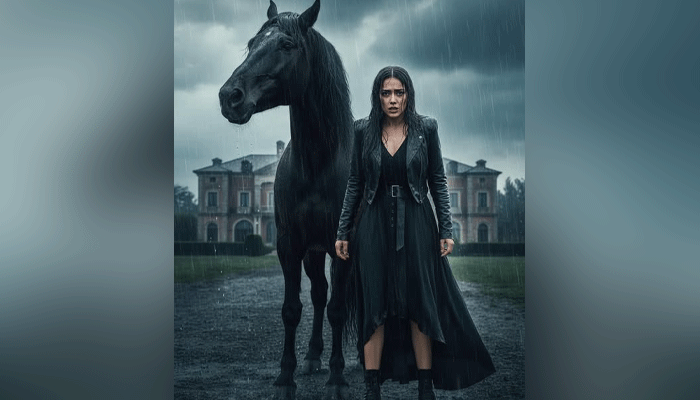
Vicente removed his hat slowly, rainwater dripping from the brim, and looked toward the separate corral where Tormenta paced in circles like a storm trapped inside flesh.
“They were laughing,” he said, “but they didn’t know why your father refused to sell that horse.”
Natalie stood motionless in the mud, soaked through, cold clear to the bones, the notary’s words still echoing in her ears.
And to my daughter Natalie, I leave Tormenta.
Nothing else.
No land.
No accounts.
No herd.
No business.
Just the old horse everyone feared and mocked.
Her brothers’ laughter had followed her all the way from town to the ranch. She could still hear Ricardo pounding the table, Emilio calling her useless, Fernanda watching with that sharp, bloodless calm that always made cruelty look refined. Even now, standing in front of the pen where Tormenta snorted and slammed one hoof against the wet ground, Natalie felt the same humiliation tightening in her chest.
She looked at Vicente.
“If there’s some joke in all this,” she said quietly, “I’m too tired for it.”
The old foreman shook his head.
“There’s no joke, niña.”
He still called her that, just as he had when she was six and used to trail after him in the fields asking why the earth smelled different after rain. Back then, she had been Don Aurelio’s shadow when the great man still had patience for tenderness. Before business hardened him. Before the older children became extensions of ambition and Natalie became, as the family liked to say, “the soft one.”
Vicente stepped closer to the fence.
“Your father kept many things from his sons,” he said, “and from your sister too. But this matter—this one—he kept from everyone.”
Natalie glanced back at the horse.
Tormenta’s ears flattened. He tossed his head once, black mane whipping against the rain.
“What matter?”
Vicente did not answer immediately. Instead, he opened the gate to the narrow side passage beside the corral and motioned for her to follow.
Natalie hesitated.
“Are you insane? He’ll kill us.”
“No,” Vicente said. “He only kills lies.”
That sounded like something her father might have said, years ago, before the illness hollowed his face and softened his voice. Natalie almost smiled despite herself.
Almost.
She followed Vicente down the passage until they reached the old feed room, a low adobe structure half-hidden behind a wall of tangled bougainvillea. The rain drummed on the tin roof. Inside, everything smelled of oats, leather, dust, and old wood. Vicente lit a yellow lamp hanging from a beam, and the room glowed dimly.
There, in the corner beneath a blanket stiff with age, stood a battered saddle chest.
Natalie stared at it.
She knew that chest.
It had once been in her father’s private tack room, the one no one entered without permission. As a child, she had seen him kneel before it only twice. Once to take out an old silver spur for a charro exhibition. Once when her mother died and he locked himself in the tack room for an hour without saying a word.
Vicente pulled the blanket aside.
“Your father told me,” he said, “that if he died before telling you himself, I was to show you this only after the will was read. Only if they gave you Tormenta.”
Natalie’s throat tightened.
“Why not before?”
“Because he wanted to know if they would show their true faces.”
She let out a hollow laugh.
“Oh, they did.”
Vicente nodded once. Then he reached into his shirt pocket and brought out a small brass key on a worn leather strip.
“He gave me this at the hospital,” he said. “He said, ‘When my sons see wealth, they’ll rush toward it. When my daughter sees humiliation, she’ll still walk into the rain. She’s the only one who’ll make it to the horse.’”
Natalie closed her eyes for a second.
Her father had not been an easy man to love. He had measured people by endurance, silence, and usefulness. The older children had learned to become sharp enough to impress him. Natalie never had. She asked too many questions, cried too visibly, spent too much time among the workers and animals and not enough in account books.
Still, those last hospital words had stayed with her.
Take care of him like I took care of you, and he’ll show you what no one else can see.
Vicente unlocked the chest.
The lid groaned open.
Inside, neatly wrapped in oilcloth and tied with rawhide strips, were bundles of documents, a velvet pouch, and a smaller wooden box. Under them all lay a folded notebook with Don Aurelio’s initials burned into the leather cover.
Natalie just stared.
“This… this was in there the whole time?”
Vicente nodded.
“Thirty years.”
Her pulse quickened.
“Why?”
“Because your father trusted walls less than flesh and blood. He said money in a bank can be frozen, land can be stolen with signatures, cattle can be counted by any fool with a pencil… but a secret attached to an old horse and a dead man’s reputation? That can sleep for decades.”
Natalie reached for the notebook first.
The leather was cold.
When she opened it, she found pages of dates, names, land coordinates, transactions, and short entries in her father’s unmistakable handwriting—hard, precise, slanted slightly to the left.
At first, none of it made sense.
Then she saw a repeated phrase:
Blue ravine vein.
Original concession.
Untouched.
Held in trust.
She looked up.
“Vicente…”
The old foreman exhaled slowly.
“Your father discovered silver on the north lands before your brothers were even men,” he said. “A rich vein, maybe richer than anything in the district. But at the time, he was fighting debts, legal disputes, and your uncle’s gambling losses. If word got out, every vulture in Jalisco would’ve descended. So he did what only a man as paranoid as Aurelio would do.”
Natalie’s fingers tightened around the notebook.
“He hid it.”
“Yes.”
“In a horse?”
Vicente almost smiled.
“Not exactly. Tormenta was the marker.”
Natalie frowned.
Vicente pointed toward the corral outside.
“That horse was born the same month your father secured the hidden concession. He branded the underside of Tormenta’s left hind shoe himself, with a mark no one noticed because no one bothers looking under the feet of a demon.” He tapped the notebook. “The mark matches a map key. Without Tormenta and this ledger, the papers are worthless to strangers. The concession sits under another name, behind an old cooperative and two shell agreements. Your brothers inherited what shines in daylight. You inherited what they never saw underground.”
The room seemed to sway around her.
Silver.
Concession.
Map key.
Thirty years.
She looked back at the chest and pulled out the oilcloth bundle with shaking hands. Inside were property deeds, mineral rights records, notarized transfer documents, and one final sealed envelope addressed in her father’s hand.
For Natalie only.
Her breath caught.
She broke the seal.
Inside was a single letter.
—
Natalie,
If you are reading this, then I was too stubborn to live long enough to explain everything myself. That sounds like me.
Your brothers will laugh. Let them. Men who think wealth must arrive loudly have poor ears.
Tormenta is not your inheritance. He is the door to it. Under the old ravine lands past La Quebrada, where they all thought the soil was too bitter for corn, there is enough silver to change the destiny of every Mendoza who comes after me. I hid it because greed ran too freely in this family, and because I needed time to know who among my children understood the difference between owning and deserving.
I watched them all. Ricardo only loves what kneels before him. Emilio counts animals as if counting gives him wisdom. Fernanda understands power but mistakes cruelty for strength. You were the only one who learned names, not prices. The only one who fed workers before guests. The only one who stayed with your mother when she was dying instead of circling the estate like vultures waiting to discuss division.
They call you useless because you do not know how to devour. I call that salvation.
Vicente knows enough to help you, but not enough to cheat you. Trust him as far as the gate and no farther. Trust the horse farther than that.
If you choose to sell the concession, do it cleanly. If you choose to work it, do not become me in the process. Wealth rots men quickly and women only slightly slower.
As for Tormenta: he was Marisol’s favorite colt. Your mother said he could smell sorrow. Perhaps that is why he never let the others near him after she died. Take care of him. He owes me nothing, but he may still give you one last service.
Do not forgive your siblings quickly. Let them feel the full hunger of what they mocked. Mercy without memory only feeds wolves.
Your father,
Aurelio Mendoza
—
By the time Natalie finished reading, her tears had already fallen onto the paper.
Not because the letter was tender. Her father had never been built for softness, not even in farewell. But because in the hard, crooked way available to him, he had seen her. More clearly, perhaps, than he ever had while alive and strong enough to speak it.
Vicente stood quietly by the door, pretending not to watch.
Natalie folded the letter carefully.
“He knew,” she whispered.
“Yes.”
“All these years?”
Vicente nodded.
“He knew exactly what each child was.”
Outside, Tormenta struck the fence once with a hoof, as if to remind them he still existed and had no patience for human revelations.
Natalie wiped her face.
“What do I do now?”
Vicente scratched his jaw.
“First? Feed the horse. A secret tied to a hungry animal is a foolish inheritance.”
Despite everything, she laughed.
Then they went out into the rain.
Tormenta watched them approach with his neck arched and nostrils flaring. Up close, he looked even more formidable than Natalie remembered from childhood. His dark coat was shot with gray now, but the old power still sat under the scars. One of his ears had a split tip. His left shoulder bore a pale crescent from some long-ago collision with wire or wood.
Vicente handed Natalie an apple from his pocket.
“He won’t take it from me anymore,” he said. “Maybe he’ll take it from you. Your mother used to feed him apples and call him vain.”
Natalie stepped to the fence.
For a second, Tormenta did nothing.
Then he came forward—not gently, but with wary purpose. His hot breath hit her palm before his lips closed over the apple. He crunched once, loud as a branch snapping, and stared at her while chewing.
Natalie swallowed hard.
“Hello, Tormenta.”
The horse’s ears shifted forward.
Vicente let out a low sound, almost respectful.
“He remembers.”
“Me?”
“Or her.”
Natalie touched the fence with one hand.
Rain slid down her face. Mud soaked the hem of her dress. Her brothers had left the notary’s office grinning over hectares and cattle and pedigreed horses. Meanwhile she stood in a storm with a violent old stallion, a hidden silver concession, and a dead man’s letter in her pocket.
For the first time that day, the humiliation inside her began to transform.
Not into triumph.
Not yet.
Into shape.
Three days later, Ricardo came to see her.
Of course he did.
Word travels quickly in ranch country, especially when Vicente starts visiting the lower ravine with maps and a surveyor from Guadalajara. By then Natalie had moved into the old foreman’s house near the edge of the north lands because she had no intention of sleeping under the same roof as her siblings while she sorted papers they would happily steal.
Ricardo arrived in a white truck too clean for the road, sunglasses on despite the cloudy afternoon, boots polished, temper already visible in the set of his jaw.
He didn’t greet her.
He stood outside the gate and called out, “Tell Vicente to stop digging around where he doesn’t belong.”
Natalie was brushing Tormenta in the yard when he arrived. The horse lifted his head at Ricardo’s voice and pinned his ears back so fast it was almost comical.
She kept brushing.
“Good afternoon to you too.”
Ricardo stepped through the gate without being invited.
“You think this is funny?”
“No. I think it’s overdue.”
His eyes flicked to the horse, to the brush in her hand, to the mud on her skirt. He looked at her the way men like him look at women who have unexpectedly become inconvenient.
“What did the old man hide?”
Natalie set the brush down slowly.
“A better opinion of me than you ever managed.”
He smiled without warmth.
“Don’t get clever. I know Vicente’s been snooping around the ravine. Emilio heard it too.”
“Then perhaps Emilio should go back to counting cows. It suits his gifts.”
Ricardo stepped closer.
“We divided everything legally.”
“Did you?”
The question stopped him.
For a second, something like uncertainty crossed his face.
She saw it and almost enjoyed it.
“My lawyer says the will is final,” he said.
“I’m sure your lawyer is very comforting.”
Ricardo’s mouth tightened.
“Natalie, if there’s something out there—some debt, some hidden property, some nonsense our father forgot to declare—then it concerns all of us.”
“No,” she said. “That’s the interesting part. It concerns exactly the person he intended.”
He stared.
Then laughed once, short and ugly.
“You? Please. He left you a horse because he knew you’d be too sentimental to question it.”
Natalie took one step toward him.
It was a small movement, but Tormenta surged behind her with such force the fence rattled. Ricardo flinched despite himself.
“Maybe,” she said softly, “he left me the only creature in this family who could smell a fraud.”
That hit home.
Ricardo looked at the horse again and, for the first time since arriving, stepped back.
“You think one old animal makes you powerful?”
Natalie smiled without friendliness.
“No. But the papers in my kitchen might.”
He went still.
And there it was: the first true crack in his arrogance.
He turned sharply and left without another word.
By nightfall, Emilio was calling.
By dawn, Fernanda had sent a message through a lawyer requesting “a full and transparent review of any omitted estate assets.”
Natalie laughed when she heard that phrasing.
Transparent.
From people who had laughed when she received Tormenta.
The surveys took two weeks.
The results were worse—for them, better for her—than even Vicente had guessed. The old ravine lands, long dismissed as unproductive and too hard to irrigate, sat over a silver deposit large enough to attract international interest. Not fantasy. Not rumor. Geological confirmation. Commercial viability. Real money.
Serious money.
More than the cattle.
More than the racehorses.
More than the accounts disclosed in the will.
When the report arrived, Natalie sat at the kitchen table with Vicente and stared at the figures until they stopped looking like numbers and started looking like danger.
Vicente whistled low.
“Your brothers are going to lose their minds.”
Natalie folded the report shut.
“They already lost them. They just had prettier furniture while it happened.”
He chuckled, then grew serious.
“What will you do?”
That question haunted her all night.
Because wealth revealed through humiliation is intoxicating. She could feel it already—the dark temptation of reversal. The fantasy of summoning Ricardo, Emilio, and Fernanda to the same notary’s office, dropping the report on the table, and watching their faces curdle. She could keep the whole thing. She could sell it. She could divide it unequally just to mirror their cruelty. She could become the hand now holding the knife.
And then she remembered the letter.
If you choose to work it, do not become me in the process.
Mercy without memory only feeds wolves.
The next morning, she saddled Tormenta.
Vicente nearly choked.
“Miss Natalie, that horse hasn’t taken a rider in years.”
“He took my hand.”
“That is not the same as carrying your bones.”
Natalie ran a palm down Tormenta’s neck. The stallion turned his head and nudged her shoulder once, hard enough to almost count as affection.
“It is for today.”
The old foreman muttered a prayer.
But she mounted.
Tormenta danced twice, shook his head, then settled—not obediently, never that, but with a tense, alert acceptance. Natalie had ridden as a child before her siblings and social expectations pushed her toward “proper” feminine uselessness. The memory returned in fragments through muscle and fear. Together, she and the horse climbed the north trail to the ravine.
The land stretched below them in wet green folds, stitched with stone walls, mesquite, and scrub. Far off, the ranch buildings shone pale in the morning sun. The sky was enormous, indifferent, and clean.
She stopped at the ridge and let Tormenta breathe.
“This is yours too, isn’t it?” she murmured.
The horse flicked one ear back toward her.
For the first time in years, Natalie felt something like direction—not borrowed, not assigned, not laughed into smallness by siblings who measured worth in aggression.
Her father had hidden silver under the earth.
But what he had really buried, perhaps without fully knowing it, was an answer.
Not to the question of who deserved money.
To the question of who could hold power without immediately using it to devour.
When the legal war began, it was uglier than rain.
Ricardo argued diminished capacity.
Emilio argued concealed marital property.
Fernanda argued that any undeclared concession invalidated the spirit of the original division.
Natalie responded with documents.
Then more documents.
Then the letter.
Not all of it—only enough.
The notary, who had asked for silence three times while they laughed at her, read the addenda with a much paler face this time. He confirmed the concession’s structure, the independent registration, and the legal language that made it explicit: Aurelio had designed the hidden asset to pass only through the mechanism linked to Tormenta and the sealed instructions.
Ricardo shouted.
Emilio threatened appeals.
Fernanda stopped pretending sisterhood and became what she had always really been: elegant venom.
“You think this makes you superior?” Fernanda asked one afternoon in the courthouse corridor.
Natalie looked at her calmly.
“No. I think it makes father theatrical.”
Fernanda stared, then almost smiled despite herself.
That was the first honest expression Natalie had ever seen on her face.
The settlement, when it finally came, was brutal but clean.
Natalie retained primary ownership of the concession and the rights to negotiate extraction or sale.
Her siblings received no legal share beyond what had already been granted in the will.
However—and this was Natalie’s decision, not the court’s—she established a structured family trust from a minority percentage of future profits, tied to strict transparency rules and with worker benefits written into the first operating agreements.
Ricardo called her weak for that.
Emilio called her sentimental.
Fernanda called her manipulative.
Natalie accepted all three accusations as compliments in bad clothing.
She also funded medical insurance and pensions for ranch workers who had given Don Aurelio their backs and knees for decades and received almost nothing but wages.
Vicente cried when she told him.
“Your father would have called that bad business,” he said.
“I know.”
“And your mother would have called it decency.”
Natalie smiled.
“Then I’m keeping the better inheritance.”
A year later, journalists began arriving.
They wanted the story everyone wanted:
the useless daughter,
the worthless horse,
the hidden fortune,
the siblings brought low by arrogance.
Natalie gave very few interviews. When she did, she kept the story short.
“My father left me an old horse,” she said. “The rest was already there. No one had bothered to look properly.”
But the town told the richer version.
They said the brothers laughed in the notary’s office.
They said the daughter walked three kilometers in the rain for a horse no one wanted.
They said the old stallion led her to silver.
They said the foreman kept the secret like a priest keeps confession.
They said the father, for all his hardness, knew exactly which child could survive being underestimated.
All of that was true.
But not the whole truth.
The whole truth was standing in the paddock one cool evening at sunset, when Natalie leaned against the fence watching Tormenta graze. The stallion moved slower now. Age had softened the sharpness of his coat and made his scars more visible. But his eyes were clearer. Less haunted.
She had kept him.
Of course she had.
She could have moved him to some fine retirement pasture with polished stables and staff who bowed around old bloodlines. Instead she kept him near the ravine where mesquite scented the wind and Vicente still cursed affectionately whenever Tormenta stole apples from his jacket pocket.
Natalie walked into the paddock with one in her hand now.
Tormenta lifted his head and came toward her.
“There you are,” she murmured.
He took the apple gently.
She stroked the broad line of his face and felt gratitude rise, strange and full, for an animal everyone else had dismissed as dangerous waste.
Not because he had made her rich.
Because he had carried a truth long enough for her to become the sort of person who could receive it.
She thought of her father then.
Of his hard mouth.
His difficult love.
His sharp, often cruel understanding of weakness.
And the way, at the end, he had chosen not to reward obedience or ambition or family performance, but something else.
Quiet seeing.
Endurance.
The refusal to mock what looks useless before asking what it has survived.
The wind moved through the grass.
“You were impossible,” she said softly to the memory of him.
Tormenta snorted as if in agreement.
Natalie laughed.
And that, perhaps, was the final irony: her father had hidden a fortune under the land, but the greater secret was what he had hidden inside the insult itself.
He had let the others reveal themselves first.
Years later, when schoolchildren visited the education center Natalie built near the ravine—funded by the first silver profits and named after her mother, Marisol—they would sometimes ask about the old photograph hanging in the entrance hall.
In it, a young woman in muddy boots stood beside a black, scarred horse under storm clouds, one hand on the fence, chin lifted, eyes unreadable.
“Is that really the horse?” they would ask.
“Yes,” Natalie would say.
“The one everyone laughed at?”
“The very same.”
And then she would tell them:
“People laughed because they thought value had to arrive polished, loud, and easy to count. They were wrong.”
If the children were lucky, she would add one more thing:
“Never mock the inheritance you don’t understand. Sometimes the most important thing in the room is the one everyone has already dismissed.”
Tormenta died in his sleep at twenty-three.
Vicente found him at dawn under the mesquite tree near the upper fence, as if he had simply laid himself down where the land opened widest and decided he had carried enough.
Natalie buried him on the ridge above the ravine.
No grand monument.
Just a stone marker and one line carved into it:
He showed what no one else could see.
Her siblings came to the burial.
That surprised everyone.
Ricardo stood awkwardly, hat in hand, older now in the face than pride usually allows. Emilio looked at the grave as if unsure what part of himself he was supposed to feel. Fernanda wore black and said very little.
At the end, Ricardo stepped beside Natalie.
“I was cruel,” he said, not looking at her. “At the notary. And before.”
“Yes,” she replied.
He nodded once, accepting the absence of comfort.
“I was wrong about you.”
Natalie looked at the fresh earth covering Tormenta’s body.
“No,” she said after a moment. “You were wrong about what strength looks like.”
That was all.
It was enough.
Because some apologies do not restore love.
They only finally stop insulting the truth.
And if anyone later retold the story as a fairy tale—if they said a poor, mocked daughter inherited a worthless old horse and discovered hidden silver that made her richer than all the siblings who laughed—they missed the real treasure entirely.
The silver changed her life, yes.
But the true secret her father had hidden for thirty years was simpler and far rarer:
he had hidden his faith in the one child no one else thought worth betting on.
And when that faith was finally uncovered, it was not just the siblings who regretted their laughter.
It was the whole valley, forced to reckon with how often it had mistaken gentleness for uselessness, old age for worthlessness, and visible wealth for true inheritance.
Natalie had received an old horse.
What he gave her was sight.