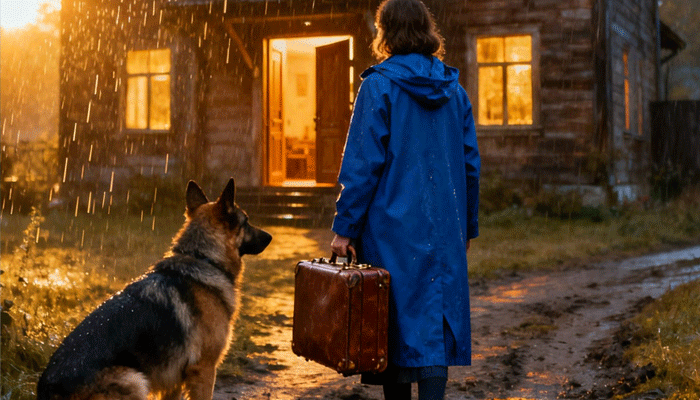
Thrown Out, Pregnant and Alone, She Reached Her Grandpa’s House—What Waited Inside Changed Her Life Forever
Claire Bennett had never imagined that the coldest night of her life would begin on the front steps of her in-laws’ house.
The wind was sharp enough to sting her cheeks, and the February rain had that miserable half-frozen bite that made everything feel harder than it already was. Her suitcase sat open on the driveway, one wheel broken, baby clothes spilling out onto the wet concrete. A framed wedding photo had landed face down in a puddle. Beside it, a plastic bag of prenatal vitamins rolled toward the curb.
Ranger, her seventy-pound shepherd mix, stood in front of her with his hackles up, muddy paws planted wide, a low growl rumbling in his chest.
From the doorway, Judith Bennett folded her arms across her expensive wool coat and looked down at Claire as if she were something embarrassing that had finally been dragged into the light.Outerwear
“You need to leave,” Judith said. “Tonight.”
Claire pressed one hand to the underside of her swollen belly. The baby had been restless all evening, twisting beneath her ribs like she felt every ounce of the tension in the air. “Judith, please. It’s almost freezing. I’m seven months pregnant.”
Harold Bennett stepped into view behind his wife, his face red and hard. “You should’ve thought about your future before you refused to cooperate.”
Cooperate.
That was the word they always used when they wanted something from her.
Three weeks earlier, Harold had put a stack of papers in front of her at the kitchen table and told her signing them would “protect the family business” after Ben’s death. Judith had poured coffee and spoken in that icy, practiced tone of hers about responsibility, legacy, and sacrifice.Family
Claire had actually read the documents.
Ben’s life insurance money—money that was supposed to help her survive after her husband died in a highway accident before their baby was born—would be redirected into the failing Bennett Hardware account. A second document gave Harold “temporary financial oversight” of any estate assets until “the child reached maturity.”
A third draft, sloppier and more alarming, spoke about future guardianship support if Claire proved “emotionally unable” to care for the baby alone.
They had expected grief to make her obedient.
Instead, she had pushed the papers back.
Now Judith stared at her from the doorway like refusal had transformed Claire from family into a threat.
“You can’t put me out like this,” Claire said, her voice shaking. “Ben would never—”
“Ben isn’t here,” Harold snapped.
The sentence hit like a slap.
Ranger barked once—deep, explosive, furious.
Judith flinched. “Control that dog.”
Claire looked down at the only creature in the world who still seemed certain she deserved defending. Ranger had belonged to Ben before they married. Ben had rescued him from a shelter outside Springfield, a one-year-old stray with one torn ear and nervous eyes. Ranger had adored Ben, but after the funeral, he never left Claire’s side. He followed her from room to room, slept by the bedroom door, and nudged her hand whenever crying made it hard to breathe.Doors & Windows
“He is under control,” Claire said.
Judith kicked one of the fallen baby onesies back toward the suitcase with the pointed toe of her boot. “Take your things and go wherever girls like you go when the money runs out.”
Claire stared at her. For a second, she truly could not understand what she was hearing.
Girls like you.
She had married Ben four years ago in a white church outside Columbia, Missouri, beneath dogwoods and summer heat. Harold had shaken her hand that day. Judith had smiled for the photos. Ben had whispered jokes into Claire’s ear during the reception until she laughed so hard she nearly spilled champagne on his tie.
Now all of that felt like it had belonged to someone else.
“Please,” Claire said again, because desperation strips pride fast. “Just let me stay until morning. I’ll leave at first light.”
Harold came down the steps, lifted her old duffel bag with two fingers, and dropped it beside the suitcase. “You have ten minutes.”
Claire swallowed hard. “I have nowhere to go.”
Judith’s face did not change. “That is not our problem.”
The baby kicked hard enough to make Claire catch her breath.
Ranger moved closer to her leg.
And in that raw, humiliating moment, with the rain soaking through her sweater and the world collapsing in front of two people who had once toasted her wedding, a single memory rose out of the wreckage.
A white farmhouse.
A wraparound porch.
A tall man with rough hands lifting her to sit on the hood of an old truck so she could see fireflies over a hayfield.
Grandpa Amos.
She had not seen him in fifteen years.
Not since her mother died.
After the funeral, Claire’s father had cut ties with nearly everyone from her mother’s side of the family. He told Claire that Amos Reed was stubborn, bitter, too proud to be bothered with grandchildren. Over time, the silence hardened into something that looked like truth.Family
But Claire still had one thing.
An address written years ago on the back of a Christmas card she had never answered.
Amos Reed
1874 County Road 12
Willow Creek, Missouri
Her fingers trembled as she knelt and gathered baby clothes from the wet driveway.
Harold turned and went back inside.
Judith stayed where she was, watching.
Claire zipped the suitcase as best she could, stuffed the wet onesies into the duffel, and kept her eyes on the ground because she refused to let Judith see her cry.
By the time she loaded everything into her dented blue Honda, her hands were numb.
Ranger jumped into the back seat without being told.
She slid behind the wheel, breathing too fast, her vision blurred.
The front door shut behind Judith with a solid, final sound.Doors & Windows
Claire sat there for three full seconds in the dark, one hand gripping the steering wheel, the other spread across her belly.
“I know,” she whispered to the baby. “I know. I’m trying.”
Then she started the car and drove away.
The roads were nearly empty once she got clear of town.
Rain swept over the windshield in wild, slanting sheets, and the wipers struggled to keep up. Headlights tunneled through darkness, catching the silver flash of fence posts and flooded ditches. Every so often Claire passed a gas station or a shuttered diner or the faint glow of a farmhouse sitting deep in black fields.
Ranger rested his chin between the front seats, warm breath brushing her shoulder.
Twice she thought about turning around.
Not to go back to the Bennetts. Never that.
But to stop somewhere. Sleep in the car. Wait until daylight.
Then the memory of Judith’s voice would return, sharp as broken glass, and Claire would grip the wheel tighter.
Somewhere girls like you go when the money runs out.
By midnight, the rain had eased into a cold drizzle. Claire pulled into a truck stop outside Fulton, bought a bottle of water, crackers, and the cheapest coffee she could find, then stood under the harsh fluorescent lights trying not to break apart in public.
A cashier with tired eyes glanced at her belly, then at Ranger waiting in the car.
“You all right, honey?”
Claire almost lied.
Instead she nodded once too quickly and said, “Just a long drive.”
The woman slipped two extra packets of peanut butter crackers into the bag. “For the road.”
It was such a small kindness that Claire had to bite the inside of her cheek to keep from crying.
She drove on.
As the miles passed, her fear changed shape.
At first it had been immediate and practical. Where would she sleep? What if the car broke down? What if something happened to the baby?
But as the night stretched out around her, another fear took hold.
What if Grandpa Amos wasn’t there anymore?
What if the house had been sold?
What if he opened the door, looked at the pregnant stranger on his porch, and said he didn’t know her?Doors & Windows
She had built so much of her life around making herself useful, uncomplaining, easy to keep. When Ben died, that instinct only deepened. She cleaned Judith’s kitchen. She answered condolence texts. She sorted Ben’s clothes. She thanked people for casseroles she couldn’t swallow. She listened while Harold talked about debt and responsibility and the pressure Ben had carried.
At no point had anyone asked Claire what she needed.
And now she was driving through the dark toward the last person in the world who might still call her his own.
By the time she turned onto County Road 12, dawn had begun to thin the sky.
Missouri winter fields spread out on either side of the road, silver with frost. Bare trees lined the fence rows. A low mist hovered over the creek bed. Her headlights swept across an old mailbox leaning at an angle, the numbers half-faded but still visible.
Claire slowed.
A quarter mile ahead, a white farmhouse emerged from the gray morning like something pulled from memory.
The porch wrapped around two sides. The roof sagged a little in the middle. One shutter hung crooked. There was a red barn beyond it, weathered to rust and brown, and an old Ford pickup parked under a lean-to.
But what made Claire’s throat close was the porch light.
It was on.
Smoke curled from the chimney.
And as she rolled to a stop in front of the house, the front door opened.
An old man stepped onto the porch in a canvas coat, a mug in one hand. He was taller than she remembered, or maybe just more solid. His hair had gone entirely white. His shoulders were stooped in a way age forces on even strong men. But his face—Outerwear
She knew his face.
The same deep-set eyes her mother had given her. The same stubborn jaw.
He looked at the car for one long beat, then set the mug down on the porch rail and came down the steps.
Claire had barely turned off the engine before tears blurred everything.
She opened the door and tried to stand, but emotion and exhaustion made her clumsy. Ranger jumped out first and circled the man once, tail low but not hostile, then stepped aside.
The old man stopped two feet away and studied Claire’s face with an expression so steady and unreadable that for one terrible second she thought she had made a mistake.Doors & Windows
Then he said, softly, like he was answering a question he had been asked years ago, “Took you long enough, Peanut.”
Claire broke.
A sound left her that was half sob, half laugh, and then Amos Reed opened his arms.
She stepped into them like she had been falling for months.
He smelled like cedar, coffee, and cold morning air. His hug was careful because of her belly but strong enough to hold up everything inside her that was trying to collapse.
“I’m sorry,” she cried into his coat. “I’m so sorry—I didn’t know where else—”
“Hush now,” he said, one rough hand on the back of her head. “You’re here. That’s all I need to know.”
Ranger leaned against Claire’s hip.
Amos looked over her shoulder at the loaded car, the suitcase jammed crooked in the trunk, the strain on her face, and something flinty darkened in his eyes.
“Who did this?”
Claire tried to answer, but he shook his head. “No. Inside first. Questions later.”
He bent to pick up her duffel. Claire reached for it automatically.
“I’ve got it,” he said.
The simple certainty of those words nearly undid her again.
Amos led her up the porch steps and through the front door.
And the moment Claire crossed the threshold, everything changed.
The house was warm.
That was the first thing.
Not just heated, but lived-in warm. Wood smoke and cinnamon and bacon grease and old pine floors. A yellow lamp glowed beside a patched sofa. A cast-iron skillet sat on the stove. Folded quilts were stacked neatly in a basket near the hearth. The windows were bright with dawn. Somewhere a radio played low, an old country song humming like memory.
The second thing she noticed was the cradle.
It stood by the fireplace, hand-built from honey-colored cedar, sanded smooth and polished with care. A pale green blanket rested inside it.
Claire stared at it, stunned.
Amos followed her gaze. He shifted once, clearing his throat. “Figured if you ever came, you might not come alone.”
Her hand flew to her mouth.
There, beyond the cradle, was the third thing.
On the wall above the mantel hung photographs.
Her mother as a little girl in overalls, standing beside Amos in a cornfield.
Claire at age six on a swing, missing her front teeth.
Discover more
doors
Outerwear
coat
A wedding picture of Claire and Ben—one she had never sent him.
She stepped closer, breath shallow. “How do you have this?”
“Internet’s a mighty nosy place,” Amos muttered. “Your friend Macy posted it years back. Printed it at the library.”
Claire laughed through tears.
Amos took off his coat and hung it by the door. “Sit down before you fall down.”Outerwear
Only then did she realize how badly her legs were shaking.
He guided her to the kitchen table, a scarred oak thing with one corner worn smooth. Ranger lay immediately at her feet. Amos poured coffee for himself, then warm milk with honey for Claire without asking, as if he remembered she had hated coffee as a child and knew some things never changed.
When he set the mug in front of her, he also placed a plate beside it.
Biscuits. Eggs. Bacon.
Claire stared at the food like she couldn’t make sense of it.
Amos sat across from her. “Eat.”Doors & Windows
She managed a small nod.
For a minute the only sounds were the tick of the kitchen clock and the scrape of his fork against the plate. Claire forced herself to take a bite of biscuit. It was buttery, hot, and so good it hurt.
Amos waited.
He was wise enough not to rush silence.
Finally Claire set her fork down and said, “Ben’s parents threw me out.”
His eyes narrowed, but he said nothing.
“They wanted the insurance money. They said the store’s in trouble, that Ben would’ve wanted to save the business.” Her fingers tightened around the mug. “They put papers in front of me. Not just the insurance. Future guardianship, access to estate accounts, all of it. Like I was too emotional to handle anything.”
Amos’s jaw hardened.
“I said no,” Claire whispered. “So they told me to leave.”
His expression did not shift dramatically, but the room seemed to get quieter around him.
“Judith Bennett always did love money more than decency,” he said.
Claire blinked. “You know them?”
“Small towns are long memories wearing church clothes.” He leaned back. “Your Ben came out here last summer.”
Claire stared at him. “What?”
Amos nodded toward the back porch. “Drove that blue truck of his clear down my lane, boots muddy as sin, asked if I’d throw him off the property if he introduced himself as your husband.”
Claire’s throat tightened. “He came here? And you never—”
“You never wrote,” Amos said gently. “And I wasn’t about to force my way into your life if you didn’t want me there.”
The truth of that landed harder than accusation would have.
Claire looked down.
Amos reached into the pocket of his flannel shirt and laid an envelope on the table.
Her name was written on the front in Ben’s handwriting.
Claire froze.
“I was waiting for the right time,” Amos said. “Looks like the right time showed up in the dark with a suitcase and a dog.”
Her fingers shook as she picked it up.
Inside was a folded letter, a copy of an insurance policy, a property deed, and a business card for an attorney named Lena Torres in Willow Creek.
Claire opened the letter first.
Claire,
If you’re reading this, either I finally worked up the nerve to tell you I went to see Amos, or something happened before I could. I’m hoping for the first one. If it’s the second, I need you to know three things.
One: I love you. That never changes.
Two: my parents are in worse financial trouble than they admit. If anything happens to me, do not sign a single paper they put in front of you unless Lena Torres reads it first.
Three: the policy lists you as sole beneficiary, with our child as contingent beneficiary. Nobody else. That was my decision. I made copies because Dad’s been acting strange about the business accounts, and I don’t trust what he’ll do if he panics.
I went to see Amos because you once told me that when you were little, he was the one place that felt safe. I figured any man who gave you that feeling was worth knowing. I was right. He’s stubborn, cusses at fence posts, and makes better biscuits than your husband ever will, but he’s solid. If life gets ugly, go to him.
And one more thing. In the glove box is the key to the lake parcel. I bought it because I wanted us to build something that was ours, not mine, not theirs. Ours.
Tell the baby I’m trying my best to be someone worth missing.
—Ben
Claire could not see the page anymore.
She bowed over the letter, sobbing soundlessly while Ranger pressed his head against her knee.
Across the table, Amos said nothing for a long time.
Then he spoke in a voice low and rough with feeling. “He was a good man.”
Claire wiped at her face. “Why didn’t he tell me he came here?”
Amos looked toward the window, where pale morning light lay over the yard. “Said he wanted to surprise you. Said maybe he’d bring you out in spring, after the roads cleared, after he fixed up that old parcel by the lake. Said he wanted you to have somewhere that belonged to no one but the two of you.”
That did it.
Grief opened like a fresh wound inside Claire, but for the first time since Ben died, it wasn’t just pain. It was proof. Proof that he had been thinking of her, planning for her, protecting her.
Inside this house, in the span of ten minutes, she had found more loyalty than she had known in months.
Amos rose slowly from his chair. “There’s a room ready.”
Claire looked up.
He rubbed the back of his neck like he hated explaining sentiment. “At the end of the hall. Fresh sheets. I put a rocking chair in there too. Figured every baby needs somebody awake at three in the morning.”
A broken laugh escaped her.
Amos’s eyes softened. “You can stay as long as you need, Claire. That’s not charity. That’s blood.”
She had spent so long bracing for doors to close that hearing one open without condition left her almost speechless.Doors & Windows
“All right,” she whispered.
He nodded once. “Good. After you sleep, we’ll talk to Lena.”
Sleep lasted nearly fourteen hours.
Claire woke to afternoon light and the deep ache of exhaustion lifting inch by inch from her bones. For a moment she forgot where she was. Then she saw the quilt over her legs—blue and cream patchwork, hand-stitched—and remembered.
Ranger was sprawled on the braided rug by the bed, one eye half-open in case she needed him.
The room around her was small and simple. Iron bedframe. Oak dresser. White curtains lifting with the breeze. A rocking chair in the corner with a folded baby blanket draped over the arm.
And on the dresser, in a silver frame, was a picture of her mother at sixteen, smiling with her head thrown back.
Claire sat up slowly, emotion rising again.
She moved through the house in sock feet, following the smell of tomato soup and grilled cheese. Amos was at the stove, flipping sandwiches with the concentration of a man handling delicate machinery.
“About time,” he said without turning. “Thought I might need to check for a pulse.”
Claire smiled despite herself. “What time is it?”
“Nearly six.”
“Oh my God.”
“You needed it.”
He set a plate on the table.
Claire sat. “Thank you.”
He shrugged. “You can thank me by eating before my sandwiches die in vain.”
There was comfort in his plainness. No performance. No pity. No effort to make grief neat and manageable. He just kept putting food in front of her and space around her, as if shelter could be built one ordinary act at a time.
After they ate, he led her into the den.
A fire crackled in the stone fireplace. On the coffee table sat a dented tin box.
Amos lowered himself into his armchair with the careful stiffness of old injuries. “There are some things I ought to tell you.”
Claire sat on the sofa.
He opened the box and took out a bundle of letters tied with faded twine.
“Your father told you I abandoned your mother,” he said.
Claire swallowed. “Yes.”
Amos nodded once, as if he’d expected no less. “Truth is uglier and dumber than that.”
He handed her the top letter. The envelope was yellowed, unopened, her mother’s name written across the front in Amos’s blocky handwriting.
“After your grandmother died, your mother fell hard for your father. I didn’t much like him. Thought he was smooth in all the wrong ways. We fought. Harsh words got said. She married him anyway.” Amos stared into the fire. “Once he realized I wouldn’t bankroll his schemes, he started keeping her from me. We still wrote some. Not often, but enough. Then the letters stopped.”
He tapped the bundle.
“Years later, when I came down to the city after hearing she was sick, he met me at the hospital door and told me she didn’t want to see me. Told me I’d made my choice years before.”Doors & Windows
Claire’s chest tightened.
“When your mother died, I got these in a box.” He looked at her. “Every letter I’d sent for six years. Unopened.”
Claire closed her eyes.
“I went to see you after the funeral,” Amos said. “Your father told me if I came near you again, he’d call the sheriff and say I was trespassing. You were little. Already scared. I figured barging in would only make it worse.”
He folded his hands. “So I waited. Sent birthday cards. Christmas cards. Kept the address the same in case you ever wanted to find me.”
Claire remembered them now. A few cards over the years. Brief, awkward, always signed Love, Grandpa Amos. Her father had tossed most of them in a drawer unopened. Once, at twelve, she had read one secretly under the covers and cried without understanding why.
“You kept my wedding photo,” she said softly.
Amos gave a dry snort. “Library printer charged me a fortune.”
A tear slid down Claire’s cheek anyway.
“I’m sorry,” she whispered. “I should’ve come sooner.”
“No.” He leaned forward, his voice firm. “You don’t carry guilt for other folks’ lies. Not in this house.”
In this house.
The words settled deep.
He reached for another envelope, this one newer. “Now as for your Bennett problem. Lena Torres is coming tomorrow. Smartest lawyer in three counties, mean as a snake in court, and owes me two favors and a fishing trip.”
Claire laughed through the tears still clinging to her face.
“Ben trusted her,” Amos said. “So do I.”
Lena Torres arrived the next morning in a charcoal coat and boots polished enough to reflect the porch boards.Outerwear
She was in her early forties, sharp-eyed, dark-haired, and moved with the efficient confidence of someone who had no patience for intimidation. She greeted Amos with a one-armed hug, crouched to let Ranger sniff her hand, then sat at the kitchen table and read everything Ben had left behind.
When she finished, she stacked the papers neatly and looked at Claire.
“First,” she said, “you do not sign anything. Second, you do not answer calls from Harold or Judith Bennett without me present. Third, based on this policy copy, they have no lawful claim to the insurance payout.”
Claire released a breath she had not realized she was holding.
Lena continued. “That said, people without a legal claim can still create legal problems. If the hardware business is failing and Harold’s desperate, he may try to argue fraud, undue influence, emotional instability, anything that buys time or leverage.”
Claire looked down at her hands. “They already hinted I might not be able to handle the baby alone.”
Lena’s mouth flattened. “Of course they did.”
Amos muttered something impolite under his breath.
Lena slid the business card toward Claire. “I’m filing notice today that I represent you. I’ll also request an immediate hold against any attempt to alter beneficiary distributions. If Harold has tried to tamper with records, that will matter.”
“Can he do that?” Claire asked.
“He can try,” Lena said. “Trying stupid things is free.”
That startled a laugh out of Claire.
Lena’s expression softened a fraction. “Listen to me. Being grieving and pregnant does not make you incompetent. Being temporarily displaced does not make you unfit. Anyone who says otherwise in my courtroom is going to regret breathing.”
Something hot and shaky moved through Claire’s chest. Relief, maybe. Or the first flicker of safety turning into strength.
After Lena left, Amos handed Claire a pair of work gloves.
She blinked. “What are these for?”
“The barn,” he said. “You’ve got two choices when life guts you. Sit in the wreckage, or build something. Today we start with shelves.”
Claire looked out toward the red barn, sunlight catching the frost on the roof. For the first time in months, the day ahead did not feel like something she had to survive. It felt like something she might step into.
So she followed him.
The barn smelled of hay, sawdust, and old leather.
Sunlight streamed through the slats in thin gold bars. Amos had converted one side into a woodshop over the years. There were clamps on the wall, jars of nails sorted by size, planes worn smooth from use, and a scarred workbench that looked like it had seen half a century of stubborn projects.
Claire ran a hand over the bench. “You made the cradle here?”
Amos nodded. “And the rocking chair. And about half the kitchen.”
He handed her sandpaper. “Today we’re refinishing those shelves. Light work.”
For hours they worked side by side in companionable quiet. Claire sanded while Amos stained. Ranger patrolled the doorway like a guard on duty. Every so often the baby kicked, and Claire would pause with a hand on her stomach until Amos pretended not to notice the emotion on her face.
By late afternoon, a thin layer of calm had settled over her.
That was when Ranger suddenly lifted his head.
His ears pricked. He trotted to the far wall behind an old cabinet, sniffed hard, and pawed at the floorboards.
“What is it?” Claire asked.
Ranger whined and scratched again.
Amos frowned. “He smells something.”
Together they moved the cabinet, revealing a patch of boards slightly lighter than the rest.
Amos crouched with a groan and ran his fingers along the edge. “Well, I’ll be damned.”
Using the claw end of a hammer, he pried up one loose plank.
Beneath it was a narrow cavity.
Inside sat a small metal lockbox.
Claire’s pulse kicked up. “What is that?”
Amos lifted it out and squinted. “Looks like the key’s still in it.”
He turned the tiny brass key taped beneath the handle.
Inside were three items.
A flash drive.
A folded ledger sheet.
And a sealed note in Ben’s handwriting.
Claire opened the note first.
If you’re finding this, Ranger probably found it for you. Good dog.
Despite everything, Claire let out a broken laugh.
Dad keeps two sets of books. One for taxes, one for truth. I copied what I could after I realized he was moving money from the business line into private debt. If anything happens and he comes after you, take this to Lena. I hid it here after visiting Amos because I trusted this place more than my own house.
Claire looked up slowly.
Amos’s face had gone hard as carved wood.
He took the ledger sheet and scanned it. “Private transfers. Personal loans. Lord Almighty.”
Claire stared at the flash drive in her palm.
Proof.
Not of money alone, but of Ben’s fear. Ben had known. He had seen what his father was capable of and had tried, in the small ways available to him, to protect her anyway.
That evening Lena came back, and when she reviewed the contents of the flash drive on Amos’s old desktop computer, her eyebrows rose.
“Emails,” she said. “Accounting screenshots. A voice memo.”
She clicked the audio file.
Harold Bennett’s voice crackled through the speakers.
If Claire won’t sign, we’ll remind her what a grieving pregnant woman looks like in front of a judge. She’s got no income, no house, no family worth mentioning. Once the baby gets here, we’ll have options.Family
Judith’s voice followed.
Then make sure she doesn’t get that money first.
Silence filled the room after the recording ended.
Claire felt cold all over.
Lena removed the flash drive carefully. “Well,” she said, very calmly, “that is spectacularly illegal.”
Amos stood by the stove with both hands braced on the counter. “Tell me what to do.”
Lena looked at Claire. “We go on offense.”
The next week moved faster than Claire expected.
Lena filed motions. The insurance company opened an investigation. A county judge granted a temporary order preventing any estate changes until review. Harold’s attorney sent an indignant letter accusing Claire of theft, manipulation, and emotional instability. Lena replied with seventeen pages and three exhibits.
Meanwhile life at the farmhouse kept unfolding in ordinary, healing ways.
Claire learned where Amos kept the extra towels, how he liked his tea, which porch step creaked, and why he never threw away old coffee cans. She helped him sort seed packets in the mudroom. He taught her how to patch a torn quilt and how to tell when a storm would really hit by looking at the tree line beyond the pasture.
At night they sat by the fire. Sometimes they talked about Ben. Sometimes they talked about her mother. Sometimes they said very little at all.
One afternoon Claire found Amos in the nursery he had set up across from her room. He was standing over a half-painted dresser, reading the instructions upside down.
She smiled. “You know that won’t help, right?”
He glanced back, caught, and grunted. “Manufacturers should write in plain English.”
Together they finished the dresser in a soft cream color. Amos installed little brass pulls shaped like moons. When he stepped back and wiped paint from his knuckles, Claire felt a lump rise in her throat.
“You really made all this before I came?”
He nodded, suddenly interested in the drop cloth. “Had a feeling.”
“What kind of feeling?”
“The kind old men get when the world starts circling back around.”
It was not a grand explanation. It was better.
But safety has a way of making space for fear to return in new clothes.
Late Friday morning, Claire was folding baby clothes in the living room when Ranger exploded into barking.
A black SUV was rolling up the drive.
Claire went still.
Judith Bennett got out first, sunglasses on despite the overcast sky. Harold followed, his coat collar turned up. A third man climbed out from the passenger seat—thin, carrying a leather briefcase.Outerwear
Claire’s pulse thudded in her neck.
Amos came in from the porch, one glance enough to understand. “Stay inside.”
But Claire was done hiding behind windows while other people discussed her life like she was furniture.
She stepped onto the porch beside him.
Judith looked at the house with open disgust. “So this is where you ran.”
Harold’s gaze flicked over Claire’s belly, then to Ranger, who stood rigid at her knee. “Control that animal.”
Amos leaned one shoulder against the porch post. “You’re on my property. Best learn manners fast.”
The thin man cleared his throat. “Mr. Reed, I’m Daniel Wexler, counsel for Harold and Judith Bennett. We’re here to discuss the return of certain estate-related materials removed from the Bennett residence.”
Lena had warned her this might happen.
Claire folded her arms. “Nothing was removed from your house that belongs to you.”
Judith took a step forward. “Ben’s records are family property.”Family
“Ben was my husband,” Claire said. “And the child I’m carrying is his family too. Funny how you forgot that.”
Judith’s face sharpened. “Don’t speak to me about family after everything you’ve cost us.”
Before Claire could answer, Amos straightened to his full height.
“I’ve lived long enough,” he said quietly, “to know what decent people sound like. You two don’t sound like it.”
Harold’s mouth tightened. “Stay out of this, old man.”
Ranger lunged one step with a thunderous bark.
Harold stumbled back.
Amos didn’t even glance down. “That dog’s got a better read on character than most judges.”
The lawyer tried again. “Mr. Reed, my clients are prepared to pursue custodial and financial remedies if Ms. Bennett continues interfering with the estate.”
Claire felt the words like ice water.
Custodial.
Financial.
Remedies.
All neat terms for taking and taking until nothing human was left.
But this time she did not shake.
She stepped forward, one hand resting low on her belly, and met the lawyer’s eyes.
“Tell your clients to speak to my attorney,” she said. “And tell them if they step foot on this property again without notice, I’ll add trespass to the list.”
Judith stared at her as if she’d suddenly started speaking another language.
Then, quietly vicious, she said, “You think that old house makes you somebody? You’ll come crawling when the money runs out.”
Amos chuckled under his breath.
Claire looked at Judith and, to her own surprise, smiled.
“No,” she said. “I already know what it’s like to live in a house with no love in it. I’m not going back.”
For the first time, Judith had no reply.
Harold cursed, turned, and stalked back to the SUV. The lawyer followed. Judith lingered one second longer, eyes sweeping the porch, the windows, the warmth she had failed to destroy.
Then she left too.
When the SUV disappeared down the lane, Claire exhaled shakily.
Amos looked at her sideways. “Not bad.”
She laughed weakly. “My knees are still shaking.”
“That’s all right,” he said. “Courage ain’t the absence of shaking. It’s speaking anyway.”
The court date was set for March 18.
Claire spent the days leading up to it in a strange mix of dread and determination. Her belly had grown heavy enough that sleep came only in patches. Ranger had become even more protective, shadowing her from room to room. Amos, pretending not to worry, checked the truck tires twice and filled a hospital bag “just in case.”
The night before the hearing, Claire found him sitting alone on the porch, looking out over the field under a sky washed with stars.
She lowered herself into the chair beside him.
For a while they just listened to frogs waking in the creek bed and the soft rattle of wind through dry grass.
Then Amos said, “Your mama used to do this too.”
“Sit in silence?”
“Sit in silence like she was listening to something the rest of us missed.”
Claire smiled faintly.
He handed her a folded sheet of paper. “Updated my will.”
She frowned. “Grandpa—”
“Hear me out.” His gaze stayed on the field. “This place goes to you. House, barn, land, workshop. To you, and then to that baby of yours.”
Claire’s throat closed. “You don’t have to do that.”
“Yes, I do.” He turned then, eyes steady. “I won’t spend what years I’ve got left pretending blood doesn’t matter. I lost enough time already.”
Tears stung her eyes. “I don’t want this because I showed up desperate.”
“You don’t get it, Peanut.” He gave a tired smile. “This was yours long before you came back. I was just holding it.”
Claire leaned over carefully and put her head on his shoulder.
For the first time since losing Ben, the future did not look like a cliff. It looked uncertain, yes. Hard, yes. But possible.
Inside that old house, possibility had returned.
The courthouse in Willow Creek was red brick, square-shouldered, and smelled faintly of dust, floor polish, and old paper.
Lena met them on the front steps wearing a navy suit and an expression that promised bloodshed in polite legal language.
“You look good,” she told Claire.
Claire had chosen the only maternity dress she owned that still fit properly, a dark blue knit one, with Amos’s mother’s pearl brooch pinned at the collar. Amos wore a suit that had likely attended more funerals than weddings.
“I feel like I’m going to throw up,” Claire admitted.
Lena nodded. “Perfectly normal. Save it for opposing counsel if possible.”
Inside, Harold and Judith sat with their attorney on the other side of the aisle. Harold looked haggard, gray at the temples, rage pulling at his mouth. Judith was immaculate as ever, but there was strain around her eyes now.
For a strange second Claire saw them clearly.
Not giants. Not gatekeepers. Just frightened, greedy people who had mistaken cruelty for control.
The hearing lasted nearly three hours.
Harold’s lawyer argued first. He spoke about the Bennett family business, Ben’s supposed verbal intentions, Claire’s “unstable condition,” and the “unsafe” environment of the farmhouse. He suggested Claire had isolated herself with an elderly relative after removing sensitive estate materials.Family
Then Lena stood.
She dismantled him piece by piece.
She produced the policy copy bearing Ben’s signature and clear beneficiary designations. She introduced the deed to the lake parcel in Claire and Ben’s names. She called Claire’s obstetrician by affidavit to establish that Claire had kept every prenatal appointment and showed no impairment beyond normal grief. She submitted photographs and an inspection report proving Amos’s home was safe and habitable.
Then she played the recording.
The courtroom changed when Harold’s own voice filled it.
A murmur ran through the benches.
Judith went white.
Harold stared straight ahead, jaw locked hard enough to crack teeth.
When the recording ended, Lena entered the accounting files from the flash drive, along with the ledger showing private transfers from business funds into Harold’s debt accounts.
Then she called Amos.
He took the stand slowly but with dignity, placed one weathered hand on the Bible, and told the truth in plain language.
About Ben’s visit.
About the envelope.
About the lockbox in the barn.
About the morning Claire arrived at his house exhausted, pregnant, and thrown out.
When Harold’s attorney tried to suggest Amos had coached Claire for financial gain, Amos looked him dead in the eye and said, “Son, I’m too old to lie for sport and too tired to do it for money.”
Even the judge nearly smiled.
Finally Lena called Claire.
Walking to the witness stand with her belly leading the way, she felt the baby shift and settle, as if reminding her she was not there alone.
Lena’s questions were simple.
Did Claire love her husband?
Yes.
Did Ben discuss protecting her financially after his death?
Yes.
Did Harold and Judith pressure her to sign documents she did not understand?
Yes.
Had they threatened to question her fitness as a mother if she refused?
Yes.
And then the hardest question.
“Mrs. Bennett,” Lena said, her voice gentler now, “why did you go to Amos Reed’s house?”
Claire looked at the judge, then at Harold and Judith, then down at her hands.
“Because it was the last place I could think of where love might still open the door,” she said.Doors & Windows
The courtroom went very quiet.
The judge recessed for twenty minutes.
Claire sat in the hallway outside the courtroom with Amos and Lena while Ranger, who had been waiting with Amos’s friend Earl downstairs, was finally brought up to her for comfort. She buried her fingers in his fur and tried to breathe.
When they were called back in, the judge adjusted his glasses and delivered his ruling from the bench.
The insurance policy would be honored as written.
Claire Bennett was confirmed as the lawful beneficiary.
Any attempt by Harold or Judith Bennett to interfere with distributions, intimidate the beneficiary, or pursue speculative custody claims without evidence would be subject to sanction.
The evidence of financial irregularities in the hardware business would be referred to the county prosecutor and the insurance investigator.
And, pending any legitimate future petition, Harold and Judith Bennett were ordered to cease direct contact with Claire outside counsel.
By the time the judge finished, Claire’s ears were ringing.
It was over.
Not every grief. Not every wound. But this part. The part where other people tried to reduce her to something easy to remove.
Over.
Harold pushed back from the table so violently his chair scraped the floor.
Judith didn’t move.
As the courtroom emptied, she looked once at Claire.
There was no apology in her face. No remorse. Only the cold shock of discovering she no longer held power.
Claire turned away first.
That was its own kind of freedom.
The contractions started in the parking lot.
At first Claire thought it was nerves. A tightness low in her back, a pulling across her stomach. Then it came again, sharper.
Lena noticed her expression immediately. “Was that one?”
Claire nodded slowly. “I think so.”
Amos was already moving. “Truck. Now.”
The next hour blurred.
Hospital lights. Forms. A nurse with a Missouri drawl telling Claire she was in early labor but doing well. Amos calling Macy and then somehow arranging for Ranger to stay with Earl. Lena stopping by with a bag of toiletries and legal papers Claire absolutely refused to read while having contractions.
By midnight the pain was real, relentless, and impossible to politely endure.
At 4:12 in the morning, after one long, shaking push that felt like splitting in two and being remade at the same time, Claire heard a furious little cry fill the room.
“It’s a girl,” the doctor said.
They laid the baby on Claire’s chest, wet and warm and furious at the world.
Claire cried so hard she could barely see her.
The baby had a head full of dark hair and Ben’s stubborn mouth.
“Hi,” Claire whispered. “Hi, sweetheart.”
Amos stood near the bed, one rough hand covering his face.
Claire looked up. “Grandpa.”
He lowered his hand, eyes red. “You did good, Peanut.”
She smiled through tears. “Meet her.”
He approached slowly, as if the moment deserved reverence. When the nurse lifted the baby and settled her into his arms, Amos looked down at her with an expression Claire would remember for the rest of her life.
Wonder. Grief. Joy. Repair.
“What’s her name?” he asked.
Claire touched the baby’s tiny fist.
“Rosalie Anne Bennett,” she said. “Rose, for short. Ben liked roses. And Anne was Mom’s middle name.”
Amos nodded, unable to speak for a second.
“Well,” he managed at last, “hello there, Miss Rose. You came into a fight and won before breakfast.”
Claire laughed weakly.
Outside the hospital window, dawn was breaking over Willow Creek.
A new day.
A new life.
And for the first time in a very long time, the future felt bigger than fear.
Spring came slowly to the farmhouse.
Mud first. Then shoots of green along the fence rows. Then dogwoods blooming white at the edge of the woods and the creek running fuller from rain.
Claire brought Rose home wrapped in the pale green blanket from the cradle.
Ranger sniffed her once, sneezed, and then stationed himself beneath the rocking chair as though he had been assigned the job personally.
Days took on the rhythm of a new household.
Feed Rose. Burp Rose. Change Rose. Cry because Rose was crying. Laugh because Rose made a face like a grumpy old farmer. Fall asleep in the rocking chair with her on Claire’s chest and wake to find Amos had draped a quilt over both of them.
The insurance payout came through in April.
Lena, efficient to the end, helped Claire set up accounts for Rose, settle Ben’s remaining medical bills, and secure the lake parcel deed. Harold Bennett was formally charged with insurance fraud and financial misconduct tied to the hardware business. Judith moved out of town not long after. Claire heard it through gossip at the feed store and felt…nothing much.
She had spent too much energy surviving them to waste more imagining their downfall.
Instead she began building.
Ben’s lake parcel was beautiful in the spring—five acres of gentle slope above a narrow blue lake fringed with sycamores. Claire cried the first time she saw it, standing there with Rose in a sling against her chest and Amos beside her.
Ben had been right.
It felt like theirs.
But she didn’t rush to build there. Not yet.
The farmhouse needed her now, and she needed it.
Using part of the insurance money, Claire repaired the porch, replaced two windows, and updated the barn roof before storm season. Amos protested the expense until she reminded him the roof had been trying to die for ten years. Together they expanded the workshop.
It started as a practical project.
Then one afternoon Claire found herself sketching nursery furniture while Rose slept in the sling and Ranger snored at her feet.
By June she had made her first sale: a hand-finished cedar toy chest to a couple in Columbia expecting their first baby. By August she had orders lined up for cradles, rocking horses, and shelves.
She named the little business Open Door Woodworks.
Amos pretended to hate the name because it was sentimental.
Then he built the sign himself.
On the first Saturday of September, they held a small open house at the barn. Neighbors came. Lena came. Earl came. Macy drove in from St. Louis with pie and too many balloons. Rose, now six months old and round-cheeked and bright-eyed, spent half the day on Amos’s hip like she had been born there.
Claire stood in the doorway of the workshop for a moment and looked at it all.
Sunlight on polished cedar.
The smell of sawdust and coffee.
A row of handmade cradles.
Her grandfather laughing at something Earl had said.
Ranger stretched beneath the workbench, keeping one eye on Rose’s blanket on the floor.
For so long Claire had thought survival would feel like merely not drowning.
She had not understood that sometimes survival grows roots. Sometimes it becomes home.
That evening, after the last neighbor left and the sky turned peach over the pasture, Amos sat on the porch with Rose in his lap while Claire rocked beside them.
“She’s got your mother’s eyes,” he said.
Claire nodded. “And Ben’s temper.”
“Good,” Amos said. “Nice to have two solid people haunting a child.”
Claire laughed.
Rose waved one tiny hand at the air, then yawned dramatically.
Amos adjusted the blanket over her legs. “You know, your mama used to say the best thing a house could do was tell the truth about the people in it.”
Claire looked toward the front door, the warm windows, the cradle by the fireplace, the table that had held so many hard and healing conversations.Doors & Windows
“What truth does this one tell?” she asked.
Amos considered it.
“That people can fail each other,” he said. “And still, if they’re lucky, love can be stubborn enough to wait.”
Claire felt tears sting her eyes again, but these were different from the tears that had carried her up the driveway that freezing morning months before.
These tears did not come from being cast out.
They came from being claimed.
She leaned back in the rocker and listened to the soft creak of old wood, the distant hum of crickets, the rustle of night settling over the fields.
When she had arrived at Grandpa’s house, soaked, grieving, and carrying everything she owned in the back of a Honda, she thought she was coming there because she had nowhere else to go.
What she did not know—what waited inside and changed everything—was not just a safe bed, a legal lifeline, or an inheritance of land.
It was proof.
Proof that she had not been abandoned.
Proof that Ben had loved her wisely as well as deeply.
Proof that family could still mean a hand reaching out instead of a door slamming shut.Family
And most of all, proof that the life growing inside her had not begun in ruin, but in rescue.
Rose stirred in Amos’s lap.
Ranger lifted his head.
The porch light clicked on behind them as the last line of sunset faded.
Claire smiled into the darkening yard and felt, with a quiet certainty that went all the way to the bone, that she was home.
THE END