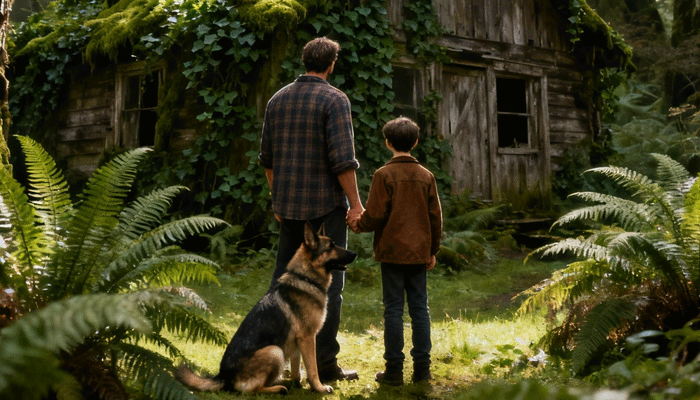
They Laughed When the Veteran Bought a Rotten $50 Cabin—Until His Dog Unearthed a Fortune No One Could Explain
When Luke Harlan bought the cabin for fifty dollars, the entire town of Bitter Creek, Montana, laughed like he had paid too much.
The laugh started in Earl Dempsey’s feed store, spread to the gas station by noon, and reached the Elk Horn Bar before dark. By the next morning, folks were telling the story like it was the funniest thing they had heard all year.
“Fifty bucks for that place?” old men said over coffee. “He should’ve charged them to haul it away.”
Some called it a shack. Some called it a coffin with windows. The county tax records called it “an uninhabitable rural structure of no commercial value.” The truth was uglier than all of it.
The cabin sat twelve miles outside town at the edge of a dead pine ridge, leaning slightly to the west as if it had been trying to lie down for thirty years. Its roof sagged in the middle. The porch had collapsed long ago. The chimney was split from top to bottom. Half the windows were broken, and the others were clouded white with age. In winter, snow drifted through cracks in the wall. In summer, wasps nested in the rafters. No power, no plumbing, no insulation. Just gray boards, rusted nails, and a smell inside like wet ash and old secrets.
Luke bought it anyway.
He bought it at a county auction held behind the courthouse on a bright, windy Saturday in April. There were tractors, seized tools, two wrecked pickups, and a lot of old farm equipment nobody wanted. The cabin wasn’t really sold as a house. It came with two scrubby acres and an easement road that was barely a road at all. The county wanted it off the books. Back taxes had stacked up for years after the last owner died without heirs anyone could find.Books & Literature
“Opening bid?” the auctioneer called.
Nobody said a word.
“Fifty?”
Luke raised a hand.
That was it.
Sold.
A few men clapped sarcastically. Someone whistled. Earl Dempsey shouted, “Congratulations, Luke. You’re the proud owner of raccoons, termites, and tetanus.”
Even Luke smiled at that.
He had heard worse.
He was forty-six years old, broad-shouldered, sun-burned, and quieter than most people liked. He walked with the faint stiffness of a man whose body remembered things he never talked about. Before Bitter Creek, before Montana, before the silence settled into him for good, he had been Sergeant Luke Harlan, United States Army, 75th Ranger Regiment. Afghanistan twice. Iraq once. Medals in a drawer. Shrapnel in his thigh. A scar under his ribs. A folded flag in a cedar box he never opened.
He lived alone except for the dog.
The dog’s name was Bandit, which had started as a joke when he was a puppy because of the black mask around his eyes. But over the years the name had become something else—something fitting. Bandit was a German Shepherd with a deep chest, torn left ear, and the alert, serious expression of a creature who had seen enough of men to trust only one. Luke had adopted him from a retired K-9 handler in Billings. According to the paperwork, Bandit had washed out late in law enforcement training after taking a bullet graze during a standoff and developing an aggressive distrust of strangers. According to Luke, Bandit was the smartest living thing in Montana.
Luke had not bought the cabin because he thought it was valuable.
He bought it because he was tired.
Tired of the trailer he rented on the south edge of town where the wind rattled the tin all night. Tired of hearing highway trucks in the dark. Tired of landlords. Tired of people asking careful questions with pity behind their eyes. Mostly he was tired of feeling temporary.
The cabin was falling apart, but the land around it was quiet. There was a spring down the slope, a stand of aspen beyond the ridge, and enough open sky to make a man feel like maybe he could breathe again. Fifty dollars for peace seemed like the first decent deal he had gotten in years.
He drove out there that Monday in his rusted Ford F-250 with Bandit riding shotgun, ears up, watching the road. The truck bounced hard over the ruts. When the cabin first appeared between the trees, Luke killed the engine and sat for a long moment.
Bandit made a low sound in his throat.
“Yeah,” Luke said. “I know.”
He got out and stood in the wind. The place looked even worse without the distance and courthouse laughter between them. Weather had worn the boards silver. One corner of the roof had caved in just enough to let in rain. The front door hung crooked.
But underneath the rot, Luke saw the lines of how it used to be. Hand-hewn beams. Fieldstone chimney. Deep foundation. Somebody had built it to last. Somebody had loved it once.
That was enough.
He worked all spring.
He tarped the roof first, then jacked the porch enough to replace the broken posts. He cleaned rat droppings by the shovel-full. He pulled out moldy mattresses, rusted stove parts, broken chairs, cracked Mason jars, and three truck beds’ worth of trash left behind by hunters, squatters, and kids who needed a place to drink unseen. Bandit followed him constantly, nosing corners, watching the woods, sleeping in the doorway like a sentry.
Every few days somebody from town would drive out just to gawk.
Sometimes it was Earl from the feed store, who always had to spit before he talked.
Sometimes it was Wade Morrow and his brother Clint, ranch hands with loud mouths and small souls, the kind of men who mistook cruelty for humor.
Once it was Sheriff Ron Bledsoe, who rolled down his window, looked at the place, and said, “You really plan on living out here?”Doors & Windows
Luke nodded.
Sheriff Bledsoe rested an elbow on the door and looked at him for a beat too long. “Just be careful. That ridge has a history.”
“What kind of history?”
“Bad luck.”
Then the sheriff drove away.
Luke did not ask more questions. In war, he had learned that men loved to call things bad luck when they did not want to explain them.
The work gave his days shape. That mattered. He rose before dawn, fed Bandit, drank black coffee from a thermos, and spent the daylight tearing away what had to go and saving what could be saved. At night, back in the trailer, his muscles shook with exhaustion. Sometimes he slept straight through. Sometimes he woke sweating from dreams full of dust, rotor wash, and voices he could not reach in time.
Bandit always woke before he did. Always sat beside the bed until Luke’s breathing slowed.
By June, the cabin had a patched roof, a door that shut, and one room clean enough to hold a cot, a camp stove, and a folding table. Luke moved in with a kerosene lantern, a cooler full of groceries, two duffel bags, and Bandit’s blanket.
That first night, wind moved through the pines like distant surf. The cabin creaked. Bandit lay by the door with his head on his paws. Luke sat in the lantern light and listened.
No highway.
No neighbors.
No sirens.
Nothing but the woods and the old boards settling around him.
He had not realized how badly he needed silence until it wrapped around him.
For three weeks, life was almost simple.
He worked mornings at Rawlins Auto Repair in town, where he fixed engines, replaced brakes, and spoke only when necessary. In the afternoons he came back up the ridge to work on the cabin. Bandit patrolled the property. They settled into a rhythm. Luke cleared brush, fixed shutters, and started digging a line to run water from the spring into a holding tank. He even caught himself planning—real planning, not just surviving the next week. Maybe a garden. Maybe chickens. Maybe a woodshop in the lean-to.
Then Bandit found the first sign.
It happened on a hot Thursday in July.
Luke was prying up rotten floorboards in what used to be the kitchen when Bandit, outside, started barking in a strange pattern—not the sharp warning bark he used for deer or passing trucks, but a hard, urgent bark that came in bursts. Luke dropped the pry bar and stepped outside.
Bandit stood at the back of the property near a patch of scrub and half-dead grass behind the cabin. His body was tense, front paws planted, nose down. He barked once more, then began scratching furiously at the ground.
“What is it?”
Bandit did not look up.
Luke crossed the yard. The soil there was odd—hard-packed in a shape that was almost rectangular under the weeds, as if something had once been buried and the earth never settled right. He crouched and brushed away loose dirt. Metal glinted for a second.
He frowned.
At first he thought it was an old barrel or junk sheet left underground. He fetched a shovel from the porch and started digging. Bandit kept circling, whining low in his throat.
A foot down, the shovel hit steel with a hollow clang.
Luke cleared more dirt. What emerged was the rusted lid of a large metal drum, sealed tight and buried flat. Army green, faded nearly to gray. No markings he could make out. He dug around the sides. The barrel had been intentionally hidden.
Luke sat back on his heels, sweat running down his neck.
Bandit stared at the drum like he expected it to move.
Luke’s first thought was not treasure. It was explosives.
Rural Montana had plenty of abandoned caches, old fuel dumps, illegal hunting gear, and the occasional ugly surprise left by paranoid men. He had seen enough things buried in enough countries to distrust any metal container found underground.
He backed away and thought it through.
No wires visible. No smell of fuel. The drum seemed too carefully sealed, too deliberately placed. He fetched a long iron bar, stood to one side, and carefully levered at the lid. Rust snapped. The seal gave with a wet sucking sound.
Nothing exploded.
Bandit barked once.
Luke stepped closer and lifted the lid the rest of the way.
Inside were bricks.
For half a second his brain did not understand what he was seeing. The barrel was packed full of rectangular bundles wrapped in yellowed plastic and old banking bands. Money. Stacks and stacks of money. He picked one up. Hundred-dollar bills. Old design. Dry and intact.
He stared.
There are moments when a man’s whole life seems to stop and pull tight around one impossible fact. Luke had one hand on the edge of a rusted barrel in the back dirt of a falling-down cabin he bought for fifty dollars, and he was holding more money than he had ever seen in one place outside a bank vault.
Bandit whined.
Luke swallowed hard and set the bundle back down.
He looked around the tree line instinctively, as if someone might be watching. The ridge was silent.
He did not touch anything else. Instead he stood up, wiped both hands on his jeans, and breathed slow until the pounding in his ears eased.
There were maybe forty bundles visible in the top layer alone. He did quick math and stopped himself before it ran too far. Whether it was fifty thousand or five million, one thing was already clear:
The money had been hidden on purpose.
Which meant someone once knew it was there.
Which meant someone else might still care.
He put the lid back on the drum, shoveled dirt over it, tamped the earth flat, and laid a rusted sheet of tin across the spot. Then he walked Bandit inside, shut the cabin door, sat in a chair, and tried to think like a soldier instead of a desperate man.
The sheriff was the lawful answer. Report the find. Let the county, the courts, and the federal government sort it out. Any honest person would do that.
But honest had not saved Luke much over the years. Honest had not saved men he served with. Honest had not stopped the bank from taking his brother’s farm after the medical bills. Honest had not stopped the VA from losing his paperwork twice. Honest had not kept strangers in bars from saying “thank you for your service” in the same tone they used to order another beer.
Still, this was not his money.
He knew that.
He also knew there were reasons to be careful before telling anyone.
Sheriff Bledsoe’s visit came back to him. That strange pause. That line about bad luck. And the way people in town joked about the cabin with something underneath the humor that felt like discomfort.
Luke lit the lantern as dusk fell.
Bandit paced.
The dog’s unease settled the question for him. Bandit trusted instincts more than men, and Luke had learned to respect that. He would not go to the sheriff. Not yet. First he would find out what the money was and why it had been buried there.Dogs
The next day after work, he drove to the Bitter Creek library, which occupied two rooms in an old brick building beside city hall. The librarian, Mrs. Dolores Finch, was in her seventies, wore cat-eye glasses on a chain, and knew everyone’s business while pretending not to.
“Well,” she said when Luke walked in, “to what do I owe this rare honor?”
“I need local history.”
“That’s broad.”
“The cabin on Black Pine Ridge. Used to belong to somebody. I want records.”
Her expression changed just slightly. “Harlan place, is it?”
“It’s mine now.”
“I know. This town talks too much.” She lowered her voice. “You’ll want the newspaper archives. Property records are at the county office, but the old papers will tell you more than official records ever do.”
She led him to a back room with bound volumes and microfilm. For two hours Luke dug through articles about logging claims, weather damage, hunting accidents, and land disputes. The cabin had once belonged to a man named Walter Kessler, a trapper and sometime prospector who built it in 1958. Kessler lived there alone for nearly twenty years. Then, in 1979, he vanished.
No body was ever found.
The article about his disappearance was short: local eccentric missing from remote property, possible exposure, no foul play suspected.
But another article, dated three months later, caught Luke’s eye.
REGIONAL BANK ROBBED IN HELENA: $5.2 MILLION MISSING
The amount made his pulse jump.
He read every line. A private bank transport linked to Granite State Trust had been ambushed outside Helena by three armed men. One guard killed, two wounded. The robbers disappeared with cash intended for multiple institutions across western Montana. Two suspects were later found dead in an abandoned vehicle near Missoula. The third vanished with the money. Authorities believed he may have crossed into Canada. Case unsolved.
Luke read it twice.
Then he searched the following weeks of papers until he found a name buried in a later report: one of the suspected robbers had ties to Bitter Creek through a cousin who owned land near Black Pine Ridge.
The cousin’s name was Walter Kessler.
Luke sat back slowly.
There it was. Not proof, but a trail.
He copied dates and names into a small notebook. Mrs. Finch looked over the desk when he returned the reels.
“Find your ghost?” she asked.
“Maybe.”
Her mouth tightened. “Just remember, some stories stayed buried around here because people wanted them that way.”
“Who?”
“People who were around then. People with influence now.” She glanced toward the front windows. “You didn’t hear that from me.”
Outside, the summer sun was still high, but Luke felt cold.
He drove back to the cabin by the long route, checking mirrors more than once. Nobody seemed to follow him.
That night he dug up the barrel again after dark and counted enough visible bundles to know one thing with certainty: if the bills were real, the amount could indeed be around five million dollars.
Bandit stood sentry at the tree line while Luke examined one bundle with a flashlight. The band was brittle. The bills smelled faintly of old paper and oil. He checked serial numbers from a few notes against nothing at all—just because his hands needed to do something.
He found a second drum three feet away.
Then a third.
By midnight his shirt was soaked through, his back ached, and the truth lay open before him in three rusted barrels hidden behind a ruined cabin no one wanted.
Five million dollars.
Maybe more.
He covered them again before dawn.
Over the next week, the world around him changed, though outwardly nothing had changed at all. Bitter Creek still sold bait and diesel and cheap beer. Trucks still rolled down Main Street. Earl still leaned in the feed store doorway talking loud enough for everyone to hear. But Luke began noticing things he had not before.
Sheriff Bledsoe started passing the auto shop more often.
Clint Morrow showed up one afternoon pretending he needed a fan belt and spent ten minutes asking Luke whether he had “found anything interesting” up at the old cabin.
Wade Morrow drove slowly by the ridge road twice in one evening.
Maybe it meant nothing. Or maybe word had gotten around that Luke was digging and repairing and disturbing ground no one had touched in decades. In a town that small, privacy was a rumor.
Then someone broke into the cabin.
Luke and Bandit had gone into town for lumber and fencing wire. They were gone less than three hours. When the truck bounced back up the ridge, Bandit went rigid before they even reached the clearing.
The front door stood open.
Luke killed the engine, grabbed the .45 he kept under the seat, and stepped out. Bandit moved ahead low and silent.
Inside, drawers had been yanked open. The cot was overturned. Floorboards Luke had stacked neatly were scattered. Someone had slashed open feed sacks, dumped nails, kicked over the lantern, and ripped through both duffel bags. They had searched everything.
Not thieves looking for electronics or tools.
Someone hunting.
Bandit sniffed fast, then went to the back window and growled.Doors & Windows
Luke checked the property. Boot prints in the dirt. Two men, maybe three. One set was heavy with a heel drag. Another had a distinctive star pattern on the sole. They had gone behind the cabin and churned up the ground not fifteen feet from the barrels. But they had not found the exact spot.
Luke stood in the ruined doorway with anger rising hot and clean through him. It was the kind of anger he trusted, because it burned away fear and left only choices.
That night he did not sleep.
He moved the barrels.
Alone, with a hand truck, pry bar, tarps, and more stubbornness than sense, he hauled them one by one through the trees to an old storm cellar he had found under brush a hundred yards uphill. The cellar door was rotted, but the stone walls were sound and the pit stayed cool and dry. He dragged the barrels inside, covered them with canvas, stacked scrap lumber and rusted tools over them, then reset the brush across the entrance.
By dawn, the ground behind the cabin looked empty again.
The next morning he drove to Helena on his day off and visited a retired FBI agent named Frank Delaney whose name he found in an old article about the robbery case. Delaney now lived in a small yellow house with a flag out front and a bad knee that made him open the door slowly.
When Luke introduced himself and mentioned the old Granite State robbery, the old man’s face shut down.
“That was a lifetime ago.”
“I think I found something connected to it.”
Delaney looked at him for a long time, then stepped aside. “You’d better come in.”
Frank Delaney was seventy-eight, sharp-eyed, and far less retired in his mind than in his paperwork. Luke told him almost everything—about the cabin, Kessler, the barrels, and the money—but not the exact location of the cellar. Delaney listened without interrupting, then leaned back in his chair.
“If you’re right,” he said, “that money’s part of the Helena transport robbery. We always believed the third man doubled back west instead of north. Could never prove it.”
“Who was he?”
“Name was Calvin Rourke. Smart, disciplined, Army vet himself. That’s what made him dangerous. Not a common thug. He had family ties around Bitter Creek through Kessler. We suspected Kessler helped hide him or the cash. Then Kessler vanished, and every lead died.”Family
“Why didn’t local law ever push harder?”
Delaney gave a dry laugh. “Because local law back then was Sheriff Amos Bledsoe.”
Luke caught the name instantly. “Ron Bledsoe’s father.”
“Exactly.” Delaney’s expression darkened. “Amos fought us at every step. Claimed we were harassing local citizens. Lost reports. Misplaced evidence. By the time we got warrants where we needed them, the trail was cold.”
“You think he was involved?”
“I think he knew more than he admitted. Maybe a lot more.” Delaney leaned forward. “Listen to me carefully. If the current sheriff is anything like his old man, do not hand this over blindly. Official channels are the right channels only when the officials are clean.”
Luke felt something settle into place.
“What do I do?”
“Document everything. Photograph the barrels, the bills, serial numbers, the property, all of it. And contact the state attorney general or the FBI field office directly—not through Bitter Creek.” Delaney paused. “But be ready. Money like that has gravity. It pulls out greed from everyone nearby.”
Luke thanked him and left with Delaney’s private number in his pocket.
He should have gone straight to federal authorities then.
Maybe later, he would wish he had.
But the road back to Bitter Creek was long, and halfway through it he saw a black pickup in his rearview mirror that stayed with him for twenty miles. When he pulled into a gas station, it drove on without stopping.
He read the plate anyway.
It belonged to the sheriff’s department.
That night Luke did what Delaney said. He photographed everything in the cellar, recorded serial numbers, and wrote down every date he could reconstruct. Then he sealed a copy of the evidence in a metal ammo can and buried it under a marked rock half a mile from the cabin. In war, redundancy kept people alive.
The confrontation came sooner than he expected.
Two nights later, just after sundown, Bandit let out a deep, explosive bark that snapped Luke upright from the table where he was eating beans from a tin bowl. Headlights washed across the wall through the cracks.
Luke blew out the lantern and moved to the window.Doors & Windows
Sheriff Bledsoe’s SUV rolled into the clearing, followed by Wade Morrow’s truck. Clint sat in the passenger seat. Three men got out.
No warrant.
No pretense.
Bandit’s fur stood up like a brushfire.
Luke opened the door before they could knock. “Evening.”
Sheriff Bledsoe kept one hand near his belt. “Got a report of suspicious activity out here.”
“At my house?”
“Your place sits on county interest land connected to an old investigation.”
“That sounds vague.”
Wade smirked. “You been digging a lot, Luke.”
Luke did not look at him. “Problem?”
Sheriff Bledsoe took a slow step forward. “Maybe. We hear you found something that doesn’t belong to you.”
Luke said nothing.
The sheriff read silence as confirmation. “Best thing for you is to cooperate.”
“With what?”
“Turning over whatever you found.”
“Do you have a warrant?”
Bledsoe’s jaw tightened. “Don’t make this difficult.”
Bandit moved onto the porch beside Luke, head low, teeth barely visible.
Clint muttered, “That dog oughta be put down.”Dogs
Luke’s eyes shifted to him once, and Clint looked away.
“I’ll say it again,” Luke said. “Do you have a warrant?”
“No,” Bledsoe said. “But I can get one.”
“Then get one.”
For a second it looked like Wade might charge the porch just to prove he could. Then Bandit let out a growl so deep it seemed to rise from the earth itself.
Sheriff Bledsoe lifted a hand slightly, keeping his men back. “You don’t understand what you’re in the middle of.”
“Then explain it.”
The sheriff’s face hardened. “My father kept order in this county when outsiders came sniffing around trying to pin things on good men. Some money went missing a long time ago. The kind of money that ruins families, towns, lives. If you found some remnant of that mess, it should stay local.”
“Stay local,” Luke repeated.
“You’re not from here,” Wade said. “You don’t get to walk in and cash in on history.”
There it was. Greed wearing the costume of loyalty.
Luke crossed his arms. “Come back with a warrant.”
The sheriff stared at him another moment, then nodded once. “Fine.”
They turned to leave.
At the SUV, Bledsoe looked back. “One more thing. If that dog attacks an officer, I’ll shoot him.”
Luke’s face did not move. “Then you better not trespass again.”
After they drove off, Luke locked the door, loaded the shotgun, and sat through the night with Bandit at his feet. Around 2 a.m., he made the call to Frank Delaney.
By sunrise, Delaney had contacted someone he still knew in the FBI field office at Billings.
By noon, Luke drove there with the evidence cache in the truck.
He did not tell anyone in Bitter Creek where he was going.
The agents who met him were younger than he expected and far more interested than skeptical once they saw the photos and serial numbers. Several notes matched stolen currency records preserved from the original case. Not all of them—they would need time to verify the rest—but enough to establish a probable connection.
The lead agent, a woman named Miriam Voss, listened with her hands folded and eyes intent.
“You understand,” she said, “that this becomes federal evidence now.”
“I understand.”
“And ownership won’t be simple. If it’s stolen bank property, there’ll be claims, forfeiture issues, maybe reward provisions depending on statutes and recovery circumstances.”
“I didn’t come here for a payday.”
She studied him a second. “Most people say that.”
“I’m not most people.”
Something in his tone must have convinced her. She gave a small nod. “All right. We move carefully. If the sheriff’s department is compromised, we don’t alert them until we’re ready.”
“How ready?”
“Ready enough to keep you alive.”
The plan was simple. Too simple, Luke thought, which usually meant dangerous.
Federal agents would come to Bitter Creek quietly under the cover of a land records review. Luke would stay at the cabin as normal. If Bledsoe or the Morrows made a move before the warrant package was ready, Luke was to call immediately and stall.
He returned to the ridge by late afternoon.
Bandit met him at the truck and searched his face before relaxing.
“You and me,” Luke said, scratching behind the dog’s ear, “we may have stepped in it.”Dogs
The next forty-eight hours stretched long and sharp.
Every engine on the road made Luke look up.
Every distant truck light felt wrong.
Bandit barely slept.
On the second night, the attack came.
It was close to midnight when Bandit exploded from dead sleep into savage barking. Luke rolled from the cot and reached for the shotgun just as the back window shattered inward. Glass sprayed across the floor. A bottle with a rag wick skidded across the boards trailing fire.Doors & Windows
Molotov.
Luke kicked it back out through the broken frame as it burst. Flames whooshed up the siding outside.
Then gunfire ripped through the dark.
The cabin wall splintered beside him. Bandit lunged toward the rear door. Luke grabbed the dog’s collar with one hand and fired once through the window line with the shotgun. A man shouted outside.
Another bottle crashed against the front porch and ignited.
Smoke filled the room almost instantly.
Luke made his choice in less than a second. Staying meant burning or getting pinned. He yanked open the trapdoor he had uncovered beneath old rugs during renovation—a shallow crawl access leading under the front half of the cabin—and shoved Bandit down first. Then he dropped in after him with the shotgun and dragged the hatch nearly shut above them.
Heat roared overhead.
Through gaps in the boards he saw boots moving, heard men shouting. Wade’s voice. Maybe Clint’s. One of them yelled, “Get around back!”
Bandit strained, growling with killing force.
“Easy,” Luke whispered, though his own heart felt like a hammer.
They crawled through dirt and spider webs toward the front edge where the foundation stones had shifted, leaving a gap barely wide enough. Luke pushed Bandit through, then wriggled after him into the night air on the downhill side of the cabin, hidden by smoke.
The cabin’s north wall was burning now.
Two figures moved near the trucks with weapons in hand. A third man stood by the porch, half-lit by flame. Sheriff Bledsoe.
Luke’s mouth went dry with a calm so complete it terrified him.
He slipped through the brush with Bandit at heel until he reached the shadow of the woods twenty yards away. From there he had a clean angle on the porch. He raised the shotgun.
“Federal agents are on their way!” he shouted.
All three men jerked.
Bledsoe swung around. “He’s in the trees!”
Luke fired low, blasting the dirt at Wade’s feet. Wade screamed and stumbled backward. Bandit shot forward before Luke could stop him, a dark shape arrowing through smoke straight at Clint Morrow, who had raised a pistol toward the woods.
Bandit hit him chest-high.
The gun flew.
Clint went down hard, howling, arms flailing as the dog locked onto his forearm.Dogs
Wade turned and fired wildly. Luke dropped behind a stump and returned fire. Splinters flew off the truck’s fender. Sheriff Bledsoe shouted, “Move! Move!”
Then red and blue lights flashed on the ridge road.
Too many.
Not county.
Unmarked SUVs came fast through the clearing, tires spraying gravel. Men and women in vests poured out shouting commands. “FBI! Drop your weapons!”
Everything broke at once.
Wade ran for the woods and got tackled before he made five steps.
Sheriff Bledsoe froze, then slowly lowered his gun.
Clint kept screaming until an agent kicked the pistol away and Luke whistled Bandit off. The dog released instantly and returned to Luke, blood on his muzzle and chest heaving but eyes locked for the next command.
The cabin crackled and burned behind them, roof sagging inward in sparks.
Agent Miriam Voss stepped from the smoke with her sidearm trained on Bledsoe. “Sheriff Ronald Bledsoe,” she said, voice flat as steel, “you are under arrest for conspiracy, attempted murder, obstruction of justice, and evidence tampering pending additional charges.”
Bledsoe stared at her with an expression that was almost offended. “You have no idea what that money was tied to.”
“Oh, I think we do,” she said.
Luke stood in the firelight with one hand on Bandit’s neck and watched the only home he had built for himself in years collapse into flame.
He felt strangely empty.
Then Miriam Voss walked over and said, “The cellar’s secure. Your evidence held.”
Luke nodded once. “Good.”
“Are you hit?”
“No.”
She looked at the burning cabin, then back at him. “I’m sorry.”
He glanced down at Bandit. “Could’ve been worse.”
By dawn, the ridge swarmed with federal personnel, state investigators, and crime scene teams. The barrels were recovered under armed supervision. The money was counted, logged, photographed, and packed. The total came to just over $5 million in surviving currency, with some damaged loss accounting for the difference from the original robbery amount.
Over the next month, the rest of the story came loose piece by piece.
Calvin Rourke, the surviving robber, had indeed fled west after the Helena ambush in 1979. He hid at Walter Kessler’s cabin because Kessler was his cousin and because Black Pine Ridge was the kind of place men vanished into even when they were not trying. But Rourke never got the chance to retrieve the money. According to records and later testimony, Amos Bledsoe—then sheriff—learned where Rourke was hiding through an informant. Rather than arrest him cleanly, Bledsoe struck a deal.
Rourke would bury the money temporarily on Kessler’s land and split it later.
Only Bledsoe decided later was too long.
What happened next was never reconstructed perfectly, but evidence suggested Amos Bledsoe confronted Rourke and Kessler at the cabin. Shots were fired. Rourke disappeared for good. Kessler vanished soon after. Their bodies were never found, though investigators reopened searches in old wells and ravines across the ridge. Amos Bledsoe publicly declared the matter dead and quietly waited for the heat to pass. But before he could safely recover the money, a wildfire season, a broken bridge road, and perhaps sheer paranoia kept delaying him. Then age and illness took over. He died without reclaiming the barrels.
He did, however, pass the story to his son.
Sheriff Ron Bledsoe grew up believing the hidden cash was not stolen evidence but family inheritance denied by bad timing and nosy outsiders. Wade and Clint Morrow—his cousins on his mother’s side—became muscle around the secret. They watched the ridge for years whenever rumors stirred. When Luke bought the cabin and started digging, panic set in. First they tried intimidation. Then burglary. Then arson and murder.Family
Bitter Creek was stunned.
Some people claimed they always suspected the Bledsoes were crooked. Most had not. That was the way of small towns: people preferred the familiar rot they understood to the truth they didn’t.
Mrs. Finch from the library sent Luke a handwritten note that read, I knew the ridge was cursed, but it appears it was only occupied by cowards.
Earl Dempsey showed up in Helena one afternoon while Luke was giving a formal statement and stood awkwardly in the hallway holding a paper bag.
“Brought pie,” Earl said. “Peach. My wife made it.”
Luke looked at him. “Why?”
Earl shifted his boots. “Because we laughed. Because you almost got killed. Because your dog’s braver than most men I know.” He paused. “Also because I figured a pie can say things a man can’t.”Dogs
Luke took the bag. “Tell your wife thanks.”
“Town’s talking different now,” Earl said quietly. “About you.”
Luke almost smiled. “Town always talks.”
The legal process dragged, as legal processes do, but several facts emerged clearly enough.
The recovered money belonged to institutions long since absorbed, liquidated, or insured into corporate history. Federal law complicated who could claim what. Insurance companies argued. Successor banks argued. Government lawyers argued harder. But Luke’s role as the reporting discoverer, combined with his documented cooperation and life-threatening assistance in exposing an active criminal conspiracy, made reward considerations not only possible but politically attractive.
Frank Delaney called it “the first time paperwork ever did a decent thing.”
Months later, Luke received official notice that after restitution settlements, litigation agreements, and a negotiated federal reward allocation, he would receive a lawful recovery award large enough to change his life forever. Not five million. Not even close.
But enough.
More money than he had ever imagined owning honestly.
He sat on a bench outside the federal building in Billings and read the letter three times while Bandit lay at his feet. Autumn wind moved through yellow cottonwoods. Traffic hissed on wet pavement.
He should have felt triumphant.
Instead he felt quiet.
All that blood. All those years. Men killing men over stacks of paper buried in dirt.
He looked down at Bandit. “You know what? I think we did all right anyway.”
Bandit thumped his tail once.
Winter came early that year, sharp and white. Luke did not go back to the burned cabin right away. The ridge needed time, and so did he. The government cleared the crime scene and released the land back to him after the investigations were done, but by then snow had buried the blackened remains under a clean layer that made everything look gentler than it was.
One gray morning in November, he drove up there with Bandit and stood in the silence. The cabin was gone, reduced to a stone chimney, twisted nails, and a rectangle of ash under the frost. The pines stood around it unchanged, as if human greed had been just another weather event passing through.
Luke walked to the spot where the porch had been.
Bandit pressed against his leg.
“Still ours,” Luke said.
He had choices now. More choices than he had known what to do with. He could buy a nice place near town, easy road access, modern plumbing, no ghosts. He could leave Bitter Creek entirely. Start over in Idaho, Wyoming, Texas—somewhere no one knew his name or the story.
Instead, by Christmas, he hired a builder.
Not to restore the old cabin. That was gone.
To build a new one on the same foundation line, using salvaged stone from the chimney and beams from the original structure where they could be saved. Solid roof. Proper insulation. Big windows facing east. Wood stove. Running water. Mudroom. A wide porch for coffee in the mornings. A dog door built into the side entrance because Bandit had earned every privilege a dog could have.Dogs
When the first trucks rolled up with lumber, Wade Morrow’s trial was underway in Helena. Clint had taken a plea deal. Sheriff Bledsoe, pale and suddenly older, sat in a courtroom under federal custody while prosecutors laid out forty years of lies across charts and exhibits for the public record.
Bitter Creek stopped laughing.
People waved differently now when Luke drove through town. Some with admiration. Some with embarrassment. Some with the uneasy caution reserved for a man who had stared down corrupt power and lived.
Luke did not ask for any of that. But he accepted one thing it brought.
Distance.
Nobody came up the ridge uninvited anymore.
By spring, the new cabin stood finished.
It was not fancy. Luke did not want fancy. It was strong, clean, and built to last. The porch wrapped around the front. The kitchen had pine cabinets and a cast-iron sink. The living room held two chairs, a bookshelf, a rug, and the same folding table he had once used in the old place, now sanded and stained smooth. Over the mantle sat no medals, no framed service photographs. Just a small black-and-white print of the original cabin before the fire, and beneath it, a brass tag that read:
FOUNDATIONS MATTER
Bandit claimed the porch as his command post on day one.
That summer, Luke planted a garden.
Tomatoes, beans, squash, peppers. Simple things. Good things.
He fenced a patch for chickens and learned quickly that Bandit considered them idiots but part of the family. He built a workshop behind the cabin and started taking in custom restoration projects from people who could afford to pay. He slept better. Not perfectly. Some nights still came hard. But more mornings arrived without dread.Family
One evening in late August, Frank Delaney drove out from Helena in a rattling Buick to see the finished place. He stepped out stiffly, looked around the ridge, and whistled low.
“Well,” he said, “that’ll do.”
Luke handed him a beer. They sat on the porch while sunset washed the hills gold. Bandit lay stretched across the boards like a lion at rest.
Delaney took a long sip. “You know, most men who stumble into fortune lose themselves before the dust settles.”
“I didn’t stumble,” Luke said. “He found it.” He nodded at Bandit.
Delaney chuckled. “Fair point.”
They sat in silence a while.
Then Delaney said, “You ever think about what would’ve happened if you’d sold the place cheap after everybody mocked you?”
“Sometimes.”
“And?”
Luke looked out over the ridge. “Somebody else would’ve dug there. Somebody worse.”
Delaney nodded. “Maybe.”
A few days later, a local paper ran a feature on the new cabin and the recovered robbery money. Luke almost refused the interview, but the reporter—young, respectful, smart enough not to ask stupid combat questions—convinced him it might help close the story right.
The article ended with a line that the whole state quoted for a week:
A dog’s instinct uncovered what greed hid, and a veteran’s conscience finished what law abandoned.Dogs
Luke hated the sentence. It sounded like a movie poster.
Bandit, however, enjoyed the extra beef jerky people brought him in town after the article ran, so Luke let it stand.
The last loose thread came in October.
A state search team, following new testimony from Clint Morrow and old property maps, found human remains in a dry ravine a mile north of the ridge. Dental records confirmed one was Walter Kessler. The other, heavily degraded, could not be identified with certainty but was widely believed to be Calvin Rourke.
Luke attended Kessler’s small memorial at the county chapel even though no one asked him to. There were only nine people there, including Mrs. Finch, Earl Dempsey, and a second cousin from Spokane who had never met Walter but said family ought to mean somebody shows up.Family
The pastor spoke about loneliness, unfinished truths, and the dignity owed to the dead.
Afterward, outside in the cold, Mrs. Finch touched Luke’s sleeve.
“You gave that old man his name back,” she said.
Luke looked toward the hills. “Took long enough.”
That night he returned to the cabin, built a fire, and sat on the porch steps after dark with Bandit beside him. Stars burned above the ridge in fierce, clean numbers. The world smelled of pine and smoke and distant snow.
“Funny thing,” Luke said softly. “I thought buying this place was the kind of mistake a man makes when he’s given up.”
Bandit leaned against his knee.
Luke scratched the dog’s neck. “Maybe it was the first good decision I made in years.”
The dog huffed, as if that had been obvious from the start.
Years later, people in Montana still told the story.
They told it badly, mostly.
In some versions, Luke was a Navy SEAL, not an Army Ranger. In others, the cabin cost one dollar, not fifty. Some said the dog was part wolf. Others swore the money was gold, not cash. The amount went from five million to ten, then to twenty, as stories do when truth passes through enough barrooms.
Luke never bothered correcting anyone unless they got Bandit’s name wrong.
That part mattered.
Because in the only version Luke cared about, the truth was simple.
A tired veteran bought a wreck of a cabin because it was all he could afford and all the peace he could find.
People laughed.
His dog found something buried in the dirt that greed, murder, and corruption had hidden for decades.Dogs
And in the end, what saved the man was not the money.
It was that he chose not to become the kind of man the money had buried.
On the first snow of Bandit’s twelfth year, Luke opened the front door at dawn and the dog trotted onto the porch, muzzle graying now, gait a little slower but still proud. The ridge lay white and quiet around them. Smoke rose straight from the chimney into the pale winter sky.
Luke stood in the doorway with coffee warming his hands.
Bandit looked back once, just once, with those old dark eyes that had seen him through fire, fear, and the buried weight of history.
Then the dog went down the steps to inspect his kingdom.
Luke smiled and followed.
THE END