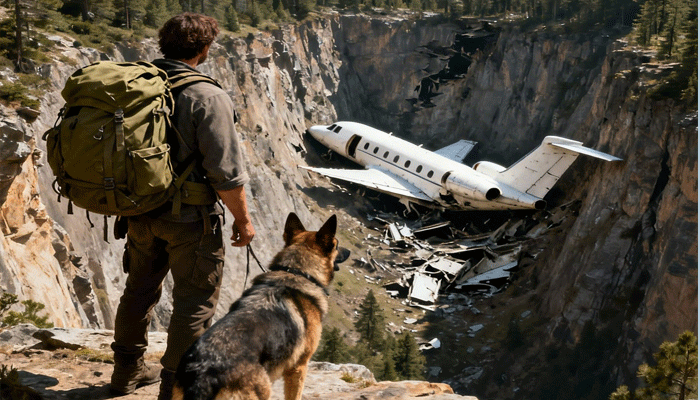
A Retired Navy SEAL Found a Crashed Jet in Montana—Then His Dog Unearthed the Secret They Killed For
By the time Logan Mercer saw the smoke, the sun had barely climbed over the Bitterroot Range.
It was that thin blue-gray kind of smoke that did not belong in a Montana winter morning. Not woodstove smoke. Not a rancher burning brush. This was oily, chemical, wrong. It cut a dark ribbon through the clean white air above the pines and rose from somewhere deep in the timber west of Lost Horse Creek.
Logan stopped halfway up the ridge and narrowed his eyes.
Beside him, Ranger froze too.
The Belgian Malinois stood with one paw lifted, ears forward, body stiff as carved oak. At twelve years old, Ranger had gone gray around the muzzle, and there was a scar along his ribs from a mission in Syria Logan still dreamed about more nights than he admitted. Age had slowed the dog some, but it had not dulled what made him dangerous. Ranger’s nose still worked. His instincts still worked. And when Ranger stared at something, Logan had learned a long time ago not to question it.
“Yeah,” Logan muttered, adjusting the sling on his rifle. “I see it.”
The mountain wind sliced through his coat. Snow creaked under his boots. Somewhere lower in the trees, a creek moved beneath a lid of ice with the soft, buried sound of running glass.
Logan had not come out that morning looking for trouble. He had told himself it was just another conditioning hike, another excuse to keep his body moving and his mind from drifting into places he hated. He lived alone in a cabin outside Darby now, did odd jobs for ranchers, volunteered with county search and rescue when they needed him, and tried not to think too hard about the twenty years he had spent in a different life.
But trouble had a way of finding men who used to go looking for it.
Ranger let out a low, sharp huff and pulled toward the smoke.
Logan looked at the sky, gauging weather by habit. High clouds. Wind from the northwest. Snow later, maybe heavy by afternoon. He pulled a satellite phone from his pack, checked for a signal, and got nothing useful. The canyon walls out here swallowed reception whole.
He slipped the phone back into the pack and gave the dog a nod.
“Let’s move.”
They cut off the trail and dropped through thick lodgepole pine, weaving around deadfall and granite shelves glazed with old snow. The air changed as they descended. The clean scent of sap and ice gave way to burned metal and jet fuel. Ranger moved faster, nose down now, muscles bunching under his coat. Logan followed, quiet and deliberate, his breathing steady, boots placed carefully. Old habits. Noise discipline. Eyes always scanning.
Ten minutes later he saw the first shard of wreckage.
It hung from a broken fir branch thirty feet up, a jagged strip of white-painted metal with a charred edge that still smoked. Another fifty yards down the slope he found insulation, wiring, a seat cushion torn open like an animal carcass. The forest floor looked as if a giant hand had raked the mountainside with claws of fire.
Then the trees opened.
The jet lay in a narrow bowl of snow and rock below him, broken across the middle.
It was a midsize private aircraft, or had been. The tail section had sheared off and lodged against a stand of pines. The fuselage had plowed through the basin, carving a long black scar in the snow before slamming to a stop against a granite outcrop. One wing was gone. The other was twisted upward at a grotesque angle. Flames still licked from the front section where fuel burned in bursts and hissed against the ice.
Logan crouched behind a boulder and studied the scene.
No movement. No voices. No sirens. Just the hiss of fire and the wind worrying smoke through the trees.
Ranger’s hackles lifted.
Logan saw it too: boot prints in the snow.
Fresh.
At least one person had walked away from the crash.
He moved lower, keeping cover between himself and the wreck. As he closed the distance, the details sharpened. The nose had been obliterated. The cockpit was a crushed black ruin. The cabin was partly exposed, torn open so he could see leather seats, burst overhead compartments, streaks of blood against cream-colored interior paneling.
The side of the aircraft bore no company logo, only a scorched tail number he could barely make out beneath soot and shredded paint. A Gulfstream, maybe. Expensive. The kind of plane men used when they did not want crowds, delays, or too many questions.
Logan unslung his rifle and advanced.
The first body was twenty feet from the fuselage, sprawled face down in the snow. Male, mid-thirties, tactical haircut, broad shoulders. Dressed too lightly for the mountains but too heavily for a normal passenger: expensive jacket, concealed-carry holster, body armor under the shirt. Logan rolled him with his boot.
Entry wound in the neck. Not from the crash.
Gunfight, Logan thought.
He checked the man’s pulse anyway. Nothing.
Ranger circled wide, nose working. The dog did not go to the corpse. He went to the torn cabin and stopped at the opening, head angled, tail rigid.
“Hold.”
Logan swept the cabin with his eyes, then climbed inside.
The smell hit him hard—burned plastic, blood, fuel, hot metal, and something sweeter underneath that he had smelled on battlefields and disaster sites and never once gotten used to.
Three more bodies.
Pilot in what remained of the cockpit, impossible to help.
A woman in a tailored black suit slumped across a seat, chest crushed by collapsed paneling.
Another man in tactical gear half in the aisle, one hand still wrapped around a pistol. Logan removed the weapon and checked the chamber. Empty.
He looked around the cabin again.
Something felt off.
Not just the obvious violence. Not just the missing survivor. There was an absence here, a shape in the story that had not shown itself yet.
He crouched by the dead gunman and studied the floor. Expensive carpeting, streaked with soot. Broken glass. Blood. One spent shell casing lodged near the seat rail. Another under a briefcase. The angle of impact marks on the interior wall suggested shots fired from the rear of the cabin toward the front.
The man in the aisle had not been shooting out. He had been shooting in.
Ranger barked once.
Logan turned.
The dog had wedged himself into the back of the cabin near the luggage bulkhead, scratching furiously at a warped panel beneath the rear jumpseat.
“What do you have?”
Ranger scratched again, then looked back with urgent dark eyes.
Logan moved to him and grabbed the panel. It did not budge. He put his shoulder into it and felt resistance from bent metal. He drew his knife, jammed it into a seam, and pried. The panel gave with a shriek.
Behind it was not wiring or storage.
It was a hidden compartment.
Small. Insulated. Custom-built.
And inside, curled tight against the wall like a trapped animal, was a girl.
For one stunned second Logan only stared.
She could not have been older than thirteen. Dark blond hair matted with blood at the temple. Gray sweatshirt. Jeans. Barely visible beneath a silver emergency blanket. Her wrists were zip-tied in front of her, though the ties had been partly cut against some sharp edge. A backpack was clutched to her chest with white-knuckled desperation. Her eyes were open—huge, frightened, far too alert for somebody who had just survived a plane crash.
Ranger let out a soft whine and lowered his head.
The girl flinched.
“It’s okay,” Logan said immediately, forcing his voice down into the calm, flat tone he had used with hostages and terrified civilians in places half a world away. “You’re okay. I’m not with them.”
Her lips parted, but no sound came out.
Logan carefully set the rifle aside, showed her his empty hands, and crouched lower. “My name is Logan. This is Ranger. We’re here to help.”
She looked at the dog first.
Something in Ranger’s posture changed. The hard alertness melted. He lay down in the aisle, ears back, tail still. Not submissive—gentle. An old working dog offering the one thing he knew frightened humans needed most.
Permission.
The girl swallowed. Her voice came out hoarse. “Is… is he dead?”
“Who?”
“The man with the silver ring.”
Logan’s eyes narrowed. “I don’t know yet.”
Her breath hitched. “He was shooting. Then the plane—” She squeezed her eyes shut as if holding back a scream. “I thought I was gonna burn.”
“You didn’t.” Logan reached into his medical kit. “I need to get you out of there and check you over. Can you move?”
She nodded once.
He cut the zip ties, then carefully lifted her out of the compartment. She was lighter than she should have been and shivering hard. Shock. Maybe mild concussion. He sat her on the least damaged seat, draped a thermal blanket around her shoulders, and checked her pupils with a penlight.
“What’s your name?”
She hesitated. “Sadie.”
“Sadie what?”
A pause. “Calloway.”
“Okay, Sadie. You with anybody on this plane?”
Her fingers tightened on the backpack. “No.”
“You kidnapped?”
She looked away.
That was answer enough.
Before Logan could ask more, Ranger sprang to his feet and faced the torn opening in the fuselage. A growl rolled out of him, deep and lethal.
Someone was outside.
Logan grabbed his rifle, killed the light, and pushed Sadie down between the seats.
“Do not move,” he whispered.
A shadow crossed the snow outside.
Then a voice called out through the smoke, smooth and male and close enough to raise the hairs on Logan’s neck.
“I know somebody’s in there.”
No local accent. Controlled. Professional.
“I’m injured,” the voice continued. “I’m unarmed. If you’re a hunter or rescue, I could use a hand.”
Logan stayed silent.
Ranger’s growl deepened.
The voice waited a beat, then changed just a little—less wounded now, more calculating.
“You found the girl, didn’t you?”
That answered all Logan needed.
He eased to the edge of the torn fuselage and stole a look.
The man stood thirty yards away near a cluster of boulders, half hidden by smoke. Mid-forties. Tall. Athletic. Dark winter coat over what looked like tactical gear. One sleeve stained with blood. A pistol in his right hand, held low but ready. On his left hand, even from that distance, Logan saw a flash of silver.
A ring.
The man smiled without warmth. “That child doesn’t belong to you.”
Logan raised his rifle and said, “Neither does this mountain.”
The man’s expression sharpened.
Then he fired.
The shot punched through the fuselage where Logan’s head had been a half second earlier. Logan returned two quick rounds through the smoke, not to kill but to move him. The man ducked behind granite. Ranger lunged toward the opening, barking now, every muscle alive with violence.
“Back!”
The dog stopped on command but trembled with effort.
Outside, silence.
Logan counted seconds.
Ten.
Fifteen.
No second shot.
He risked another glance and saw only snow swirling through drifting smoke. The man had repositioned or withdrawn. Neither option made Logan feel any better.
He turned back to Sadie.
She was pale, breathing fast, but steady enough to speak.
“Was that him?” Logan asked.
She nodded.
“Name?”
She stared at him as if deciding whether he was a man worth trusting with the truth. Maybe she saw the old scars across his knuckles. Maybe she saw Ranger planted between them like a furry promise. Maybe she was just out of lies.
“Gideon Voss,” she whispered.
Logan had never heard the name, but he filed it away.
“Why was he after you?”
She shook her head.
“Sadie.”
Her eyes filled suddenly, but she did not cry. “My mom said if anything happened, I was supposed to keep my mouth shut until I found somebody decent.”
Logan almost laughed at the wording. Somebody decent. That was one he had not heard applied to himself in a while.
“Your mom sounds smart.”
“She was.”
Was.
He caught that too.
Outside, wind pushed smoke flat against the snow. The light had shifted. Storm coming faster than expected.
They could not stay.
Logan did a rapid search of the cabin. He found a dead man’s satellite phone smashed beyond use, two spare magazines, a compact med kit, and a document pouch scorched at the edges. In the rear galley he found bottled water and a box of high-calorie emergency bars. He took everything useful, then checked the bodies one last time.
The woman in the suit had a federal ID clipped inside her jacket: U.S. Marshal Tessa Wainwright.
That changed the whole picture.
Private jet. Armed men. Hidden compartment. Kidnapped girl. Federal marshal dead in the wreck.
This was no accident. This was an extraction gone bad—or an abduction interrupted by somebody who had tried to stop it.
Logan pocketed the marshal’s ID and moved back to Sadie.
“We’re leaving.”
She looked toward the torn opening and swallowed. “He’ll follow.”
“Probably.”
Ranger nudged her hand with his nose.
That got the first flicker of life into her face.
Logan helped her stand. “Can you walk?”
She nodded, though the answer was braver than true.
He slung his pack, handed her one insulated glove from his spare pair, and led them out the rear of the wreckage instead of the obvious downhill route. He paused long enough to glance at the basin and map the terrain.
Steep timbered slope east. Boulder field north. A narrow drainage running south toward Lost Horse Creek. His truck was three miles away as the crow flew, five by broken ground. The nearest fire lookout sat on a ridgeline two miles northeast. Seasonal, boarded for winter, but it might have an old emergency radio if vandals had not stripped it.
He chose the lookout.
“Stay on me,” he told Sadie.
They climbed.
The first half mile was hell on her. She stumbled often, and twice Logan had to catch her before she went down hard. Ranger ranged ten yards ahead, then circled back, ears working, always listening for the thing behind them.
At a rocky switchback Logan stopped and knelt in the snow beside Sadie.
“I need the truth now.”
She stared at the white ground between her boots.
“The woman on the plane was a U.S. Marshal,” Logan said. “So either she was protecting you, or she was transporting you. Which was it?”
“Protecting me.”
“From Voss?”
She nodded.
“And who is Voss?”
Her breath fogged the air. “He works for Black Banner.”
“That a company?”
“It’s what Mom called them. Not the real name. Just what she called them when she didn’t want to say it out loud.”
Logan waited.
She pulled the backpack closer. “My mom worked at a place outside Billings. Aviation parts. Government contracts. She found out they were shipping stuff they weren’t supposed to. Not just parts. Guidance systems. Files. Everything moved through shell companies and private flights so nobody would notice. She copied proof.”
“Where is it?”
Sadie’s eyes flicked to the pack.
“On you?”
She didn’t answer, which told him yes.
“What happened to your mother?”
This time the girl looked straight at him, and what he saw there was not fear. It was anger old enough to have roots.
“They said her brakes failed on Highway 93. But she checked that truck every Sunday after church. Every Sunday. She didn’t miss things.”
Logan felt something cold settle into place inside him.
“How’d the marshals get involved?”
“Mom mailed something before she died. To a reporter and to somebody in D.C. A month later a marshal came to get me from my aunt’s house in Missoula. She said we were driving to Helena. We never got there. Men in SUVs hit us outside Lolo. They killed the deputy with us.” Sadie swallowed hard. “Marshal Wainwright got me away. We hid for two days. Then she said somebody higher up arranged a plane. She thought it was safe.”
“But it wasn’t.”
“No.”
Ranger snapped his head around.
Logan heard it then too.
A distant crack through the trees.
Not a branch. A rifle shot.
The bullet clipped bark two feet over Logan’s shoulder.
“Move!”
They ran.
Logan shoved Sadie uphill through the pines as another shot tore snow from a stump behind them. Voss was good. He had circled wide, used elevation, and waited until they paused. Logan zigzagged, pushing the girl ahead while Ranger broke right through the brush, barking furiously to split the shooter’s focus.
A third round hit a tree trunk so close Logan felt bark spray his cheek.
Then silence again.
Logan knew the type. Patient. Disciplined. The kind of man who never rushed a kill if the terrain could do half the work for him.
They reached a granite shelf that overlooked the basin and dropped behind it, breathing hard.
Sadie’s face had gone paper white.
Logan checked her quickly. No blood. No hit.
Ranger bounded back from the trees and planted himself over them, panting, eyes wild and bright.
“Good boy,” Logan whispered, pressing his forehead briefly to the dog’s.
He looked downslope and saw no target, only shifting timber. But he knew exactly what Voss was doing now. Herding them. Keeping pressure just behind, not enough to force panic, just enough to deny them time.
“Listen to me,” Logan said to Sadie. “We’re not hiking to the lookout anymore.”
“Why?”
“Because he knows that too.”
“Then where?”
Logan looked north.
A memory surfaced: an abandoned hard-rock mine on federal land, maybe a mile and a half away. He had found it two summers earlier while helping search for a missing teenager. The entrance was partly collapsed but usable. One approach. Solid rock. Easy to defend.
“We’re going somewhere with only one door.”
They moved again, faster now, cutting across the slope toward the old mine. Snow began to fall around noon, soft at first, then thicker, blurring the trees and flattening sound. Good and bad. It would hide them, but it would hide Voss too.
They crossed a frozen creek, climbed through black spruce, and came out at a narrow shelf of broken stone. The mine entrance yawned in the cliff wall ahead, dark and low, half choked with old timbers.
Logan swept it with his rifle, then waved Sadie in.
Inside, the air changed at once. Damp. Cold. Mineral-heavy. The tunnel extended maybe forty feet before turning. Old ore cart tracks rusted into the mud. Water dripped somewhere deeper in the dark.
Logan set a chem light, dimmed it under a rock, and took stock.
It would do.
He had Sadie sit on an old timber stack while he checked her head wound more thoroughly. A shallow scalp cut. Bruised ribs. Dehydration. Shock. He cleaned the blood and wrapped the cut.
Ranger lay at the entrance, watching the snow.
For a while none of them spoke.
Then Sadie said, “You were military.”
It was not a question.
“Yes.”
“What kind?”
“Navy.”
Her gaze slid to Ranger. “Him too?”
Logan almost smiled. “More or less.”
That earned the tiniest curl of her mouth, gone almost before it formed.
She dug into the backpack and pulled out a peanut-butter cracker pack, crushed but intact. She looked at Ranger, then at Logan. “Can he have some?”
“Now you’re asking the important questions.”
She broke one in half and held it out.
Ranger took it with exquisite care, tongue barely brushing her fingertips.
The girl’s shoulders loosened an inch.
That was how trust often began—not with speeches, not with promises, but with a dog taking food gently from a shaking hand.
After a few bites Logan said, “Show me what they were willing to kill for.”
Sadie hesitated, then opened the backpack.
Inside were ordinary things at first glance: a sweatshirt, a paperback, a charger, a framed photograph of her and a woman in mechanic’s coveralls standing beside a beat-up Chevy pickup. Then she reached into the lining and tore open a hidden seam.
From it she pulled a blue flash drive wrapped in electrical tape.
“She sewed it in herself,” Sadie said.
Logan took it and turned it over in his hand. No label. Nothing special to look at. Just a few grams of plastic and metal that had already left a trail of dead bodies across western Montana.
“What’s on it?”
“Mom said names, contracts, videos, bank transfers. Enough to bury people.”
“People in the company?”
Sadie looked at him with a bleakness no child should know. “People in government too.”
That tracked. Things like this rarely stopped at one dirty company. Corruption liked company. It liked layers, distance, deniability.
Logan tucked the drive inside his shirt.
Sadie noticed. “You trust yourself more than me?”
“I trust your courage,” he said. “I trust my experience.”
She considered that, then nodded.
A gust of wind moaned across the mine entrance. Snow was falling hard now. Visibility outside had dropped to maybe fifty yards.
Logan wished for a radio. A better weapon. A team. Failing that, he wished for younger knees and fewer ghosts. What he had instead was an old dog, a frightened girl, and the kind of situation that turned bad faster than men admitted.
He rose and started arranging the entrance.
“Are we staying here all night?” Sadie asked.
“If we have to.”
“What if he comes in?”
“Then he dies in a narrow tunnel.”
She stared at him, unsure whether he was kidding.
He wasn’t.
By midafternoon the storm buried the world.
Logan used old planks and fallen rock to build a chest-high firing position ten feet inside the entrance. He scattered loose gravel farther out where a careful step would still make noise. Ranger rotated between resting and listening, nose twitching. Sadie drifted in and out of sleep under the thermal blanket, waking with small panicked starts whenever the wind changed.
At some point Logan found himself looking at her and seeing another child—dark-eyed, dust-covered, six years old, on a roof in Kandahar as rounds snapped overhead and smoke rolled through a street below. He had gotten her brother out. Not her. Sometimes the brain chose one face to keep forever.
He pushed the memory down.
Near sunset Ranger stood.
No growl. No bark. Just instant full attention.
Logan went still.
A voice floated through the snow from outside the mine.
“Logan Mercer.”
Sadie jerked upright.
So Voss had identified him. Probably from the crash site. Maybe from old databases. Men like that collected information the way ranchers collected barbed wire—always more than they needed, in case.
“I know who you are,” Voss called. “I know what unit you served with. I know what your dog is trained to do.”
Logan said nothing.
“You’re taking risks for a kid you don’t know.”
Still silence.
A few more seconds passed, then Voss tried a different angle.
“She’s not innocent.”
Sadie stiffened.
Logan’s jaw tightened.
“I mean that,” Voss said. “Her mother stole classified material. Sold some of it. Kept the rest for leverage. Your little survivor isn’t a victim, Mercer. She’s an accessory.”
Sadie looked at Logan with naked alarm, as if she expected him to believe it.
He didn’t even turn around. “He’s trying to make you doubt yourself.”
“I’m trying to keep you alive,” Voss called back. “You hand over the drive and the girl, and you walk out of there. That’s the offer.”
Logan finally spoke.
“You killed a federal marshal.”
Voss laughed once, humorless. “Do you think that still matters where this goes?”
That answer told Logan two things. First, Voss was confident in protection above his pay grade. Second, he was close enough to feel confident at all.
Logan shouldered the rifle and said, “You take one step into this tunnel, your protection runs out.”
Silence again.
Then footsteps retreating in the snow.
Sadie exhaled shakily. “What if he’s right?”
Logan looked back at her. “About what?”
“My mom.”
He crouched so they were eye level. “Did your mother tell you to hurt anybody?”
“No.”
“Did she try to get you out alive?”
“Yes.”
“Then we deal with facts we have, not lies from men with guns.”
Her chin trembled, but she held together.
The light outside faded to blue, then iron gray. Night came early in storms.
An hour later Logan heard something different under the wind.
An engine.
He killed the chem light and moved to the edge of the entrance. Through the snow-glow he saw a pale beam sweep the trees below. Snowmobile.
Then another.
Voss had help.
Logan muttered a curse.
Two machines stopped somewhere downslope. Voices carried faintly. One of them sounded local—flatter vowels, western Montana.
Deputy, maybe. Rancher. Hired muscle.
That was the other bad truth about rural counties: when money moved, loyalty often followed before questions did.
Logan pulled back into the tunnel.
“We’re leaving.”
Sadie blinked. “You said one door.”
“I lied. There’s always another way.”
He had seen a ventilation shaft deeper in the mine when he first checked it—a narrow vertical split where cold air breathed in. If memory served, it exited somewhere higher on the cliff face. Hard climb. Dangerous in snow. But better than waiting to be smoked out or blasted in place.
They moved into the dark.
The tunnel narrowed and bent left, then opened into a chamber the size of a two-car garage. Rusted tools lay scattered under calcite drips. The shaft was there, just as Logan remembered: a jagged break in the rock rising maybe fifteen feet to a slanted exit choked with brush and snow.
Possible.
Not easy.
Behind them, a voice boomed faintly from the entrance.
“Mercer! County deputy! Come out slow and unarmed!”
Logan almost laughed.
He boosted Sadie up first. She climbed like a kid who had spent enough time outdoors to know how not to waste movement. Logan shoved the backpack after her, then the rifle on its sling. Ranger whined once from below.
“I know,” Logan said softly. “You next.”
The dog was old but willing. Logan braced, lifted under Ranger’s chest and hindquarters, and pushed while the dog scrambled against the rock. Sadie grabbed the harness and hauled. Ranger vanished over the lip with a scramble of claws.
Then came the first explosion.
Not dynamite. Flash-bang or concussion device at the mine entrance.
Dust rained from the ceiling.
“Logan!” Sadie hissed from above.
He jumped, caught the edge, and hauled himself into the shaft as voices echoed from the tunnel below.
“Clear left!”
“Watch the dog!”
So at least one of them knew Ranger was the bigger problem.
The shaft angled upward through rock, tight and slick. Logan climbed by feel, shoulders scraping stone, lungs burning. At the top he shoved aside snow-laden brush and emerged into a white blast of wind halfway up the cliff.
Sadie and Ranger crouched beside the opening.
Logan looked down.
Through the storm he could barely make out headlamps near the mine entrance below. Three figures at least. One on overwatch farther out. Smart enough. Organized.
They could not descend the obvious slope.
He pointed east along the cliff line. “Stay low.”
They crabbed across ledges glazed with ice, the drop falling away in darkness beneath them. Twice Sadie slipped and Logan caught her by the jacket. Ranger moved like he had been born on stone.
At the far end of the cliff they found a game trail descending through twisted pine. Logan let Sadie go first while he checked their back trail. Snow was erasing signs fast. Good.
At the bottom of the slope they reached a narrow meadow and, by blind luck or mountain providence, stumbled onto an old Forest Service access road buried beneath drifts.
Logan knew that road.
It led eventually to a ranger maintenance cabin near Painted Rock Reservoir.
Four miles.
Too far for comfort, but possible if they kept moving.
They made it maybe two.
Then headlights appeared through the trees ahead.
A pickup.
Logan yanked Sadie and Ranger off the road just as the truck rolled closer, tires grinding chains on packed snow. County vehicle. Door emblem half obscured by mud and ice.
The truck stopped twenty yards away.
A man climbed out in a deputy’s winter jacket and lifted both hands.
“Mercer!” he called over the wind. “It’s Keene. Ravalli County. Sheriff Bennett sent me. She got the crash beacon and your partial ping off a tower before the storm killed signal.”
Logan knew the name. Travis Keene. Mid-level deputy. Seen him once or twice in town.
“You alone?” Logan called back.
“Yeah.”
That was a lie.
Ranger’s gaze was fixed not on Keene but on the passenger side of the truck.
Logan saw the window shift down a fraction.
“Get down!”
A rifle cracked from inside the cab. The round tore through the tree where Logan had been standing.
Keene dove for cover, already drawing.
So he was dirty too.
Logan returned fire twice, forcing Keene behind the engine block while the shooter in the truck cab scrambled out the far side. Ranger launched before Logan could stop him, a blur of muscle and teeth through the snow.
The hidden shooter barely had time to turn.
Ranger hit him high, slamming him backward into the drift. The man screamed once as the dog locked on to his forearm and drove him into the ground. Keene raised his pistol toward Ranger and Logan shot first, hitting the deputy in the shoulder. Keene spun, fired wild, and disappeared behind the truck.
“Sadie, move!”
They ran past the rear of the vehicle while Ranger released the first man on command and bounded after them, jaws red.
Another shot rang out behind them, then another. Keene was still in it.
Logan shoved Sadie behind a fallen log and pivoted, firing across the hood. He saw Keene lean out and squeeze off two desperate rounds before Logan’s third shot caught him in the thigh. The deputy collapsed into the snow, shrieking.
The storm swallowed the sound.
For several seconds all Logan heard was his own breath and the engine idling.
Then silence.
Ranger stood over the downed second shooter, chest heaving, waiting for permission to finish what he had started.
“Out,” Logan commanded.
The dog backed off, trembling with drive.
Logan advanced on the truck.
The shooter on the far side was alive but useless now, blood pumping through his glove where Ranger had crushed the forearm. Not Voss. Younger. Contractor type. Military bearing without real discipline.
Keene, half under the front bumper, had stopped reaching for his sidearm and started reaching for mercy.
“Don’t,” he gasped. “Don’t, Mercer. I got kids.”
Logan kept the rifle trained on him. “Then you should’ve gone home to them.”
Sadie stepped out from behind the log, face pale and hard.
Keene saw her and tried a different tone. “Honey, you don’t understand. Your mama stole from bad people. We were trying to get you somewhere safe.”
Sadie’s voice cut through the snow like wire. “You killed Marshal Wainwright.”
Keene’s mouth opened.
That hesitation was confession enough.
Logan zip-tied both men with restraints from the truck. In the cab he found two rifles, extra ammo, a county radio, and a paper map with the crash site circled in red. Another circle marked Painted Rock Reservoir.
An extraction point.
Voss had planned to funnel them there.
Which meant one ugly thing.
“He’s already ahead of us,” Logan said.
Sadie looked toward the road disappearing into white darkness. “Then why are we still going there?”
“Because now I know where he wants the end to happen.”
She understood before he said it: sometimes the safest place to run was the place where the hunter believed he controlled the ground.
Logan took the radio mic and tried dispatch.
Static.
Then, faintly: “—unit, repeat—”
He keyed up. “This is Logan Mercer. I have two armed suspects down on Forest Service road nine-one-seven north of Painted Rock. Active pursuit by third suspect, named Gideon Voss. Possible aviation crash tied to homicide and kidnapping. Notify Sheriff Bennett and federal response.”
Static swallowed most of it, but maybe not all.
He ditched the truck, knowing Voss would expect them to use it, and moved on foot through the trees parallel to the road. The reservoir lay ahead, a dark plate hidden beneath snow and ice, surrounded by old service structures from a decommissioned dam project. There was a ranger cabin there, one boathouse, and a maintenance shed with a roof strong enough to hold out weather and maybe bullets.
They reached the reservoir near midnight.
The storm had eased to a steady fall, and moonlight glowed weakly behind clouds. The frozen lake stretched pale and enormous through the pines. Wind swept snow across its surface in silver ribbons.
The ranger cabin sat near the shoreline, dark and boarded except for one broken window.
Logan put Sadie and Ranger inside while he checked the perimeter. The place smelled of dust, old woodsmoke, mouse droppings, and cold iron. Better shelter than the mine. Worse, in some ways. Too many windows. Too much dead ground outside.
He found an old woodstove, some split pine, and enough dry kindling to start heat without advertising much light. While the fire came up, Sadie sat at the table clutching the backpack.
“What happens if we make it to morning?” she asked.
“We hand the drive to the right people.”
“How do you know who that is?”
Logan thought of the dead marshal. Of the dirty deputy. Of Voss’s confidence. “I don’t. But I know wrong when I see it.”
She looked down at the table. “Mom used to say that. She said decent people don’t always know the whole map. They just know when they’re standing in something rotten.”
“She was right.”
For the first time since the crash, Sadie’s eyes filled and spilled. She turned away fast, ashamed of it.
Logan pretended not to notice. Ranger did not. He crossed the room, set his chin on her knee, and stayed there until her breathing steadied.
The dog was better at grief than most humans.
A sound outside snapped Logan to the window.
Crunch.
Single set of footsteps.
Not rushed. Not hidden.
Voss.
He moved to the broken pane and saw the man standing thirty yards out near the boathouse, coat unzipped despite the cold, pistol in one hand, flashlight in the other. Blood darkened his sleeve but his posture stayed relaxed. Dangerous men looked most dangerous when they were relaxed.
“You’re cornered,” Voss called.
Logan stayed off the window line. “You said that at the mine.”
“This time I’m right.”
“Deputy Keene would disagree, if he’s still conscious.”
That landed. Voss’s voice cooled. “Small town help was always the weak link.”
“Then come settle it yourself.”
A thin smile crossed Voss’s face in the moonlight. “I intend to.”
The next seconds happened fast.
Voss hurled something black toward the side of the cabin.
Logan saw the shape, the arc, the intent.
“Down!”
The device struck the outer wall and burst in a flash of white and thunder. Windows shattered inward. Sadie cried out. Ranger barked explosively.
Before the ringing in Logan’s ears faded, Voss opened fire through the broken front window. Logan rolled behind the stove and returned two shots. Wood splintered. Glass sprayed. The fire kicked sparks into the room.
“Back room!” Logan yelled to Sadie.
She crawled low with Ranger glued to her side.
Voss shifted left outside, trying angles.
Logan moved opposite, using the cabin’s interior wall as cover. A bullet ripped through the stove pipe and showered him with soot. Another tore the lantern off a shelf.
Then everything went still.
No shots.
No footsteps.
That was worse.
Logan listened.
Wind.
Fire.
A faint creak from the back porch.
He spun just as the rear door exploded inward.
Voss came through like a machine, fast and ruthless, pistol up.
Logan hit him with the cabin chair before he could fire clean. The shot went into the ceiling. They crashed together against the wall, slamming hard enough to rattle dishes from a shelf. Voss drove an elbow into Logan’s ribs, trying to create space for the gun. Logan trapped the wrist, twisted, and felt the pistol discharge again, this time into the floorboards.
Years fell away in an instant. Training took over. Pain became information. Weight. Balance. Angles.
Voss was strong, skilled, and younger by maybe ten years. He fought like a contractor who had been paid very well to survive. Knee strikes. Head pressure. Dirty leverage. He smashed Logan’s wounded shoulder into the wall and almost broke free.
Then Ranger hit him.
The dog launched from the side room like a missile, slamming into Voss’s upper back and dragging him off balance. Voss roared and crashed sideways. Logan ripped the pistol loose and kicked it under the stove.
“Sadie, run!”
She bolted for the front room with the backpack.
Voss, half under Ranger, reached to his belt and produced a knife.
Logan saw the blade flash and grabbed Voss’s wrist just as the man drove it upward toward the dog’s ribs. The knife hung inches from Ranger’s chest. Muscles bulged. Teeth snapped. Voss snarled and rammed his forehead into Logan’s nose. Light burst behind Logan’s eyes. Blood filled his mouth.
The knife dropped.
All three of them hit the floor.
Voss rolled free first and went for the stove poker leaning by the hearth. Logan tackled him from behind before he could swing. They burst through the shattered front window and into the snow in a spray of glass and blood and freezing air.
Outside on the shoreline, the moon had broken briefly through the cloud deck, silvering the reservoir.
Voss came up with the stove poker anyway.
He swung for Logan’s head.
Logan ducked and the iron bar whistled past his ear. He drove a punch into Voss’s throat, but the man absorbed it and hammered the poker into Logan’s thigh. Pain exploded down to the knee. Logan staggered.
Voss smiled then, feral and certain.
“You should’ve walked away.”
He advanced.
Behind him the cabin door banged open and Sadie ran out, not away from the fight but toward the maintenance shed twenty yards downshore.
Smart kid.
Voss saw her and pivoted.
That was his mistake.
Logan hit him low, driving both of them into the snow at the edge of the frozen reservoir. The ice beneath the drift boomed under their combined weight. Old, thick ice—but not as thick near shore where current moved underneath.
Voss jammed his thumb toward Logan’s eye. Logan trapped the hand, twisted, and finally got a clear look at the silver ring Sadie had described. Heavy. Engraved. Custom. The kind of thing men wore when they wanted their identity to mean fear.
Logan broke the finger wearing it.
Voss screamed and stabbed Logan in the side with a backup blade produced from somewhere inside his sleeve.
Hot pain. Sudden weakness.
Logan grunted and drove his forehead into Voss’s face. Bone cracked. Voss reeled back. Ice groaned beneath them again, spiderweb cracks running under the snow.
Then came a new sound.
Sirens.
Faint but real, carrying through timber from the access road.
Voss heard them too. Panic flickered for the first time.
He lunged past Logan toward the trees.
Ranger met him halfway.
The dog slammed into Voss’s knees, knocking him sideways onto the cracked ice. Voss fired one wild shot from a small pistol he had somehow recovered or hidden. The muzzle flash lit the shoreline blue-white. The round missed Ranger and punched into the dark.
Sadie’s voice rang out from the shed.
“Sheriff! Over here!”
She had found an old emergency flare gun.
A red flare streaked into the sky above the reservoir, bathing the snow in blood-colored light.
Voss twisted under Ranger and got the pistol up one more time.
Logan fired first.
His round struck Voss in the chest and drove him backward.
The ice gave way.
One second Voss was there, eyes wide with pure disbelief, arms pinwheeling.
The next he vanished through black water and broken ice.
The pistol disappeared with him.
For a heartbeat nobody moved.
Then Ranger lunged toward the hole, barking furiously.
“Leave it!” Logan commanded.
The dog skidded to a stop at the edge, chest heaving, staring down into the churning black water where Voss had gone under.
No hand resurfaced. No shot came up. The reservoir swallowed him whole.
Headlights burst through the trees moments later—three sheriff’s units, one forest service rig, and an ambulance bouncing hard over the snowy track. Doors flew open. Deputies poured out with rifles up.
A woman in a brown sheriff’s coat took one look at Logan standing bloody on the ice edge, one look at Sadie clutching a flare gun bigger than her forearm, and one look at Ranger bristling like a wolf beside them.
Then she barked, “Stand down! All of you! That’s Mercer!”
Sheriff Nora Bennett was in her fifties, broad-shouldered, hard-eyed, and exactly the sort of person Logan had hoped still existed in uniform.
She crossed to them fast. “You hurt bad?”
“Enough,” Logan said.
“Girl?”
“I’m okay,” Sadie whispered.
Bennett looked between them. “The deputy on the radio?”
“Dirty. Keene and one other contractor, alive when I left them.”
“And the third?”
Logan turned toward the black hole in the reservoir.
Bennett followed his gaze and said nothing for a beat. Then she nodded once, like a woman adding one more grim fact to a long ugly ledger.
“Medics,” she snapped. “Now.”
Everything blurred after that.
Warm hands. Bandages. Questions. Radio traffic exploding with code words and names. A federal team from Missoula put in motion. State investigators. Aviation recovery. The wreck site secured before dawn. Keene taken alive and singing by sunrise, according to what Bennett later told him. The contractor lived too, mostly because Ranger had been more controlled than merciful.
And the drive—
Logan refused to let it leave his sight until Sheriff Bennett personally handed it, in his presence, to an FBI special agent she had known since academy days. Then he made that agent sign a chain-of-custody form with Sadie watching.
Trust, he had learned, was not a feeling. It was procedure.
Three weeks later the story broke nationally.
Black Banner was not the real company name, but it might as well have been. The actual corporation—a defense subcontractor wrapped in shell LLCs and political favors—started collapsing within forty-eight hours of the first indictments. Two federal procurement officials resigned. A congressman denied everything on camera, then hired criminal counsel by the weekend. Bank records leaked. Surveillance footage surfaced. The dead U.S. Marshal, Tessa Wainwright, got the kind of buried-then-belated hero treatment the government specialized in when the truth became too public to dodge.
Sadie Calloway testified in a closed federal hearing with Sheriff Bennett by her side and Logan waiting outside with Ranger’s head in his lap.
The photograph of Sadie and her mother in front of the Chevy pickup ran in half the papers in the country.
People called Sadie brave.
They were right, but Logan knew courage better than reporters did. Courage was not a child speaking once the room was safe. Courage was that same child surviving the room before it ever became safe.
By Christmas, Sadie had moved in with her grandmother in Hamilton, thirty miles from Logan’s cabin.
On the first Sunday after New Year’s, Logan was splitting wood when a dusty blue pickup rolled up his drive.
He knew the truck from the photo before he saw who was inside.
Sadie climbed out first, bundled in a red coat and knit cap. Her grandmother, a wiry woman with mechanic’s hands and a church coat, stepped out slower from the driver’s side holding a casserole dish.
Ranger was off the porch before either of them reached the gate.
Sadie laughed—a clear, startled sound Logan had not heard from her before—and crouched to meet the dog as he danced around her with all the dignity a retired war dog could pretend to keep.
Grandma Calloway extended the casserole like a peace treaty. “I’m told decent people in Montana still accept thank-you food.”
Logan took it. “That depends. What is it?”
“Chicken pot pie.”
“Then yes, ma’am. We absolutely do.”
She studied him a moment, then nodded as if he had passed some internal inspection. “Good.”
Inside, they drank coffee while snow drifted past the windows and Ranger pretended he was not inching closer to Sadie’s chair for handouts. The radio played low. The cabin smelled of pine, coffee, and pastry.
At one point Sadie reached into her backpack and pulled out a small velvet box.
“For Ranger,” she said.
Logan opened it.
Inside was a new brass nameplate for the dog’s harness.
It read: RANGER — STILL WORKING
Logan looked at the dog, then at the girl, and felt something in his chest loosen that had been knotted for years.
“Fits him,” he said.
Sadie smiled. “I know.”
There were still hard things ahead. Court dates. Nightmares. Reporters. Men with expensive lawyers trying to bury what could no longer be buried. Healing was never neat. Justice was never clean. And some names on that flash drive would spend years wriggling before the law finally pinned them flat.
But the mountain had not kept its secret.
A dead woman’s courage had reached daylight.
A marshal who did not fold had not died for nothing.
A child who had every reason to break had not broken.
And an old Navy SEAL who thought his useful years were behind him had found out, on a frozen Montana slope, that purpose sometimes came back wearing muddy paws and looking at you like the mission was not over yet.
That spring, Logan started volunteering twice a month with the county’s youth wilderness program. Sheriff Bennett claimed she had bullied him into it. Sadie told people she had. Logan let both of them take the credit.
Ranger wore the new nameplate on every trip.
Whenever kids asked about the scar on the dog’s side or the one on Logan’s nose that had healed a little crooked after Painted Rock, Logan usually just said, “Long story.”
Sadie, when she came along, would grin and say, “Not that long. He found a crashed jet. Ranger found me. The rest got complicated.”
And every single time, Ranger would sit taller, as if he knew exactly which part of the story mattered most.
THE END